Vinyl Ether: A Closer Look at Its Roots and Place in Modern Chemistry
From Pioneering Labs to Modern Benchmarks: The Historical Arc of Vinyl Ether
Tracing the path of vinyl ethers uncovers a story that begins in 19th-century curiosity and has grown into an essential component of industrial chemistry. Early chemists searching for new classes of reactive molecules stumbled upon vinyl ethers as offshoots of broader research into unsaturated compounds. By the turn of the 20th century, these substances went from obscure laboratory curios to valued building blocks in organic synthesis. Researchers noted the willingness of the vinyl group, affixed to an oxygen atom, to participate in a range of reactions traditional ethers avoided. This marked the start of a shift, as vinyl ethers found their way into polymer chemistry, agrochemical design, and specialty resins. Vinyl ether chemistry, ultimately, is shaped as much by practical breakthroughs as it is by academic interest, driven by the industry’s hunger for more reactive and adaptable intermediates.
Vinyl Ether: What’s on Offer
Across the world’s chemical markets, vinyl ether exists mostly as a clear, flammable liquid—sometimes with a faint sweet smell reminiscent of early gasoline additives. Formulas tend to stick close to the core C=C-O structure, though there are plenty of substitutions possible. Methyl vinyl ether and ethyl vinyl ether are among the most notable relatives, each type appealing to chemists for slightly different reasons. Utility stems from the ability of these ethers to act as monomers, comonomers, and intermediates in the creation of everything from protective coatings to adhesive formulations. In my experience, finding that sweet spot—balancing reactivity without sacrificing stability—defines the ongoing challenge for manufacturers and end users alike.
Physical and Chemical Characteristics: In the Details
Vinyl ethers display a strong dichotomy between their reactivity and their physical stability. Most members of the family boil at relatively low temperatures, often under 40°C, which means storing and transporting them demands vigilance, especially in warm climates or poorly ventilated spaces. Their volatility can make a safe working environment difficult, and the flammability only adds pressure for strict adherence to established handling practices. What sets vinyl ethers apart in the chemical realm is the electron-rich double bond next to the oxygen, making them standout nucleophiles and prime targets for electrophilic attack. Compared to conventional ethers, this alters how these molecules interact with acids, bases, and free radicals. Chemists are drawn to this behavior, especially for polymerization work and applications demanding fine control over the final product's architecture.
Technical Benchmarks and Labeling: Clarity for Safe Use
Clarity and consistency drive the technical standards applied to vinyl ethers. The modern label features the compound’s structural formula, key hazards, recommended storage temperatures, and flammability warnings. Specific gravity, boiling ranges, and flash points round out the critical metrics. Labels now often highlight the need to avoid contact with oxidizing agents and acids, both of which can provoke rapid, uncontrolled reactions. Standardized nomenclature—such as IUPAC conventions—keeps international trade friction-free, and regulatory pressure ensures that safety data sheets accompany every shipment. Proper labeling is no bureaucratic hurdle; it’s the difference between a routine lab session and an emergency room visit. As someone who’s spent time with regulatory inspectors, it’s clear these requirements have teeth and for good reason.
Making Vinyl Ether: From Simple Building Blocks to Ready-to-Use Chemicals
A standard approach for synthesizing vinyl ethers runs through elimination reactions, often using alkoxy compounds and strong bases. Industrial chemists tend to favor methods with few waste products and minimal by-products, keeping production costs and environmental footprints low. For instance, a typical route might start with an alcohol, introduce it to acetylene, and leverage tailored catalysts designed to minimize side reactions. The chosen method often boils down to factors like reaction yield, scalability, and safety under plant conditions. Labs working on cutting-edge variations constantly hunt for catalysts that boost selectivity, chasing the elusive balance that delivers more product with less hazardous residue and lower energy input.
Reacting and Modifying: The Heartbeat of Organic Synthesis
Vinyl ether’s claim to fame rests on its willingness to join up with a huge range of other chemicals. The molecule’s double bond beckons acids, alcohols, and halogens, making it a prime site for polymerization and cycloaddition reactions. This behavior carved out space for vinyl ether in the development of specialty coatings, flexible films, and even pharmaceutical scaffolds. Tinkering with the substituents around the vinyl group allows for fine-tuning of solubility, reactivity, and resistance to environmental stress. Chemists working on new materials now look to vinyl ether as a key player, particularly where there's a demand for materials that combine chemical resistance with customizable flexibility. Every lab test starts from that same core structure and asks how it can be improved, tailored, or adapted to new markets or stricter regulations.
Synonyms and Product Names: Decoding Labels
People in labs and on factory floors rarely use the formal “vinyl ether.” Instead, you’ll hear “ethenoxy,” “vinyl oxide,” or the more descriptive “ethenyl alkyl ether,” matched with varying chain lengths on the alkyl group. Product names reflect these differences—think “methyl vinyl ether” or “isobutyl vinyl ether.” Trademarks and trade names sometimes pop up, especially for specialized grades, though these can create confusion when working across borders. If you’ve ever searched a warehouse or ordered a drum from a new supplier, you know how vital it is to cross-reference synonyms and local naming customs to avoid expensive mistakes.
Safety and Operational Practice: Where Precision Meets Practice
Working with vinyl ethers demands respect. The volatility and low flash point means ignition sources in the workplace spell disaster. Most production lines feature closed systems, explosion-proof equipment, and stringent ventilation requirements. Engineers install sensors that monitor for leaks and vapor buildup, ready to trigger alarms at the slightest hint of trouble. Real-world accidents—often documented in trade journals—underline the importance of regular maintenance, clear training, and routine safety drills. In my own lab days, regular refresher sessions and surprise safety audits kept everyone’s attention focused and underscored what’s at stake. Personal protection runs from lab coats to face shields and respiratory gear, with strict discipline required for disposal and spill containment.
Where Vinyl Ether Works: Beyond the Lab
Industry’s appetite for vinyl ethers stretches from automotive topcoats to the adhesives holding together modern electronics. Flexible polymers, anti-corrosive agents, and specialized resins for medical devices all harness vinyl ether’s unique chemical profile. The construction world values the weather resistance and UV protection in coatings built from these molecules. In my experience working with product developers, the draw comes down to choice—vinyl ethers allow tuning for flexibility, adhesion, or chemical inertness without constant reformulation. The pharmaceutical world, always on the outlook for new synthetic shortcuts, turns to vinyl ethers for constructing reactive intermediates or masking groups. Agricultural chemicals, too, benefit as these ethers help build up frameworks resistant to degradation by sunlight.
Innovation on the Horizon: Research and Development Trends
Today’s research builds on work from the last fifty years, chasing eco-friendly production, bio-based feedstocks, and low-toxicity alternatives. Green chemistry pushes labs to reduce solvent use and swap legacy catalysts for less toxic, more selective versions. Academic and industrial partnerships focus on biodegradable vinyl ether-derived polymers, hoping to ease mounting environmental concerns. Exploration has also expanded into the field of photopolymers, where the precise reactivity of vinyl ethers lets engineers design materials that cure under light, offering advanced solutions from dental cements to microelectronics. Anyone involved with research funding knows grants increasingly favor sustainable methods—directing innovation away from hazardous side products and energy-intensive steps.
Toxicity: The Dark Side Demanding Vigilance
Toxicity research on vinyl ethers moved forward in fits and starts, often prompted by workplace incidents and shifting regulatory standards. Common hazards arise from the inhalation of volatile vapors; exposure can lead to respiratory irritation, headache, and, at higher doses, neurological symptoms. Some vinyl ethers have shown potential for liver and kidney impacts in animal studies, fueling demands for stricter occupational exposure limits. As the understanding of long-term effects deepens, regulatory thresholds adapt, pushing industries to invest in better containment and cleaner synthetic routes. Laboratories now dedicate significant resources to personal monitoring, engineering controls, and medical surveillance, particularly where continuous exposure seems likely. In practice, safer handling, improved process design, and regular health checks become non-negotiables—a hard-earned lesson underpinning modern workplace culture.
The Road Ahead: Where Vinyl Ether Chemistry May Travel
The future of vinyl ether chemistry stands at a crossroads shaped by tightening environmental rules, consumer safety concerns, and the steady pursuit of efficiency. The drive for greener synthesis and reduced hazardous waste gains momentum, especially as government agencies heighten scrutiny over emissions and residual toxicity. Materials scientists see opportunities in crosslinked resins, self-healing films, and new biomaterials. For those willing to invest in new catalysts, feedstocks, and energy-saving processes, there’s a promise of performance improvements and competitive differentiation. My own outlook is cautiously optimistic—breakthroughs in catalyst performance, polymer design, and bio-based manufacturing could cement vinyl ethers as the backbone of a chemical industry facing an era of stricter standards and restless consumer demand.
What is Vinyl Ether used for?
Everyday Chemistry Meets Industry
Vinyl ether strikes most folks as a word they last saw in a textbook or scrawled in a chem lab. Yet, dive just beneath the surface and you’ll spot it playing a big role in several industries. I’ve seen it more often as a backbone to processes rather than a flashy end product on a shelf. Still, what it does behind the scenes affects everything from the cars we drive to the coatings on our walls.
Resins and Modern Materials
Most people don’t pause to think about the chemistry that holds paints together or keeps protective coatings tough through all sorts of weather. Vinyl ether helps make all of that happen. Producers use it to create specialty resins — those are the substances that keep paint from peeling and coatings clinging, even when they’re battered by rain or the midday sun. Resins made this way stick well, resist heat, shrug off chemicals, and don’t crack the moment the temperature swings. This matters not only for looks but for durability.
Adhesives Strong Enough for Industry
The last time I talked with a manufacturing engineer at a plant, she told me adhesives keep getting tougher and smarter, and vinyl ether is a big part of that. Its chemical structure has a knack for quick, reliable curing, allowing glues and adhesives to bond quickly and securely. In automotive factories, for instance, these adhesives help fix together some small parts that simply would not stay put otherwise. Not using screws or rivets cuts down weight, which feeds right back into fuel efficiency.
Pharmaceutical Potential
Chemists also see vinyl ether as a handy tool in drug design. It provides a way to link molecular pieces together when building complex molecules, especially during the stages where raw pharmaceutical ingredients turn into something with real medical potential. Even if I’m not designing new medicines myself, I realize every shortcut in synthesis helps deliver affordable treatments faster.
Laboratory Synthesis and Beyond
In academic labs or specialty facilities, vinyl ether often comes up in custom synthesis. Its double-bond, oxygen-rich structure makes it reactive in ways that other simple molecules can’t match. Researchers exploit this reactivity to try out new reactions, explore advanced polymers, or tweak catalysts.
The Safety Conversation
Handling vinyl ethers raises some important questions. Over the years, experts flagged concerns about volatility and health effects. There’s a real need for protective gear and solid ventilation. The fact that it can create peroxides if left sitting too long means labs and factories keep strict inventories and monitor storage closely. These are the kinds of things safety officers stress daily. The chemical industry as a whole keeps shifting to greener, safer alternatives, but until replacements do the job as well, vigilance remains key.
Pushing Toward Cleaner Chemistry
Chemists feel the pressure to find more sustainable paths. There’s a real push now to explore renewable sources, cut down on waste, and reduce emissions during manufacturing. Some labs experiment with bio-based vinyl ethers or look for ways to recover and recycle solvents at every stage. Change takes time and lots of trial, but seeing the industry’s progress even in the last decade makes me hopeful. It reminds me that every new advance, even in basic building blocks like vinyl ether, helps turn chemistry into something not just useful but responsible.
Is Vinyl Ether hazardous or toxic?
Hazards You Can’t Ignore
Vinyl ether, a colorless liquid with a sharp odor, often turns up in labs, chemical plants, and sometimes in the hands of artists working with specialty plastics and adhesives. A look at its data sheet reveals the skull-and-crossbones symbol for a reason. Breathing in the vapors irritates the nose and throat, and headaches or dizziness can show up quickly. Higher concentrations risk much worse—nausea, respiratory distress, or even unconsciousness.
Speaking from a chemical handling background, nobody wants to pay for cutting corners around volatile organic compounds. Vinyl ether forms explosive peroxides on exposure to air, especially if stored carelessly or for long periods. These peroxides can detonate with very little provocation, such as shaking or opening a container. In one case at a mid-sized manufacturing shop I knew, a technician discovered white crystals lining an old bottle’s neck—a classic warning sign. They sealed off the bench and called hazardous materials handlers to dispose of it. No one got hurt, but only because people respected the risk.
Toxicity Isn’t Always Obvious
Some people assume that what smells sharp, probably stings. There’s more going on here, though. Vinyl ether doesn’t just bother your nose; it’s absorbed by the lungs and liver. Animal studies—usually rodents—show the compound can cause organ damage over repeated contact and probably has some cancer risk. Fewer human data exist, though occupational exposure reports caution against chronic low-level contact.
Vinyl ether has historically featured in anesthesia, but only until less toxic and less flammable options took over. That shift speaks volumes. Doctors and hospitals don’t abandon substances lightly. I’ve read enough old pathology reports to understand how quickly a substance’s real harms can surface after years of regular use.
Facts, Not Fear
Handling this stuff without proper ventilation, gloves, and eye protection isn’t just a beginner mistake—it’s gambling with your health. The Environmental Protection Agency highlights that indoor air can quickly reach hazardous levels if vapor escapes. Fire marshals comb through warehouses for forgotten bottles because the risk does not fade over time.
With tighter chemical regulations, tighter labeling, and routine training, most accidental poisonings or explosions have become rare. Honest conversations about chemicals like this help avoid the sort of embarrassment—and harm—caused by complacency or ignorance. I’ve seen rushed new hires try to “wash out” ether smells with soap and water, not realizing the vapor itself posed the worst danger.
Better Ways Forward
Better safety depends on concrete habits. Always date and tightly seal containers and store them in dark, cool cabinets. Regular peroxide tests matter, too; old stock needs disposal before crystals build up. Employers should make safety reviews routine, not just after an incident. On the personal side, workplace culture plays a role. When people take health risks seriously and speak up, fewer shortcuts happen.
Safe alternatives are out there for many applications, so switching materials isn’t just smart for liability reasons—it protects everyone who walks through the lab door or production floor. Listening to stories from those who’ve handled these substances day in and out taught me: safety isn’t something you do by rote. It grows from experience, respect for the facts, and a willingness to learn from close calls.
What are the storage requirements for Vinyl Ether?
Why This Chemical Deserves Respect
Vinyl ether doesn’t get shipped around in glass jars for a reason. This chemical’s flammable nature means a little slip-up can turn costly or even dangerous fast. The storage rules might sound strict, but plenty of workers have seen spills and near misses that prove the wisdom behind them. Vapor from vinyl ether is heavier than air, sneaking along the floor in poorly ventilated rooms. One spark and the results can be ugly.
Fire Hazards and the Importance of Containment
Unlike oils or acids that just stain clothes, vinyl ether brings a genuine fire threat. The flash point is so low, ambient temperatures start to look risky. A metal drum catching sunlight can heat up. If the room temperature creeps too high, vapors can collect, making any static charge or spark a recipe for disaster. Fires in chemical plants don’t only destroy products and equipment; they risk lives.
What Real-World Storage Looks Like
A safe storage space involves more than throwing barrels in a corner. A cool, well-ventilated chemical room is the backbone. Experienced handlers set up explosion-proof lighting and keep grounded containers. You’re not storing apples after all. Genuine care shows through details like flame arresters fitted to the drums and clear aisle space for proper airflow.
Small leaks matter. I’ve seen warehouses put absorbent materials on standby—just a few drops can fill a room with vapor. Any sign of swelling or corrosion on a container means an urgent transfer to a new drum, not a shrug and a note to maintenance. Old-timers will tell stories about what happens when a lazy shortcut leads to an emergency call.
Labeling and Access Control Save More Than Time
Sharp labeling isn’t about following rules—it keeps everyone who walks by safe. No one wants to see an intern unwittingly dragging a dolly bumping into a barrel of vinyl ether. Locking up storage areas and keeping a record of access limits those accidental run-ins. Mixing up containers, even for veterans, lands people in hot water. Clear signage sorts that out.
Why Freshness Counts
Vinyl ether doesn’t just sit and wait forever. Over time, especially if left exposed to light or air, it can form peroxides. These compounds don’t just sound scary; they can explode given very little provocation. Reliable facilities rotate their stock, mark delivery and opening dates, and don’t let drums linger past the manufacturer’s shelf life. Freshness isn’t about product quality—it protects everyone nearby.
Solutions for Everyday Storage Worries
Temperature and ventilation come first. Facilities rely on temperature loggers and exhaust fans to back up their safety plans. Sprinkler heads won’t do much against a flash fire, but walls lined with non-sparking tools and floors swept clean help keep the area ready for anything. Contractors who inspect equipment regularly spot those weak spots that can cause issues—cracked gaskets, worn seals, and rust patches get fixed fast.
Training pays off every single day. Regular refreshers on spill drills and evacuation get teams ready without panic. New hires who learn to respect vinyl ether by observing seasoned workers will understand why shortcuts have no place in storage.
Simple steps—better labeling, reliable checks, airtight containers, and steady cool temperatures—lead to a safer workplace for everyone involved.
What is the chemical formula of Vinyl Ether?
Understanding the Chemical Formula
Vinyl ether carries the chemical formula C4H8O. Each molecule has four carbon atoms, eight hydrogens, and one oxygen. The most basic vinyl ether is ethenoxyethane—also called divinyl ether, using the formula CH2=CHOCH=CH2.
Why Vinyl Ether Gets Noticed
Anyone who works with chemicals, paints, or adhesives has crossed paths with vinyl ether chemistry, even if they didn’t know it. This family of compounds brings quick-reacting properties for coatings, giving chemists a way to tune drying times, film hardness, or flexibility.
With this functional group, two carbon atoms are double-bonded—a shape that lets vinyl ethers pair up with other molecules easily. The oxygen atom, sitting between carbon chains, makes reactivity easier and introduces unique flavors into how vinyl ethers combine during large-scale production. This makes them a favorite in industrial labs, where process efficiency and product performance determine profit margins.
Hazard and Handling: What’s at Stake
Keen eyes in the lab see vinyl ether’s chemical structure and stay alert. The oxygen atom doesn’t sit idly—it helps accelerate reactions, but it can turn volatile under the wrong conditions. Divinyl ether, for example, is highly flammable and prone to forming explosive peroxides when exposed to air or light over time. Chemists use cold storage, protect from light, and flush containers with inert gas, especially when dealing with larger quantities.
Years of handling these substances teach a lot about respect and attention to detail. Even a splash or inhalation brings risk. Regular monitoring, tight labeling, and ventilation all play roles in keeping workplace injuries out of the news.
Playing a Role in Pharmaceuticals and Polymer Science
Vinyl ethers, such as methyl vinyl ether (C3H6O) and ethyl vinyl ether (C4H8O), offer more than just speed. In my time working with resin formulations, adding vinyl ether meant a faster curing process while balancing strength and clarity. This chemistry also supports drug synthesis. Certain anesthetics—including older ones—relied on the backbone provided by divinyl ether. Medicine makers value the controlled reactivity, which cuts side products and drives cost savings.
Modern plastics research loves the trick vinyl ethers bring to the table. Large polymer chains, made using these small reactive units, can shift from rigid to flexible with just a tweak in ratios. Everyday products like coatings, adhesives, and sealants exist thanks to the contributions from this quiet but significant formula.
What’s Next for Safer, Greener Use?
Not all that glitters is gold. Vinyl ethers raise eyebrows because of their flammability and potential toxicity. Industry insiders have started to look for greener routes—catalysts that cut waste, closed-loop systems that avoid emissions, and cleaner manufacturing steps, all in the hunt for better health and safety.
Some researchers work on bio-based feedstocks to create vinyl ether derivatives, aiming to shrink both environmental and social impact. Newer safety systems—such as sensors for peroxide buildup—help warn teams before trouble breaks out. Practical wisdom gained from years in the field teaches that it’s not enough to know a chemical’s formula; staying vigilant for evolving risks always deserves a seat at the table.
How should Vinyl Ether be handled safely?
No Room for Guesswork Around Vinyl Ether
Handling vinyl ether has never been about cutting corners. People working with it owe each other the same degree of care that they’d expect from others handed the same responsibility. This chemical has proven itself useful in various industrial applications, especially in organic synthesis and as a solvent. Its benefits come with risk, though, and stories from chemical labs show that accidents usually start with someone getting too comfortable or complacent.
Skin, Eyes, and Lungs: Routes of Exposure
Straight from experience: splashes and fumes catch people off guard. Vinyl ether can sting the skin, cause redness, or trigger dermatitis, so direct contact has to be avoided. Fumes target the lungs and eyes, which quickly lead to headaches, irritation, or even more severe long-term effects. Data from the CDC point out that chronic exposure without safeguards can hit the central nervous system, slow reaction times, and, over years, affect liver and kidney health. Good gloves, goggles, and a snug-fitting lab coat are basic requirements, not optional gear.
Inhalation Risks and the Power of Ventilation
Ventilation is not some nice-to-have luxury; it’s the real line between safe and sorry. Vinyl ether vaporizes easily, and concentrations above recommended occupational limits cause dizziness or nausea. From years in chemical labs, a properly running fume hood never goes unappreciated. Portable fans don’t cut it. NIOSH and OSHA reference limits for a reason: 30 ppm as an 8-hour time-weighted average forms the safety line. Regular monitoring and calibrated gas detection equipment can turn uncertain guesses into real numbers.
Storage: Every Step Matters
The right container beats improvisation any day. Vinyl ether reacts with oxygen and light, which causes it to form dangerous peroxides. Explosions from unnoticed peroxide buildup have wrecked labs and cost lives. Chemical suppliers and safety officers alike stress storing the material in airtight amber glass, away from sunlight or sources of heat. Add inhibitors if the ether has to sit any length of time; it’s not a place to test fate. Regular peroxide testing using potassium iodide starch paper or other approved kits should be on the monthly checklist.
Fire: The Constant Shadow
Flammable chemicals like vinyl ether keep people sharp. The flash point sits well below room temperature — a small static spark can trigger a fire. Ground the containers and use proper bonding when transferring between vessels. Spraying water doesn’t control ether fires. Carbon dioxide, dry chemical, or foam extinguishers are fire fighters’ first line responses. Fire drills don’t happen for show; people need to make sure they know every exit and which alarms to sound.
Spills and Disposal: Acting Before Problems Grow
Spills ask for calm judgment. Absorbent pads, neutralizing agents, and sealed disposal containers speed up safe cleanup. Open flames, sparks, or unauthorized cleanup materials introduce big risks fast. Chemical waste sits in dedicated, labeled containers, not mixed, and every bit is logged for regulatory inspection. Waste disposal must go through certified industrial channels. For those who think one shortcut won’t hurt: environmental damage and big fines always trace back to ignored protocols.
Training and Real-World Vigilance
Knowledge means nothing until put to work. Training goes beyond watching a video or signing a waiver; it calls for practice, quizzes, and honest conversations. The best-run labs keep emergency showers, eyewash stations, and up-to-date chemical safety data sheets posted in plain sight. Nobody wants to see a co-worker rushed to the ER because a hazard was brushed aside.
Vinyl ether rewards careful handling but punishes carelessness. A work culture that values communication, preparation, and shared responsibility keeps injuries (and regrets) off the books.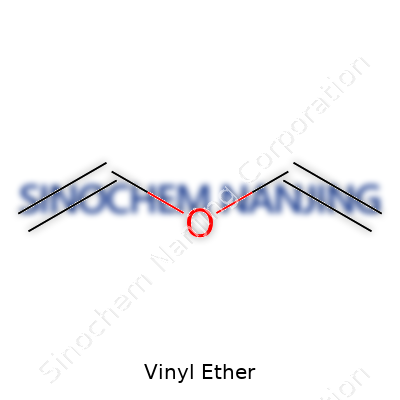
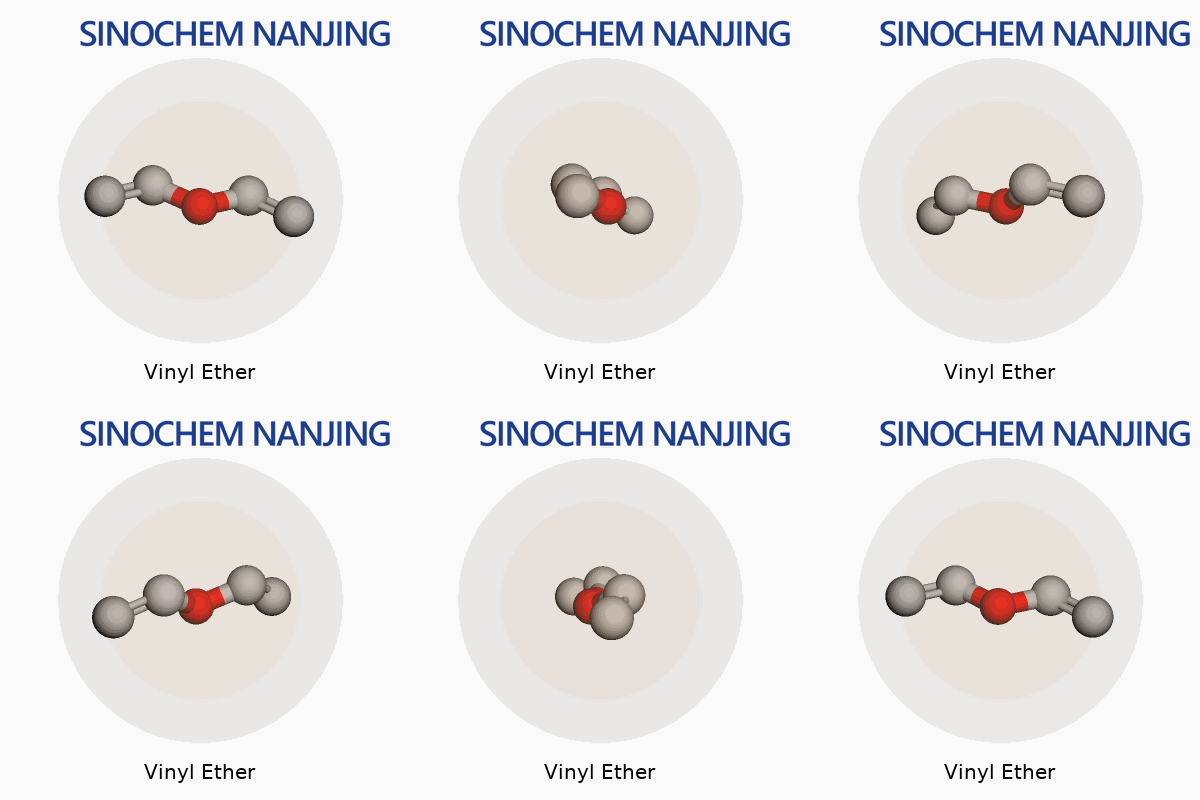
| Names | |
| Preferred IUPAC name | Ethenoxyethene |
| Other names |
Divinyl ether Ethylenyl vinyl ether |
| Pronunciation | /ˈvaɪ.nɪl ˈiː.θər/ |
| Identifiers | |
| CAS Number | 100-18-5 |
| 3D model (JSmol) | `JSmol('C=CO')` |
| Beilstein Reference | Beilstein Reference: 1698726 |
| ChEBI | CHEBI:51688 |
| ChEMBL | CHEMBL363079 |
| ChemSpider | 52022 |
| DrugBank | DB14075 |
| ECHA InfoCard | ECHA InfoCard: 100.003.236 |
| EC Number | 2.5.1.31 |
| Gmelin Reference | Gm. 6/302 |
| KEGG | C01133 |
| MeSH | D014738 |
| PubChem CID | 7909 |
| RTECS number | YN9275000 |
| UNII | 365F9QIF40 |
| UN number | 1302 |
| CompTox Dashboard (EPA) | DTXSID6020828 |
| Properties | |
| Chemical formula | C4H8O |
| Molar mass | 86.13 g/mol |
| Appearance | Clear colorless liquid |
| Odor | sweet odor |
| Density | 0.79 g/cm³ |
| Solubility in water | slightly soluble |
| log P | 0.83 |
| Vapor pressure | 73.4 kPa (at 20 °C) |
| Acidity (pKa) | ~23 |
| Basicity (pKb) | pKb ≈ 6.9 |
| Magnetic susceptibility (χ) | -7.15e-6 cm³/mol |
| Refractive index (nD) | 1.403 |
| Viscosity | 1.5 mPa·s |
| Dipole moment | 1.30 D |
| Thermochemistry | |
| Std molar entropy (S⦵298) | 313.7 J·mol⁻¹·K⁻¹ |
| Std enthalpy of formation (ΔfH⦵298) | -35.8 kJ/mol |
| Std enthalpy of combustion (ΔcH⦵298) | -1991 kJ/mol |
| Pharmacology | |
| ATC code | N01AB05 |
| Hazards | |
| GHS labelling | GHS02, GHS07 |
| Pictograms | C=C(OCC)OC |
| Signal word | Danger |
| Precautionary statements | P210, P233, P240, P241, P242, P243, P261, P271, P280, P303+P361+P353, P304+P340, P305+P351+P338, P312, P337+P313, P370+P378, P403+P235, P501 |
| NFPA 704 (fire diamond) | 2-4-2-W |
| Flash point | < -20 °C |
| Autoignition temperature | 160 °C |
| Explosive limits | 1.7–36% |
| Lethal dose or concentration | LC50 (rat, inhalation): 124,000 mg/m³/4H |
| LD50 (median dose) | LD50 (median dose) of Vinyl Ether: **520 mg/kg (rat, oral)** |
| NIOSH | KWG |
| PEL (Permissible) | PEL: 200 ppm |
| REL (Recommended) | 1 ppm (4.4 mg/m³) |
| IDLH (Immediate danger) | 400 ppm |
| Related compounds | |
| Related compounds |
Enol ether Vinyl acetate Vinyl alcohol Vinyl chloride |



