Vinyl Benzoate: A Closer Look at a Versatile Chemical Player
Historical Development
Vinyl benzoate carries a history that traces back to the quest for functional monomers in polymer science. Chemists searching for new ways to tweak material properties found inspiration in this benzoic acid derivative. As the plastics and coatings industries blossomed mid-20th century, vinyl benzoate drew attention for the way it blended aromatic stability with the reactivity of vinyl groups. Patents began to mention vinyl benzoate during the postwar chemical boom, though larger manufacturers didn’t push it as heavily as other commodity monomers. Its real boost came in research circles and specialty applications, especially when demanding environments called for more robust aromatic-based polymers. Watching a molecule like this carve out a role in labs and pilot plants before being recognized for its unique properties gets me thinking about how innovation rarely follows a straight road.
Product Overview
Vinyl benzoate stands with its molecular formula C9H8O2 and the structure where a vinyl group bonds to a benzoic acid backbone. It looks like a colorless to pale yellow liquid or sometimes a low-melting solid, depending on purity and storage. Ask anyone working with esters or aromatics, and they’ll tell you why vinyl benzoate’s reactivity comes in handy. It slips into polymer blends or takes on life as a tailored monomer. This isn’t the sort of chemical you expect on every lab shelf, but it pops up when a project demands both rigidity from the benzene ring and potential crosslinking via the double bond.
Physical & Chemical Properties
Vinyl benzoate doesn’t shy away from standard lab handling. With a boiling point near 258°C and a melting point just above room temperature, it’s pretty manageable. It holds together under basic lab conditions, although its vinyl group means it can polymerize without much coaxing. The aromatic ring offers a layer of stability not seen in aliphatic vinyl esters. It dissolves smoothly into a range of organic solvents, including chloroform, ether, and toluene. The reactivity of its vinyl group means it can work in radical polymerizations, especially where chemists look to spice up backbone rigidity or density. Color can darken on exposure to air or light, giving a signal that storage conditions matter.
Technical Specifications & Labeling
Labeling for vinyl benzoate puts a spotlight on purity, most often with ranges documented above 98%, and stores the product in amber bottles or metal drums to slow down unwanted changes. Details show up about moisture, inhibitors, and typical molecular weight. Lab stock should come with clear hazard warnings: even if toxicity isn’t explosive, contact with skin or inhalation needs to be minimized. The volatility isn’t as wild as more common monomers, but any handling protocol that works for acrylates should cover the bases. Safety data sheets flag the expected issues—potential eye and respiratory irritant, avoid open flames, and store away from strong oxidizers. The labeling also reinforces the need for chemical splash goggles, gloves, and local exhaust if used in bulk.
Preparation Method
Most labs approach vinyl benzoate synthesis with either direct esterification or via transvinylation. A typical route mixes benzoyl chloride or benzoic acid with vinyl alcohol—though since vinyl alcohol quickly tautomerizes to acetaldehyde, modern methods use vinyl acetate as an intermediate. Acid catalysis helps swap the acetyl group for a benzoyl group, releasing acetic acid and yielding vinyl benzoate. This swap isn’t always efficient, so purification through vacuum distillation or column chromatography becomes necessary. Making a batch of this stuff at benchtop scale feels a bit like fiddling with a recipe—run it too hot, and decomposition or unwanted polymerization sneaks in. Getting it right means watching chemistry in action, sometimes under inert gas to keep air-sensitive steps from ruining the day.
Chemical Reactions & Modifications
Vinyl benzoate shows off its star quality in how it behaves during polymerization. The vinyl group takes part in free-radical and occasionally anionic polymerizations, opening the door to custom polymers with rigid, aromatic backbones. It stands apart from esters like vinyl acetate, offering aromatic reinforcement to resulting plastics or resins. The molecule can swap out substituents on the ring, providing even finer control over end-use properties—think electron-donating or withdrawing groups to tune glass transition temperature or solubility. Copolymerization with other monomers tailors impact resistance, transparency, or thermal stability—all crucial in specialty coatings and adhesives. Anyone who’s ever struggled to match polymer toughness with chemical resistance knows how valuable this toolkit becomes.
Synonyms & Product Names
Across literature, vinyl benzoate slips by as benzoic acid vinyl ester, ethenyl benzoate, and several entries from the CAS and IUPAC naming systems. Some chemical catalogs still use the old-school “vinyl benzoic acid ester.” Industry tends to standardize on “vinyl benzoate,” but checking alternate names stops confusion during ordering or literature searches. This isn’t a name that pops up at the hardware store, but knowing what to look for in databases or regulatory paperwork makes a difference when accuracy matters.
Safety & Operational Standards
Handling vinyl benzoate brings a few non-negotiables. Gloves and goggles stand as the bare minimum; forced-air hoods make sense for anything beyond milligram quantities. Review of lab accidents always reminds me that assumptions cause trouble, especially with compounds that polymerize or generate flammable fumes. Spill kits, eyewash stations, and up-to-date MSDS are habits that stick with you for good reason. Disposal requires adherence to rules for aromatic esters and unsaturated compounds; burning off residues or pouring them down the drain causes both legal and environmental headaches. Research facilities remind users about entry logs and tracking materials due to regulatory scrutiny in some countries. Over the years, I’ve seen strong safety cultures pay off again and again—those layers of caution let curiosity thrive without landing anyone in the emergency room.
Application Area
Vinyl benzoate’s real-world impact starts showing up in specialty polymer blends. It beefs up certain thermoplastics, infusing them with a mix of chemical resilience and rigidity that suits high-performance films or coatings. Electronics benefit from the low dielectric loss and optical clarity, making it attractive in display layers and circuitry insulation. Coatings use it for UV resistance and toughness without going brittle. Adhesives, especially those needing heat stability or solvent resistance, draw on its aromatic backbone. It’s rare to find pure vinyl benzoate on supermarket shelves, but its derivatives appear in the quiet underpinnings of durable products—circuit boards, specialty laminates, and lab equipment among them.
Research & Development
Scientists exploring new polymers still turn to vinyl benzoate as a monomer of interest, particularly when standard vinyl esters don’t cut it. It crops up in studies on advanced copolymer architectures and as a test case for regioselective modifications on aromatic rings. The push for green chemistry also points to vinyl benzoate, hoping bio-based feedstocks or milder synthetic routes can unlock sustainable production. Reading through the latest literature, I notice work looking at vinyl benzoate’s compatibility with other functional monomers, aiming to snare both performance and easier processing. Innovation in crosslinking technologies and surface modification keeps the door wide open for future discoveries based on this molecule.
Toxicity Research
Vinyl benzoate’s toxicity doesn’t hit the levels of notorious solvents or plasticizers, but that’s not a blank check for careless use. Studies point to mild to moderate irritation with prolonged exposure—nothing dramatic, but enough to demand careful handling. Animal studies show low acute toxicity, yet the absence of long-term data suggests a need for continued caution. Metabolism in biological systems mimics other esters, breaking down into benzoic acid and vinyl alcohol, though the latter rapidly rearranges or reacts. Chronic studies remain sparse, opening a clear call for more work to clarify safe environmental thresholds, potential carcinogenicity, and breakdown pathways under industrial conditions. Researchers who dig into these questions carry real weight—they don’t just guard health on the job, but help set smarter rules for future production and disposal.
Future Prospects
Looking ahead, vinyl benzoate sits in a sweet spot for development: the molecule brings together a core of aromatic stability and opportunities for fine-tuning new material properties. Growth in electronic materials, need for more durable coatings, or a push toward specialized adhesives nudges this monomer back into the spotlight. Researchers aim to widen application into greener plastics, either with renewable synthesis routes or by blending in biopolymers—meeting the rising push for sustainability. Advances in living polymerization techniques may finally unlock high-volume, high-performance uses that were too costly or finicky with older chemistry. Markets hungry for more heat resistance or chemical inertness in plastics might find value here, especially as regulations clamp down on more hazardous alternatives. The road ahead relies on both patient research and stubborn problem-solving, but vinyl benzoate stands ready to surprise anyone who gives it a closer look.
What is vinyl benzoate used for?
Not Just Another Chemical
Vinyl benzoate often slips under the radar, especially compared to headline-grabbing plastics or flashy 3D printing resins. Not many people outside of chemistry circles have heard of it, but this compound shows up much more than you’d expect if you start poking around in manufacturing labs, adhesives factories, or specialty coatings workshops. If you check the label on a high-gloss, scratch-resistant surface or a specialty sealant, there’s a chance chemistry like this sits behind the finish.
Building Better Materials
The core use of vinyl benzoate revolves around creating better polymers. Chemists use it as a building block—sort of like a LEGO brick with some serious attitude. What makes it different from standard vinyl compounds is that aromatic ring from benzoic acid. This ring changes how the final material behaves, giving chemists more tools to tweak flexibility, toughness, or resistance to sunlight.
If you’ve ever used a plastic box that doesn’t warp in the sun or a binding glue that stays clear and strong for years, there’s a fair chance it got that way because someone tweaked the recipe with additives like vinyl benzoate. From what I’ve seen, materials with this kind of chemistry often bring a shine or resistance that older recipes struggled to match.
Paints, Coatings, and Performance Additives
Shop floors get slippery from time to time, and specialized paints that line those surfaces rely on additives for durability. Here, vinyl benzoate enters the mix. Manufacturers add it into certain coatings because it can improve adhesion and gloss without making the paint brittle.
It pops up in more than just the floor at the local mall. Some packaging films, the kind used for perishable foods or sterile instruments, benefit from these vinyl-based tweaks. The barrier against gases or liquids doesn’t come by accident. Chemists blend in monomers like vinyl benzoate to fine-tune how the polymer keeps things fresh or clean inside the wrap.
Challenges and What’s Next
There’s always a trade-off in the lab. Adding vinyl benzoate can get tricky, especially if the production process isn’t dialed in to control how it reacts. Mix the ingredients too roughly, the final plastic turns cloudy or brittle. Skip the stabilizers, and sunlight can yellow the surface before a product leaves the warehouse.
From experience working with industrial suppliers, I know the chemical industry wants safer, less toxic options. Vinyl benzoate doesn’t rank as high-risk, but people worry about its byproducts or what happens in larger quantities. This means a call for better processes and greener chemistry—a trend that’s moving fast.
Keeping an Eye on Quality
Reliability always matters in the end. Professionals expect the adhesive on a label to grip. Protective coatings on electronics must last through heat and handling. Every step forward in chemistry—whether it’s a new way to use vinyl benzoate or a cleaner process for making it—shows up in the real world. For the industry, it’s not just about the next big breakthrough. It’s dozens of quiet improvements, batch by batch, that help products last longer and work better.
What brings this all home is that vinyl benzoate isn’t flashy. But for manufacturers focused on quality and durability, it’s a tool that opens up new possibilities, delivers stronger performance, and supports the push toward sustainability. That’s where its true value lands in everyday products.
What is the chemical formula of vinyl benzoate?
Looking Beyond the Formula: Vinyl Benzoate in Everyday Contexts
Vinyl benzoate—C9H8O2—joins two familiar building blocks: a vinyl group and benzoic acid. This small pairing hides some intriguing possibilities, especially for anyone working with plastics, adhesives, coatings, or even curious chemists running experiments in their own kitchens. The structure of vinyl benzoate means it links up well with other molecules, turning it into a useful stepping stone for bigger projects in organic synthesis.
Real-World Significance
People sometimes think chemistry belongs to labs or textbooks, but these simple formulas shape our lives. The backbone of vinyl benzoate—when broken down—reminds me of the long afternoons spent tinkering in the garage, fixing up old paint jobs with whatever material I could find. A lot of coatings rely on compounds related to vinyl benzoate because they need to dry fast, stay tough, and stick well, especially when humidity tries to make a mess of things.
The raw materials behind C9H8O2 aren’t rare. Benzoic acid comes straight from certain plants and preservatives, and the vinyl group springs up all over synthetic chemistry. That availability means manufacturers don’t have to jump through hoops to create these vital molecules, keeping costs in line for paints, plastics, and beyond.
Safety and Health Aspects
Handling chemicals demands respect, no matter how familiar they seem. Vinyl benzoate itself doesn’t cause much drama under normal use, but just like anything in the workshop or factory, ventilation and gloves matter. Inhaling the vapors or letting these compounds soak into the skin day after day adds up. A few years ago, I worked in a facility where a lack of safety culture cost people their well-being. Skin irritations, headaches, and even some long-term sensitization can sneak up fast if companies ignore safety basics. Industry experience shows that keeping workspaces well-aired and enforcing glove use prevents most issues.
Governments keep a close watch on how chemicals move from labs to assembly lines. For vinyl benzoate, regulations center on safe handling and disposal, not outright bans. Workers and small-scale users benefit from Material Safety Data Sheets, which break down risks and control measures in plain language. Regular training on reading these documents saves headaches later. The American Chemical Society estimates that more than half of chemical incidents involve skipped steps or misunderstanding the paperwork, not freak accidents.
Environmental Impact and Sustainability
Environmental responsibility shapes chemical use today more than ever before. Vinyl benzoate ends up in resins and polymers that last years, which sounds great until disposal time. Once discarded, materials derived from vinyl benzoate can break down slowly, adding to landfill pressure or microplastic pollution. My time volunteering with community clean-up groups taught me how these forgotten scraps clog streams and cause headaches for wildlife.
Innovation offers a path forward. Scientists now seek catalysts and synthetic paths that use greener solvents and biodegradable partners. Some labs experiment with enzymes or plant-based feedstocks to cut reliance on fossil fuels. Supporting these efforts with research funding and better recycling programs promises a cleaner future—one where chemical tools like vinyl benzoate play their role without lingering damage.
Moving Forward Responsibly
Vinyl benzoate outlines the delicate balance between chemistry’s promise and its responsibilities. Chemistry powers so much, from household paints to large-scale manufacturing. Using this power thoughtfully—by learning, adapting, and investing in better practices—turns even a small molecule into something positive for everyone.
Is vinyl benzoate hazardous to health?
Understanding Vinyl Benzoate
Vinyl benzoate pops up in the chemical industry, especially as an intermediate in making polymers and resins. Its use remains mostly specialized, so you won’t find it in household products sitting under your sink. Folks who work in labs, chemical plants, or manufacturing come into contact with it more often than the general public. Even though it’s not famous like some other chemicals, its possible health impacts deserve a close look.
The Science on Exposure
My years researching health hazards show that chemicals like vinyl benzoate don’t always get top billing in regulatory circles. Limited toxicity data often leaves big gaps. But available studies and chemical safety sheets tell us that vinyl benzoate can irritate the skin, eyes, and respiratory tract. Breathing in high concentrations of its vapor can cause headaches, dizziness, and nose or throat irritation. Direct skin contact sometimes leads to redness and discomfort.
Animal studies offer clues. In high doses over an extended period, some mammals showed minor changes in liver and kidney function. Current evidence doesn’t link vinyl benzoate definitively to cancer, reproductive harm, or genetic damage. But researchers haven’t covered every angle. Absence of proof isn’t always proof of absence, especially with long-term, low-level exposure.
Worker Health and Safety
Occupational safety stands out, since most exposure reads as accidental or job-related. I’ve met plant workers who barely noticed the fumes until symptoms crept up—burning eyes, mild cough, occasional headaches. These symptoms might seem minor, yet nobody wants to return home every shift feeling off.
Regulators, including OSHA and NIOSH, haven’t set exposure limits specific to vinyl benzoate. Companies fill the gap with general best practices for chemicals—active ventilation, face shields, gloves, and airtight storage. From my workshops, I’ve seen that protection gear only works when paired with training and clear safety culture. Some decided to cut corners, thinking they’d be fine for a quick task, and then wound up regretting it. Even with limited data, caution just makes sense.
Paths to a Safer Workplace
Deciding whether vinyl benzoate ranks as truly hazardous means digging deeper. Toxicologists and epidemiologists need to study its impacts at lower doses and over decades, not just in short spurts. Trade groups and major chemical companies can support independent studies and share findings publicly, instead of tacking warnings onto dense safety sheets.
Manufacturers can redesign processes so exposure risks drop. Closed-system equipment keeps vapors inside pipes and tanks, cutting out much of the hazard. Local exhaust hoods in lab spaces and reliable personal protective equipment add backup. I recall a site audit where swapping out one type of gasket for a better-sealing material brought vapor readings near zero—simple fix, massive improvement.
The Bottom Line
Vinyl benzoate shares risks with many chemical intermediates: too little information and underappreciated potential for harm. Until the research catches up, relying on strict handling rules and protective gear stays smart for those who work with it. No lab tech or plant operator deserves lingering uncertainty about health and safety, especially for chemicals that fly under the radar. Industries, researchers, and frontline workers all play a role in building better knowledge and stronger safeguards.
How should vinyl benzoate be stored and handled?
Everyday Experience Meets Chemical Science
I remember my first day in a small research lab, opening a storage cabinet and staring at shelves of bottles, each promising something different. You can’t help but wonder about safety until you actually handle these chemicals. Vinyl benzoate crosses my mind mainly because it looks so unassuming in its glass container. Yet, this clear liquid is pretty reactive, and keeping things safe goes beyond simply screwing the cap back on.
The Real Hazards Lurking in the Bottle
Vinyl benzoate brings a unique set of challenges. It’s flammable, so any spark or high heat turns careless moments into real accidents. Inhaling the fumes or getting this stuff on your skin stings, and long-term exposure makes things worse. The value of reading a safety data sheet really hits home here—facts like a flashpoint near 95°C or the risk of forming peroxides get overlooked during a busy day.
Practical Storage: Out of Sight, Top of Mind
For organizations where many people come and go, clear rules aren’t bureaucratic—they’re lifesavers. Chemicals like vinyl benzoate belong in a cool, dry place, away from sunlight and heat sources. I’ve seen colleagues improvise by stacking bottles on radiator covers. The heat issue might seem minor until you realize one small mistake could ruin a month’s work or much worse.
Sticking with tightly sealed containers reduces lots of hassle. Air sneaks in and triggers reactions that turn a stable bottle into a shelf hazard. Resealable glass is best, but sturdy plastic makes sense in busy environments, as long as it’s chemical-resistant. Big block letters on every label don’t just satisfy audits—they help newcomers figure out what’s safe to use.
Hands On: Safer Handling Every Time
There’s no shortcut with personal protective equipment. Lab coats, gloves, and proper eye protection cut down both short-and long-term health problems. I had a friend who thought grabbing a rag was enough after a spill—he ended up at a clinic with chemical burns. Bottom line: even brief skin contact with vinyl benzoate calls for running water and medical follow-up.
Good ventilation turns a risky task into a routine one. Fume hoods suck away vapors, making it easier to measure or transfer the liquid without breathing in harmful stuff. Never eat, drink, or get distracted around chemicals. Reminders taped to walls can sound patronizing, but in a real emergency, every second counts and a clear head matters even more.
Disposal: Where Thought Meets Responsibility
Poor disposal methods bring legal trouble and environmental headaches. Pouring leftovers down the drain pollutes water and exposes others to harm. Most labs and factories team up with licensed hazardous waste services, keeping waste streams isolated from household trash. Neutralizing empty containers and marking them for chemical waste cuts down on hidden dangers during routine cleaning.
Training and refreshers keep safety front and center. Short, regular sessions—where people hear about real mistakes, not just rules—make safe storage and handling second nature. Whether new to chemistry or working with it for decades, responsibility echoes through each bottle handled and every step taken in the lab.
Can vinyl benzoate be used in polymerization reactions?
A Chemist’s View on Vinyl Benzoate in Polymers
Anyone who’s spent much time in a polymer lab gets used to the usual suspects: styrene, vinyl chloride, methyl methacrylate. Vinyl benzoate doesn’t usually make headlines, but it deserves a closer look. The core issue is whether this molecule really fits in with the demands of polymerization. The short answer? Yes, vinyl benzoate can participate in polymerization reactions. The details make the story far more interesting.
Structure and Reactivity: Not Just Textbook Theory
Vinyl benzoate packs a benzoate ester attached to a vinyl group. This setup gives it an aromatic ring and the potential for pi-stacking interactions, plus that all-important double bond for radical polymerization. In my own experience, oddball monomers like this can open up new properties that the basic workhorses just can’t deliver. The benzoate group brings bulk, stiffness, and some electronic effects you won’t get from simpler esters.
From the literature and lab reports, radical polymerization works, though reaction rates lag behind heavyweights like styrene or vinyl acetate. Electron-withdrawing effects from the benzoate slow down the polymerization. This lines up with classic organic chemistry: electron-hungry vinyl groups struggle to propagate because the radical formed is too stable. You'll hear about higher temperatures or specialized initiators to nudge the polymerization along.
What Polymer Chemists Look For
Making polymers isn’t just about getting chains to form. The end-use properties matter if you plan to sell a product, make a coating, or develop a biomedical material. Vinyl benzoate delivers high rigidity and thermal stability because of its aromatic backbone. You get increased glass transition temperatures and better resistance to creeping under heat, compared to alkyl vinyl esters. In my own projects, we searched for materials that wouldn’t slump out of shape in a hot car – polymers based on aromatic residues always held up better.
Solubility presents a mixed bag. You often get polymers that want organic solvents, not water. That has consequences for coatings, adhesives, and any process demanding easy clean-up or flexible formulation. But specialty plastics, high-performance resins, and niche applications such as certain adhesives benefit from these properties.
Risks, Challenges, and Real Value
Anyone considering vinyl benzoate for a new project needs to think about the cost and safety. It’s not as easy to source as standard monomers. Few suppliers offer it at scale, and price per kilogram won’t compete with the volumes seen in mainstream materials. On top of that, vinyl esters release acetic acid or, in this case, benzoic acid during hydrolysis. Environmental and occupational exposures must be monitored, and this isn’t the best pick for applications in direct food contact or medical devices without thorough testing.
Innovation comes from trying what’s uncommon. Specialty coatings, electronics, and esoteric composites sometimes need the performance edge that bulkier, aromatic monomers offer. Vinyl benzoate opens the door to materials that resist heat, hold shape under pressure, and show off unique chemical resistance. Researchers have demonstrated those benefits, even if adoption remains limited by cost and processing hurdles.
Future Paths
Better catalysts and smarter process design cut down on energy and cost in these reactions. There’s ongoing work looking at copolymer systems—mixing vinyl benzoate with more reactive monomers lets chemists dial in properties, like toughness balanced with clarity, or heat resistance paired with flexibility. Open conversations with suppliers and colleagues often spark the real innovations, so staying curious often leads to practical breakthroughs for niche but high-value products.
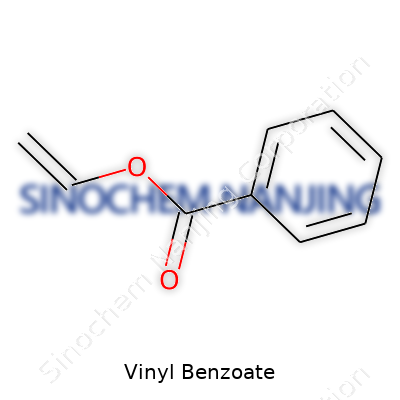
| Names | |
| Preferred IUPAC name | (Ethenyl benzoate) |
| Other names |
Benzoic acid vinyl ester Vinyl benzenecarboxylate Vinyl benzenoate Vinyl phenylformate |
| Pronunciation | /ˈvaɪ.nəl bɛnˈzoʊ.eɪt/ |
| Identifiers | |
| CAS Number | 2446-77-9 |
| Beilstein Reference | 1204234 |
| ChEBI | CHEBI:51957 |
| ChEMBL | CHEMBL198157 |
| ChemSpider | 16718 |
| DrugBank | DB08615 |
| ECHA InfoCard | 100.046.038 |
| EC Number | 205-142-5 |
| Gmelin Reference | Gmelin Reference: 141293 |
| KEGG | C06555 |
| MeSH | D014738 |
| PubChem CID | 70051 |
| RTECS number | OX0175000 |
| UNII | 82Z5C4T20G |
| UN number | UN2367 |
| Properties | |
| Chemical formula | C9H8O2 |
| Molar mass | *164.18 g/mol* |
| Appearance | White crystalline solid |
| Odor | Odorless |
| Density | 1.08 g/cm3 |
| Solubility in water | insoluble |
| log P | 2.8 |
| Vapor pressure | 0.03 mmHg (25°C) |
| Acidity (pKa) | 13.05 |
| Basicity (pKb) | Product: Vinyl Benzoate; Basicity (pKb): 9.85 |
| Magnetic susceptibility (χ) | -61.0×10⁻⁶ cm³/mol |
| Refractive index (nD) | 1.554 |
| Viscosity | 2.16 cP (20°C) |
| Dipole moment | 2.73 D |
| Thermochemistry | |
| Std molar entropy (S⦵298) | 340.5 J·mol⁻¹·K⁻¹ |
| Std enthalpy of formation (ΔfH⦵298) | -61.5 kJ/mol |
| Std enthalpy of combustion (ΔcH⦵298) | -3194 kJ/mol |
| Pharmacology | |
| ATC code | null |
| Hazards | |
| GHS labelling | GHS02, GHS07 |
| Pictograms | GHS02,GHS07 |
| Signal word | Warning |
| Hazard statements | H315: Causes skin irritation. H319: Causes serious eye irritation. |
| Precautionary statements | Precautionary statements: P210, P220, P221, P262, P280, P305+P351+P338, P370+P378 |
| NFPA 704 (fire diamond) | 2-1-0 |
| Flash point | Flash point: 113°C |
| Autoignition temperature | 445°C |
| Lethal dose or concentration | LD50 (oral, rat): 2700 mg/kg |
| LD50 (median dose) | LD50 (median dose) of Vinyl Benzoate: Oral-Rat LD50: 2892 mg/kg |
| NIOSH | BVP000 |
| PEL (Permissible) | PEL (Permissible Exposure Limit) for Vinyl Benzoate: Not established |
| REL (Recommended) | 250 mg/L |
| Related compounds | |
| Related compounds |
Benzoic acid Benzyl benzoate Vinyl acetate Ethyl benzoate Phenyl acetate |



