Trimethyl Borate: An Understated Marvel in Chemical Science
The Path from Discovery to Modern Utility
Talk to anyone who’s dipped their hands into chemistry labs, and they’ll tell you that progress often comes through the quiet workhorses. Trimethyl borate doesn’t get flashy headlines. Even so, it’s earned its spot through decades of practical value. Its story traces back to pioneering work on organoboron chemistry in the late 19th and early 20th centuries, when researchers explored what could happen if you jammed boron and methanol together. No quantum leaps, just dogged curiosity and a willingness to heat methanol and boric acid over time. What started as a controlled reaction at a workbench grew into a reagent shaping organics, pharmaceuticals, and flame retardants. Over the years, new uses have popped up. Large-scale production picked up pace only once folks noticed the connection between trimethyl borate and boronic acids—tools prized in coupling reactions now at the center of fine chemical synthesis.
Walking Through Its Features
Trimethyl borate stands out on a shelf: a colorless, mobile liquid packing a sweet, faint odor. Pour some out and it flashes with volatility; its boiling point lands just under 70°C, making for a quick evaporation risk in a warm lab. You can’t ignore its flammability—a definite hazard in facilities without proper air flow. Raised in glassware, you see the stuff burn with that classic green boron flame, often used as a quick demo in chemistry classes. Mix it with air, and you get a vapor that’s just waiting for a spark. Its molecular structure, B(OCH3)3, basically boron sitting at the center and three methyl groups etched at the corners, helps explain its symmetry and reactivity. Friends who track MSDS certifications always point out its water sensitivity. It reacts with water, liberating methanol and, eventually, boric acid—classic hydrolysis at work.
Performance Benchmarks Aren’t Just Numbers
A few technical points can’t hurt. On the bench, you’d spot a density around 0.96 g/cm³—lighter than water, so it floats on the surface. Vapor pressure, which tells you how ready it is to leap into the air, is high enough to demand tight lids and careful handling. Using GC or titrations, analysts check for purity, since trace water or methanol shifts how reliably it works in downstream reactions. Shelf-life, never guaranteed past six months in open air, hinges on keeping the bottle tight and sealed. Labelling lines tend to highlight its flammability front and center. Still, all this talk of numbers misses the point that standards grow from repeated lab checks—a reminder not to skip routine quality assessments.
How Chemists Make It
Synthesize trimethyl borate and you see basic chemistry in action. Toss boric acid and methanol together with a mineral acid catalyst—sulfuric, most often—and then heat gently. This transesterification produces trimethyl borate and water. Pulling out the water as it forms shifts equilibrium toward the final product; basic Le Chatelier’s principle at work. On the industrial scale, setups get fancier, using continuous distillation for improved yield and purity. Out in the field, problems crop up if your feedstocks carry old moisture, so most operators dry methanol carefully before adding it to the reaction pot. I’ve run small batches in my own lab, and even minor temperature shifts or impure acid lead to disappointing yields. That’s chemistry for you—unforgiving when shortcuts are taken.
Chemical Chameleon: Pathways and Possibilities
Trimethyl borate is more than a pretty torch flame. As a methylating agent, it jumps into cross-coupling reactions, paving the way to boronic acids—vital cogs in Suzuki-Miyaura and other C-C bond-forming reactions. The hydrolysis reaction forms a teacher-student rite of passage: add water, watch nedious droplets split, methanol waft out, and boric acid start to form. O-methylation and transesterification reactions build off its core structure, making it a favorite in modifying biomolecules and preparing advanced intermediates. Study reaction pathways, and you’ll find trimethyl borate reacting neatly with Grignard and organolithium reagents. Niche uses like preparing isotopically labeled materials for NMR work, or as a precursor in producing boron-doped semiconductors, highlight just how versatile it can be when used by imaginative hands.
One Chemical, Many Faces
Industry circles know trimethyl borate by several names—boric acid trimethyl ester, trimethoxyborane, BME—and its registry numbers follow it in every safety file. Chemical catalogs list it in categories ranging from esters to boron compounds, and analytical suppliers highlight its role as a specialty reagent. Out in the lab, labels always trumpet its hazard class up top. Whether you call it trimethyl borate, or shorthand it to TMB, it’s clear that names morph according to context, not unlike the chemical itself.
Risk Under Control: Handling Realities
Not everyone gives boron esters the respect they demand. Trimethyl borate brings both opportunity and risk, especially in bulk storage or hot reaction flasks. Its quick evaporation fills confined rooms, so ventilation reigns supreme. Gloves and goggles are the bare minimum; good chemists still go beyond, checking for leaks and storing the chemical in tight-lidded, grounded metal cans away from acids, bases, or oxidizers. Spills require quick cleanup, since friction on the floor can lead to ignition. Fire isn’t the only concern: slow hydrolysis in damp storage gradually forms methanol—a substance with its own toxicological baggage. Working with manufacturers who prioritize proper labeling and education helps, as does regular staff training. Over the years, I’ve seen neighbors learn this lesson the hard way, tracking methanol exposure only after someone started feeling lightheaded near an open container.
Field-Tested and Proven: Where Trimethyl Borate Shines
Step outside of synthesis and you’ll see trimethyl borate’s reach. Its ability to introduce boron plays into the world of flame retardants—especially in natural fibers and polymers. Fine chemical companies use it in producing boronic acids, earning its keep in pharmaceutical R&D. Semiconductor makers value it when doping silicon wafers for electronics. Even as a solvent or dehydration agent, its volatility and water sensitivity give it a niche in laboratory workups. Beyond formal settings, pyrotechnicians appreciate the vivid green color it brings to flame displays. Some of the most innovative work—such as in advanced battery chemistries or specialized optics—leans on that famous reactivity. The heart of its appeal comes from how chemists, engineers, and artists alike spot new opportunities in its clear, slightly sweet-smelling form.
Pushing Boundaries in the Lab
Research keeps drawing new blueprints with trimethyl borate. The march toward sustainable technologies gave boronic compounds new relevance; efforts now focus on greener synthesis routes, minimizing byproduct waste and embracing renewable feedstocks. Old methods using aggressive mineral acids slowly give way to milder, recyclable catalysts. Large academic programs fine-tune protocols for improved atom economy, while startups race to patent more efficient routes to boronic esters, often with trimethyl borate as a key intermediate. Computational chemists model reactivity pathways to help cut experiment time and cost. In high-energy physics or advanced materials, isotopically labeled derivatives of trimethyl borate open doors for tracing and structural studies. Each advance rests not on abstract innovation, but on hands dirty from real lab work.
Hard Truths: Evaluating Toxicity and Human Impact
No shortcut exists when it comes to safety. Toxicity research tags trimethyl borate as a risk: inhalation and direct skin contact can lead to irritation, and the methanol formed during hydrolysis brings classic hazards—headache, nausea, fatigue, or worse at high exposure. Animal studies show repeated exposure can trigger organ impacts, especially to the liver and kidneys. Chronic exposure studies point to the danger of using this chemical in enclosed, poorly ventilated rooms; simple air monitoring often catches problems too late. Regulations in the US and Europe demand strict storage and waste management, since boron compounds and methanol both count as priority pollutants in many watersheds. Personal experience, and plenty of cautionary tales, taught me to never underestimate repeated low-level exposure: colleagues in older labs sometimes paid the price before fume hood standards climbed in the 1990s. Modern work calls for not just gloves, but airtight handling, constant air exchange, and a zero-tolerance approach for open containers.
Where Does It Go From Here?
Trimethyl borate’s story isn’t finished. Growing demand for organic electronics, pharmaceutical reagents, and flame retardants keeps it relevant. Green chemistry pushes researchers to innovate manufacturing using biosourced methanol and recyclable processes. In semiconductor fabrication, its role as a boron source remains steady, but shifting regulations around solvent waste and workplace safety may shape which processes win out. Looking further, efforts to recycle boron compounds from industrial waste, or tailor trimethyl borate derivatives for niche electronics, signal that industry won’t sideline this reagent any time soon. The chemical world tends to forget its old standbys, then rediscovers them once a new trick is needed. Trimethyl borate may not grab headlines, but its mix of usability, reactivity, and challenge ensures it will keep shaping corners of chemical progress well into the next era.
What is Trimethyl Borate used for?
On Paper and in the Lab
Trimethyl borate usually shows up as a clear liquid with a vaguely sweet, alcohol-like smell. For folks outside the lab, the name barely rings a bell. Chemists, though, work with it often—especially as a raw material for more advanced boron chemicals. Its most well-known use comes from the world of organic synthesis, where it takes on the role of producing boronic acids. Boronic acids pave the way for key reactions, letting researchers attach together tricky molecules for building pharmaceutical ingredients, agricultural chemicals, or even advanced polymers.
Everyday Chemistry: A Surprising Flame
In school, I watched a science teacher pour a bit of trimethyl borate on a stick and light it. The flame burned with a bright green shimmer nobody could forget. This reaction helps fireworks makers, who rely on the chemical for that perfect emerald hue in their performances. Beyond fireworks, this color trick helps scientists check for boron in minerals. In laboratory analysis, adding a small amount to a sample and lighting it up remains an age-old, reliable method for detecting trace elements.
Boron’s Role In Modern Tech
The world keeps craving better screens and gadgets. Tech manufacturers turn to boron-based compounds for producing flat-panel displays, touchscreens, and semiconductors. Trimethyl borate steps in again—supplying boron atoms that get laid down in thin films or fused into glass. It’s not the only substance for the job, but it stands out for burning cleanly and breaking down without dropping contaminants that would mess up delicate electronics.
Helping Keep Wood Stronger
Wood doesn’t last in damp places without help. Wood treatment companies sometimes use boron compounds—trimethyl borate included—as part of solutions to block out fungus and rot. This approach lets furniture makers, boatbuilders, and construction crews push wood’s lifespan without resorting to more toxic chemicals. Fewer termites, less mildew, more stable homes.
Hazards Most People Don’t See
Trimethyl borate’s sweet smell can fool people, but inhaling it never ends well. Breathing its fumes irritates the nose and throat, and repeated contact can leave skin raw or eyes burning. Most workplaces set up serious ventilation and keep personal protective gear on hand. Even in creative hands—like glassblowers or chemistry teachers—safety stays at the front.
Building a Safer Future
Looking at the facts, knowledge and strict safety checks matter more than ever. The U.S. Occupational Safety and Health Administration and international agencies have set clear guidelines for handling and storage. Anyone working with trimethyl borate gets proper training, uses fume hoods, and stores the liquid away from open flames or sparks. In schools, educators need to stress not just the dramatic green fire, but also how to respect the risks.
Room for Improvement
Chemical companies keep searching for greener alternatives and safer production methods. Research teams are tinkering with ways to recover boron from waste, cut down emissions, and minimize human exposure. That kind of steady progress means the benefits of trimethyl borate keep showing up, without dragging along unwanted costs to health or the planet.
Is Trimethyl Borate flammable?
What Makes Trimethyl Borate Flammable?
You don’t have to work in a chemical plant to spot trouble in a bottle with “Trimethyl Borate” on the label. This liquid catches fire with real ease. Flip open its safety data sheet and the flash point jumps out at you: just 0°C. That’s colder than you’ll find outside on most winter mornings. If a liquid gives off flammable vapors at fridge temperatures, it doesn’t just “catch fire”; it seriously wants to burn. Once a spark or open flame comes near, it can go up instantly. As someone who’s worked with solvents and reagents in basic research labs, I remember the drill — keep the flames away, keep the bottle closed, and respect that smell of sharp alcohol with a whiff of sweet, almost pleasant aroma. It hides a nasty sting.
The vapors from Trimethyl Borate mix well with air. All it takes is a little too much in the air and one stray spark to fire up the whole room. The colorless flames might not announce themselves loudly, but they burn hot and fast — some folks barely see it until it’s too late. This makes it not just a hazard for workers, but for anyone transporting or storing it without proper ventilation.
Why Fire Safety Rules Matter
Laboratories and industrial users get constant reminders about fire safety for chemicals like this, but mistakes still happen. Fires in chemical storage areas have shut down entire facilities and sent people to the hospital. Once in college, our shared lab fridge shorted out, igniting some volatile organics. Only a quick-thinking grad student with a charged extinguisher stopped it from spreading. Now, try imagining that with a chemical with an even lower flash point. The lesson sticks. Trimethyl Borate isn’t a common household name, but the risk is as real as it gets in industrial and academic settings.
The National Fire Protection Association (NFPA) gives Trimethyl Borate its highest flammability rating, a solid “3.” Chemicals in this group ignite at room temperature, so proper storage isn’t just a suggestion — it’s mandatory for keeping people safe. Ordinary lab shelving or home storage options won’t do. The liquid needs a flame-proof closet, fire-rated containers, and ventilation that sweeps away any built-up vapors. Spill containment isn’t a “nice to have” — it means the difference between a harmless cleanup and a fire that explodes across the bench.
Reducing the Risk
Reliable training and equipment top the list for fire prevention. People handling Trimethyl Borate should wear proper protective gear, keep open flames and sparks well away, and use chemical fume hoods designed to vent dangerous vapors. Good housekeeping keeps old residues out of the way, and waste management protocols mean flammable leftovers don’t build up near exits or stored materials.
Fire suppression setups — like sprinklers and CO2 extinguishers — give extra peace of mind. Some facilities install flammable vapor sensors that trip alarms or ventilation if concentrations get too high. I’ve watched safety officers run these drills once a month, and those minutes spent running through “what if” keep you sharp when mistakes happen.
In the end, the flammability of Trimethyl Borate isn’t up for debate. It’s not a question of “if” it will burn, but how quickly and how badly things go wrong if someone gets careless. Safety means planning ahead, building good habits, and taking every precaution seriously — not because a rulebook says to, but because experience shows what the consequences look like up close.
What is the chemical formula of Trimethyl Borate?
Chemical Makeup of Trimethyl Borate
Trimethyl borate carries the chemical formula B(OCH3)3. This formula reflects three methoxy groups (OCH3) bonded to a central boron atom. Small molecules like this one shape dozens of industrial and scientific processes, far beyond basic research labs.
Practical Uses Driving Real-World Demand
Trimethyl borate often steps up in the manufacture of boronic acids and esters. Both groups sit on the foundation of Suzuki coupling reactions—transformative techniques that build complex organic molecules. Suzuki coupling fuels advances in pharmaceutical production, crop protection chemistry, and OLED manufacturing. Reliable supply of reagents like trimethyl borate isn’t just about chemistry—it means streamlined development of new medicine and next-generation display screens.
Inside the lab, its clear, mobile liquid form makes trimethyl borate easy to handle and transfer, delivering versatility. The substance lights up with a green flame during combustion, offering a simple way to test for the presence of boron. This low-tech test supports both educators and industrial chemists who need fast verification tools.
Why the Chemical Formula Matters
Memorizing B(OCH3)3 once seemed like another hurdle in an endless stream of formulas, but the more time I spent in research labs, the more these details shaped the outcome of projects. A single misplacement—a missed hydrogen or stray oxygen—created months of confusion. Every atom counts, not just for graduate students adjusting to the learning curve, but also for patent examiners, product designers, and production managers eyeing regulatory compliance.
Trimethyl borate’s structure, with three identical arms, provides predictability in reactions. Predictability helps chemists scale up from test tubes to production lines without constant surprises. Each methoxy group brings specific reactivity, letting chemists control what attaches where—engineers use this property when creating specialty polymers and fire retardants.
Addressing Real Challenges
Toxicity and volatility stand out as key concerns. Spills mean flammable vapor risks, especially in places that handle tons instead of milliliters. I’ve watched teams struggle to balance safety and efficiency, juggling the desire for fast throughput with the real cost of lost product or worse, a lab accident.
Solutions often start with training. Every technician, from novice to expert, needs hands-on experience with specialized handling procedures. Good labeling, clearer material safety data sheets, and robust ventilation systems prevent the worst outcomes. Some facilities invest in “smart” monitoring—sensors that catch even minor leaks of methanol vapors.
Responsible Progress
Academic and industry leaders continue pushing for safer synthesis and storage methods. Process engineers look for slight tweaks in formulation or automation, trading small bumps in production cost for stronger worker protection. There’s always room for improvement, whether that’s learning from near-misses or sharing results openly so competitors can avoid repeating mistakes.
How should Trimethyl Borate be stored?
Understanding the Real Risks with Trimethyl Borate
Trimethyl borate isn’t something to toss in with random chemicals on a shelf. Been around enough labs to watch what can go wrong when folks treat storage like an afterthought. Just because it’s a colorless liquid with a faint odor doesn’t mean it plays nice. It’s highly flammable, and contact with moisture opens up a whole new headache: boric acid and methanol. Methanol is toxic as it gets—nobody wants that leaking out and mixing with air, so regular storage practices fall short.
Why the Right Containers Matter
Skip anything that lets moisture seep in. Glass seems like a natural fit—it’s inert, doesn’t corrode, and won’t react. But it’s not just the material; every screw cap, gasket, and liner counts. Metal containers develop rust, and plastic can crack or degrade, especially if you’ve got old bottles. I’ve seen folks cheat with worn-out lids, thinking a rubber band’s enough. Don’t play games with chemicals that flash at low temperatures.
Securing the Environment
Nobody benefits from storing trimethyl borate in hot or stuffy rooms. Keep it in a cool, dry space away from sunlight and open flames. Avoid busy areas where forklifts pass by or folks are hauling around other volatile materials. In some places, safe ventilation feels like overkill, but one whiff of the fumes and you realize it’s not. Methanol vapor can sneak up on you and ruin your day—whether by headache or worse. I’ve seen tight storage areas go from neglected to accident zones in seconds because someone thought a cracked window would do the trick.
Think About Compatibility
It never pays to ignore what stands next to your container. Acids, alkalis, oxidizers—mixes with trimethyl borate and you get bigger problems. The chemical doesn’t want friends, so put it in a separate cabinet. I once watched a tiny leak make contact with an oxidizer—we spent an afternoon evacuating because nobody took inventory seriously. Flammable liquids require their own space, preferably in a flammables cabinet with self-closing doors and proper labels. Don’t compromise by stacking containers or crowding them just to save space.
Who Has Access?
Accessible storage for every worker sounds efficient on paper, but only trained staff should handle the keys. Too many times, untrained hands cause spills or try to “clean up” with the wrong materials. It’s not just about remembering the protocols—the right training builds a mindset that sees potential mistakes before they happen. Documentation helps here: always keep a log of what’s coming in or out, and check expiration dates. Even well-sealed trimethyl borate won’t last forever.
Routine Inspections and Planning
Set up a routine schedule for checking seals and looking for signs of moisture or discoloration. Drips, pressure buildup, or weird smells shouldn’t wait for the next safety audit. Keep spill kits close by and make sure everyone knows where the emergency eyewash and showers sit. If you treat precautions as daily habits, mistakes turn into teachable moments, not disasters. Store trimethyl borate thoughtfully, and the whole lab works better.
What are the safety precautions for handling Trimethyl Borate?
Spotting the Hazards of Trimethyl Borate
Trimethyl borate, a clear liquid with a fruity odor, does more than add complexity to a laboratory shelf. It can catch fire at the drop of a match – its vapors form explosive mixtures with air. Each time I’ve handled it, that flammability sat at the front of my mind, not buried in the fine print. Burns from solvents aren’t just pain—they leave reminders. Vapors rise quickly and fill a room if you’re not careful. Just a bit too much heat, one loose cap, or a dropped flask might end with trouble.
Personal Protection That Really Matters
My first encounter with trimethyl borate drilled home the value of a fitted pair of safety goggles and gloves. Splashing the stuff, even a tiny amount, onto bare skin delivers more than a tingle—it can eat into tissue. Gloves made from nitrile stand up to the challenge. Chemical goggles are non-negotiable. Even reliable lab coats need to be buttoned up and made from fire-resistant fabric. Breathing in these fumes scratches your throat and lungs, so if the work area doesn’t open up to plenty of fresh air, a respirator rated for organic vapors deserves a place on the bench.
Workspaces That Don’t Invite Disaster
Working in a fume hood changes everything. The fans and venting pull dangerous vapors away from you and your coworkers. I’ve seen how even a small spill on an open bench quickly becomes everyone’s problem. No open flames or heat sources nearby—this isn’t a candlelit dinner. Is there an extinguisher close? Not all fire extinguishers put out chemical fires, so keeping a carbon dioxide or dry powder type nearby gives peace of mind. Keeping exit doors clear—no clutter or boxes in the way—might sound basic, but rushing out should never mean tripping hazards.
Storage: Out of Sight, Never Out of Mind
Storage shapes tomorrow’s safety. Stashing trimethyl borate in tightly sealed containers limits vapor leaks. I found metal or glass containers fare best, as plastic sometimes softens or dissolves. Dark, cool spots in a chemical cabinet slow down vapor pressure, reducing the risk of an accidental pop or leak. It deserves distance from oxidizers and acids, since those combos turn small slip-ups into emergencies. Labeling needs to be bold and easy to read—labels fade fast, and not every visitor knows what a code means.
Dealing with Spills and Disposal
Nobody expects a spill, but having an absorbent on hand—vermiculite or sand—makes cleanup more straightforward. Forget mops and water; water reacts with trimethyl borate, releasing methanol and boric acid fumes, both a nightmare on the lungs. Even small drips should get reported immediately—hiding a minor incident invites more harm. Waste heads into sealed containers and then to a specialized facility—not the drain, not the regular trash can.
Training and Culture Save the Most Lives
No chemical runs itself; it’s people who make choices. Supervisors who train new team members build real safety. I once had a colleague who taught me to run dry runs before any actual pouring or transfer. That bit of preparation stuck with me. Emergency showers, eyewash stations, and clear procedures make the difference between a scare and a scar. Safety drills sound dull until the day they move feet faster than thought. Keeping up with the latest safety bulletins from OSHA and chemical suppliers gives teams better footing.
Responsible Science Means Respecting the Risks
Test tubes and beakers don’t create danger by themselves; forgetfulness does. Respect for chemicals like trimethyl borate runs deeper than following rules—it’s a mindset shaped by stories, scars, and the people you want to see safe after every shift. Safety doesn’t add time; it adds everyone’s tomorrow.
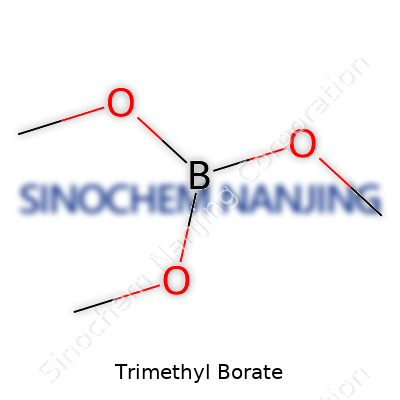
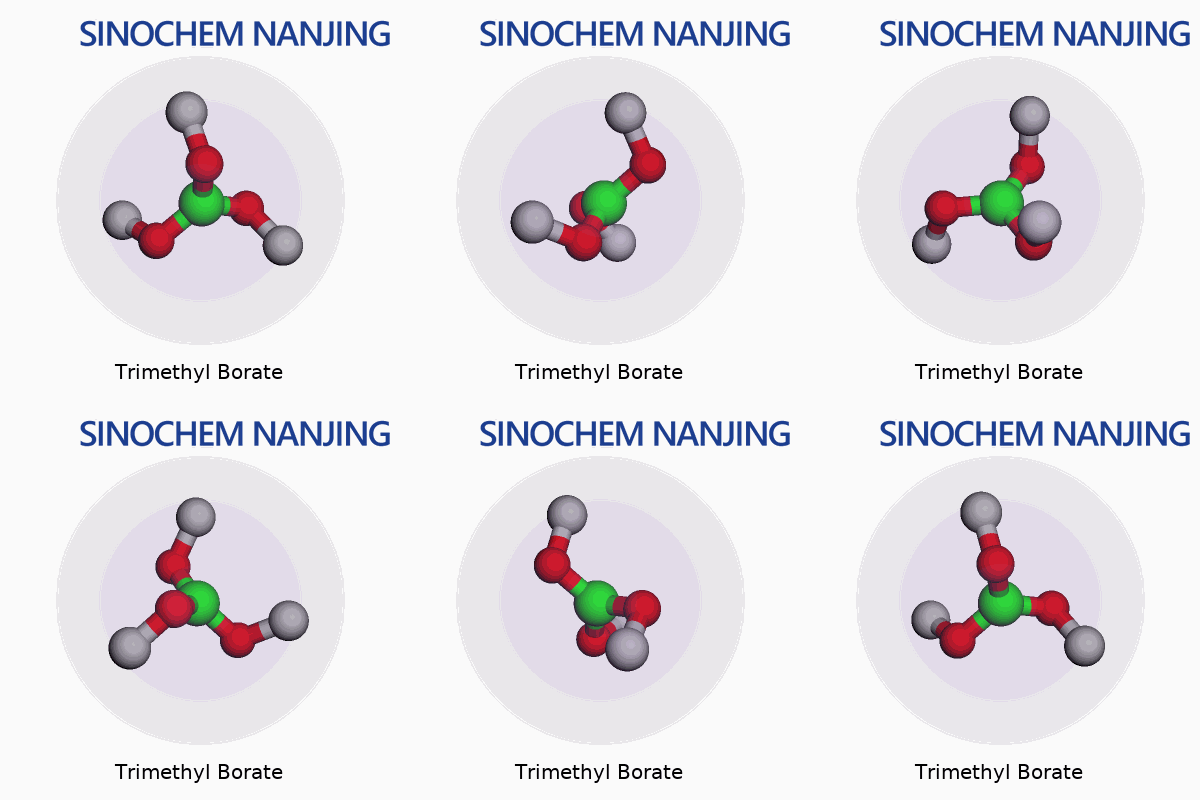
| Names | |
| Preferred IUPAC name | Trimethoxyborane |
| Other names |
Boron trimethoxide Trimethoxyborane |
| Pronunciation | /traɪˈmɛθ.ɪl ˈbɔː.reɪt/ |
| Identifiers | |
| CAS Number | 121-43-7 |
| 3D model (JSmol) | `JSmol('B(OCH3)3')` |
| Beilstein Reference | Beilstein Reference: 1697555 |
| ChEBI | CHEBI:47441 |
| ChEMBL | CHEMBL137737 |
| ChemSpider | 8670 |
| DrugBank | DB11218 |
| ECHA InfoCard | 100.005.678 |
| EC Number | 204-464-6 |
| Gmelin Reference | Gmelin Reference: **1211** |
| KEGG | C14125 |
| MeSH | D001823 |
| PubChem CID | 6629 |
| RTECS number | ED3325000 |
| UNII | W9K3U6ZR8D |
| UN number | UN1993 |
| Properties | |
| Chemical formula | B(OCH3)3 |
| Molar mass | 103.91 g/mol |
| Appearance | Colorless liquid |
| Odor | Alcohol-like |
| Density | 0.88 g/cm³ |
| Solubility in water | miscible |
| log P | -0.36 |
| Vapor pressure | 40 mmHg (20 °C) |
| Acidity (pKa) | 15.1 |
| Magnetic susceptibility (χ) | -48.0e-6 cm^3/mol |
| Refractive index (nD) | 1.369 |
| Viscosity | 0.43 cP (25 °C) |
| Dipole moment | 0.07 D |
| Thermochemistry | |
| Std molar entropy (S⦵298) | 254.8 J·mol⁻¹·K⁻¹ |
| Std enthalpy of formation (ΔfH⦵298) | -355.6 kJ/mol |
| Std enthalpy of combustion (ΔcH⦵298) | -1958.5 kJ·mol⁻¹ |
| Hazards | |
| GHS labelling | GHS02, GHS07 |
| Pictograms | GHS02,GHS07 |
| Signal word | Danger |
| Hazard statements | H225, H319 |
| Precautionary statements | P210, P233, P240, P241, P242, P243, P280, P303+P361+P353, P305+P351+P338, P370+P378 |
| NFPA 704 (fire diamond) | 1-4-3-W |
| Flash point | 29 °F |
| Autoignition temperature | 427 °C |
| Explosive limits | 1.3% - 16% |
| Lethal dose or concentration | LD50 (oral, rat): 6,300 mg/kg |
| LD50 (median dose) | LD50 (median dose): Oral rat LD50: 6310 mg/kg |
| NIOSH | ST8925000 |
| PEL (Permissible) | TWA 2 mg/m3 |
| REL (Recommended) | REL (Recommended)" of product "Trimethyl Borate" is "2 mg/m³". |
| IDLH (Immediate danger) | 2500 ppm |
| Related compounds | |
| Related compounds |
Boronic acid Boric acid Sodium borohydride Potassium trimethylborate |



