Digging Into Tetrabutylammonium Chloride: A Modern Chemical Catalyst and Its Story
Roots of Tetrabutylammonium Chloride in the Chemical World
Tetrabutylammonium chloride, known in labs and industry as TBAC or TBACl, came out of a wave of research pushing for better phase transfer catalysts in the mid-20th century. Back then, organic chemists wanted tools that could coax stubborn molecules dissolved in water to react with oily organic reactants. TBAC stepped onto the scene as a game-changer. Today, TBACl continues to pop up everywhere from university research benches to chemical plants. Looking back, it’s clear that the story of tetrabutylammonium compounds follows the historical shift towards more efficient and sustainable synthetic methods. In some ways, the demand for TBAC reflects the broader march of science yearning to connect water and oil, polar and nonpolar, old limits and new frontiers.
Character and Features of Tetrabutylammonium Chloride
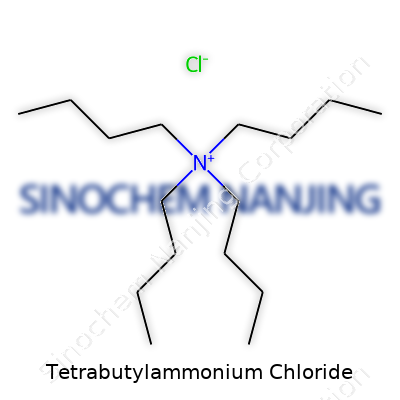
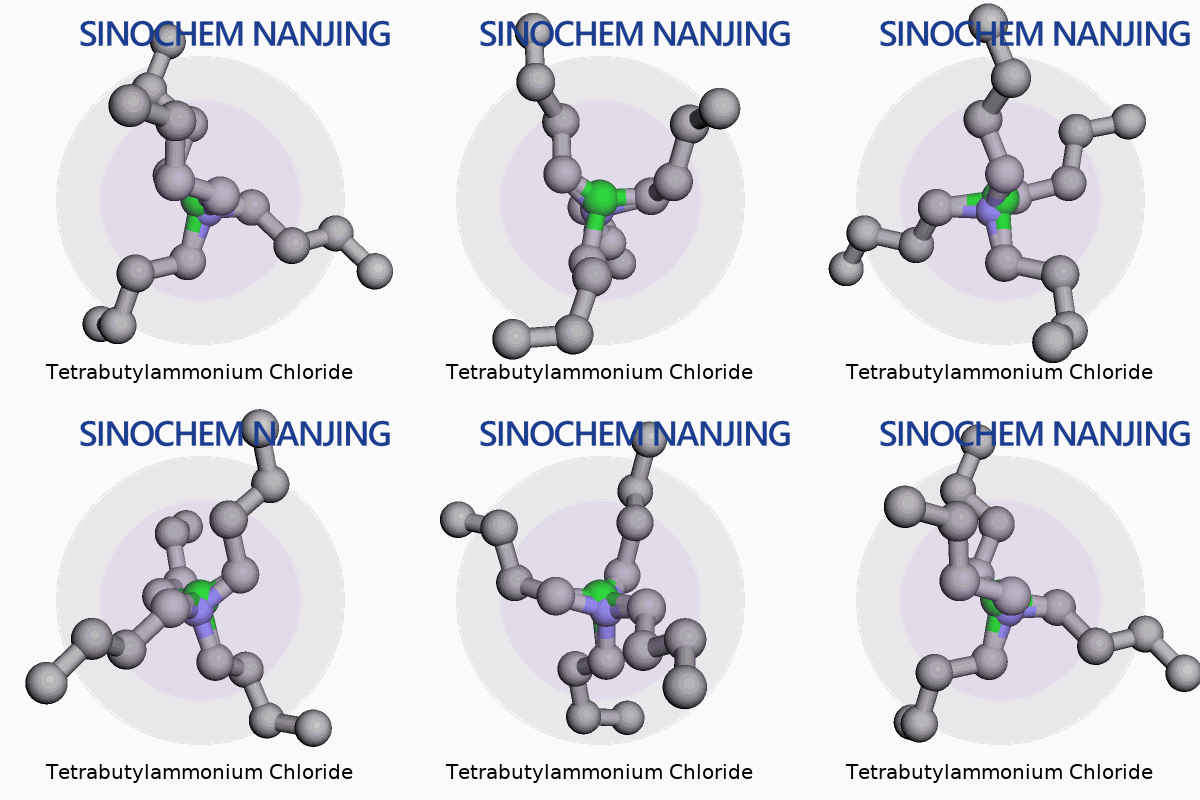
TBACl, with its straightforward chemical formula N(C4H9)4Cl, appears as a white, crystalline powder or as a sticky solid under humid conditions. Its melting point usually falls close to room temperature and it dissolves with ease in water, as well as many common organic solvents. The structure features a big, bulky ammonium center, flanked by four butyl groups, which practically act like buoys that keep the positively charged core floating in organic phases. That’s not just chemistry trivia, either. It means TBAC offers something special: the ability to shuttle ions across phase boundaries, which helps reactions that usually struggle in water or oil alone. Most chemists who use TBACl learn quickly how much these traits matter when chasing higher yields and cleaner products.
Technical Considerations and Labeling
You can spot TBACl in bottles labeled with names like Tetrabutylammonium chloride, TBACl, or even the slightly less common N,N,N-tributyl-1-butanaminium chloride. The label needs to state the purity, which matters in fine synthesis, as trace water or byproducts can soak up active reactants or drag down performance. Chemists who trust their syntheses to TBACl rarely ignore these basics. Real-world lab work relies on knowing what’s in the bottle and trusting that each batch stands up to its name. Some researchers even call for certificates of analysis to back up their results, especially where subtle contaminants make the difference between success and failure.
The Pathway to Making TBAC
Industrially, TBAC comes from a quarternization process — typically by reacting tributylamine with 1-chlorobutane under heat. The reaction brings together an amine and an alkyl halide, locking them into the four-legged tetrabutylammonium ion with a chloride counterion. Filtering and washing the solid typically produces a product with high purity. Many bench chemists have tried small-scale versions, often in a fume hood, reminding themselves with each step that careful purification determines the final outcome. Methods evolve as new solvents and greener procedures get tested. Avoiding tough-to-remove impurities serves up cleaner results for downstream reactions, making the prep step a linchpin in the chemical journey.
How Tetrabutylammonium Chloride Reacts and Morphs
TBAC grabs attention in phase transfer catalysis, where its ammonium center can pair with a range of anions, straddling the line between water and organic solvents. The chloride ion can swap out for other anions, which lets researchers tailor new tetrabutylammonium salts with different behaviors. Plenty of synthetic chemists have watched their reaction rates jump thanks to this effect. TBACl also takes part in nucleophilic substitution, and as a strong electrolyte, it finds a niche stabilizing charged reaction intermediates. It often butts up against similar compounds like tetrabutylammonium bromide or iodide, depending on what a particular synthetic pathway calls for. One of the genuinely exciting aspects springs from the way it expands the range of chemistries possible, not just as a reagent, but as an agent of transformation.
Other Names and Synonyms in the Field
Tetrabutylammonium chloride travels under a handful of aliases, including N,N,N-tributyl-1-butanaminium chloride and simply TBACl. In catalogs, it might show up alongside similar compounds, so a sharp eye for the CAS number helps separate it from lookalikes. Anyone who’s ordered from multiple suppliers knows product names sometimes stray from strict nomenclature, especially across different countries and regulatory regions, so verifying identity and purity counts for a lot on a busy lab schedule.
Working Safely Around Tetrabutylammonium Chloride
Handling TBAC means keeping an eye on the basics — gloves, goggles, and good ventilation. TBAC isn’t the most toxic member of its family, but it can irritate skin and mucous membranes. Industrial guidelines put exposure limits in place and everyone handling bulk quantities swears by thorough washing and spill protocols. Safety data often points to the environmental persistence of quaternary ammonium compounds, so care after use matters just as much as during. Anyone working in the chemical industry long enough quickly learns from the mistakes — a little spilled TBACl on the bench lingers, and a breezy attitude towards disposable gloves never pays off. Watching toxicology trends reminds us that even time-tested chemicals deserve respect, not just for immediate hazards but for what they leave behind.
Where TBAC Makes a Difference: Applications Across Sectors
TBACl’s role in the lab goes far beyond phase transfer catalysis. It steps into organic synthesis, playing a key part in making pharmaceuticals and fine chemicals, not just as a catalyst, but sometimes as a supporting player in extraction, purification, or crystallization processes. The electrochemical industry has found friends in the family of tetrabutylammonium salts, using them as supporting electrolytes for nonaqueous electrochemistry. Some analytical chemists reach for TBACl when setting up high-performance liquid chromatography, coaxing ionic compounds through columns for better peak resolution. My experience in a research group taught me that there’s rarely a perfect one-size-fits-all salt — TBACl just happens to handle a lot of jobs, filling in gaps between more specialized additives and common inorganic salts. The market for these chemicals keeps growing with the hunger for cleaner reactions and finer separations.
Research Directions and Testing the Edges
Research into TBAC pushes into uncharted ground every year. Green chemistry and sustainable processes now command the spotlight, forcing researchers to rethink TBAC’s role as both a catalyst and a material with environmental weight. Labs test new approaches to synthesis that minimize waste and favor recyclable components — TBAC gets recaptured, reused, or swapped out altogether for less persistent variants. Analytical teams look closer at degradation pathways and breakdown products, aware that regulatory restrictions get tighter every decade. The intersection of organometallic chemistry and ionic liquids sometimes calls for new TBAC derivatives, and interdisciplinarity shapes the trajectory of how, where, and why TBAC sees use in the next decade.
Digging Deeper Into Toxicity and Environmental Effects
Toxicology tells us TBAC is less hazardous than many heavy metal catalysts or reactive organics, but the story isn’t black-and-white. Chronic exposure hasn’t been studied as deeply as acute toxicity, putting pressure on both manufacturers and researchers to keep testing. Quaternary ammonium compounds sometimes resist breakdown, and persistent chemicals eventually come back to haunt their producers if not handled carefully. More scrutinized environmental regulations in the EU, US, and China keep pushing for lower emissions, better wastewater management, and closed-loop processes. For myself, reading toxicology reports on TBAC and similar compounds always drives home the difference between theoretical safety and the real-world messiness of manufacturing, waste, and human factors.
What Lies Ahead: Prospects for Tetrabutylammonium Chloride
Shifting industrial priorities have started to reshape the demand and profile of TBAC. Green chemistry, tighter regulations, and sharper consumer scrutiny set the direction for future research and industry adoption. Scientists and manufacturers will keep optimizing the cost, purity, and reactivity of TBACl, possibly designing analogs that break down more quickly in the environment or give even higher catalytic performance. Some labs focus on finding catalysts that deliver similar benefits using renewable feedstocks. The future for TBAC won’t just depend on performance in the test tube — long-term success depends on how well researchers, regulators, and manufacturers balance efficiency, safety, and sustainability. From my vantage point, TBAC represents not just a workhorse chemical, but a kind of crossroads for the next chapter in industrial chemistry — a test of whether smarter science can deliver both innovation and responsibility.
What is Tetrabutylammonium Chloride used for?
Why Chemists Reach for Tetrabutylammonium Chloride
Tetrabutylammonium chloride often ends up on the lab bench, especially in research labs focused on organic chemistry or pharmaceuticals. Most chemists who use it remember their first experience with this salt—usually to help a stubborn reaction proceed or to improve the yield of a challenging process. Its bulky organic structure lets it cross into roles that old-fashioned inorganic salts can't handle. The four butyl groups stick out, which helps dissolve it in organic solvents and lets it carry ions from one phase to another. For anyone who's spent hours coaxing polar compounds into nonpolar solvents, this property feels more like magic than mere science.
What Makes It Special?
Working with Tetrabutylammonium chloride means breaking away from the usual water-soluble world of salts like sodium or potassium chloride. Many reactions demand salts that dissolve smoothly in organic liquids, which allows reactants to mix and interact in new ways. The key role here is ion pairing: this chemical can move ions from water to organic layers, which opens up options in making pharmaceuticals, agrochemicals, and new materials.
Real-World Uses in the Lab
If you spend time setting up reactions involving phase transfer catalysis, you appreciate what Tetrabutylammonium chloride can deliver. A classic example comes in nucleophilic substitution reactions—getting an anion across the boundary into the organic phase means the chemistry proceeds, rather than stalling out. This chemical acts like a bouncer at a club, getting the right people inside so the party kicks off. It can also be used in electrochemical setups, as the bulky cation often creates solutions with predictable behavior, something prized in sensitive measurements.
Talking to colleagues, I notice that analytical chemists use this salt to support ion-pair chromatography. In that context, its structure lets it enhance separation for tricky molecules that refuse to stay put under standard conditions. Materials scientists find value in it too, using it to make ionic liquids or as supporting electrolytes in experimental batteries. The applications branch far past basic organic synthesis, touching on energy research and advanced polymer work.
Risks and Responsible Handling
I think every chemist who’s ever made a spill remembers the first time they handled a quaternary ammonium salt. The balance comes in knowing the compound’s limits. Tetrabutylammonium chloride, for all its convenience, can release toxic or irritating byproducts if handled roughly. Skin contact or inhalation isn’t something to brush off. Labs need solid procedures: gloves, proper ventilation, good clean-up techniques. The MSDS isn’t just a formality here. When greener substitutes are available, responsible labs take a hard look at switching. That kind of forward-thinking, supported by industry guidelines, matches the push for safer and more sustainable chemistry.
Finding a Better Path Forward
Tetrabutylammonium chloride has its place, but as laws and safety culture shift, alternatives matter more. Researchers keep working to develop salts that offer similar performance with fewer health or environmental worries. One solution might come from biodegradable phase transfer catalysts, or by optimizing reaction setups to lower the need for organic solvents. Sharing data and safety outcomes through publications can help the next generation of chemists choose wisely, reducing the risks without losing the creative edge that makes research exciting.
What is the chemical formula of Tetrabutylammonium Chloride?
Tetrabutylammonium Chloride: Breaking Down the Basics
Tetrabutylammonium chloride carries the chemical formula C16H36NCl. Not everyone hears that name every day. Chemists use it like a Swiss Army knife in the lab, from transposing molecules to pulling off precise separations. You see four butyl groups tightly bound to an ammonium ion, and a lone chloride ion tagging along. Each butyl chain gives flexibility and bulk, which keeps this salt soluble in a wide range of organic solvents. I spent hours in graduate labs, watching those particles dissolve and do their job, so this stuff sticks in memory.
Why the Formula Matters in Real Labs
Formula knowledge might sound straightforward—numbers and letters telling us “what’s inside.” In a real-world setting, though, knowing that formula means predicting how the salt behaves. Chemists lean on C16H36NCl for its unique ability to ferry ions across boundaries. For example, it acts as a phase-transfer catalyst, carrying ions from aqueous into organic environments. That’s where the recipe of four butyl chains around ammonium matters—long carbon tails help it slide into organic layers, while the positively charged nitrogen snags what’s needed from water. Misjudging the chemical makeup spells trouble, not just for chemistry experiments but for future processes in pharmaceutical and materials science work.
Fact-Driven Choices in the Lab
The difference between success and failure sometimes hangs on recognizing the elements and ions in play. Tetrabutylammonium chloride, with its 16 carbons, 36 hydrogens, 1 nitrogen, and 1 chlorine, is more than a formula for a shelf label. Pure batches depend on understanding what each part contributes. At one point, we used the chloride version where other labs went for the bromide or iodide cousin, and that swap shifted reaction rates and product purity—easy to underestimate but hard to ignore when results matter. Studies in the Journal of Organic Chemistry show that phase-transfer catalysts like this compound cut down waste and resource use, making greener labs possible. Environmental impact relies on people knowing their formulas well enough to pick the right salt for the right step.
Moving Toward Better Practices
Missteps pile up quickly without attention to chemical structure. Mistakes in reagent choice drain budgets and slow projects. In my experience, double-checking formulas like C16H36NCl protects both people and experiments. It’s tempting to grab whatever’s available, but tracking every atom guards against mishaps and keeps safety reviewers happy. Safety Data Sheets rely on precise naming and formulas to flag hazards. Chloride, for example, points to certain handling risks. Skipping that detail risks exposure to dangerous reactions or failed syntheses—a shortcut that always costs more in the end.
The Importance of Staying Informed
Experience builds trust in numbers—knowing each subscript in a formula can change outcomes. Beginners learning to handle products like tetrabutylammonium chloride soon find out that one misplaced digit turns a routine process chaotic. Mentors in research settings remind students to put formula accuracy at the top of their list, just under safety glasses. Counting atoms may seem basic, but each lab mishap from a formula slip echoes a lesson worth remembering: keep the fundamentals close, because chemistry never cuts corners for anyone. Awareness pays off through safer, cleaner, and more efficient lab work—and in the end, that keeps both the science and the scientists moving forward.
How should Tetrabutylammonium Chloride be stored?
Understanding Storage Risks
Tetrabutylammonium chloride shows up in a lot of labs, usually labeled with some intimidating safety warnings. I remember first time I handled it in my university’s chemistry lab, a senior student reminded me: “Better keep the lid on and stay neat.” Back then, it sounded obvious, but not every rule sticks until you understand what’s at stake.
The compound draws water from the air, turning clumpy and hard to weigh correctly. Moisture doesn’t just mess with the numbers on the scale, it can nudge reactions out of whack and cause stubborn clogs in bottles and dispensers. Many researchers slip up on this point, shelving the bottle alongside ordinary salts or mixing it with wet reagents. Tetrabutylammonium chloride breaks down faster when water, heat, or light get into the picture, changing its physical form and spoiling its reactivity.
Storing for Safety and Quality
Most chemical suppliers send this reagent packed snug, inside amber bottles with tight-fitting screw caps. On the label, you’ll often see advice to keep it in a cool, dry place, away from direct sunlight. I’ve learned that the “dry” part carries real weight. Dry doesn’t just mean “not next to the sink.” I keep mine with silica gel packets, stash the jar inside desiccators, and double-check the seal each time. Once moisture slips inside, the problem doesn’t wait — batches get ruined, making experiments unpredictable.
Tetrabutylammonium chloride rarely explodes, but its fumes and dust shouldn’t go up your nose or onto your skin. In my own workspace, I set up near a fume hood whenever opening containers. Reseal everything as soon as I’m done; not much point getting careful during weighing if you leave the lid off for cleanup. I’ve seen entire projects delayed because someone left a container open near the bench, creating hidden hazards and contamination.
Health and Environmental Concerns
It’s easy to overlook long-term exposure. Chronic handling without gloves can cause dry or irritated skin. I usually wear a lab coat, goggles, and gloves—no matter how brief the transfer. Most spills can be wiped up with dry cloth, but residues should go in chemical waste, not the trash. Some folks toss small amounts down the drain, thinking dilution makes it safe. That’s risky thinking. Environmentally, this compound isn’t especially toxic, but waste rules exist for a reason. Local guidelines change, so double-checking disposal policies always makes sense.
Offering Reliable Solutions
Setting up storage for tetrabutylammonium chloride doesn’t take fancy hardware. Even in small labs, airtight bottles, simple desiccators, and a shelf away from sunny windows prove effective. Some colleagues use automated reminders to swap out drying agents or check chemical stocks, but a clear lab notebook and a good routine are just as useful. Regularly inspecting bottles for caked solids, leaks, or faded labels keeps everything on track.
Training new folks on these basics helps avoid headaches later. Getting used to proper PPE, tidy handling, and good labeling practices stops problems before they start. Not every chemical in the storeroom needs so much fuss, but treating tetrabutylammonium chloride with a little respect ensures purity and safety for everyone working nearby.
Is Tetrabutylammonium Chloride hazardous to health?
What Tetrabutylammonium Chloride Is Used For
Tetrabutylammonium chloride turns up in chemical laboratories, especially where organic synthesis or phase-transfer catalysis takes place. Research teams like the convenience of its handling and solubility, and lots of folks view it almost as a standard helper in reactions. An easy-to-use salt, with some distinctive properties, that’s climbed onto the lab shelf.
Identifying Health Concerns
People worry about safety for good reason. Open a bottle of tetrabutylammonium chloride and you’ll notice a faint odor. Safety data sheets point out this compound can cause eye, skin, and respiratory irritation. Direct exposure — splashing it on skin, catching a whiff of the powdery dust — usually leads to redness or discomfort.
Accidental ingestion isn’t common outside of a lab setting, but if it happens, nausea, dizziness, or more severe reactions might show up. Chronic or repeated skin exposure can lead to dryness or cracking, especially for those working with the chemical over long periods.
Documented Risks and Occupational Exposure
Regulatory agencies catalog tetrabutylammonium chloride as an irritant, but they haven’t listed it on high-priority lists for carcinogenicity or reproductive toxicity. NIOSH and OSHA don’t offer a specific workplace exposure limit, yet standard practice calls for gloves, goggles, and adequate ventilation. I remember more than one seasoned chemist emphasizing: always handle such salts with gloves and work behind a sash.
Studies on long-term effects are thin. Most available research focuses on accidental exposure and short-term outcomes. Medical cases don’t frequent the literature, but nobody wants to test their luck. I recall seeing a mild skin rash on a colleague’s hand where a glove had torn. Even though it resolved quickly, these small incidents add up and nudge researchers to respect lab protocols.
Environmental and Secondary Health Issues
Beyond direct health impacts, improper disposal of tetrabutylammonium chloride can stress wastewater systems. I’ve seen warnings about not dumping it down the drain. Breaking down these chemicals in industrial wastewater can be tricky. If not managed well, residues could slip into the environment, and aquatic organisms are sensitive to them.
Communities near chemical manufacturing sites face greater risks if releases aren’t tightly controlled. In practice, most problems come from neglecting safety culture and skipping over simple measures like labeling, storing, and disposing of the substance correctly.
Reducing Health Hazards
The real challenge comes down to maintaining awareness and sticking to best practices. Good education and up-to-date training for lab workers set the foundation. Lab coats, gloves, goggles — these enter the territory of every routine experiment. Fume hoods and decent ventilation systems remain important, not only for tetrabutylammonium chloride but for a range of reagents.
Institutions with strong safety programs keep rates of chemical injury low. Those working in home labs, or new university students unaware of risks, benefit from guidance and oversight. Manufacturers could help by improving label clarity, offering spill kits, and providing clear instructions for safe disposal — I always check for these before opening any new container.
Personal Reflections and Suggestions
Respect for chemicals shapes lab routines more than fear. No one wants to be the person who skips gloves and ends up with a trip to the campus clinic. Building habits for safe handling, swift response to spills, and straightforward communication about hazards cuts down on mistakes and accidents. Over time, a mindful approach is the simplest shield against the health risks of compounds like tetrabutylammonium chloride.
What is the purity and grade of Tetrabutylammonium Chloride available?
Purity That Makes a Difference
Purity decides a lot in the world of chemicals, and Tetrabutylammonium Chloride shows this well. In a typical lab, you’re going to spot this quaternary ammonium salt in bottles labeled anywhere from 97% to just over 99%. These numbers might sound close, but in research or manufacturing, they mean more than a number on a label. Imagine you’re pushing for exact reaction yields or tracing down side-products that could mess with your results. That one or two percent gap is where stubborn contaminants like water, silicates, or halides live, throwing off sensitive chemical reactions.
I remember years back, trying to pull off a precise halide exchange in grad school. The project called for a strong nucleophile, and only the 99% high-purity Tetrabutylammonium Chloride delivered the selectivity needed. Lower-grade material, sold as “technical” or “laboratory” grade, brought unpredictability. Reactions kicked out odd products, or they stalled entirely. That’s the difference real-world purity makes when troubleshooting stops being a paper exercise, and you face a strict deadline.
Grades in the Marketplace
You’ll find labels like “technical,” “laboratory,” and “puriss” or “reagent” thrown around by suppliers. Technical grade Tetrabutylammonium Chloride can run as low as 95%, meant more for bulk processes or less sensitive applications. Reagent grade often nudges up to 98–99%, hitting specifications needed for pharmaceutical, analytical, or electronics work, with limits on metals or other practical impurities. Ultra-pure versions (99–99.5%) exist, carrying price tags that sting the wallet, but these show up in specialty electronics, battery research, or demanding synthesis.
Out in industry, purity feels even more personal. In electronics, chloride traces can trash a batch of sensitive materials. Pharmaceutics leans heavy on the high end as well. Purification costs time and money. Most companies hate watching a reaction bomb out due to contaminated starting material. Cost factors into everything, but no one wants recalls or unsafe batches with untracked impurities.
Why Should Anyone Pay Attention?
It’s easy to gloss over a chemical’s grade, until a failed experiment or product recall winds up on your desk. For those in research or production, choosing the right grade is a matter of trust in your supplier and a willingness to pay for real value. Counterfeit or mislabeled chemicals haven’t disappeared. Reliable manufacturers share certificates of analysis, spelling out sodium, potassium, iron, and heavy metal levels in fractions of a part per million. Labs can verify this with their own techniques—like NMR, Karl Fischer, or ion chromatography—and some do for every lot.
It helps to look at the supply chain, too. In my own work, delays sometimes crept in because only one supplier met both grade and documentation requirements for a grant proposal. Having two or three backup vendors, checking transparency, and keeping enough on the shelf avoids disruptions—especially in fields where every chemical needs a trail for audits.
Moving Toward Fewer Surprises
Purity issues rarely vanish but keeping records, confirming batch numbers, and sharing findings across labs does more than protect ego. Speaking up about surprise reactions or unexpected yields helps shift the conversation from “risk” to “routine.” Tetrabutylammonium Chloride might sound common, yet its finer details ripple out into new research, better batteries, or cheaper medicines. Choosing the right grade—and confirming what’s inside—still matters more than most people realize.
| Names | |
| Preferred IUPAC name | N,N,N-tributylbutan-1-aminium chloride |
| Other names |
TBACl Tetrabutylammonium chloride N,N,N-tributylbutan-1-aminium chloride |
| Pronunciation | /ˌtɛtrəˌbjuːtaɪl.əˈmoʊniəm ˈklɔːraɪd/ |
| Identifiers | |
| CAS Number | 1112-67-0 |
| 3D model (JSmol) | `[NH4+].Cl-` |
| Beilstein Reference | 1718732 |
| ChEBI | CHEBI:38761 |
| ChEMBL | CHEMBL1375 |
| ChemSpider | 14347 |
| DrugBank | DB11106 |
| ECHA InfoCard | 100.111.467 |
| EC Number | 200-697-4 |
| Gmelin Reference | 8488 |
| KEGG | C14329 |
| MeSH | D014038 |
| PubChem CID | 3034099 |
| RTECS number | WSZ4750000 |
| UNII | 9Z6O4FO6FS |
| UN number | UN2811 |
| Properties | |
| Chemical formula | C16H36ClN |
| Molar mass | 339.00 g/mol |
| Appearance | White crystalline powder |
| Odor | Odorless |
| Density | 0.89 g/cm3 |
| Solubility in water | Soluble in water |
| log P | 0.7 |
| Vapor pressure | <0.01 mmHg (20°C) |
| Basicity (pKb) | pKb = 4.95 |
| Magnetic susceptibility (χ) | -67.0e-6 cm³/mol |
| Refractive index (nD) | 1.427 |
| Viscosity | 100 cP (20 °C) |
| Dipole moment | 3.7 D |
| Thermochemistry | |
| Std molar entropy (S⦵298) | 360.8 J·mol⁻¹·K⁻¹ |
| Hazards | |
| Main hazards | Harmful if swallowed, causes skin and serious eye irritation. |
| GHS labelling | GHS07, GHS05 |
| Pictograms | GHS07 |
| Signal word | Warning |
| Hazard statements | H315, H319, H335 |
| Precautionary statements | P264, P280, P301+P312, P305+P351+P338, P337+P313 |
| NFPA 704 (fire diamond) | 1-0-0 |
| Flash point | > 85 °C |
| Lethal dose or concentration | LD50 (oral, rat): 550 mg/kg |
| LD50 (median dose) | LD50 (median dose): Oral-rat LD50: 4060 mg/kg |
| NIOSH | **BS8925000** |
| PEL (Permissible) | Not established |
| REL (Recommended) | 10 mg/m³ |
| IDLH (Immediate danger) | No IDLH established. |
| Related compounds | |
| Related compounds |
Tetrabutylammonium bromide Tetrabutylammonium iodide Tetraethylammonium chloride Tetrabutylammonium fluoride Tetrabutylammonium hydroxide |



