The Story of Succinic Acid: Roots, Realities, and Future Paths
Historical Development
Succinic acid has a backstory that reaches into the early days of chemistry. People first drew it out of amber with simple heat, giving it the nickname “spirit of amber.” This happened at a time when the word “organic” referred only to anything derived from living things. For years, it stood as an oddity from tree sap before turning into a cornerstone for deeper scientific inquiry. It took enterprising scientists in the 1800s to map its structure. They unlocked its four-carbon backbone and showed how natural processes like fermentation could generate it in a lab instead of from fossilized trees. Some call this progress, but it really marks a shift from relying on rare resources to taking control of the process, showing how chemistry adapts to cut out the middleman.
Product Overview
Succinic acid doesn’t pull crowds on its own, but behind the scenes, it powers a surprising range of industries. It belongs to the dicarboxylic acid family. With its straightforward structure, it lends itself to many uses. Manufacturers count on it to become solvents, flavor enhancers, drugs, resins, and even plastics. You might not spot its name on the back of a consumer product, but its fingerprints are all over specialty polymers, additives, and even the tartness in certain foods. The reason is simple: its chemical make-up allows it to act as a bridge or building block, making it valuable for anyone looking to scale up beyond basic chemistry.
Physical & Chemical Properties
Succinic acid looks like a colorless, crystalline solid at room temperature, slightly dissolving in water and alcohol. Its taste lands somewhere between sour and bitter, reminding some people of unripe fruit. Its melting point lands around 185°C, high enough to avoid most accidental melting during storage or transport. In both form and behavior, it’s stable as long as it stays away from strong oxidizers or bases. Chemically it pulls from two carboxyl groups; that means it can donate protons or react with bases to form salts (succinate salts), a key property for many commercial applications. These traits carry practical meaning—stable enough to store and ship, reactive enough to matter in controlled settings.
Technical Specifications & Labeling
Most of the world knows succinic acid by a series of names: butanedioic acid, spirit of amber, E363 as a food additive. On any label, purity tops the list of demands, more so for pharmaceutical or food uses. Industrial batches must also stick to specific levels for water content, ash, and heavy metals—no one needs accidental contamination ruining a process or putting health at risk. Clear labeling cuts down on mistakes, while regulatory agencies press for standards to track quality and lot history. These aren’t just paperwork headaches; traceability and accurate tags help spot problems quickly during recalls or audits. Smart suppliers treat documentation not as a box to check but as an insurance policy for safety and reliability.
Preparation Method
Old approaches relied on distilling the resin from amber, but few rely on nature’s leftovers anymore. Today, most succinic acid comes from petrochemical processes starting with maleic anhydride or butane. Microbial fermentation has started to surge back, this time with genetically engineered bacteria and renewable feedstocks. Some producers tout this method as “bio-based,” even though fermentation requires its own checks and strict control. Both roads aim to supply tons of product with reliability in mind—a misplaced variable can yield off-spec acid. As energy practices change and concerns about waste mount, companies and researchers turn toward bio-based routes, hoping to find a blend of scale, efficiency, and sustainability. There’s no perfect route, but process engineers keep tweaking the recipe.
Chemical Reactions & Modifications
Chemists value succinic acid as a starting point. From this simple platform, they spin off dozens of useful compounds. React it with alcohol, you get succinate esters. Heat and dehydrate it, you’ll arrive at succinic anhydride, a reactive intermediate used in alkyd resins, plastics, and coatings. Feed it into hydrogenation routes, and it can form 1,4-butanediol—a base for spandex. Modify it further, and pharmaceutical scientists explore salts and derivatives for better drug delivery. Each upgrade taps new uses, and every tweak changes how it works in the real world. Industry sees this flexibility as a strength, letting one commodity reshape itself depending on the season or the challenge.
Synonyms & Product Names
Scan through technical catalogs and you’ll see a lineup of names: butanedioic acid, amber acid, or simply E363 for some food regulatory systems. The variety depends on whether it shows up as a pure acid, a salt, or complexed with other ingredients. None of these alter what’s in the drum, but the labels matter. Clear names help scientists avoid confusion, especially in international trade or multi-language settings. For people outside the lab, most of these names fade into the background, but chemists memorize them out of caution—one wrong word can mean the wrong chemical, with costly fallout.
Safety & Operational Standards
Safe handling rules for succinic acid come down to risk management and preparation. In fine powder or bulk, it can irritate the skin, eyes, and respiratory tract. Workers use gloves, goggles, and dust masks during mixing and dispensing. Regulations such as OSHA or the European REACH framework recognize the importance of exposure limits and proper ventilation. Spills stay manageable, and it doesn’t build up in tissues, but accidents need fast cleanup plans to keep workflows on track. Storage needs dry, closed containers, kept away from oxidizers or incompatible materials. These steps might sound simple, but they set apart safe operations from costly mistakes. Well-practiced teams build checklists and training into daily routines, while manufacturers deliver clear guides based on real-world risks.
Application Area
The reach of succinic acid goes wider than textbooks let on. Food technologists add it as a flavor enhancer and acidity regulator in products like candy and soft drinks. Drug makers use it as a buffering agent or intermediate—a quiet helper in pain relief medications and vitamin formulations—while agricultural suppliers blend it into growth stimulants for plants. In plastics and biodegradable polymer production, the acid serves as a monomer, supporting industries searching for better alternatives to petroleum-centric materials. Industrial water treatment and corrosion protection rely on its chelating ability, and metal cleaners use its safe yet effective chemical strength. Even the cosmetics industry, sometimes late to the game, experiments with derivatives for skincare products. People find new ways to put it to work because the core molecule remains versatile and cost-effective.
Research & Development
Some of the most interesting action around succinic acid happens quietly in university and company laboratories. With the shift toward green chemistry, researchers develop new bacterial strains and fermentation tweaks that pull higher yields from agricultural waste or non-food sugars. Biotechnologists write papers about engineered yeasts switching from glucose to more complex sugars, looking for better process economics. Chemists push the boundaries of catalysis, aiming for fewer steps and less waste getting to downstream chemicals. In industry, engineers work on separation and purification routes that use less energy—pushing the final price point lower while meeting ever-firmer environmental guidelines. The work rarely gets flashy headlines, but its impact ripples outward, helping transition away from purely fossil-based supply chains.
Toxicity Research
Compared with many industrial chemicals, succinic acid scores low on the toxicological scale for short-term exposures and moderate doses. The human body can process it naturally—it even appears as a metabolite in cellular respiration. That doesn’t mean all uses bring zero risk. Extremely high exposures can cause irritation, and studies on chronic low-level ingestion still play out among regulatory scientists. Animal models show low acute toxicity, but safety studies keep expanding to follow new application areas, especially as the move to bioplastics means more contact with food and consumer goods. Academics and regulators alike watch for subtle effects, making sure old safety assumptions stay valid as manufacturers push to higher production volumes and broader uses.
Future Prospects
The next decade looks set to transform how the world produces and uses succinic acid. Bio-based production keeps gaining traction as large chemical players and startups adapt to pressure for sustainable sourcing. If cost parity with petrochemical routes holds, it could unlock a surge in new polymers and green solvents that lean on succinic acid chemistry. You’ll see more retailers and manufacturers touting products with a smaller carbon footprint thanks to these feedstock shifts. Current research into more efficient microbial strains and crystal separation techniques may make organic acids like succinic a front-runner in the race for cleaner production pathways. One thing stands out: as more sectors prioritize renewable resources and circular economy solutions, overlooked workhorse chemicals like succinic acid will quietly shape the next wave of industrial progress.
What are the main uses of Succinic Acid?
A Closer Look at Common Uses
Succinic acid sounds like something out of a chemistry textbook, but its impact touches daily life in ways most folks might miss. From snacks on grocery shelves to clothing fiber, this simple organic acid steps up in surprising places. Over the years, I’ve watched industries reinvent their production lines to rely more on bio-based chemicals like succinic acid, shifting away from harsh petrochemicals for greener alternatives. There’s a reason companies keep coming back: it’s effective, renewable, and cost-friendly.
Food and Beverages
Anyone who’s baked sourdough or read the label on packaged candy has likely encountered succinic acid, though they probably didn’t recognize it. As a food additive, it controls acidity and helps preserve shelf life. The tang in some hard candies comes from this acid. Breweries use it too. It balances flavors in beers and non-alcoholic drinks. The U.S. Food and Drug Administration recognizes it as safe, and industry leaders choose it to modernize older recipes that once leaned on less sustainable ingredients.
Pharmaceuticals and Supplements
Pharmaceutical companies trust succinic acid to serve as an intermediate in making several medications. Some migraine medicines start out as a compound closely related to this acid. In supplement form, it finds use as a stabilizer. Many manufacturers see it as a reliable option because of its low toxicity and predictable reaction profile — important qualities in the world of health products. Research keeps uncovering more about how succinic acid supports energy metabolism in the body, which has led to more interest in using it in sports nutrition and wellness formulas.
Biodegradable Plastics and Polymers
Walking through a shopping mall, I’ve seen biodegradable shopping bags and compostable food trays take over from their plastic counterparts. Behind the scenes, succinic acid plays a critical role. It acts as a building block for polybutylene succinate (PBS), a biodegradable plastic. Companies in Europe and Asia saw potential early, ramping up production as environmental laws tightened. Scientists continue to search for more bio-based materials to cut down plastic waste, and succinic acid often finds a place in their prototypes.
Cosmetics and Personal Care
The cosmetics aisle tells another story. Succinic acid shows up as a pH adjuster and buffering agent in everything from toothpaste to skin creams. When you want shelf-stable formulas that feel gentle on sensitive skin, this acid checks the boxes. Over recent years, more brands pushed their formulations to clean up ingredient lists, and plant-based succinic acid fits that narrative well.
Industrial and Chemical Uses
Industrial chemists use succinic acid as a precursor to a long list of chemicals. It breaks down into solvents, coatings, dyes, and even some coolants. Not all of these processes win headlines, but they improve efficiency and create durable products. It helps with leather tanning and even slips into some herbicides, where its relatively low environmental impact appeals to manufacturers. Newer methods allow companies to make succinic acid from renewable feedstocks, cutting their carbon footprint and appealing to customers who follow ethical sourcing.
Facing Challenges and Pushing Forward
While demand grows, bottlenecks appear in supply chains, especially in markets dependent on traditional petrochemical sources. Switching to fermentation-based production gives hope for steady supply and healthier margins. Governments support these shifts, betting on jobs and cleaner air. If costs keep dropping, more brands will likely make the jump. Succinic acid’s story shows how one ingredient, rooted in both old and new technology, can shape how we eat, heal, clean, and build a world that’s less wasteful and more responsible.
Is Succinic Acid safe for human consumption?
What Is Succinic Acid?
Succinic acid comes from many familiar places—cheese, sugar beets, and even our own bodies. Food producers use it as a flavor booster, acidity regulator, and preservative. So, plenty of us have already eaten it in small amounts, even without knowing its name.
What Science Says About Safety
Regulators in the U.S. and Europe, including the Food and Drug Administration and European Food Safety Authority, give succinic acid the green light for use in food. The FDA actually lists it as “generally recognized as safe” (GRAS). That recognition comes after decades of research showing that natural metabolic processes in humans break down this acid easily. Our own cells make it as they generate energy, so it’s hardly a foreign chemical.
Doctors and nutrition experts rarely see issues from normal dietary intake of succinic acid. In lab tests, rodents only ran into trouble at very high doses—levels way beyond anything showing up in food or supplements. Humans would need to eat comical quantities of foods rich in succinate to see those problems. Regulatory agencies put strict upper limits on how much gets added to packaged food, keeping exposures firmly in the “safe” zone.
Why Succinic Acid Pops Up on Ingredient Lists
Bakers and food companies lean on this acid mostly for its sour punch that balances sweet, salty, or fatty tastes. It serves a practical purpose: sharper flavor means less salt and sugar in the final recipe. I’ve seen this work in action while developing baked goods—adding a pinch of succinic acid rounded out the taste and kept the bread fluffier for longer.
Food preservation offers another benefit. Succinic acid helps slow spoilage by lowering the pH, making the food less friendly to bacteria and mold. That means less waste and a longer shelf life, especially important in parts of the world where keeping food fresh without refrigeration matters a lot.
Dangers of Excess and Who Should Watch Out
Like most things in daily life, more isn’t always better. If taken in silly amounts—think pure form, not what’s found in food—it could add acidity to the bloodstream and stress out the kidneys. Children, people with kidney disease, or those on strict low-acid diets might want to watch intake, but even then, regular food sources rarely pose trouble unless there’s an underlying medical problem. Side effects from food are vanishingly rare, and the much-hyped risks people pass around online don’t show up in medical journals.
Building Trust Through Transparency
Plenty of shoppers wonder about these “chemical-sounding” names on food packaging. Many fear additives, but science tells a different story—at least with succinic acid, which lands at the gentle end of the spectrum. The safest approach always involves sharing ingredient details openly and explaining their function. If food companies took time to communicate the facts, skepticism might shrink. The best safeguard remains a diverse diet made mostly of whole foods, with less reliance on processed snacks heavy on extras like acidifiers.
Stay curious about what goes into your meals—but don’t let complicated names alone raise alarms. Succinic acid, as the rules and mountains of research show, plays a surprisingly unexciting and safe role in modern diets.
What are the physical and chemical properties of Succinic Acid?
What Makes Succinic Acid Stand Out
Succinic acid doesn’t usually grab headlines. Sitting in a small jar in the lab or spinning inside the world’s bioprocessors, it looks like an off-white powder, only a faint glimmer of its potential peeking through its appearance. Strong, glassy granules pack a sharp, sour punch if tasted—nothing extraordinary at a glance, but packed with possibility. This four-carbon dicarboxylic acid grows from simple roots, with a formula of C4H6O4. In practical terms, it melts somewhere near 185°C, has a density close to 1.56 g/cm³, and dissolves quickly in water. That sharp solubility means it blends into drinks, medicines, and food products without fuss, giving manufacturers a level of control many other acids can't match.
Where Chemistry Comes Alive
In basic and acidic solutions, succinic acid shows off its multipurpose nature. It holds two carboxylic groups ready to react, opening doors to a range of chemical changes. During one college chemistry experiment, the transformation from succinic acid to a simple salt was clear as day—add one sodium base, see a clean new compound. The two dissociation constants — pKa1 sitting at roughly 4.2, pKa2 near 5.6 — speak to just how unique its buffering is. In food and beverage factories, this means it helps set the perfect pH, balancing sharpness and shelf life. At the bench, companies use that same buffering capacity for everything from flavor enhancers to corrosion inhibitors.
Real-World Benefits and Uses
Succinic acid’s real power shows in the range of places it lands. Microbes churn it out from renewable feedstocks, so producers can step away from petroleum-heavy processes and choose a greener route. The world’s aiming for lower emissions and eco-friendlier practices, so succinic acid fits right in, offering a way to cut fossil-based inputs. Industries lean on its reactivity—it turns into resins, pharmaceuticals, biodegradable plastics, and personal care products with ease. Pharmaceutical companies, for instance, benefit from its low toxicity and reliable safety profile when formulating tablets and infusions.
Issues on the Table
Even though making succinic acid biologically fixes sustainability worries, scaling up bio-based production still faces technical hurdles. Yields can be limited by microbial stress or feedstock purity, making costs unpredictable. Plus, large facilities must keep an eye on energy use and water needs to avoid swapping one problem for another. Some producers may slip back into cheaper synthetic routes if economics swing the wrong way. From personal experience with startups trying to market new “green” solvents, I’ve seen investment dry up if supply wobbles or prices spike beyond what traditional chemical plants offer.
Steps Toward Solutions
Research teams have already started tweaking organisms and tweaking process parameters, aiming for consistent yields and lower waste. Companies sharing best practices on purification steps make a real dent on output. Regulators and trade groups can give biobased succinic acid a leg up, fostering connections with buyers looking to clean up supply chains. As consumers pay closer attention to ingredients, it helps when businesses spell out why bio-based acids offer value—not just as a talking point but in actual properties and final product performance. Outreach builds trust, and trust powers change across industries that might otherwise stick with what they already know.
How is Succinic Acid produced or manufactured?
Digging Into Succinic Acid’s Roots
Succinic acid sounds fancy, but it’s something you’ve probably met in everyday life—plastic food wrappers, coolers, medicines, even sturdy auto parts. Some of us have used aspirin or cleaned a counter with a biodegradable product that owes its punch to succinic acid. Older versions came straight from the grapevines, like a quiet guest in fermented wine. Today, the world asks for much more than winemakers can make. That need has turned succinic acid into a star on the production line, pushed by two main playbooks: petrochemicals and biology.
Petrochemical Pathways — The Traditional Route
I remember walking through a chemical plant as a young science intern, floors humming with the sound of reactors. Workers fed oil-based chemicals such as butane or benzene into barrels, sparking reactions with air, water, and plenty of heat. Succinic acid showed up through this transformation, sandwiched somewhere between fumes and green powder. While that path works, it leans hard on fossil fuel. Modern times bring price swings and pressure to cut down on carbon. Petrochemical methods leave a big environmental shoeprint, and pollution costs money, too.
Fermentation — The Greener, Friendlier Way
Fermentation always felt familiar to me—like making sourdough bread or brewing beer. Break down sugar with help from microorganisms, and suddenly, simple beets or corn syrup turn into new building blocks. For succinic acid, producers load up big tanks with glucose, then add a dash of special bacteria or yeast. These tiny workers chew through the sugar and churn out succinic acid. Compared to oil, starting with plants offers something simpler and less toxic. The world’s top bioplastics now begin their journey in farms before reaching tank farms.
Challenges — Scaling Up and Competing on Cost
Efficient, large-scale fermentation doesn’t happen overnight. Companies must keep tanks sterile and the bugs happy. Yields depend on the quality of feedstock. Right now, glucose from corn or cane solves this, but crop seasons and drought bring risk. Some factories get creative, feeding bacteria leftovers from food processing (think broken pasta or damaged potatoes). The process produces fewer toxic byproducts, but sometimes the product needs more cleaning to meet strict food or pharma standards.
Opportunities for Smarter, Cleaner Production
Biotech keeps marching forward, with companies engineering bacteria that waste less feedstock and churn out more acid per hour. New strains gobble up more unusual materials, like agricultural waste or even carbon dioxide from factory vents. I’ve read about pilot plants that run almost entirely on renewable energy, driving fermentation with solar panels or wind turbines. The hope is clear: a reliable, lower-cost supply, small environmental impact, and options for local economies near farms, not distant refineries.
Where it’s Headed
People want greener plastics, smarter medicines, and food preservatives that don’t scar the planet. Succinic acid gives industry a way forward if the technology keeps evolving. Training a new generation of scientists, finding new feedstocks, and building better purification steps matter as much as enzymes or catalysts. The stakes are real—lowering pollution, making the most out of resources, and competing globally. There’s no silver bullet, but plenty of hard work, invention, and practical problem-solving ahead.
What industries commonly use Succinic Acid?
How Food and Beverage Makers Lean on Succinic Acid
Look in most packaged foods, and you might spot succinic acid on the label. This organic acid brings out a tart flavor and helps balance pH. It's one of those behind-the-scenes players that ensures canned goods keep for long stretches. I’ve worked with food technologists who say a sprinkle of succinic acid in sauces or jams helps lock in freshness and gives a cleaner tang than citric acid alone. The world’s appetite for shelf-stable snacks and beverages keeps demand high year after year. The European Food Safety Authority and U.S. Food and Drug Administration both list succinic acid as generally recognized as safe, so formulators don’t hesitate to use it when tweaking taste or texture.
Pharma and Biotech: More Than a Simple Additive
Walk into any lab focused on drug discovery, and odds are they’ve got succinic acid on the shelf. It takes on a chemical workhorse’s role—acting as a buffer, building more complicated molecules, or helping active ingredients dissolve better. In my university days, I ran across it often in biochemistry labs and noticed how it played a part in energy cycles within cells. Drug makers draw on that property for injectable solutions, softgels, and even in some vaccination processes. The World Health Organization lists it as a key excipient, so its reputation in medicine circles stays strong.
Polymers, Plastics, and Sustainable Manufacturing
Succinic acid earned more headlines lately for its role in the push to swap fossil-based plastics for greener options. Polybutylene succinate (PBS), a popular bioplastic, starts off with this acid. Factories in Asia and Europe produce tons of it every year, crafting compostable bags, films, and packaging. At a plastics trade show last year, I saw presentations raving about PBS’s promise to stand up against traditional plastics in both performance and compostability. The demand hits hard in electronics and consumer goods, where manufacturers field pressure to cut their carbon footprint. New companies pop up every season trying to make bio-based succinic acid faster and cheaper, hoping to chip away at oil-based counterparts.
Cosmetics and Personal Care Products
Succinic acid slips quietly into daily skincare. It helps exfoliate without the sting of harsher acids and acts as a pH adjuster in lotions, creams, and foil masks. Talking to dermatologists over the years, I’ve learned that it appeals to formulators aiming to meet strict clean beauty trends—non-irritating but still effective at smoothing skin. Global cosmetic giants and indie brands both list succinic acid in oily or acne-prone skin lines. Market data from Statista projects steady growth for acid exfoliants in skincare, with succinic acid claiming a share thanks to that mild touch.
Cleaning Products and Industrial Applications
Commercial cleaners and detergents have used succinic acid as an eco-friendlier option compared to older phosphates. It shifts water’s acidity just enough to lift stains on metal, glass, or clothing, while breaking down pretty well after each wash cycle. Environmental watchdogs track the shift towards biodegradable ingredients, and manufacturers respond knowing that getting flagged for phosphates can cost millions. At an industrial cleaning expo in Chicago, a booth rep walked me through test results showing succinic acid-based solutions outperforming legacy options—without leaving residues that foul up downstream processing.
What Could Come Next
Curiosity and research dollars continue to drive new uses for succinic acid. As industries rethink sources and supply chains post-pandemic, this versatile acid stands out for its flexibility and history of safe use. Startups and established labs alike hunt for better fermentation methods using plant sugars or even captured CO2, hoping to make tomorrow’s batch of succinic acid even cleaner than today’s. Experience has taught me that these efforts rarely move in a straight line, but pressure to green industrial processes keeps succinic acid in the conversation across multiple fields.
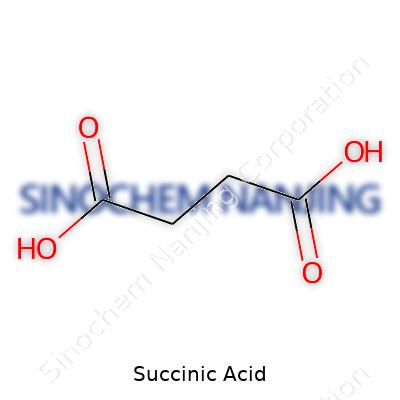
| Names | |
| Preferred IUPAC name | Butanedioic acid |
| Other names |
Amber acid Butanedioic acid E363 Ethylene succinate |
| Pronunciation | /ˈsʌk.ɪ.nɪk ˈæs.ɪd/ |
| Identifiers | |
| CAS Number | 110-15-6 |
| Beilstein Reference | 1718732 |
| ChEBI | CHEBI:15741 |
| ChEMBL | CHEMBL726 |
| ChemSpider | 533 |
| DrugBank | DB02716 |
| ECHA InfoCard | 100.003.222 |
| EC Number | 2.4.1.19 |
| Gmelin Reference | 835 |
| KEGG | C00042 |
| MeSH | D010996 |
| PubChem CID | 1110 |
| RTECS number | WN0350000 |
| UNII | F6U7NNH25X |
| UN number | UN3261 |
| Properties | |
| Chemical formula | C4H6O4 |
| Molar mass | 118.09 g/mol |
| Appearance | White crystalline powder |
| Odor | Odorless |
| Density | 1.56 g/cm³ |
| Solubility in water | 58 g/L (20 °C) |
| log P | -0.59 |
| Vapor pressure | 1.48E-7 mmHg at 25°C |
| Acidity (pKa) | 4.21 |
| Basicity (pKb) | 3.99 |
| Magnetic susceptibility (χ) | -47.6·10⁻⁶ cm³/mol |
| Refractive index (nD) | 1.558 |
| Viscosity | 1.53 mPa·s (25 °C) |
| Dipole moment | 4.52 D |
| Thermochemistry | |
| Std molar entropy (S⦵298) | 157.4 J·mol⁻¹·K⁻¹ |
| Std enthalpy of formation (ΔfH⦵298) | -911.2 kJ/mol |
| Std enthalpy of combustion (ΔcH⦵298) | -1566.6 kJ/mol |
| Pharmacology | |
| ATC code | A16AX10 |
| Hazards | |
| GHS labelling | GHS07, GHS08 |
| Pictograms | GHS07 |
| Signal word | Warning |
| Hazard statements | H319: Causes serious eye irritation. |
| Precautionary statements | P264, P270, P280, P301+P312, P330, P501 |
| NFPA 704 (fire diamond) | 2-1-0 |
| Flash point | 205°C |
| Autoignition temperature | 210 °C |
| Explosive limits | Not explosive |
| Lethal dose or concentration | LD50 Oral Rat 2260 mg/kg |
| LD50 (median dose) | LD50 (median dose) = 2260 mg/kg (Rat, oral) |
| NIOSH | WSO2450000 |
| PEL (Permissible) | 50 mg/m³ |
| REL (Recommended) | 10-20 mg/L |
| Related compounds | |
| Related compounds |
Fumaric acid Malic acid Glutaric acid Adipic acid Maleic acid |



