Polyoxymethylene: A Closer Look at the Workhorse of Modern Materials
From Discovery to Modern Use: A Story of Innovation
Polyoxymethylene, often known in the industry by names like acetal, POM, or by well-known product brands, has followed a fascinating journey since its discovery. Back in the mid-20th century, scientists recognized a need for plastics that could offer sturdiness along with chemical resistance. POM filled that gap. The push for innovation during the post-war boom meant industries craved a material that could take on metal’s role without the weight or cost. This hunger for efficiency and better performance set the stage for rapid development and widespread adoption. Chemists saw how polymerizing formaldehyde produced a material with exceptional rigidity and toughness—qualities in high demand from automotive to electronics.
Getting Acquainted: Overview of Polyoxymethylene and Its Properties
Acetal resin stands out in a crowded field of engineering plastics. People choose it for its high strength, low friction, and uncanny ability to shrug off a wide range of chemicals. In everyday life, many of us have handled POM without even realizing it: zippers, fuel system parts, gears in appliances, even guitar picks. Its tactile smoothness and durability give it away. It stays slick without added lubricants and doesn’t lose shape under repeated stress. On the chemical side, the backbone made from repeating -CH2O- units gives POM its stability and resilience. This stable structure keeps the material from absorbing much water—handy for uses in wet environments. Still, it’s no friend of concentrated acids or bases, which can break it down more quickly than milder exposures.
The Techy Details: Specifications and Labeling
Polyoxymethylene usually comes in two main grades: homopolymer and copolymer. The first rides on the simplicity and strength of a pure chain, while the second introduces comonomers to boost thermal stability and make processing easier. Density usually hovers around 1.41 g/cm³. Melting points reach 175–180°C for homopolymers and a bit lower for copolymer grades. It can handle repeat impacts, always returning to its original form unless exposed well past its design limits. These numbers may not jump off the page, but to an engineer, they offer confidence that POM won’t fail under mechanical strain or lose mojo in heating-cooling cycles.
How It’s Made: A Tale of Precision and Control
Factories make POM by mixing formaldehyde gas with other agents under tightly filtered conditions. Getting things wrong leads to dangerous residues or weak chains. In the homopolymer route, purification steps must strip out rogue chemicals, or the final product could fall apart decades sooner. The copolymer approach often involves dioxolane as a co-monomer. Here again, the goal is to lengthen chains but add a touch of thermal resistance. Both methods require expertise and careful monitoring. I’ve known industry veterans who spent years perfecting polymerization setups—messing up conditions ruins tons of material and costs serious money. This isn’t a backyard project; it’s a showcase in industrial precision.
Reactions and Modifications: Tweaking Nature’s Recipe
Unmodified POM stays pretty inert, thanks to its stable structure, but chemists never leave well enough alone. Sometimes manufacturers blend in stabilizers to fend off degradation from heat or UV light. Other times they add toughening agents or pigments to give designers more options for look and feel. The base polymer doesn’t react easily, which is a blessing for many uses, but researchers still find ways to graft on new features. For example, surface treatments can help paint stick or improve electrical properties. These custom tweaks show how no big innovation ever stands still—there’s constant pressure to squeeze more performance from the same basic material.
Names and Nicknames: Sorting Out the Many Faces of POM
People in the trade call this material by a bunch of synonyms. The acronym POM pops up often, while some folks swear by “acetal” or “polyacetal.” Then there are the commercial brands—Delrin shows up on technical forums, and Celcon appears in product documents. These names signal the same core chemistry but sometimes refer to small differences in processing or additives. Knowing the cross-linked lingo comes from years dodging confusion between product spec sheets and warehouse shelves. If you ask for acetal and someone brings over Delrin or Hostaform, you’ll see they’re talking about the same family, just not always the same flavor.
Working Safely: Standards and Operating Wisdom
Anyone running an injection molder or machine shop hears the safety spiel about POM early on. Most of the time, it plays nice—no toxic fumes under ordinary conditions, no odd allergic reactions. The real risk comes at high temperatures or in the event of a machine jam, where formaldehyde gas could sneak out. Industry standards reflect that: Local exhaust fans, temperature warnings, and clear signage help avoid disaster. POM does burn if exposed to flame, giving off formaldehyde that smells sharper than hot plastic. Fire safety and good ventilation earn their keep here. Keeping workers informed and trained makes a real difference in accident rates, especially with materials easy to handle under normal use but dangerous in rare failures.
Everyday and High-Tech Applications: Where POM Proves Its Worth
You’ll find polyoxymethylene quietly serving behind the scenes across dozens of industries. Gear wheels, bearings, lock components, and even medical device housings rely on acetal resin to deliver reliable motion and resilience. Car makers use it for fuel system connectors and door mechanisms, while electronics producers run with POM for precision mechanical parts that never squeak or stick. The food industry trusts it for conveyor parts and pump housings that must meet rigorous cleanliness standards. Musicians keep coming back for the feel it brings to instrument parts. I’ve seen small companies swap out metal gears for POM versions, cutting both weight and noise for end-users. These aren’t glamorous roles, but they make equipment run smoother, last longer, and cost less.
Pushing the Frontier: Research and Development Efforts
No material stays on top without constant research. Scientists and engineers investigate ways to boost POM’s resistance to heat, cut costs for recycling, and tune its surface for specific uses. In recent years, there’s been a focus on improving mechanical toughness through blending with nano-fillers or reinforcing fibers. Other research tracks how trace additives influence plasticity and thermal behavior. In the effort to keep up with stricter environmental regulations, manufacturers explore “greener” production routes or blends with bio-based components. University labs dig into the details of chain-scission and degradation—pushing for smarter ways to make acetal components live longer in hard-driven applications.
Toxicity and Health: Looking Out for People and the Planet
The story of POM’s safety starts with its raw material: formaldehyde, which carries well-documented health risks in gaseous form. Finished products, though, hold onto those risks only under mishap or misuse. Below its melting point, POM stays put, with almost zero emissions. Researchers keep an eye on residual monomers and the risk of small amounts off-gassing during manufacturing. Studies over the years have looked for cancer risk or chronic effects; regulatory agencies tend to treat POM as safe for workplace exposure if rules about temperature and ventilation are respected. Old parts can go into the waste stream, where guidelines call for careful incineration or landfill to avoid environmental buildup. Responsible manufacturers and operators stay educated about both human and environmental health standards, revising procedures as science advances.
Looking Ahead: Challenges and Possibilities for Polyoxymethylene
The future of POM will likely follow society’s shifting demands: greener chemistry, more robust recycling, and materials that hold up under even more demanding conditions. Designers want lighter, tougher, and more adaptable plastics—meaning researchers can’t rest on past achievements. Work on bio-based variants picks up steam as pressure mounts for lower carbon footprints. Recycling POM has lagged behind other commodity plastics, partly due to its thermal stability and partly from contamination in mixed streams; here lies a challenge and opportunity for innovation. At the same time, electronics miniaturization, clean-energy machinery, and newer automotive platforms offer growing markets for materials meeting strict durability and safety specs. My own experience suggests that no one expects miracles, but those who keep refining POM, for both its strengths and vulnerabilities, hold a key to future engineering breakthroughs.
What is Polyoxymethylene (POM) used for?
A Workhorse in the Modern World
Polyoxymethylene, or POM, gets little fanfare outside engineering circles, but this plastic quietly shapes plenty of objects I use every day. I’ve handled it on power tools, slid doors open with it, and snapped parts together without giving much thought to what makes those mechanisms so reliable. Fact is, POM brings something special to the table, especially when strength and precision matter.
POM in Action
Automobiles run smoother thanks to POM gears, bushings, and fuel system parts. Its low friction lets moving pieces glide against each other instead of grinding down, something any car owner waiting for a tow truck can appreciate. Years ago, a mechanic showed me how degraded plastic bearings can wreck airflow valves in a throttle body. Switch them out for POM, and those headaches seem to drift away. Car manufacturers embrace POM because it lasts longer, resists fuels and lubricants, and won’t warp during heat waves or winter freezes. That means fewer callbacks, fewer owner complaints, and more trust in the brand.
Household appliances draw heavily on POM’s reliability. Coffee makers, washing machines, and microwave latches pack in POM for gears and levers. Why? It takes constant motion and stress remarkably well. If you ever had an appliance handle snap, odds are good the replacement part featured tougher plastic—often POM. In my own repairs, I’ve swapped out faded, brittle pieces for fresh POM parts and found they outlast the old ones.
Why Engineers Pick POM
POM doesn’t just survive where water, solvents, or oils spill. Its stiffness keeps it from flexing out of shape under load. Not only does it resist everyday wear, but its slick surface slashes the need for extra lubrication—a bonus in spots where adding grease makes a mess or draws dust. Think of sliding window tracks, zip ties, or even buckles on backpacks. All glide more smoothly and snap more reliably thanks to POM’s natural “slipperiness.”
Medical device manufacturers invest heavily in quality and safety because people’s lives depend on it. POM fills roles here, too, from insulin pen components to joints in surgical tools. Regulatory barriers demand materials that won’t leach chemicals or fail in a crisis, so only proven plastics make the cut. In my research, several studies highlight POM’s stability, reducing risks posed by breakage at critical moments.
Concerns & Solutions
With all its benefits, concerns about plastic waste nag at the industry and at me as a consumer. Most plastics stick around in landfills a lot longer than anyone wants. POM isn’t biodegradable, and that raises questions about long-term use. Companies need to keep improving recycling streams and push for circular solutions. Car scrapyards, for instance, strip out POM components for reuse, not just for the environment but to cut manufacturing costs. That approach ought to expand to consumer goods, making recovery as routine as tossing out a soda can.
POM’s story isn’t just about strong, slippery plastic. Its real impact shows in reliability—parts that hold up and keep essential gear running. As awareness builds about waste, the next step is finding ways to keep those high-performance components in play longer, or at least out of the landfill. That’s a challenge innovators can’t sidestep.
What are the main properties of Polyoxymethylene?
Why Polyoxymethylene Matters
Polyoxymethylene, known to many as POM or acetal, ends up in a surprising number of everyday items. From car parts to zippers, gears, or plumbing components, it shows up because it brings value where toughness and stability matter. For engineers and manufacturers chasing reliability, this polymer hits the sweet spot.
Core Strengths That Stand Out
At its core, POM packs a serious punch in terms of strength and rigidity. Out of personal experience working with materials for prototyping, I’ve seen how POM pieces handle loads or impact without warping or cracking. It resists creep, which means under tension, parts don’t slowly deform over time—unlike some cheaper plastics. This makes it a go-to choice for parts expected to last for years under repetitive stress.
Slippery surfaces set POM apart as well. It’s self-lubricating, which means moving parts made with this stuff glide smoothly without lots of maintenance. Gears and bushings, for example, benefit from this property because they see plenty of wear and tear. Designs stay quieter, and failures due to seizing or sticking drop off.
Keeping Its Shape, Handling Chemicals
Dimensional stability is no small benefit in parts that need a tight fit. POM expands and contracts much less than lower-cost plastics when the temperature jumps. From my time around machinery, poorly matched fits often spell breakdowns. Relying on POM for precision means fewer surprises, even in gear trains, valves, or lock components exposed to wide temperature swings.
Chemical resistance also earns POM a spot in places where oils, fuels, or cleaning agents threaten to break down plastics. It shrugs off most solvents. We find it in automotive fuel systems and food processing machinery because it doesn’t degrade quickly. This reliability cuts replacements and downtime—every business owner’s dream.
Challenges Under the Surface
No material comes without drawbacks. POM tends to react poorly to strong acids or oxidizing agents. In situations where chlorine-enriched water flows through, degradation follows. I’ve seen water fittings made from POM fail early in pools or spas for this reason.
Another sticking point: flammability. Once alight, POM burns fast and produces formaldehyde gas. For any project near heat sources or open flames, alternative polymers like PTFE or flame-retardant blends offer safer solutions. Product designers need clear risk assessments before turning to acetal.
Taking Steps Toward Better Performance
To stretch what POM offers, some companies blend it with glass fibers or other fillers. These tweaks build extra strength or reduce wear, helping the material reach new roles. I’ve handled reinforced POM gears running much longer between failures than standard grades, so the results show.
Proper part design matters, too. Sharp corners and thin sections lead to cracking. Most failures come down to pushing material beyond its comfort zone. Training and solid user guides prevent trial-and-error headaches.
Real-World Role and Limitations
POM deserves its reputation for reliability where strength, stability, and slippery motion cross over. It thrives in mechanical parts found in cars, home appliances, and industry. Still, careful selection, clear limits, and respect for its weaknesses form the backbone of good engineering choices. That’s how products built with this polymer stay in service for the long haul, with less hassle and more peace of mind for everyone involved.
Is Polyoxymethylene safe for food contact applications?
Looking at Polyoxymethylene in the Kitchen
Polyoxymethylene, or POM, turns up in unexpected places around the house. Check the handle on the vegetable peeler or the moving parts in a coffee machine. Chances are good you’ll find this engineering plastic earning its keep. Manufacturers like POM because it resists wear, shrugs off moisture, and keeps its shape in hot conditions. Many kitchen tools and food-processing machine parts depend on these qualities.
Regulations and Safety Standards
It’s not just material engineers who check POM out—regulators take a close look too. The U.S. Food and Drug Administration (FDA) lets food manufacturers use POM in certain applications as long as the product meets purity standards. That means POM for food contact has to contain only approved additives and must pass tests that limit the amount of chemicals which could migrate into food.
Europe does the same. The European Union’s Plastics Regulation (EU) No 10/2011 gives POM a slot on its whitelist, but only for specific uses and under careful conditions. Migration limits keep any substance transfer to safe levels. Food simulant testing takes place at high temperatures to mimic real cooking and storage scenarios. If POM parts pass these tests, authorities agree they’re suited for food contact.
Concerns About Chemical Leaching
Some stories say chemicals can leach from plastics into food, and this risk deserves attention. POM has a main building block called formaldehyde. At room temperature, the gas bonds are stable. Still, at elevated heat, trace amounts might escape. This issue prompts a lot of debate, especially for items exposed repeatedly to boiling water or steam.
The truth comes down to exposure and concentration. In day-to-day use, studies often show well-made POM parts release amounts far below safety limits. Routine monitoring by regulatory labs checks this all the time. In my experience working with kitchen equipment, damaged or poorly made parts shed particles or chemicals faster, so I always check for cracks and replace worn-out pieces after extended use. People sometimes try to repair broken plastic with DIY solutions, but food safety drops if you do that.
Why Transparency from Brands Matters
Trust stands on shared knowledge. I like brands that list the exact type of plastic in their products. Top brands point out compliance with regulations right on the packaging or their website. Clear traceability makes it possible to double-check manufacturer claims. If food safety certifications show up, it’s easy to feel confident about daily use. On the other hand, generic or unknown products often skip over this step, and that uncertainty never helps.
A Practical Way Forward
POM has a role in many kitchens worldwide, supported by both robust science and strong regulatory oversight. Regular review of research keeps standards modern. For buyers, sticking to well-known brands and looking for certification stamps is an easy way to lower risk. At home, avoid heating POM parts beyond their design specs or using them for tasks not listed by the manufacturer. Keep an eye on the physical condition: toss chipped or deformed parts without hesitation.
Small choices add up. Turning an eye to plastic type, reading up on company disclosures, and swapping out damaged gear all build toward safer kitchens—one utensil at a time.
How does Polyoxymethylene compare to other plastics like nylon or ABS?
Everyday Use Reflects True Toughness
Step into a car and run your hand across the dashboard. Pick up a power tool. Open the back of a printer. These small interactions rely on the “working-class” plastics—polyoxymethylene (POM, sometimes called acetal), nylon, and ABS. Years in injection molding have drilled a lesson into my head: The “right” plastic often boils down to what people overlook until their stuff breaks. That’s where POM shows its value most.
The Grind of Moving Parts
You find POM in places where smooth movement matters. Door lock sliders, gear wheels in copiers, fasteners that get snapped in and out. It resists wear, keeps its shape, and doesn’t suddenly shatter in cold temperatures. Nylon fights in the same weight class, handling friction well but reacting badly to moisture. Waterlogged nylon quietly swells, loses some strength, and can warp—ask anyone who has opened up a dripping garden hose reel.
ABS covers most home gadgets and toys, and wins points for easy coloring and cheap parts. Its toughness handles bumps from dropping a TV remote or smartphone case. But try using it for heavy gears or bushings, and the shortcut becomes obvious: teeth snap, wear builds up, parts go loose. POM offers twice the mechanical stability of ABS and shrugs off many lubricants, including stubborn chemicals found leaking from old engines or under-chlorinated pools. In other words, you won’t find your lawn equipment’s moving bits failing in the field just because you forgot to wipe off a spill.
Fatigue, Creep, and Real Trouble
One headache with nylon: Creep. Hang a weight on a nylon hook for a few weeks; slowly, it bends and might not bounce back. POM stands stiffer over time. ABS, on the other hand, doesn’t even enter the competition here. Furniture makers rarely pick anything but POM for fasteners that are tightened and untightened over years. Car manufacturers stick with it for seat adjusters for exactly that reason.
Machining Tells Another Story
Taking a lathe or mill to POM feels like cutting wax. It slices clean, leaves better edges, and doesn’t gum up like nylon. Repairs in small shops lean toward POM for custom bushings and jigs. Nylon chips melt and glue up tools, and ABS emits fumes that encourage leaving the window wide open.
The Price Tag and Sustainability Question
POM usually costs more than ABS. You pay extra up front for less fuss later. Nylon sometimes runs cheaper, especially in bulk, but the savings fade after counting the replacements. The world’s growing concern about waste sees companies hunting for ways to recycle these plastics. ABS wins there: more facilities can handle it, and more recycled ABS winds up back on store shelves. POM and nylon, less so. But certain chemical and mechanical recycling projects are slowly expanding—something I hope scales up soon.
What Actually Matters for Most People
Nobody checks behind their washing machine expecting parts to crumble, but that’s exactly where under-performing plastics cause headaches. POM doesn’t absorb water, holds shape, and pushes through years of use. In the scramble between performance, cost, and environment, POM stands out for strength and reliability in the nastiest spots—just not as cheap or easily recycled as ABS. Picking the right plastic still means thinking ahead, not just about how something rolls off the assembly line, but about how it survives in the wild mess of real life.
What are the typical processing methods for Polyoxymethylene?
Looking Closer at Polyoxymethylene
Polyoxymethylene, or POM, goes by a few trade names like Delrin or Acetal. Folks rely on it for car parts, electrical housings, gears, and even zippers. Why? It’s tough, handles wear, and holds shape. People often ask, “How do they shape this stuff into everyday products?” You’ll find that most factories lean on a handful of tried-and-true methods. Each one carries its practical quirks—something I also ran into when evaluating plastic part failures in my shop days.
Injection Molding: The Go-To in Production Halls
Almost every conversation about shaping POM starts with injection molding. Here, plastic pellets heat up between 175°C and 210°C—pushing that temperature can break down the plastic and release formaldehyde, which nobody wants in the air. Those hot pellets melt, then they get shot into a metal mold. The material cools and pops out as the finished part. Colleagues in the tool shop always reminded me, POM flows quick in the mold, so filling details like thin walls or ratcheted gears isn’t such a headache as it is with some plastics. Cycle times stay short, making it the workhorse for big runs of knobs, levers, or precision cogs.
Extrusion: Miles of Consistent Shape
For rods, sheets, or long profiles, extrusion does the job. Pellets fall into a hopper, pass through a heated barrel, and get pressed out of a die. What comes out is basically an endless stick of plastic, so places cutting sheet stock or rod blanks for machining love this method. I've handled these rods plenty—even seen them run through CNC lathes to build bushings for heavy machinery. Keeping the barrel at the right heat is crucial. Otherwise, sections of the rod show odd textures or, worse, might turn brittle overtime.
Blow Molding: Hollow and Hardy
Blow molding creates hollow objects—the kind you’d find in a fluid reservoir or a chemical tank. Workers drop a hot tube of POM in a mold, blast air into the center, and the material hugs the mold’s walls. Getting the thickness right matters a lot here. I watched more than one QA tech chase down leaks on tanks because the wall cooled unevenly. Automation helps here, but hands-on checks still catch duds early.
Machining: Precision Finishing
POM handles machine tools better than most plastics. Lathes, mills, and drills cut it with little fuzz or gumming up the tools. That makes it a favorite for custom components, gears, and small runs where molds would just bloat the budget. Some folks worry about chips melting and sticking, but we used coolants and sharp tools to skirt that mess. Machined POM holds tight tolerances—which explains its use in gears and precision fixtures rolling off the workbench.
Practical Problems and Forward Moves
Factories wrestle with moisture since POM absorbs water slower than nylon but enough to matter. Stored wrong, it can warp or crack. I once spotted warped stock sitting near a factory vent—lesson learned about air conditioning and plastic handling. Top firms use sealed storage and just-in-time delivery to dodge this. There’s real pressure to improve air handling and exhaust, since overheated POM does leak formaldehyde gas. Modern sensors offer one real fix—alarms catch spikes before they put folks at risk.
Bottom line, working with POM takes patience, decent machines, and strict safety practice. Folks who pay attention to heat, moisture, and tool sharpness end up with longer-lasting parts. It’s a simple story of knowing your material and not cutting corners. The small fixes—sealing racks, watching the machines, keeping a sharp eye on mold temps—pay off more than almost any big tech leap.
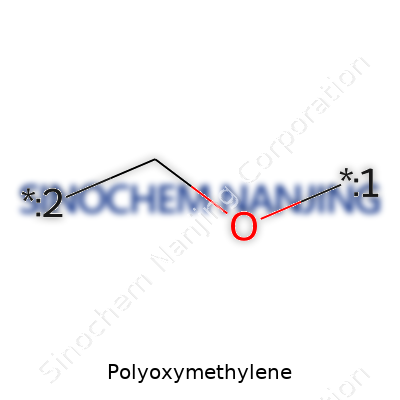
| Names | |
| Preferred IUPAC name | poly(oxy-methylene) |
| Other names |
Acetal Polyacetal POM Polyformaldehyde Delrin Hostaform Ultraform |
| Pronunciation | /ˌpɒl.iˌɒk.si.mɪˈθiːn/ |
| Identifiers | |
| CAS Number | 9002-81-7 |
| Beilstein Reference | 1098724 |
| ChEBI | CHEBI:53255 |
| ChEMBL | CHEMBL3745655 |
| ChemSpider | 30915 |
| DrugBank | DB14027 |
| ECHA InfoCard | 100.013.292 |
| EC Number | 200-001-8 |
| Gmelin Reference | 62654 |
| KEGG | C17276 |
| MeSH | D011084 |
| PubChem CID | 72729 |
| RTECS number | SL8225000 |
| UNII | F9C2L3615X |
| UN number | UN 3279 |
| CompTox Dashboard (EPA) | DTXSID2022646 |
| Properties | |
| Chemical formula | (CH₂O)ₙ |
| Molar mass | 30.026 g/mol |
| Appearance | White granular solid |
| Odor | Odorless |
| Density | 1.41 g/cm³ |
| Solubility in water | Insoluble |
| log P | -0.6 |
| Vapor pressure | Negligible |
| Magnetic susceptibility (χ) | −10.2×10⁻⁶ |
| Refractive index (nD) | 1.48 |
| Viscosity | 1.0–2.0 Pa·s |
| Dipole moment | 2.10 D |
| Thermochemistry | |
| Std molar entropy (S⦵298) | 217 J·mol⁻¹·K⁻¹ |
| Std enthalpy of formation (ΔfH⦵298) | -117 kJ/mol |
| Std enthalpy of combustion (ΔcH⦵298) | -761.1 kJ/mol |
| Pharmacology | |
| ATC code | V09AX14 |
| Hazards | |
| GHS labelling | GHS02, GHS07 |
| Pictograms | Pictograms": "GHS07 |
| Signal word | Warning |
| Hazard statements | H315, H317, H319, H335 |
| Precautionary statements | P210, P261, P280, P304+P340, P312, P370+P378 |
| NFPA 704 (fire diamond) | 2-1-0 |
| Flash point | 300 °C |
| Autoignition temperature | 440 °C |
| Explosive limits | 7–19% |
| Lethal dose or concentration | LD50 Oral Rat: 800 mg/kg |
| LD50 (median dose) | LD50 (median dose): > 800 mg/kg (rat, oral) |
| NIOSH | RT087 |
| PEL (Permissible) | 50 ppm |
| REL (Recommended) | REL: 5 mg/m³ |
| IDLH (Immediate danger) | 100 mg/m3 |
| Related compounds | |
| Related compounds |
Polyacetal Polytetrafluoroethylene Polyethylene Polypropylene Polycarbonate |



