Nonane: Beyond the Lab Bench
Historical Development
Nonane doesn’t jump off the page. In the world of chemistry, you’ll rarely see headlines dedicated to this nine-carbon alkane. Still, stories about scientific progress usually thread through the quiet workhorses as much as the headline makers. Nonane was first isolated in the 19th century, at a time when standard laboratory practices included distillation and fractional separation of crude oil. Since the very first separation columns started bubbling over, nonane became a bookmark between lighter fuels and heavier fractions, settling right in the gasoline range. Its early identification played a part in the rise of petrochemical industries, which relied on careful cataloging of hydrocarbons to unlock more efficient fuels and lubricants. Watching the chemical industry use nonane for calibration and as a reference in refining tells you the history isn’t just about extraction, but about learning to slice nature into useful pieces.
Product Overview
Nonane rarely takes the spotlight in nightly news or even in specialty chemical trade magazines. In truth, it mostly travels under the radar, found in the bulk chemical catalogs and quietly balancing chromatography columns. Chemists rarely give it a second thought except when they need an inert hydrocarbon or a boiling point reference. Still, every time someone checks a gas mixture or tunes a refinery stream, nonane moves in and does its job. This chemical shows up in research labs, in industrial settings, and even as a trace ingredient in fragrances, where it helps carry volatile scents. It doesn’t burn with a dramatic flame nor glow under UV lights, but it’s a solid backbone for processes that help keep the industrial engine running.
Physical and Chemical Properties
Take a bottle of nonane and you’ll find a clear, colorless liquid, a visual twin to many other straight-chain alkanes. You could pour it out, and unless your nose is sharp, you might miss the faint gasoline-like odor it gives off. Nonane boils at around 151°C, melting at −54°C, and nothing about it suggests drama or volatility — it’s as close to neutral as you get, which is what makes it valuable. Chemically, it doesn’t put up much resistance to most reagents at room temperature. Want to set it alight? It’ll catch, and you’ll see a characteristic luminous flame, but outside of those conditions, it prefers silence. Its hydrophobic nature means it slips right past water with barely a stir, so it’s used to check how substances interact with nonpolar solvents.
Technical Specifications and Labeling
Walk down the aisle of a chemical storeroom, and you’ll see nonane labeled with its distinct CAS registry number, maybe next to a purity percentage or assay verification. Most labs source it at high purity, since a stray impurity can throw off chromatographic measurements that use it as a reference. Labels warn clearly about its flammability and store it away from sources of ignition. Safety data sheets keep the details up front so the workers don’t find themselves in avoidable trouble. Researchers who work with it get used to the faint smell but don’t forget the flashpoint, since safety matters every day, not just in dramatic incidents.
Preparation Method
Nobody pulls nonane from thin air. In the real world, most commercial nonane comes out of petroleum, through fractional distillation. Refineries draw it out from crude oil, relying on its boiling point to separate it from lighter and heavier cousins. Lab preparations are rare, but chemists have stitched it together through catalytic hydrogenation of nonenes or by Wurtz coupling, mashing together shorter chains with a little sodium magic. But hand on heart, hardly anyone makes it that way outside a classroom demonstration now, since the whole process is overkill with so much refined nonane pouring out of oil distillation columns every day.
Chemical Reactions and Modifications
Set nonane in a flask, and it’ll pretty much stay out of the way. Only with enough heat, a spark, or the right catalyst will it start to react. Crack it under high temperature, and the chain splits into smaller alkanes and alkenes — that’s the fingerprint of the petrochemical industry’s constant tinkering to get just the right mix for fuels or feedstocks. Nonane burns in oxygen-rich air, giving carbon dioxide and water, the old friends of hydrocarbon combustion. Swap out a hydrogen or two in the lab under the right trick, and you’ll have halogenated derivatives, useful when you need a stepping stone to something more reactive. Each reaction opens doors to other chemicals traded in larger volumes and higher values, but nonane typically stands as a baseline or reference.
Synonyms and Product Names
Pick up a bottle and it might read “n-Nonane,” “normal-nonane,” or just “Nonane.” On the international circuit, IUPAC locks it down as nonane, but chemists sometimes call it “C9H20” in shorthand, especially if they want to skip lengthy labels. These names all point to the same straight, nine-carbon chain, easily distinguished from branched isomers like 2,2,5-trimethylhexane, which veer off in structure but not in formula. The clarity in naming helps avoid confusion, since many of nonane’s roles depend on tight identification for calibration and testing.
Safety and Operational Standards
Nobody should let the “inert” label lull them into sloppiness. Like most medium chain alkanes, nonane brings real fire risk. Leaking vapors can reach ignition sources, and its flames travel fast once lit. Occupational standards lay out exposure limits, and professionals know to work with proper ventilation and keep open flames somewhere else. Gloves protect against skin contact not because nonane is acutely toxic, but because repeated exposure dries out the skin, especially in busy labs or refineries where splashes sneak up. The EPA and workplaces rely on clear labeling, proper storage in cool, secure places, and training that treats “common” chemicals with respect.
Application Area
Most would be surprised just how many places nonane turns up. The chromatography world counts on it as a calibration standard for retention times. Refineries measure its percentage in fuel blends for fine-tuning gasoline volatility, blending stoic chemistry with dollar-driven decisions. In fragrances and flavorings, diluted nonane acts as a stable carrier, because it doesn’t clash with precious aromatic molecules. Sometimes it gets drafted into extraction work, pulling out oils from plant matrices in food or pharmaceutical development, simply because it behaves and keeps contaminants to a minimum. Industrial processes look for cheap, reliable solvents, and nonane earns its keep without fuss or flare.
Research and Development
For the research-minded, nonane offers more than meets the eye. Environmental scientists study how nonane and its cousins move through soil, influencing our understanding of contamination and clean-up work. Energy researchers use it as a model molecule, testing catalysts and combustion mechanisms in engines striving for lower emissions and higher efficiency. In academic circles, it stands as a test subject for physical chemistry classes, helping new generations pin down properties like vapor pressure and enthalpy, not just as numbers to memorize, but as real, measurable data. Ongoing research looks at how nonane behaves in novel solvent systems, in microfluidics, and even as a probe for understanding nanoscale interactions in confined spaces.
Toxicity Research
Nonane’s impact on health often comes down to chronic exposure more than immediate hazard. Animal studies show that inhaling high levels can depress the nervous system, with dizziness and lack of coordination marking early warning signs. Workers in petrochemical industries must keep to regulated airborne levels, avoiding the more insidious effect of long-term skin or eye irritation. Environmental scientists also dig deep into the impact of nonane leaks or spills, tracing its spread in groundwater and soil. Ecotoxicity research continues, especially as more attention falls on overlooked pollutants — most findings place nonane as less persistent than heavy aromatics, but the drive to quantify and minimize impact picks up steam with tighter environmental rules.
Future Prospects
Nonane won’t headline splashy tech news, but its future still matters in subtle but real ways. The move to greener fuels, stricter emission rules, and the rise of bio-based feedstocks challenge the petrochemical status quo, but industries still keep an eye on every molecule in the chain. Upstream research keeps looking at nonane as a model for reaction kinetics in alternative fuel designs. Cleaner separation and recycling methods offer the chance to repurpose refinery byproducts, where nonane often emerges. In academic circles, it stays relevant as a teaching tool for the next generation of chemists who’ll move past hydrocarbons, but never forget them. Whether or not synthetic chemistry pivots to greener solvents, nonane plays a quiet but steady role, tracing the line from past petroleum dependence to whatever comes next.
What is Nonane used for?
Nonane: More Than Just Another Hydrocarbon
Nonane sounds like something you’d read about in a dense chemistry textbook, but it actually plays a role in some everyday products and essential industrial processes. At its core, nonane is an organic compound made up of nine carbon atoms bonded to hydrogen. You’ll find this hydrocarbon in crude oil, gasoline, and even in specialty solvents. The world doesn’t often talk about the smaller parts making up the things we use, but nonane is a backbone for a lot of chemical jobs that aren’t flashy, just necessary.
Nonane in Fuels: The Workhorse of Combustion
Gasoline isn’t a single substance. It’s a blend of many hydrocarbons put together to get the right energy content and behavior in engines. Nonane provides stability and a cleaner burn in fuel mixes. Having grown up working in a family-run auto shop, I saw firsthand how engines performed better when engineers tuned their fuel blends. Nonane contributes to gasoline’s ability to withstand high temperatures without pre-ignition. This means engines run smoother and last longer. Major gasoline suppliers include nonane in their blending recipes for both regular and premium grades. In fact, refining companies regularly use nonane as a benchmark when testing how fuel resists knocking—a real-world issue that causes wear and reduces fuel efficiency.
Nonane as a Laboratory Solvent
Many research labs turn to nonane for its ability to dissolve oils, fats, and resins. Its chemical properties make it a valuable solvent without bringing much toxicity or dangerous reactivity. Chemists need reliable solvents—ones that won’t introduce unwanted reactions or leave residues difficult to remove. Nonane steps in during analytical work, especially gas chromatography, to separate compounds cleanly. My first job at a chemical supplier showed me how lab technicians count on pure nonane for calibrating their equipment. It’s not glamorous, but getting accurate readings sometimes comes down to choosing the right solvent for the job. Safety protocols outline everything, as nonane vapors are flammable, so proper storage and ventilation matter as much as the compound itself.
Industrial and Consumer Products
Certain cleaning agents, adhesives, and even paints call for hydrocarbons that evaporate slowly and mix well with oils or waxes. Nonane fits that bill. Manufacturers use it as a carrier fluid or to boost drying times, avoiding harsher chemicals. I’ve witnessed how companies producing stain removers and specialty lubricants lean on nonane for its gentle action on surfaces, cutting through grime or grease without breaking down plastics or rubber. Choosing a solvent means balancing effectiveness with health and environmental impact. Nonane isn’t the most toxic out there, but strict workplace guidelines help reduce exposure just the same.
Thinking About Safer and Greener Alternatives
There’s always room for improvement, and the conversation around nonane’s impact grows louder every year. Scientists look at ways to recycle or minimize emissions where nonane gets used. Companies invest in containment systems and air monitoring so workers stay safe. Across Europe and the US, regulatory bodies monitor hydrocarbon usage to limit volatile organic compounds (VOCs) escaping into the environment. More chemists and engineers put their heads together to design new molecules with less impact but the same performance. The shift will take years, but each incremental step helps. My own experience tells me real progress happens when people on the ground work together with policy makers, not against them. It takes teamwork and a willingness to adapt.
Is Nonane hazardous to health?
Understanding Nonane’s Role in Daily Life
Nonane flies under the radar for most people. You probably won’t see it on a cleaning bottle at the store, and it doesn’t show up in flashy headlines. Still, nonane pops up as a component in gasoline. Oil refining plants separate it out for its predictable boiling point, which makes it helpful in octane research and industrial uses.
What Happens After Exposure?
Walking into a room where nonane is present, you’d catch a faint smell that reminds you of petrol. Breathing in high amounts can leave you feeling dizzy, a bit light-headed, or even nauseated. Irritation to the throat, nose, and lungs is common at higher concentrations. If someone swallows it by accident, the chemical can slip down the wrong pipe and get into the lungs, raising the risk for serious pneumonia.
Beyond moments of exposure, workers at fuel storage terminals or refineries run into higher levels than average folks. Some studies looking at hydrocarbon exposure in these settings describe headaches, tiredness, and a general ‘off’ feeling after a day around these chemicals. While nonane is far from the most hazardous in its chemical family, data doesn’t clear it from suspicion in long-term settings. A 2020 review from the Journal of Occupational Medicine pointed out that long-chain hydrocarbons like nonane can build up in tissues after years of regular contact. Animal research has linked repeat exposure to liver and kidney changes, though real-life evidence in people remains murky.
Fire Risk Can’t Be Ignored
One thing about nonane sticks out: it catches fire easily. People who’ve worked in fuel depots or shipping yards know how fast vapors from materials like nonane can spread in a confined space. Inhaling those vapors in an enclosed truck or tank can be much more dangerous than what most people would face at a gas station pump. Sparks from static electricity or a dropped tool could spell disaster. Firefighters treat tanks and barrels of nonane with a lot of respect for exactly this reason. The takeaway: this is not a chemical you want loose anywhere fire safety isn’t tight.
Everyday Exposure isn’t a Major Worry
Most people outside the oil business don’t need to wring their hands about nonane. You won’t find it in household products or on grocery shelves. Trace amounts in urban air result from traffic and industrial activity, but air monitoring reports from U.S. environmental agencies keep these levels below anything linked to public health problems. In my city, air quality sensors sometimes pick up hydrocarbons near highways, but nonane numbers stay well below action levels. That aligns with the risk data from health authorities—the occasional whiff isn’t cause for alarm.
Better Work Practices Make a Difference
For workers up close, strong ventilation, respirators, and regular health tracking help lower the risks. I’ve talked to refinery employees who see training as their best protection—knowing what you’re handling always beats guessing. Updated safety protocols and personal monitoring badges have made a world of difference since the days when folks worked barehanded around open chemical drums.
Room for Smarter Substitutes and Regulation
Technology could reduce reliance on chemicals like nonane in fuel testing. Research teams keep hunting for substitutes for petroleum-based solvents. In policy, pushing for stricter air monitoring near storage and distribution sites can catch problems early. Companies that support a transparent record of exposures build trust, and these efforts send the message that public health matters as much as profit margins.
What are the physical and chemical properties of Nonane?
Physical Profile Roots the Story
Nonane falls into the group of alkanes, with nine carbon atoms in every molecule. You find it as a colorless liquid at room temperature, carrying a light, almost gasoline-like odor. Its boiling point sits around 151°C, higher than familiar hydrocarbons like octane or hexane. Nonane’s melting point is on the lower side, settling near −54°C, so it stays liquid in most environments workers and drivers encounter. At the same time, it’s not as heavy as motor oils, but heavier than stuff like propane. If you spill some, you’ll notice it floats on water due to its lower density—typical for carbons arranged in straight chains.
Nonane doesn’t mix with water at all. Instead, it dissolves easily in organic solvents such as ether and chloroform. Handling nonane, I’ve noticed its volatility: leave it open and it starts to evaporate, though not as fast as gasoline. This property helps in fuel research and gives insight into why nonane features in discussions about diesel blends, standards, or even reference fuels for engine testing.
Chemical Character Paves the Way for Uses and Concerns
On the chemical side, nonane shows what you might call textbook alkane behavior. It doesn’t react quickly with acids or bases, nor does it jump into chemical reactions under mild conditions. It burns cleanly, giving off carbon dioxide and water if you light it, which links to its regular spots in energy and transport sectors. But burning alkanes like this can add to air pollution when not managed well.
The molecule’s straight chain property means it’s part of the n-alkane group. This changes only when you reshape the carbon backbone—branching shifts the boiling point lower, which is why engineers care about structure. In the chemical refinery field, nonane helps set performance benchmarks for fuels. Its simplicity also makes it a good candidate for control experiments in labs, or for calibration work in gas chromatography.
Real-World Impact
The properties of nonane reach beyond textbooks. In my time in a lab, measuring flash points mattered hugely—nonane has one around 31°C. Flammable liquids require careful storage. Safety training always brings these flash point numbers front and center, and nonane never strays into the background during those talks. Whether moving tanks at a fuel depot or working on solvents, this awareness prevents mishaps.
Nonane’s physical properties—low viscosity, high boiling point, clear liquid form—make it a good solvent in industrial applications. It can help dissolve oils, waxes, and greases, earning its spot in cleaning agents, extraction processes, and even spot tests for oil standards. Still, the chemical’s stability means spills can linger before breakdown. If left unchecked, it can affect soil or water environments, similar to other petroleum products. Regular monitoring in workspaces and around refineries helps reduce risks of accidental release.
Tighter regulations and more accurate leak detection systems have chipped away at nonane-related hazards. Research in greener solvents now challenges its role, nudging industries toward lower-impact options. Even so, the baseline properties of nonane ground it as a reference point in studies and daily fuel blending. Understanding and managing its profile will keep it relevant in quality control and safety circles for years yet.
How should Nonane be stored and handled?
Nonane in the Real World
Nonane doesn’t show up in most home workshops, but it plays a quiet role in chemical labs and industry. As a colorless, flammable liquid with a faint gasoline-like smell, it often pops up in fuels, research, or as a solvent. Its low flash point and steady evaporation rate call for careful attention—ignoring the basics here never pays off.
Risks Pile Up with Carelessness
Anyone who has worked in a lab will tell you: a misplaced bottle or sloppy habit can set the stage for a big problem. Nonane vapors form flammable mixtures with air, and a simple spark can trigger a serious fire. It’s easy to remember a story or two—colleagues who forgot about old containers near a heat source or unplugged fridges and watched safety get stretched thin.
Staying Safe with Sturdy Storage
A metal safety cabinet marked for flammables makes the best home for any supply of nonane. Forget about open shelves or regular closets. I’ve seen situations where folks try to sidestep these basic rules, only to regret it when the safety inspector shows up. Always keep containers tightly sealed and clearly labeled. Overflow bottles or sticky residues just make cleanup harder and risks higher.
Never stick nonane in your standard office fridge. Specialized explosion-proof refrigerators exist for a reason. Vapors tend to gather, and one loose spark behind a compressor does the rest. Grounding all storage equipment prevents static; grounding slips often cause the kind of scare we all want to avoid.
Ventilation Keeps the Air Clear
Any area meant for handling nonane should have solid ventilation. It goes beyond simply cracking a window. I’ve worked in labs where strong fume hoods kept headaches and dizziness at bay, even after hours with solvents. A well-maintained exhaust system does the job—no one likes getting hit with that “solvent smell” in poorly circulated rooms. Good airflow also saves everyone from higher exposure or lingering contamination.
Every Step in Handling Counts
Personal experience shows that getting too comfortable with flammables leads to trouble. Always wear the right gloves, goggles, and lab coat—neoprene offers better protection from spills than cheaper options. Don’t assume a quick transfer will be spill-free. Real stories involve more small splashes and accidental drips than anyone wants to admit. Every surface deserves wipe-downs after use, using materials that don’t spark or catch fire easily.
Mixing nonane with incompatible chemicals invites reactions or toxic byproducts. Water won’t help in a fire; foam or dry powder extinguishers work better. Good training and regular refreshers matter—a quick walkthrough of safety steps before a busy shift can make a big difference.
A Culture Shift Toward Respect and Awareness
Storing and handling nonane safely doesn’t take heroics, just solid habits. Learn from those who came before—ask questions, follow rules, and be that person who checks twice. Share stories, even the embarrassing ones. Push for better signage, well-stocked emergency kits, and regular fire drills. The payoff comes in workdays that finish safely and uneventfully. In the end, protecting health, property, and time always trumps shortcuts.
Is Nonane soluble in water?
Understanding Nonane’s Nature
Nonane, with its chain of nine carbon atoms, lands in the family of alkanes. Chemically, its formula is C9H20. Most folks don’t bump into nonane at the hardware store, so it tends to go under the radar. It comes from crude oil refining and can be found in gasoline blends. When folks in the lab talk about nonane, they point out that it looks like a clear, oily liquid. Unlike water, it has no scent that jumps out right away.
Oil and Water: The Immiscibility Tale
Drop nonane in water, and the two float apart like strangers at a party. The reason comes down to chemistry: water molecules stick together through hydrogen bonds. That’s what keeps raindrops clinging to your window and puddles pooling on the sidewalk. Nonane doesn’t have this sticky property. It’s nonpolar, which means its electrons hang around in balance on both ends of its molecule. Water is polar—one side tugs more on the electrons, giving it a weak charge. This polarity difference means water and nonane push each other away, not mix together.
Why Some Liquids Do—and Some Don’t—Mix
People often hear the phrase, “Like dissolves like.” Water and salt blend because their molecules carry charges that attract. Oil and vinegar separate for the same reason that nonane and water can’t get along. This isn’t just a chemistry lesson for the classroom. At home, this plays out every time someone shakes a salad dressing and watches layers separate once the shaking stops.
Why It Matters Outside the Lab
Nonane’s lack of solubility in water comes up in environmental safety and industrial processes. Gasoline spills often contain nonane or its chemical cousins. Because nonane won’t mix with water, oil slicks form on lakes or rivers after a spill. The nonane floats on the surface, creating risks for animals, plants, and anyone relying on that water. Experience handling cleanup shows that mixing detergents or dispersants can break up oil. Yet only specialized chemicals can get nonane to dissolve.
Making Good Choices in Industry and Cleanup
Industry can’t simply let oily waste trickle down the drain. Waste streams must be separated and filtered, often through absorbent materials that attract oil but ignore water. Workers on cleanup crews have learned to tackle oily slicks with booms, skimmers, and absorbent pads. Removing nonane before it reaches drinking water or wildlife means knowing about its refusal to mix. Regulations from agencies like the EPA set penalties for ignoring these risks. Companies have to meet legal benchmarks to avoid fines and environmental damage.
Looking for Chemical Solutions
Researchers have spent years searching for “green” solutions to mix oil and water. Emulsifiers and surfactants—molecules that have a foot in both camps—can split an oil slick into tiny droplets and help them stay suspended in water. These tools are now used in firefighting foam, some industrial cleaners, and even things like mayonnaise. Testing new surfactants happens with nonane, because of its stubbornness to dissolve. Finding options that break down naturally, instead of lasting in soil and water, keeps scientists busy.
Practical Lessons from the Nonane Story
Nonane’s relationship with water gives a clear reminder that chemical behavior shapes real-world outcomes. Dumping something as simple as a household solvent or gasoline can lead to long-lasting problems. Paying attention to how chemicals behave—long before an accident happens—sets the stage for safer communities and cleaner environments. Knowledge gained in the lab turns into industry standards, government regulations, and practical advice that matters when accidents happen.
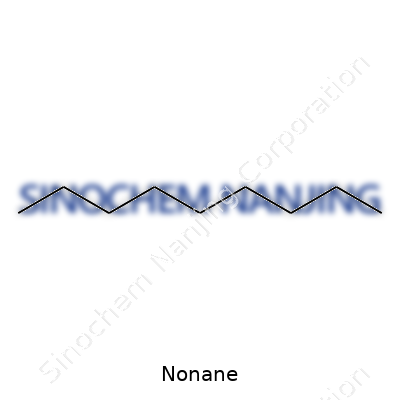

| Names | |
| Preferred IUPAC name | nonane |
| Other names |
N-nonane Shellsol 140 Nonyl hydride |
| Pronunciation | /ˈnəʊneɪn/ |
| Identifiers | |
| CAS Number | 111-84-2 |
| Beilstein Reference | 1721617 |
| ChEBI | CHEBI:35796 |
| ChEMBL | CHEMBL140260 |
| ChemSpider | 6928 |
| DrugBank | DB03183 |
| ECHA InfoCard | 100.001.242 |
| EC Number | 203-913-4 |
| Gmelin Reference | 785 |
| KEGG | C00724 |
| MeSH | D009645 |
| PubChem CID | 8900 |
| RTECS number | BA2975000 |
| UNII | C3646EMT54 |
| UN number | UN1920 |
| Properties | |
| Chemical formula | C9H20 |
| Molar mass | 128.26 g/mol |
| Appearance | Colorless liquid |
| Odor | Gasoline-like |
| Density | 0.718 g/cm³ |
| Solubility in water | 0.0095 g/L (20 °C) |
| log P | 5.98 |
| Vapor pressure | 1.47 kPa (at 25 °C) |
| Acidity (pKa) | ~50 |
| Basicity (pKb) | > 20 |
| Magnetic susceptibility (χ) | -7.62×10⁻⁶ |
| Refractive index (nD) | 1.387 |
| Viscosity | 0.923 mPa·s |
| Dipole moment | 0.00 D |
| Thermochemistry | |
| Std molar entropy (S⦵298) | 249.7 J·mol⁻¹·K⁻¹ |
| Std enthalpy of formation (ΔfH⦵298) | -224.4 kJ/mol |
| Std enthalpy of combustion (ΔcH⦵298) | -6135.0 kJ/mol |
| Pharmacology | |
| ATC code | V03AW22 |
| Hazards | |
| GHS labelling | GHS02, GHS07 |
| Pictograms | GHS02, GHS07, GHS08 |
| Signal word | Danger |
| Hazard statements | H226, H304, H336, H411 |
| Precautionary statements | P210, P233, P240, P241, P242, P243, P261, P273, P301+P310, P303+P361+P353, P304+P340, P331, P370+P378, P403+P235, P405, P501 |
| NFPA 704 (fire diamond) | 1-2-0 |
| Flash point | 96.0 °C |
| Autoignition temperature | 220 °C (428 °F; 493 K) |
| Explosive limits | 1.8 - 5.6 % |
| Lethal dose or concentration | LD50 oral rat 3200 mg/kg |
| LD50 (median dose) | LD50 (median dose): Oral-rat 3200 mg/kg |
| NIOSH | UNUN1309 |
| PEL (Permissible) | 200 ppm |
| REL (Recommended) | 85 ppm |
| IDLH (Immediate danger) | 900 ppm |



