N,N-Diethyl-1,3-Propanediamine: Commentary on an Industrial Essential
Historical Traces and Growth
Chemistry likes to surprise. N,N-Diethyl-1,3-Propanediamine started off decades ago as little more than a niche lab curiosity. Once researchers mapped out its twin nitrogen atoms and those stretched-out three carbons, industry began to notice. A reliable route through nucleophilic substitution—ethanolamine derivatives, for the chemistry buffs—gave chemical manufacturers a cheap, practical way to make this molecule in bulk. Some early uses looked pretty rough around the edges compared to what goes on today. The stuff turned up in early efforts to make water-softening agents, quaternary ammonium compounds, and even specialty resins. I’ve seen papers from chemical journals of the 1960s and ’70s showing how research teams used it as a stepping stone to more complicated molecules. As better process controls, higher-purity batch production, and nation-by-nation standards came online during the 1990s, more folks realized this building block brought flexibility to a lab or plant that few other diamines could match.
Glimpses of the Compound
N,N-Diethyl-1,3-Propanediamine looks pretty unassuming—a clear liquid with a faint fishy odor if you open the cap in a still room. Density sits a little lower than water. This stuff loves to grab water from the air if left uncapped too long, so anyone who’s ever worked with it learns fast about good bottle habits. Boiling point runs above most ordinary solvents—think right around the 200-degree Celsius range, which is quite handy in plenty of distillation and cleaning applications. It’s soluble in water, though it mixes with organic solvents just as well. A solid choice in many organic syntheses. Most labs keep it in brown glass or sealed drums, labeled for amine content and flammability, not just out of habit but because this base’s vapor can sting your nose before you realize you’ve gone nose-blind to it.
Preparation and Production Experience
In my years working with small- to mid-scale chemical plants, preparation boiled down to two clear choices: either alkylate a lower amine directly with a dihaloalkane like 1,3-dibromopropane, or start from diethylamine and stretch the chain. Batch reactors with glass lining make cleanup less of a headache. Over-alkylation can waste raw material and create byproducts, so temperature and addition rates become everything. Purifying the finished product, distilling off the main fraction, and scrubbing for color and odor all take hands-on care. Unreacted bits can cause corrosion or off-odors if you’re not careful. Most batches pass through a quality check for amine content, water, color, and occasionally trace metals.
Chemical Personality and Transformations
This is a molecule that wears two hats—both as a nucleophile and a base. I’ve seen how it can snatch up alkyl halides, pop open epoxides, or act as a chelating ligand in metal-organic syntheses. Modifications happen all the time to decorate it with sulfonic acids, quats, or extra carbon chains. That’s not just bench-top play; big-volume, specialty surfactants trace their backbone to diamines like this. On the flip side, the two amines are pretty exposed, so oxidation happens fast if you leave a container open, especially in a humid warehouse or storeroom. I’ve mixed it for resin cross-linking, where a simple change in stirring speed can tweak results for hours.
Labeling and Technical Details That Matter in Practice
Labeling practice has shifted over the years. Most suppliers list it as "N,N-Diethyl-1,3-Propanediamine" but don’t flinch if you hear “DEPA” in the field, or even “diethylpropanediamine” from old-timers. Look for it as CAS 104-78-9 in chemical inventories. Shipping labels display hazard diamonds—flammable liquids, toxic by inhalation or contact. Labels warn about skin and eye contact, not to be obsessive but because accidents add up fast. Many plants want a certificate of analysis attached, checking for percent purity and residual monoamine—not just a regulatory demand, but a real safety concern in high-energy environments.
Working Safely and Smartly
Operational standards have grown tighter, and for good reason. Lab experience and industrial reports both stress gloves, goggles, positive ventilation—even for small-scale benchwork. The easiest mistakes come from thinking “just this once” and letting your guard down. Regulatory bodies like OSHA and ECHA in Europe have flagged acute exposure risks, especially through inhalation and skin absorption. Over a shift, headaches and respiratory issues creep up on folks who cut corners. Local exhaust, chemical splash aprons, regular skin monitoring—they aren’t just paperwork measures. I’ve seen emergency showers and flush stations save skin from minor mishaps more than once. Disposing of this amine demands trained waste handlers. It doesn’t break down in the open air fast, so mishandling means possible groundwater or soil contamination.
Shifting Uses and Expanding Roles
If you look at industrial catalogs or regulatory filings from the last decade, N,N-Diethyl-1,3-Propanediamine pops up everywhere—in water treatment, textile manufacturing, corrosion inhibitors, and lately, in some specialty pharmaceutical syntheses. Its physical flexibility—staying liquid under reasonable storage—makes it a favorite for making new quaternary ammonium salts. Surface-active agents get a boost from this amine’s straightforward reactivity. Some epoxy resins, especially ones needing tailored flexibility or resilience, draw on its chain structure. Paint technologies lean on it for crosslinking; water purification relies on it for chelation and softening. The testing and modification never seem to slow down. Even battery research teams eye it for use in organic electrolytes—a field that wasn’t even imagined back when textbooks first mentioned this molecule.
New Research, Old Questions
Innovation never stops, and neither does the search for new, safer, or greener applications. Studies from North American and European universities keep looking for less hazardous synthetic routes, and for better ways to minimize waste. Some labs try biocatalysis, hoping to outpace the old petrochemical approaches. Toxicity data from animal and cell studies show moderate acute exposure risks—irritation, temporary CNS effects—but practically, repeated exposure in rat models highlights liver and kidney stress. Ecotoxicity trends warn that careless disposal causes aquatic damage. There’s an ongoing need for updated chronic exposure data; most tests lag behind industrial adoption by a few years, meaning regulatory updates often play catch-up. Responsible manufacturers participate in ongoing monitoring, reporting unanticipated effects or supply chain incidents.
Looking Down the Line
Production of N,N-Diethyl-1,3-Propanediamine won’t disappear any time soon. The world’s appetite for fine chemicals, chain extenders, and functional amines shows no sign of dropping off. New green chemistry initiatives might lower the footprint of its synthesis and use—a promising thing for people who worry about downstream waste and emissions. Pushing for lower-toxicity, renewable feedstock approaches makes sense, both for worker safety and environmental protection. There’s talk in industrial circles about closed-loop recycling to reclaim even trace residues from process streams—something that gives older chemical plants a chance to retool for the future. Public understanding, especially among new chemists and factory hands, needs to match the speed of process change. Transparent labeling, regular safety audits, and open data-sharing encourage good habits, not just to meet rules, but to build the kind of industry that someone can be proud to hand off to the next chemist in line.
What is N,N-Diethyl-1,3-Propanediamine used for?
Spotlight on Industrial Chemistry
N,N-Diethyl-1,3-propanediamine pops up in more places than most people would guess. I first came across it during my university days, in a lab surrounded by the persistent smell of amines. The stuff carries that distinct whiff, but its true value comes out in what it helps create—rather than how it smells.
Building Block for Everyday Products
This compound works as a raw material in chemical synthesis, letting companies build bigger, more complex molecules. Surfactants, for example, rely on it. These cleaning agents make up most household detergents because they break down grease and oil. The demand for efficient, skin-friendly cleaners keeps growing, and that demand drives continued research into compounds like this one. People care about cleaner homes and safe products, though few ever hear of the chemicals doing the heavy lifting.
Polyurethane and Its Many Faces
If you’ve ever leaned against foam in a chair or used insulation panels in home repairs, then you’ve crossed paths with polyurethane. N,N-Diethyl-1,3-propanediamine acts as a catalyst in polyurethane manufacturing. It speeds up reactions and helps control the foam’s texture—sofas, mattresses, and insulation owe some of their comfort to its presence. Without it, these goods would be pricier or perform poorly. This isn’t just industry talk. I once helped move house for a friend whose sofa had totally collapsed after just two years. Cheap materials and poorly made foam can give products a bad name, so chemistry like this pays off for everyone sitting on the couch.
Water Treatment and Clean Air
Industries dealing with wastewater depend on certain chemicals to keep their output safe. Here, N,N-Diethyl-1,3-propanediamine gets used to remove contaminants, as part of specialized water treatment formulas. Some factories and power plants even use it in gas scrubbing—the process that strips out unwanted compounds before air leaves their stacks. Air quality around these plants improves with tighter controls and better chemistry. These steps make a difference you can feel, especially in crowded urban spaces where pollution affects health.
Pharmaceutical Exploration
While it doesn’t go into pills directly, this compound sees use in research labs while scientists chase new medicines. Certain ingredients call for amine groups, and this one provides those during the synthesis stage. Drug discovery often needs hundreds of steps, so every reliable building block matters for speed and safety. While the pharma side tends to stick with more specialized amines, versatility counts for a lot.
Quality, Regulation, and Responsibility
Handling N,N-Diethyl-1,3-propanediamine requires experience. Its safety guidelines aren’t just bureaucratic overkill; skin contact or inhalation carries real risks. Trained staff, proper ventilation, and good storage all matter—corners get cut, people get hurt. Regulations protect workers, but they also help keep toxic chemicals out of consumer goods. Inspections and reporting aren’t glamorous, yet they’re a safeguard everyone depends on.
Pushing for Greener Chemistry
There’s a push coming from both inside and outside the chemical industry to develop safer, greener alternatives. I’ve seen companies invest in new processes that cut waste and reduce toxicity. Some smaller startups even explore biobased amines to replace traditional raw materials. Progress won’t happen overnight, though. Building on what already works, while pushing for cleaner options, keeps standards high without raising prices for the average person.
What is the chemical formula of N,N-Diethyl-1,3-Propanediamine?
Understanding the Structure and the Science
N,N-Diethyl-1,3-Propanediamine is more than just a mouthful for anyone reading chemical catalogs or searching through chemical supply inventories. Its chemical formula, C7H18N2, reflects its structure: a three-carbon propane backbone, with two amine groups hanging at the ends, and each nitrogen atom attached to two ethyl groups. While on paper, it looks simple, real chemistry starts with understanding these symbols and how they influence the properties and uses of the compound.
Why Knowing Chemical Formulas Matters
Chemical formulas are foundational. They do not only tell you how many carbon, hydrogen, and nitrogen atoms are in a molecule. What they really provide is a starting line for predicting reactivity, toxicity, solubility, and compatibility with other chemicals. In my own lab days, it was clear that overlooking the small details in a formula led to incorrect predictions, poor experiment outcomes, or, worse, safety issues. For anyone mixing or handling chemicals, formulas offer a roadmap to safety and purpose.
Real-World Uses and Industry Significance
In the world of organic synthesis, N,N-Diethyl-1,3-Propanediamine frequently pops up. Its formula gives it a flexibility to serve as a building block in manufacturing pharmaceuticals, surfactants, corrosion inhibitors, and even rubber chemicals. I have seen chemists rely on it for creating custom ligands that stabilize metal ions or as intermediates in the production of specialty chemicals. The way those ethyl groups change its basicity and reactivity means it does not simply behave like a basic diamine. In practice, that can make or break a reaction pathway.
Safety, Sourcing, and Sustainability
Understanding the chemical formula is a big part of addressing real-world challenges—chief among these are safety and environmental impact. N,N-Diethyl-1,3-Propanediamine, with its two amine functions, acts as a strong base and can be corrosive. Knowing the number of nitrogens helps predict its interactions with acids, its ammonia-like smell, and handling requirements. Factoring in C7H18N2 helps companies craft better material safety data sheets and train workers on how to store and use it properly.
Sourcing also gets interesting. The underlying formula opens the door for chemists to look for green synthesis routes that cut down on waste or reduce hazardous byproducts. Countless times, innovation starts with re-examining a molecule’s building blocks—finding bio-based feedstocks for those seven carbons, or greener reductants for assembling the diamine core.
Paths Forward
No one compound unlocks the future of chemistry, but each one provides lessons. With N,N-Diethyl-1,3-Propanediamine, remembering its formula helps guide safer choices, smarter research, and more sustainable manufacturing. Chemistry rewards curiosity and care, and taking time with the basics, like C7H18N2, keeps doors open for innovation and responsible progress.
Is N,N-Diethyl-1,3-Propanediamine hazardous or toxic?
Understanding What We’re Working With
N,N-Diethyl-1,3-propanediamine often turns up in the chemical industry as a building block or intermediate. Researchers and manufacturers may know it as a colorless or pale yellow liquid with a distinct ammonia odor. While the name sounds like something that belongs on a chemistry exam, real people interact with this stuff, sometimes without realizing what it could mean for their health or safety.
Hazards Faced by Workers and DIYers
Chemical data sheets point out right away that direct contact can irritate skin, eyes, or the respiratory system. I’ve spent time in labs—one splash on the arm tends to sting. Short-term exposure usually means redness or discomfort. Eyes do not handle it well; those who work with it every day stay cautious, gloves on and goggles within reach. If someone breathes in a bit too much, headaches and dizziness sometimes hit before they know what went wrong.
People storing or transporting this chemical for workplaces or school labs should realize that, in a spill, it gives off vapors that can hang around in the air. Even small leaks can lead to coughing, sore throats, or chest tightness; nobody on a cleanup crew forgets that kind of reaction. Not just the lungs—skin risk exists too. Extended exposure or poor ventilation brings more severe effects. More than a few old timers carry stories about colleagues who learned the hard way that respirators aren’t just for show.
What Science Says About Toxicity
The data available draws a pretty solid line: this isn’t a gentle chemical. According to the European Chemicals Agency, repeated or large exposures may impact the liver and kidneys. Animal studies back this up—higher concentrations caused organ changes, which tells us it pays to respect safety limits. The U.S. National Library of Medicine lists it as “harmful if swallowed or inhaled.” I remember reading hazard reports that flagged even low doses as a problem, especially if someone already deals with asthma or skin sensitivity.
By law, chemicals like this one belong under strict rules for labeling, storage, and disposal. The Occupational Safety and Health Administration (OSHA) lays out procedures—proper containment, precise labeling, emergency eyewash access, and quick spill response. It’s not overregulation or paranoia; it’s learning from past mistakes. In my own shop, we never cut corners with those steps. Accidents come quicker than most folks expect.
Reducing Hazards and Protecting People
Smart safety habits mean less risk. I’ve always found practical solutions work best. Direct ventilation, such as fume hoods, keeps vapors from building up. Solid training for everyone handling the chemical cuts down the odds of a mistake. Storing the chemical in sturdy containers, far from heat or incompatible substances, stops problems before they can start. Wearing gloves, protective clothing, and chemical splash goggles feels like a hassle until someone skips a step and lands in urgent care.
Safe disposal can’t take a back seat—down the drain is not an option. Local hazardous waste protocols do the job right. Quick access to spill kits and neutralizers makes everyone breathe easier. Managers need to set expectations, keep up with legal updates, and push for a safety-first culture across the board.
The importance of staying vigilant with chemicals like N,N-Diethyl-1,3-propanediamine isn’t just about obeying the law. It’s about valuing people’s well-being and learning from experience. Anyone who works with or near this chemical owes it to themselves and their coworkers to treat it with the caution the science demands.
How should N,N-Diethyl-1,3-Propanediamine be stored and handled?
The Reality of Working with a Chemical Like N,N-Diethyl-1,3-Propanediamine
You don’t want to underestimate the risks of handling chemical compounds. N,N-Diethyl-1,3-Propanediamine isn’t a common household name, but in many labs and industrial settings, it pops up as a useful amine. Working in a lab for years has shown me how easy it is to get casual with procedures, yet one bad move with a chemical like this can easily put someone’s health on the line or mess up an experiment you’ve spent weeks preparing. That’s not just an inconvenience—it’s a threat to safety and productivity.
Why Proper Storage Matters
Fumes, spills, and fire are real risks. This diamine carries an unpleasant odor and can become hazardous if not kept in check. Whether you’re in a research lab or on a factory floor, you really want to keep this stuff in a cool, dry spot, tucked away from direct sunlight and away from anything that sparks or ignites. Flammable liquids and chemicals that might react aggressively should stay far apart. I remember a colleague overlooking this once; a leaky cap, a hot room, and a pile of used cleaning cloths led to an after-hours fire scare. It’s a warning you don’t forget.
Ventilation: Not Just a Box to Check
If you’ve worked in a busy lab, you know ventilation keeps more than just odors at bay. Vapors from N,N-Diethyl-1,3-Propanediamine can catch in your throat and eyes, so you want to open caps and bottles only in a well-exhausted hood. It’s easy to skip this step on a rushed day, but those minor exposures add up. Over time, there’s evidence that repeated low-dose exposure to volatile amines can irritate the airways, and nobody wants persistent coughs or headaches at work.
Personal Protective Equipment Saves the Day
Rushing through work without gloves or goggles can feel tempting if you’re dealing with repetitive tasks, but the risk isn’t worth it. N,N-Diethyl-1,3-Propanediamine can burn your skin, and just a drop in your eye sends you straight to the eyewash station. I learned early in school that it only takes one accident to make PPE a daily habit. Chemical-resistant gloves, lab coats, and snug-fitting goggles belong every time you work with compounds like this.
Label Everything, Protect Everyone
One lesson you pick up quickly: clarity in labeling protects everybody, from new interns to seasoned researchers. Write clear, permanent labels on all containers. Don’t trust memory—misidentifying chemicals is behind many avoidable emergencies. Store N,N-Diethyl-1,3-Propanediamine in tightly sealed bottles made from HDPE or glass, with the right hazard warning stickers firmly attached. Double-checking saves a lot of explaining and, more importantly, keeps people safe.
Cleanup and Emergency Planning
Spills are going to happen—either through a careless pour, a cracked bottle, or a knock from an elbow. Training everyone on immediate cleanup with the right neutralizers and absorbents keeps a small accident from becoming a disaster. Knowing where you stash the spill kit and emergency shower matters. During a routine shift, I watched a spill get mopped up with just a rag—which turned out to be flammable. A fire extinguisher close at hand, plus good training, kept an incident from getting out of control.
Looking Ahead: Improving Everyday Lab Safety
Every chemical brings its own hazards. But N,N-Diethyl-1,3-Propanediamine asks for a little extra respect because of its volatility and possible health impacts. Using checklists, keeping solid records, and building a culture where workers speak up about safety makes labs and plants not just compliant, but truly secure for everyone involved.
What are the physical properties of N,N-Diethyl-1,3-Propanediamine?
Putting the Spotlight on N,N-Diethyl-1,3-Propanediamine
N,N-Diethyl-1,3-Propanediamine keeps turning up in labs and on production floors. Chemists look for its physical traits before weighing out molecules or tweaking recipes. This compound comes across as a clear, colorless to slightly yellow liquid once you have it outside its bottle. My first experience handling it made me double-glove; its vapors have a way of pricking your nose, much like a stubborn solvent does. You sense right away, this isn’t something you spill on your bench.
Boiling, Melting, and All That Jazz
Curiosity about any chemical should start with its temperature behavior. N,N-Diethyl-1,3-Propanediamine boils near 177°C—high enough that a hot summer day doesn’t pose a risk, but it’ll quickly fill a closed room with pungent fumes if left on a heated plate. Its melting point sits well below water’s freezing point; as a liquid below –50°C, it isn’t one for forming neat crystals in your freezer. These traits shape how it acts during purification, storage, and shipping. Companies shipping it overseas pack it tight, using seals that keep both liquid and vapor locked away.
Solubility and Compatibility in Everyday Use
This compound mixes easily with water, alcohols, and almost any organic solvent I have on my lab shelf. Thanks to the flexible carbon chain and the two nitrogen atoms, it slips into polar and non-polar mixtures with little fuss. These features open the door to a variety of industrial uses—from resin curing agents to specialty coatings. I’ve seen it add punch to a corrosion inhibitor blend, never flaking or separating even after months in storage.
Weight and Vapor Pressure—Implications for Safety
The density drops just below that of water, resting around 0.85 g/cm³. Leaning over an open jug, you’ll notice a strong smell, reminding you of its considerable vapor pressure. At room temperature, it doesn’t simply sit still; it wafts into the air, especially if the cap isn’t tight. For anyone working with the substance, local exhaust ventilation isn’t optional. Eye, skin, respiratory protection get a fresh meaning here, not only during use but even when cleaning spills.
Color and Clarity: More Than Just an Appearance
Pure samples look colorless, but slight yellowing creeps in if the container sits open or the chemical absorbs moisture. That yellow tinge sometimes points to breakdown products forming. I’ve learned to check for this before using leftovers from a poorly stored bottle. Even a small hint of color says something changed—maybe air snuck in, or some moisture got trapped inside.
Building Trustworthy Practices Around Basic Chemistry
Working with N,N-Diethyl-1,3-Propanediamine teaches a few practical things—never underestimate a liquid just because it looks like water, take vapor into account, and watch for any color shift. Material safety data sheets lay out the facts, but hands-on experience drives the lessons home. Good labeling, periodic checks on bottle integrity, and a habit of working in well-ventilated areas all spring from understanding its physical properties. I always double-check containers and storerooms not just out of caution, but because a quick check today keeps accidents off tomorrow’s news. These steps make the difference between safe, reliable lab work and a regrettable headline.
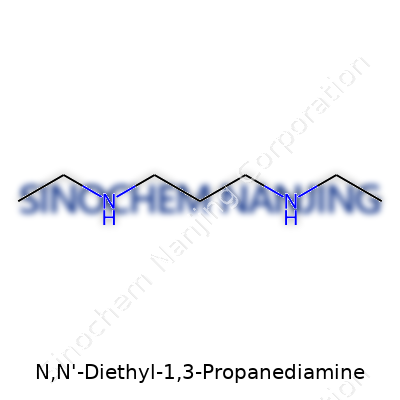
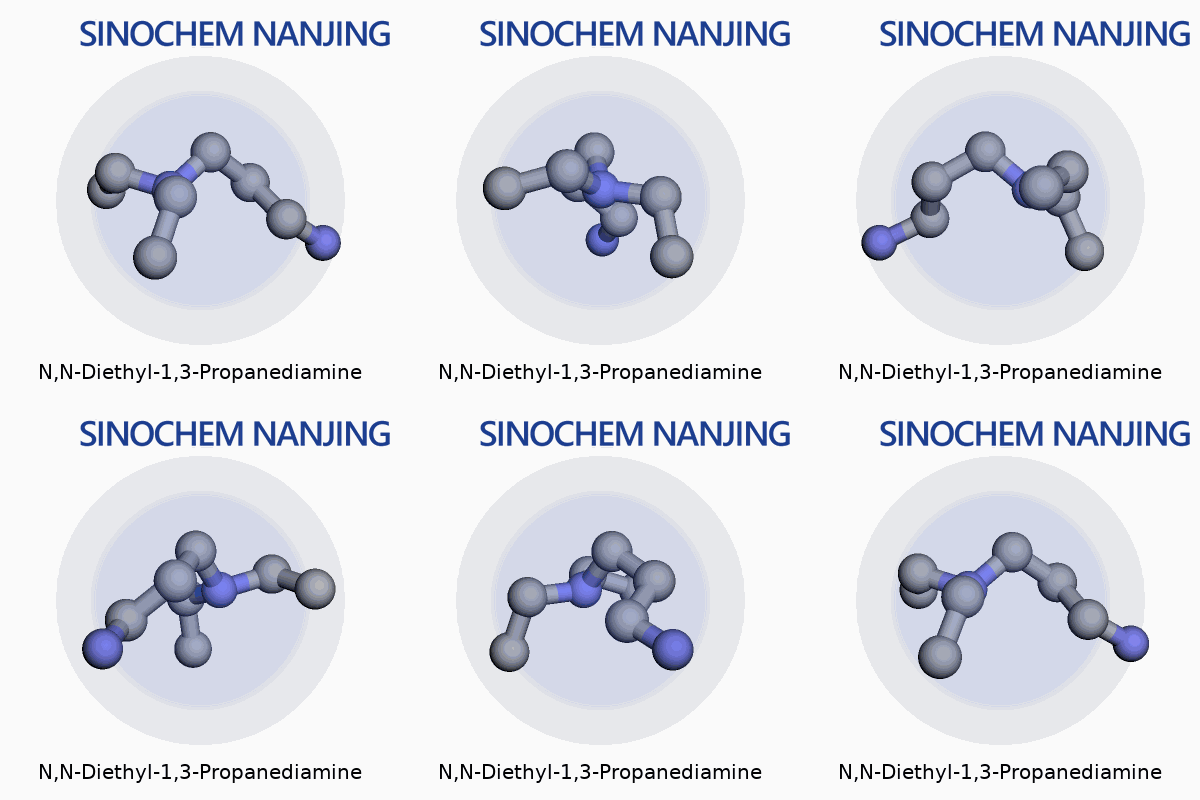
| Names | |
| Preferred IUPAC name | N,N-DiethyLpropane-1,3-diamine |
| Other names |
DETA N,N-Diethylpropane-1,3-diamine 1,3-Propanediamine, N,N-diethyl- N,N-Diethyltrimethylenediamine |
| Pronunciation | /ˌdiːˈɛθaɪl ˌwʌn θriː proʊˈpeɪndiaˌmiːn/ |
| Identifiers | |
| CAS Number | 104-78-9 |
| Beilstein Reference | 1208735 |
| ChEBI | CHEBI:35568 |
| ChEMBL | CHEMBL318396 |
| ChemSpider | 23171 |
| DrugBank | DB08808 |
| ECHA InfoCard | ECHA InfoCard: 100.003.834 |
| EC Number | 202-999-4 |
| Gmelin Reference | 7784 |
| KEGG | C18922 |
| MeSH | D017247 |
| PubChem CID | 8057 |
| RTECS number | UE2275000 |
| UNII | U55U7JH8U8 |
| UN number | UN2382 |
| CompTox Dashboard (EPA) | DTXSID9020602 |
| Properties | |
| Chemical formula | C7H18N2 |
| Molar mass | 131.23 g/mol |
| Appearance | Colorless to yellowish liquid |
| Odor | Ammonia-like |
| Density | 0.824 g/mL at 25 °C |
| Solubility in water | Soluble |
| log P | 0.06 |
| Vapor pressure | 0.8 mmHg (25 °C) |
| Acidity (pKa) | 10.94 |
| Basicity (pKb) | 4.08 |
| Magnetic susceptibility (χ) | -65.6×10⁻⁶ cm³/mol |
| Refractive index (nD) | 1.430 |
| Viscosity | 3.9 mPa·s (at 25 °C) |
| Dipole moment | 3.05 D |
| Thermochemistry | |
| Std molar entropy (S⦵298) | 302.7 J·mol⁻¹·K⁻¹ |
| Std enthalpy of combustion (ΔcH⦵298) | -4647.0 kJ/mol |
| Hazards | |
| GHS labelling | GHS02, GHS05, GHS07 |
| Pictograms | GHS02,GHS07 |
| Signal word | Warning |
| Hazard statements | Harmful if swallowed. Causes severe skin burns and eye damage. Harmful if inhaled. May cause respiratory irritation. |
| Precautionary statements | P280, P261, P305+P351+P338, P310 |
| NFPA 704 (fire diamond) | 2-3-1 |
| Flash point | 72 °C (closed cup) |
| Autoignition temperature | 315 °C (599 °F; 588 K) |
| Explosive limits | 3.2–10.8% |
| Lethal dose or concentration | LD50 oral rat 1620 mg/kg |
| LD50 (median dose) | LD50 (oral, rat): 1,785 mg/kg |
| NIOSH | SKC37900 |
| PEL (Permissible) | PEL (Permissible Exposure Limit) for N,N-Diethyl-1,3-Propanediamine: 10 ppm (40 mg/m³) |
| REL (Recommended) | 10 ppm (40 mg/m3) |
| IDLH (Immediate danger) | 75 ppm |
| Related compounds | |
| Related compounds |
N,N-Dimethyl-1,3-propanediamine N-Ethyl-1,3-propanediamine 1,3-Propanediamine N,N-Diethyl-1,3-diaminopropane N,N-Diethyl-2-propanediamine N,N-Diethyl-1,2-ethanediamine |



