N-Butylamine: Substance with a Past, Substance for the Future
The Roots: A Chemical Story Shaped by Industry
Every bottle of N-butylamine tells a story that reaches back to the early days of organic chemistry’s golden age. Chemists once spent long hours at wooden benches, seeking new compounds that could help agriculture, medicine, and later, the growing world of plastics and coatings. As one of the simpler primary alkylamines, N-butylamine—sometimes described as 1-aminobutane—stood out thanks to its manageable reactivity and its role as a building block. Its use expanded throughout the twentieth century, not because it dazzled on its own, but because it could fit into so many processes and help fill gaps in supply chains that were always in need of something adaptable.
What Sets N-Butylamine Apart
N-butylamine doesn’t try to impress with flash. Colorless and liquid, it releases a distinct, fishlike odor that makes its presence obvious in any lab or warehouse. Volatility gives it a knack for disappearing into the air if left uncovered, an issue for storage and safety that has kept warehouse managers on their toes. Its structure—a four-carbon straight chain ending in an amine group—delivers a blend of basicity and reactivity that lends itself to both synthesis and modification.
How Chemists Know It: Physical and Chemical Character
The physical form of N-butylamine stays liquid around room temperature, simplifying handling but demanding proper containment due to its tendency to evaporate. Boiling up at around 78°C means even modest heat can fill a room with its pungency, making ventilation a must. It’s soluble in water, but not as easily as the short-chain amines, and mixes freely with many organic solvents. Chemically, its amine group gives it a knack for forming salts or reacting with acylating agents, helping build everything from surfactants to pharmaceuticals. Its basic nature surfaces clearly in lab work, behaving as a nucleophile and demonstrating why primary amines matter across organic chemistry.
Labeling and Technical Specs Are More Than Paperwork
In real settings, a container’s label ensures more than just compliance. For professionals, knowing the CAS number—109-73-9 for N-butylamine—avoids confusion with the isobutyl or sec-butyl variants. Precise data on purity, water content, and stabilizers make or break downstream reactions, especially when process yields are at stake. Clear hazard codes warn about flammability and health effects, and every label provides an immediate cue for anyone moving drums or drawing samples. In labs, missed details translate into mistakes, so the technical paperwork stays as much a safety tool as a regulatory requirement.
Preparation: The Craft Behind the Commodity
Most industrial N-butylamine starts from butanol or butyronitrile, running through processes like amination or hydrogenation. These methods, especially catalytic hydrogenation of butyronitrile, reflect decades of refinement in reactor technology and catalyst science. The dance between temperature, pressure, and catalyst choice marks a ground where textbooks meet factory floors, and changes—like continuous flow systems—often ripple through the supply to research and industry customers. Chemists may note which synthetic route was used, since trace impurities can impact sensitive reactions downstream.
The Chemical Versatility: More Uses Than You’d Guess
The real value of N-butylamine shows up in its chemistry. Primary amines like this one form amides by coupling with acid derivatives, deliver stability as antioxidant precursors, or react in Mannich-type cyclizations to build rings and chains. In dyestuff manufacturing, as well as the creation of rubber processing agents, N-butylamine finds steady work. Some of the more memorable moments in my own experience involved watching an innocuous-looking flask transform after a well-timed addition of this amine, shifting colors and viscosities as new molecular scaffolds took shape. Even after so much commercial production, discoveries keep emerging in niche pharmaceuticals and specialty resins.
More Names for Familiar Territory
Anyone who’s spent real time with chemicals knows how names shift across the map. N-butylamine is sometimes labeled as 1-aminobutane, butan-1-amine, or butanamine. Old French and German catalogues show it as n-Butylamin, while some industrial circles use simple “butylamine”—though this can create confusion with its branched cousins. Jargon like N-BA pops up too, especially where shorthand rules the day.
Operational Demands: Safety Earned by Hard Lessons
Seasoned professionals never underestimate the hazards after witnessing an event like a sudden spill or an overexposed worker. N-butylamine burns easily, and its vapors can trigger headaches, nausea, or more severe health issues if inhaled in quantity. Standard practice calls for robust ventilation, proper gloves, goggles, flameproof containers, and regular air monitoring. The lessons behind safety regulations—accidents, fires, near-misses—line the memories of both industry veterans and young bench chemists. Documentation and inspections might seem tedious, but every unchecked shortcut drags risk into the workplace. Keeping up with improvements in PPE and handling gear reduces incidents and keeps teams healthier.
Where the Product Earns Its Keep
N-butylamine weaves through several industries. Agrochemicals use it as a starter for herbicides and fungicides, pharmaceutical labs depend on its role in synthesizing intermediates, and the rubber industry values its contribution to vulcanization agents. The coatings world taps its chemical flexibility for additives and accelerators. Even though buyers rarely see it in finished goods, nearly every worker handling modern lubricants, elastomers, or specialty chemicals owes something to its presence upstream.
Progress Isn’t Static: Research and Development
Ongoing work stretches the applications of N-butylamine wider each year. Academic groups test derivatives as potential pharmacological leads, spurred by the unique reactivity the primary amine provides. Green chemistry trends drive innovation toward cleaner, safer production routes and alternative feedstocks that could lessen dependence on petrochemical chains. On the scale-up side, companies assess new catalyst systems or reactor designs to cut costs, reduce energy, and boost yields. Scientific journals increasingly include data on safety profiles, reaction selectivity, and environmental compatibility—reflecting how the landscape of research points to evolving priorities.
Understanding the Risks: Toxicity and Environmental Debate
Toxicity research digs into both acute effects and long-term exposures. Early studies uncovered risks to the eyes, lungs, and skin, and more recent research seeks insight into chronic toxicity for staff exposed via inhalation or dermal absorption. Regulatory bodies such as OSHA and the European Chemicals Agency use this data to set workplace exposure limits, highlighting the importance of continuous monitoring for health effects at low doses. Wastewater streams from production present their own challenge, as amines can cause ecosystem upset if not properly treated. My experience, echoing many environmental scientists, shows the worth of investing in closed-loop systems and improved treatment protocols, both to satisfy regulators and to show real stewardship of natural resources.
The Road Ahead: Where N-Butylamine Fits in Tomorrow’s Industry
The chemical sector doesn’t stand still. N-butylamine continues to serve staple roles, but concerns about sustainability, worker safety, and tighter environmental standards spark change. Replacement or modification of amine derivatives could reduce hazards or improve performance in new formulations. The trend toward bio-based chemicals puts pressure on traditional production methods, challenging chemists and manufacturers to adapt or risk obsolescence. Advances in green chemistry and biotechnology offer alternatives that might one day supplant petroleum-based N-butylamine altogether. Yet, so long as innovation demands a flexible, reactive amine, this compound is likely to keep finding work, whether as part of legacy applications or in new, cleaner industries just coming into view.
What is N-Butylamine used for?
Everyday Chemistry Behind the Scenes
N-Butylamine pops up in more places than most people realize. It’s easy to miss the role simple molecules play in daily life, yet here it lies—essential in making things work for bigger industries and everyday needs. Growing up in a family that had roots in agriculture and basic manufacturing, I’ve come to see just how much certain chemicals shape the background of goods, even if you never see them on the label.
Why Industrial Chemistry Turns to N-Butylamine
One of the big jobs N-Butylamine tackles is as a building block for agricultural chemicals, especially in herbicides and pesticides. Farmers count on their crops staying healthy and resilient, and many key weedkillers start out in the lab with butylamine. It’s not just about fighting weeds; it’s about helping feed communities, and with so much global pressure on farms to boost yields, these chemicals fill an important gap.
Rubber production makes heavy use of butylamine too. Most people never give a second thought to how tires, hoses, and shoe soles get their bounce or durability, but chemists know the details. Butylamine reacts with other compounds to kickstart the vulcanization process, so rubber ends up with the right mix of flexibility and toughness. Riding my bike as a kid, I never guessed how much work had gone into making those tires take a beating season after season.
Helping Keep Factories Running Smoothly
Factories use N-Butylamine as a “corrosion inhibitor” in products such as cooling fluids. Rust can cripple expensive machinery, and repair bills grow fast when a part fails. By adding butylamine to water systems, machine shops and power plants get more miles out of their equipment. My uncle, an engineer, often talked about downtime eating profits—every hour spared means workers keep jobs, companies pay less for replacement parts, and prices stay fair for customers.
Pharmaceuticals and Beyond
Drug makers depend on butylamine, too. Small organic molecules like this help synthesize complex medicines. The process isn’t glamorous, but it’s necessary—N-Butylamine often assists in making ingredients for painkillers, allergy tablets, or even cancer therapies. Every step in drug creation relies on compounds working as intended; a weak link delays breakthroughs. There is comfort in knowing the molecules hold up under scrutiny since my own family has depended on access to reliable medicine.
What Are the Challenges?
Handling butylamine takes training. It’s strong-smelling, volatile, and can irritate skin or lungs. Workers need safety gear and a culture that puts health above shortcuts. Each accident avoided is a reminder—respect for chemicals matters, from the factory floor to the finished product.
Room for Improvement
Cleaner manufacturing presents a challenge and an opportunity. It’s possible to improve containment, recycling of byproducts, and monitoring for leaks. After all, efficient management saves money over time, protects communities, and comforts investors who worry about regulatory fines or PR disasters. Looking back, companies that invest in training and technology end up in a stronger spot—one spill avoided is one headline they never have to see.
Final Thoughts on Value
N-Butylamine seems unremarkable if you just read the name, but tracking its path shows how chemistry reaches into almost every part of modern life. Each step—on the farm, in the factory, or at the pharmacy—depends on tools people rarely think about, yet couldn’t go without. That’s the lesson in every bottle, drum, and shipment: unseen doesn’t mean unimportant, and stewardship today protects chances tomorrow.
What is the chemical formula of N-Butylamine?
The Importance of Chemical Identification
N-Butylamine shows up in laboratories, chemical plants, and college classrooms. Any time work involves solvents, corrosion inhibitors, or even the production of pharmaceuticals, a quick recall of its formula heads off trouble and keeps people safe. The formula, C4H11N, might seem like a string of letters and numbers at first glance, but it carries real meaning for everyone involved in chemistry or safety management.
Breaking Down the Formula
N-Butylamine falls into the category of primary amines. Staring at the structural formula, what appears simple—a chain of four carbon atoms connected to a single -NH2 group—offers a wealth of practical details. C4H11N contains four carbons, eleven hydrogens, and a nitrogen. The arrangement tells chemists what kind of reactions to expect, how to store the bottle, and what kind of exposure controls need to go in place.
Real-World Applications and Safety
No one wants to mess up calculations during synthesis or waste time fixing mistakes that start with a simple misidentification. Industrial operators use N-Butylamine to manufacture pesticides or rubber accelerators, boost the curing in paints, and stabilize chemical mixtures. With the amount of product that passes through factories each day, misreading even a single character in the formula leads to wasted resources or an unsafe reaction. Knowing the exact formula becomes the baseline for hazard communication and prevents emergency situations.
The Role of Education in Safe Chemical Handling
Years ago, in my college lab, one misplaced formula didn’t just cause a failed experiment—it put the group in real danger. Our supervisor took the time to drill safety into every session. Those habits stayed with me and now translate directly to real-world safety culture. N-Butylamine emits strong vapors. Because of this, labs with good ventilation, correct labeling, and standard operating procedures help keep everyone healthy. Regulatory agencies such as OSHA in the US maintain that workers receive training down to the level of proper chemical formula memorization. Skipping this step leaves workers open to preventable health risks.
Supporting Accuracy with Reliable Sources
Trustworthy sources support any claim about chemical identity and use. The CRC Handbook of Chemistry and Physics, one of the most widely-referenced texts, lists C4H11N as n-butylamine’s formula. PubChem, managed by the US National Library of Medicine, houses detailed records about substances, including their safety profiles, chemical reactivity, and recommended first aid. As misinformation flows more freely online, relying on reputable, peer-reviewed references disables problems before they start.
Solutions for Safer Chemical Environments
Labels in storage rooms need to match shelf contents perfectly. Regular training sessions for lab workers reinforce safe handling habits. Quick access to Material Safety Data Sheets (MSDS) helps in emergencies. Software-based inventory systems offer a modern upgrade, cutting out guessing. Companies moving fast with new product development benefit when chemical formulas sit at the front of every file and discussion. Solid information, shared openly, builds a foundation for good decisions and better health outcomes in every environment where chemicals cross human hands.
What are the storage requirements for N-Butylamine?
Getting Storage Conditions Right
N-Butylamine comes with some quirks. With a low flash point and strong vapors, it ranks among those chemicals people cannot just stash on a back shelf and forget. I spent three months as a lab technician early in my science career, working regularly with volatile amines, so I’ve seen firsthand what skipping protocol can do. We once had a minor leak in a poorly ventilated store room. The fumes alone forced us out for hours and reminded me that these chemicals ask for respect, not shortcuts.
Risks in Daily Handling
Anyone around N-butylamine long enough recognizes its sharp ammonia-like smell. That’s no harmless cue—it gives a hint to how quickly vapors can spread, especially in tight spaces. Left unchecked, these fumes can irritate the eyes and respiratory tract in no time. If kept near heat sources or open flames, forget about safety; fires and explosions can follow. No one wants to see that destruction, especially in a lab or warehouse where people rely on each other to keep standards up.
Best Practices—Built on Experience
From an operator’s perspective, locking the drum or bottle tight isn’t enough. The space matters most. My old supervisor never stopped hammering this home: use a cool, dry, well-ventilated area. Avoid any direct sunlight, and keep far from oxidizers and acids—mix-ups can get ugly and unpredictable. Indoor storage, away from loading docks or sources of vibration, limits accidental spills. Throw in spark-proof tools, just to be safe.
Strong labeling helps, too. I once caught a coworker reaching for the wrong drum—labels had faded, and three solvents sat side by side. The right practice would have saved that confusion. Keeping containers upright and double-sealed, especially once opened, controls fumes. Secondary containment trays catch leaks before they go far. Every chemical spill cleanup I’ve helped with forced me to appreciate this one simple step.
Staying Compliant with Real-World Regulation
Rules exist for a reason. OSHA and local fire codes don’t just add bureaucracy—they protect staff and property. Eyes and skin need covering; chemical-rated gloves, goggles, and smocks blunt the worst of the exposure. A proper eyewash station stands close, and well-stocked spill kits belong within arm’s reach, not hidden in a locked office. In some regions, only licensed handlers can transport or buy amines like these, reflecting just how risky they can get in the wrong hands.
Ventilation cannot be an afterthought. Whether it’s a small workshop or a big distribution warehouse, high-efficiency vents keep air fresh and limit vapor buildup. It’s easy to cut corners here for cost, but tragedies usually start with tiny leaks that nobody spotted soon enough.
Forward-Looking Solutions
Training prevents most problems. Even the old hands on our team needed annual refreshers on chemical hazards. Simulated spill drills and real PPE checks did more than paperwork ever could. Digital inventory systems help track hazardous stock, reducing the odds of someone stumbling into an old, degraded sample.
The art of safe chemical storage isn’t just following a rulebook. It’s learning from mistakes—your own and others’—and never losing respect for the substances that make our work possible. With something as reactive and pungent as n-butylamine, every extra precaution pays back in safety for everyone involved.
Is N-Butylamine hazardous or toxic?
Getting to Know N-Butylamine
N-Butylamine shows up in quite a few places: pharmaceuticals, pesticides, rubber production, and soon enough, it might end up on a shelf or production floor nearby. I’ve come across it in a lab setting. To the untrained nose, the “fishy” scent alone signals caution. This colorless liquid packs a pungent punch and isn’t something you’d want to spill or breathe in.
Is It Hazardous?
N-Butylamine falls under the “hazardous chemical” listings for good reason. Direct contact can irritate the eyes, skin, and respiratory tract. Inhaling vapors or getting the substance on your hands could lead to coughing, headaches, or a rash, and splashing it in your eyes can cause burns. Even at lower concentrations, prolonged exposure can translate to more permanent damage.
According to the U.S. National Institute for Occupational Safety and Health (NIOSH), N-Butylamine carries a recommended exposure limit of 5 parts per million over an 8-hour shift. Anyone who works around it should not brush off this advice. In my own experience, even a short stint cleaning up a small spill turned into a long afternoon of headaches and red hands. This isn’t just another chemical name on a label—those warnings exist for a reason.
Toxicity and Risks
Studies show that accidentally swallowing N-Butylamine can lead to nausea, vomiting, or worse. Animal research marks it as seriously toxic; a mouse or rat will hardly survive even modest ingestion. No surprise that it gets flagged for kidney and liver risks if mishandled or abused. Skin absorption, though less common in most workplaces, isn’t off the table—some people react with allergic skin responses or chemical burns.
Environmental risks shouldn’t get swept aside. If this chemical drains into a water source, local wildlife gets knocked off balance. Even moderate spills find their way to aquatic organisms, who don’t handle butylamine’s toxicity well. As regulations tighten, companies face more pressure to monitor storage and accidental releases, both for health and environmental reasons.
Real-World Solutions
Ventilation stands out as a crucial line of defense for anyone using N-Butylamine. I’ve realized a good fume hood and a reliable pair of gloves—not just the thin latex ones—mean the difference between a safe shift and a trip to the safety shower. Face shields, aprons, and proper footwear cut down risk further. Spill kits with neutralizing agents aren’t just checkboxes for audits; they’re lifesavers if something goes sideways.
Training should go deeper than handing out safety sheets. In places where I’ve trained new workers, I found that walking through hands-on procedures had a greater effect than a stack of PDFs. Regular drills and honest conversations about “near-misses” and what worked or didn’t matter far more than posters on a bulletin board.
Safety data and transparency help catch issues early. Employers who keep detailed logs of incident reports, air monitoring results, and medical checks not only comply with the law but keep their teams on alert. Knowing what to look for—a red eye, sudden cough, or unexpected odor—lets everyone react quickly. I’ve seen mistakes caught in minutes thanks to this approach, keeping damage or injury at bay.
If communities or neighbors have concerns, opening up about handling practices helps avoid miscommunication and fear. I’ve found public meetings and walk-throughs do more to reassure than any closed-door memo could. Regulators often surprise people by inspecting, but open records and honesty build trust where it counts.
What precautions should be taken when handling N-Butylamine?
Understanding the Risks in Plain Terms
N-Butylamine isn’t your everyday chemical. It hits the nose with a strong, fishy smell that seems to linger in labs and workshops. My first time working with it, I felt the stinging on my skin within seconds and realized why respect for these chemicals is non-negotiable. N-Butylamine belongs to the alkylamine family, which means it stands out as both flammable and corrosive. Splashing it on skin can cause burns, and breathing its fumes for a few minutes can make your lungs regret it.
Personal Protection Comes First
Skip the shortcuts. Put on chemical-resistant gloves, not just your usual latex pair. Nitrile or neoprene actually keep this stuff from eating through and burning your hands. If it touches your skin, the immediate burning feels a lot like touching a hot pan; rinsing with water won’t always stop the irritation fast enough. Long sleeves and a proper lab coat help, but eye protection gets personal. A splash in the eye can cause real damage, even partial vision loss. Safety goggles make the difference between a trip to the eyewash and a trip to the ER.
Ventilation and Air Quality
N-Butylamine’s fumes will spread. Relying on just an open window in your workspace isn’t smart. Always handle this in a fume hood or a well-ventilated area with forced extraction. It’s easy to underestimate how quickly vapors build up during a routine weighing or transfer. Tight chest or watery eyes signal that exposure has already gone too far. I once worked in a space where someone skipped the hood; it took less than twenty minutes before the whole room had to be evacuated.
Storage and Housekeeping Habits
This chemical sets off fires with little encouragement. It catches flame from a spark, static, or even a slightly warm hotplate. Store it in air-tight containers, clearly labeled, in a cabinet designed for flammable chemicals. Never keep containers near acids since N-Butylamine reacts and gives off poisonous gases. Make it a habit to clean spills immediately using absorbent material rated for alkylamines and never let them dry out on a surface; the stench alone can cause headaches.
Immediate Action Counts in Emergencies
Spills and splashes demand a rapid response. For skin contact, flush the area under running water for at least fifteen minutes. Inhalation accidents require moving the person to fresh air, often sending them straight to medical care. Keeping emergency eyewash stations and showers within several steps can save vision and prevent long-term injuries. In my experience, calling for help sooner instead of later kept people healthy and prevented a small mistake from growing into a disaster.
Looking Out for Health—Short Term and Long Term
Breathing in vapors may cause coughing, chest tightness, and headaches on the spot, but prolonged exposure brings more than just discomfort. Studies publish real links between repeated contact and damage to organs or chronic respiratory symptoms. Good training and consistent vigilance stop these problems before they start.
Improving Safety Culture in the Workplace
The best labs and workshops always have safety briefings and retrain people on chemical handling. Building a community where everyone watches out for each other while sharing updates on better gloves or equipment elevates everyone’s safety. Reporting near-misses and sharing stories about mistakes helps new people avoid repeating old errors.
Common Sense Wins Every Time
Handling N-Butylamine takes more than a label and a safety sheet. It needs practical habits, the right gear, and good ventilation every day. Sharing first-hand stories and facts creates a culture where safety isn’t just a rule, but a way of working that keeps everyone healthy and productive.
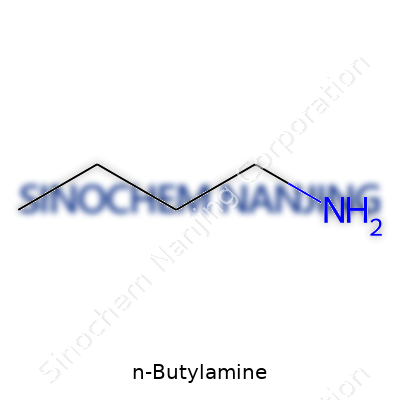
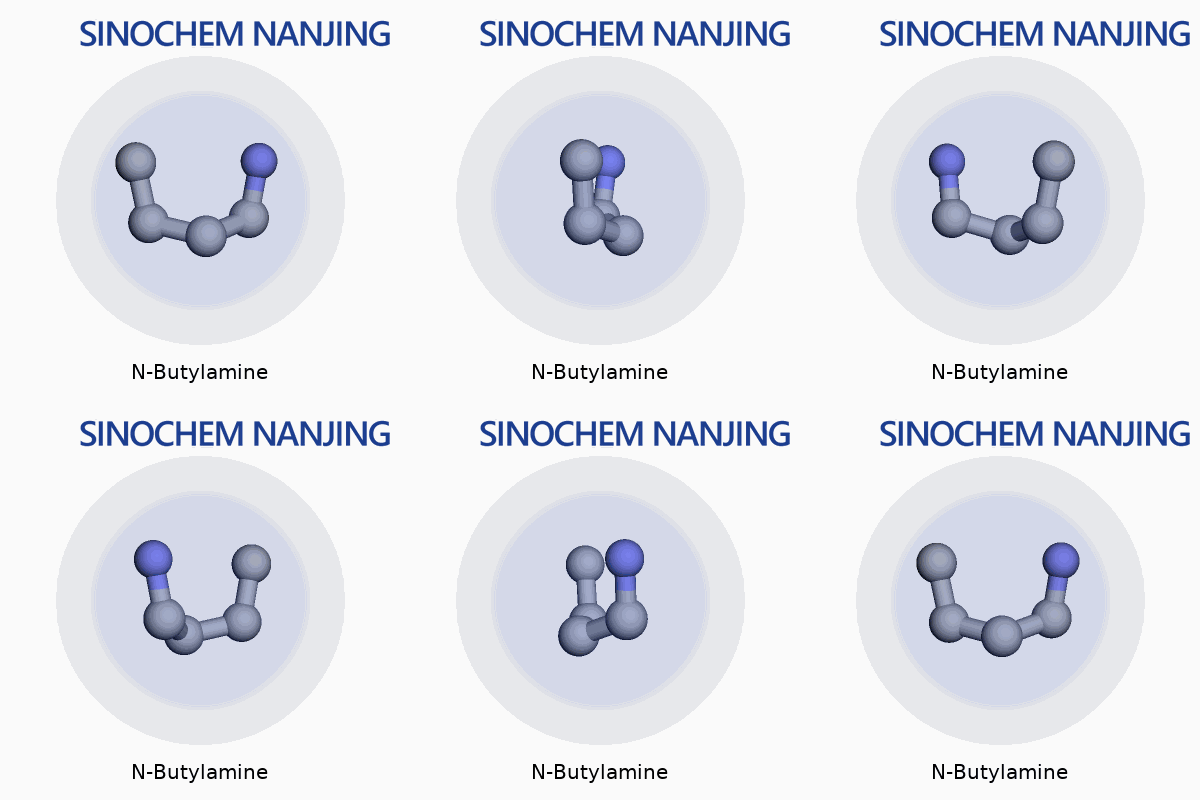
| Names | |
| Preferred IUPAC name | butan-1-amine |
| Other names |
1-Butanamine 1-Aminobutane Butylamine n-Butylamin |
| Pronunciation | /ɛnˈbjuː.tɪl.əˌmiːn/ |
| Identifiers | |
| CAS Number | 109-73-9 |
| Beilstein Reference | 605293 |
| ChEBI | CHEBI:28997 |
| ChEMBL | CHEMBL15419 |
| ChemSpider | 6824 |
| DrugBank | DB01943 |
| ECHA InfoCard | 100.005.300 |
| EC Number | 200-699-2 |
| Gmelin Reference | 8180 |
| KEGG | C01799 |
| MeSH | D002032 |
| PubChem CID | 8113 |
| RTECS number | EB2975000 |
| UNII | 3E8S8DLK70 |
| UN number | UN1125 |
| Properties | |
| Chemical formula | C4H11N |
| Molar mass | 73.14 g/mol |
| Appearance | Colorless transparent liquid |
| Odor | Ammonia-like |
| Density | 0.74 g/cm³ |
| Solubility in water | Miscible |
| log P | 0.88 |
| Vapor pressure | 11.3 kPa (at 20 °C) |
| Acidity (pKa) | 10.78 |
| Basicity (pKb) | 3.38 |
| Magnetic susceptibility (χ) | -6.4 × 10⁻⁹ cm³/mol |
| Refractive index (nD) | 1.396 |
| Viscosity | 0.586 mPa·s (20 °C) |
| Dipole moment | 4.16 D |
| Thermochemistry | |
| Std molar entropy (S⦵298) | 229.6 J⋅mol⁻¹⋅K⁻¹ |
| Std enthalpy of formation (ΔfH⦵298) | -71.3 kJ/mol |
| Std enthalpy of combustion (ΔcH⦵298) | -3730 kJ/mol |
| Pharmacology | |
| ATC code | C01DX15 |
| Hazards | |
| GHS labelling | GHS02, GHS05, GHS07 |
| Pictograms | GHS02,GHS07 |
| Signal word | Danger |
| Hazard statements | H226, H302, H312, H314, H332 |
| Precautionary statements | P210, P233, P240, P241, P242, P243, P264, P271, P280, P303+P361+P353, P304+P340, P305+P351+P338, P311, P312, P321, P330, P337+P313, P370+P378, P403+P235, P405, P501 |
| NFPA 704 (fire diamond) | 3-3-0-A |
| Flash point | -10 °C (14 °F; 263 K) |
| Autoignition temperature | 285 °C (545 °F; 558 K) |
| Explosive limits | 2.0% - 10.0% |
| Lethal dose or concentration | LD50 oral rat 366 mg/kg |
| LD50 (median dose) | LD50 (median dose) of N-Butylamine: Oral-rat LD50: 366 mg/kg |
| NIOSH | NIOSH: EO1400000 |
| PEL (Permissible) | 5 ppm |
| REL (Recommended) | 35 ppm |
| IDLH (Immediate danger) | 300 ppm |
| Related compounds | |
| Related compounds |
n-Butanol Butyronitrile Butyramide Di-n-butylamine n-Butyl isocyanide |



