Morpholine: A Chemical Backbone in Modern Industry—Past, Present, and What Lies Ahead
A Look Back: How Morpholine Emerged from the Lab
Morpholine stepped into the spotlight of industrial chemistry in the early 20th century. Chemists started out trying to modify basic organic molecules and stumbled across morpholine while exploring new heterocycles. Research journals from the past century show that as soon as morpholine made its way into labs, it soon found all sorts of uses. Its combination of oxygen and nitrogen atoms in a six-membered ring seemed to create a unique balance between stability and reactivity. Factories caught on fast since this tiny molecule could do big things with corrosion control and as a building block in pharmaceuticals.
Understanding Morpholine: What It Is and How It’s Built
At its core, morpholine is a small, colorless liquid that looks innocent enough but packs serious versatility. The molecule consists of a ring containing both oxygen and nitrogen—lying between the worlds of amines and ethers. You notice a slightly fishy odor and instantly recognize that it mixes very well with water and many common solvents. Its structure, C4H9NO, makes it a chameleon in chemical reactions. This comes in handy for industries that want a single ingredient to pull double duty in both acidic and basic environments. Its boiling point sits just above 128°C, and it carries a pKa around 8.3, making it strong enough to serve as a mild base but not so strong that it creates handling problems in large-scale operations.
Diving into the Details: How Morpholine Measures Up
For anyone who spends time around process plants, morpholine is notable for its straightforward handling requirements. It’s not flammable in the regular way that alcohols or ethers are, but it still asks for careful storage since it reacts with strong acids and oxidizers. Its vapor is pretty irritating to eyes and lungs—something you learn quickly in a lab that isn’t well-ventilated. On the labeling front, regulations in the European Union and United States demand clear hazard symbols and guidance about respiratory protection—rightfully so, as inhalation leads to immediate discomfort. Morpholine’s density hovers near 1.0 g/cm3 and keeps a low freeze point, so standard drums and tanks work fine for most transfer tasks.
Breaking Down Production: From Chemical Feedstock to Finished Product
Most commercial morpholine gets made by reacting diethylene glycol with ammonia at high temperatures using catalysts like alumina or tungstates. This process squeezes out water and creates morpholine in good yields. Plants recycle unreacted feedstock and feed gas back through the system, keeping efficiency high and waste low. Each step—charging the reactor, filtering the product, and distilling—relies on operators who check temperatures and pressures day and night. There’s a certain pride that comes from producing a ton of high-purity morpholine, knowing it’s destined for everything from steam lines in power plants to specialty pharmaceuticals.
Changing the Chemistry: Reactions and Modifications that Matter
Chemists love morpholine because it acts as a building block for endless chemical reactions. Its nitrogen center allows for alkylation and acylation, turning out custom molecules for everything from rubber accelerators to complex drug candidates. Morpholine gets used to make fungicides, corrosion inhibitors, and specialty surfactants. In some reactions, it grabs carbon dioxide to form carbamates—useful for water treatment. I’ve seen researchers swap out hydrogen for bulky side groups, pushing morpholine’s capabilities into new territories. This flexibility keeps research teams interested, searching out unexpected twists in old reactions just by tinkering with substituents on the ring.
What’s in a Name: Synonyms and Industrial References
Across different suppliers and countries, you might run into other names for morpholine—diethylene oximide and tetrahydro-1,4-oxazine come up now and then. Product labeling sometimes references trade names that change depending on the application. Despite the shifting aliases, folks dealing with this chemical usually stick to ‘morpholine’ for simplicity. It’s a badge of usefulness and a term that brings quick recognition among chemists, plant workers, and engineers alike.
Holding the Line: Safety Principles and Operational Discipline
Safety rules for morpholine come from hard lessons learned in both factories and research labs. Vapors sting the eyes and nose within seconds, and accidental splashes cause burns. Workers gear up with rubber gloves, splash goggles, and respirators—nobody takes shortcuts. Spills need fast cleanup with absorbent materials, not rags that might smolder. Regulatory agencies keep tabs on exposure levels, setting worker limits at just a few parts per million in air. Plant managers invest plenty in equipment that houses morpholine in sealed lines and maintains emergency showers near mixing operations. There’s an unspoken code in chemical plants: pay attention to the safety data, and don’t forget that a moment’s carelessness means hours at the clinic.
How Morpholine Powers Industry: Real-World Applications
One of the most practical uses of morpholine shows up in steam boilers, where it acts as a corrosion inhibitor, keeping costly pipes free of rust. You also see it turning up in fungicides for crops, in rubber manufacturers who need stable curing agents, and in textile processes that help dyes grab onto fabric without fading. Pharmaceutical companies add it to the toolkit for making custom molecules, since morpholine rings often appear in new drug candidates and active ingredients. In fuel processing, it scavenges acids that would otherwise eat through refinery equipment. You notice its reach wherever an industry depends on stable, water-soluble solutions that also bring basicity to the table.
R&D: Continual Experimentation and Push for Innovation
Research on morpholine hasn’t tapered off. Scientists at public universities and in corporate labs keep chasing new derivatives that solve specific problems. Anyone following the literature knows there’s a jump in patent filings for morpholine-derived pharmaceuticals, especially as chemists work to outpace antibiotic resistance by tweaking the molecule’s core. Environmental researchers look for less toxic ways to break it down after use, hoping to tame runoff into local water supplies. There are constant attempts to turn morpholine into custom polymers, greener solvents, and safer additives—each aimed at carving out new sectors or lowering its ecological footprint. The momentum in research circles says a lot about how essential even old molecules can remain.
Toxicity Studies: Where Vigilance Meets Responsibility
Safety data on morpholine paints a clear picture—high doses or repeated contact put people at risk of skin burns, eye irritation, and lung challenges. Animal studies produced enough evidence to push regulatory agencies to add tight controls and regular monitoring requirements. Drinking water standards in many countries ban residues above strict parts-per-billion limits. Plant-based remediation projects aim to degrade traces in soil and effluent, with varying success. Industry partners know that being upfront about safe handling and disposal practices goes further than PR spin. A chemical like morpholine works for society’s benefit only if everyone in the handling chain—researchers, plant operators, farmers, and disposal crews—stays honest about its hazards and acts accordingly.
Where Things Go from Here: Prospects and Practical Solutions
Morpholine’s future depends on whether industries can dig out greener production routes and less toxic applications. One path points toward catalytic processes that use less energy and produce fewer byproducts. Researchers keep testing biocatalysts and recyclable solvents, chipping away at costs and environmental burdens. Demand keeps rising on the pharmaceutical side, so improving yields and separating high-purity morpholine gets plenty of attention. Risk management efforts call for new detection tools on plant floors—real-time air sensors and leak detection systems. Tighter rules about release and recycling are already nudging companies toward more responsible practices. Workers who put in decades around this compound say the biggest gains came from admitting mistakes and adapting quickly. That mindset will keep morpholine in the game for years to come, as long as honest stewardship matches the chemistry’s potential.
What is Morpholine used for?
What is Morpholine?
Morpholine shows up in places most people never notice. This chemical, which smells a bit like ammonia, comes out of labs around the world and lands in everything from food packaging to rust-proofing fluids. There’s nothing flashy about morpholine’s ring-shaped structure, but it’s got just enough reactivity to make it useful for a long lineup of industries.
Food Packaging and Preservation
Many people might not expect to find a chemical like morpholine in food production, but its role stands out in making fruits look better on grocery store shelves. Morpholine gets mixed into wax coatings so apples and other fruit reflect appealing shine. The shiny skin may grab your attention, but the purpose focuses on slowing down spoilage. The World Health Organization and the Food and Agriculture Organization set tolerable daily intake levels, acknowledging that morpholine residues can end up on fruit skins. Canada and Europe allow these fruit waxes in tightly regulated amounts. The United States bans its use for this purpose because of concerns about by-products known as nitrosamines, which can show up under certain storage conditions.
Industrial Applications
Engineers and mechanics may encounter morpholine on the job, especially those keeping steam systems running. Morpholine neutralizes acidic compounds that corrode pipes and boilers, protecting expensive infrastructure. It keeps steam systems operating longer and cuts down on repair costs for power plants and heating facilities.
Morpholine’s ability to dissolve in water and oil helps it serve as a building block in rubber accelerators, pharmaceuticals, herbicide chemicals, and dyes. Workers in chemical factories boost the efficiency of paints and cleaning agents by adding morpholine, making products more useful without breaking the bank.
Medicines and Cleaning Products
Drug developers rely on morpholine during the creation of certain pharmaceuticals, where its unique chemistry lets it bond with substances that target infection. It shows up in antifungal and antibacterial products, plus some that help manage cholesterol levels. In cleaning products you might find at hardware stores, morpholine helps stabilize formulas and increase shelf life.
Safety Concerns and Exposure
Morpholine works well in the places it belongs, but that doesn’t mean it does not come with risks. People exposed to large amounts on the job, especially through inhalation or skin contact, can experience irritation or even more serious consequences if safety precautions fall short. Personal experience in a lab setting demonstrated the importance of gloves, face shields, and good airflow. Federal agencies like OSHA and the European Chemicals Agency enforce guidelines for workplace safety, and product manufacturers follow strict rules on allowable amounts in consumer goods.
Households remain safe because the levels of morpholine in finished products end up far below what experts consider dangerous—if products are used as intended. The scientific community keeps reviewing studies to make sure guidelines reflect the latest knowledge on long-term exposure. Several consumer advocacy groups push for tighter limits or alternative methods in food coatings, suggesting beeswax or other plant-based options where possible.
Looking Ahead: Balancing Utility and Safety
Morpholine brings clear benefits in transportation, agriculture, food preservation, and medicine. At the same time, it calls for responsibility from producers and regulators. Better ventilation and handling procedures reduce incidents in workplaces. Food companies that adapt to rising consumer concern often choose alternatives for coatings, though these may carry their own production costs. Change usually happens when safer options become practical and effective, but morpholine’s usefulness keeps it relevant across many fields for now.
Is Morpholine hazardous to health?
Understanding Morpholine’s Everyday Reach
Few people outside chemistry circles talk about morpholine, yet this compound sneaks into everyday life. Manufacturers use it in everything from rust inhibitors to food packaging, and even as a fruit-coating agent. Most shoppers have no idea their shiny apple or glossy cardboard might involve a dash of morpholine.
Looking Closer at Morpholine’s Health Impact
The story gets serious where health steps in. Morpholine can irritate skin, eyes, and the respiratory tract. Laboratory tests have shown repeated exposure in high doses damages the liver and kidneys in animals. Health authorities—including the World Health Organization and the U.S. Environmental Protection Agency—classify morpholine as a possible human carcinogen, especially when it reacts with nitrites to form N-nitrosomorpholine, a substance linked to cancer in lab rats.
In food, morpholine is not supposed to mingle with anything that converts it into these risky compounds. Yet, reality rarely promises clean lines. Apples treated with wax coatings might have minute traces of morpholine, and even at extremely low levels, the thought nags. Kids eat apples at school. Adults snack without a second thought. Anyone with allergies or chronic health conditions gets uneasy glances at these invisible additives.
Rules and Gaps in the System
Europe banned morpholine in food coatings. Health Canada allows it, saying the levels present no health risk. The United States takes a similar stance, pointing to rigorous controls and “safe” limits in waxes. But food travels. Fruit in your local supermarket often crosses borders, dancing past differing regulations. Gaps in oversight open the way for inconsistent exposure. I once saw imported apples in a Toronto market with waxy skin that stung my mouth—a tingle that made me pause.
Workers handling morpholine face higher risks than the public. Factories using open vats, old ventilation, or poor training see more spills and inhaled vapors. Short-term exposure brings on headaches, dizziness, and coughing, long-term exposure threatens organ health. I spoke with a friend who managed a paint shop; stories of itching, red eyes, and sharp chest pain after cleaning up a morpholine spill show the real dangers behind a simple white drum.
What Makes Morpholine Worth Worrying About?
Problems tied to morpholine point to a much larger pattern. Chemicals get fast-tracked for industrial use—sometimes before their health effects have been seriously studied. Governments play catch-up, only adding new rules after issues appear. Gaps between global regulations create weak spots where enforcement falls through.
Moving Toward Healthier Choices
Pushing for better labeling puts consumers in the driver’s seat. If food carries clear warnings about additives, shoppers choose their risks. Supporting farmers and brands that skip coatings or use plant-based waxes shifts industry habits. Calling on leaders to rethink “accepted” chemicals in food pushes policy in the right direction. For workers, better training and adequate protective equipment lower exposure. Updating factory safety rules—like installing air scrubbers and urging regular health checks—does more than paperwork ever could.
No one can dodge chemical exposure completely. Still, facing up to what’s in our food and workplace begins with questioning quiet ingredients like morpholine. Health grows from knowing what lands on our plates and in our air, and demanding better options where we spot problems.
What industries commonly use Morpholine?
How Chemical Know-How Shapes Everyday Products
Morpholine sounds like the kind of word you’d find buried in a chemist’s handbook, but this chemical pops up far more often than people think. After spending years working near industrial plants and watching trains haul morpholine-labeled tanks through the Midwest, I’ve come to appreciate how essential this compound is. It’s not just another chemical on a supply list—it holds up some of the unsung corners of modern living.
Keeping Boilers Safe and Efficient
The power sector doesn’t usually take center stage outside times of blackout or record heat. Inside those humming facilities, steam does the heavy lifting to spin turbines and keep the lights on. Boiler water needs protection from rust and scale—corrosion can cripple whole operations. Morpholine steps in as a pH adjuster and corrosion inhibitor, mixing with water vapor and reaching even hidden corners of complex systems. It’s been chosen for its ability to buffer water and scavenge stray acid, stretching the lifespan of pipes and cutting down the repair bills that could threaten reliability.
The Smooth Finish on Pharmaceuticals
Walk through a pharmacy and every tablet, every capsule has a story of synthesis behind it. In drug making, morpholine acts as a building block for antihistamines, antibiotics, and fungicides. Its small ring structure fits neatly into more complex molecules. It’s the invisible hand in recipes for important medicines like linezolid, a crucial antibiotic in the fight against resistant infections. FDA records show morpholine has played a part in chemical reactions where alternatives just didn’t fit the bill—its value is measured in lives saved and hospital stays shortened.
Fruit That Stays Fresh
Everyone knows the disappointment of biting into an apple with a waxy, off-flavor coating. Morpholine has helped tweak those coatings so fruit looks shiny without going bad too quickly. While its use in fruit waxes has sparked debate over food safety in Europe and elsewhere, the United States still allows morpholine in these coatings within established limits. Risk assessments from the World Health Organization and the FDA have found the exposure so tiny that it falls well below thresholds for concern. Every time the conversation turns to safe food, science and regulation walk a tightrope between extending shelf life and protecting public health.
The Quiet Workhorse in Rubber and Paint
Down the production lines for car tires and latex paints, morpholine helps stabilize and speed up the work. In rubber production, it acts as a vulcanization accelerator, packing toughness into road-bound tires and heavy equipment hoses. Paint manufacturers use morpholine to balance acidity, keep emulsions stable, and slow down the growth of mold in cans left sitting on the shelf. Workers in these factories rely on safety routines because of morpholine’s chemical nature—but its contribution means products last longer, perform better, and cost less to replace.
Toward Safer, Smarter Chemical Uses
Morpholine’s story isn’t just about chemistry; it’s about the pressure on companies to innovate without cutting corners. Regular audits, tighter regulations, and better worker protection should always ride alongside old habits. Leaning on science for guidance, pushing for transparency from suppliers, and supporting more training for the people who handle these compounds can minimize risks. Most people never spot morpholine on a label, but the mark it leaves on reliable services, modern medicine, and safer manufacturing fills a gap we’d all miss otherwise.
How should Morpholine be stored and handled?
Understanding the Risks in the Workplace
Morpholine does a lot across industries, showing up in everything from corrosion inhibitors to rubber additives. Behind laboratory benches or inside plant walls, dealing with this compound means taking real care. I’ve seen what happens when folks cut corners with chemical storage. A simple lapse can turn into a medical emergency. Morpholine gives off a strong ammonia-like odor, acting as an early warning, but the real hazard stays quiet on skin and in the lungs.
Why Safety Gear Is Non-Negotiable
Getting morpholine on skin—just a splash—burns fast. The liquid and vapor both bother eyes, nose, and lungs, sometimes worse than folks expect. I keep gloves, splash goggles, and full coveralls close whenever working with volatile chemicals like this. Fume hoods pull vapors away, making the air easier to breathe. I always remind newcomers that quick exposure might not feel severe, but hours later, rashes and eye irritation show up.
Changing How We Store Morpholine
Workers new to storage usually ask why morpholine can’t sit in any old drum. Moisture, light, and oxygen all mess with its purity and create acidic byproducts that corrode containers. The best answer comes from simple practice: stainless steel or high-density polyethylene tanks kept sealed tight. Avoiding copper and aluminum prevents ugly reactions. I’ve learned not to trust plastic containers without checking their chemical compatibility; some soften or crack over a few months.
Ventilated and Cool Locations Work Best
Heat makes morpholine volatile. Stashing barrels in a climate-controlled corner, with airflow, keeps vapor pressure low. Fire risks go up quick if the compound sits next to ignition sources or direct sunlight. I store flammable chemicals in a locked cabinet away from any chance of a stray cigarette or tool spark. Fire extinguishers rated for chemical fires don’t just look good for inspections—they save lives if someone does slip up.
Labeling and Emergency Steps
Clear labeling helps, especially as weeks go by and barrels move around. I keep emergency wash stations operational and instruct others on what to do if an accident happens. Folks who handle morpholine must know exactly where eyewash and showers sit, not just on paper but from muscle memory. Spills get cleaned up using absorbent pads designed for corrosive liquids. Rags or untreated sawdust create more harm, releasing more fumes or even catching fire.
Continuous Learning Protects Everyone
Handling morpholine always comes with a learning curve. OSHA and CDC provide updated guidelines, which I share with new team members. I remind them that reporting leaks or spills right away makes a big difference; hidden problems grow over time. Training never stops—demonstrations of safe storage or personal protective equipment use can feel repetitive, but experience tells me that hesitation in an emergency only comes from poor practice.
Moving Toward Safer Work Culture
Storing and handling morpholine reflects a bigger attitude toward safety in any chemical industry. Management and workers both shape this culture. Open discussion around protocols, easy access to safety equipment, and a clear plan for emergencies protect everyone involved. No short cut or improvised fix will match honest, ongoing attention to the risks at hand.
What is the chemical formula and structure of Morpholine?
What is Morpholine?
Morpholine’s chemical formula is C4H9NO. In its pure form, it looks like a clear, colorless liquid that smells a bit like fish. If you spend any time in laboratories or work around industrial processing, the scent can stick with you. Beyond the smell, morpholine finds itself in dozens of places, from industry to agriculture. Its popularity links directly to its chemical makeup.
Breaking Down the Structure
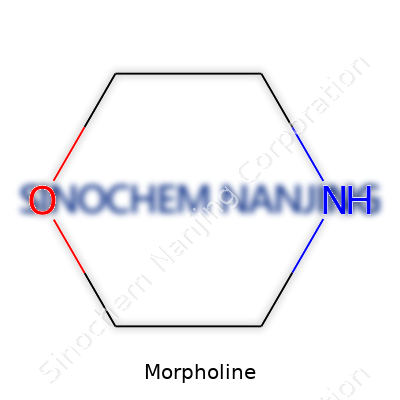
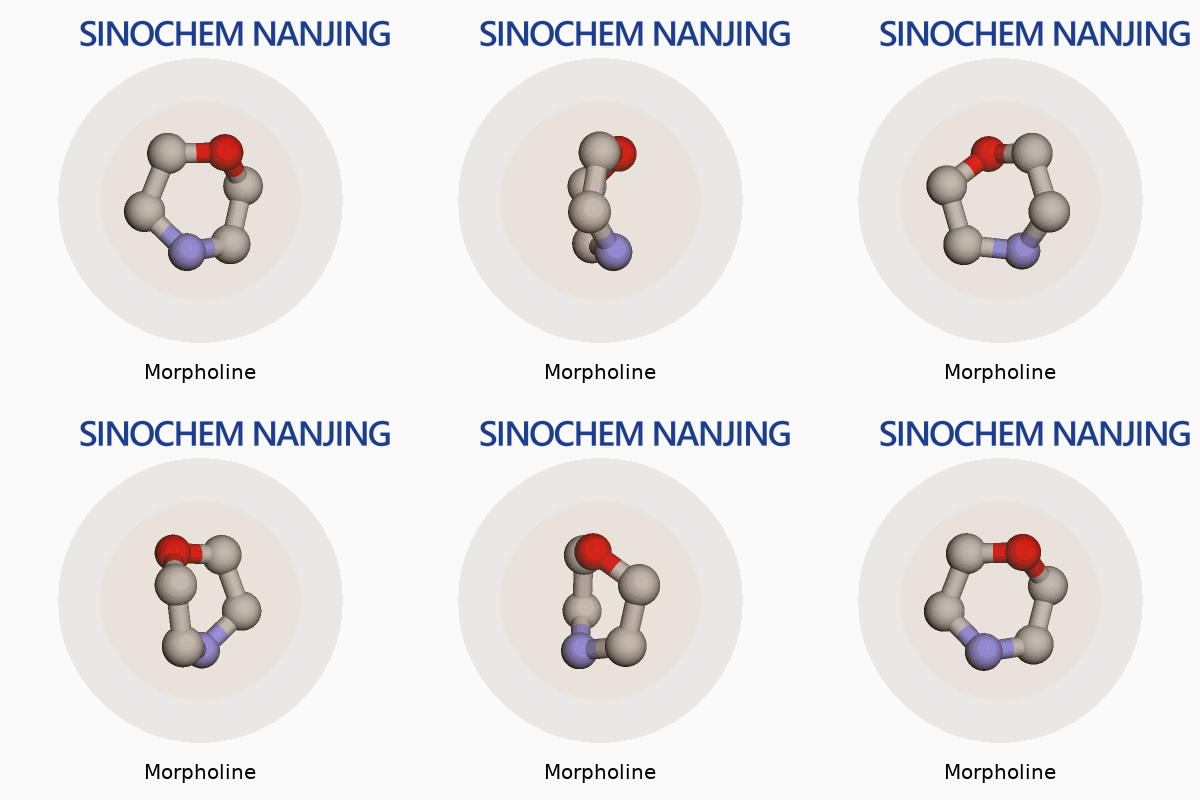
The structure of morpholine tells a story in itself. Picture a ring made up of four carbon atoms, one nitrogen, and one oxygen atom. The ring holds six members, alternating between two types of atoms. Think of it as a hexagon, where two opposite corners aren’t carbon at all—one corner is nitrogen and the opposite is oxygen. Chemists see this as an example of a heterocycle: a ring that’s not just all carbon. The formula C4H9NO sums up the core, but the unique properties show up because of its shape and the atoms involved.
Why Morpholine Matters
Morpholine’s structure gives it a special ability to mix with both water and organic solvents. Because of the nitrogen, it acts as a base. This has big consequences in real-life scenarios. In the oil and power generation sectors, morpholine treats boiler water. It helps prevent corrosion by neutralizing acid, so pipes last longer. In agriculture, morpholine salts show up in fungicides—helping protect crops and food storage from spoilage and rot. The pharmaceutical industry uses it as a building block for bigger, more complex molecules. People who work with these products rarely think about the starting materials, but without simple chemicals like morpholine, much of our modern infrastructure stumbles.
The Facts and Current Safety Concerns
Morpholine isn’t without challenges. Exposure to high concentrations leads to eye and skin irritation—it can burn if not handled with safety goggles and gloves. Research shows that prolonged high-level exposure, rare in day-to-day factory work but still a concern, can harm respiration or even liver function in animal studies. Because of this, many countries regulate workplace exposure. The US Occupational Safety and Health Administration (OSHA) sets a permissible exposure limit of 20 parts per million. The European Chemicals Agency keeps a close eye on its use in consumer products. Good science supports these limits. An occupational study published in the Journal of Occupational and Environmental Medicine in 2018 tracked workers in industrial settings over 10 years; moderate, regulated exposure levels showed no evidence of chronic health issues.
Responsible Use and Future Pathways
Modern industries rely on chemicals like morpholine to keep operations efficient and safe. Managing exposure lines up with basic workplace responsibility. Clear labeling, good training, and practical safety equipment cut down health risks—a practice that stems from decades of lessons learned in both research and factory floors. In labs, students get their first mask-and-goggles lesson with morpholine and other reactive amines. Replacing morpholine isn’t always feasible, but ongoing research into greener substitutes adds hope for applications where toxicity poses a wider problem. Until then, practical controls and regular monitoring provide the best way forward.
| Names | |
| Preferred IUPAC name | Oxazinane |
| Other names |
Diethylene imidoxide Tetrahydro-1,4-oxazine Tetrahydro-1,4-oxazine 1,4-Oxazinane |
| Pronunciation | /ˈmɔːrfəˌliːn/ |
| Identifiers | |
| CAS Number | 110-91-8 |
| 3D model (JSmol) | `3D model (JSmol)` string for Morpholine: ``` C1COCCN1 ``` |
| Beilstein Reference | 505332 |
| ChEBI | CHEBI:8026 |
| ChEMBL | CHEMBL503 |
| ChemSpider | 6947 |
| DrugBank | DB00505 |
| ECHA InfoCard | 100.005.422 |
| EC Number | 203-815-1 |
| Gmelin Reference | 6329 |
| KEGG | C02340 |
| MeSH | D008937 |
| PubChem CID | 8057 |
| RTECS number | QH6475000 |
| UNII | 6U8X9A1EWS |
| UN number | UN2054 |
| Properties | |
| Chemical formula | C4H9NO |
| Molar mass | 87.12 g/mol |
| Appearance | Colorless to pale yellow liquid with an amine-like odor |
| Odor | Ammonia-like |
| Density | 1.007 g/cm³ |
| Solubility in water | Miscible |
| log P | -0.86 |
| Vapor pressure | 11.8 mmHg (20°C) |
| Acidity (pKa) | 8.36 |
| Basicity (pKb) | pKb = 5.64 |
| Magnetic susceptibility (χ) | -11.3·10⁻⁶ cm³/mol |
| Refractive index (nD) | 1.454 |
| Viscosity | 1.7 mPa·s (at 25 °C) |
| Dipole moment | 1.96 D |
| Thermochemistry | |
| Std molar entropy (S⦵298) | 249.0 J·mol⁻¹·K⁻¹ |
| Std enthalpy of formation (ΔfH⦵298) | -352.5 kJ/mol |
| Std enthalpy of combustion (ΔcH⦵298) | -4783.8 kJ/mol |
| Pharmacology | |
| ATC code | C04AX21 |
| Hazards | |
| GHS labelling | GHS02, GHS05, GHS06 |
| Pictograms | GHS05,GHS06 |
| Signal word | Danger |
| Hazard statements | H226, H311, H314, H331 |
| Precautionary statements | P260, P261, P264, P271, P280, P301+P310, P303+P361+P353, P304+P340, P305+P351+P338, P311, P321, P330, P362+P364, P363, P405, P501 |
| NFPA 704 (fire diamond) | 3-2-0 |
| Flash point | 94°C (201°F) |
| Autoignition temperature | 316°C |
| Explosive limits | 1.8–15.2% |
| Lethal dose or concentration | LD50 oral rat 1,450 mg/kg |
| LD50 (median dose) | LD50 (median dose): 1,050 mg/kg (oral, rat) |
| NIOSH | NJ8225000 |
| PEL (Permissible) | PEL (Permissible Exposure Limit) of Morpholine: "20 ppm (70 mg/m³) (OSHA) |
| REL (Recommended) | 100 ppm |
| IDLH (Immediate danger) | 140 ppm |
| Related compounds | |
| Related compounds |
Oxazolidine Thiomorpholine Piperazine Dioxane Pyrrolidine |



