Mesitylene: Chemistry, Industry, and the Road Ahead
Mesitylene’s Backstory: A Tale from 19th Century Chemistry
Mesitylene, also known by its straightforward title “1,3,5-trimethylbenzene,” has a surprisingly old pedigree. Michael Faraday first isolated benzene in the 1820s, laying the groundwork for a wave of aromatic hydrocarbon research. Then came Robert Kane, who pulled mesitylene out during his work in the 1830s by distilling acetone and taking note of an odd-smelling, flammable oil. Chemists spent decades bickering over the structure, as the tools people take for granted today—NMR, X-ray crystallography—weren't around. The hexagonal arrangement of carbon atoms sat as a puzzle till the aromatic ring’s discovery helped everything fall into place. Before computers and mass spectrometers, it all came down to careful distillation, a sharp nose for new scents, and keen observation of chemical behaviors. The roots of mesitylene go straight back to an era when chemical research involved a fair bit of guesswork, strong stomachs, and risk.
Getting Acquainted: Properties and Behavior
Mesitylene doesn’t impress at first glance. This clear, aromatic liquid that smells a bit sweet shows a boiling point around 164°C. The three methyl groups on the benzene ring help keep it somewhat stable, less prone to aggressive reactions than its simpler cousin, toluene. Pour some out, and you’ll see it doesn’t dissolve in water. Instead, it loves mixing with other non-polar liquids. The chemical formula, C9H12, says it straight. Those methyl branches make all the difference—adding just enough heft to slightly change how it acts compared to simple benzene. In industrial labs, people appreciate this—reactivity takes on a more predictable edge, making mesitylene reliable for very specific reactions.
Specs and Labels: The Real-Day Side of the Barrel
Most drums of mesitylene carry labels warning about its flammability—no surprise, given how quickly it catches fire. Federal regulations in many countries place mesitylene under strict oversight. Material safety data sheets (MSDS) outline flash points, vapor pressure, and chemical codes. While it’s legal to transport, handlers need solid ventilation, and safe gloves. Eye and skin contact need to be avoided, since aromatic hydrocarbons don’t treat living cells kindly. Technically, mesitylene is categorized under CAS Number 108-67-8. No vitamin blend here—strictly the territory of bulk chemicals, handled with a respect for both the science and the potential health hazards.
From Lab Bench to Factory Tanks: How People Make Mesitylene
Industrial mesitylene comes from methylation—a chemical process that starts with toluene and treats it with methanol over a catalyst at high heat. Zeolite catalysts make this possible without a fuss, delivering much higher yields than old-school methods. Refineries crank up this reaction to supply thousands of gallons for industry, since making mesitylene from scratch by distilling resin or handling coal tar just doesn’t stack up any more for efficiency. Sometimes, chemists dig back into older preparation methods for fun or for educational use, but most of the world’s supply these days draws straight from petrochemical plants.
What Synonyms Say About Its Reach
Ask for mesitylene in a lab, and someone might offer “1,3,5-trimethylbenzene.” Sometimes it shows up as “sym-trimethylbenzene” in synthetic routes or “mesitene” in older European publications. This jumble of names comes from its symmetry around the benzene ring. These aliases carry clues to its chemical make-up, but they all link back to that same trio of methyl groups sprouting from the central hexagon.
Chemical Attitude: Reactions and Tweaks
Mesitylene has a knack for classic aromatic substitution. Bromination or nitration? Mesitylene’s methyl groups direct incoming fragments to very specific zones, making synthetic chemists happy by cutting down on by-products. Its use as a starting point for more exotic chemicals—like mesityl oxide and certain phthalic acids—keeps it in steady demand among those who fine-tune dyes, pharmaceuticals, and resins. In research circles, folks take advantage of its triple methyl protection to create stable intermediates, pushing the boundaries in organic synthesis.
On the Safety Front: Handling and Precautions
Mesitylene smells sweet, but anyone who’s worked around it knows not to get careless. Vapors irritate the eyes and throat. Even brief skin contact can dry out or irritate the skin. Inhalation brings headaches, dizziness, and nausea at relatively low levels. Factories and labs handling this solvent keep area monitoring on hand and train workers with drills. Long-term toxicity research hasn’t raised the alarm to the levels benzene does, but that doesn’t mean mesitylene gets a free pass. Regular risk assessments, hard rules about protective gear, and good engineering controls show up wherever people are moving mesitylene from plant to pipe to drum.
From Solvents to Science: Mesitylene’s Haunt
Go into the world of paints, adhesives, dyes, and resins, and mesitylene shows up time and again. As a solvent, it helps bring strong dissolving power without dissolving the bank account. In petroleum labs, mesitylene acts as a clear component for octane boosting in gasoline, playing into the ongoing fight for cleaner engines. Chemical companies use it as a raw material for making antioxidants, light-stable plastics, and additives for lubricants. Researchers in academic labs lean on it for developing new methods in organic chemistry, particularly for studies where a non-polar solvent with a sturdy backbone gets the job done.
From Safety to Science: Operational Standards
There are no shortcuts: safe work with mesitylene requires vigilance. Emissions from handling and storage must stay below national guidelines. Closed systems, regular personal protective equipment checks, and up-to-date ventilation save both lives and property. Industry players keep a tight leash on quality, with regular batch testing and shelf-life checks to avoid contamination and off-spec shipments. Those who cut corners usually get weeded out quick, thanks to the scrutiny brought by environmental regulators and community watchdogs.
Research Keeps Eyes on the Future
As science pushes toward greener chemical processes, researchers keep looking for ways to make mesitylene from renewable resources—not just from fossil fuels. Early pilot projects for biomass or catalytic conversion of bio-derived substrates have started to show promise, but haven’t rewired the production lines yet. Toxicity and environmental fate studies keep chipping away at the knowledge gaps around breakdown products, bioaccumulation, and safe thresholds for water and soil contamination. Some hope that advances in catalysis might open new doors: more selective reactions, less waste, and safer working conditions. That promise hasn’t faded even as regulations and consumer pressure push for cleaner, safer, and more sustainable chemical processes.
Why Mesitylene Still Matters
Mesitylene won’t become a household name, but anyone dealing with industrial chemistry, pollution control, and cleaner fuel science never loses sight of it. As fuel standards tighten and the world looks for alternatives to high-toxicity solvents and intermediates, mesitylene’s solid safety record and predictable chemistry give it ongoing appeal. Old hands in the field remember the trial-and-error of making, labeling, and reacting mesitylene in less controlled times. As the world changes, the push for less toxic, more sustainable, and better-monitored chemicals means mesitylene stands as both a lesson from the past and a player in the industry’s next chapters. The story isn’t over yet, especially with catalytic innovation still going strong and a future only limited by creativity and regulation.
What is mesitylene used for?
What Exactly Is Mesitylene?
Mesitylene, known in many labs by its more formal name, 1,3,5-trimethylbenzene, falls into that group of chemicals most folks never hear about unless they work directly with solvents, coatings, or fuel blends. It has a smell like turpentine and appears as a colorless liquid. Chemically, it’s a little cousin to benzene, but with some added methyl groups that change where and how it gets used.
On the Front Lines of Chemistry Labs
I spent a few years in university labs, and mesitylene often played a big role in our experiments. It’s a favorite solvent because it resists reacting with strong acids or bases. If you need to dissolve something stubborn, mesitylene often does the job without breaking a sweat. And because it remains stable even when heated, it finds a home in plenty of high-temperature applications—including as a solvent during synthesis of new organic compounds. In many cases, scientists like using it to control the speed and outcome of their reactions. Data from the Royal Society of Chemistry shows that its boiling point (about 164°C) makes it an attractive option for those tricky setups where the temperature climbs and others start to evaporate.
Making Better Fuels
On the industrial scale, mesitylene has a life well beyond the lab. Refineries use it as part of the recipe when blending gasoline. It isn’t the main ingredient, but it brings valuable properties, boosting the octane rating of fuel. This helps engines run smoother and cleaner, keeping knocking and pinging at bay. Sources like the U.S. Energy Information Administration have documented how aromatics, including mesitylene, help gasoline meet tighter pollution standards without sacrificing performance.
Paints and Coatings: Behind the Scenes
Walking through any hardware store, you don’t see “mesitylene” on paint cans, but it lurks behind much of what keeps those products liquid and usable. Manufacturers rely on mesitylene to control how fast paint dries and to dissolve resins that form the backbone of coatings. The European Chemicals Agency highlights mesitylene’s use as a solvent for varnishes and printing inks. If you’ve watched a coat of spray paint dry to a smooth finish, there’s a good chance mesitylene was helping the process along.
Risks and Safe Handling
Mesitylene comes with risks. It’s flammable, and breathing its vapors can irritate lungs or cause headaches. I remember my first safety briefing in the lab: goggles, gloves, and a fume hood whenever mesitylene came out. Industry pushes for systems that trap and recycle solvent vapors, both to protect workers and cut waste. Regulations in the European Union and United States set limits on exposure, aiming to keep harmful levels out of the air.
What’s Next for Mesitylene?
The push for greener chemistry means mesitylene faces pressure. Companies seek less toxic alternatives, especially as environmental rules keep tightening. Researchers at universities and private firms look for new solvents that match mesitylene’s performance but reduce environmental impacts. Substitution isn’t quick or easy, though. Until a truly ideal replacement arrives, mesitylene keeps earning its spot as a practical, reliable workhorse in science and industry.
What is the chemical formula of mesitylene?
Digging Into Mesitylene
Mesitylene, known in chemistry circles as 1,3,5-trimethylbenzene, carries the chemical formula C9H12. Each molecule has a benzene ring decked out with three methyl groups, spaced out evenly. On paper, it feels pretty basic, but in practice, mesitylene pulls a surprising amount of weight in labs and industry.
Where You Find Mesitylene
Plenty of folks never realize it, but mesitylene helps fuel a huge range of chemical reactions. I’ve seen it in university labs, stored in brown glass bottles, making its rounds through distillation columns. Most chemists first learn about it as a textbook example of aromatic compounds, yet its true value shows up through its use in making dyes, drugs, and advanced plastics.
A big reason mesitylene sees so much action: its structure offers three methyl groups that let it react in very specific ways. It's tough to overstate what that means in a synthesis. Those methyl groups offer just enough push to direct chemical reactions toward a cleaner, more predictable product—often much needed for pharmaceutical and specialty product development.
Why Care About Simple Aromatic Compounds?
C9H12 might not sound exciting, but the precise understanding of such chemical formulas keeps entire research projects honest. Chemical safety depends on such accuracy. In my experience, a clear grasp of what you’re working with reduces mistakes, boosts productivity, and keeps teams safe. Mesitylene’s moderate toxicity, for example, requires gloves and goggles, a fact that gets lost if people confuse compounds or mishandle formulas.
Aromatics like mesitylene also drive innovation in cleaner fuels. There’s been real movement toward reducing harmful emissions from gasoline, and mesitylene plays a role in research as scientists work to tweak octane ratings without ramping up pollution. Small improvements in understanding such molecules pay off in air quality and public health.
Problems and Next Steps
Some headaches come from tracking the spread and safety of mesitylene. I’ve seen companies stumble with waste management, letting leftover chemicals pile up or leak into the environment. That matters: aromatic hydrocarbons stick around in soil and water, and folks living near chemical plants deserve better. Regulatory oversight can only do so much, so personal responsibility from chemists and plant managers is key.
Fixing these issues starts on the ground. Education in chemical handling, along with stricter waste tracking, makes a difference. Facilities could adopt sensors that watch for chemical leaks, and researchers could push for replacements or alternative synthesis routes that yield less waste. Collaboration with environmental agencies helps create a safer space for both workers and surrounding communities.
The Value of Knowing What’s in the Flask
Every day, small details like C9H12 keep projects on track and communities safe. Chemistry grows when those handling these compounds both respect their utility and understand their risks. Mesitylene isn’t just a background player—it represents the importance of clarity, safety, and responsibility in science. That matters for anyone who steps into a lab, rides the bus, or walks past a chemical plant fence.
Is mesitylene hazardous to health?
Understanding Mesitylene in Everyday Context
People run into chemicals like mesitylene more often than they realize. It's a clear, sweet-smelling liquid often found in labs and industries that make solvents, dyes, and resins. I first ran across it in a college chemistry lab—open bottle, barely a warning, almost no fuss. That sort of casual attitude pops up in workplaces too, usually when something looks harmless. The truth is, appearances fade fast when health risks turn real.
What Science Says About Safety
Mesitylene belongs to aromatic hydrocarbons, a group known for flammability and vapors that don’t play nice with the human body. Short-term exposure can lead to headaches, dizziness, or nausea—that was something I heard straight from a coworker who forgot to crack a window during an experiment. If you get the stuff on your skin, irritation follows. Eyes stinging? That might come next.
Breathe mesitylene fumes too often, and the risks stack up. Chronic exposure can impair the nervous system and even the liver or kidneys. A 2021 review in ‘Toxicology Reports’ found repeated inhalation in lab animals damaged their lungs and livers, with changes in behavior. People who work in production plants tend to see the effects after years and sometimes notice symptoms just from not using proper ventilation or personal protection. It’s not just what the label says—the risks build in silence.
Regulations and Handling—Gaps Remain
OSHA sets exposure limits for mesitylene, but the numbers rely on people actually following best practices. In real-world shops and labs, shortcuts slip in. Protective gloves, goggles, and a good exhaust fan can make a difference, but not everyone suits up for “brief” jobs. Even with warnings, it’s easy to get lax if you think a liquid doesn’t look toxic.
Safety Data Sheets do lay out emergency actions if someone splashes mesitylene or breathes the vapors, but a lot of users skip reading those. Language barriers, missing sheets, or small print keep workers from learning what steps matter.
Long-Term Health and Our Habits
Doctors seldom ask about chemical exposure unless workers bring up symptoms. That gap often delays connections between a health issue and chemicals like mesitylene. As companies shift toward greener processes, some try swapping in safer alternatives, but those efforts crawl because mesitylene does its job well and costs less than many substitutes.
I know several small manufacturers that never taught their staff about vapor hazards until an inspector flagged them. Making people aware means sharing more than basic rules. Managers, teachers, and lab heads can share real-world stories—like the time a forgotten spill made three lab partners queasy for hours. Those memories convince people to treat chemical safety as more than just a checklist.
Improving Health Outcomes
It’s easy to say “just use protective gear,” but not everyone can spot when they need it. Visual warnings like clear signs, routine safety drills, and pairing new workers with safety-minded veterans raise awareness. Companies benefit from regular air quality checks and updated ventilation. Health clinics can prioritize education on chemical exposure during check-ups for at-risk workers.
Sparking a culture that values safety over speed or convenience stands as the game changer. Mesitylene stays in use because it delivers on the technical side, but a strong focus on people’s well-being needs to anchor the conversation. My own experience says honest communication and daily vigilance trump any false sense of security a familiar chemical might bring.
What are the storage requirements for mesitylene?
Understanding What’s at Stake
Mesitylene, or 1,3,5-trimethylbenzene, often shows up in labs or industrial sites as a solvent or a chemical building block. Its vapors carry a strong, sweet smell, hinting at both its volatility and the risk if handled without care. Mesitylene is flammable and can irritate the skin, eyes, and lungs, so a little preparation goes a long way in keeping people and property out of harm’s way. Anyone who has walked through a cluttered chemical storage room knows that a few basic rules decide whether a workplace feels safe or like a ticking time bomb.
Temperature Control Matters
Heat and mesitylene don’t get along. Temperatures above room level can nudge mesitylene toward vaporization. Vapors searching for an ignition source equal real danger. Lined-up drums next to a heat vent or window gathering up summer sun? That sets the stage for problems. Cool, dry, and shaded conditions keep the fire risk down and help the chemical last longer without breaking down or leaking fumes.
Location Choices and Fire Safety
Most folks working with chemicals know that fire safety isn’t just a box-ticking exercise, it’s survival. Non-sparking ventilation pulls risky vapors outside if something goes wrong. Steel safety cabinets rated for flammable liquids put a sturdy layer around containers, adding a dose of peace of mind. In busy settings, labeling cabinets is more practical than relying on memory. Spending an afternoon sorting bottles into the right cabinets pays off immediately when emergencies crop up.
Avoiding Contamination and Spills
Many headaches crop up from mixing up incompatible chemicals. Even ordinary cleaning solutions can brew surprises if they get into a drum by mistake. Mesitylene shouldn’t sit near oxidizing agents or acids. Labels and logs sound boring, but they keep surprises away. Leaky lids waste money and can start chain reactions, so tight seals matter. Keeping containers off the floor limits rusting or accidental kicks from carts.
Ventilation and Fume Safety
Few things instill more respect for ventilation than catching a lungful of chemical fumes. Mesitylene needs a well-ventilated spot. Dedicated exhaust fans and chemical fume hoods keep breathing easy, which means fewer headaches, both literal and legal. In tight spaces, simple fans might lead to risky vapor clouds, so mechanical systems built for flammable solvents serve well.
Training and Emergency Preparation
No fancy container or cabinet beats simple training. Staff who know what mesitylene can do spot a spill or gas leak before it gets out of hand. Regular drills on handling flammable liquids and using spill kits turn confusion into routine. Accessible eye-wash stations and fire extinguishers can mean the difference between a close call and a disaster. Companies that share lessons from near-misses — instead of hiding mistakes — build a culture where safety grows naturally.
Responsible Disposal and Staying Compliant
Disposal rules for chemicals like mesitylene cut through red tape for a good reason. Dumping leftovers down the drain contaminates water and invites legal trouble. Partnering with certified chemical disposers, keeping disposal bins locked, and recording every outgoing batch closes the loop.
Real-World Solutions
Keeping mesitylene secure isn’t just about following regulations. Staff who feel confident around chemicals work more efficiently and worry less. Investment in proper cabinets, signals, and training pays off by reducing lost time and cleaning up fewer messes. Small steps — a few extra labels, a better lid, or another training session — support both safety and productivity.
How is mesitylene produced or synthesized?
Understanding What Goes Into Making Mesitylene
Mesitylene, or 1,3,5-trimethylbenzene, pops up in daily conversations less often than other chemicals, but it plays a pretty important role in the world of solvents, fuel additives, and specialty chemicals. Talking through how it’s made grabs more attention than you’d expect. I remember a long visit to a petrochemical plant years ago where the hum of distillation columns and faint aroma around the production floor made abstract chemistry a lot more real. Out of all the compounds created, mesitylene’s unique blend of practicality and efficiency caught my eye.
The Chemistry Behind the Synthesis
Most industrial mesitylene comes from toluene through a careful process called methylation. This approach usually means bringing toluene together with methanol over a zeolite catalyst at high temperatures — often beyond 400 degrees Celsius. The catalyst plays a big part in this. Instead of just mixing and hoping for the best, this structure helps slot methyl groups onto the aromatic ring much more effectively, bumping the yield far beyond what older, less selective methods could offer.
Some chemical processes lean on the ancient Friedel-Crafts alkylation trick, using methyl chloride and aluminium chloride. That path, though, leaves a pile of byproducts and acid waste. Folks working on cleaner chemistry continue chasing better routes, and modern catalysts mean a cleaner run and easier recycling. The rise of zeolites stands as a game-changer. Zeolites not only help boost output but also cut the need for harsh chemicals, which can eat into operating costs and bring more headaches at the waste treatment end.
The Market Impact of Cleaner Methods
Down on the ground, new synthesis routes make things smoother for manufacturers. Running a more selective methylation process means less separation work at the end and fewer toxic leftovers. Having watched this industry respond to demands for greener practices, I see that environmental rules nudge many plants to switch over to processes that leave a lighter footprint — fewer emissions, better solvent recovery, and less waste. Zeolite-based approaches don’t just make sense on paper; they help companies meet actual regulatory targets and prove they care about people and the planet.
Safety and Environmental Considerations
Putting mesitylene’s production through its paces brings up important health and safety questions too. Working with high temperatures, volatile aromatics, and strong acids means plants have put strong safety practices up front. Plant operators don’t take shortcuts. Training, ventilation, and sensor arrays get special attention. Anybody who’s spent time near such production lines knows the value of cautious optimism — always checking for leaks, watching systems closely, and responding quick to anything out of order.
Improvements on the Horizon
Forward-thinking scientists and engineers keep working at the boundaries of what’s possible. There’s always a push to fine-tune catalysts, retool reactors, and hunt for new feedstocks like biomass to sidestep the need for crude-oil derivatives. Realizing a bio-based mesitylene pull would reshape things, cutting carbon emissions and making the supply chain less vulnerable to swings in oil supply. That vision takes investment and time, but the demand for sustainable chemicals grows louder each year.
Watching chemical production evolve from old-school alkylation to smarter, cleaner methods taught me that progress often starts with curiosity, and sticks around thanks to thoughtful engineering. Mesitylene might not make the news every day, but it tells a bigger story about the give-and-take between industry, the environment, and the expectations of an informed public.
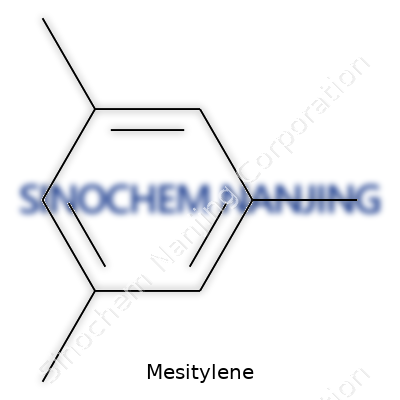
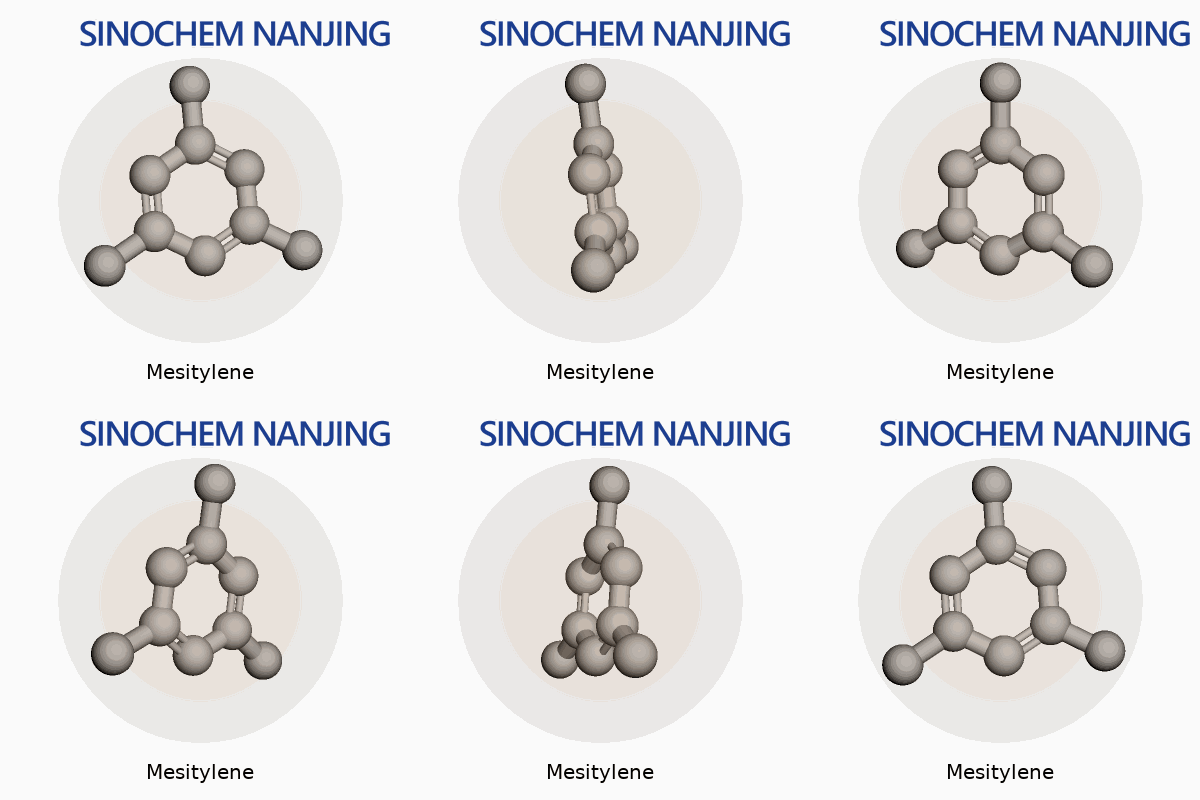
| Names | |
| Preferred IUPAC name | 1,3,5-Trimethylbenzene |
| Other names |
1,3,5-Trimethylbenzene Sym.-trimethylbenzene Mesitylbenzene |
| Pronunciation | /ˌmɛs.ɪˈtaɪ.liːn/ |
| Identifiers | |
| CAS Number | 108-67-8 |
| Beilstein Reference | 605605 |
| ChEBI | CHEBI:27871 |
| ChEMBL | CHEMBL1406 |
| ChemSpider | 6197 |
| DrugBank | DB04268 |
| ECHA InfoCard | 100.164.665 |
| EC Number | 203-604-4 |
| Gmelin Reference | 625023 |
| KEGG | C01579 |
| MeSH | D008770 |
| PubChem CID | 7807 |
| RTECS number | OI0700000 |
| UNII | YNWYZLUZHQVUOY-UHFFFAOYSA-N |
| UN number | UN1239 |
| CompTox Dashboard (EPA) | DTXSID2022651 |
| Properties | |
| Chemical formula | C9H12 |
| Molar mass | 120.19 g/mol |
| Appearance | Colorless liquid |
| Odor | Aromatic |
| Density | 0.864 g/cm³ |
| Solubility in water | Insoluble |
| log P | 2.7 |
| Vapor pressure | 0.97 kPa (at 20 °C) |
| Acidity (pKa) | 6.77 |
| Basicity (pKb) | 12.0 |
| Magnetic susceptibility (χ) | -72.4·10⁻⁶ cm³/mol |
| Refractive index (nD) | 1.495 |
| Viscosity | 0.66 mPa·s (20 °C) |
| Dipole moment | 0.00 D |
| Thermochemistry | |
| Std molar entropy (S⦵298) | 199.6 J·mol⁻¹·K⁻¹ |
| Std enthalpy of formation (ΔfH⦵298) | −34.1 kJ·mol⁻¹ |
| Std enthalpy of combustion (ΔcH⦵298) | -4590.8 kJ/mol |
| Pharmacology | |
| ATC code | 'V03AB18' |
| Hazards | |
| GHS labelling | GHS02, GHS07 |
| Pictograms | GHS02,GHS07 |
| Signal word | Warning |
| Hazard statements | H226, H315, H319, H335 |
| Precautionary statements | P210, P261, P273, P301+P310, P302+P352, P305+P351+P338, P501 |
| NFPA 704 (fire diamond) | 2-3-0 |
| Flash point | 77 °C |
| Autoignition temperature | 537 °C |
| Explosive limits | 1.1–6.4% |
| Lethal dose or concentration | LD50 oral, rat: 5000 mg/kg |
| LD50 (median dose) | LD50 (median dose): Oral (rat): 5000 mg/kg |
| NIOSH | SY6125000 |
| PEL (Permissible) | 25 ppm |
| REL (Recommended) | 25 ppm |
| IDLH (Immediate danger) | 500 ppm |
| Related compounds | |
| Related compounds |
Benzene Toluene Xylene Durene Isodurene Hemimellitene Pseudocumene |



