Isoprene: Where Science Meets Everyday Life
Historical Development
Anyone taking a walk through the timeline of chemistry will find isoprene cropping up much earlier than people expect. Chemists in the 19th century scratched their heads over the strange oily liquid they noticed in tree sap and tar. The real race kicked off with Charles Goodyear and his famous accidental discovery of vulcanized rubber. Isoprene, a five-carbon diene, soon landed square in the middle of the conversation, not just as a curiosity in natural rubber but as a molecule with big potential for the climbing industrial age. By the 20th century, wars and shortages forced the push for synthetic rubber, and isoprene took center stage. The Soviets poured resources into synthesizing rubber for trucks and tanks. Across the globe, research teams learned not everything could be left in the hands of nature—or the climate of the tropics. Now, isoprene’s journey has tracked from wild forest saps to high-volume production in giant chemical plants, reflecting patterns seen across many building blocks of the modern world.
Product Overview
Most people don’t wonder where their car tires or running shoes get their bounce. Those springy soles, tough seals, and flexible hoses owe a lot to isoprene. It shows up as a nearly colorless liquid, pungent and flammable, and usually arrives in steel drums kept out of the sun. Isoprene’s main claim to fame is its spot at the core of polyisoprene rubber, both natural and synthetic. Chemists count on its reactive double bonds, which make it a handy starting point for tweaking and transforming into more useful forms. It doesn’t act alone; it's just one spoke in the wheel of a vast chemical supply chain.
Physical & Chemical Properties
With the molecular formula C5H8, isoprene still manages to punch above its weight. Boiling at about 34°C and giving off vapors easily, workers need solid ventilation where it’s stored and handled. The two double bonds built into its structure tweak its chemical nature toward reactions, especially under the right catalyst or spark. Its low viscosity helps it mix and flow, making large-scale reactions practical. Left open, it vaporizes quickly, and it floats on water, showing just how combustible it can get around open flames or sparks.
Technical Specifications & Labeling
Barrels and tankers full of isoprene don’t just roll out without clear warnings. Standard packaging has to connect with safety regs, including clear hazard marks for flammability. A tightly controlled supply chain keeps it from degrading or gumming up during transport. Purity often matters, thanks to the way trace impurities can change the way rubber comes out at the tail end. Labels focus on more than just the name—flash point, boiling point, and emergency procedures elbow their way next to regulatory codes. Winning trust in a deal comes down to more than numbers on a page; it rides on chemistry that works in the real world, not just in the lab.
Preparation Method
For a long time, squeezing sap from the hevea tree played the leading role in getting isoprene. Economies found out quickly they couldn’t always count on nature alone. By the early and mid-20th century, sets of industrial processes ramped up. Today, bulk isoprene runs off every kind of chemical assembly line: steam cracking of naphtha, dehydrogenation of isoamylene, even fermentation at smaller scales. Planners often lean toward steam cracking since it fits with other petrochemical processes. Every method brings with it a different set of waste, cost, and energy tradeoffs—but that’s the deal with large-scale industrial chemistry.
Chemical Reactions & Modifications
Isoprene doesn’t shy away from new chemistry. It flips into polymerization right away with a helping hand from catalysts, forming rubbers with elastic properties that fuel countless industries. Scientists work these reactions with surgical precision, controlling temperature, pressure, and catalyst to pull specific traits out of the resulting material. Modifications don’t stop at rubber alone. Grafting other molecules onto the isoprene backbone, chemists have developed adhesives, coatings, and specialty elastomers. Its double bonds react with halogens, acids, and other small reagents, opening the door to specialty chemicals used in pharmaceuticals and fragrances. Lab benches and pilot plants alike have seen isoprene as an eager template for new reaction pathways.
Synonyms & Product Names
Chemists and suppliers call isoprene by its standard name, but older literature might use “2-methyl-1,3-butadiene.” Some corners of the trade refer to it simply as “polymer-grade monomer.” Names don’t change the fact that every bottle or drum carries the same core chemical. Most synthetic products hide isoprene in the names of their end-products: “polyisoprene,” “cis-1,4-polyisoprene,” or in certain cases, names of brands built around its rubbery qualities. Whether in formula lists or project plans, the molecule stands out for what it helps make, not just its label.
Safety & Operational Standards
On the plant floor, safety isn’t up for debate. Isoprene poses fire and explosion risks due to its low flash point and tendency to vaporize. Direct inhalation or skin exposure, even for a short time, brings potential for headaches or irritation. Workers keep proper gloves, goggles, and air monitoring gear close by. EPA and OSHA have clear standards, and major producers run drills for leaks or spills right alongside fire training. Storage involves pressure-rated steel and well-ventilated areas, far from ignition points. Good practice doesn’t stop with the immediate team; it reaches into the communities and the environment surrounding production sites, forcing accountability beyond the fence line.
Application Area
Where rubber matters, isoprene follows. Tires eat up the bulk of all polyisoprene. Belt makers and shoe manufacturers chase after its resilience and bounce. In medicine, isoprene-based latex shows up in surgical gloves, baby bottle nipples, and catheters—places where purity, softness, and safety all intersect. Some high-tech sectors pick up isoprene derivatives for use in adhesives or as intermediate chemicals that shape fragrances, plastics, and even agricultural compounds. Across these fields, the question isn’t whether isoprene matters, but how much depends on its reliable supply and tailored properties.
Research & Development
Research teams turn over every stone to drive greener and more cost-effective isoprene production. Some push deeper into bio-production, where genetically engineered microorganisms chew through sugars and pump out isoprene. Others angle for better catalysts and lower-energy synthetic routes. Improvements in polymerization lead to longer-lasting tire treads, medical products with fewer allergens, or other engineered properties. Academic centers and industrial labs stress test polyisoprene’s performance—tracking microscopic changes over millions of cycles, exposing it to chemicals, or measuring off-gas. Big change rarely happens overnight, but it stacks up through steady refinements and open collaboration.
Toxicity Research
No responsible company can dodge the hard questions about toxicity. Inhaled isoprene sits on regulatory lists of occupational hazards: short-term exposure can cause dizziness or respiratory irritation, long term shows some evidence for higher cancer risk in animal studies. Environmental impacts come under scrutiny, too, since isoprene can react in the air to create ground-level ozone, contributing to smog. Labs around the world keep sifting data, updating health guidelines, and looking at ways to minimize exposure by tightening processes, monitoring emissions, and using enclosed systems wherever possible.
Future Prospects
Looking forward, isoprene faces the same crossroads as many petrochemical building blocks. Fears over fossil fuel reliance and greenhouse emissions push the search for renewable sources. At the same time, performance demands keep rising. On one hand, bio-based isoprene from agricultural waste or purpose-grown plants could pull the industry away from oil altogether. On the other, relentless tweaking in materials science keeps uncovering new uses—whether it’s for flexible electronics, specialty adhesives, or safer medical devices. Market demand doesn’t seem poised to drop, but what changes is how isoprene gets produced and how makers handle its footprint on health and environment. The coming decades may not erase isoprene itself, but the chain linking nature, industry, and innovation seems set for another turn in the story.
What is isoprene and what is it used for?
Digging Into Isoprene’s Role
Most folks don’t think much about where their tires, gloves, or sneakers come from. I didn’t either, until I learned how one small molecule powers modern life as we know it. Isoprene is a colorless liquid that pops up nearly everywhere, and its chemical punch packs a major wallop for manufacturing.
This compound starts out in crude oil and natural gas and also comes from some trees—especially rubber trees. That might sound simple, but turning raw isoprene into the things people depend on each day takes real know-how. Factories churn through millions of tons each year, proving that isoprene isn’t just another obscure chemical; it’s an indispensable workhorse.
Why Industries Rely on Isoprene
The main job for isoprene goes to the making of synthetic rubber. Think of the tires on every car, truck, or bike rolling down the street. These aren’t just old-school rubber tapped from trees. More than half of the world’s rubber actually comes from isoprene that’s been cooked up in giant chemical reactors. Synthetic rubber gets used everywhere—shoes, hoses, seals, and conveyor belts all depend on it holding up under pressure, flexing without falling apart, and surviving temperature swings.
Outside the tire world, isoprene shines in medical supplies. Doctors and nurses wear gloves made from synthetic latex every day because the material fights off tears and stands strong against disease. Allergy concerns with natural latex have led even more hospitals toward isoprene-based products.
The Real-World Impact of Isoprene
Isoprene’s reach goes way past manufacturing and medical care. It shows up as fragrances in cosmetics and cleaning products. Some scientists even study how isoprene moves through forests and the atmosphere—because trees breathe it out, and it can shape local air quality in big ways.
Because isoprene plays a role in pollution, the debate around responsible production has started to heat up. Some plants leak the gas, and if it mixes with other emissions, it forms smog. That means companies need to take air monitoring seriously to keep neighborhoods safe. From experience, I know how important it feels to live in a community where you can breathe comfortably—crowded cities don’t have room for extra health risks.
Where We Go from Here
People and companies can’t just shrug off the negatives tied to isoprene. Producers set up better controls nowadays—using filtration, recycling leftover gases, and tracking leaks more closely. Workers need masks and proper training; that’s not just a regulation on paper, it keeps families safer back home.
There’s research on cleaner ways to make isoprene, too. Some labs want to use plants or engineered microbes, cutting out petroleum entirely. That idea feels promising not just for sustainability, but for lessening air problems linked to urban and industrial sprawl.
Isoprene remains a small player on the molecular scale, but it helps hold the modern world together. Tires carry food and families, medical gear keeps hands safe, and daily products point to a science story unfolding behind the scenes. By paying close attention to both opportunity and risk, society can keep building on isoprene’s value—without letting simple convenience cloud our responsibility.
Is isoprene hazardous to health?
Looking at the Facts Behind Isoprene Exposure
Isoprene pops up in plenty of everyday places. Factories release it, car exhaust gives off small amounts, and even trees throw it into the air. Our own bodies make isoprene, too, especially when we breathe or exercise. Still, most folks don’t think much about what it does, at least not until the word “hazard” comes up.
Industry loves isoprene because it’s a building block for synthetic rubber, adhesives, and other materials. Heavy production in the U.S., China, and Europe means workers end up spending long hours around it. I've worked in industrial areas and saw how smells from plants linger well past quitting time. No one likes the idea of breathing in something that could cause harm, no matter how common it is.
Research Shows Real Risks
Plenty of studies looked at how isoprene affects health. Long-term animal research links isoprene exposure to higher cancer rates, especially in mice. Researchers spotted more liver, lung, and kidney tumors in small critters breathing in a lot of it each day. A few government agencies, like the International Agency for Research on Cancer (IARC), call isoprene “possibly carcinogenic to humans.” While direct links in people remain tricky to pin down, the signs from animal tests can’t be ignored.
The U.S. Environmental Protection Agency (EPA) takes a conservative stance. Agencies set exposure limits for air and workplaces. The Occupational Safety and Health Administration (OSHA) places strict limits for workers: 3 parts per million over an 8-hour shift. Those rules recognize risk, even if studies in people haven’t finished. Symptoms from breathing in more isoprene—throat irritation, dizziness, headaches—sound mild, but over time, even low doses sometimes stack up.
Real Life Impacts: Who Faces the Biggest Danger?
People making rubber or adhesives see the highest levels at work. Workplace safety gear, proper ventilation, and careful maintenance all play a part in lowering risk. In my experience, workers keep a close eye on air quality but still get concerned, especially after hearing about animal cancer research. Health officers often run training sessions on exposure limits. Despite this effort, things go wrong if equipment malfunctions or companies cut corners.
Outside of factories, the average person breathes far less isoprene—most cities measure outdoor air at levels way under safety guidelines. That’s good news, since most folks only face isoprene occasionally, maybe while stuck in traffic or walking near busy intersections.
Lowering the Risks: Better Choices, Safer Work
Focusing on prevention works best. The goal shouldn’t just be legal compliance but building a culture of awareness. Factories with newer systems, proper exhaust fans, and regular air tests cut exposure sharply. Worker education—straightforward, no-nonsense—makes the rules more than just paperwork.
Cleaner manufacturing methods and greener chemistry help, too. A few companies already started swapping out isoprene-based materials for less risky alternatives, at least for some products. Extra research into isoprene’s long-term effects in people could push more industries to adjust.
No one gets a choice about their body making its own isoprene. For everyone else, plenty can still be done to keep levels safe, especially on the job. Listening to science, setting tough standards, and improving oversight stand out as the most reliable paths for protecting health.
How is isoprene produced or synthesized?
What Fuels the Need for Isoprene?
Anyone driving a car, chewing gum, or donning a pair of athletic shoes meets isoprene without realizing it. The tire industry, especially, leans hard on this colorless liquid for making synthetic rubber. Natural rubber from trees has its place, but the globe’s appetite for mass-produced goods outpaces what those trees can offer. That pressure didn’t pop up yesterday; it’s ridden alongside industrial growth since the early 1900s. But where does all this isoprene come from, and why do production choices actually matter to people and the planet?
How Industry Makes Isoprene
Factories crank out most of the world's isoprene through the cracking of petrochemicals. Petroleum and natural gas supply the backbone: workers break down larger hydrocarbons like naphtha, sending them through furnaces at high heat. The end product lines up as a mix of different chemicals. After that, teams use distillation to separate out what they need, and isoprene joins the lineup. This process built an empire of cheap, abundant rubber that runs the modern world. According to industry sources, about 800,000 tons of isoprene flows from plants worldwide each year.
On the flip side, some trees—particularly Hevea brasiliensis—produce isoprene naturally. Farmers tap them for the latex in much the same way as maple syrup collection. Yet that source can’t fill every order. Demand outpaces trees, pushing manufacturers back to oil and gas. The chemical route easily out-muscles nature in sheer output, but it comes with baggage.
Environmental Choke Points
I’ve seen far too many towns bear the heavy cost of petrochemical production. Cracking, distillation, and burning all churn out greenhouse gases and toxic byproducts. The US Environmental Protection Agency links these emissions to smog, higher disease rates, even climate change. Fossil fuel dependence also creates price shocks—every conflict in an oil-rich corner of the world trickles down to cost hikes on sneakers and tires. The synthetic rubber juggernaut pulls along a shadow few casual product users see.
Biotech’s Promise and Roadblocks
Biotechnology keeps edging into this market. Researchers in labs and business parks rewire bacteria and yeast, teaching them to pump out isoprene the way trees do. Companies like Genomatica and Amyris chased small-scale runs of microbe-made isoprene, eyeing the day petroleum might not be the only option. This route cuts fossil fuel reliance, slashes carbon footprint, and uses renewable sugars from corn or cane. Still, real scale takes more than test tubes. Feedstocks such as corn bring fresh questions around land-use and food prices, while commercializing bio-based platforms calls for funding, regulation, and cultural acceptance.
Pushing for Smarter Solutions
If we treat isoprene as just another invisible commodity, the negative impacts stack up. People in communities near chemical plants deserve clean air, and the earth could do with less strain from fossil carbon. Business has a way of following money, so consumer interest in green products moves the needle. Policy can steer companies, too, with carbon pricing and investment in alternative feedstocks. Research shouldn’t slow down; breakthroughs in cell engineering and process design could reshape the story, making isoprene production safer, cleaner, and possibly more local.
The journey from oil barrel or tree sap to finished product doesn’t end on a factory floor. It stretches into neighborhoods, supply chains, and ecosystems. Even something as small and unremarkable as isoprene sits at a crossroads of technology, environment, and daily life.
What are the storage requirements for isoprene?
Challenges of Handling Isoprene
Isoprene is flammable, volatile, and feels unpredictable in the hands of anyone not prepared for its quirks. Storing it isn’t as simple as stacking drums in a corner. I’ve walked into facilities that smell sharp, almost sweet, like you know something wants to escape. That’s isoprene, even in tiny concentrations. Anyone who’s read about the 1951 Texas City disaster, rooted in chemical mishandling, has seen how dangerous small oversights get with highly volatile chemicals.
Flammability Comes First
Flashpoint at –48 °C makes just about every spark and static discharge a risk. Isoprene vapor forms explosive mixtures with air, which means a warm warehouse without proper ventilation courts disaster. Anyone storing drums or tanks should drag in grounding wires, spark-proof equipment, and explosion-proof lighting from day one — I’ve seen what happens when someone tries to cut corners with generic fixtures. It doesn’t take a big fault for disaster.
Temperature control plays a bigger role than many folks expect. Allowing heat to build up, especially in the summer, increases pressure inside containers, risking leak or rupture. I always recommend refrigerating isoprene to handle vapor pressure. The chemical industry standard typically keeps it below 10°C. But chilling needs more than a simple cold room. You can’t use household freezers; you want temperature alarms, backup power, plenty of separation from ignition points, and easy cleanup for spills.
Pressure Buildup—A Real Threat
If containers sit unprotected from sunlight or placed near machinery exhaust, internal pressure can mount quickly. Drums and tanks should always allow a bit of headspace and use relief valves designed for hydrocarbons, the sort I’ve watched in action during storage audits. These aren’t overkill; they prevent hundred-liter mistakes from becoming warehouse-filling fireballs.
Keep Oxygen Away
Oxygen isoprene contact in storage leads to not just fire danger but also gum formation—a sticky, polymerized mess. I’ve scraped this gum out of valves before. Fill tanks with nitrogen to blanket the liquid, pushing out air. Nitrogen-blanketing isn’t exotic; it’s a straightforward solution that protects both the product and the workers.
Choosing the Right Container
Isoprene aggressively attacks certain plastics, so stainless steel makes the safest tank material. Polyethylene? It barely lasts a season before degrading. Big operators use double-walled tanks and dike the area for secondary containment—small spills are still hazardous since vapors ignite quickly. I once saw a minor leak spiral into a headache for an entire team, all down to the wrong gasket material chosen for a single valve.
Worker Protection
Smelling a hint of isoprene in the air is already too much. Occupational Safety and Health Administration (OSHA) puts the permissible exposure limit at 20 ppm for good reason. Every storage area should have sensors, alarms, and trained workers ready for leaks. Simple habits, like removing ignition sources and storing only as much as needed, turn catastrophic risk into manageable routine.
Looking Forward
Newer regulations keep raising the bar for storing high-hazard chemicals like isoprene. Automatic fire suppression, real-time vapor monitoring, and digital logs help catch small issues early. Companies investing in smarter storage—alarmed pumps, remote monitoring, and automatic nitrogen blanketing—can spot leaks or pressure spikes long before anyone’s at risk. Learning from past mistakes saves both lives and business. For anyone working with isoprene, the storage area should get as much attention as the production line.
Is isoprene environmentally safe or biodegradable?
What Isoprene Brings to Our Lives
Plenty of folks have heard of natural rubber, but fewer realize isoprene makes up the core molecule behind it. Almost every car tire on the road, every hospital glove, and more, owes something to isoprene. Synthetically produced or straight from certain trees, isoprene seems to pop up everywhere.
The Environmental Question
People look at any industrial chemical with suspicion these days, for good reason. Isoprene enters the conversation because not only does nature make it—plants and even humans let it out into the air—but manufacturers churn out thousands of tons every year to keep up with demand. The critical issue circles back to whether this stuff lingers, breaks down safely, or quietly causes trouble.
Biodegradability means nature’s own processes can snap a molecule apart, recycling each bit instead of piling up in soil or water. Natural rubber, made almost entirely of isoprene units, does break down very slowly because micro-organisms chew through it bit by bit. Pure isoprene, though, escapes into the air pretty quickly. Left on soil or in water, it evaporates or gets chewed up by bacteria. Its structure, basically a chain of carbon and hydrogen, helps microbes recognize and digest it. The U.S. Environmental Protection Agency and similar organizations point out that isoprene will not persist for years in the environment.
Synthetic rubber tells a different story. Industrial processes add other ingredients, cross-links, and fillers, slowing down the natural breakdown. Car tires and latex gloves throw isoprene molecules into a sort of plastic prison—bacteria can’t get at the pieces easily. As a result, whole products, not just raw isoprene, end up clogging landfills for generations.
Isoprene in the Atmosphere
Trees send over 500 million tons of isoprene into the air each year, much more than humans produce in factories. My own memory of a humid summer walk often comes tangled up with the scent of fresh greenery—that’s isoprene from oaks, poplars, and eucalyptus. Sky scientists call isoprene a “volatile organic compound”; it jumps out of leaves and enters the ozone cycle. This means isoprene speeds up ozone creation when it mixes with car fumes and sunlight, nudging up local smog and air quality headaches in big cities. Facts from NASA and EPA studies show that urban areas surrounded by lots of trees grapple with summer haze as plant-produced isoprene reacts with emissions.
Keeping an Eye on Solutions
As a society, we need to use fewer single-use rubbers and collect more waste for recycling. Researchers tinker with products to make them break down faster or depend less on additives that block biodegradation. Plant-based rubbers hold more promise for returning safely to the soil, as do some synthetic blends designed to degrade. Cities and industry groups have started chipping away at end-of-life rubber mountains, either with chemical recycling or by finding new ways to reuse old tires and gloves.
Final thought: Anything produced by humans in large amounts can outpace what nature can handle. Isoprene, in its pure form, shows a friendly side to microbes and breaks down. Problem arrives in what we add to it and how we use it, especially in slow-decaying rubber products. Striking a smarter balance in production and disposal stays right at the heart of environmental safety discussions.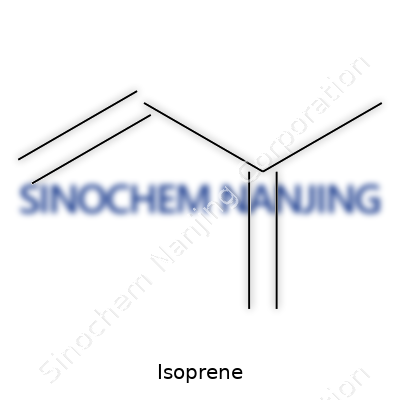
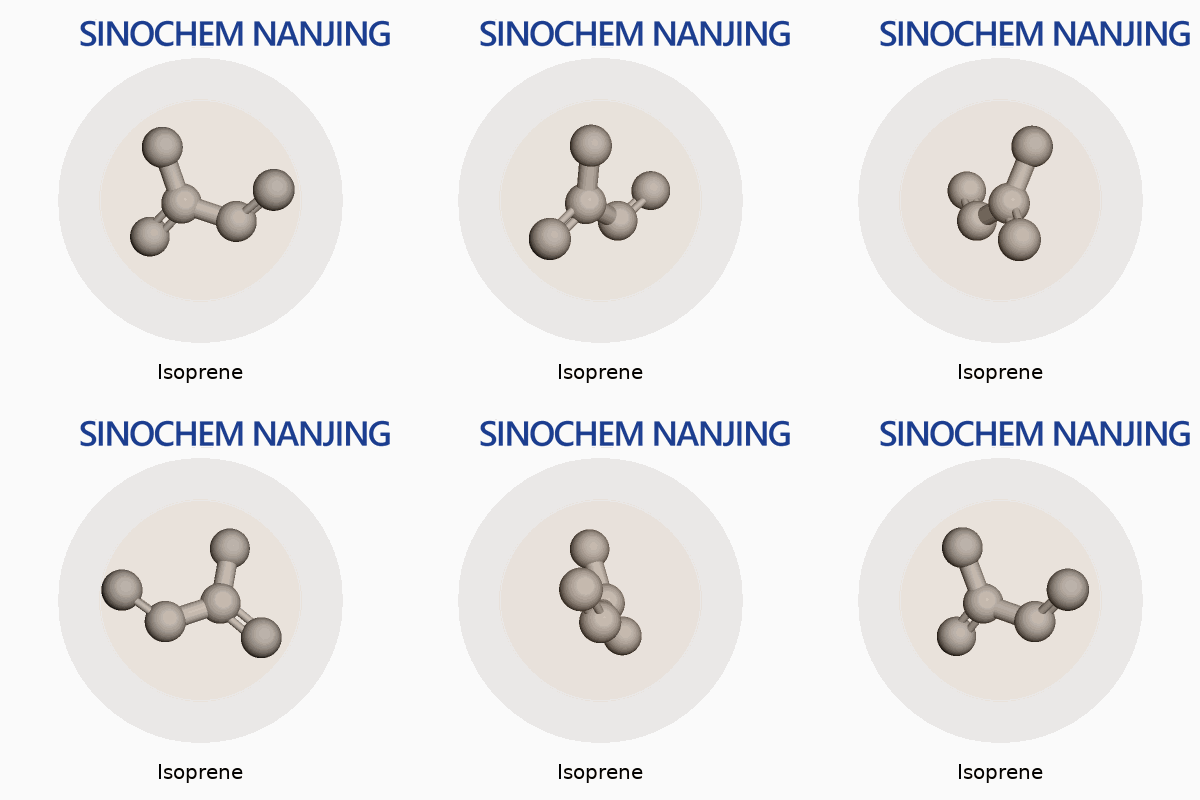
| Names | |
| Preferred IUPAC name | 2-methylbuta-1,3-diene |
| Other names |
2-methyl-1,3-butadiene Isoterpene 2-Methylbuta-1,3-diene |
| Pronunciation | /ˈaɪ.səˌpriːn/ |
| Identifiers | |
| CAS Number | 78-79-5 |
| Beilstein Reference | 1718733 |
| ChEBI | CHEBI:17544 |
| ChEMBL | CHEMBL14261 |
| ChemSpider | 5366 |
| DrugBank | DB01970 |
| ECHA InfoCard | 100.003.325 |
| EC Number | 200-817-4 |
| Gmelin Reference | 562 |
| KEGG | C06574 |
| MeSH | D007533 |
| PubChem CID | 6557 |
| RTECS number | GI8385000 |
| UNII | K4H6ZG93Y6 |
| UN number | UN1218 |
| Properties | |
| Chemical formula | C5H8 |
| Molar mass | 68.12 g/mol |
| Appearance | Colorless liquid with a faint petroleum-like odor. |
| Odor | mild petroleum |
| Density | 0.681 g/cm³ |
| Solubility in water | 0.6 g/L (20 °C) |
| log P | 2.42 |
| Vapor pressure | 5.3 bar (20 °C) |
| Acidity (pKa) | 16.7 |
| Basicity (pKb) | 10.7 |
| Magnetic susceptibility (χ) | -8.6×10⁻⁶ |
| Refractive index (nD) | 1.409 |
| Viscosity | 0.68 mPa·s (at 20°C) |
| Dipole moment | 0.51 D |
| Thermochemistry | |
| Std molar entropy (S⦵298) | 311.0 J·mol⁻¹·K⁻¹ |
| Std enthalpy of formation (ΔfH⦵298) | -20.0 kJ mol⁻¹ |
| Std enthalpy of combustion (ΔcH⦵298) | −3010 kJ·mol⁻¹ |
| Pharmacology | |
| ATC code | N01AX02 |
| Hazards | |
| GHS labelling | GHS02, GHS07, GHS08 |
| Pictograms | GHS02,GHS07 |
| Signal word | Danger |
| Hazard statements | H225, H315, H319, H335, H351 |
| Precautionary statements | P210, P233, P240, P241, P242, P243, P261, P264, P271, P273, P280, P302+P352, P304+P340, P308+P313, P332+P313, P337+P313, P362+P364, P370+P378, P403+P235, P403+P233, P405, P501 |
| NFPA 704 (fire diamond) | 2-4-3 |
| Flash point | -48°C (-54°F) |
| Autoignition temperature | 220 °C |
| Explosive limits | 1.5% - 9.7% |
| Lethal dose or concentration | LD50 oral rat 7400 mg/kg |
| LD50 (median dose) | LD50 (median dose): 2100 mg/kg (oral, rat) |
| NIOSH | TI8010000 |
| PEL (Permissible) | PEL: 400 ppm |
| REL (Recommended) | 3 ppm |
| IDLH (Immediate danger) | 800 ppm |
| Related compounds | |
| Related compounds |
2-Methyl-1,3-butadiene (Isoprene) Butadiene Myrcene Chloroprene Cyclopentadiene Geraniol Farnesene |



