Hexamethyldisilazane: A Ground-Level Look at a Unique Chemical Player
Historical Development
Hexamethyldisilazane, sometimes called HMDS, first caught major attention decades ago as the world of organosilicon chemistry picked up steam. Chemists in the 1950s, eager for new tools to protect sensitive groups during multi-step syntheses, found value in this compound. Over time, demand moved from academic benches to industry floors, especially in the electronics boom when photoresist adhesion became a production bottleneck. This intersection of curiosity and clear need shaped HMDS into a mainstay for labs and factories alike.
Product Overview
HMDS, carrying the formula (CH3)3SiNHSi(CH3)3, joins the lineup of silazane derivatives with a reputation for versatility. Clear, colorless, and with a sharp ammonia-like smell, it doesn’t look like much on the surface. Yet its ability to replace reactive -OH groups with protective -Si(CH3)3 units has kept it on chemical shopping lists from semiconductor plants to biotech startups. Many researchers value its way of making surfaces less sticky to water, a practical trait in microfabrication and other settings where even invisible traces of moisture spell trouble.
Physical & Chemical Properties
HMDS flows as a low-viscosity liquid at room temperature. It handles typical acetone and hydrocarbon solvents easily and brings a boiling point that lets it vaporize under standard laboratory conditions. Its volatility makes it easy to deposit onto wafers or glass slides, but also means anyone using it should keep the hood sash down. Chemically, HMDS reacts strongly with water, splitting into trimethylsilanol and ammonia in a fast, exothermic step. This water shyness sits at the core of its value both in organic synthesis and surface treatment.
Technical Specifications & Labeling
You see a wide purity range in commercial samples. Electronic grade lots promise the absence of particles and metal ions that cause havoc in chip production. Laboratory-grade material, while a bit less stringently filtered, gets the job done in silylation work or as a reagent for surface prep. Labels flag it as flammable and offer guidance on safe handling. Real-world experience in any lab tells you not to take these warnings lightly — mixing HMDS and moisture is an easy way to foul up a reaction or worse, set off a cloud of ammonia vapor.
Preparation Method
Old hands remember making HMDS by reacting hexamethyldichlorodisilane with ammonia. Today, most production routes stick with that theme, swapping chlorosilane for ammonia or other amines to drive the transformation. Vapor-phase synthesis routes yield purer products especially for electronics, while batchwise approaches satisfy most other markets. Smart engineering keeps water out of the process, since even traces cut yield and force extra purification steps.
Chemical Reactions & Modifications
In the chemistry toolkit, HMDS comes through both as a silylating agent and as a nitrogen source. It swaps easily with -OH protons on alcohols or carboxylic acids, turning them into trimethylsilyl derivatives. Chemists looking to run water-sensitive reactions often use HMDS as a temporary mask, so functional groups survive under tough conditions. Research in more specialized areas, like organometallic chemistry, uses HMDS-modified intermediates to tune stability and reactivity. In every case, deft handling means taking into account its explosive reaction with water, along with careful workup to control byproduct ammonia.
Synonyms & Product Names
Alongside Hexamethyldisilazane and HMDS, the material pops up in catalogs under names like bis(trimethylsilyl)amine, N,N-bis(trimethylsilyl)amine, or even silylamine. Long shelf lives and the relative affordability of these materials have made such names familiar sights both in traditional catalog pages and digital procurement systems. It's worth checking for these synonyms during literature searches to avoid missing key developments or hazard notes.
Safety & Operational Standards
People working with HMDS learn early not to grow complacent. The compound flares up easily, turning even mild spark sources hazardous. The pungent ammonia odor that wafts out when things go wrong provides an early warning, but short of a major spill, most operations stick to strict ventilation and spark-free tools. Personal anecdotes collect quickly; the time a pipette sizzled in a humid room, the afternoon a beaker clouded up under an open window. Regulators require adherence to strict fire codes, and storage in tightly sealed, water-free environments is not optional for anyone wanting to keep incidents off their record.
Application Area
Semiconductor manufacturing tops the list for HMDS usage, especially as a primer for silicon wafers ahead of photoresist application. Its ability to render surfaces hydrophobic ensures crisp pattern transfer and reduces defects during chip etching. Outside electronics, folks in the pharmaceutical industry lean on HMDS for preparing samples before GC-MS analysis, cleaning up active sites for catalyst work, or as a silylation agent in complex molecule synthesis. Researchers in organic chemistry labs appreciate its straightforward chemistry and the way it helps them push reactions that stall or degrade under wet conditions. Textile finishing, specialty coatings, and polymer modification all find a use for HMDS where water resistance, chemical durability, and clean modifications matter.
Research & Development
Research communities keep a sharp eye on new uses, greener synthesis routes, and strategies to minimize waste. Teams investigating greener alternatives want to reduce the environmental footprint both of its manufacture and of its byproducts, including the energetic ammonia released during hydrolysis. Advances in nanofabrication and MEMS devices keep HMDS relevant as both tool and research subject. Practical challenges like improving selectivity in silylation or finding ways to reuse or safely dispose of spent reagent drive collaborative projects between academia and industry. Grant agencies now ask about life cycle analysis and environmental discharge, reflecting broader societal shifts toward sustainability in specialty chemical production.
Toxicity Research
Though HMDS doesn’t attract the red flags of some organosilicon cousins, it can cause skin and respiratory irritation. Chronic exposure carries poorly understood risks, so prudent labs stick to tightly managed protocols and regular safety reviews. Toxicology studies show acute irritancy, especially at high concentrations. A friend running long syntheses learned to take the flushing eyes and dry mouth as early warning signs. Regulatory bodies set workplace exposure limits, but uncertainty remains about long-term low-dose effects, prompting continued monitoring and more granular research.
Future Prospects
Demand for advanced materials and new processing techniques keeps HMDS front and center. Upgrades in semiconductor lithography translate into more precise control over silylation chemistry, so refinements in HMDS use continue to matter. Sustainability pushes, both internally from industry and externally through regulatory shifts, prompt manufacturers to look for process improvements—less waste, lower emissions, and closed material loops. Next-generation biomedical devices, microfluidics, and finer organic syntheses need reliable, flexible reagents. HMDS, through decades of steady adaptation and a reputation built on performance, stands likely to hold its ground. Still, the industry doesn’t stand still. Researchers search for drop-in replacements with even lower toxicity and better environmental characteristics. For now, HMDS stays relevant not just because of its technical value, but also through a continuous balancing act of safety, efficiency, and practical outcomes.
What is Hexamethyldisilazane used for?
A Chemical That Shapes Modern Manufacturing
Hexamethyldisilazane, or HMDS, slips into many labs without fanfare, but it pulls a heavy load behind the scenes. Chemists and engineers call on it when regular old solvents and cleaning agents come up short. If you’ve ever seen a pristine silicon chip or noticed that electronics are shrinking, HMDS deserves some credit. Working in a semiconductor facility, I saw its impact first-hand. Those chips don’t start smooth and flawless—HMDS plays its part in making surfaces ready for the next step. You’ll find technicians using it on wafers, prepping them so light-sensitive coatings stick just right. Without that strong surface prep, the photographic process that draws intricate chip patterns wouldn’t work nearly as well. Miss a step with HMDS, and you’re staring at costly process errors.
Beyond Microchips—Lab Tools and Medicine
Not everything HMDS touches winds up in a circuit. Masters students crowding around a NMR machine already know this. Many researchers trust HMDS as a silylating agent. It helps swap out hydrogen atoms for silicon ones, making stubborn molecules easier to work with. For instance, some medicines need precise chemical tweaks before anyone can analyze them. HMDS helps chemists “dress up” molecules, making them less sticky or reactive before testing. After working with organic synthesis in grad school, I learned that these transformations save labs hours of troubleshooting.
Working with Glass, Ceramics, and Adhesives
Artists and industrial designers rarely cross paths with silicon wafers, but even they owe HMDS a nod. Adhesion often becomes a frustration. HMDS “primes” surfaces, adding a sort of invisible handshake between two different materials. If you’ve fixed a tiny crack in a glass beaker or needed glue to stick to a polished ceramic, you may have benefited from a process that starts with this compound. Manufacturers treat surfaces with HMDS to keep coatings stable. Having worked with laboratory glassware, I’ve seen how much easier cleaning and reuse becomes after these treatments.
Health and Environmental Questions
No tool serves every need without drawbacks. HMDS carries health and safety flags. Its fumes irritate the lungs and eyes, and folks working with it suit up in protective gear. Many labs invest in ventilation systems and regular training. If it spills or leaks, cleanups take care. The Environmental Protection Agency tracks where and how it enters the environment, since it doesn’t simply break down in soil or water. Those of us who have managed chemical inventories know the attention HMDS gets on a safety audit. Companies face pressure to find safer alternatives, keep exposure low, and train workers to respect the risks.
Looking Toward Safer Solutions
Science keeps moving, and so do regulations. Driven by concerns over toxicity, some organizations push for greener processes. Research groups experiment with different surface coatings that don’t rely on volatile chemicals like HMDS. Automation helps by keeping people and chemicals separated where possible. Employees ask for more transparency in workplace safety, pushing managers to improve air quality and chemical training. These changes aren’t always simple or cheap, but they nudge the industry toward less harmful routines.
Why This Matters
HMDS enables many breakthroughs we take for granted, from faster smartphones to more reliable medical tests. At the same time, it challenges workplaces to stay on top of health, safety, and waste. Awareness and innovation pave the way for safer labs, cleaner processes, and progress that doesn’t come at too steep a cost.
What are the safety precautions when handling Hexamethyldisilazane?
The Hazards Lurking in the Lab
Hexamethyldisilazane, or HMDS, gets a lot of use in research, electronics, and labs working with silicon wafers. It’s known for its usefulness in modifying surfaces, but this compound doesn’t mess around when it comes to risk. HMDS can catch fire easily, its vapors sting the eyes, irritate the lungs, and just one careless mistake can cause real trouble. I remember a time in grad school when a bottle of HMDS leaked — the stinging smell filled the room, and everyone got a lesson the hard way. Some lessons stick for good reason.
Personal Protection: Skimping Isn't an Option
There’s a rule many learn early: protect your skin, eyes, and lungs from HMDS. A pair of disposable nitrile gloves, a face shield over safety goggles, and a sturdy lab coat do more than tick off safety boxes — they cut down risk. Gloves should fit well and cover past the sleeve; HMDS can slip through small cracks and evaporates in a blink. Eye injuries from splashes take seconds and last a lifetime. Fume hoods aren’t just fancy furniture in the lab. Whenever HMDS bottles come out, the sash belongs down where your face won’t catch vapors. Decent airflow keeps vapor levels from getting out of hand.
Storage and Handling: Thinking Beyond the Label
HMDS does not play well with moisture or flames. Water reacts with it, turning surfaces slimy, and like many volatile organics, a careless spark or sloppy pour can set off a flash fire. Storing HMDS in a cool, dry spot away from acids, bases, and oxidizers just makes sense. Tight-fitting caps and labeled containers keep confusion to a minimum — no assumptions, no shortcuts. Anyone opening a bottle needs to double-check the seals and date; old, degraded HMDS brings extra hazards, so fresh stock is safer.
Spills and Emergencies: Speed and Smarts Matter
A good spill kit includes absorbent pads, a neutralizer fit for organosilicon compounds, and a sealed disposal bag. During a spill, fresh air and distance matter more than panic. Anyone affected needs clean air and medical help if they start coughing or feel dizzy. Regular drills and clear signs help — no one wants to hunt down instructions with tears in their eyes. Fire extinguishers rated for chemical fires (Class B) need to stand ready, checked and unblocked.
Training and Community Responsibility
People working with HMDS need proper training before the first bottle opens. Reading the Safety Data Sheet cover to cover gives more insight than a quick look at the label. In my own experience, workers need a real walkthrough — not just a signature on a safety form. Peer checks help spot missing gloves or careless habits. Supervisors set the tone, but culture grows from colleagues who have each other's backs.
Better Solutions for Safer Labs
Regular audits and peer feedback spark improvement. Digital tracking of chemical use can flag expired or overstocked HMDS. Where possible, swapping in less hazardous alternatives deserves consideration. Open conversation between lab managers and staff stops problems before they pile up. No one gets safety perfect, but real progress comes from shared vigilance, solid training, and a readiness to act fast when things go sideways.
How should Hexamethyldisilazane be stored?
Why Hexamethyldisilazane Needs Careful Attention
Working in labs and factories over the years has taught me respect for sharp-smelling chemicals that flare up at the drop of a hat. Hexamethyldisilazane, better known as HMDS, falls squarely into that category. A colorless, flammable liquid used for making silicon-based coatings and prepping microelectronics, it can cause chaos if left sitting in the wrong conditions. I’ve watched a simple mistake—like an open cap or a dented drum—lead to a week-long panic thanks to leaks and even small fires.
Storing HMDS Safely
Quality storage starts with good containers. Stainless steel drums line up as the top choice—no corrosion, no sneaky leaks, nothing that’ll react with what’s inside. Over the years, I’ve seen glass containers used in tight lab setups, but those come with breakage risks. Room temperature, away from sunlight, wins over cold rooms most days, simply because sudden temperature swings can build up pressure or mess with the container seals. Store HMDS in a cool, dry space, shielded from any moisture. Water sets off violent reactions and turns this clear liquid into a nasty hazard in seconds.
I once saw a dozen bottles left near a window in a store room; when the sun came through, the temperature shot up over a few hours. Sweat beaded on the exterior, and we had a stinky mess that cost money and time to fix. Sun and dampness bring risk—not just to the chemical, but to anyone nearby.
Fire Hazards and Ventilation
Let’s not mince words—HMDS fumes catch fire fast. Open flames, heaters, sparks from nearby machinery, or even static electricity dancing on a plastic container spell trouble. My advice for any workplace: keep HMDS far away from anything that could provide an ignition source. Many labs set up proper flameproof storage cabinets, and for larger operations, segregation from oxidizers or acids prevents disastrous run-ins. Good airflow in the storage space can sweep away low-lying vapors that build up. Always check for proper exhausts and certified fume hoods if you’re dealing with big volumes.
Labeling, Training, and Inspections
Thorough training prevents accidents before they start. Years ago, I saw a coworker reach for a bottle of what he believed was acetone—and splash himself with HMDS instead. Labels fell off or faded, and confusion set in. Labels with bold print, clear expiration dates, and hazard symbols make the difference. Anyone responsible should know what to do after a spill, how to use an eyewash, and whom to call if things go wrong. Regular checks flag broken seals, bulging drums, or misplaced bottles. Daily and weekly routines spot problems before they erupt into emergencies.
A Culture Built on Safety
While regulations offer guidance, building a real safety culture matters just as much. I’ve always believed in sharing lessons from mistakes—talking through close calls with coworkers and making everyone feel responsible. When it comes to storing HMDS, no shortcut justifies the risks. Safe storage demands methodical habits and equipment that won’t let you down. By treating HMDS with the respect it deserves, any lab or factory can run smoothly, keeping people and expensive projects safe from trouble.
What is the chemical formula of Hexamethyldisilazane?
Importance in Modern Laboratories
Chemistry often surprises people outside the field with how straightforward its building blocks can look on paper. Take hexamethyldisilazane—often abbreviated as HMDS by researchers who use it every day. Its chemical formula, C6H19NSi2, expresses a reality that seems far removed from its daily impact in science, industry, and even fields like art conservation. For those handling sensitive silicon wafers or preparing samples for a scanning electron microscope, HMDS shows up as an essential tool.
Everyday Experience Working with HMDS
My own time in research labs put me in contact with countless bottles labeled with HMDS. In tissue processing, labs use it to prepare surfaces so water slides away and samples mount cleanly. On a bigger scale, semiconductor manufacturers depend on HMDS for making surfaces friendlier to photoresist—the substance driving intricate patterning on chips that power smartphones and computers. According to the U.S. National Institute for Occupational Safety and Health, making silicon-based electronics often involves this compound, laying the groundwork for devices everyone uses on a daily basis.
Chemical Makeup and Behavior
The formula, C6H19NSi2, might seem a jumble of letters and numbers. Broken down, the six carbons and nineteen hydrogens form the methyl groups you find in everyday solvents and fuels. The single nitrogen bridges two silicon atoms at the heart of the molecule. All these elements add up to a chemical that doesn’t play nicely with water, which suits it perfectly for creating dry, hydrophobic surfaces. In practice, this means a drop of water beads up and rolls off anything treated with HMDS, much like rain on a well-oiled jacket.
Safety and Environmental Concerns
Anyone handling HMDS knows it brings both benefits and risks. Just a quick whiff in the lab can remind you this is not something to get casual about. Its vapors irritate eyes and lungs and can pose fire hazards. The Centers for Disease Control and Prevention spotlights the need for good ventilation and reliable protective equipment. Unlike some chemicals that break down harmlessly, unused HMDS demands careful disposal to prevent environmental troubles. Companies and laboratories follow strict rules for waste treatment, reflecting a growing respect for both worker safety and environmental health.
Exploring Alternatives and Improvements
Demand for safer, greener methods never slows down. Researchers keep searching for ways to replace HMDS or at least limit exposure. Some new photoresist technologies claim lower toxicity and similar performance. Educational outreach and strict procedures also limit accidental exposure, which helps young scientists develop good habits early. Companies redesign processes to keep HMDS use to a minimum, knowing regulators and customers watch chemical inventories closely.
A Place in Science and Industry
HMDS’s formula, C6H19NSi2, stands for more than a chemical—it represents a set of choices about how people clean, treat, and refine materials every day. Its convenience and power show what happens when chemistry leaves the textbook and reaches into the heart of modern work, shaping everything from microchips to medical samples. By understanding its benefits, handling risks with respect, and searching for even better solutions, the field moves forward, piece by piece.
Is Hexamethyldisilazane hazardous to health or the environment?
About This Chemical
Hexamethyldisilazane turns up in labs and factories as a silylating agent. Some folks use it to treat surfaces or as a reagent in organic synthesis. In my time working in a chemical plant, its sharp ammonia-like smell always kept me on alert. Sitting next to bottles of other reagents, it blends right in—until someone pops the cap, and the distinct odor fills the room.
Risks to Health
Breathing in the vapors from hexamethyldisilazane can irritate your nose and throat. Back in my early lab days, I saw a co-worker cough and complain of burning eyes after measuring a batch with poor ventilation. Chemical Safety Data consistently mention symptoms like headaches, dizziness, shortness of breath, and even nausea after exposure. Direct contact to skin or eyes can cause burns. Long sleeves and goggles aren’t simply company policy—they really stand between you and a bad day.
Accidental swallowing is rare, but it happens. Paramedics once came due to a mislabeled beaker. They warned about stomach pain, vomiting, and possible lung damage if the fumes got into someone’s lungs. These health effects are no exaggeration. Every year, health reports cite real injuries in both industrial and academic settings.
Bigger risks emerge during spills or fires. If hexamethyldisilazane leaks out or catches flame, it releases dangerous gases like ammonia and nitrogen oxides. Firefighters I’ve spoken with recall days wearing respirators for chemical blazes, praising the gear that protected their lungs from just this kind of smoke.
Impact on the Environment
Short-lived spills evaporate fast, but that doesn’t mean the problem just disappears. Evaporation turns the liquid into airborne contaminants. Once in the air, hexamethyldisilazane can enter nearby neighborhoods. Chronic exposure to such chemicals in the environment links to asthma, headaches, or other health problems, as detailed in studies by the National Institute of Environmental Health Sciences.
If it soaks into soil or leaks into water, it can harm plants and aquatic life. Aquatic toxicity studies show that exposure above certain levels stunts growth or kills fish and insects. Cities near chemical plants often see more fish kills after careless dumping—not all of it gets into the headlines, but local anglers notice.
Better Practices and Solutions
Working with chemicals always demands a healthy respect for risk. Good ventilation, gloves, goggles, and solid training keep the worst effects at bay. One solution that improved my lab’s safety record involved installing fume hoods and running regular air quality checks. These small investments paid off—exposure complaints dropped noticeably after just a month.
Labeling chemicals clearly, storing them away from heat or moisture, and limiting use to trained workers all cut down on accidents. After a scary near-miss, my old workplace started lockdown drills and regular emergency reviews. The extra prep time made sense the next time a container cracked during shipping—the protocol reduced exposure and panic.
Waste handling matters just as much. Following local regulations and sending waste to approved treatment facilities keeps hexamethyldisilazane out of streams and ponds. Community outreach programs where plant staff share details about chemical handling build trust with neighbors and keep everyone informed.
Staying Aware
Keeping conversations honest and open about hexamethyldisilazane’s dangers helps people work smarter. Nobody should need a near-miss to realize these hazards. Good practices, ongoing education, and accountability—for companies and individuals—offer the best defense against both health and environmental problems from this chemical.
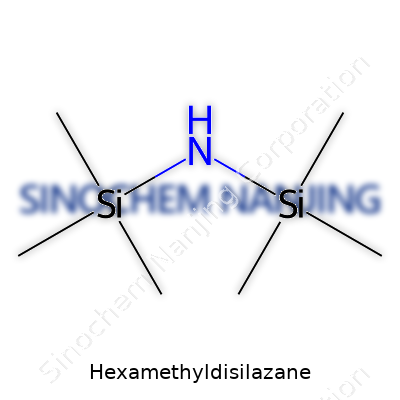
| Names | |
| Preferred IUPAC name | Trimethylazane |
| Other names |
Bis(trimethylsilyl)amine Hexamethyldisilazanyl HMDS 1,1,1,3,3,3-Hexamethyldisilazane N,N-Bis(trimethylsilyl)amine |
| Pronunciation | /ˌhɛk.səˌmɛθ.əlˌdɪ.sɪlˈeɪ.zeɪn/ |
| Identifiers | |
| CAS Number | 999-97-3 |
| Beilstein Reference | 358755 |
| ChEBI | CHEBI:59712 |
| ChEMBL | CHEMBL15860 |
| ChemSpider | 7410 |
| DrugBank | DB11192 |
| ECHA InfoCard | 100.003.126 |
| EC Number | 203-837-1 |
| Gmelin Reference | 9239 |
| KEGG | C06835 |
| MeSH | D006622 |
| PubChem CID | 6616 |
| RTECS number | MV5420000 |
| UNII | F93S028MOC |
| UN number | UN3380 |
| CompTox Dashboard (EPA) | DTXSID7020172 |
| Properties | |
| Chemical formula | C6H19NSi2 |
| Molar mass | 161.38 g/mol |
| Appearance | Colorless transparent liquid |
| Odor | Ammonia-like |
| Density | Density: 0.77 g/mL at 25 °C |
| Solubility in water | Insoluble |
| log P | 0.96 |
| Vapor pressure | 3 mmHg (20 °C) |
| Acidity (pKa) | 25.8 |
| Basicity (pKb) | 7.45 |
| Magnetic susceptibility (χ) | -48.0e-6 cm³/mol |
| Refractive index (nD) | 1.395 |
| Viscosity | 0.65 mPa·s (25 °C) |
| Dipole moment | 0.60 D |
| Thermochemistry | |
| Std molar entropy (S⦵298) | 322.1 J·mol⁻¹·K⁻¹ |
| Std enthalpy of formation (ΔfH⦵298) | -109.5 kJ/mol |
| Std enthalpy of combustion (ΔcH⦵298) | -4012 kJ·mol⁻¹ |
| Pharmacology | |
| ATC code | V03AB21 |
| Hazards | |
| GHS labelling | GHS02, GHS07 |
| Pictograms | GHS02,GHS07 |
| Signal word | Danger |
| Hazard statements | H226, H302, H312, H314, H332 |
| Precautionary statements | P210, P261, P280, P301+P312, P303+P361+P353, P304+P340, P305+P351+P338, P312, P330, P337+P313, P370+P378, P403+P235, P501 |
| NFPA 704 (fire diamond) | 2-3-1 |
| Flash point | 42 °C |
| Autoignition temperature | 400 °C (752 °F; 673 K) |
| Explosive limits | 0.7–17% |
| Lethal dose or concentration | LD50 Oral Rat 8500 mg/kg |
| LD50 (median dose) | LD50 (median dose): Oral rat LD50: 8500 mg/kg |
| NIOSH | KH7200000 |
| PEL (Permissible) | PEL (Permissible Exposure Limit) of Hexamethyldisilazane: "50 ppm (Ceiling) |
| REL (Recommended) | 0.03 - 0.05 |
| IDLH (Immediate danger) | 30 ppm |
| Related compounds | |
| Related compounds |
Trimethylsilyl chloride Hexamethyldisiloxane Tetramethyldisilazane |



