Heptanol: A Closer Look at a Chemical with Quiet Reach
Historical Development
A trip through the chemistry archives turns up heptanol as anything but glamorous, but that doesn’t mean it lacks quiet significance. Chemists first studied straight-chain alcohols like heptanol in the early part of the twentieth century, coffee-stained lab notes showing systematic breakdowns of longer carbon chains beyond the attention-grabbing ethanol and butanol. Heptanol’s tie to the broader push for aliphatic alcohols came at a time when extending the toolkit for synthetic organic work was a badge of pride. I recall paging through older textbooks, seeing heptanol listed with little ceremony, sandwiched between its shorter and longer cousins—almost as if it waited patiently for specialty uses to catch up to its capabilities. The rise of industrial organic chemistry in the mid-twentieth century gave heptanol a practical spotlight, especially as interest in surfactants and organic synthesis began to grow in postwar economies.
Product Overview
Heptanol isn’t a front-row star in most chemical conversations, yet its odd-carbon backbone, C7H16O, gives it a crucial niche. Among the straight-chain alcohols, it attracts interest for being long enough to show unique behavior compared to its smaller siblings. Many chemists picture heptanol as a colorless liquid that smells faintly medicinal, slipping quietly into chemical processes involving surfactants, esters, and plasticizers. Lab workers who use it for its solvent properties know that heptanol sits in a sweet spot: just enough carbon to stir up some interesting physical properties, but not so large that it drifts into waxiness or immiscibility.
Physical & Chemical Properties
Every high-school chemistry student learns that adding carbon atoms tweaks a molecule’s feel, and heptanol proves this in the lab. It looks clear in the flask, has a boiling point close to 176°C, and weighs about 116 grams per mole. Pour some on a watch glass and the scent telegraphs its alcohol nature. Its molecular structure, CH3(CH2)6OH, gives it both a hydrophobic tail for oily interactions and a hydrophilic head for hydrogen bonding. That dual nature shows up in emulsification experiments, in cleaning formulations, and even in the slow evaporation rates that help separate it from lighter alcohols. With a moderate vapor pressure and just enough solubility in water to be noticeable, it resists easy classification. Experience in the lab tells you that while it’s miscible with many organic solvents, it mixes only slightly with water, making it useful for partitioning experiments and solvent blends.
Technical Specifications & Labeling
Regulatory and labeling requirements treat heptanol with the caution expected of mid-sized alcohols. Chemical supply catalogs set the quality standards, usually demanding purity of at least 98 or 99 percent for research and industrial purposes. Labels warn against inhalation and skin contact, reflecting experiences with skin drying and the potential for mild toxicity upon absorption or ingestion. Storage guidelines ask for sealed containers, away from open flames, echoing personal memories of ventilated chemical stores and fume hood warnings. Material safety data sheets (MSDS) stick closely to established norms—flammable, irritant, requiring standard protective gear and grounded handling for bulk quantities.
Preparation Method
Heptanol synthesis tells the story of organic chemistry’s move from extraction to artificial routes. Early chemists wrestled with isolating it from castor or other plant oils, but most modern heptanol comes from chemical synthesis. The oxo process—hydroformylation of hexene, followed by hydrogenation of the intermediate aldehyde—remains the backbone method in industry. Years back in undergraduate labs, I watched instructors emphasize controlled hydrogenation and careful selection of catalysts, underscoring how small tweaks could shift alcohol chain length distributions. Side reactions can generate branched isomers, but straight-chain 1-heptanol remains the main industrial target.
Chemical Reactions & Modifications
Heptanol takes well to modifications familiar to anyone who has spent time with primary alcohols. Oxidation, using chromium reagents or milder conditions, channels it to heptanal or heptanoic acid, linking it to the world of aldehydes and carboxylic acids. Esterification adds industrial value, letting it serve in the making of fragrances and plasticizers. Direct substitution can give halides or ethers. I remember a few troubleshooting sessions in synthetic labs where controlling unwanted dehydration and side reactions with sulfuric acid proved trickier than textbooks suggested. Each modification opens a door: heptanoic ester for synthetic flavors, heptyl halides for specialty materials, or even ethers for laboratory solvents.
Synonyms & Product Names
In the chemical marketplace, heptanol goes by more than one name. Most often, it appears as 1-heptanol or n-heptanol, but catalogs sometimes list it as heptyl alcohol or simply heptan-1-ol. Context changes its label, but the straight-chain molecule underneath stays the same. Some fragrance and flavor industries might refer to it as heptanols, encompassing minor branched isomers. Consistent naming helps pin it down for researchers and buyers seeking exact compounds in a catalog sea of similar-sounding names.
Safety & Operational Standards
Labs working with heptanol follow straightforward but important safety practices. The chemical’s flammability means no open flames nearby, and fume hoods prevent buildup of vapors that could irritate the airways or trigger alarms. Personal experience reminds me that glove selection matters—heptanol soaks through latex fairly quickly, so nitrile or thicker rubber gets the nod for longer work. Spills get addressed with plenty of sorbent and good ventilation. Short exposures result in skin dryness, headaches, or mild nausea, especially at elevated concentrations. Factories scale up these precautions, deploying grounding, spark control, and improved ventilation to keep risks low. Clear labeling, training, and standard PPE set the baseline for most operations.
Application Area
Heptanol shines in several practical spots. Its chain length and reactivity give it a foothold in surfactants, lubricants, and plasticizers. It also steps into the fragrance and flavor industry for specialty esters that bring out “green” or slightly fatty notes. In organic synthesis, it serves as both a building block and a solvent for reactions that can’t risk the volatility or excessive solubility of smaller alcohols. Laboratory workers see it as a case study for partition coefficients in biochemistry, often measuring its partition between oil and water to model cell membrane transport. Industrial-scale applications, ranging from flavors to fine chemicals, draw on its ability to deliver hydrophobicity without becoming waxy or solid at room temperature.
Research & Development
Current research into heptanol spans several interesting threads. One area involves its effects on biological membranes, where its presence disrupts lipid bilayer packing, giving it a niche in studies of anesthesia and nerve transmission. Scientists in pharmacology look to heptanol to probe gap junction blocking in cell communication—a feature that has thrown up both opportunities and puzzles about heart arrhythmias and neural signaling. Other research circles back to surface chemistry, exploiting heptanol’s properties for new surfactant formulations or exploring its performance in renewable resource processing. Its behavior under alternative catalytic conditions occasionally spurs green chemistry research targeting energy-efficient or waste-reducing processes.
Toxicity Research
Animal studies give a clearer window on heptanol’s toxicity, showing that like many alcohols, it causes central nervous system depression at high exposures. Researchers measure LD50 values in rodents and observe mild liver stress at sub-lethal doses. In cell culture, heptanol’s action as a gap junction inhibitor creates both risks and research leads, particularly in cardiac tissue. Direct skin exposure dries and irritates, while inhalation induces symptoms similar to other medium-weight alcohols—drowsiness, confusion, and mild respiratory distress at high vapor concentrations. Most regulatory reviews group it with related alcohols; guidelines for workplace exposure focus on minimizing long-term inhalation and skin contact.
Future Prospects
Looking ahead, heptanol’s role may expand as researchers and manufacturers hunt for alternatives to legacy solvents and develop new surfactant and plasticizer systems with lower toxicity and environmental burdens. Sustainable chemistry efforts keep an eye on using plant-based feedstocks or engineered microbes for heptanol production, reflecting both regulatory pressures and consumer demand to shift away from petrochemicals. There’s ongoing curiosity about its use in fine-tuning drug delivery systems and exploring new reactions where a mid-chain alcohol carries the right blend of hydrophobicity and reactivity. Experiences from the past suggest that chemicals like heptanol benefit from quiet persistence—a readiness to surprise in future kitchens, labs, and factories, shaped by both new regulations and unanticipated applications.
What is Heptanol used for?
Heptanol in Everyday Products
Heptanol doesn’t make headlines often, but this simple alcohol has a knack for showing up where you least expect it. Most people haven’t heard of it, but walk down the cleaning aisle or let a scented candle burn at home, and you might cross paths with it. In personal care and household products, heptanol offers practical benefits—bringing a mild yet distinctive scent, helping mix fragrance oils, and lending texture to lotions and creams. It doesn’t get the fame of lavender or coconut, but it helps those ingredients blend smoothly so the product works as it should.
The Role in Industrial Applications
Heptanol's real muscle shows at the manufacturing level. Chemical plants use it when they need something that dissolves both water and oil-based substances. It dissolves certain dyes and resins, which means it steps right into the factories that craft paints, varnishes, and coatings. Chemists see heptanol as a reliable building block for creating plasticizers, which give flexibility to plastics instead of leaving them brittle. These seemingly small contributions support important supply chains, right down to the finish on your car’s dashboard or the paint that coats your garden furniture.
Healthcare and Research: Behind the Scenes
Pharmaceutical research taps heptanol’s properties too. Labs lean on it as a solvent during drug synthesis—not for the final medicine a patient takes, but as a trusted ingredient that helps other chemicals combine. Drug development can get complicated, and having a substance that safely and reliably carries out these bonding reactions is valuable. Heptanol also appears in scientific research that explores cell membranes or the nervous system—helping researchers understand how nerve signals get blocked or passed along.
Sustainable Chemistry: The Road Ahead
Anyone working with chemicals today feels pressure to weigh safety and sustainability. Heptanol isn’t classified as a highly toxic or cancer-causing substance for humans, but it doesn’t mean you can toss it down the drain. Exposure can cause skin irritation, eye discomfort, or problems if inhaled too much, so responsible handling matters. Factories now look harder at how they store, transport, and dispose of heptanol to prevent leaks or environmental harm. Environmental engineers are already rethinking how to source alcohols like heptanol from renewable feedstocks rather than petroleum, and green chemistry labs experiment with biobased routes that bolster both worker safety and environmental protection.
Charting a Responsible Path Forward
Making safer products calls for sticking with chemicals like heptanol only when their role can’t be filled by safer, milder options. Regulators and consumer advocates want more transparency about what cycles through our daily lives, which nudges manufacturers to reconsider old formulas. At the same time, education and responsive design keep pushing for less waste and lower risks. Companies that value safety train staff, keep storage tight, and document how their processes avoid accidents. Scientists and engineers continue searching for even better performance with a lighter impact on our bodies and ecosystems. Heptanol plays its part, but progress hinges on curiosity, accountability, and a willingness to try again until everyone benefits.
Is Heptanol safe to handle?
Understanding the Substance
Heptanol isn’t a household name. In labs, it shows up as a colorless liquid with a faint, sometimes unpleasant smell. Someone who’s worked in a chemistry lab knows it doesn’t look dangerous. Still, appearance can trick you with organic compounds like this.
Risks That Deserve Attention
There’s a temptation to treat heptanol like any other mild solvent, but people need to remember even common lab supplies can bring real risks. Touching heptanol straight with bare skin can cause irritation and dryness. Inhaling those vapors, especially over a long shift in a stuffy storeroom or a warm corner of the lab, can bring dizziness, headache, or nausea. In one notorious case, a technician cleaning glassware got a rash down both forearms from careless splashing. It taught me the lesson that gloves aren’t just a formality.
Liquid heptanol doesn’t ignite as easily as acetone or ether, but it burns fiercely once it gets going. Dropped cloths or contaminated paper thrown into a regular trash bin raise the fire risk, especially where lab safety checks slack off.
Facts That Shape How We Handle It
OSHA classifies heptanol as a hazardous material. That fact sits behind every warning label. Skin contact, eye splashes, or vapor inhalation all need a fast response, not a wait-and-see approach. National guidelines advise using goggles, lab coats, and resistant gloves (nitrile works better than latex). Good ventilation isn’t optional—open a window or turn on a fume hood.
Spilling heptanol can spread slick, almost invisible spots over tile and create a slip hazard or vapor buildup. Years ago, a spill in a teaching lab cleared out a whole class for the afternoon—nobody got badly hurt, but the smell lingered for days, a blunt reminder.
Building a Safer Routine
Straight talk: no shortcut beats basic lab safety. Heptanol belongs in sealed, labeled containers, away from open flames or static sources. Anyone transferring liquids should pour slowly, with pipettes, not by upending the jug. Used wipes or scraps ought to go into closed metal bins. If you ever get splashed, wash immediately and tell a supervisor—delaying only makes things harder.
Training: Not Just for Newcomers
New and experienced hands both benefit from renewed safety training each year. Memories blur, and it’s too easy to slip into risky habits. Good labs go beyond putting up a hazard sign; they explain the stories behind the sign—the incidents where corners got cut and what happened as a result. That makes the message stick.
The Value of Acting on What We Learn
Heptanol isn’t the world’s most dangerous chemical, but it rewards respect. Protect yourself with gear, store it with care, and ask questions if something looks off. People working together to watch for each other’s safety get to the end of the day a little smarter, a little healthier, and—most of all—prepared for whatever comes next.
What are the storage requirements for Heptanol?
Straight Talk on Heptanol Storage
Heptanol shows up in labs and factories all over the world. Some chemists remember their first time working with it— hoping not to knock over the bottle, catching a heavy, oily scent that clings to your gloves. This isn’t an everyday house product. It brings a few risks into the room, more so if it lands in the wrong spot or someone skips safety steps.
Fire Risk: The Burning Truth
Heptanol catches fire more easily than folks expect. In my own early years at the bench, one mentor showed me what a little static spark can do to a puddle of liquid. The advice stuck. Keep the container away from open flames and hot surfaces. Even sunlight streaming through a window can heat up a bottle faster than you’d think. Store bottles in a flame-rated cabinet, and aim for a spot lower to the ground—vapors tend to sink.
Container Choice and Labeling
Heptanol comes packed in glass or metal, never plastic that can break down or react. A hand-written label gets smudged or fades, which leads to confusion, especially in a crowded storeroom. Clear printed labels with the name, hazard class, and date avoid mix-ups. If you decant heptanol, use a fresh bottle and keep the top sealed tight. Tight sealing stops fumes from leaking. Nobody likes opening the storeroom and getting hit by a sharp, chemical reek.
Ventilation and Spill Plans
A good chemical storage area runs with plenty of airflow, helped by a vented hood or room extractor. Heptanol doesn’t vanish quickly like some solvents. One in-house spill years ago taught our crew the value of quick mop-up plans. Dry rags and slow response let vapors linger and travel. Granular absorbents, followed up with soap and water, finish the job fast.
Temperature Matters
Store heptanol at room temperature—ideally between 20 and 25 degrees Celsius. Don’t leave the bottle near radiators, ovens, or in sun-baked sheds. If the temperature drops below 10 degrees Celsius, you may notice crystals or cloudiness, but it returns to liquid form if warmed gently. Avoid routines that send the bottle through temperature swings.
Protecting People and the Environment
Lab workers who handle heptanol need gloves and goggles, always. A splash packs a punch on skin and eyes, leading to irritation. If your hands smell like heptanol at the end of your shift, it’s time to rethink technique. Companies set aside chemical spill kits and emergency eyewash stations close to storage. Drains and water sources must stay covered: spilled heptanol heading down a drain can cause trouble in the environment, harming aquatic life.
Legal Checks and Respecting Regulations
Storage rules come from OSHA in the United States, and similar safety regulators in other countries. They set limits for exposure and give guidance on keeping people safe on the job. Storing above allowed amounts brings fines and extra scrutiny, but the bigger risk rests with health and lost product.
Getting Storage Right
People working with heptanol don’t need luck or guesswork. Training and a common-sense approach lay a foundation for safety. Double-checking the cabinet, making sure labels stand out, and working with fresh gloves create habits that pay off. Every bottle should move out as safely as it came in, with zero injuries or surprises along the way.
What are the physical and chemical properties of Heptanol?
Getting a Grip on Heptanol’s Identity
Heptanol carries a simple structure: seven carbon atoms strung into a chain with a single -OH group tucked onto one end. It falls into a group known as alcohols, and more specifically, higher aliphatic alcohols. To most eyes, it shows up as a colorless, oily liquid, giving off a sharp, sometimes pungent scent close to that of classic rubbing alcohols, but heavier. The seven-carbon chain sparks memories of both gasoline vapors and distant chemistry labs.
Physical Properties You Can Feel and See
Heptanol sets itself apart by how it behaves on your hands and in the air. Its boiling point lands around 176°C, which makes it noticeably less volatile than lower-chain alcohols like ethanol or propanol. This means less of it disappears into the air at room temperature. It won’t catch fire as quickly as lighter alcohols, but it will burn, sending off a pale blue flame typical of saturated alcohols. Its melting point sits close to -34°C, so it stays liquid under all but the most extreme cold.
This alcohol doesn’t mix well with water. Try pouring it in, and it floats, holding tight to its oily form. Solubility drops sharply as the carbon chain grows longer—a big reason why you don't see heptanol used in folks’ disinfectant sprays or cocktails. On the flip side, heptanol blends easily with other organic solvents like ether or chloroform. As for density, it presses just under water, with a value near 0.82 grams per cubic centimeter at room temperature.
Chemical Behavior—and Why It Matters
The presence of that one -OH group gives heptanol a unique set of chemical tricks. The molecule remains pretty stable under normal conditions, but mix it with a strong oxidizer and it transforms, picking up new roles as a heptanal or heptanoic acid depending on reaction steps. The -OH group can swap places in chemical reactions, making heptanol valuable for chemistry labs and industry: it builds esters for flavors and fragrances, and surfactants for cleaning and emulsifying.
Heptanol stands out for its lower toxicity compared to shorter-chain alcohols, but that doesn’t turn it safe for casual use. Skin contact leaves a greasy feeling, and inhalation of vapor, especially in closed rooms, leads to dizziness or respiratory irritation. Lab workers learn quickly to reach for gloves and solid ventilation.
Looking at Safety and Sustainability
Heptanol rarely pops up around typical households, but it finds a spot in specialty production lines—in lubricants, plasticizers, and chemical synthesis. Extra care must follow each step: its fumes, flammability, and tight safety margin call for respect in handling. Teams using heptanol need reliable ventilation and proper storage away from sparks and oxidizers.
As the world turns toward greener chemistry, big questions face higher alcohols like heptanol. The production process often starts with fossil sources, so new research focuses on bio-based synthesis—growing heptanol from plant feedstock or engineered microbes. Progress here makes a difference, both lowering risks and building a future less tied to oil.
How is Heptanol different from other alcohols?
Getting to Know Heptanol
Most folks have heard of alcohols like ethanol or methanol. They pop up in everyday life, from hand sanitizer to car fuel. Heptanol doesn’t get the same limelight. It’s a straight-chain alcohol with seven carbon atoms. That longer chain changes everything — smell, how it reacts with water, how it handles in the world of manufacturing.
Why Length Matters
Short-chain alcohols like ethanol mix with water easily. The drink in your glass, as well as the sanitizer at the grocery store, show this property off every day. Heptanol shrugs this off. That extra length pushes it further away from water, making it less mixable. Pour heptanol in water and you’ll spot it floating on top. The difference here shapes how factories use it or don’t use it in their products.
Smell, Feel, and Getting Noticed
One of the first things you’ll pick up about heptanol is the scent: there’s a slightly floral quality, almost like olives or fresh leaves. This makes it interesting to perfume makers and those working in flavors. I remember trying to identify scents at a friend's lab—heptanol sticks in the memory, not sharp like rubbing alcohol, but softer and more earthy.
The way heptanol feels also stands out. Put a bit on your skin, and it lingers longer than ethanol or isopropanol. Its oily nature means companies sometimes use it as a solvent, especially in situations where a slower-evaporating, richer feel is wanted. I saw this in the formulation of specialty inks. The ink would dry smoothly, with colors blending in a way you don’t get from faster-evaporating alcohols.
Industrial Use and Health Aspects
Heptanol doesn’t show up behind the bar or in pharmacies. Industries use it for tasks that need less volatility and a longer chain structure. It gets pressed into service for making plasticizers, special esters, and solvents for advanced coatings. Longer alcohols like heptanol sometimes step in when shorter ones evaporate too quickly or fail to mix with certain fats and oils.
Toxicity varies within alcohols. Methanol, sometimes found in dangerous spirits, can cause blindness. Ethanol is less harmful in small amounts but still poisons in excess. Heptanol’s toxicity sits in the middle ground. Swallowing heptanol won’t be pleasant — it causes irritation and other health issues if handled sloppily. Yet, it isn’t prone to the intense, acute toxicity of methanol or ethylene glycol.
Environmental and Safety Talking Points
Heptanol’s low solubility creates waste handling dilemmas. If spilled, it has a habit of floating on water and resisting cleanup, which means extra caution near waterways. This is a headache some plants have shared in safety briefings I’ve attended.
It’s flammable, although not as eager to catch fire as the lighter alcohols. Fire risk still applies in storage areas — I’ve seen companies install specialized containment instead of the bulk ethanol facilities found at most distilleries.
Different, Useful, and Demanding of Respect
Heptanol doesn’t make headlines, but its properties give it a unique role in industry and science. Longer chains bring advantages and headaches alike. Product designers searching for slow evaporation or a certain texture sometimes land on heptanol after trying the more familiar options. These differences call for mindful use: respect for health, smart storage, and care for what could happen if it escapes into the environment. The right alcohol for each job depends on knowing those subtle details.
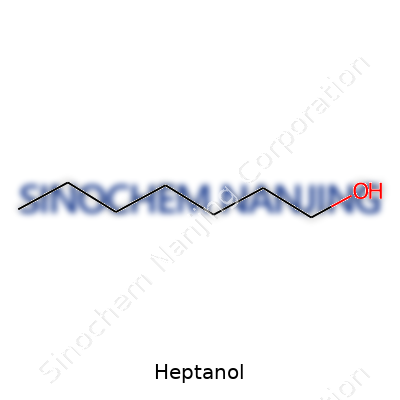
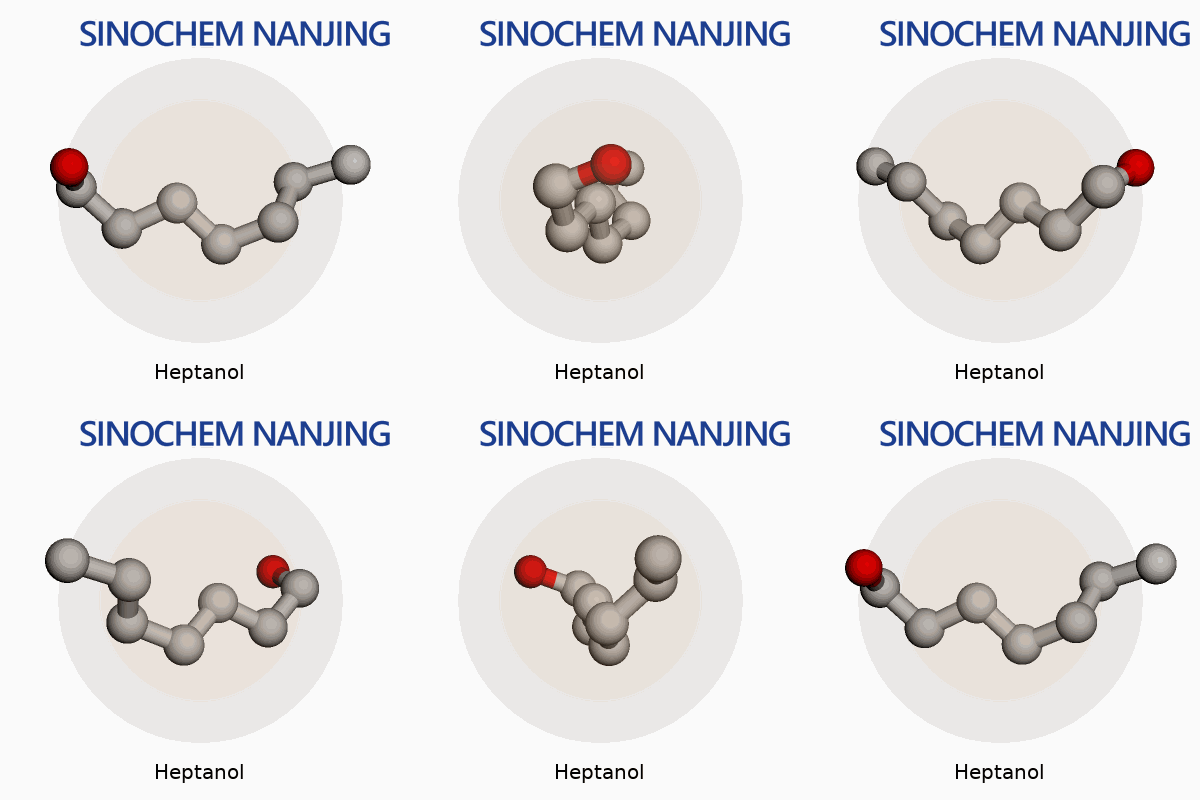
| Names | |
| Preferred IUPAC name | Heptan-1-ol |
| Other names |
1-Heptanol n-Heptanol Heptan-1-ol Heptyl alcohol |
| Pronunciation | /ˈhɛptən.ɒl/ |
| Identifiers | |
| CAS Number | 111-70-6 |
| Beilstein Reference | 1718732 |
| ChEBI | CHEBI:4302 |
| ChEMBL | CHEMBL12337 |
| ChemSpider | 5042 |
| DrugBank | DB02961 |
| EC Number | 203-852-3 |
| Gmelin Reference | 15207 |
| KEGG | C08580 |
| MeSH | D007888 |
| PubChem CID | 8107 |
| RTECS number | MC5950000 |
| UNII | 3A8S8K4436 |
| UN number | UN 1993 |
| Properties | |
| Chemical formula | C7H16O |
| Molar mass | 116.20 g/mol |
| Appearance | Colorless liquid with a mild, alcohol-like odor |
| Odor | aromatic |
| Density | 0.819 g/mL at 25 °C |
| Solubility in water | 1.6 g/L |
| log P | 2.8 |
| Vapor pressure | 0.0701 mmHg at 25°C |
| Acidity (pKa) | 16.1 |
| Basicity (pKb) | pKb = 6.52 |
| Magnetic susceptibility (χ) | -63.0·10⁻⁶ cm³/mol |
| Refractive index (nD) | 1.417 |
| Viscosity | 4.55 mPa·s (at 20 °C) |
| Dipole moment | 1.70 D |
| Thermochemistry | |
| Std molar entropy (S⦵298) | 336.8 J·mol⁻¹·K⁻¹ |
| Std enthalpy of formation (ΔfH⦵298) | -351.5 kJ/mol |
| Std enthalpy of combustion (ΔcH⦵298) | –4520.7 kJ/mol |
| Pharmacology | |
| ATC code | C01EB07 |
| Hazards | |
| GHS labelling | GHS02, GHS07, GHS08 |
| Pictograms | GHS02,GHS05,GHS06 |
| Signal word | Danger |
| Hazard statements | H226, H302, H315, H318, H411 |
| Precautionary statements | P210, P233, P240, P241, P242, P243, P261, P264, P271, P280, P303+P361+P353, P304+P340, P305+P351+P338, P312, P337+P313, P370+P378, P403+P235, P405, P501 |
| NFPA 704 (fire diamond) | 1-2-0 |
| Flash point | 82 °C |
| Autoignition temperature | 220 °C (428 °F; 493 K) |
| Explosive limits | 1.0–6.7% |
| Lethal dose or concentration | LD50 Oral Rat 2.05 g/kg |
| LD50 (median dose) | LD50 (median dose): 370 mg/kg (rat, oral) |
| NIOSH | SKH500 |
| PEL (Permissible) | PEL (Permissible Exposure Limit) for Heptanol: "5 ppm (skin) |
| REL (Recommended) | 5 ppm |
| IDLH (Immediate danger) | 750 ppm |
| Related compounds | |
| Related compounds |
1-Hexanol 1-Octanol 2-Heptanol 3-Heptanol Heptanal Heptanoic acid |



