Diphenyl Ether: More Than Just a Laboratory Curiosity
Tracing the Journey: Historical Development
Long before diphenyl ether landed in speciality chemical catalogs or the perfumes that line department store shelves, chemists first stumbled across this compound while chasing the mysteries of aromatic chemistry in the mid-19th century. Friedrich August Kekulé, whose name rings familiar in most chemistry classrooms for mapping out benzene’s structure, helped lay down some of the earliest work on ether-linked aromatic systems. Even so, diphenyl ether built a low-key reputation, partly because it wasn’t as flashy as new dyes and explosives capturing attention at the time. Over the years, as laboratories matured and technical expertise deepened, the practical value of this substance started to shine — from serving as a high-boiling solvent in the nitty-gritty of industrial chemistry, to bridging processes that called for both resilience and versatility. Looking back, it stands as a symbol of how scientific curiosity can bring unassuming materials into the mainstream.
Product Overview
Diphenyl ether carves out a space in both laboratory benches and heavy-duty manufacturing setups. This colorless solid, also known as phenyl ether, falls into the family of aryl ethers. It melts just above room temperature and puts out a faint, slightly floral aroma — a trait that hasn’t gone unnoticed in fragrance circles. In the world of specialty chemicals, it often comes blended with other agents or in various grades for perfume formulation, heat transfer fluids, and as a building block for higher-value products. Whenever strict purity matters, users look for chemical suppliers who know how to keep trace contaminants at bay, since even small traces can throw off downstream chemistry or product scent.
Digging Into Physical and Chemical Properties
Chemists tend to appreciate diphenyl ether for its reliable stability. It keeps its cool even under heat, with a melting point hovering around 26–28°C, and a boiling point near 259°C. That high thermal ceiling means engineers often tap it for heat transfer applications. Under most conditions, it won’t corrode metals or help along unwanted side reactions. Unlike many organic compounds with strong smells, diphenyl ether slips by with a delicate aroma. Its chemical structure — two benzene rings joined by an oxygen atom — stands up well to acids but breaks down in the presence of strong bases or halogens. This balance of durability and accessibility lets process chemists steer it through modifications and substitutions without sweating unexpected breakdowns.
Reading the Fine Print: Technical Specifications and Labeling
Most buyers and labs don’t have the luxury of trusting just a supplier’s word, especially for technical-grade compounds. Certificates of analysis take center stage, spelling out water content, residue on evaporation, and GC purity. These technical details matter more than marketing hype; a trace impurity in thermal oil can jam up heat exchangers, while even minimal leftover solvents can spoil a carefully balanced fragrance. Labels carry hazard information, storage guidance, and regulatory compliance based on regional laws like REACH or OSHA. Chemists rely on these cues not just for legal compliance but to keep labs and factories safe — which translates into smooth operations and fewer hazardous surprises.
Synthesizing Diphenyl Ether: Preparation Method
Historically, diphenyl ether’s preparation involved simple but robust techniques. Williamson ether synthesis provided the ideal approach — reacting phenol with halobenzenes, such as bromobenzene, in the presence of a strong base like sodium hydroxide. Industrial settings often ramp up this reaction, introducing catalysts to bump up both reaction speed and yield. More modern tweaks favor phase transfer catalysis, since it can streamline reactions and cut down on by-products. Each synthesis breathe new life into age-old chemistry, reinforcing how combinations of clever techniques and robust equipment push laboratory discoveries into large-scale production.
Exploring Chemical Reactions and Modifications
Diphenyl ether may seem unyielding at a glance, but it acts as a foundation for diverse chemistry. Electrophilic aromatic substitution rings familiar here: nitro, sulfo, and halogen groups can slide onto the aromatic rings, making the simple molecule a stepping stone to dye intermediates, flame retardants, or more exotic specialty polymers. Under harsher conditions, like with strong reducing or oxidizing agents, diphenyl ether lends itself to rearrangements or cleavage. Research on selective functionalization continues, especially where greener solvents or milder conditions can replace legacy protocols. These ongoing efforts aim to wring as much value and flexibility from this old, sturdy scaffold as possible.
What’s In a Name: Synonyms and Product Names
Anyone who’s spent time in a chemical storeroom knows the same compound can wear an array of aliases. For diphenyl ether, old academic literature calls it “diphenyl oxide” or “phenyl ether,” while the perfume industry often leans on “DPE” for shorthand. Imported grades may carry local brand names depending on regulations, but the core structure stays the same. Some heat transfer fluids list it as part of their trade formulations, pitched for its thermal stability and low reactivity. Regardless of what’s printed on the drum, those working with it know what sits inside can act as both a raw material and a performance booster.
Unpacking Safety and Operational Standards
Handling chemicals means looking beyond just the end-goal — personal safety stands front and center. Diphenyl ether lands somewhere in the middle territory; it’s less hazardous than potent solvents like benzene, but it won’t score high marks for being benign. Eye and skin irritation can crop up with prolonged contact. Its low volatility means inhalation risk stays low in well-ventilated labs, but process lines working at higher temperatures can generate vapors that call for proper extraction and respiratory protection. Fire safety protocols apply, too. Teaching laboratories and factories alike that the key to safety lies in maintaining clear protocols, up-to-date safety data sheets, and regular staff training. Safety — while sometimes tedious — pays off, not just in compliance, but in the peace of mind that everyone clocks out at the end of their shift in the same shape they clocked in.
Finding Applications in Real-World Settings
Diphenyl ether sneaks into more everyday products and processes than most people suspect. Anyone scrolling through the ingredients of high-end fragrances could spot it tucked away for its stabilizing effect and pleasant note. In industry, its use inside heat transfer fluids powers chemical processing plants, keeping reactors and exchangers humming at steady, high temperatures. The plastics sector leans on it for synthesizing polyaryl ethers like polyphenylene oxide, prized in electronics and automotive parts. Crafting specialty surfactants and flame retardants, diphenyl ether gives engineers a springboard for moving from theoretical designs to products that withstand wear and keep people safer. Its sheer versatility means it continues finding new niches, some big, some hidden behind trade secrets.
Spotlight on Research & Development
No chemical compound stands still, at least not in the eyes of researchers. Institutions and industrial labs keep poking at diphenyl ether, looking to unlock even more value or reduce side effects. Some research focuses on gentler synthesis, aiming to cut waste and boost atom economy. Others push for selective functionalization, making it easier and cheaper to step from the base molecule to advanced intermediates for pharmaceuticals or new polymers. Advances in catalysis and computational modeling now let chemists zoom in on molecular interactions, optimizing reaction conditions in ways that were science fiction a few decades ago. This ongoing push toward innovation means new applications and improved safety profiles could make diphenyl ether more prominent in the toolbox of future chemists.
Weighing Toxicity Concerns: What the Data Tells Us
In toxicology, data often turns up surprising results. For diphenyl ether, animal studies and occupational exposure profiles describe a compound that’s nowhere near the worst offenders in the aromatic ether family, but it still calls for respect. Exposure can provoke irritation, mostly to skin and eyes, and chronic inhalation — rare in most settings — has prompted some concern at high levels. Environmental groups take an interest, too, since persistence in water and soil can raise eyebrows about long-term ecotoxicology. Regulators recommend buffering against foggy handling habits and advise against discharge into waterways unsuited for proper breakdown. Keeping safety culture alive in labs and factories goes hand-in-hand with following clear disposal procedures, environmental audits, and updating risk assessments as scientific evidence evolves.
Future Prospects: Where to Next?
Science seldom lets familiar molecules gather dust. Diphenyl ether, once a humble lab curiosity, stands poised for fresh relevance. Demand for greener, more sustainable chemistry could see it serving as a safer alternative in old-school processes. Its resilience under heat and resistance to decomposition opens doors in electronics, where it might play a bigger role in crafting components that handle high currents or sharp temperature swings. Advances in fragrance technology show promise in valorizing its gentle aroma, pushing it further into mainstream consumer products. From where I sit, the most exciting developments will come from the collision between robust tradition and cutting-edge science, as researchers and engineers keep building on what’s already proven useful. For those working with chemicals, compounds like diphenyl ether serve as a reminder that even workhorse molecules can offer new surprises, given the right curiosity and expertise.
What is Diphenyl Ether used for?
What Makes Diphenyl Ether Useful?
Diphenyl ether isn’t a household name unless you have a foot in the door of chemical engineering or industrial manufacturing. Picture a clear, colorless liquid—faintly fragrant, easy to mistake for something less important. That’s far from the truth, though. This compound is a workhorse for several industries, and its role deserves some honest attention.
Industrial Insights from Day-to-Day Work
I spent some time working with large-scale chemical processes for a local company, and it’s one of those jobs where you get to know materials like diphenyl ether well. It pops up most often as a critical ingredient in heat transfer fluids. In my real-world experience, this use stands out above the rest.
Factories run on efficient heating systems, not just boilers but complex networks moving heat from here to there without losing energy. Traditional water-based systems freeze up or boil off at certain temperatures. Diphenyl ether, especially blended with biphenyl, keeps equipment humming at both high and low temperatures. This reliability cuts the risk of plant shutdowns and extends machinery life; that’s not small potatoes if you’ve seen production halt because of failed heat transfer.
Beyond Industrial Plants – Everyday Impact
It plays other roles, too. Think about flame retardants. Used in plastics, furniture, and electronics, diphenyl ether derivatives help keep homes and offices safe by slowing the spread of fires. This isn’t just some distant benefit. Some years ago, my neighbor’s kitchen appliance overheated. Flames didn’t spread far, partly because those plastics buffered the fire. The chemistry worked in the real world, not just in the lab.
Perfumeries and soap-makers also find value in it. This compound acts as a base note in certain fine fragrances. A faint floral quality lingers that synthetics sometimes struggle to produce. It feels quirky knowing a substance from industrial heat systems helps keep soaps fresh-smelling and scents sophisticated.
Health and Environmental Concerns
It’s not all upside. Over the last decade, as more research cropped up, concerns around toxicity and environmental persistence started grabbing headlines. For instance, some forms of diphenyl ether—polybrominated derivatives—show up in flame retardants and can linger in soil and water long after products get discarded. That’s enough to make you pause before calling anything a miracle material.
Regulators and researchers have their hands full sorting out which uses remain safe, which need tighter rules, and which should phase out entirely. Europe's REACH regulations lead the way, flagging chemicals that build up in the food chain or disrupt ecosystems. The US follows, but lags in some areas. Anyone who’s worked in a plant with environmental controls knows compliance isn’t just about ticking off boxes; it often demands real investment and accountability.
The Road Forward
Making diphenyl ether safer doesn’t have a single answer. Stronger workplace protections, better ventilation, and personal safety equipment keep workers from overexposure. Substituting safer chemicals where possible makes a difference, especially in consumer goods. Companies investing in greener chemistry can replace some uses, helping limit what ends up in air, water, or soil. Reclaiming and recycling heat fluids from end-of-life industrial equipment also closes the loop, cutting waste and exposure.
From someone who’s been inside these systems, it’s clear every link in the chain—chemists, plant managers, regulators, even end-users—share the job of squeezing out the benefits without piling up the risks. Diphenyl ether isn’t invisible, even if we don’t see it in our everyday lives.
Is Diphenyl Ether hazardous to health?
Getting to Know Diphenyl Ether
Diphenyl ether turns up in places nobody really expects. Find it in industrial cleaning products, as a heat transfer fluid, or in the very fragrance of some soaps and cosmetics. Reminds me of my high school chemistry teacher who always warned us about reading the ingredient labels, even on the air fresheners we thought were safe. The stuff sounds scientific, but its health profile isn’t as clean as the products it helps make.
Short-Term Effects: Immediate but Manageable
A splash or accidental whiff of diphenyl ether rarely ends with a hospital visit, unless you’ve got serious exposure. Still, eye and skin irritation happen more often than we want to admit. Inhaling the fumes brings headaches, dizziness, or nausea. Think back to the one time you used too much cleaning solvent in a closed bathroom — the pounding in your head and irritability stick around far longer than they should. Studies from the National Institute for Occupational Safety and Health (NIOSH) point to respiratory issues in people who breathe in diphenyl ether over an extended shift. Anyone working in production can recognize the toll long hours in poorly ventilated areas take on the body.
Long-Term Risks: Cause for Real Concern
What makes diphenyl ether truly worrying isn’t a single contact. It’s what happens after years of showing up on factory lines or living close to waste from certain industries. Animal research shows liver and kidney problems start to surface when larger amounts pile up over time. The Agency for Toxic Substances and Disease Registry (ATSDR) describes ongoing exposure as a real trigger for organ damage. No one wants to learn this truth through their own health falling apart slowly as years pass.
Personal experience adds another layer to dry government reports. Last winter, a friend working in a perfume manufacturing plant started feeling fatigued and kept catching odd rashes. After talking through symptoms with a doctor, the connection to workplace chemicals became clear — diphenyl ether among them. The company set stricter safety protocols and made upgrades, but not before several employees learned some tough lessons about workplace safety.
Vulnerable Groups Pay the Steepest Price
Kids and people with asthma or skin sensitivities notice reactions quicker and more dramatically than others. Older workers approaching retirement often talk about “the chemical cough” after decades on the job. Even short exposure at the wrong moment can bring on asthma-like symptoms. Air quality controls help, but not everyone has the luxury of leaving a risky environment, especially in communities close to heavy industry.
Solutions: Personal Action Meets Policy Changes
People working with diphenyl ether gain the most by pushing for better ventilation, regular air quality checks, and clear labels on cleaning products at work and home. Gloves, goggles, and respirators matter — protective gear isn’t optional. Community voices push regulators to set lower exposure limits. Companies respond to pressure, especially when workers band together or health advocacy groups raise a flag.
Making safer choices at the consumer level still counts. Look for alternatives in household cleaners and personal care products. Spread news about the health risks to friends who work in factories or custodial jobs. Every step toward transparency arms people with knowledge — and that puts health back in the hands of communities, not just corporate boardrooms.
What is the chemical formula of Diphenyl Ether?
Straightforward Chemistry: Diphenyl Ether
Diphenyl ether is no stranger in the world of chemistry. Its formula—C12H10O—paints a simple yet powerful picture. You get two benzene rings linked by an oxygen atom. Just looking at its molecular structure, it’s easy to see why the compound shows up in so many places, from industry to research labs.
How C12H10O Comes to Life
Everyday chemistry doesn’t happen in isolation. My own time in the lab taught me that certain molecules, like diphenyl ether, offer a lot for their simplicity. Two six-membered aromatic rings joined tightly with an oxygen—this isn’t just a classroom example. This backbone delivers stability, thermal resistance, and more.
Industry Roots and Real-World Impact
Production often ramps up where demand for heat-stable and non-reactive materials runs high. Diphenyl ether fits the bill for high-performance heat transfer fluids. In big manufacturing plants, this translates into the ability to move heat efficiently without risking rapid breakdown of the medium. Good heat transfer means consistent product quality and steady output. As a former engineer, I’ve seen faulty heat mediums grind entire procedures to a halt, wasting money and resources fast.
Facts support this. The global industrial sector values diphenyl ether for its robust performance, especially alongside its cousin biphenyl. Drop this formula into a synthetic oil blend and the results speak for themselves at high temps—no gunk, no unexpected shutdowns.
Diphenyl Ether in Everyday Products
Beyond factories, diphenyl ether’s formula shows its usefulness in household goods. It helps create fragrances and works as an antiseptic agent. The molecule’s structure lets it hold onto scent, so soaps and detergents don’t lose their punch over time. During a research project years ago, I saw how this ether can anchor volatile essential oils in a blend, keeping things stable—even on supermarket shelves.
You’ll also spot C12H10O in some plastics. It’s chosen for its low toxicity and high melting point, two features that make a real difference for consumer safety and material reliability. That peace of mind counts, especially for parents worried about products in close contact with kids.
Environmental and Safety Questions
No chemical, even one as robust as diphenyl ether, comes without baggage. Improper disposal can lead to water contamination. Researchers found traces in some river systems, raising red flags about long-term persistence. Legislative action and better process management can close many of these loopholes. Factories today are already under growing pressure to adopt greener separation techniques and tighter recycling loops.
On the personal side, anyone handling raw diphenyl ether should stick to proper protective equipment. Inhaling the vapor or skin contact can irritate. It’s a lesson hammered home after watching a coworker scramble for clean water after a splash—safety nets should never be skipped, even with chemicals that seem routine.
Looking Ahead
The simple formula of diphenyl ether belies a web of real-world implications. Scientists and engineers have a chance—and a duty—to keep this valuable chemical safe for people and the planet. Good practice, better oversight, and a nod to new green chemistry routes can build a safer path forward for both industry and communities.
How should Diphenyl Ether be stored?
Why Diphenyl Ether Demands Attention
Diphenyl ether shows up in all kinds of industrial settings, from perfumes to heat transfer fluids. It looks harmless, almost like a clear aroma oil. But if you’ve spent any time around chemical storage rooms, you already know looks can fool you. A chemical like diphenyl ether can turn into a fire risk in no time if folks get lazy with storage.
Lessons Learned in Real-World Storage
I learned the hard way just how easy it is to overlook a flammable compound because it isn’t marked with scary warning symbols everywhere. One summer, a leaky drum of diphenyl ether sat in a poorly ventilated space at a plant I visited. The musty, sweet smell drifted into the hallway—an early warning, ignored until someone finally checked. That spill could have ignited, and it would have threatened every person in that corridor.
Too often, workplace routines skip the basics: people forget to double-check the seals, or assume that a substance without a bright orange warning label can shrug off some heat and sunlight. Yet diphenyl ether boils at 258°C and gives off fumes much earlier. These fumes catch fire easily. Research from the National Fire Protection Association lists diphenyl ether as a Class II combustible liquid, just in case anyone still thinks it is safe alongside copier toner or food supplies.
Key Storage Facts That Change the Equation
Diphenyl ether thrives in cool, dry shade, inside sealed metal containers. Keep it away from open flames and spark sources. Metal drums, not plastic, stand up better to accidental bumps or punctures, since this compound can wear down some plastics with time.
If anyone stores it outdoors, they need covered shelters—those old shipping containers with a shaded overhang work much better than most sheds. Don't place containers near oxidizing agents or strong acids, since those can trigger rapid chemical reactions. I’ve talked with safety managers who swap stories about solvents attacking each other in shared cupboards or janitor closets, and the same thing applies here.
Bad Habits Bring Real Risks
Ignore temperature and you get expansion—sometimes enough to pop container lids. Stacking drums upright keeps physical stress off the lids. Don’t forget to label every single container, even partial leftovers. Everyone laughs at labeling until someone grabs the wrong barrel in a rush. Over the years, mishaps I’ve seen always trace back to skipping simple steps like these.
Staying Ahead: Checks and Planning
Walkthrough inspections catch trouble early. Watch for pooled liquid, corrosion near seams, or labels peeling off. Good ventilation matters—open windows work better than air-conditioned isolation. Local fire codes give clear orders for storage amounts, spacing, and signage. Many companies set dedicated flammable liquid cabinets for these chemicals, with lipped shelves that contain small spills.
Staff training changes outcomes more than safety posters. It might sound old-fashioned, but regular drills with “what if” spill scenarios set routines in people’s minds. The best workers I’ve known took these rules to heart, double-checking everything and passing down habits to the next shift.
Smart Storage, Fewer Disasters
Diphenyl ether doesn’t intimidate anybody at first glance, but the risk is real. Give it true respect in storage, practice what you preach, and the odds of disaster drop way down. Every well-managed drum, every checked seal, and every prepared team member keeps people safe and work rolling forward.
What are the physical properties of Diphenyl Ether?
What You Notice About Diphenyl Ether
Anyone who has worked in a lab or factory using Diphenyl Ether knows the sight and smell right away. You pour out a clear, colorless liquid. It's got a slight floral touch, reminding some of it in perfumes or even soaps, though you wouldn’t want it on your skin. The molecular weight sits at about 170 grams per mole—so it’s a little heavier than water but nothing compared to metals like mercury. If you’ve ever spilled a bit on a bench, you’d see it run slowly, and your nose would pick it up almost immediately.
Temperature and Stability
Diphenyl Ether melts at about 26°C. That’s just below the warmer room temperatures, so you might find it as a solid sitting on the shelf in the winter and a liquid in the summer, depending on where your storage is. You can heat it up to just under 260°C before it boils away. This wide liquid range makes it useful in heat transfer fluids and as a solvent for tough jobs, like dissolving cellulose. Add it to a mixture, and you know it won’t break down or evaporate too soon—engineers and chemists bank on it for this.
Solubility and Mixing
Try to mix it with water and you’ll get nowhere. Diphenyl Ether shrugs off water, so if there’s a spill, you won’t clean it up by watering it down. On the other hand, it mixes smoothly with other organics—ether, alcohols, and benzene bring out its best side. Manufacturers and researchers rely on this: formulating lubricants, hydraulic fluids, or something as basic as a dye blend. If you spend any time in color chemistry, you get how important a good organic solvent is. Garbage in, garbage out holds especially true with bad solvents.
Density and Handling
Its density hovers around 1.07 grams per milliliter at room temperature, just a bit denser than water. So if you spill both in the same pan, Diphenyl Ether will sink but only slightly. This property makes transport predictable. Storage tanks and pipes don’t corrode as quickly since Diphenyl Ether resists rusting metals, and it doesn’t eat up glassware, either. That’s a plus for anyone tasked with cleaning up at the end of the day.
Odor and Safety Considerations
Take off the cap, and Diphenyl Ether’s scent hangs in the air—sometimes pleasant, sometimes cloying, depending on your sensitivity. If you breathe too much, you might feel dizziness or slight nausea. It’s not especially toxic, but I’ve always erred on the side of caution, wearing gloves and working under a hood. The flash point lands at 113°C, meaning if you bring a flame near, it can ignite at lower-than-expected temperatures, especially in an open lab or shop. That prompts respect among workers. Fire safety conversations often revolve around which chemicals catch first, and Diphenyl Ether warrants a spot on that list.
Its Value in the Real World
People use Diphenyl Ether for a reason. That big liquid range, reliable handling, and selective solubility let it stand out as a heat transfer agent and a solvent. It shows up in pharmaceuticals, reed diffusers, and even electronics manufacturing. For those who handle it day-to-day, recognizing its physical traits isn’t just chemistry trivia: that knowledge guides how we store, move, and work with it, keeping projects safe and on track.
Room for Improvement
Disposal remains a sticking point. Because it resists breaking down in water and doesn’t mix well with it, industrial waste treatment plants face challenges. Careful incineration works, but costs pile up. The community could push for research into catalysts designed to break down persistent solvents like Diphenyl Ether or develop closed-loop systems that let us reuse fluids until they’re fully spent. That would cut waste and make every property of this compound serve us a little longer.
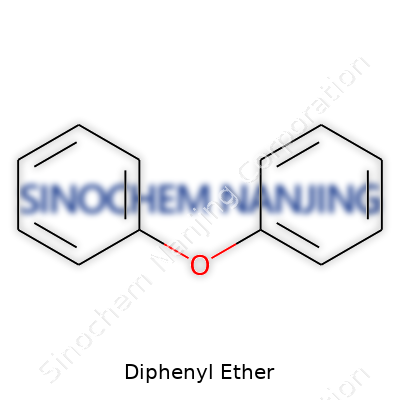

| Names | |
| Preferred IUPAC name | diphenyl ether |
| Other names |
Phenyl ether Diphenyl oxide DPE oxybenzene diphenyl oxide |
| Pronunciation | /daɪˈfiːnəl ˈiːθər/ |
| Identifiers | |
| CAS Number | 101-84-8 |
| Beilstein Reference | 1204587 |
| ChEBI | CHEBI:28368 |
| ChEMBL | CHEMBL15410 |
| ChemSpider | 8216 |
| DrugBank | DB04243 |
| ECHA InfoCard | 100.003.236 |
| EC Number | 203-973-9 |
| Gmelin Reference | 635 |
| KEGG | C06587 |
| MeSH | D003975 |
| PubChem CID | 3121 |
| RTECS number | KN3325000 |
| UNII | 9DVX6MPX8D |
| UN number | UN3076 |
| Properties | |
| Chemical formula | C12H10O |
| Molar mass | 170.21 g/mol |
| Appearance | Colorless crystalline solid |
| Odor | Faint, geranium-like |
| Density | 1.073 g/cm³ |
| Solubility in water | 0.0004 g/100 mL (20 °C) |
| log P | 4.21 |
| Vapor pressure | 0.04 mmHg (25°C) |
| Acidity (pKa) | pKa ≈ 18.5 |
| Basicity (pKb) | -4.10 |
| Magnetic susceptibility (χ) | -74.5e-6 cm³/mol |
| Refractive index (nD) | 1.585 |
| Viscosity | 2.32 cP (25°C) |
| Dipole moment | 2.20 D |
| Thermochemistry | |
| Std molar entropy (S⦵298) | 340.6 J·mol⁻¹·K⁻¹ |
| Std enthalpy of formation (ΔfH⦵298) | +17.7 kJ/mol |
| Std enthalpy of combustion (ΔcH⦵298) | -6117.7 kJ/mol |
| Pharmacology | |
| ATC code | D08AX02 |
| Hazards | |
| GHS labelling | GHS07, GHS09 |
| Pictograms | GHS07,GHS09 |
| Signal word | Warning |
| Hazard statements | H302, H315, H319, H335 |
| Precautionary statements | P261, P273, P280, P302+P352, P305+P351+P338, P337+P313 |
| NFPA 704 (fire diamond) | 1-2-0 |
| Flash point | 129°C |
| Autoignition temperature | 575 °C |
| Explosive limits | Explosive limits: 1.5–9.2% |
| Lethal dose or concentration | LD50 oral rat 3,600 mg/kg |
| LD50 (median dose) | LD50 (median dose): Oral (rat) 49,100 mg/kg |
| NIOSH | BT6650000 |
| PEL (Permissible) | 1 ppm |
| REL (Recommended) | 1,000 |
| IDLH (Immediate danger) | 500 ppm |
| Related compounds | |
| Related compounds |
Phenol Anisole Biphenyl Dioxins |



