Taking a Closer Look at Diethylbenzene: Why This Chemical Matters
Historical Development of Diethylbenzene
Diethylbenzene has deep roots in organic chemistry, tracing back to times when scientists pushed the boundaries of aromatic compound research. In the early 20th century, interest in aromatic hydrocarbons really took off, and benzene derivatives attracted much attention because of their unique properties and industrial promise. By introducing ethyl groups into the benzene ring, researchers eventually created isomers of diethylbenzene. As someone who’s walked through university chemistry labs, I remember the tedious work required to tease apart similar compounds, a process mirrored in the history of diethylbenzene’s discovery and isolation. Large-scale production started to pick up only after chemists refined techniques like Friedel–Crafts alkylation. Those early breakthroughs enabled mass production and opened the doors for diethylbenzene’s entry into various industries.
What Stands Out About Diethylbenzene
Diethylbenzene exists in several isomeric forms: ortho, meta, and para. Each has its own slightly different behavior, but all share a core structure—two ethyl groups attached to a benzene ring. This straightforward structure belies a surprising versatility. I’ve seen it used as a solvent in laboratories, often preferred over similar substances for certain reactions because it brings good solvency for nonpolar materials and greater chemical stability than some other aromatic compounds. Synthesis processes often aim for the para isomer, given its use as an intermediate in producing antioxidants and resins. Lab workers tend to appreciate that it doesn’t evaporate as fast as lighter aromatics, cutting down on loss through volatilization.
Physical and Chemical Properties That Count in Practice
Scientists look at things like boiling point, melting point, density, and solubility when picking chemicals for industrial use. Diethylbenzene pulls its weight here. With a boiling point higher than common solvents like toluene, it offers good thermal stability. This matters in processes that need sustained heating, like polymer production. Its low water solubility means it’s easy to separate out of aqueous mixtures, simplifying recovery and reuse in closed-loop manufacturing setups. The presence of two ethyl groups raises its molecular weight compared to benzene or ethylbenzene. Those added carbons also help reduce the rate of evaporation, which can bring practical cost savings for large operations. Chemical resistance holds up well, making it slow to oxidize or break down under most conditions. These qualities together have made diethylbenzene a resilient workhorse in organic chemistry and industry.
Technical Specifications & Labeling: Navigating The Details
Anytime I order chemicals for a lab, clear information about purity, contaminants, and safety labeling heads my checklist. Reputable suppliers detail ratios of isomers, list trace impurities, and flag the presence of other aromatics or alkanes. Labels spell out the CAS number, correct isomeric form, and hazard symbols required by global regulations. One persistent challenge lies in separating diethylbenzene from similar byproducts. High-performance liquid chromatography and gas chromatography usually resolve different isomers and keep the product within specification. Meeting occupational safety standards means containers display GHS pictograms, exposure limits, and handling reminders, all standardized for international distribution. Such transparency forms the first line of defense for workers, researchers, and anyone shipping or receiving this compound.
Preparing Diethylbenzene: Synthesis That Scales
Most manufacturing begins with benzene and ethylene, using a Friedel–Crafts alkylation reaction in the presence of an aluminum chloride catalyst. The reaction rarely proceeds cleanly to a single diethylbenzene isomer; instead, it forms a mixture. This is where distillation and other separation steps come in. In my student days, this step gave us a greater appreciation of just how finicky aromatic chemistry can be. Managing temperature and catalyst ratios is crucial; overheating or catalyst poisoning means unwanted byproducts. Industrial facilities have optimized the process, minimizing energy consumption and catalyst waste while improving selectivity. Some operations integrate continuous-flow reactors to boost throughput and cut down on downtime, something rarely possible in the teaching labs where I first encountered this chemistry.
Chemical Reactions and Modifications: Keeping Up With Demand
Chemical engineers and bench chemists rely on diethylbenzene’s reactive benzene ring and ethyl side chains. The compound participates in typical aromatic-substitution reactions, making it a convenient starting material for synthesizing other organic compounds. Chlorination, oxidation, and sulfonation all target either the ring or the side chains. Para-diethylbenzene, in particular, serves as a precursor to 4,4′-diethylstilbene and bis(2-ethylhexyl) phthalate. Through catalytic oxidation, labs turn it into diethylbenzene hydroperoxide, which serves a crucial role as a radical initiator. Modifying side groups opens the door to a range of specialty chemicals. The adaptability of this molecule proves its value in both small-scale research and bulk manufacturing.
Synonyms and Naming: A World of Aliases
Chemists love their shorthand and synonyms. Diethylbenzene may turn up in literature as 1,2-diethylbenzene, 1,3-diethylbenzene, or 1,4-diethylbenzene for the three isomers. Sometimes, people call it DEB or use older names referencing historic classification systems. Cross-referencing synonyms across international databases avoids confusion and ensures safe handling—a lesson hammered home in those heated discussions around confusing shipments in academic storerooms. CAS numbers and IUPAC naming conventions help, especially as regulatory and patent filings require airtight precision.
Safety Practices and Operational Standards: Shielding Workers and Communities
Nobody enjoys chemical accidents, and diethylbenzene presents familiar hazards found in other aromatics. Extended exposure to vapors can irritate the eyes and respiratory tract. At higher concentrations, the compound carries a risk of central nervous system effects, including dizziness or headaches. Standard practice keeps all storage areas well ventilated, away from sources of ignition, and equipped for spill containment. Workers wear nitrile gloves and goggles, along with lab coats or coveralls, during handling. Federal and international guidelines insist on transport in tightly sealed containers with robust secondary containment. I’ve handled enough minor spills in my own lab days to know that protocols aren’t just bureaucracy—they’re how you get home safely at the end of the day.
Application Areas: Where Diethylbenzene Makes a Difference
Diethylbenzene finds heavy use as a starting material for manufacturing other chemicals. It’s the backbone for synthetic resins, particularly ion-exchange resins used in water purification. These resins keep everything from drinking water to industrial effluents safe for people and the environment. In specialty solvents, diethylbenzene dissolves oils, fats, and some gums, making it a go-to option for extracting or purifying materials. Its chemical stability brings value in electronics manufacturing, where sensitive components interact best with low-reactivity solvents. Some industrial cleaners and degreasers also use diethylbenzene blends because of their effectiveness against tough hydrocarbon residues. The chemical keeps showing up wherever durability, strong solvency, and manageable vapor pressure matter.
Research & Development: Pushing The Boundaries
Research teams remain busy searching for cleaner, greener synthesis routes. Green chemistry approaches use alternative catalysts or feedstocks to reduce hazardous waste. Life-cycle analyses seek to lessen the environmental footprint by cutting byproducts and improving recyclability. Process improvements target better isomer selectivity, aiming to increase yields of the most sought-after para-isomer. Smaller companies and academic labs experiment with bio-based aromatic Building blocks, aiming to lower dependency on fossil fuels. Smart technologies now optimize reaction conditions in real time, using sensors and artificial intelligence to tweak parameters mid-stream, cutting waste and slashing energy costs. The excitement around diethylbenzene’s role in up-and-coming applications, including advanced polymer synthesis and nanomaterial fabrication, keeps funding and intellectual energy flowing.
Toxicity Research: Separating Myth From Fact
Safety studies show diethylbenzene shares many health risks with other aromatic hydrocarbons. Short-term exposure at low levels rarely causes persistent symptoms, but repeated or high-level contact can damage the liver, kidneys, or central nervous system. Animal studies confirm these links, prompting strict workplace exposure limits in the US, EU, and Asia. Community advocates keep calling for greater transparency in emissions monitoring at production sites, especially in regions hosting clusters of chemical plants near residential neighborhoods. Transparent reporting helps identify spillover risks and push for better engineering controls. Research continues into possible links between chronic low-dose exposure and longer-term health impacts, reinforcing the need for public health vigilance along with robust internal safety programs.
Future Prospects: What Lies Ahead for Diethylbenzene
The future of diethylbenzene looks closely tied to advances in both green chemistry and industrial efficiency. Pressure is mounting to replace old, energy-hungry manufacturing methods with cleaner alternatives. Companies competing in the global market recognize that customers and regulators increasingly value chemicals produced with lower emissions and improved recycling prospects. Research into new catalysts, renewable aromatic feedstocks, and digital process optimization will likely shape the next chapter. For communities hosting chemical facilities, this could mean safer environments and jobs that mesh with high-tech manufacturing standards. For chemists and engineers, ongoing innovation in diethylbenzene’s synthesis and applications holds promise for better products, cleaner processes, and improved chemical stewardship.
What is Diethylbenzene used for?
Understanding What It Does
Diethylbenzene sneaks its way into plenty of industries, though many folks have never even heard of it. This colorless liquid belongs to the aromatic hydrocarbon family. Basically, it’s built from a benzene ring with two ethyl groups hanging off—think of a fancier cousin to everyday gasoline components. The structure of this chemical makes it valuable for making more complex compounds. For any chemist, practical building blocks like this save time, money, and effort.
Chemical Factories Lean on Diethylbenzene
Diethylbenzene’s primary home is inside chemical plants. Its biggest gig is serving as a starting material for producing other chemicals. Manufacturers often turn it into diethylbenzene hydroperoxide, a key piece in creating phenol and acetone. Both these chemicals go into making plastics, resins, and adhesives, which show up in everything from sunglasses to phone cases and even plywood.
To put it another way, every time I see plastic panels at the hardware store, I remember how easily trace chemicals tie together these far-reaching industries. The stuff may not have a glossy advertising campaign, but industries would miss it if supply chains hit a snag.
Solvents and Their Role
The laboratories and factories of the world need effective solvents, and diethylbenzene pulls its weight here too. Unlike water, it dissolves substances most kids wouldn’t recognize, often in industrial cleaning or processing. Paints, coatings, and dyes sometimes carry it because it helps keep pigments smooth and blends uniform.
Solvents like diethylbenzene play a quiet but essential role in keeping manufacturing lines running. Without them, work grinds to a halt, and costs rise. I’ve seen how a reliable solvent can cut down cleaning time and prevent wasted batches—small wins, but crucial for plant managers who count every cent.
A Role in Specialty Fuels
Specialty fuel blends, especially in some engines, occasionally count on chemicals like diethylbenzene. By bringing its own blend of stability and burn characteristics, it gives fuel makers more control over how engines run. Long-haul trucks, small aircraft, and some generators rely on the kind of reliability specialty solvents deliver.
Working in a shop surrounded by machine parts, I learned the headaches that come when engines gum up or lose efficiency. Better blends matter, and diethylbenzene does its part behind the curtain.
Safety and Environmental Perspective
Not all chemicals come risk-free. Exposure to diethylbenzene can bring irritation or, in big quantities, worse health problems. Safe handling helps keep workers out of harm’s way. Personal experience in a research lab reinforced how routine checks and good ventilation can lower the risks, turning diethylbenzene from a hazard into a manageable tool.
Disposing of this chemical also deserves attention. Dumping or burning it can add pollution, so responsible companies treat their waste to limit the damage. It’s the sort of thing local safety committees stress during annual reviews, and those reminders pay off over time.
Looking Ahead: Safer Alternatives and Cleaner Practices
Chemistry keeps pushing for less toxic and more environmentally friendly alternatives. While diethylbenzene still stands tall for many uses, companies explore greener options as pressure grows to cut hazardous waste. Some outfits switch-out for less persistent chemicals, while others tweak their processes to reuse what would have hit the drain.
A transparent supply chain and regular safety audits serve everyone. Workers, consumers, and neighbors benefit as companies keep one eye on practical results and another on health and safety. That’s where real progress starts, and where diethylbenzene fits into modern industry.
Is Diethylbenzene hazardous to health?
Everyday Chemistry in Industrial Life
Every major city runs on countless chemicals, many with long, hard-to-pronounce names. Diethylbenzene probably doesn’t show up in home cleaning supplies, but it shows up behind the scenes: in factories, chemical plants, and sometimes in specialized fuels or solvents. Most people walking through a city won’t have any idea they just passed a tanker truck with it inside, but folks working with the stuff can’t afford to ignore its risks.
Not Your Typical Benzene
People hear the word “benzene” and alarm bells ring. They should, since benzene on its own causes blood disorders and can lead to cancer after repeat exposure. Diethylbenzene sits in the same chemical family, but it comes with two ethyl groups attached. That subtle difference changes the game for its uses—but not so much for safety. It can still evaporate into vapors, and breathing those in stresses out the body, especially the nervous system. If skin picks up liquid diethylbenzene, irritation follows. At high exposures, symptoms like headaches, dizziness, or a cough tell workers it’s time to step away.
Real Risks on Real Shop Floors
I grew up near a refinery, where talk of splitting and building benzene-based chemicals came up around the dinner table. Some of my older relatives worked there, their hands rough and noses tuned to chemical leaks. Back then, changing masks or gloves wasn’t automatic. These days, regulations push for good ventilation, personal protective equipment, and testing the air. Still, folks who work long shifts in these environments run their own risk calculations. If a pipe leaks or a storage drum spills, the health hazard turns real fast. Eyes start burning, breathing feels heavy, and no one wants to see long-term consequences pop up a decade down the road.
Hard Science and Medical Opinion
The American Conference of Governmental Industrial Hygienists set a threshold for diethylbenzene in workplace air: 25 parts per million. Cross that line day after day, and problems add up. Toxicology studies flagged irritation in animal lungs and livers, pushing industry leaders to keep a watchful eye. Practical experience lines up with the scientific papers: handle diethylbenzene carelessly, and it will hand out acute symptoms and possibly long-term trouble. The National Institute for Occupational Safety and Health puts out guidelines to handle everything from accidental splashes to vapor releases, but relying just on guidelines can tempt people into a false sense of safety.
Improving Safety Without Panic
What counts for most people is trusting the gear provided, checking safety data sheets, and following up on training. Some companies go beyond minimum rules, testing air quality and upgrading ventilation more often than required. That comes from years of seeing what happens if shortcuts get taken. On the policy side, stricter labeling and transparent reporting help communities understand the risks. For anyone near a chemical site, pushing for emergency drills and honest communication keeps small incidents from turning into big disasters.
Looking for Better Substitutes
Some researchers dig into greener solvents that don’t carry the same worries. Others improve protective gear so working with diethylbenzene feels less like Russian roulette. Real progress happens from both ends—engineers reducing the chemical footprint, and regulators keeping the bar high for safety. Trust builds one day at a time, with open eyes and honest talk about both old hazards and new solutions.
What is the chemical formula of Diethylbenzene?
Getting to Know Diethylbenzene
Diethylbenzene represents one of those compounds that people in the chemical industry spot right away. This compound shows up in plenty of places, usually when folks are working with solvents, making resins, or looking for something to help in organic synthesis. Its structure follows a pretty straightforward approach: benzene sits at the core, and two ethyl groups attach to the ring. The chemical formula, C10H14, sums up its atoms in black-and-white, telling anyone studying it that we’re looking at a benzene base with two ethyl chains added.
Why This Formula Matters
People working in labs count on formula accuracy. That formula, C10H14, helps chemists calculate molar masses—an essential step before starting any synthesis. You don’t want to mix ingredients based on rough guesses. One misstep leads to wasted material or, worse, dangerous reactions. I recall running an experiment in grad school—misreading formulas caused a chain of mishaps, forcing our team to halt and troubleshoot for hours.
Efficiency and safety sit at the heart of good practice, and understanding exactly what C10H14 means saves time and keeps people healthy. The ethyl groups, two of them, alter how this molecule interacts with other substances, giving it special traits. For instance, the different isomers—ortho, meta, and para—depend on where these groups attach, and this formula gives us the math for all these structures.
Science in Everyday Life
People outside the chemistry lab see the impact of such formulas, though it might not seem obvious. Diethylbenzene appears in cleaning products and plays roles in making other chemicals used in the plastics or paint sectors. The knowledge packed into C10H14 gives manufacturers a reliable foundation for blending safe products. Messing up the formula leads to spoiled batches or compromised safety, which no company or consumer wants.
Developing safer alternatives in industry starts with understanding formulas. For example, if a process engineer knows exactly which compound sits in a solution—diethylbenzene or something else—they can pick greener solvents or design better waste treatment. Accurate formulas keep compliance with environmental regulations in check too.
Digging Deeper: Challenges and Solutions
Naming comes up as a hurdles for newcomers. Diethylbenzene isn’t the only compound out there with ethyl groups on benzene. The location of these groups changes its name and properties, leading to confusion. Labeling in warehouses sometimes misses this nuance. I once saw a storage mix-up where ortho-diethylbenzene landed in the wrong drum, delaying a project by a week. Better training and clear signage change the game, saving both time and money.
Technology helps here. Barcode systems and digital chemical registries cut down on errors. Consistent education keeps teams ready to spot differences, not just by labels but also by checking formulas like C10H14. Robust documentation gives confidence that everyone, whether a researcher or technician, speaks the same language.
Staying Informed and Safe
The world needs more than formulas scribbled in notebooks. Labs, manufacturers, and students should treat every chemical detail with care. C10H14 is more than eight numbers and letters—it offers a snapshot of both opportunity and responsibility in modern industry. Talking about formula accuracy and safe handling isn’t just a science lesson, it’s about building trust every day.
How should Diethylbenzene be stored and handled?
Staying Safe with Diethylbenzene
Anyone who’s spent time around industrial chemicals knows how easily routine can breed carelessness. Diethylbenzene, a colorless, oily liquid used in making resins and dyes, reminds me of that every time I see a careless drum left in sunlight or a half-labeled bottle on a bench. It seems harmless on a quick glance, but this stuff brings real risks that deserve respect. Without attention to detail, the flammable vapors and potential health hazards stack up fast, setting up trouble for workers and the environment.
Simple Steps That Save Headaches
Let’s get straight to it. Diethylbenzene burns easily, so I never feel comfortable with it sitting near sparks or open flames. A well-ventilated, cool spot makes a real difference since this liquid gives off fumes at room temperature. Keeping storage temperatures in the mid-teens Celsius—think a comfortable air-conditioned room—slows down vapor formation and lowers fire risk. If warm machinery or steam lines run through the storage room, I start worrying about what could go wrong if something leaks.
Drums and bottles hold up best when made from steel lined with a tough plastic inner layer. I avoid plain plastics; they can soften or interact with the solvent over time. Tight-fitting, clearly marked lids stop unwanted evaporation. Having seen the mess caused by cracked gaskets or missing labels, I double-check them every time storage shifts or the seasons change. Separation from oxidizers or acids is more than a textbook rule—those chemical neighbors cause nasty surprises if a spill hits the wrong shelf.
Handling: All About the Right Gear and Mindset
Personal experience taught me early that gloves and goggles aren’t just for show. Splashes won’t just irritate skin; they stick around and cause more trouble the longer they’re left alone. Installing eyewash showers in any room where handling happens pays off fast. Respirators sit nearby if ventilation lags or if there’s a chance the container might spray under pressure. Long sleeves and closed shoes keep the stuff from soaking in unnoticed.
Moving diethylbenzene by pump or hand sometimes ends with drips—whatever care you take. Absorbent pads and spill kits clean up quickly, stopping fumes and slick floors from causing accidents. Staff training skips the false comfort of online slides. Actual walk-throughs and drills turn safety into muscle memory. If someone hesitates or skips a step, corrections catch on quicker through hands-on practice.
No Room for Guesswork
Labeling matters. Every drum, every secondary bottle, even the smallest vial, carries clear, updated info about contents and hazards. No one should grab the wrong thing by accident. Waste, even old wipe-down rags, goes into closed metal bins, not office trash. With regular audits and a system for reporting leaks or spills—without blame or delay—mistakes get fixed before they develop into major incidents.
I’ve worked in spaces where close calls happened simply because routines got sloppy over time. Diethylbenzene deserves sharp attention both in storage and handling—not just for compliance, but because it lets everyone go home healthy at the end of their shift. Following these habits isn’t just about ticking boxes or passing inspection but about making sure every worker and building stays out of the news for the wrong reasons.
What are the main industries that use Diethylbenzene?
Industry Needs and Chemical Know-How
No one talks about Diethylbenzene at the dinner table, but without it, plenty of everyday things just wouldn’t work. As a writer who has spent years following the chemical industry, it’s clear to me how much people rely on chemicals like this—even if they’ve never heard the name. Diethylbenzene turns up where chemistry shapes the backbone of production and innovation, especially in areas demanding strong solvents or specialized building blocks.
Solvents in the Paint and Coatings World
Anyone who has watched paint dry—literally or metaphorically—knows the challenge of getting the right drying speed and finish. Paint manufacturers use Diethylbenzene as a solvent because it dissolves other ingredients with ease, contributing to smooth, uniform coats. Paint shops and factory lines prefer it because it blends pigments and resins better than many alternatives, leading to durable and consistent results. Industrial coatings benefit from this, especially in automotive and construction sectors, reducing flaws while speeding up drying. In my experience talking with manufacturers, every gallon saved in rework or wasted product makes a difference for the bottom line and sustainability goals.
Petrochemical Processes and the Search for Efficiency
Refineries have little room for wasted motion. Diethylbenzene sees heavy use as an intermediate in petrochemical processes. Ethylbenzene and xylene plants, for example, use this compound during manufacturing steps that require separation and purification of hydrocarbons. The efficiency of these steps directly affects fuel prices and availability. I remember visiting a refinery in Texas where an engineer explained how even minor improvements in solvent use can save hundreds of thousands of dollars per year at scale. The quality and purity levels they achieve often depend on chemicals like Diethylbenzene doing their job quietly but thoroughly.
Creating Ion Exchange Resins for Cleaner Water
Water treatment might seem worlds away from heavy industry, but there’s a connection that matters to families and communities everywhere. Diethylbenzene plays a vital role in producing certain ion exchange resins, which help purify water in municipal systems and home filters. These resins remove unwanted minerals, keeping kettles clear of scale and allowing factories to run their boilers more efficiently. My own family relies on a water softener that uses resins derived from compounds like this, and I’ve seen firsthand how critical reliable purification is, whether you’re living in a city or a rural area.
Specialty Applications in Laboratory and Chemical Synthesis
While some chemicals have one main job, Diethylbenzene has a few. It turns up in laboratories as a solvent for organic synthesis, helping scientists discover new materials and medicines. Research chemists count on its stability and low reactivity in certain reactions, giving them a reliable tool for experimenting with new compounds. The pharmaceutical industry, especially, values any reagent that reduces risks of side reactions or contamination during drug development. Good laboratory practice and innovative treatments often start with tested, dependable chemicals behind the scenes.
Reducing Hazards, Finding Substitutes
Industry experts stay mindful of health and environmental concerns. While Diethylbenzene serves many uses, it’s important to handle it with care, using proper ventilation and protective gear. There’s ongoing research into safer alternatives and better waste management, especially since regulations are tightening across many regions. Efforts to design new green solvents might eventually shift reliance away from traditional aromatics like this, but for now, trained workers and strong oversight help keep risks in check.
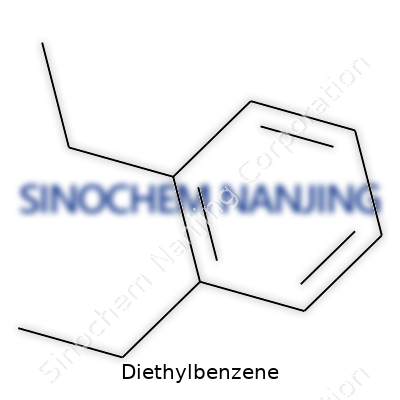
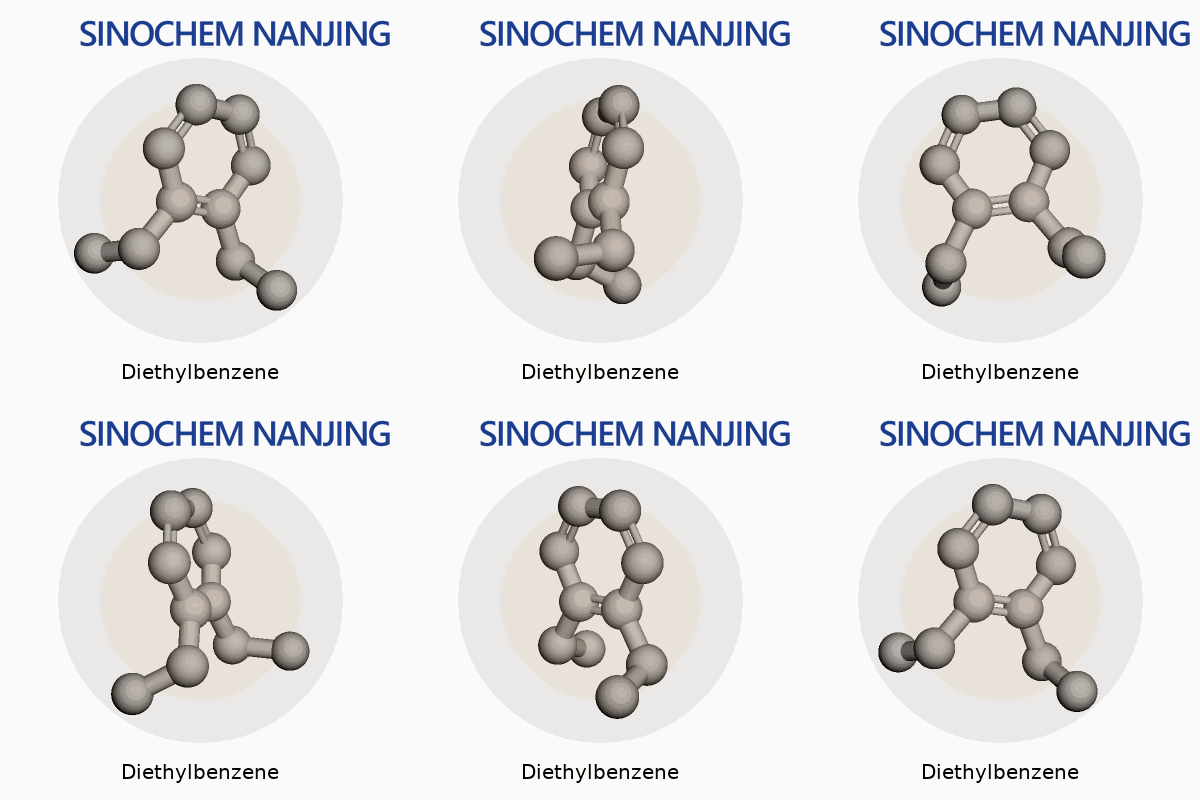
| Names | |
| Preferred IUPAC name | 1,2-Diethylbenzene |
| Other names |
Diethyldibenzene 1,2-Diethylbenzene 1,3-Diethylbenzene 1,4-Diethylbenzene |
| Pronunciation | /daɪˌiːθəlˈbɛnziːn/ |
| Identifiers | |
| CAS Number | 25340-17-4 |
| Beilstein Reference | 392145 |
| ChEBI | CHEBI:34568 |
| ChEMBL | CHEMBL57397 |
| ChemSpider | 6927 |
| DrugBank | DB13806 |
| ECHA InfoCard | 100.133.00.1 |
| EC Number | 202-849-4 |
| Gmelin Reference | Gm. 2035 |
| KEGG | C01745 |
| MeSH | D005909 |
| PubChem CID | 7507 |
| RTECS number | ZE2625000 |
| UNII | 2FLQ9SC8BR |
| UN number | UN2465 |
| Properties | |
| Chemical formula | C10H14 |
| Molar mass | 162.24 g/mol |
| Appearance | Colorless liquid |
| Odor | aromatic |
| Density | 0.867 g/cm³ |
| Solubility in water | insoluble |
| log P | 3.90 |
| Vapor pressure | 0.27 mmHg (at 25 °C) |
| Acidity (pKa) | pKa ≈ 43 |
| Basicity (pKb) | pKb ≈ 19.99 |
| Magnetic susceptibility (χ) | -65.5·10⁻⁶ cm³/mol |
| Refractive index (nD) | 1.490 |
| Viscosity | 0.963 mPa·s (25 °C) |
| Dipole moment | 0.71 D |
| Thermochemistry | |
| Std molar entropy (S⦵298) | 373.0 J·mol⁻¹·K⁻¹ |
| Std enthalpy of formation (ΔfH⦵298) | -23.8 kJ/mol |
| Std enthalpy of combustion (ΔcH⦵298) | -5527.8 kJ/mol |
| Hazards | |
| GHS labelling | GHS02, GHS07, GHS08 |
| Pictograms | GHS02,GHS07 |
| Signal word | Warning |
| Hazard statements | H226, H304, H315, H319, H335 |
| Precautionary statements | P210, P261, P280, P301+P310, P303+P361+P353, P305+P351+P338, P403+P235 |
| Flash point | 64 °C |
| Autoignition temperature | 432 °C (810 °F; 705 K) |
| Explosive limits | 1.1–6.7% |
| Lethal dose or concentration | LD50 oral, rat: 2050 mg/kg |
| LD50 (median dose) | LD50 (median dose) of Diethylbenzene: 3,890 mg/kg (oral, rat) |
| NIOSH | DIETHYL BENZENE |
| PEL (Permissible) | PEL (Permissible Exposure Limit) of Diethylbenzene: 25 ppm |
| REL (Recommended) | 25 ppm |
| IDLH (Immediate danger) | 180 ppm |
| Related compounds | |
| Related compounds |
Ethylbenzene Cumene Propylbenzene Diphenylmethane Xylene |



