Decylamine: More Than Just Another Chemical
The Road to Decylamine’s Discovery
Every bottle of decylamine sitting on a laboratory shelf comes with a backstory that goes a long way past factories and glassware. Chemistry didn’t wake up one day knowing about decylamine. The early 20th century brought a drive to understand long-chain amines as industries began craving new surfactants and intermediates. Researchers realized that stretching the carbon chain of a simple amine, introducing a decyl group, yielded a compound with unique surfactant properties. Over decades, advancements in organic synthesis and catalysis allowed chemists to isolate and scale up what used to be obscure chemicals. Today, decylamine’s legacy runs not just through lab notebooks but also through real products shaping our daily experience.
Getting to Know Decylamine
It’s tempting to toss decylamine into a pile with other aliphatic amines, but this compound brings its own flavor to the table. Pop open a bottle and the distinctive amine odor makes an impression. Appearance-wise, decylamine typically sits as a colorless to pale yellow liquid at room temperature. Pour it out and you’ll notice its slipperiness—a texture that hints at its low viscosity and hydrocarbon backbone. Its molecular structure looks like a long carbon chain with an NH2 group at one end, a setup that lends itself to countless reactions and modifications. This chemistry isn’t just a textbook curiosity; it’s what lets decylamine work as a building block in real-world processes.
Physical and Chemical Realities
Decylamine doesn’t try to hide its nature. Boiling at around 201°C, it stands up to moderate heat before giving up its liquid form. It’s lighter than water, with low solubility in water but good miscibility with most organic solvents. Its pKa sits in the ballpark for simple aliphatic amines, making the basicity reliable when put to work as a reactant or neutralizing agent. It gets along well with most neutral and slightly acidic compounds, but throws up a fuss under oxidation—long-chain amines can yield nitroso derivatives or even break down if pushed hard enough. Handling it, you’ll notice how ten carbon atoms in a straight line can take a molecule from a simple amine to something with serious surface-active potential.
From Reaction Vessel to Label: Specs and Standards
Quality matters. Whether pouring decylamine for lab use or scaling up for commercial applications, specifics like purity, water content, and the presence of trace amines shape how the final product performs. Most bottles bear labels noting percent purity, standard CAS number, and storage instructions. These aren’t throwaway details. The presence of extra amines or residual solvents can make or break a chemical reaction downstream. Color, odor, and even how fast it evaporates get referenced—small things matter in a field where a missed impurity can sabotage a batch. Regulations require careful load-outs and labeling with hazard pictograms and detailed precautionary statements—factors that anyone working with decylamine bumps up against in daily practice.
How It’s Made: Synthesis at Work
Early attempts at crafting decylamine usually fell back on reduction of the corresponding nitrile or oxime, tapping into established methods for turning long-chain precursors into amines. More recent approaches rely on catalytic hydrogenation, sometimes with metal catalysts or even biocatalytic systems where cost and environmental impact play growing roles. The industry has seen a gradual shift from old-school batch synthesis using harsh reagents to cleaner, more controlled processes. Production at scale involves not only chemistry but logistics: moving raw materials, recycling byproducts, and tightening up reaction yields. Making decylamine in the real world demands more than just running a reaction; it takes a system tuned for efficiency and safety.
Chemistry in Action: Reactions and Adaptations
Take decylamine and toss it into a reaction flask—it rarely stays the same. The amine group acts as a handle for building out bigger molecules, whether in the lab or in an industrial reactor. Acid chlorides and isocyanates latch on easily, giving rise to amides and ureas. Manufacturers use this reactivity to spin out everything from specialty surfactants to intermediates for agrochemicals. Under gentle oxidation, decylamine steps into roles as nitroso or even nitro compounds. Modifications don’t end with functional groups; chain length tuning and branching have opened up classes of derivatives with tailored solubility, melting points, or surface activity that make them fit for unique industry demands.
Alternate Names and Market Monikers
Chemistry loves synonyms, and decylamine comes with plenty. The name “n-decylamine” pops up just as often, pinning down the unbranched chain. The less flashy but still accurate “amino decane” and “1-aminodecane” show up on labels. Trade literature sometimes uses names tied to specific suppliers or formulations, but at its core, all roads lead back to a primary amine with a ten-carbon chain. This variety in names reflects wide-ranging work in both laboratory research and commercial product development. Whether retrieving supplies or scanning safety paperwork, recognizing this family of names smooths the path for anyone stepping between research and industry.
Operational Realities: Safety and Handling
No chemical is free from hazards, and decylamine deserves respect. Its vapors, though less pungent than lower amines, still irritate eyes and mucous membranes. Handling means gloves, goggles, and good ventilation. Storage in cool, well-ventilated spaces helps dodge unwanted reactions, especially away from acids and oxidizers. Accidental skin contact doesn’t draw the headlines lower aliphatic amines do, but washing hands after use isn’t up for debate. Industry standards in Europe, the US, and Asia lay down threshold limits for workplace exposure, and waste handling routines ensure environmental release stays well below regulatory cut-offs. Careful labeling and staff training help keep incidents rare.
A Territory Owned by Many: Where Decylamine Shows Up
The value of decylamine isn’t in its name but in its reach. Agriculture, cleaning, mining, and chemical manufacturing each lay claim to it. It’s a backbone for synthesizing quaternary ammonium salts—powerful agents in surfactant production and water treatment. In ore flotation, decylamine acts as a collector, sticking to mineral surfaces and pulling valuable metals from gangue. Chemical plants harness it for making agrochemical intermediates and corrosion inhibitors. The cosmetics world tinkers with decylamine derivatives in conditioners and antistatic agents, benefiting from the balance of hydrophobic and hydrophilic character. In pharma, its role may not be center stage but it still acts as a useful building block for more complex therapeutic agents. Fields that depend on specialty surfactants or fine chemical intermediates rarely move forward without considering decylamine or its kin.
Research, Development, and New Horizons
The last two decades have seen a shift in how the industry approaches molecules like decylamine. Green chemistry principles are pushing researchers to find new, less wasteful routes. Enhanced catalytic systems, biotransformations, and solvent-saving synthesis methods all nudge the field forward, trimming costs and reducing environmental footprints. Scientists track down tweaks for higher selectivity or yield, especially for downstream products with tight regulatory requirements. Interest keeps building around bio-based decylamine sources, drawing from renewable feedstocks instead of fossil fuel roots. Academic groups and industrial teams both chase after applications in cutting-edge materials, functionalized polymers, and smart surfactant systems that adapt in real time to environmental changes.
Unraveling Toxicity and Environmental Impact
Much has been learned about amine toxicity over the years. Direct exposure to decylamine causes irritation—a trait shared with many aliphatic amines. Animal studies have hinted at threshold levels for acute toxicity, and regulatory bodies lay out workplace limits that reflect decades of experience. Chronic exposure data remains sparse, with most concerns circling around inhalation and prolonged skin contact. Environmental impact gets extra scrutiny: decylamine doesn’t bioaccumulate quickly, but its toxicity to aquatic organisms keeps discharge limits tight. Ongoing research digs into biodegradation, byproduct formation, and approaches that limit or treat effluent as part of routine operations. Stronger focus on closed-loop reactions and better waste handling aims to cut risk for both workers and the environment.
On the Horizon: Future Potential of Decylamine
Chemical innovation doesn’t sit still, and decylamine continues to ride that wave. Emerging markets for high-performance surfactants, advances in ore beneficiation, and a global pivot toward green production methods keep the compound in demand. Research groups keep dissecting the molecule’s interactions at biological membranes, chasing ideas for greener corrosion inhibitors and smarter formulation ingredients. Regulations around environmental footprint, workplace safety, and food or pharma impurities challenge makers to upgrade not just chemistry but the systems that produce and use decylamine. Cross-talk between academic innovation and industrial scale-up helps keep the field nimble. For those looking to reduce environmental impact, improve technical outcomes, and answer new challenges, decylamine holds ground as more than a historical curiosity; it’s a tool continuously reinvented by the industry and scientific community alike.
What is Decylamine used for?
The Many Faces of Decylamine
Decylamine shows up in places most people wouldn’t expect. I first noticed it when reading the label on a drum at a friend’s small chemical supply shop. He rattled off its uses as if it was a household staple, but outside of chemistry circles, decylamine sounds like something from a science fiction story. Yet, this simple long-chain amine matters in ways that touch agriculture, manufacturing, and even daily consumer goods.
What Decylamine Does in Manufacturing
Decylamine acts as the unsung hero in the world of surfactants. Thanks to its structure—an amine group attached to a ten-carbon chain—it sticks to both water and oil. This dual nature makes it essential for companies needing to blend ingredients that don’t want to mix. In my early days working in a paint factory, decylamine was always in the storeroom, ready to keep pigments suspended evenly. Surfactants like this keep soaps and cleaning products effective at removing grime because they help oil and water play along.
The textile industry also taps into decylamine for softening agents. Fabrics processed with amine-based softeners come out smooth and pleasant to touch. There’s an upside here: products made softer with lighter chemical loads last longer and feel better, which keeps customers happy and reduces waste. This points to a broader truth—making chemicals work more efficiently means a smaller environmental footprint, less runoff, and less pollution.
Agricultural Connections and Crop Protection
Out on the farm, decylamine helps farmers by acting as a raw material for fungicides and herbicides. Manufacturers build these protective agents on the backbone of the decylamine molecule, targeting weeds and fungi that threaten harvests. I’ve seen how effective such chemicals can be, but I also watched debates in my local co-op over their environmental effects. It’s a reminder that chemical ingredients carry real-world impacts. The upside comes from careful handling, better application methods, and continued research into less persistent, safer alternatives.
Everyday Interactions Most People Don’t Notice
Think of hair conditioners, personal care lotions, and some detergents. Decylamine makes these products blend smoothly, spread evenly, and wash out well. Products work because someone in a lab tinkered with their chemical makeup, and decylamine sits right at the crossroads of performance and usability. This is a big reason the ingredient pops up on so many labels in the personal care aisle. If you have ever wondered why some shampoos seem to leave hair lighter and less greasy, decylamine often plays a part.
Safety, Handling, and Responsible Choices
No commentary is complete without looking at the safety side. Unprotected skin exposure can cause irritation. Breathing vapors in closed spaces irritates lungs and eyes. My experience handling this stuff hammered home the need for gloves, goggles, and good ventilation. Regulatory agencies keep a close eye on chemical exposure, updating guidance as new toxicity studies emerge. Transparency from manufacturers and retailers lets professionals and consumers make informed decisions.
Smarter chemistry means more responsible chemistry. The industry has shifted, slowly, toward biodegradable and greener amine-based products. Everyone in the chain—from producers to end users—can push for better labeling, recycling programs, and alternatives with cleaner breakdown products.
Looking Ahead
Decylamine may not have the name recognition of other chemicals, but its fingerprints are all over the products and processes we rely on. Familiarity with its roles empowers buyers and end-users to ask better questions, demand safer options, and help shape a more thoughtful approach to the chemicals cycling through our lives.
Is Decylamine safe for skin contact?
Understanding Decylamine’s Role
Decylamine appears in several chemical processes and sometimes makes its way into consumer products as a surfactant or corrosion inhibitor. The name can sound intimidating if you haven’t worked in a lab or followed the lists of ingredients on bottles closely, but basically, this compound helps substances mix or protects surfaces from rusting. In industrial contexts, workers might touch surfaces or products that contain trace amounts of decylamine.
Direct Experience and Risks
After handling chemicals for years in both research and manufacturing settings, it’s clear that every substance tells its story through its safety data. When it comes to decylamine, the information threads together into a cautionary tale. Several credible sources, including the European Chemicals Agency and the U.S. National Library of Medicine, warn about its high irritancy. This material can cause severe burns on skin, along with eye and respiratory irritation. Even in diluted forms, there’s a risk of redness and inflammation from skin exposure.
From personal experience, even a small splash on an unprotected hand can become a serious concern. Colleagues who made contact, sometimes from leaks or accidents, struggled with dryness, redness, and skin peeling for days. That isn’t something that gets brushed off as minor, especially in places where safety procedures expect perfection. This level of risk changes how one thinks about day-to-day routines in the lab or factory.
Scientific Perspective on Toxicology
Toxicological reports highlight that decylamine acts as a potent irritant, not just an occasional cause of concern. Safety data sheets published by chemical suppliers report it as corrosive, with recommendations for gloves, goggles, and full skin coverage during use. Accidental splashes, even at low concentrations, prompt immediate rinsing with water for up to 15 minutes, a strong sign that this chemical demands respect. Studies on animal models support these warnings, showing both acute and delayed skin damage after contact.
Consumer Products and Regulations
Thankfully, in finished consumer products, regulatory bodies set strict limits on how much—if any—decylamine appears. The FDA and European regulators look closely at data before approving substances for skin contact. It’s rare to see decylamine outside of industrial settings, and where it does show up, it lands on labels marked with warnings. The Cosmetic Ingredient Review panel has not approved it for skin care products, underscoring how most manufacturers err on the side of caution.
Minimizing Risks
Safety should come from knowledge and clear routines. Wearing proper gloves, using face shields, and following established protocols protect workers and consumers. For anyone who works with chemicals, vigilance pays off. Companies aim to lower risk by substituting less aggressive chemicals where possible or automating processes to limit contact. In facilities that still use decylamine, routine safety training and spill drills build confidence and cut down on injury.
No product is worth a health hazard. Whether you mix chemicals for a living or just pay attention to what’s on your skin, being informed matters. Choosing products with proven safety profiles, reading ingredient labels, and demanding transparency from manufacturers keep everyone safer over time.
What is the chemical formula of Decylamine?
Looking Under the Hood of Decylamine
Most folks walking past a shelf of chemicals probably don’t think twice about what goes into surfactants, specialty chemicals, or even industrial lubricants. Decylamine might not spark cinematic daydreams, but this compound sneaks into plenty of day-to-day products, quietly working in the background. Its chemical formula—C10H23N—paints a simple picture: ten carbon atoms, twenty-three hydrogen atoms, and one nitrogen atom. That’s the map to a straight-chain, primary alkylamine.
Why Formulas Like C10H23N Make a Difference
Seeing a formula on paper brings back memories of high school chemistry, but out in the real world, knowing a molecule means understanding its risks and benefits. Decylamine’s straight-chain structure creates a “tail” that acts as both a building block and a surfactant. It helps spread, dissolve, and carry, making it valuable in more than just beakers and test tubes. Companies combine decylamine into corrosion inhibitors for pipelines and boilers, feedstock for pesticides, and even a helper in ore flotation during mining operations.
Experience in industrial settings has shown just how much trouble a misjudged chemical mix can cause. Things can go wrong if a chemical’s traits—like its reactivity, flammability, or ability to irritate—aren’t appreciated. Decylamine, for example, will burn eyes, sting skin, and create harmful fumes if not handled with proper care and routine training. Workers in chemical plants or labs regularly receive training in labeling, storage, and response, simply because even one simple nitrogen atom can spell a health emergency.
Why Safety Information Matters as Much as Formula
Decylamine counts as a hazardous substance under the Globally Harmonized System. Working with it means gloves, goggles, and ventilation—no shortcuts. In laboratories, Material Safety Data Sheets (MSDS) and routine labeling help folks stay out of harm’s way. One trip to an emergency room after accidental exposure shows how a single slip can wreck a worker’s week. I’ve seen seasoned workers treat decylamine with a careful respect because, while chemistry can solve tough problems, it always demands attention to detail.
The chemical formula also gives clues about how this compound can break down in nature or interact with other chemicals. Long, carbon-based chains like the one in decylamine might stick around longer in the environment, compared to something that breaks down easily. This impacts policies for waste management and drives research on greener alternatives—chemicals that won’t linger or bioaccumulate.
Where Decylamine Ends Up—and What to Watch For
Decylamine ends up in places most people never think about: lubricants that cut down on machine wear, anti-caking agents in industry, and agents that help separate minerals from ore. As the chemical industry pivots toward safer, less polluting rivals, the pressure mounts to chart a course that values both performance and hazard reduction. Regulators, researchers, and workers all play a role here. Keeping a close eye on formulas like C10H23N means companies can swap in new, safer options faster.
Getting familiar with chemicals, their formulas, and practical impacts means mending the gap between lab smarts and factory-floor realities. Decylamine’s formula may look simple, yet it tells a story of innovation, risk, and the daily work of everyone making modern living possible. Safety, sustainability, and skill join forces every time a new batch gets made or a process gets refined. That’s how the humble language of chemistry becomes a part of everyone’s life.
How should Decylamine be stored?
What Makes Decylamine Tricky?
Decylamine doesn’t attract much attention on warehouse shelves, but it deserves real respect. This liquid packs a strong odor and brings along risks that people in labs or warehouses shouldn’t ignore. Breathing too much of the vapor burns the nose, eyes, and throat. Workers handling decylamine often talk about headaches if the smell lingers. Skin contact stings as well. None of these are pleasant experiences, and labeling isn’t enough.
Containers and Direct Sunlight: The Toughest Foe
Glass, stainless steel, or high-quality plastic containers block most reactions. Cheaper plastics react with decylamine, breaking down and creating leaks. A cracked lid or thin-walled jug puts everyone at risk, especially with large drums. Direct sunlight turns storage into a problem, since UV rays heat the liquid and may weaken the cap’s seal. Temperatures in a sunroom can spike in the afternoon—one summer, I learned this quickly when a poorly shielded jug bulged and leaked, costing time and mopping. Every warehouse should pick a cool, dim spot with steady airflow, away from main workspaces and heat sources.
Ventilation Isn’t Just a Bonus
Any small spill quickly fills a room with sharp-smelling fumes. Opening a window or flipping on a fan clears the air, but a dedicated vent hood or air exchange system cuts down on regular exposure. Storing jugs in sealed cabinets with vents connected to the outside protects people during long shifts. Lab managers and custodians thank themselves for installing proper ventilation—what starts as a minor irritation can turn into hospital visits during a bad incident.
Labels and Safety Information—Not Extras, Essentials
On the warehouse floor, hardly anyone picks up a bottle and checks the small print every time. Big, bold labels with all hazard signals keep workers in the loop at a glance. Print right onto the container and don’t just rely on the box it came in. Everyone should keep a spill kit nearby: gloves, goggles, absorbent pads, and a copy of the safety data sheet taped to the cabinet. It sounds excessive, but knowing exactly how to react during a spill means fewer mistakes, especially at the end of a long day.
Segregation Prevents Dangerous Mixes
Mixing decylamine with mild acids leads to heat and even toxic fumes. Keeping this compound away from oxidizers, strong acids, and reactive metals is a routine set by hard-earned lessons. Paint clear lines or store it on its own shelf, far from cleaning chemicals or peroxides. Make this a routine part of weekly checks.
Temperature Control Brings Peace of Mind
Cool, stable temperatures slow down the vapor release and stop pressure from building up inside containers. Set up a thermometer in the storage room. Heating systems and poorly insulated walls invite sudden spikes that catch everyone off guard. After one winter cold snap, I saw a shipment of chemicals ruined simply because a drafty window let freezing air in, causing jars to crack. Sometimes, simple foam insulation keeps the worst surprises away.
Training: The Real Solution
Rules on paper rarely save the day if no one follows them. Every employee, not just the manager, benefits from real-world training—practice drills, reviewing spill procedures, and reminders during morning meetings. A good team shares stories and learns from each incident, building a culture where safety isn’t a side note.
The right containers, dark spaces, decent airflow, and honest training stop most incidents. Decylamine doesn’t forgive shortcuts, so careful storage pays off in health and peace of mind every time.What are the handling precautions for Decylamine?
Understanding the Hazards of Decylamine
Decylamine is a chemical that many people in laboratories and factories use for making surfactants, pesticides, and other goods. It has a strong fishy odor, and, in its raw form, it’s a clear to pale yellow liquid. Most folks will read a warning label and think it’s just another chemical, but after a day working with it, you remember the headaches, dizziness, and itching skin. Decylamine doesn’t fool around: skin contact can burn, eyes sting, and breathing in the vapors leaves your throat raw.
The Importance of Using the Right Personal Protective Equipment
Gloves aren’t optional with decylamine—they’re your main defense. Choose chemical-resistant options like nitrile or neoprene. Never use thin plastic or latex disposable gloves, since decylamine can chew through them faster than you’d guess. For eye protection, wrap-around goggles work best, ideally with side shields. If there’s any risk of splashing, wear a face shield. Trust me, eye irritation isn’t the worst-case scenario—blindness is a genuine risk.
A decent lab coat or chemical apron adds a helpful layer. People sometimes skip this and regret it when they see how quickly the liquid soaks into regular cotton. Your skin absorbs chemicals quietly at first, but irritation and burns often follow. After handling, always wash exposed skin right away using soap and water.
Ventilation and Air Quality Make a Difference
Decylamine gives off vapors that irritate your throat and lungs. Ventilation isn’t fancy—just open the windows or use a fume hood if you’re indoors. Keep a flow of clean air across your workspace. If vapor concentrations creep up, headaches set in. For bigger jobs, a respirator with organic vapor cartridges should be standard equipment. I’ve watched folks tough it out without them, and every single one wished they hadn’t by lunchtime.
Safe Storage Cuts Down on Accidents
People sometimes think a sealed plastic jug and a back shelf are all you need. Not true. Store decylamine in a tightly closed container, away from sunlight and heat. Glass or HDPE containers work best since some plastics soften or crack. The chemical reacts with acids, oxidizers, and even strong cleaning agents—so keep it separated. I once saw a spill in a room with bleach nearby, which made matters a hundred times worse due to toxic byproducts.
Spills and First Aid: Fast Action Matters
If decylamine pours or sprays onto a surface, evacuate non-essential staff and use absorbent material like sand or commercial chemical pads. Ventilate the area until the spill gets cleaned up completely. Never sweep up or vacuum dry spills—mixing dust and fumes leads to nasty inhalation hazards.
Eye contact? Rinse under gently flowing water for at least fifteen minutes, and call for medical help. On the skin, soap and water, no shortcuts. If someone swallows decylamine, don’t induce vomiting—head to the emergency room.
Simple Habits Make the Workplace Safer
Staying safe isn’t just about rules on paper. It’s built around habits—always wearing protection, labeling containers, working in well-ventilated spots, handling spills with confidence, and never eating or drinking near the workspace. Regular safety drills and honest conversations with coworkers about near-misses are how you get home healthy at the end of the day.
Decylamine isn’t a villain, but it is unforgiving. Treat it with respect, and workplaces see fewer accidents, healthier staff, and a lot fewer nasty surprises. Clear training and consistent practices give everyone a fighting chance when something goes wrong.
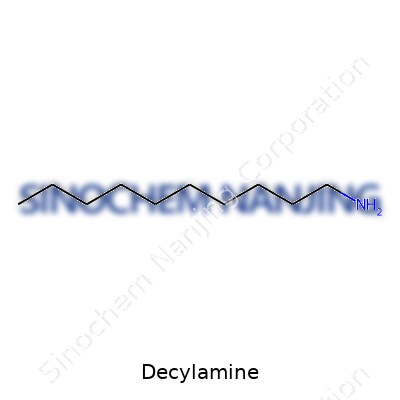
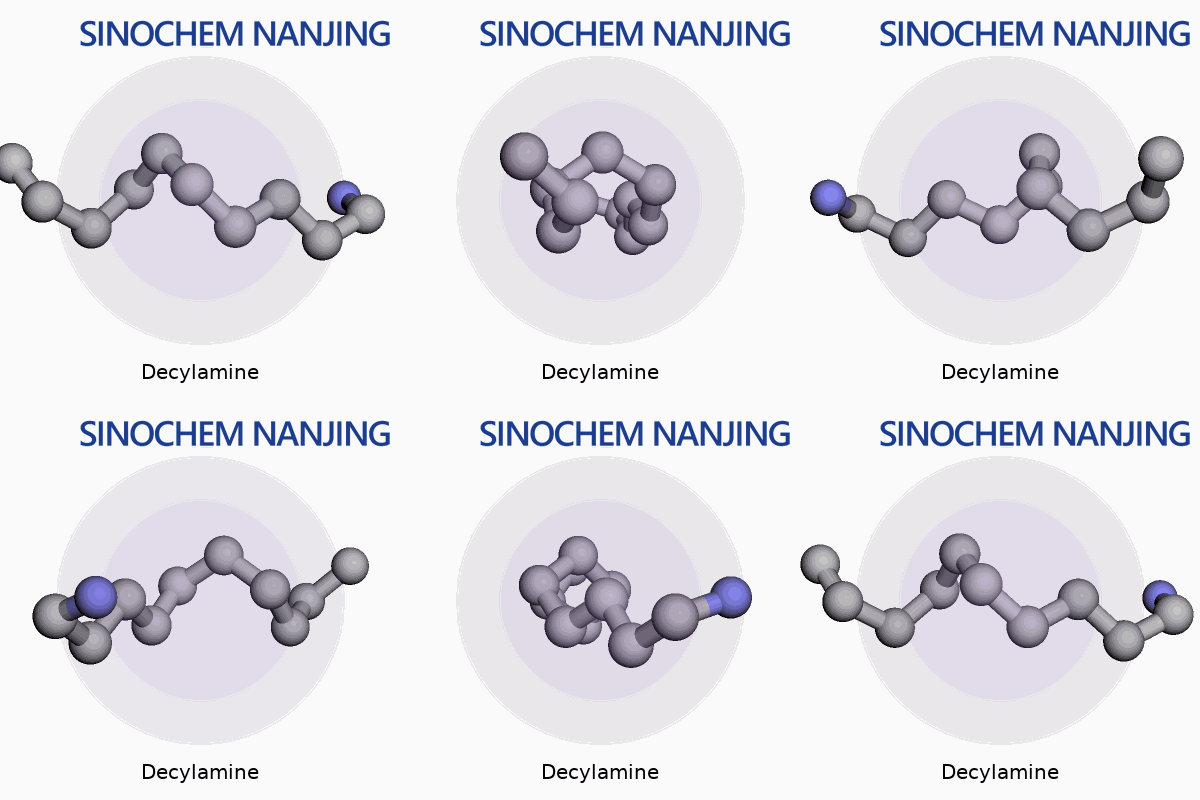
| Names | |
| Preferred IUPAC name | decan-1-amine |
| Other names |
1-Decanamine Decyl amine n-Decylamine n-Decyl amine Decan-1-amine |
| Pronunciation | /ˈdɛsɪl.əˌmiːn/ |
| Identifiers | |
| CAS Number | 2016-57-1 |
| Beilstein Reference | 1710834 |
| ChEBI | CHEBI:36467 |
| ChEMBL | CHEMBL14512 |
| ChemSpider | 6737 |
| DrugBank | DB13917 |
| ECHA InfoCard | 03bebd99-f3fa-4049-883e-6f141c0b568e |
| EC Number | 204-681-6 |
| Gmelin Reference | 120134 |
| KEGG | C01876 |
| MeSH | D003756 |
| PubChem CID | 8147 |
| RTECS number | KK6475000 |
| UNII | TT86HPP332 |
| UN number | UN2735 |
| Properties | |
| Chemical formula | C10H23N |
| Molar mass | 157.3 g/mol |
| Appearance | Colorless to yellow liquid |
| Odor | Ammonia-like |
| Density | 0.74 g/mL at 25 °C (lit.) |
| Solubility in water | slightly soluble |
| log P | 3.9 |
| Vapor pressure | 0.21 mmHg (25°C) |
| Acidity (pKa) | 10.6 |
| Basicity (pKb) | 3.29 |
| Magnetic susceptibility (χ) | -6.2e-6 cm³/mol |
| Refractive index (nD) | 1.428 |
| Viscosity | 2.02 mPa·s (25 °C) |
| Dipole moment | 1.35 D |
| Thermochemistry | |
| Std molar entropy (S⦵298) | 357.6 J·mol⁻¹·K⁻¹ |
| Std enthalpy of formation (ΔfH⦵298) | -126.7 kJ/mol |
| Std enthalpy of combustion (ΔcH⦵298) | -6436.5 kJ/mol |
| Hazards | |
| GHS labelling | GHS02, GHS05, GHS06, GHS08 |
| Pictograms | GHS05,GHS06 |
| Signal word | Danger |
| Hazard statements | H302, H314, H411 |
| Precautionary statements | P261, P273, P280, P302+P352, P305+P351+P338, P310 |
| NFPA 704 (fire diamond) | 3-3-0 |
| Flash point | 75 °C |
| Autoignition temperature | 190 °C |
| Explosive limits | Explosive limits: 1-7.3% |
| Lethal dose or concentration | LD50 oral rat 373 mg/kg |
| LD50 (median dose) | LD50 (median dose): 550 mg/kg (rat, oral) |
| NIOSH | UB3675000 |
| PEL (Permissible) | PEL (Permissible Exposure Limit) for Decylamine: "5 ppm (skin) |
| REL (Recommended) | 1 ppm |
| IDLH (Immediate danger) | 140 ppm |
| Related compounds | |
| Related compounds |
Nonylamine Undecylamine Dodecylamine |



