Dodecane: More Than Just a Chemical—A Look at Its Roots, Risks, and Role in Science and Industry
Digging Into the History of Dodecane
Dodecane has shown up on lab benches longer than most folks realize. This hydrocarbon, tucked into the broader family called alkanes, came under sharper focus in the late 19th and early 20th centuries as chemists chased after how crude oil breaks down. The old timers found dodecane as they pushed for kerosene and gasoline, hunting for anything they could use from a barrel of oil. Over decades, dodecane changed from a leftover to a staple. As a science student, seeing it packed neatly away with solvents gave me a sense of just how broad the reach of petrochemical research had become. They say necessity is the mother of invention—this stuff proves it, adapting along with industry demands, from surging fuel needs during World War eras to peacetime curiosity about hydrocarbons and their quirks.
What’s Dodecane All About?
Take one look at dodecane, and you’d miss its story. Colorless, with a faint petroleum whiff, it sits in its bottle and waits. But under the surface, it packs twelve carbon atoms linked in a straight line—nothing fancy on the face of it, just C12H26. In my old chemistry classes, teachers treated it as a model for n-alkanes, the backbone for learning about hydrocarbons. That long, unbranched chain sets dodecane apart, as it brings unique properties that show up only in compounds big enough to be liquid at room temperature but small enough to mix easily with non-polar substances. Its simplicity ends up being its strength, whether you’re after a standard for gas chromatography or building blocks for more complex syntheses.
Physical and Chemical Properties—What Makes Dodecane Tick
At room temperature, dodecane gives you a clear liquid that barely budges the scale, lighter than water. The boiling point sits just above 216 degrees Celsius, so it easily shrugs off heat that’d knock out lighter alkanes. Its melting point, just below –10 degrees Celsius, means you rarely see it as a solid in daily use. Chemistry labs teach that dodecane hates water but loves dissolving things like oils, fats, and other hydrocarbons. That hydrophobic character comes in handy in extraction work, separating organics during synthesis or analysis. You won’t find it eager to react at normal temperatures and pressures, but it burns with a luminous flame and makes carbon dioxide and water when fully combusted—simple, predictable, dependable. The lack of functional groups makes it pretty stubborn, but push it hard enough with the right catalysts and heat, and it’ll start cracking or turning into more interesting stuff.
What’s On the Label—Technical Specs and Safe Use
Every bottle of dodecane wears a label warning about flammability, since an open flame turns it into a fire hazard in a hurry. Labs stick to clear storage guidelines: don’t mix with oxidizers and keep the bottle cool, dry, and away from sunlight. I remember safety sheets headlining its flash point, the temperature where it gives off enough vapor to ignite if a source comes along. Handling means gloves and goggles, because even though dodecane doesn’t eat through skin or plastics like acids, spills create slick patches and the liquid can dry out hands after repeated exposure. Regulations require clear hazard icons, batch numbers, and info for quick reference in an emergency. As someone who prepared reagents for countless undergrad experiments, this discipline in labeling isn’t just fussy bureaucracy—when stress hits, clarity saves lives.
Getting Dodecane—How It’s Made
Modern dodecane mainly comes out of petroleum refining. For decades, oil refiners cracked heavier hydrocarbon chains, targeting gasoline and diesel but pulling off dodecane as one of the byproducts. The process relies on distillation—heating up crude oil until the different alkanes separate out at their boiling points. Sometimes, industries turn to the Fischer-Tropsch process, starting with coal or natural gas and building up straight-chain hydrocarbons through clever catalysis. In university workshops, making dodecane from scratch was only a topic of discussion—practical labs didn’t let students near heated crude or synthesis reactors. Big producers stick with refining, since the infrastructure delivers large quantities, and purity gets a boost through repeated distillation and filtering.
Diving Into Dodecane’s Chemical Reactions
Dodecane doesn’t leap into reactions without a push. Its straight-chain structure gives it stability, but under strong heat or the right catalyst, it cracks into smaller alkanes and alkenes. Oil refineries use this reactivity for more profitable gasoline production. In a lab, students find oxidation doesn’t come easy, but mixed with the right reagents, dodecane forms alcohols, aldehydes, or even carboxylic acids. Chlorination and bromination let chemists swap out hydrogens for halogens, creating intermediates for surfactants or lubricants. These reactions require strict controls—unmonitored halogenation risks messy, dangerous products. Adjustable variables, like temperature, pressure, and catalyst type, allow researchers to steer dodecane’s fate. The clean, predictable combustion has made it a staple fuel in certain test engines and academic flame studies; its consistency matters more than complexity for these tasks.
What’s In a Name—Alternative Labels for Dodecane
Pick up a chemical catalog, and dodecane parades under several names. The most common synonyms are laurane and bi-dimethyl-octane, though hardly anyone uses the latter outside old textbooks. Chemists stick to “n-dodecane” to signal the unbranched version, since branched isomers show up rarely in practical settings. Even the IUPAC calls it dodecane, sidestepping confusion. Sometimes product sheets reference hydrocarbon solvent No. 12 or CAS 112-40-3, especially in regulatory filings and inventory systems. The dizzying variety of synonyms shows how chemicals cross silos, from the lab to the warehouse, and how consistency in names matters for regulatory safety and accurate communication.
Staying Safe—Handling and Operational Standards
Flammability causes the most concern during handling. Dodecane vapors can build up in confined spaces, so proper ventilation is non-negotiable. Industrial sites use explosion-proof storage, spark-free equipment, and dedicated transfer lines to avoid accidental fires. Training goes further than simple warnings; staff need refreshers on emergency procedures and fire drills. Standard practice checks for leaks and tests air for hydrocarbon buildup, especially in warmer climates where evaporation speeds up. In labs, personal protective equipment is a given, and so is rapid cleanup of spills to prevent slip hazards. Local and international guidelines require reporting for storage above certain quantities, and disposal means collecting unused dodecane as hazardous waste—dumping isn’t just unlawful, it risks groundwater and soil health. Putting in the extra effort around safety speaks volumes about a company’s or institution’s respect for staff, students, and the community.
From Science to Streets—Where Dodecane Shows Up
Dodecane finds its way into more corners than most people imagine. In analytical chemistry, it serves as an internal standard for gas chromatography, helping labs calibrate their instruments for hydrocarbon detection. Pilot plants use it as a reference fuel in knock engine testing, since its combustion characteristics are so well understood. Manufacturers of lubricants, metalworking fluids, and cleaning agents value its solvency and low reactivity with metals. It mixes into polymer formulation, especially where non-polar characteristics are needed for specific performance profiles. In environmental engineering, dodecane sometimes pops up as a model compound for studies of pollution or oil spill behavior. I’ve seen researchers mimic crude oil slicks using dodecane, testing the limits of booms and barriers before a real disaster strikes. The aviation and defense industries rely on it for engine and fuel research. Even perfumers and flavor formulators look to hydrocarbons like dodecane for specialized extractions, though the end product needs meticulously monitored purification.
Cutting-Edge Chemistry—Research, Development, and Toxicity
Current research on dodecane straddles several fields. Some teams look at refining processes, aiming for better yields or greener production. Environmental scientists dig into how dodecane interacts with soil and water, tracking how spills evaporate or degrade with time. Toxicologists study its behavior in mammals, since high-dose laboratory exposure points to central nervous system depression, respiratory irritation, and liver changes. The science shows ordinary handlers don’t face significant risk if they stick to best practices and proper PPE, but chronic mishandling or accidental ingestion quickly shifts the risk profile. Newer papers pay close attention to its breakdown in the environment—microbial degradation offers a slow but natural clean-up, but large spills require faster responses. As a test substance, dodecane lends itself to modeling how hydrocarbons act inside living tissues, giving toxicologists tools to predict risk before animal testing. Chemists looking to unlock new types of fuel or energy storage eye dodecane as a candidate for functionalization or as a baseline for comparison. Its role as a model alkane cements its place in textbooks and practical research until something better comes along.
Looking Ahead—What’s Next for Dodecane?
Industries keep looking for safer, more sustainable alternatives to petroleum products, but as long as oil sticks around, dodecane isn’t leaving the scene. Researchers already experiment with plant-derived or waste-based syntheses, but price and scale play stubborn opposition. Energy companies check out how renewable feedstocks can yield dodecane-like compounds, aiming to cut life-cycle emissions. Regulations on volatile organic compounds tighten every year, and companies must adapt storage, transport, and handling or find alternatives for the most sensitive uses. Even so, academic labs and pilot plants treat dodecane as a go-to example for hydrocarbon research, especially in fuel science and solvent testing. Down the road, its fate likely depends on the bigger picture for fossil fuels. For now, anyone dealing with hydrocarbons owes it to themselves and their community to respect the risks, leverage the benefits, and keep safety front and center—all lessons hard-learned in labs and factories worldwide.
What is dodecane used for?
Looking Past the Science Jargon
Dodecane sounds unfamiliar until you realize it turns up all over modern life. Many have never handled it directly, but it plays an unglamorous, crucial part behind the scenes. Sitting in a chemist’s storeroom, it might come across like just another colorless liquid. Out in the real world, though, dodecane shapes fuels, industrial break-throughs, and sometimes even what’s in your local drugstore’s liquid soap aisle.
Your Gasoline Once Counted On Dodecane
Gasoline rarely sparks inspiration for thoughtful commentary, but there’s a reason to talk about how dodecane fits in. Laboratories that test fuel quality rely on it as a standard reference. Dodecane holds a clear spot on the octane scale. That means experts run test engines using this compound to compare knock resistance—a key trait for engines that run smoothly and mileage that isn’t wasted. Reliable standards matter in this business, and lives depend on safe, high-quality fuel on the road and in the air.
Solvent In The Background: Not Just For The Lab
People toss around the word "solvent" without stopping to think how few actually know what it does. Dodecane dissolves things that water can’t touch—from waxes to greases to certain paint ingredients. Paint makers draw on dodecane to produce even coatings and to formulate products that hold up under tough weather or wear. Researchers lean on it as a reaction medium when water or alcohol just get in the way. Experimenters value it for staying stable and not reacting when the only thing they need is a safe, predictable background. This stability keeps experiments on track and results dependable.
Everyday Products: Quiet Ingredient, Big Impact
Many household sprays, polishes, and cleaning products blend in dodecane. It can help formulas hit the right level of evaporation—fast enough to keep things from feeling sticky but not so fast that a propellant flashes off in your hand. Some specialty cosmetics and sunscreens count on dodecane to keep things smooth and spreadable. Not all companies announce it on front labels, but it can be there, quietly doing its work.
Environmental Considerations: Not All Smooth Sailing
With this much presence in industries, questions naturally come up about environmental impact. Dodecane breaks down slower than some lighter hydrocarbons once in the wild. While it rarely grabs headlines like crude oil or gasoline spills, releases from industry leak into water or soil. Regulations in the US and Europe keep close tabs on storage and use so accidents don’t cause trouble down the line. Anyone handling large amounts has to pay attention, since the compound floats on water and resists breaking down quickly in sunlight.
Lessons From Daily Use And Industry
Watching dodecane's path from lab to industry and back home gives a new appreciation for overlooked chemicals. The takeaway hits close to the principles of scientific responsibility and consumer trust: choices about solvents and standards shape both products and broader safety. If a company can swap to greener chemistry or improve leak-proofing, both workers and neighbors come out ahead. Educating young chemists and engineers to respect even an “ordinary” hydrocarbon like dodecane can pay off in safer work and cleaner surroundings, not just higher yield in a plant or perfect results in a flask. Dodecane holds real lessons for anyone who cares about how the practical side of science shapes society one hidden ingredient at a time.
Is dodecane hazardous to health?
What is Dodecane?
Dodecane stands as a colorless, oily liquid. This hydrocarbon pops up most often in fuels, solvents, and even some research labs. Chemists might call it C12H26, but the rest of us are more familiar seeing it as part of diesel, kerosene, or even camping stove liquids. It slips into daily life unnoticed, humming along behind the scenes.
Direct Exposure in Workplaces
I’ve seen dodecane mostly handled in industrial settings and labs. Direct contact with the liquid feels greasy on skin, and, like plenty of hydrocarbons, dodecane will irritate eyes or open skin. Most folks shrug off short-term contact — not unlike a brush with mineral oil — but the story changes if exposure continues. Some workers have reported dry or cracked hands, and a splash to the eyes delivers a nasty sting. It doesn’t absorb through the skin as fast as solvents like benzene, yet it’s best to avoid letting it linger.
Inhaling Dodecane Vapors
The part that stands out most comes from breathing in its vapors. Dodecane doesn’t give off a strong smell, so its presence can sneak up. At room temperature, it does not evaporate as quickly as lighter solvents. Start heating it, though, and the risk grows. Shortness of breath, headache, or dizziness sometimes follow if a person ends up in a space where dodecane vapor hangs in the air. The American Conference of Governmental Industrial Hygienists (ACGIH) pegs exposure limits at 100 parts per million for many similar hydrocarbons, placing dodecane in the “handle with care” column, not unlike kerosene or mineral spirits.
Long-Term Health Risks
Talking with safety managers and reading recent studies, I have not seen hard evidence linking dodecane to cancer or long-term organ damage in humans at ordinary exposure levels. Animal studies show that feeding high amounts of dodecane for long periods can hurt the liver and kidneys, but the doses in those tests ran much higher than anything found outside a research project. As a knock-on effect, dodecane can help other chemicals dissolve, letting those hitch a ride deeper into the body, so it pays to consider the bigger mix, not just one ingredient.
Protecting People From Hazards
In my own lab, gloves and eye protection stand as standard gear for all liquid hydrocarbons. Good ventilation — or, better yet, local fume hoods — does more than keep the air fresh; it keeps people safe from sneaky vapors that build up over time. When refueling camp stoves or working indoors, it’s all too tempting to skip opening a window, but stale air risks headaches or nausea. For spills, basic absorbent pads and sealing off the area work well, since dodecane doesn’t spread fast, but it can soak into floors or cloth before long.
Room for Improvement
Modern workplaces often focus on the worst offenders, leaving substances like dodecane overlooked. Safety data sheets tend to seem dry and technical, but regular staff training brings the risks to life. In smaller shops or home garages, swapping out oil-based products for safer water-based alternatives trims the hazard. Many new degreasers, cleaners, and specialty fuels walk away from hydrocarbons entirely without leaving chores undone. As a chemical that doesn’t flash-burn or vaporize at low temps, dodecane rarely causes big accidents, but steady, low-level exposure still warrants respect and regular review of safety habits.
What is the chemical formula of dodecane?
Getting to Know Dodecane
Dodecane pops up in places you might not expect. Most folks haven’t memorized its chemical formula, but plenty of us rely on products that tap into its unique properties. For those curious about the basics, here it is: dodecane’s formula is C12H26. That means it’s got twelve carbon atoms strung together in a chain, and twenty-six hydrogens snuggled around that chain. It belongs to the alkane family—a group of hydrocarbons known for being saturated, which just means the carbon atoms connect by single bonds and hold as many hydrogens as possible.
Real-World Places You’ll Find Dodecane
I remember running into dodecane during a stint at a small fuel lab job in college. It wasn’t some rare, locked-away chemical. Instead, it showed up as a reference compound when testing gasoline blends. Industries use dodecane for calibration because it burns cleanly and predictably. It also sneaks into some jet fuels and diesel, adding stability and helping researchers guess how fuels might behave under stressful conditions.
Refineries get a lot out of dodecane’s steady traits. Dodecane resists breaking down at higher temperatures, so engineers often use it for simulation exercises. It also finds work as a solvent in labs—mainly to dissolve greasy, nonpolar stuff. Turns out, not every liquid works for that job. A waxy, steady hydrocarbon works much better if you don’t want your results muddied by unexpected chemical reactions.
Why Dodecane Matters
You might think dodecane sits quietly behind the scenes, but it touches so many parts of everyday life. From fuel development to industrial cleaning, to chemical manufacturing, knowing exactly what dodecane can do leads to safer handling and smarter use. That formula—C12H26—tells chemists how to store, ship, and use it responsibly. Dodecane has a high flash point, which means it won’t catch fire as easily as something like gasoline. Still, given it’s a hydrocarbon, spills ought to be contained to protect the environment.
There’s another angle too. Dodecane’s straight-chain structure means it doesn’t blend well with water, so spills float and spread. Researchers and industry workers have studied the best ways to contain and break down spills, including using absorbents and specialized bacteria. The bigger picture here involves weighing the benefits in industry against the risk to ecosystems and the air we all share.
Looking at Responsible Use
Reading safety data sheets and following workplace protocols helps everyone—from warehouse techs to university researchers—understand what’s in their hands. I still remember the straight talk from a mentor: “If you respect this stuff, it’ll do what it’s supposed to. Take shortcuts, and even simple chemicals can bite back.” Hands-on experience with dodecane and other alkanes hammered that point in. Proper ventilation, smart storage, and quick cleanups make a difference.
Dodecane isn’t flashy. Its value rests in its predictability, so professionals trust it when they want known results. Whether folks are testing fuels, cleaning metals, or doing basic science, understanding its chemical formula isn’t just trivia—it’s a matter of safe, smart chemistry.
How should dodecane be stored and handled?
Why Attention to Dodecane Matters
Walk into any chemistry stockroom and you’ll probably find a bottle of dodecane somewhere on a shelf. People use it as a solvent, a standard for measuring in labs, and even in making fuels. It’s clear, looks harmless, and doesn’t seem all that reactive. But underestimating dodecane can bring problems that reach beyond a few spilled drops. I’ve seen folks shrug off hydrocarbons, thinking, “It’s not as bad as some other solvents.” That’s the wrong mindset.
Dodecane’s flashpoint sits at about 74°C (165°F). That sounds high, but leave a container open next to a heat source or in direct sun, and vapors start to build. It’s not explosive like ether, but you don't want any open flames or sources of sparks nearby. An accidental ignition could kick off a stubborn fire. It's not just about putting yourself at risk but everyone else in the lab or warehouse too.
What Safe Storage Looks Like
Every workplace has its own quirks, but a few common-sense rules never change. Storing dodecane somewhere cool, out of sunlight, and away from heat gives you a head start. Strong metal cabinets with fire ratings set up in ventilated sections keep things contained if something goes wrong. Wood shelving belongs in the hardware aisle, not next to a tank of flammable liquids.
Labels should jump out at you. There’s no point in a sticker if it fades or falls off the bottle. I’ve seen older stock get mistaken for other, less risky solvents because the ink wore away. Permanent markers and a second label on the lid go a long way for keeping things clear. Missing labels is a shortcut to bad accidents.
Many places just chuck dodecane with other solvents. Actually, combining it with strong oxidizers or certain acids leads to chemical reactions nobody wants to deal with after a long day. Separate flammable storage cabinets make sorting easier and safer. No mixing up solvent trash, either—keep dodecane waste containers set up with sealing lids, and empty them before they get heavy.
Handling: Personal Safety Is Always Worth It
No one likes hot, stuffy gloves, but skipping gloves turns little splashes into skin or eye irritation. Nitrile gloves make sense for dodecane. During transfer, goggles mean even a dropped funnel doesn't become a hospital visit. Ventilation matters a lot: open a bottle in a closed room, vapors linger, and you’ll smell the mistake.
Spills don't always look dramatic—just a few drops on a bench seems harmless. Quick clean-up with absorbent pads and immediate disposal stops slicks from spreading. Ordinary paper towels spread the mess. Chemical spill kits look intimidating, but every shelf that holds dodecane should have one within arm’s reach. Nobody runs across the building mid-emergency; the spill grows before you get back.
Training and Speaking Up
No one remembers the boring parts of chemical safety training, but the basics stick if they come up day to day. Supervisors who walk staff through the right handling make routines safer than any poster on the wall. People new to working with solvents should get a run-through instead of figuring it out on the fly.
If you see someone doing something risky with dodecane—maybe storing it by a window or pouring it into a drink bottle—say something right away. Peer reminders seem awkward but prevent near-misses that become stories for the wrong reason. Dodecane’s not a villain, but complacency turns it into one.
Fact is, safe storage and handling start with daily habits. Years spent around organic solvents taught me that shortcuts get expensive. Getting it right means time saved, injuries avoided, and everyone going home in one piece.
What are the physical properties of dodecane?
A Glimpse at Dodecane’s Makeup
Dodecane shows up as a clear, colorless liquid that looks kind of like a thicker, more viscous gasoline. There’s nothing dramatic about its appearance—if you spilled it, most people wouldn’t even notice unless they caught the faint, kerosene-like scent. The stuff comes in handy because it acts a lot like common fuels and other simple organic liquids but doesn’t mix with water or evaporate too quickly. I’ve seen it used in college labs as a plain, stable solvent where folks would rather avoid surprises from more volatile chemicals.
Boiling, Freezing, and More
One thing that jumps out is dodecane’s boiling point. At about 216 degrees Celsius, it hangs in there long past the limit of water and ethanol. Crack the thermometer past 212 degrees Fahrenheit, and water’s steam already fills the room, but dodecane sits there cool as anything. This high boiling point lands it a spot in applications where heat stability matters—think calibration for high-temperature machinery or controlled distillation tests. You also run into its low freezing point, hovering near -10 degrees Celsius. That makes it practical for outdoor use, cold storage, or simple winter transport.
Density and Flow
The density clocks in at roughly 0.75 grams per cubic centimeter—so it floats on water and doesn’t weigh down glassware. A jug of dodecane isn’t as hefty as the same-sized container of water, which makes handling it less of a workout on the job. Its viscosity stands at 1.34 millipascal-seconds at around room temperature, which means it pours a little thicker than water but still moves fast compared to oil. This trait matters in running clean pipelines and ensuring smooth transfers where gunk and blockages cause headaches. I remember cleaning up after experiments where thin hydrocarbon solvents like dodecane made my shift easier since they wouldn’t leave sticky residue or back up pumps.
Solubility and Mixing
Dodecane steers clear of water and most polar solvents. It blends just fine with other hydrocarbons—mix it with octane or hexane, and they form a single phase without any separation. In my own experience, this means you can swap dodecane into recipes or fuel blends without fuss, so long as everything in the mix shares that nonpolar chemistry. If you try to stir it into water, it splits out every time. That property might seem annoying if you expect uniform solutions, but it proves invaluable in separating out oil spills, managing chemical reactions, or cleaning up tough messes with a clear separation line.
Handling and Hazards
Anyone who spends time with dodecane knows it isn’t an aggressive chemical—no rapid fires or explosions unless you’re really heating things up. Still, its vapor can irritate the nose and lungs. I’ve always treated it with respect because it lingers on surfaces and creeps into the air in a warm room. Store it in closed containers, away from open flames and heat sources. If a spill happens, step back and let air flow or wear a mask, just in case. It tends to evaporate slower than lighter fuels, buying precious time for cleanup before anyone notices a sharp smell.
Why Dodecane’s Traits Matter in Real Life
These physical properties shape dodecane’s everyday roles. Its stability and low reactivity make it safe for lab experiments. High boiling point supports processes needing heat, and its non-mixing attitude with water makes it a go-to tool in separating oil-based substances. In environmental work or refining, that separation ability speeds up cleanups and analysis. The density and flow make equipment maintenance simpler, cutting down on caked residue or sticky pipes. Folks working with chemicals like dodecane know that understanding these details can save time, cut costs, and prevent accidents long before they happen.
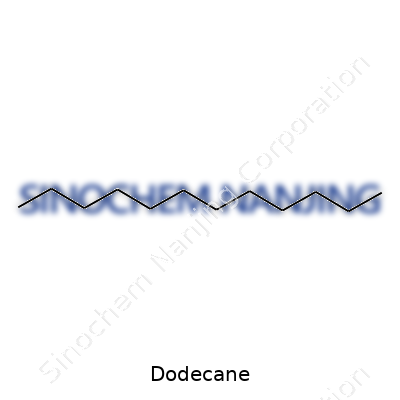
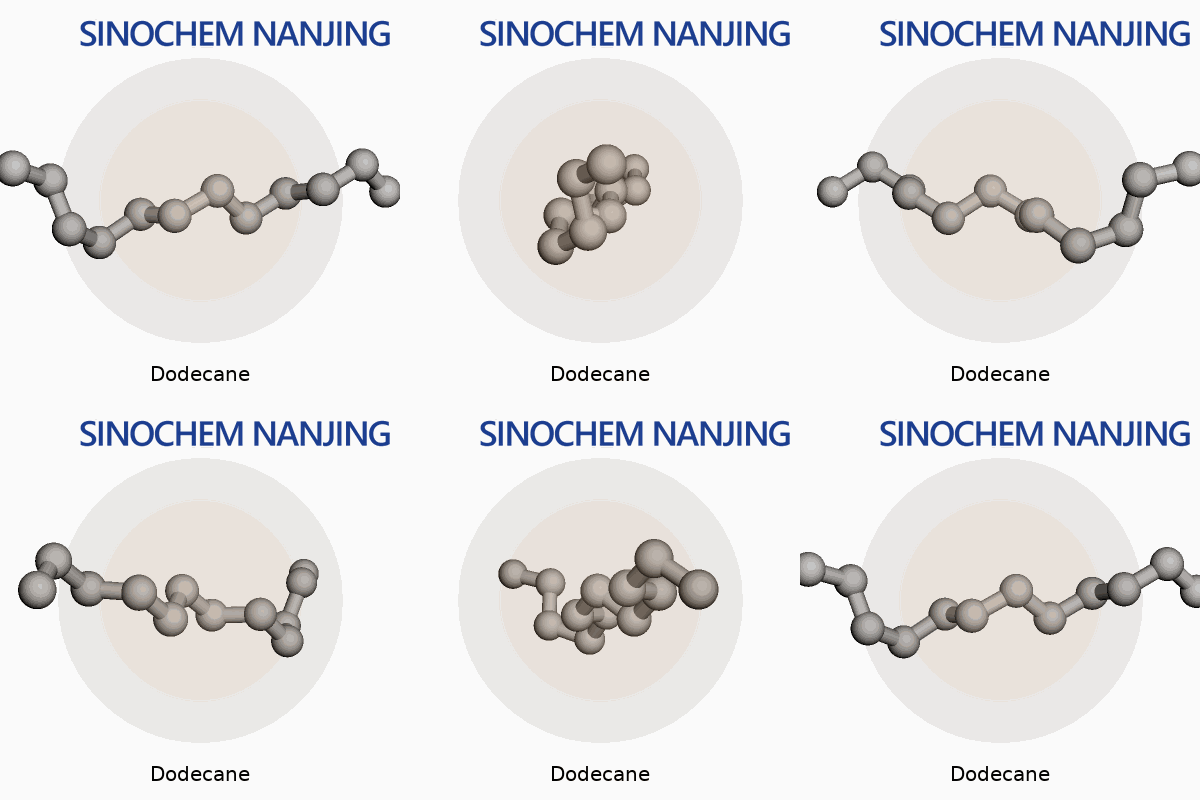
| Names | |
| Preferred IUPAC name | dodecane |
| Other names |
Dihexyl Bihexyl n-Dodecane |
| Pronunciation | /ˈdoʊˌdɛˌkeɪn/ |
| Identifiers | |
| CAS Number | 112-40-3 |
| Beilstein Reference | 1201094 |
| ChEBI | CHEBI:28837 |
| ChEMBL | CHEMBL14262 |
| ChemSpider | 8063 |
| DrugBank | DB14096 |
| ECHA InfoCard | 100.208.233 |
| EC Number | EC 203-967-9 |
| Gmelin Reference | 82183 |
| KEGG | C00726 |
| MeSH | Dodecane |
| PubChem CID | 8183 |
| RTECS number | HD4375000 |
| UNII | K3J2UM97QJ |
| UN number | UN2247 |
| Properties | |
| Chemical formula | C12H26 |
| Molar mass | 170.34 g/mol |
| Appearance | Colorless liquid |
| Odor | Odorless |
| Density | 0.749 g/mL at 25 °C |
| Solubility in water | Insoluble |
| log P | 6.10 |
| Vapor pressure | 0.019 hPa (20 °C) |
| Acidity (pKa) | ~50 |
| Magnetic susceptibility (χ) | Diamagnetic |
| Refractive index (nD) | 1.421 |
| Viscosity | 1.34 mPa·s (25 °C) |
| Dipole moment | 0.097 D |
| Thermochemistry | |
| Std molar entropy (S⦵298) | 352.7 J·mol⁻¹·K⁻¹ |
| Std enthalpy of formation (ΔfH⦵298) | –351.6 kJ/mol |
| Std enthalpy of combustion (ΔcH⦵298) | –7513.0 kJ·mol⁻¹ |
| Pharmacology | |
| ATC code | D14AB01 |
| Hazards | |
| GHS labelling | GHS02, GHS07 |
| Signal word | Warning |
| Hazard statements | H226, H304, H315, H336, H411 |
| Precautionary statements | P210, P233, P240, P241, P242, P243, P273, P280, P301+P310, P303+P361+P353, P304+P340, P321, P331, P370+P378, P403+P235, P501 |
| NFPA 704 (fire diamond) | 1-2-0 |
| Flash point | > 74 °C (165 °F; 347 K) |
| Autoignition temperature | Autoignition temperature of Dodecane is 204 °C |
| Explosive limits | 0.6–4.5% |
| Lethal dose or concentration | LD50 oral (rat): 34,600 mg/kg |
| LD50 (median dose) | LD50 (median dose): Oral (rat): 34 g/kg |
| NIOSH | PSA50000 |
| PEL (Permissible) | PEL (Permissible Exposure Limit) of Dodecane: 500 ppm (1800 mg/m³) |
| REL (Recommended) | 199 mg/m³ |
| IDLH (Immediate danger) | 1000 ppm |
| Related compounds | |
| Related compounds |
n-Undecane n-Tridecane n-Decane |



