Decahydronaphthalene: Tracing Its Path from Discovery to Modern Application
A Look Back at Decahydronaphthalene’s Journey
Decahydronaphthalene, often called decalin, traveled an interesting road through the world of industrial chemistry. Born out of advances in early petroleum research, this compound secured its place on the backbones of blending, cleaning, and synthesis labs by the midpoint of the 20th century. Chemists pushed for reliable, stable solvents to match the blooming variety of new plastics, coatings, and synthetic rubbers, and decalin fit the bill thanks to its toughness against chemical breakdown and its knack for dissolving stubborn feedstocks. In the postwar years, demand soared as synthetic rubber factories cranked up production, and decalin worked its way from bench curiosity to an everyday industrial force. Plenty of older research tied decalin’s appeal to solving practical problems engineers couldn’t ignore, rather than chasing theoretical fancy. This pattern helps explain why the compound’s popularity held steady while other flavors of solvents fell away.
Digging Into Product Basics
Decalin shows up as a clear, colorless liquid packing a faint cycloparaffin odor. What brings real value is its dual-cycloalkane structure, built from a naphthalene skeleton swollen with hydrogen. The market recognizes two flavors—cis-decalin and trans-decalin, with commercial blends swinging between the pair depending on how they were made. In practice, end users rarely pay attention to those ratios unless they work in specialty synthesis or advanced materials science. Most see decalin as a hard-working, hydrophobic solvent, prized for its muscle in handling things that leave weaker cycloalkanes flustered.
The Details That Matter: Physical and Chemical Properties
Decalin’s chemical stubbornness helps it shine in rough environments. It boils near 190°C and hardens below -43°C, which points to a solid temperature range in most field and plant settings. Its density circles 0.9 g/cm³—lighter than water but heavier than pentane or hexane. Decalin’s vapor pressure stays manageable at room temperature, so risks linked to volatility remain lower than what you'd find in benzene or toluene. Chemically, its saturated bonds let it ignore oxidizing agents most of the time, and it won’t participate in unwanted side reactions with plastics or rubber systems. The compound doesn't mix with water, which suits it for blending into nonpolar mixtures. Where many simple hydrocarbons buckle, decalin shrugs off breakdown and keeps right on performing in the presence of acids, bases, or short bursts of heat.
Technical Details and Labeling Challenges
Anyone stocking decalin in a storeroom wants to watch for confusion caused by synonyms. Synonyms like decalin, decahydronaphthalene, and bicyclodecane show up nearly interchangeably across global technical documents, though "decalin" gets the nod in most industrial catalogs. CAS numbers and UN shipping codes provide the hard identification, but labels in old labs may predate modern conventions, risking errors when updating inventories. The shipping regulations treat decalin as a flammable liquid (packing group III), and labels typically call out both fire and inhalation hazards. For operations, standardized drums and cans offer enough headspace for expansion, as pressures spike when stored near heat sources.
Making Decahydronaphthalene
Old school manufacturing relied on in situ hydrogenation of naphthalene under pressure, using metal catalysts like nickel or platinum. The process demands a temperature and pressure high enough to punch through naphthalene’s aromatic rings, locking in those added hydrogens and forming the desired bicyclic structure. In modern facilities, continuous flow reactors dominate, offering better temperature control and catalyst life. Many operators run additional purification steps to drive off cyclohexane and other polycyclic blends that would otherwise cut solvent strength. At scale, improvements in catalyst recycling and closed-loop hydrogen feedstock management help keep costs and emissions in check. Factories working with recycled streams have to control sulfur and metal contamination, as these cut into both yield and purity.
How Decalin Behaves in Chemical Reactions
Because of its saturated nature, decalin doesn’t march headfirst into chemical reactions. That’s a feature for anyone needing a neutral backdrop for synthesis, hydrocarbon cracking, or polymerization. In labs, decalin acts mainly as a reaction medium or carrier—never the star player, but always making sure the folks in the main event get their spotlight. On rare occasions, specialty chemists coax decalin into controlled chlorination or oxidation, but those cases pop up mainly in research rather than day-to-day production. As a solvent, it can help push hydrogenation reactions to completion, especially where aromatic residues slow refinery processes. Decalin’s resistance to acid attack led to its use in catalyst testing, where it holds up much longer than pure aromatics or straight-chain alkanes.
Names and Synonyms to Watch For
Decahydronaphthalene, decalin, perhydronaphthalene, and bicyclodecane pack the lion’s share of product references, but some legacy texts allude to "hexahydrobinaphthylene" or "hydrogenated naphthalene." Anyone pulling up research records, SDS sheets, or international regulations ought to double check for these monikers to catch crucial updates or hazard notifications that could otherwise slip past. For those handling imports or international trade, reading past the first line of a customs invoice often reveals all sorts of official-sounding versions tied to the same chemical.
Meeting Safety and Operational Standards
Decalin brings a flammability risk few can afford to overlook. Its flash point puts it a notch safer than gasoline but still far from harmless in open air. Industrial users keep drums under tight ventilation, locking down static discharge and leak-prone hoses as a priority. Workers get respiratory protection in poorly vented rooms, not just for decalin vapor but also for breakdown fumes creeping into the air with enough heat or UV light. Gloves must hold up to cycloalkane penetration—simple latex often fails, so nitrile and butyl gloves earn the call. Anyone using decalin on open lines watches for vapor buildup and spark sources, as a stray charge at the wrong moment can spell real trouble.
Application Areas in Daily and Specialized Use
Decalin’s knack for blending tough oils and cutting through gummy substances put it square in the heart of synthetic rubber manufacturing. Tire compounding, drum linings, and cable insulation mix in decalin not just as a diluent but as a critical agent for dissolving heavy-duty elastomers. In the paint world, decalin keeps high-solids coatings smooth enough to spread, especially in solvent-borne formulations meant to last in rugged settings. Moving from industrial benches into research, scientists count on decalin as a coolant and carrier for sensitive apparatus, with its boiling range lining up just above the boiling point of water but well short of the scorching heat that would wreck more fragile equipment. Engineers in oil refineries and catalysis research use decalin as a model hydrocarbon, simulating real-life conditions where aromatic hydrocarbons need taming or breakdown. Labs working with NMR spectroscopy lean on decalin’s simple, non-aromatic nature when running baseline scans for certain types of analysis, making it something of a “background solvent” in spectroscopy circles.
Current Research and Development Trends
Teams looking to stretch decalin’s value keep chasing ways to wring more product from every barrel of crude or recycled stock. With environmental targets tightening for volatile organic compounds, researchers explore tweaks to lower vapor emissions during transportation and blending. On the catalysis front, new alloys and nano-structured supports help drive hydrogenation yields while reducing off-spec byproducts. There’s buzz around modifying decalin’s molecular backbone for use in next-generation energy storage fluids, where stability, thermal conductivity, and fire resistance matter more than traditional solvent characteristics. A few academic groups investigate decalin’s interactions with specialty polymers, seeing if it can tailor polymer properties or facilitate self-healing coatings.
Decalin and Toxicity: Looking at the Data
Straight talk about safety—handling decalin all day carries health considerations nobody should brush aside. Inhalation exposure can leave you with headaches, dizziness, and eye or throat irritation. Chronic high-dose exposure (think leaks or closed tanks) raises the odds of impacts on liver and nervous system functions, though published data in humans remains sparse. Animal studies warn of central nervous system depression and irritation at large doses, putting it in line with other hydrocarbons but not in the same league as benzene for toxicity or carcinogenicity. Based on available workplace standards, facilities keep time-weighted average exposure well below immediately dangerous levels. Clear guidance points to using closed systems instead of open pots and switching out simple fans for certified exhaust setups. Anyone repurposing decalin-contaminated waste faces regulatory restrictions due to flammability and potential for groundwater trouble.
Where Decalin Could Head Next
Future prospects for decalin line up with trends in materials science, greener manufacturing, and advanced energy systems. Forward-looking researchers test its limits as a heat transfer agent for compact power plants and novel batteries, seeing a role that may outlast its traditional one in solvents and synthetic rubber. There’s room for improving recovery and reuse, as closed-cycle chemical plants now hunt for every chance to cut emissions and waste. At a broader level, the fate of decalin ties into advances in alternative hydrocarbons—especially as new regulations fence in high-volatility, bioaccumulative solvents. The scientific community still explores lesser-known chemical cousins, checking if slight molecular tweaks could open up fresh use cases or solve headaches in recycling composite materials. From energy transmission to next-wave nanomaterials, the pitch for decalin keeps shifting, but the theme stays steady—reliable chemistry that solves practical problems and adapts as industry evolves.
What is Decahydronaphthalene used for?
The Practical Side of Decahydronaphthalene
Decahydronaphthalene goes by the nickname Decalin around labs and factories. It’s not the kind of word you hear in daily conversation, but the stuff shows up in a surprising list of places. Chemists and engineers reach for it because of what it can do, not just because some big handbook says so.
Machines, Motors, and Grease: Where Decalin Puts in Work
One of Decalin’s main jobs is in the world of industrial lubricants. Grease producers blend it into products that need to last under heat and pressure. Machines on factory floors, turbines in power stations, and even some parts in aviation benefit from this. Decalin stands up to temperatures that push regular mineral oils to their limits. Overheating means downtime and money lost, so having an additive that keeps things running smooth means something for bottom lines.
Industrial rinsing and cleaning also take advantage of Decalin. Solvents are nothing exotic in most shops—many are flammable and a pain to deal with. Decalin solves the problem: it goes after residues, oils, and greases without catching fire easily or eating through materials. Electronic part makers and aerospace manufacturers have used Decalin because they can’t risk leftover grime in their high-stakes equipment.
Bringing Big Molecules to Life
The chemical industry keeps Decalin close for another reason: as a solvent. Some science needs fat, stable liquids to dissolve pigments, resins, and polymers. Paint labs often face the problem of color settling or paint clumping. Decalin creates a liquid environment where pigments hang in suspension without falling straight to the bottom. Boat paints, automotive finishes, and some specialty coatings rely on this to survive salt, wind, and sun.
Pharmaceutical labs sometimes run up against a brick wall when synthesizing certain drugs. Decalin provides a stable medium to coax stubborn molecules into reacting, especially when water or alcohol is off the table. The pharmaceutical field can’t always disclose every solvent due to regulations, but chemical catalogs show Decalin cropping up in research settings time and time again.
Why Decalin Deserves More Attention
Its low odor and reasonable toxicity make it less of a headache for workers. Occupational Safety and Health Administration reports find that Decalin comes with fewer health complaints compared to aromatic solvents like toluene and xylene. It’s a flammable liquid, but not as volatile, so factories can keep insurance premiums from skyrocketing.
A global push for greener chemistry puts pressure on companies to swap out harsh solvents. Decalin’s downside comes down to its fossil fuel origin—still, its performance and relative safety compared to older options have earned it a place in transitional strategies that cut hazardous waste and workplace accidents.
Building on Existing Strengths
Recycling and recovery are areas where Decalin has a chance to shine. Closed-loop systems already pull solvents from industrial exhaust and recover them for future use. Companies investing in Decalin could double down on these techniques, not just for the environment but for savings and compliance.
There’s always room for improvement in solvent handling. Better training, improved ventilation, and up-to-date personal safety equipment could cut remaining risks in plants or research labs. As industry trends keep changing, Decalin looks set to keep pulling its weight wherever chemistry, durability, and a safer workplace count most.
Is Decahydronaphthalene hazardous or toxic?
What Is Decahydronaphthalene?
Decahydronaphthalene, better known in research circles as “decalin,” fills a few key roles in everyday industrial chemistry. It often shows up as a solvent in paints, coatings, or even in labs where folks experiment with materials, plastics, or fuel additives. Its main draw lies in how well it dissolves other substances, especially those oil-based ingredients that water leaves behind.
Hazards Out in the Open
Anyone who’s uncapped a jug of decalin knows its strong, fuel-like odor. The real story lies beneath the smell. Decalin can irritate eyes, skin, and lungs. Splash some on your hand and you’ll probably wash it off quick. Let it soak into your skin for a while or breathe in its vapors for too long, irritation ramps up. Safety sheets from major chemical suppliers spell out the short-term health effects: red, itchy skin, stinging eyes, burning in your throat. The U.S. National Library of Medicine lays out the evidence, noting repeated exposure can leave you short of breath, coughing, or feeling a bit dizzy.
Based on personal experience during a college chemistry internship, I learned to respect solvents like this one. A spilled test tube meant everyone opened a window, put on gloves, and got the clean-up kit fast. You grow careful after a few headaches or rashes, and learn to trust the warnings rather than skip right past them in the safety binder.
Is Decalin Dangerous Over Time?
Short exposures feel rough, but people wonder whether decalin will cause bigger problems in the long run. To figure this out, researchers checked what happens if you take in decalin day after day. According to data included in the European Chemicals Agency records and toxicology reports, decalin has low acute toxicity by swallowing or breathing. Animal studies have shown mild organ effects at high doses, but not cancer or birth defects at the levels found in common workplaces. That said, these findings don’t mean the stuff is risk-free — anyone working around it daily, especially in a poorly ventilated area, faces more risk.
The Environmental Protection Agency’s chemistry fact sheets classify it more as a basic skin and respiratory irritant than a “toxic” compound like benzene or formaldehyde. Unlike those household names, decalin won’t attack your DNA or stick around in your fat for years. Still, repeated contact dries out skin, and everyone in the trades knows dry, cracked hands open the door to infections.
Keeping Safer With Decalin
Best practice means gloves, goggles, and fume hoods, not shortcuts. The danger climbs if you skip that fresh air or swap gloves for bare skin. One small splash doesn’t send someone to the hospital, but habits matter — and that means always treating chemicals with respect. Spills belong in a vented area, not on an open bench. Clean-up puts waste in metal containers, out of reach and clear of heat sources, since decalin also ignites if someone gets careless.
The bottom line: decalin deserves respect but doesn’t rank up there with the most hazardous chemicals in labs or factories. Staying healthy comes down to using the protective equipment, keeping good airflow, and not letting routine lull workers into taking risks. For anyone finding a drum of decalin on the job, a little attention keeps a simple irritant from turning into a real problem.
What are the physical and chemical properties of Decahydronaphthalene?
The Face of Decahydronaphthalene in Daily Life
Decahydronaphthalene, well known by its trade name “decalin,” brings a clarity to the world of solvents that you don’t often see. Those who’ve handled it in research or industry probably remember its clean, slightly sweet odor and its surprising ability to dissolve a tricky list of oils, resins, and waxes. In my early days working with organic compounds, I got a quick lesson in just how powerful and persistent decalin could be. It left its mark on glassware and stubborn stains on my gloves—a chemical you respect after a single encounter.
Toughness in Its Structure
A close look at decalin shows two fused cyclohexane rings—classic for anyone who’s run across polycyclic hydrocarbons. Because this structure is saturated, you won’t catch it sporting any double bonds. That makes it less reactive than naphthalene, so those using it can expect more stability under heat, light, and general lab conditions. Decalin separates into two forms, the cis and trans isomers, which you can actually notice—one stays liquid at room temperature, and the other will surprise you by crystallizing if you’re not careful with your cold storage.
Density checks in around 0.896 g/mL, just a smidge lighter than water. Pour some decalin into a beaker and watch it float above the water surface. That observation isn’t just trivia—it matters when cleaning up spills or handling waste. People working in labs or workshops have found that its lack of water solubility can make removal a real pain. It floats, it sticks, and with its boiling point at 187°C, you’ll need to crank up the heat to get it to leave your system by evaporation.
Chemical Behavior and Impact
Decalin doesn’t jump into reactions with acids, bases, or oxidizers—not unless you push it with real force. The chemical remains unreactive under most workbench scenarios, which made it my go-to for stubborn residue or as a replacement for naphthalene in hydrogenation reactions. Unlike aromatic solvents, it’s not likely to bite you with harsh fumes, and it doesn’t darken or polymerize in air. But this makes people underestimate its potential toxicity; long hours in poorly ventilated rooms have left technicians groggy and complaining of headaches. The Centers for Disease Control and Prevention point out neurotoxic effects after long or intense exposure, so proper ventilation and gloves are rules you don’t want to skip.
Why Decalin Matters for Industry
On the factory floor, decalin steps up as a hydraulic fluid, a lubricating base, and, sometimes, a model compound when testing how fuels behave under stress. Its chemical blandness gives a predictable, reproducible set of results—a boon in research and development. Major resin manufacturers rely on decalin’s solvency to get even coverage in varnish and paint production. Still, overreliance can lead to waste problems. Environmental persistence means decalin doesn’t break down quickly in soil or water and becomes a headache for disposal teams. Many operations install recovery systems to catch vapors instead of venting them, both out of respect for the environment and in line with legal requirements.
Moving Forward with Safer Practices
There’s a place for decalin if handled with awareness rather than indifference. Workers and lab students need introductions to the health risks and proper disposal methods before the first bottle gets cracked. Ventilation, protective gloves, and goggles aren’t suggestions—they’re requirements. Waste streams require separation, with decalin collected and processed according to both local guidelines and company best practices.
The chemical’s value comes not just from what it can do but from what users learn by treating it with care. In a time when environmental impact matters more than ever, those hands-on lessons stay with users well after they leave the lab bench.
How should Decahydronaphthalene be stored and handled?
Why Decahydronaphthalene Storage Demands Attention
Folks dealing with Decahydronaphthalene don’t want surprises. Handling chemicals can mean the difference between a regular day and a trip to the ER. This liquid, commonly called Decalin, pops up in labs and industries as a solvent. It doesn’t give off a strong odor, so you can’t smell leaks. This fact alone makes smart storage and careful handling a real priority. Personally, I learned early on that one false move with volatile chemicals can ruin more than a workbench.
Understanding the Hazards
Decalin isn’t flammable like lighter fluid, but it burns with effort. More sneaky is the vapor. At room temperature, enough vapor can linger for an invisible risk, especially if ventilated poorly. If it sits too close to a spark or open flame, it could catch fire. When I started out, nobody spelled out just how quickly fumes collect, especially in cramped storage sheds.
Smart Storage Choices
Anyone storing Decalin should pick a place that’s both cool and dry. Heat and sunlight speed up chemical changes, so the back shelf by the sunny window is the wrong pick. Solid, leak-proof containers — glass or metal — keep out air and moisture. Good closures lock down tightly, with labels that won’t come off after a single wipe. Many seasoned chemists use flameproof cabinets for flammable liquids. After seeing an inspector shut down a worksite for poor storage, I learned to spend the money on decent cabinets and shelving. Regulations in the US spell out rules for flammable chemicals. Forgetting these details can spark heavy fines or worse.
Handling Without the Drama
Anyone who’s splashed chemicals knows gloves save skin. For Decalin, think chemical-resistant gloves, eye gear like splash goggles, and lab coats. Spills spread fast, so folks use trays or spill pads to catch accidents. Ventilation matters as much as personal gear. Fume hoods pull vapors away, cutting the risk of breathing problems. I once saw a colleague work on an open bench without a hood and he got dizzy in minutes. It pays to respect these setups every day.
Disposal Done the Right Way
Pouring leftover Decalin down a drain is both wasteful and illegal. Chemical waste programs handle collection and disposal. Disposal folks need a heads up on the container labels. This stops surprise reactions or explosions in shared waste cans. Years in the lab taught me that one mislabeled bottle can clear a building in an emergency. Local and federal rules tell you where to bring solvent waste. Trying to skirt these rules isn’t just risky for the planet — it draws big penalties if regulators show up.
Building a Culture of Safety
Working with Decalin goes easier with regular safety talks and drills. Newcomers pick up good habits from experienced hands. Open shelves stacked with rusty cans set a bad example and invite accidents. I always tell teams to check their stock twice a year, looking for corroded lids or faded labels. Small checks add up to fewer emergencies. Trust between colleagues that everyone follows the same playbook builds confidence, and keeps folks out of trouble.
What are the common applications of Decahydronaphthalene in industry?
Unpacking Decahydronaphthalene: The Heart of Industrial Solutions
Decahydronaphthalene, usually called "decalin," does a lot of heavy lifting for modern industry. You run into its influence any time you deal with paints, polymers, or oil extraction. As a colorless liquid and a powerful solvent, decalin doesn't show off on its own, but often makes hard jobs run smoothly behind the scenes.
Cleaning Up and Carrying the Load
Industrial cleaning routines count on decalin. In the plastics field, manufacturers lean on it to remove stubborn residues from gear and equipment. Its knack for breaking down greases and resins has cleaned up everything from paint brushes to reactor tanks in chemical plants. When ordinary detergents stall out, decalin keeps breaking those bonds, cutting through oily layers without leaving residue.
Labs use decalin for similar reasons — not for the sake of tradition, but because it simply works. Purifying synthetic compounds or cleaning glassware gets easier, faster, and safer compared to routines that call for more toxic or slower-acting chemicals.
Powering Reactions and Building Polymers
Synthetic rubber and specialty plastics come out of a dance of heat, pressure, and solvents. Decalin stands apart because it won’t just dissolve raw materials — it keeps everything churning at high temperatures. The result is a smoother reaction and higher-quality product. Think tires that don’t just last a year or two, but ten. It’s no stretch to say the stuff helps shape the quality of things you depend on every day.
Making specialty coatings for cars and machinery also relies on decalin’s strength. Once you want glossy finishes with real chemical resistance, you need a solvent that won’t lose its punch during drying or exposure to the elements. Decalin holds up where some cheap solvents break down, and that makes a difference in the shelf life of paints and the toughness of a coating.
Driving Oil and Petrochemical Progress
Oil companies turn to decalin when extracting, transporting, and refining crude oil. It can help shift stubborn deposits through pipelines or clean gummed-up parts deep inside refineries. Down the chain, researchers tap into decalin to simulate conditions in oil reservoirs — testing out new fluids and methods that one day might make energy extraction cleaner and more efficient.
A lot of chemical engineers draw on these test results to minimize waste and maximize resource use. This doesn’t make headlines, but there are quiet improvements in energy output and pollution reduction whenever technology takes a page from lab results using decalin.
Weighing the Risks and Charting Smarter Solutions
There’s always a tradeoff. Decalin can irritate skin and lungs, and its vapors pose risks if handled carelessly. Factories with open barrels or weak ventilation risk trouble for workers. Good safety training makes a difference, but smart workplaces also look for ways to recycle or substitute less hazardous solvents. Closed-loop systems cut spills and waste; swapping to greener alternatives, wherever possible, shrinks the chemical footprint.
Progress means learning from both best and worst outcomes. No one substance solves every problem, but as cleaner tech emerges, decalin’s role could shrink. Until then, clear guidelines, honest risk assessments, and decent equipment do more than complicated policies or wishful thinking.
Looking Forward
People who rely on decalin—chemist, operator, or painter—know it holds a key place in the process, but they also see the need for balance. Better safety rules, a push for greener chemistry, and honest reporting help protect health and the planet. Change runs slow in old industries, but there’s plenty of room to move forward, one practical step at a time.
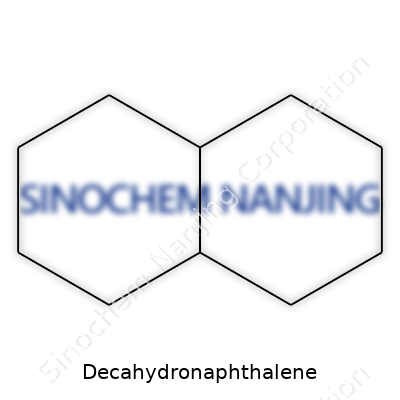
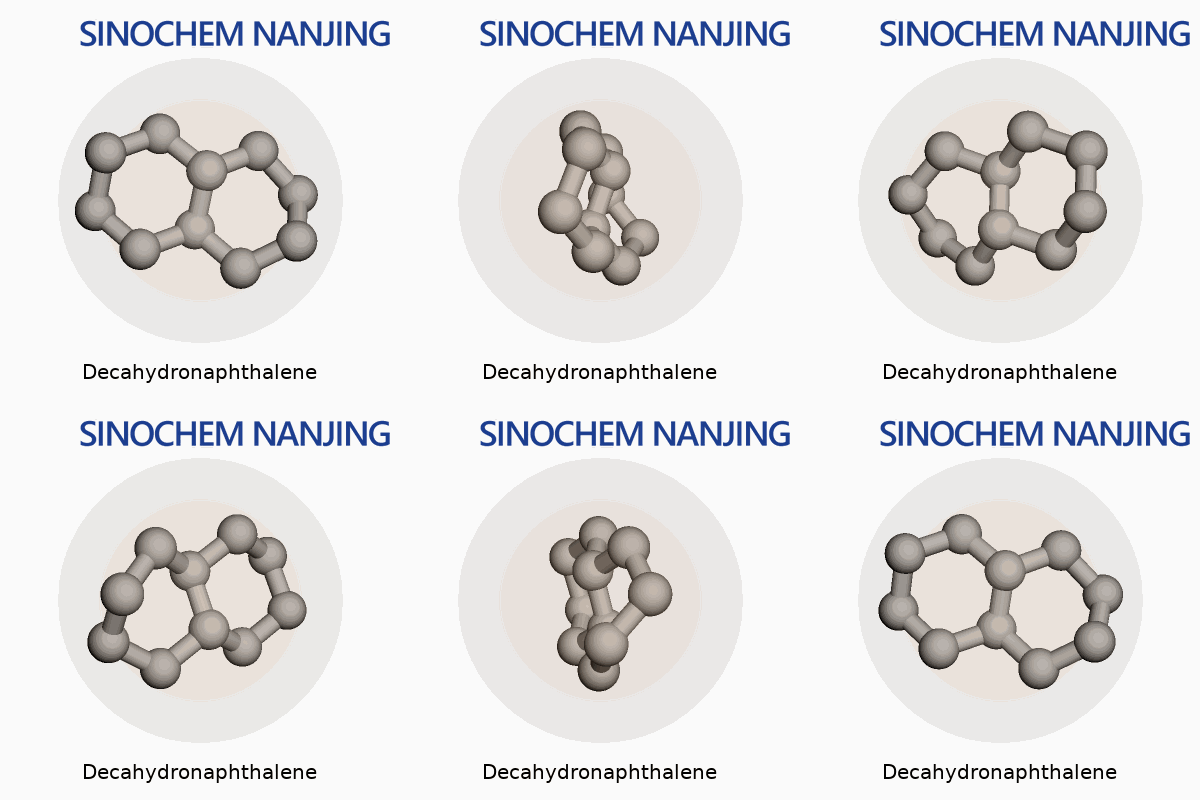
| Names | |
| Preferred IUPAC name | Decalin |
| Other names |
Decalin Bicyclo[4.4.0]decane Hydronaphthalene Decahydro-1,2-benzene |
| Pronunciation | /ˌdɛk.ə.haɪ.drəˈnæf.θəˌliːn/ |
| Identifiers | |
| CAS Number | 91-17-8 |
| Beilstein Reference | 1361874 |
| ChEBI | CHEBI:35684 |
| ChEMBL | CHEMBL14171 |
| ChemSpider | 7275 |
| DrugBank | DB01983 |
| ECHA InfoCard | 100.003.335 |
| EC Number | 01-2119473853-28-0000 |
| Gmelin Reference | 716 |
| KEGG | C06557 |
| MeSH | D003661 |
| PubChem CID | 6949 |
| RTECS number | SE5950000 |
| UNII | NJ6J3PO7TU |
| UN number | UN1147 |
| CompTox Dashboard (EPA) | DTXSID8020488 |
| Properties | |
| Chemical formula | C10H18 |
| Molar mass | 138.25 g/mol |
| Appearance | Colorless liquid |
| Odor | Mild aromatic |
| Density | 0.896 g/mL at 25 °C |
| Solubility in water | Insoluble |
| log P | 3.94 |
| Vapor pressure | 0.267 kPa (at 25 °C) |
| Acidity (pKa) | pKa ≈ 12.2 |
| Basicity (pKb) | > 7.87 |
| Magnetic susceptibility (χ) | -7.96e-6 |
| Refractive index (nD) | 1.475 |
| Viscosity | 2.1 mPa·s (25 °C) |
| Dipole moment | 0.01 D |
| Thermochemistry | |
| Std molar entropy (S⦵298) | 303.2 J·mol⁻¹·K⁻¹ |
| Std enthalpy of formation (ΔfH⦵298) | -288.15 kJ/mol |
| Std enthalpy of combustion (ΔcH⦵298) | -6287.7 kJ/mol |
| Hazards | |
| GHS labelling | GHS02, GHS07 |
| Pictograms | GHS07,GHS08 |
| Signal word | Warning |
| Hazard statements | H226, H304, H315, H319, H411 |
| Precautionary statements | P210, P261, P271, P280, P301+P312, P304+P340, P305+P351+P338, P312, P337+P313, P403+P235 |
| Flash point | 62°C |
| Autoignition temperature | Release Date: 423°C |
| Explosive limits | 0.8–6.8% |
| Lethal dose or concentration | LD50 oral rat 4700 mg/kg |
| LD50 (median dose) | LD50 (median dose): Oral rat LD50 = 4270 mg/kg |
| NIOSH | RN3675000 |
| PEL (Permissible) | 500 ppm |
| REL (Recommended) | 19 mg/m3 |
| IDLH (Immediate danger) | 250 ppm |
| Related compounds | |
| Related compounds |
Tetralin Naphthalene |



