Cyclohexyl Acetate: A Commentary on Progress, Practice, and Future Direction
Roots and Historical Development
Cyclohexyl acetate carries a legacy that traces back to early explorations in organic chemistry. Scientists like Kekulé and his peers pieced together the cyclohexane ring long before the mounting industrial demand for nuanced esters. As industries matured through the 1900s, particularly paints, coatings, and flavors, chemists realized the need for better solvents and fragrance carriers. That context fueled the commercial interest in cyclohexyl acetate. Even with new synthetic methods erupting through the 20th century, the value proposition tied closely to its underlying characteristics—low volatility, mild odor, and excellent solvency for a range of applications. The decisions made by early innovators set the course for most of the commercial production patterns seen today.
Physical and Chemical Properties—More Than Just a Formula
In my experience working with esters, cyclohexyl acetate stands out for more than its simple C8H14O2 formula. You pour a little into a beaker: a colorless liquid, noticeably fragrant but less sharp than ethyl or butyl acetates. Its boiling point, sitting well above typical solvents used in paints, lets formulators stretch the drying time of a product to match their workflow instead of racing against evaporation. The density and viscosity offer a feel closer to mineral spirits but with more flexibility in blending. All this adds up for users who don’t want lingering odors or uncontrolled evaporation during application. Solubility, on the other hand, isn’t universal; cyclohexyl acetate mixes well with many organics but gives water a cold shoulder—useful in places where you want to avoid accidental humidity pickup or phase separation. That matters in adhesives, inks, and other everyday items where a surprise from your solvent can throw off consistency or shelf life.
Technical Specifications and Labeling—A Practical Lens
In the field, folks judge a product by how reliably it delivers, not just by what’s printed on the MSDS. For cyclohexyl acetate, regulatory labeling stems from standards like CAS Registry Number 622-45-7, a well-known identifier for buyers and customs authorities alike, and typical assay grades above 98 percent. Look on any drum and you’ll spot warnings—flammable liquid, avoid inhalation, use in a ventilated area. But beyond these legal marks, practical handling centers on purity and residual acidity, which affects performance in finer applications like fragrances and flavorings. Having worked with vendors for years, I see how much users appreciate clarity—knowing if small quantities of water, cyclohexanol, or acetate remain makes a difference for consistency and safety, especially at scale. Bulk buyers in paints or inks rarely forgive a supplier who can’t prove a consistent boil point or color.
How Cyclohexyl Acetate Is Prepared
Most preparations hinge on the tried-and-true esterification reaction between cyclohexanol and acetic acid, catalyzed with mineral acids. Lab manuals may suggest using sulfuric acid; at the industrial level, one sees continuous reactors where heat management and efficient water removal make all the difference. I’ve watched operators use azeotropic distillation to tease water out of the mix, all to drive the reaction forward and polish yield. Many labs experiment with solid acid catalysts, trying to minimize corrosion and downtime. Downstream, purification steps—fractional distillation, washing, drying—shape the final purity and appearance. Almost every chemist I know has a story about chasing a stubborn impurity off the tail end of a column. Some research teams have even started looking at greener routes, leveraging biocatalysts that promise reduced waste, though these face scaling challenges.
Chemical Reactions and Modification Possibilities
The acetate ester bond holds up well in most neutral conditions but hydrolyzes back to cyclohexanol and acetic acid under acidic or basic attack—classic organic chemistry in action. This reversibility can be harnessed in flavor encapsulation and controlled release applications, a trick perfumers and flavorists keep in their toolkits. Technologists have also explored modifications at the cyclohexyl ring or by introducing functional groups via hydrogenation, though each adjustment changes solubility, volatility, or regulatory status. Over time, chemical variations have carved out new niches—plasticizers, specialty solvents, and even starting points for tailored syntheses. The challenge lies in balancing ease of modification with cost, regulatory approval, and market demand. There’s a sweet spot where you get improved performance without triggering headaches around new approvals or toxicology screens.
What Do We Call It? Synonyms and Alternate Product Names
Ask around and you’ll find plenty of names for this ester. Cyclohexyl acetate might appear on some bottles, but you’ll also spot entries like acetic acid cyclohexyl ester, 1-acetoxycyclohexane, or hexahydrobenzene acetate, depending on the supplier's region or the reference manual. One time I chased down an obscure material only to find it sitting on a shelf under a name I hadn’t heard before. These synonym quirks can catch out newcomers and frustrate veteran formulators double-checking safety data sheets. Standardizing names across supply chains improves traceability and helps prevent confusion, especially in global markets where one factory’s label doesn’t always match another’s lexicon.
Safety and Operational Standards—The Real-World Stakes
Working with cyclohexyl acetate brings a familiar set of risks for anyone used to organic solvents. Flammability stands out; open flames, static electricity, or leaky drums turn a routine task into a disaster waiting to happen. Most plants insist on explosion-proof equipment and good ventilation. Direct exposure rarely poses acute toxicity at ambient conditions, but inhalation over time or skin contact can set off headaches, irritation, or allergic responses in sensitive workers. The drum label reminders matter, but experience shows that real safety gains come from in-house education, clear spill protocols, and robust reporting culture. Environmental discharge remains a challenge. Compared to highly toxic or persistent compounds, cyclohexyl acetate breaks down quickly in the environment, but good practice for containment and waste handling can't slip. As regulations keep tightening, especially in Europe and North America, trace emissions face sharper scrutiny, forcing even legacy operations to modernize with better abatement and leak prevention.
Where Cyclohexyl Acetate Shows Up—Applications That Shape Supply
Much of the demand traces back to coatings and adhesives. At several paint factories I’ve visited, cyclohexyl acetate adjusts drying times, helps solubilize resins that traditional acetates can’t touch, and delivers a non-intrusive scent profile that customers appreciate in indoor environments. In inks, especially those used for packaging, it prevents unwanted interactions with plastics while leaving little taste or odor—critical for food-related uses. Its role in flavors and fragrances deserves attention; the subtle, floral character blends seamlessly as a carrier or fixative for more volatile ingredients. Beyond that, specialized uses in plastics manufacture, polymer modification, and even as a solvent for cellulose ethers keep a steady, if less publicized, demand. What matters most in each application is how predictably it performs—no surprises, no unwanted reactivity, no hiccups in the production line.
Keeping Pace with Research and Development
Academic research continues to unravel new tricks for cyclohexyl acetate, driven by sustainability goals and regulatory demands. I’ve seen lab groups re-engineer catalysts to lower energy use or explore enzymatic routes for ester synthesis aimed at cutting chemical waste. In flavors and fragrances, analytical chemists harness advanced GC-MS tools to dig deeper into trace contaminants and off-notes, pushing quality up for discerning global markets. On the safety front, ongoing toxicological screens use animal models and cellular assays to clarify long-term exposure limits, giving workplace regulators and end-users updated data to work from. Industry-academia partnerships, often overlooked, fuel incremental gains—a slightly better catalyst here, a lower residual impurity there. The search for drop-in bio-based alternatives means biotechnologists now look to renewables—fermenting cyclohexanol or recovering acetic acid from biomass, aiming to blend cost savings with green credentials.
Toxicity Data—What the Research Shows and What It Means for Practice
Long-term studies indicate cyclohexyl acetate possesses low acute toxicity, and in my review of workplace cases, the bigger risk involves chronic inhalation and careless handling, not single exposures. Some early studies raised questions about moderate irritation at higher doses in mammals, but consistent evidence points to reversible symptoms in most situations. Real risk climbs with improper ventilation or mixing with incompatible chemicals. Regulatory bodies such as ECHA and the US EPA include cyclohexyl acetate on lists for regular monitoring, citing a need for workers to limit direct contact and avoid vapor build-up. As chemical policy shifts toward precaution, companies cannot ignore calls for regular training, better PPE, and smart engineering controls. Responsible suppliers, realizing the wave of consumer safety advocacy, remain transparent about residuals and handling advice, cutting the chance for painful incidents or lawsuits.
What’s on the Horizon—Future Prospects and Innovation
Cyclohexyl acetate’s future rests on how the industry responds to sustainability and tightening regulations. Bio-derived routes could disrupt how the world sources basic feedstocks, slashing greenhouse gas footprints without gutting performance. I’ve watched smart teams chase new reactor designs—continuous-flow setups, lower-energy catalysts—that promise greener production and sharper control. While these prospects excite investors and researchers, everyday users focus on reliability—consistent purity, tighter tolerances on color and reactivity, and clear supply chain roots. Efforts to recycle solvents or recover emissions loop back into sustainability narratives, appealing to regulators and downstream brands that face mounting consumer pressure. In specialty applications—electronics, high-performance resins, or medical consumables—innovation hinges on expanded toxicity screens and changing consumer preferences, forcing developers to prove both safety and impact. The push comes not just from legal mandates but also from a new generation of buyers and engineers keen to lead cleaner, safer, and smarter workflows. Cyclohexyl acetate, with its blend of legacy uses and room for next-gen improvements, sits close to the center of that shift.
What is Cyclohexyl Acetate used for?
The Scent Nobody Thinks About
Walk into a room that smells fresh, open a bottle of perfume, or handle a cleaning product with a fruity twist—chances are, cyclohexyl acetate played a part in that experience. This colorless liquid brings a sweet, floral scent to countless products. It sets itself apart from heavier, more pungent chemicals by adding gentle but distinctive notes. In perfumery, cyclohexyl acetate lands in the company of compounds that make fragrances last longer and feel more inviting. Scent engineers reach for it to round out citrus profiles, not just for luxury perfumes, but for soaps, shampoos, lotions, and even some air fresheners.
Beyond Fragrance: Its Role in Manufacturing
Most folks don’t picture their furniture, cars, or electronics when they hear the name of a chemical, but the story of cyclohexyl acetate runs deeper in how products get made. Paints and coatings use it as a solvent. Dropping a paintbrush in a can, you want smooth flow and even coverage, not globs or streaks. This compound helps thin out thick paint without sacrificing the finished look, and it works in both water-based and oil-based formulas. Workers exposed to it in factories often rely on proper ventilation and protective equipment, since inhaling high levels causes dizziness or headaches. Responsible handling lowers those risks.
Making Printing Cleaner and Quicker
Printers—whether cranking out glossy magazines or specialist packaging—demand the right balance of fluidity and drying time in their inks. Cyclohexyl acetate finds its way into printing ink manufacturing for exactly this reason. I remember walking through a pressroom, seeing pallets of ink, each with different solvent mixes for paper, plastics, or foil labels. Quick drying and crisp images rely on a mix of solvents that speed up drying without damaging the printing plates or paper. This compound ensures color vibrancy and avoids smudging in high-speed commercial settings.
What Science Shows About Safety and Sustainability
Public concern about chemical exposure isn’t misplaced. Regulatory agencies in regions like the European Union and the United States categorize cyclohexyl acetate as safe to use in fragrances, food contact materials, and coatings—when guidelines get followed. Toxicity studies reveal that, at low concentrations, it doesn’t build up in living tissues or groundwater, so it breaks down before reaching dangerous levels. Long-term occupational exposure has limits for good reason, as accidental overexposure does irritate skin or lungs. Factories apply strict controls and invest in personal protective equipment for their staff.
Possible Ways Forward: Cleaner, Smarter Use
Switching to green chemistry is the watchword for next-gen chemical design. Consumers want to know what’s in their scented candles, household sprays, and painted rooms. Ingredients like cyclohexyl acetate stay on the ingredient lists because scientists know how to limit emissions and contain potential hazards. The move toward renewable feedstocks offers a path for companies: they’re already scaling up ways to source it from plant-based origins instead of pure petrochemicals. As more manufacturers swap out crude-based ingredients, the footprint left behind shrinks—at least a little. Transparency in labeling, responsible production, and regular updates to handling practices give both workers and buyers confidence in the products cyclohexyl acetate keeps smelling sweet and running smoothly.
What is the chemical formula of Cyclohexyl Acetate?
Getting Familiar with Cyclohexyl Acetate
Chemistry books like to throw formulas at people, but real understanding goes deeper than just letters and numbers. Cyclohexyl acetate, C8H14O2, represents more than a few elements joined together. With a structure made from cyclohexanol and acetic acid, it’s the product of an esterification reaction. In everyday life, you might catch its scent in air fresheners or notice it blending into flavors and fragrances. Most people never realize that substances wafting pleasant aromas across the room trace back to molecular building blocks such as cyclohexyl acetate.
Why Recognizing Chemical Structures Matters
Not all chemicals deserve suspicion—but consumers deserve clear information about what enters homes and bodies. Products listing cyclohexyl acetate as an ingredient thrive on its fresh, sweet odor, which helps mask unwanted smells. This chemical has achieved broad acceptance, mainly because regulatory bodies have assessed its toxicology and labeled it as generally safe for use within limits. Too often, people forget that understanding a formula like C8H14O2 lets researchers check safety data much more efficiently. Without formulas, database searches get messy, and professionals may stumble into confusion with lookalikes or contaminants. Chemical transparency builds trust and supports safety, whether in industry, classroom, or kitchen.
A Personal Perspective: Science in Action
During college, lab sessions seemed endless, with beakers filled and checked against textbooks. Once, a mistake in recording a molecular formula almost spoiled an experiment. Precise details didn’t just help exams—they protected classmates from mixing the wrong substances. That experience lingers every time a label reads “cyclohexyl acetate.” It isn’t an abstract point; formulas offer real-world safety, helping prevent accidents and misidentification.
Health and Environmental Impact: Importance Beyond the Lab
Scented products end up in wastewater or air. Cyclohexyl acetate generally breaks down well in the environment, but misuse or large spills create different stories. Regulations keep a close eye on how much of it enters consumer goods and the ecosystem. The formula itself—C8H14O2—provides regulators, environmental chemists, and toxicologists the shared language needed to flag potential hazards and track environmental fate. Analytical labs rely on chemical formulas to identify substances in food, water, and soil samples, especially in places with histories of contamination or illegal dumping.
Better Understanding Builds Better Choices
Education makes a difference. Teaching students and community members about chemical formulas encourages smarter decisions. With knowledge of cyclohexyl acetate’s makeup, people weigh risks and benefits, rather than avoiding chemistry altogether or fearing every long name on a product. Experiences in the lab, backed by facts and transparency, guide safer consumer purchases and responsible corporate behavior. Solutions to chemical challenges in society rest on openness, critical thinking, and clear communication—qualities that hinge on grasping basics like a simple formula.
Looking Forward: Practical Steps
Manufacturers and educators have a role in keeping the conversation going. Labels listing cyclohexyl acetate could include information resources or QR codes, connecting shoppers to plain-language reviews of its safety. Classroom demonstrations, showing both chemical reactions and responsible use, let learners see formulas in action. Regulatory agencies maintain accessible databases, so that anyone—from homeowners to professionals—checks ingredient details whenever concern arises. By grounding trust in education and transparency, formulas like C8H14O2 become more than code; they turn into everyday tools for safety and knowledge.
Is Cyclohexyl Acetate hazardous or toxic?
Everyday Exposures and Real-Life Concerns
Cyclohexyl acetate shows up in places you might not expect. It has a sweet, fruity smell, so it’s used in perfumes, flavorings, cleaning agents, and solvents for paints or inks. I’ve noticed how chemical products in daily life don’t always come with plain warnings. People assume if a substance has a pleasant scent, it’s probably harmless. That can get risky, because chemicals like cyclohexyl acetate often pose hazards that familiarity tends to mask.
What Science Tells Us About Toxicity
Toxicity depends on both the dose and route of exposure. Studies on cyclohexyl acetate point out that inhalation can irritate the eyes and respiratory tract. Skin contact may cause redness, especially with prolonged exposure. Swallowing larger amounts can lead to nausea and discomfort. According to the European Chemical Agency, cyclohexyl acetate falls under category 4 for acute oral toxicity. In simple terms, you’d need a significant dose to face severe effects, but mild reactions like headaches or dizziness are possible if you spend a while breathing its vapors, especially in small or poorly ventilated spaces.
Environmental summaries also mention moderate concern for aquatic toxicity. Fish and invertebrates can suffer if the compound leaks into waterways. In the lab, rats exposed to vapors at high concentrations developed liver and kidney changes over time. There’s no sign of carcinogenicity in standard studies, but that doesn’t mean it gets a clean bill of health for all long-term use. Lab results never fully mirror what regular folks face at home or on the job.
Workplace Experience and Regulation
Walking through factories, I’ve seen how workers sometimes skip gloves or don’t worry about ventilation unless prompted. Occupational Safety and Health Administration and similar groups recommend limiting airborne levels. Europe sets an occupational exposure limit at 100 mg/m³ for an eight-hour time-weighted average. In jobs dealing with solvents, headaches and lightheadedness often show up before more acute symptoms, acting as early warning signs.
Proper training and access to safety data sheets make a big difference. I’ve run into plenty of workers who said they’d never read a chemical label until a safety incident pushed them to check the details. That firsthand experience changes how seriously you take personal protection when handling not just cyclohexyl acetate, but any volatile compound.
Mitigating Hazards and Promoting Safety
Clear solutions start with basic protective steps—good gloves, goggles, and extra air circulation in rooms with heavy chemical use. There’s no reason not to substitute less hazardous chemicals if possible, especially in smaller shops where risks stack up quicker. Spill containment and quick clean-up of leaks help reduce environmental impacts. Proper labeling ensures people don’t mistake cyclohexyl acetate for safe household products.
Education matters. People often trust familiar products, assuming everything on the shelf passed strict safety rules. In truth, many chemicals remain on the market because acute toxicity at short exposure is low, not because they are inert or entirely safe. Responsible handling and good habits—like storing solvents tightly closed or keeping kids out of hobby rooms—protect both health and the environment. Simple measures really change outcomes with substances like cyclohexyl acetate.
What are the storage and handling recommendations for Cyclohexyl Acetate?
Understanding Cyclohexyl Acetate’s Risks
Cyclohexyl acetate pops up often in industrial settings, especially in coatings and flavor manufacturing. It smells pleasant, but safety considerations go far beyond any superficial impression. This chemical can harm someone’s health if not treated with respect, so placing safety front and center keeps both workers and products out of trouble.
Personal Experience and Real-World Lessons
Years of working alongside chemical drum storage have taught me that cyclohexyl acetate doesn’t tolerate neglect. I’ve seen too many makeshift warehouses stacked to the ceiling. Warm, unventilated buildings turn this solvent into an accident waiting to happen. Temperatures matter — once things heat up past 30°C, pressure can build fast. No one wants a lid blowing off or vapor leaks near a spark.
Good safety practice means choosing a storage area that stays cool and dry, far from open flames. This ester will catch fire if it gets too close to a heat source. Insulation and climate control often pay for themselves, especially over summer months.
Ventilation and Spill Prevention
Cyclohexyl acetate’s vapors can irritate eyes and lungs, and headaches or dizziness can follow poor ventilation. Warehouses should move air, not trap it. Decent mechanical fans or open-air eyelids do the trick, especially in barrel or drum storage. After watching a small spill creep toward a loading dock, I learned that floors need trays and spill containment measures, not just bare concrete. If residue collects on the ground, slick spots increase worker risk and threaten the surrounding environment during cleaning.
Container Material and Labeling
Metal or HDPE drums generally handle cyclohexyl acetate without trouble. Poor seals or rusty containers spell problems—no one wants a leaky barrel halfway through a busy shift. Quick checks before stacking new inventory save time, but reliable labeling spells out the risk for those who might not recognize the scent. A clear label means the next shift or delivery driver stays safe.
Protective Equipment and Training
Basic PPE goes a long way. I always reach for nitrile gloves, long sleeves, splash goggles, and work boots around this liquid. Good companies give refresher courses on chemical handling, so no worker steps up to a drum guessing about next steps.
Emergency showers and eyewash stations feel unnecessary—until that one day when they’re not. I once saw a coworker avoid a ER visit thanks to the quick rinse from a wall-mounted station after a single splash. Not just for show, these stations save vision and lives when installed appropriately.
Disposal and Environmental Responsibility
Cyclohexyl acetate doesn’t belong in a regular dumpster or sewer. Between regulatory fines and community risk, the cost of hazardous waste disposal looks tiny next to a full-fledged cleanup. Local agencies often run certification programs or provide lists of trusted disposal firms to prevent illegal dumping.
Potential Solutions and Smarter Handling
Forward-thinking companies keep electronic logs of temperature and safety checks, which helps spot problems before drums degrade or leaks occur. Automating ventilation, installing smart sensors, and conducting regular walk-throughs can help reinforce a safety culture. Older storage sites often benefit from simple upgrades—fans, insulation, spill barriers—carried out before problems arise.
Cyclohexyl acetate demands vigilance but rewards thoughtful handling with safer workplaces, higher-quality products, and lower cleanup costs in the long run.
What is the physical appearance and odor of Cyclohexyl Acetate?
Getting a Real-World Picture
Cyclohexyl acetate appears as a clear, colorless liquid, almost as if someone bottled up a small sample of spring water. In the world of chemicals, you become familiar with the look: clarity in a glass vial, no particles floating around, nothing sitting at the bottom, just pure transparency. Its consistency falls in line with other simple esters—it pours readily and moves about with ease, more freely than syrup, not quite as quickly as straight ethanol. On your hands or a countertop, it leaves a faint oily feel, which tells you there’s more here than meets the eye. It won’t evaporate the moment you open the bottle, but give it time and you’ll notice the level dropping if left uncapped.
The Scent, Straight to the Nose
Now the odor, this one catches your attention. Cyclohexyl acetate delivers a sweet, fruity scent, almost as if someone crossed pears with apples and toned down the sharpness. I have worked around plenty of esters in a lab—ethyl acetate, amyl acetate, and this one stands out because it manages to be pleasant, but not overwhelming. You don’t get the biting sharpness of acetone, nor the sickly, heavy sweetness you find in some synthetic flavorings. Instead, it feels more like sticking your nose in a bowl of mixed fruit, just after you peel the skin from a green apple. Depending on who you ask, they’ll talk about a floral hint or a certain “freshness” that makes it more agreeable than a lot of lab-grade solvents.
Folk who have spent enough time in fragrance or flavor industries recognize cyclohexyl acetate immediately once uncorked. Its aroma travels easily even in small doses, filling up a small workroom with only a couple of drops spilled or left open. It lingers too—swapping gloves or washing surfaces sometimes leaves just a hint of fruitiness hours later. That smell says quality. In the wrong situation, though, it can signal a spill or a leak, and regular exposure can trigger headaches for folks who are more sensitive to strong perfumes or esters.
Why Knowing Its Appearance and Odor Matters
Expertise sometimes starts with the senses: you learn a substance by looking at it and smelling it, not just reading a label. In any chemistry lab or fragrance facility, identifying what you’re dealing with stops accidents before they start. Mistaking one clear liquid for another could mean a ruined experiment, a fire hazard, or a product batch lost. Sometimes you can trace a bad reaction back to a mislabeled bottle, and the nose will save the day faster than a barcode scan.
From a safety perspective, cyclohexyl acetate’s odor keeps workers on their toes. If a sweet, fruity wave hits mid-shift, most seasoned hands check the benches and jug lids. They know a small leak could mean big trouble in an enclosed space. According to the National Institute for Occupational Safety and Health (NIOSH), the threshold for cyclohexyl acetate in the air, before it becomes dangerous to most, lies high enough for your body to warn you before health concerns show up. The sense of smell provides that first line of defense, especially since personal protective equipment sometimes falters.
Potential Solutions for Safer Handling
Better labeling and regular training help. Chemical suppliers must ship only in tight-sealing containers. In-house teams need to log every movement and store cyclohexyl acetate away from heat sources. Ventilation in workrooms prevents that sweet scent from becoming an occupational hazard, especially during long production runs in flavor and fragrance manufacturing.
For my part, I learned early to trust my senses just as much as lab protocols. The human nose picks up on leaks before most detectors blare alarms. Even now, a whiff of sweet fruitiness in the wrong place tells me it’s time to double-check every connection and cap. Trusting those cues protects not just the batch, but the people behind the bench, making appearance and odor far more than just dry details in a data sheet.
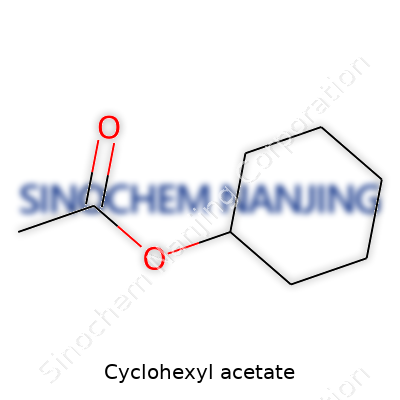
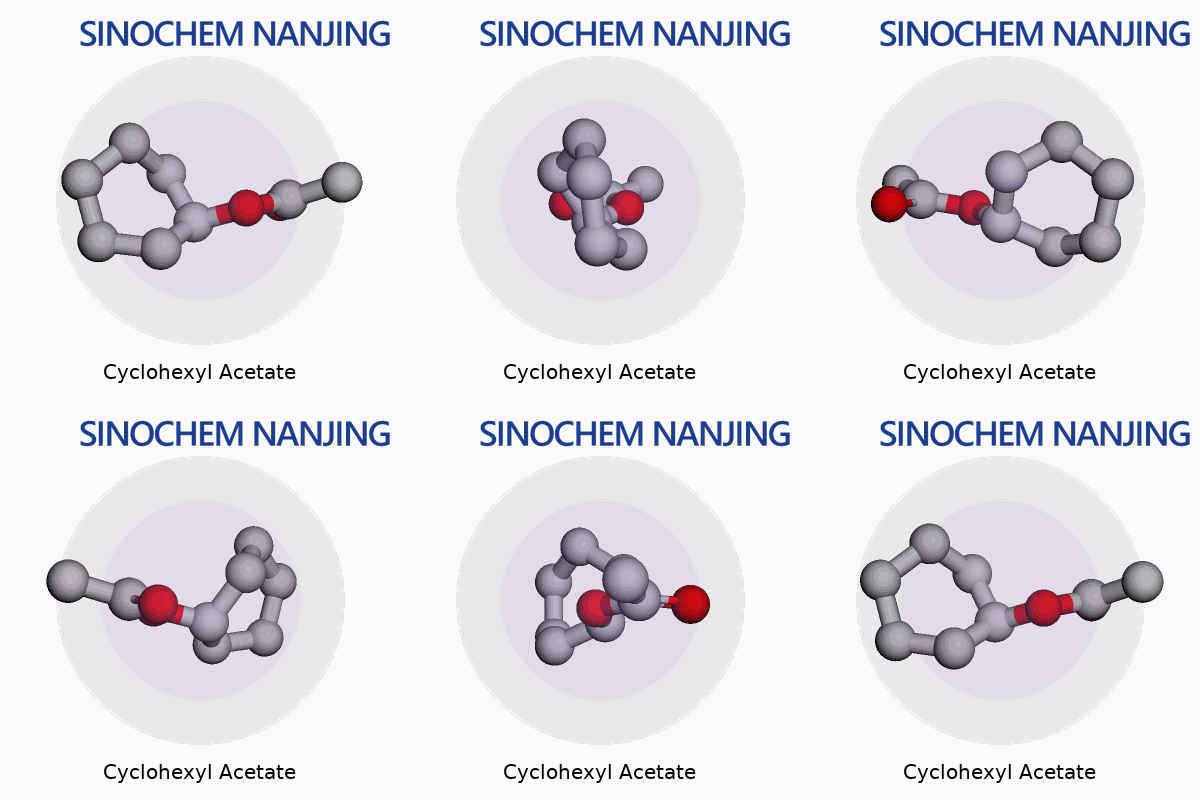
| Names | |
| Preferred IUPAC name | Cyclohexyl ethanoate |
| Other names |
Acetic acid cyclohexyl ester Cyclohexyl ethanoate Hexahydrobenzyl acetate |
| Pronunciation | /ˌsaɪ.kloʊˈhɛk.sɪl ˈæs.ɪ.teɪt/ |
| Identifiers | |
| CAS Number | 622-45-7 |
| Beilstein Reference | 1307786 |
| ChEBI | CHEBI:88572 |
| ChEMBL | CHEMBL502402 |
| ChemSpider | 10776 |
| DrugBank | DB14106 |
| ECHA InfoCard | 100.106.403 |
| EC Number | 203-687-1 |
| Gmelin Reference | 619444 |
| KEGG | C06002 |
| MeSH | D003449 |
| PubChem CID | 8126 |
| RTECS number | AF3675000 |
| UNII | 7M49PE3I7R |
| UN number | UN2248 |
| CompTox Dashboard (EPA) | DTXSID8047785 |
| Properties | |
| Chemical formula | C8H14O2 |
| Molar mass | 170.25 g/mol |
| Appearance | Colorless liquid |
| Odor | fruity |
| Density | 0.949 g/cm³ |
| Solubility in water | Insoluble |
| log P | 2.8 |
| Vapor pressure | 0.49 mmHg (25°C) |
| Acidity (pKa) | 14.8 |
| Basicity (pKb) | 16.86 |
| Magnetic susceptibility (χ) | -62.1×10⁻⁶ cm³/mol |
| Refractive index (nD) | 1.446 |
| Viscosity | 1.1 mPa·s (at 25 °C) |
| Dipole moment | 2.17 D |
| Thermochemistry | |
| Std molar entropy (S⦵298) | 348.7 J·mol⁻¹·K⁻¹ |
| Std enthalpy of formation (ΔfH⦵298) | -470.2 kJ/mol |
| Std enthalpy of combustion (ΔcH⦵298) | -3898.9 kJ/mol |
| Pharmacology | |
| ATC code | V06AE |
| Hazards | |
| GHS labelling | GHS02, GHS07 |
| Pictograms | GHS02,GHS07 |
| Signal word | Warning |
| Hazard statements | H226, H315, H319, H335 |
| Precautionary statements | P210, P233, P240, P241, P242, P243, P261, P264, P271, P280, P301+P312, P303+P361+P353, P304+P340, P305+P351+P338, P312, P337+P313, P370+P378, P403+P233, P403+P235, P405, P501 |
| NFPA 704 (fire diamond) | 1-2-0 |
| Flash point | 64 °C |
| Autoignition temperature | 255°C |
| Explosive limits | Explosive limits: 1% (LEL), 7.8% (UEL) |
| Lethal dose or concentration | LD50 oral rat 4,000 mg/kg |
| LD50 (median dose) | LD50 (median dose): Oral rat LD50: 4,000 mg/kg |
| NIOSH | NIOSH: RN3675000 |
| PEL (Permissible) | PEL: 50 ppm (250 mg/m³) |
| REL (Recommended) | 200 mg/m³ |
| IDLH (Immediate danger) | 250 ppm |



