Acetonitrile: More Than Just a Solvent
Looking Back: The Journey of Acetonitrile
Chemistry labs have seen acetonitrile on their shelves for generations. It’s one of those bottles people reach for without much thought, but that everyday spot hides a story that started over a hundred years ago. Acetonitrile sprang from the growth of coal gas and petrochemical industries. Scientists pieced together its structure in the late 1800s, but it waited until the rise of large-scale acrylonitrile production to carve out a real commercial presence. Most acetonitrile seen today comes as a byproduct during the manufacture of acrylonitrile, a base for acrylic fibers and plastics. The world’s growing hunger for synthetic fibers and plastics propelled acetonitrile’s availability, and in turn invited chemists to find new ways to use it.
At a Glance: A Product Overview
The clear, watery liquid in a glass bottle labeled “acetonitrile” packs some punch. Chemists know it as a versatile solvent, but this simple molecule, with only two carbons, three hydrogens, and a single nitrogen, sits at the core of a surprising range of industries. Its sharp, sweet smell catches your attention, yet its real character shows up in the lab. LC-MS labs count on it for purity and low background noise. Extractors in the pharmaceutical industry know their workflow moves faster when using high-grade acetonitrile. Despite being a commodity chemical, some batches fetch a premium price thanks to tight purity specifications.
Getting to Know Its Physical and Chemical Side
Acetonitrile boils at 82 degrees Celsius, which means it evaporates relatively easily but not like ether or acetone. It mixes well with water, alcohols, and most organics, giving it a valuable flexibility for folks working with a tangled mix of molecules. The nitrile group—a carbon triple-bonded to nitrogen—draws polar molecules and acts as both a hydrogen bond acceptor and a polar aprotic solvent. Think of it as both a dependable workhorse for dissolving salts and a subtle tool for coaxing out delicate organic transformations. Chemical stability sets acetonitrile apart from many similar solvents. It won’t catch fire as easily as diethyl ether and doesn’t form explosive peroxides, making it a trusted choice in many applications.
Specifications and Labels: What Matters on the Bottle
Though often lumped in with other solvents, the details on its bottle label can make or break entire experiments. Any analytical chemist who’s run high-performance liquid chromatography knows the headache of a contaminated mobile phase. Impurities—like aldehydes, water, or amines—show up as ghosts on chromatograms or gum up sensitive detectors. Some bottles state “HPLC grade,” promising tighter purity margins. Others lay out water content and even UV absorbance at multiple wavelengths. It’s these details that separate reliable solvents, especially in quantitative analysis or pharmaceutical research, from generic grades found in less demanding settings.
How Industry Makes It
The preparation of acetonitrile follows the fortunes of the greater chemical industry. Companies typically pull it from the mother liquor after making acrylonitrile through the Ammoxidation of propylene. This involves reacting propylene, ammonia, and air over a metal oxide catalyst at high temperatures. Purification often requires fractional distillation since the raw mixture brings along contaminants and water that must be carefully removed. Any shift in petrochemical output affects acetonitrile supply directly—meaning a fire at a major acrylonitrile plant in Asia or Europe could send shockwaves through labs on the other side of the world. For smaller amounts, some labs still use methods like dehydration of acetamide, but this never works at scale.
Where Chemical Curiosity Meets Industry: Reactions and Modifications
This modest molecule stands up to a surprising variety of reactions. Its nitrile group holds enough reactivity to engage in both nucleophilic and electrophilic reactions. Chemists convert it to acetic acid through hydrolysis. They pull it into Grignard reactions to make ketones. In the pharmaceutical world, acetonitrile steps up as a building block for synthesizing vitamins, antibiotics, and many agrochemicals. If you dive into organic chemistry journals or process patents, you’ll find acetonitrile serving as both a reactant and, more often, as the solvent medium for those twists and turns of modern synthesis.
Names on the Label and on the Street
Though “acetonitrile” is what most labels say, it also goes by names like “methyl cyanide” and the abbreviation “MeCN.” Some industry catalogs toss around “cyanomethane.” Whatever you call it, the molecule remains the same. In an academic setting or on a product data sheet, “acetonitrile” is the preferred term. That consistency matters in procurement, regulatory filings, and trade. Confusion over chemical names has landed researchers and companies in trouble before, so clarity keeps global supply chains running smoothly.
Living Up to Safety Standards
Ask any chemist about their first time handling acetonitrile, and most remember the sharp smell and real respect for the health and fire risks it brings. Inhalation exposure can cause headaches, dizziness, or more severe neurotoxic effects if concentrations climb high. Long-term or high-level exposure links to metabolic and neurological effects due to its metabolism to hydrogen cyanide in the body. The US Occupational Safety and Health Administration and similar agencies insist on proper ventilation, eye protection, and protective gloves. Labs fit out their hoods and solvent storage cabinets with these standards in mind. Fire codes point to its flammable nature, and even small amounts spilled in open air can ignite if a spark happens by. MSDS labels spell this out, but any regular user gets these safety measures baked into their routine.
Real-World Impact: Application Areas
Acetonitrile keeps cropping up in places outsiders don’t expect. Pharmaceutical labs can’t do without it; it’s the solvent mainstay for HPLC, one of the most precise tools for assaying drug purity and measuring trace impurities. Biotech companies lean on it to extract and purify DNA or proteins. Electronics manufacturers look to it for battery production, benefiting from its dielectric properties. Chemical fiber, pesticide, and dye industries all rely on this clear liquid to push through reaction steps. It’s even used for removing butadiene from C4 hydrocarbons in refinery streams. Every year, as regulatory margins tighten and product demands rise, the need for reliable, high-purity acetonitrile only grows.
Where the Research Flows
Scientists keep pushing the boundaries with acetonitrile. In my own experience running HPLC analyses, the search for less toxic, more sustainable alternatives comes up in nearly every department meeting—but acetonitrile’s performance keeps it near the top of most methods. Researchers look at ways to recycle and reclaim solvent, testing advanced distillation, membrane technology, or even enzymatic breakdown to minimize waste. Other teams focus on green chemistry, hoping either to engineer biosynthetic pathways for nitrile production or to adapt entirely new solvents. Yet for all these alternatives, few match acetonitrile’s unique blend of solvency, stability, and compatibility with sensitive instruments. It sets the bar for others to reach.
Wrestling with Toxicity
If there’s a downside, toxicity tops the list. Acute poisoning remains rare, but mismanagement can still lead to tragedy. Its metabolic conversion to hydrogen cyanide reminds professionals to treat it with care and for facilities to install real-time air monitors, alarms, and rigorous training. Toxicity studies dig deeper into chronic effects, environmental persistence, and breakdown products, sparking both tighter regulations and promising new containment approaches. Green chemistry advocates push for closed-loop handling, real-time sensing, and method changes to cut down exposure where possible. Solutions will need regular checks, digital logging, and more advanced fume hoods, not just wishful thinking.
On the Horizon: Future Prospects
Every industry faces pressure from rising costs, sustainability demands, and shifting regulations. For acetonitrile, uncertainty in global supply constantly drives up both price and anxiety, given its status as a petrochemical byproduct. This keeps researchers and manufacturers on the lookout for ways to either boost byproduct recovery rates or decouple solvent production from acrylonitrile output altogether. As synthetic biology matures, alternative manufacturing routes might one day supplement global supply, but for now, heavy demand from analytical, pharmaceutical, and tech sectors all but guarantees ongoing relevance. Anyone working at the chemistry-industry interface knows that change will come slowly, with innovation running up against the challenge of global infrastructure built for the current way of doing things. Whether change appears as new synthetic methods, better recycling, or gradual adoption of substitute solvents, the story of acetonitrile will keep evolving right alongside chemistry itself.
What is Acetonitrile used for?
Behind the Lab Door: The Role in Science
Labs never stop humming, and the clear, mild-smelling bottle of acetonitrile claims more shelf space than most realize. During my early days in analytical chemistry, acetonitrile was everywhere. People value it for its knack at dissolving tough molecules, making it essential for high-performance liquid chromatography (HPLC). In medicine, scientists rely on acetonitrile to separate and measure compounds in blood, helping diagnose illness and track treatments. The demand in analytical labs continues to rise as technology asks more from each test.
Connecting Chemistry and Manufacturing
Outside lab benches, acetonitrile fuels the world of industry. Manufacturers use it to create pharmaceuticals, particularly antibiotics and vitamins. It’s involved in the production of plastics and batteries, where it helps separate and purify substances that eventually land inside smartphones and electric cars. I’ve talked to people who run these plants; they have stories about its flammability and toxicity, so the margin for error runs thin. Safety protocol is not optional—it’s foundational for keeping workers out of harm’s way.
Risks and Realities
The chemical comes with downsides. Breathing in acetonitrile or touching it without protection brings health hazards, including headaches and nausea in the short run, and worse if exposure keeps up. One major spill in 2014 led to headaches in the surrounding neighborhood before hazmat teams locked things down. Most workplaces have strict rules: full protective equipment, well-ventilated rooms, and constant monitoring. Tracking disposal matters just as much—careless dumping could contaminate streams or groundwater, affecting entire communities.
Supply Chain Pressures
People don’t always see the fragility behind chemical supply. Most acetonitrile in the world arrives as a byproduct when factories make acrylonitrile. Shifts in demand for plastic and rubber hit the supply overnight. In 2008, car manufacturers slowed down, and suddenly labs everywhere had trouble buying what they needed. Prices shot up, and every lab coordinator scrambled. It makes you rethink how one ingredient, taken for granted, can choke off research or stall a drug launch.
Chasing Better Practices
Green chemistry has started changing some habits. Companies hunt for ways to use less acetonitrile—even recycling it from old samples. A few biochemists develop water-based methods for chromatography to skip solvents entirely. Regulators push industry to stop leaks and manage disposal more tightly. The shift isn’t simple. Shifting from a proven method can set back projects, but the pressure keeps mounting as younger chemists bring fresh attitudes to workplace safety and the environment.
What’s at Stake
Acetonitrile stands as both a power tool and a hazard. It pushes science forward and makes production lines possible, but with strings attached—handling it wrong can cause immediate harm and longer-term headaches for communities and workers. Investing in safety, seeking substitutes, and rethinking waste won’t erase every risk, but they show respect for the people and places connected by every clear bottle sent out into the world.
What is the chemical formula of Acetonitrile?
Science in a Simple Bottle
Acetonitrile goes by the chemical formula C2H3N. That small set of letters and numbers packs a lot of significance, not just for chemists tinkering in a lab but for industries, health professionals, and anyone who cares about safety and progress. The compound itself looks unremarkable—clear, colorless, faintly sweet-smelling—and yet its formula tells a detailed story.
Why C2H3N Matters in Everyday Life
C2H3N represents a backbone for innovation. This is the substance that runs through most high-performance laboratories and makes its way into medicines, electronics, and even your smartphone. If you’ve used a pharmaceutical drug in the last decade, odds are high that acetonitrile played a quiet role. Pharmaceutical companies lean on it to separate important compounds in the drug-making process. This clear liquid has shaped a lot of modern chemistry, from purifying ingredients to breaking down complex mixtures.
My time working in a research lab showed me how a simple change with a solvent can decide whether you get clear results or scrap weeks of work. I remember getting two beakers mixed up: one with acetonitrile, one with a less effective substitute. The tests failed, costing us both time and a little pride. Nothing drives home the importance of picking the right chemical formula quite like seeing the real-world consequences.
The Hidden Dangers Tied to One Formula
C2H3N also draws attention for what it can do outside the lab. A lack of respect for its hazards can lead to headaches, nausea, or worse. It doesn’t take a large dose to be toxic. Acetonitrile breaks down in the body to release cyanide. That means anyone handling even a small bottle has to take safety seriously. Gloves, eye protection, and good ventilation matter more than most realize.
Many safety incidents have grown from a misunderstanding about what these formulas mean. Data from chemical safety boards shows that improper storage or disposal often lies behind accidents involving C2H3N. When lapsed memory or carelessness replaces respect for such a formula, people get hurt.
Ways to Use Less, Waste Less, and Stay Safe
Solving the safety and environmental headaches of acetonitrile starts with two steps: awareness and action. Chemists and students need real-life practice with safe handling, not just a quick slideshow before a project. Clearer labeling, training refreshers, and easier access to safety gear go a long way.
On the green chemistry front, research teams push hard to swap out acetonitrile for less toxic solvents. Sometimes alternatives don’t match its performance. Sometimes they do, and labs reduce risk—both on-site and when it comes time to dispose of waste. Progress comes from honest experiments and by sharing those solutions across the field. In my experience, a culture of open dialogue, where someone can ask a “stupid” question about a bottle in the back of a cabinet, stops accidents before they start.
Learning from the Simplicity of C2H3N
Whether you’re learning chemistry in high school or developing a new medicine, the formula C2H3N stands for more than just three kinds of atoms. It reminds us that every chemical comes with a story, risks, and opportunities. Paying attention to that story shapes safer labs, better products, and healthier lives.
Is Acetonitrile hazardous or toxic?
A Closer Look at Acetonitrile
Acetonitrile shows up a lot in science and industry. Lab workers find it in chromatography solvents. Factory workers rely on it during pharmaceutical manufacturing or as a chemical intermediate. No one expects a colorless liquid to create much of a fuss, but it's important to look past appearances.
Toxic Properties and Direct Risks
Getting a whiff of pure acetonitrile makes its sharp, ether-like smell clear enough—it’s more irritating than intriguing. Inhaling its fumes, even at low levels, quickly agitates the nose, throat, and lungs. According to the National Institute for Occupational Safety and Health (NIOSH), dizziness and headaches may follow after brief exposure, and longer or higher exposures might trigger nausea and convulsions. People who work with acetonitrile every day learn to respect the stuff. The liquid doesn’t just cause trouble if you breathe it in: skin contact can lead to irritation or even absorption straight into the bloodstream, which can lead to symptoms resembling those of cyanide poisoning.
Once inside the body, acetonitrile changes to hydrogen cyanide—a fast-acting toxin, well known for its dangers. That transformation makes the risk real, not just theoretical. While these scenarios mainly crop up with large spills or accidents, smaller, repeated doses over time create their own dangers. Common sense says: gloves, eye protection, ventilation. The Environmental Protection Agency even includes acetonitrile on its list of hazardous air pollutants, showing that this compound deserves careful handling.
Industrial Impact and Worker Safety
I once worked in an industrial plant that used acetonitrile to clean complex machinery. Everyone knew the procedures, but even routine days felt high-stakes. A single splash could send someone to the eye wash station and demand a call to the company nurse. Regulations force companies to set up safety protocols, but all it takes is a little impatience or a leak in a hose to put workers at risk. That experience changed the way I thought about chemical hazards—safety becomes deeply personal once you’ve watched a colleague struggle with strong solvents.
Personal protective equipment helps, but relying on it alone isn’t enough. Regular air monitoring, strong ventilation, and training sessions make a real difference. Even so, accidents do happen. It’s easy to cut corners or rush the process. This is where company culture plays a role. When leadership values safety just as much as productivity, workers feel more comfortable slowing down and double-checking valves and seals.
Bigger Picture: Environmental and Health Concerns
Spills of acetonitrile don’t stick to factory floors—they can seep into soil or water if not managed. Communities near plants worry about leaks, especially after past incidents led to evacuation orders. Most public drinking water sources rarely face danger, but the possibility remains. The solution follows the principle of prevention, not just cleanup. That means investing in leak detection and giving emergency responders the training and resources needed to deal with chemical spills fast.
Researchers continue to look for safer substitutes, at least in routine lab work. Some chromatography can switch to less hazardous solvents, reducing risks without sacrificing results. Switching solvents or modifying processes takes time—and sometimes a little push from regulations or concerned workers. Acetonitrile is useful, but nobody misses the nail-biting moments when the risks seem to outweigh the benefits.
Clear Steps Forward
Toxic or hazardous? Both descriptions fit acetonitrile. The facts speak for themselves—irritant, toxic, and potentially deadly if handled carelessly. Companies working to protect their teams and the public show that progress is possible. Across science and industry, a little caution, context, and care make a big difference. Sometimes, it takes firsthand experience to see why respect for chemicals isn’t just following rules, but looking out for each other.
How should Acetonitrile be stored?
The Real Hazards from a Bottle of Acetonitrile
Most folks working in the lab know acetonitrile as a hardworking solvent. It’s common in analytical chemistry, but this clear liquid brings more than convenience. The stuff is flammable, can mess with your central nervous system, and produces toxic fumes. Not taking its storage seriously puts people and experiments at risk. Once, at a lab job in grad school, a bottle was left uncapped in a warm room. The headache hit fast—the result of vapor exposure. That lesson stuck with me.
Choosing Containers Built to Last
Glass and tightly sealed containers stand up well to acetonitrile’s punch. Polyethylene or polypropylene won’t crack or corrode. No one wants a leaky vessel: a simple spill brings a massive hassle, cleanup bills, and safety reviews. The safety data sheet for acetonitrile specifically points away from PVC and some metals—they can break down, leading to weakened bottles and surprise leaks. Stainless steel works for storage, but skip aluminum; acetonitrile eats away at the oxide layer, wrecking the seal and possibly contaminating your stock.
Temperature Plays a Big Role
Shelves near heaters, sunny windows, or radiators set a bad stage. Acetonitrile evaporates fast and its vapors catch fire at relatively low temperatures. Don’t keep it anywhere that swings above 25°C. Storing it in a cool, dry place takes the pressure off ventilation systems and reduces fire risk. Many labs use explosion-proof fridges designed for hazardous chemicals—these help keep vapors in check and limit chances of ignition.
Good Ventilation: More Than a Comfort
I’ve worked in places where the chemical storage room doubled as a break room. That wasn’t just awkward—it was unsafe. Even small leaks or drips can fill an unventilated space with enough vapors to cause headaches or worse. Fume hoods or well-designed ventilated cabinets limit exposure and remove accident hazards. Labs equipped with modern air exchange systems see fewer incidents and stronger morale, since staff can focus without worrying what they’re breathing.
Separating Acetonitrile from Trouble
Hungry solvents like acetonitrile can react badly with acids, bases, and strong oxidizers. One facility I visited had a shelf of mixed chemicals—a dangerous shortcut. Mixing this solvent with incompatible materials sets up the risk for dangerous gases or even explosions. Keep it on its own shelf, marked and at eye level, away from acids and oxidizers. Investing a few bucks in proper labels and storage bins costs less in the long run than dealing with an accident or failed audit.
Training Makes the Difference
Many lab mishaps happen because an intern missed the safety talk or a new hire never learned proper storage. I’ve seen overflowed spills because someone didn’t know how fast acetonitrile boils. Good training helps keep teams alert. Regular reviews and refreshers, not just check-the-box signoffs, create a culture where safety sticks. Safety grows from shared responsibility, clear labels, and honest conversations about what could go wrong and how to make things right immediately. Poor storage isn’t just a technical issue—it’s a human one.
What are the common applications of Acetonitrile in laboratories?
Why Acetonitrile Matters in Daily Lab Work
You can’t talk about modern lab work without running into bottles of acetonitrile tucked onto shelves or stacked in cold rooms. Walk into any pharma or chemical lab and you’ll find researchers pouring or measuring out this clear liquid by the liter. The draw comes from how little it interferes with reactions and how well it mixes with water and other organic solvents. For researchers chasing clean results, this stuff is more versatile than most alternatives.
Acetonitrile at the Heart of Chromatography
High-performance liquid chromatography (HPLC) eats up more acetonitrile than just about anything else. HPLC sits behind almost every routine drug test or quality control check, thanks to its precision in separating tiny amounts of chemicals. Acetonitrile acts as the mobile phase, pushing compounds through tiny columns and helping researchers tease apart mixtures that would otherwise blend together. Because acetonitrile carries few impurities and evaporates fast, it handles both sensitive drugs and tough environmental samples. Labs sometimes scramble when global shortages pop up, which shows just how crucial this solvent has become.
Not Just for Routine Batch Testing: A Tool for Synthesis
Organic chemists reach for acetonitrile when they need more control over their reactions. It dissolves polar and nonpolar chemicals, which opens the door for exploring reaction pathways that don’t play well in water. When working with heat- or moisture-sensitive compounds, acetonitrile provides a steady hand. During peptide synthesis—where you want to limit side reactions as much as possible—this solvent keeps the chemistry on track.
Sample Preparation and Extraction
In analytical labs, especially in food safety and clinical research, prepping samples means extracting target molecules from a mess of other stuff. Acetonitrile pulls pesticides out of fruit, medications out of blood, and residues out of food. Compared to methanol or ethanol, acetonitrile usually reduces background noise in detection instruments, making future analysis smoother and less prone to error.
Cleaning and Instrument Maintenance
Instrument maintenance doesn’t sound glamorous, but reliable results depend on it. HPLC and gas chromatography tools need regular rinsing for long life and stable readings. Acetonitrile washes away residues and keeps tubing, injectors, and detectors clear. This little detail saves labs from costly downtime, and with scientific research running on tight budgets, every saved hour counts.
Challenges and Safety Risks
Handling acetonitrile can make even veteran lab staff pause. Its fumes cause headaches, and a spill on bare skin can trigger irritation. Oversights sometimes lead to fires, since this solvent flashes at relatively low temperatures. The industry addresses these hazards by enforcing well-ventilated workspaces, training, and strict safety protocols. More and more labs now track usage and waste disposal to cut down on chemical waste. The green chemistry movement is pushing for substitutes and recycling systems, but replacing acetonitrile altogether is a tough ask given its unique set of strengths.
Where Do We Go from Here?
Supply issues and environmental concerns push labs to rethink how they use acetonitrile. Researchers test water-based or less toxic solvents in routine methods, but so far, none match its performance in both accuracy and efficiency. HPLC users try to recover and recycle what they can, yet strict purity standards mean most labs stick to fresh solvent for each run. The key will be finding smarter ways to reduce waste, tighten up solvent management, and push instrument makers and chemical suppliers to support sustainability without sacrificing the reliability researchers count on.
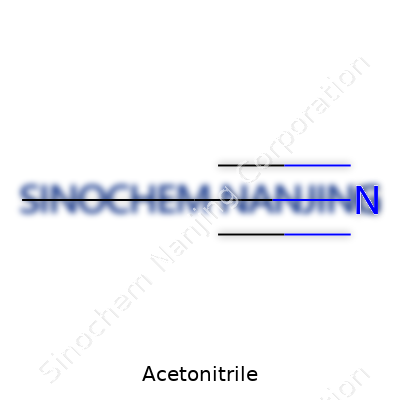
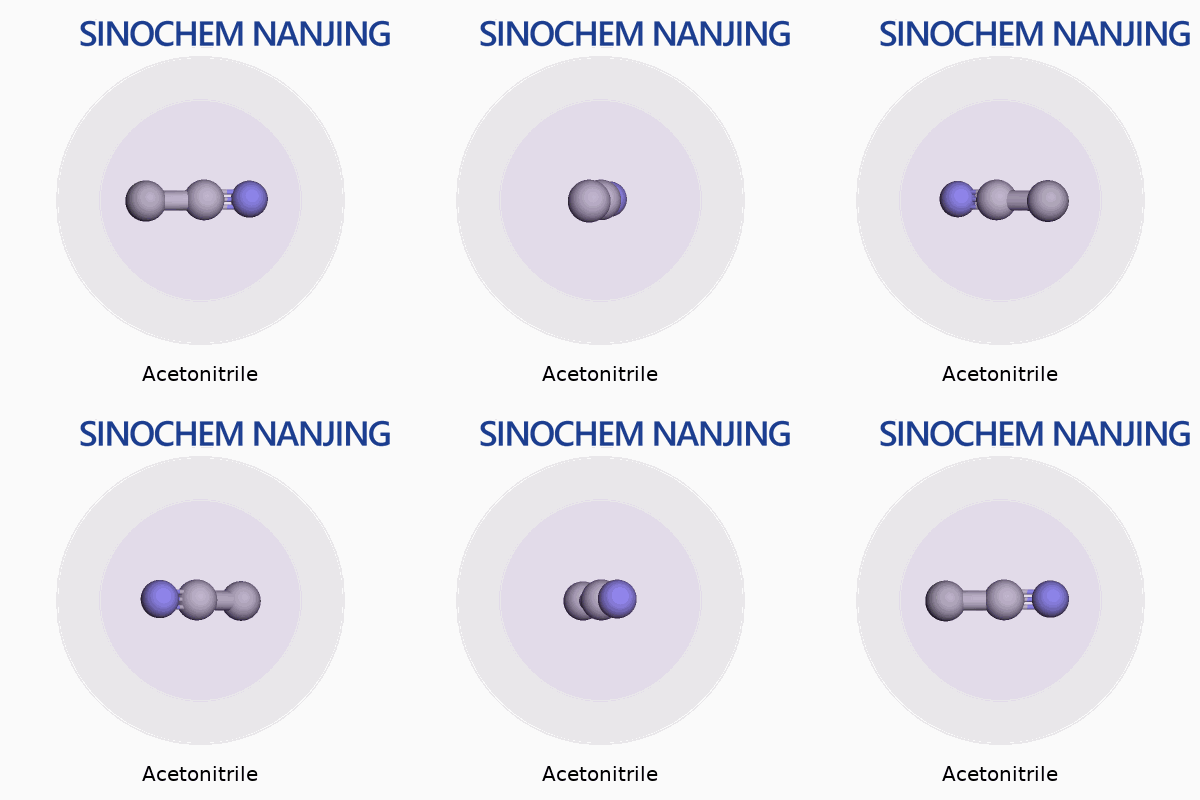
| Names | |
| Preferred IUPAC name | ethanenitrile |
| Other names |
Ethyl nitrile Methyl cyanide Methanecarbonitrile ACN Cyanomethane |
| Pronunciation | /əˌsiːtəˈnaɪtraɪl/ |
| Identifiers | |
| CAS Number | 75-05-8 |
| Beilstein Reference | 35336 |
| ChEBI | CHEBI:17562 |
| ChEMBL | CHEMBL105 |
| ChemSpider | 6089 |
| DrugBank | DB01981 |
| ECHA InfoCard | ECHA InfoCard: 100.000.601 |
| EC Number | 200-835-2 |
| Gmelin Reference | 822 |
| KEGG | C01381 |
| MeSH | D000016 |
| PubChem CID | 6342 |
| RTECS number | AL7700000 |
| UNII | XK167CJL57 |
| UN number | UN1648 |
| Properties | |
| Chemical formula | C2H3N |
| Molar mass | 41.05 g/mol |
| Appearance | Colorless liquid |
| Odor | Ethereal; faintly sweet |
| Density | 0.786 g/cm³ |
| Solubility in water | miscible |
| log P | -0.33 |
| Vapor pressure | 84 mmHg (20°C) |
| Acidity (pKa) | 25 |
| Basicity (pKb) | pKb = 24.3 |
| Magnetic susceptibility (χ) | −9.0×10⁻⁶ |
| Refractive index (nD) | 1.344 |
| Viscosity | 0.341 mPa·s |
| Dipole moment | 3.92 D |
| Thermochemistry | |
| Std molar entropy (S⦵298) | 164.1 J·mol⁻¹·K⁻¹ |
| Std enthalpy of formation (ΔfH⦵298) | ‘−45.8 kJ·mol⁻¹’ |
| Std enthalpy of combustion (ΔcH⦵298) | -849.5 kJ/mol |
| Hazards | |
| GHS labelling | GHS02, GHS07, GHS08 |
| Pictograms | GHS02,GHS07 |
| Signal word | Danger |
| Hazard statements | H225, H302, H312, H319, H332 |
| Precautionary statements | P210, P261, P273, P280, P301+P310, P304+P340, P311, P403+P233, P501 |
| NFPA 704 (fire diamond) | 2-3-2 |
| Flash point | 6 °C |
| Autoignition temperature | 525 °C |
| Explosive limits | 4%(LEL)–17%(UEL) |
| Lethal dose or concentration | LD50 oral rat 2730 mg/kg |
| LD50 (median dose) | LD50 (median dose): Rat oral 2730 mg/kg |
| NIOSH | NIOSH: AL3150000 |
| PEL (Permissible) | 40 ppm |
| REL (Recommended) | 40 ppm |
| IDLH (Immediate danger) | 60 ppm |
| Related compounds | |
| Related compounds |
Formonitrile Acetamide Acetic acid Acetaldehyde Propionitrile |



