The Many Faces of 2-Pentanone: More Than a Lab Solvent
Where 2-Pentanone Came From: A Look Back
2-Pentanone, which some folks know as methyl propyl ketone, has stood on the chemical landscape for over a century. Chemists in the late 1800s learned to make it and started adding it to their workflow for its distinct chemical behavior. This stuff really started to turn heads after the mid-20th century, blending into all sorts of industries. Back then, the emphasis was on isolating pure compounds and exploring how small tweaks could give entirely new substances. 2-Pentanone wasn’t the biggest star, but it carved out a niche, helped along by the growing thirst for solvents that offered quick evaporation and strong solvating power. Old scientific papers show chemists noting its role as a test substance and a building block, especially in academic settings that valued a wide palette of compounds.
What is 2-Pentanone, Really?
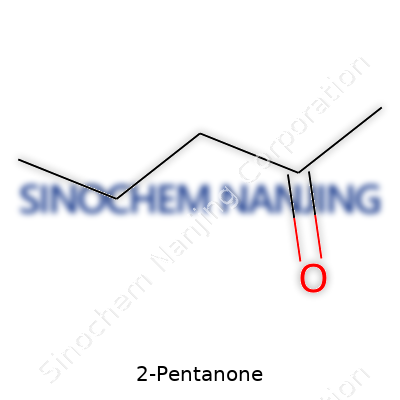
The world knows 2-Pentanone as a clear, colorless liquid with a sharp, sweet smell—imagine an odd mix between acetone and gasoline. The material’s structure is straightforward: five carbons with a carbonyl group plopped on the second carbon. That arrangement gives it a set of properties that’s just right for slicing through greases and oils. Oftentimes, you’ll see it labeled as methyl propyl ketone or sometimes as MPK in technical circles. In retail and industrial settings, no matter what name you slap on it, 2-Pentanone turns up in solvents, flavors, and even in testing analytical equipment. Bottles come stamped with everything from its CAS number (107-87-9) to basic warnings about flammability. Yet its story is a lot bigger than just a product label.
What Sets 2-Pentanone Apart: Properties and Specifications
This liquid boils off at around 102 degrees Celsius, and pours out just a bit thicker than water. Its vapor pressure keeps it mobile and volatile, which makes it a solid pick for jobs where quick evaporation counts. It mixes well with most other typical organic solvents but stays out of water, only blending a little at room temperature. Chemically speaking, the carbonyl group stays pretty reactive, and that leads to a world of modifications. 2-Pentanone’s density clocks in at just under 0.81 grams per cubic centimeter, while its refractive index and flash point keep professionals from losing sight of safety in tight quarters. That flammability tag isn’t just bureaucratic—working with this stuff calls for well-ventilated rooms and no open flames. Details on labels are never random: They reflect years of regulatory updates, lessons learned from borderline accidents, and a slow but steady push toward worker safety.
How Chemists Make It Happen
Chemical producers usually turn to one of two big routes for making 2-Pentanone. The process prefers catalytic dehydrogenation of 2-pentanol, stripping away hydrogen with precise temperature control. This yields pure liquid, often followed by careful distillation to separate it from side products. Some labs take different routes, like oxidizing 2-pentanol with strong agents, but these methods draw the line on industrial use due to cost or side reactions. In my own days working in academic labs, heating a batch of 2-pentanol and capturing whiffs of the evolving ketone drove home just how much practical finesse goes into getting a clean, usable sample. These methods, refined over decades, balance convenience, safety, and price. As the world pushes for greener alternatives, new experiments keep circling around using less hazardous reagents and tightening up waste management. It’s slow progress, but any step forward carries a big payoff in plant safety and environmental impact.
Where Things Get Interesting: Chemical Tricks and Variations
2-Pentanone’s love for chemical reactions gives it real value in the organic chemist’s toolkit. That carbonyl center jumps into action during nucleophilic addition and condensation reactions. Under lab conditions, it’s easy to tweak the molecule, shifting towards secondary alcohols through reduction, or swapping out the ketone for amines using reductive amination. These pathways play foundational roles in the synthesis of pharmaceuticals and specialty chemicals. From my own hands-on experience, 2-Pentanone stood in as a testbed for undergraduate reaction design—reactive enough to show clear results, stable enough to keep a class safe, and a bit less toxic than more notorious solvents. It’s not just a “bland” solvent; it carries a streak of versatility, fueling many technical advances both in class and out in the wild.
Names in the Chemical Jungle
In regulatory and trade circles, 2-Pentanone might show up as methyl propyl ketone, MPK, or even 2-ketopentane. Each name tracks a slightly different tradition—scientific, industrial, or just plain local shorthand. These synonyms lead to headaches if you’re browsing safety data or stocking up a supply room, but they also reveal the chemical’s broad usefulness across countries and decades. No matter what you call it, standard hazard symbols and international labeling laws keep shipments recognizable, reducing confusion while moving tons of liquids across borders.
Staying Safe with 2-Pentanone
Working with 2-Pentanone isn’t just about mixing chemicals; it’s about respecting boundaries and learning from close calls. Flammability isn’t up for debate—spills near heat sources spark real danger. That sharp, fruity odor warns you things are getting concentrated, and heavy vapors love to travel around confined spaces. Splash-proof goggles, chemical-resistant gloves, and proper exhaust systems matter more than perfect technique— anyone who’s spent time in a small lab knows the sting of breathing vapor straight from the bottle. Regulatory groups around the globe enforce containment, spill procedures, and tight exposure limits. Good practice comes from more than just paperwork; it draws on lessons passed down from mentor to student, building habits that keep teams safe even under pressure.
Why Use 2-Pentanone? A Look at Everyday Applications
Few people outside the industry realize how often they cross paths with 2-Pentanone. Paint manufacturers look to its fast-drying punch for specialty coatings. Resin workers pick it for its knack at cleaning up tough residues without leaving streaky films. Laboratories lean on it as a reference chemical or a solvent for chromatography and extractions. Food scientists discover low levels turning up in ripening fruit where it contributes to aroma—though food-grade usage stays tightly controlled by flavor safety organizations. Even in aroma research, it stands as a marker to trace metabolic pathways in both fermentation and spoilage. I remember testing trace levels in fruit extracts, learning the difference a tiny shift in concentration makes to the overall profile. This compound punches above its weight, giving diverse industries exactly what they need to keep innovation moving.
Behind the Scenes: Ongoing Research and Emerging Trends
Research labs, both private and university-based, keep probing new roles for 2-Pentanone. Analytical chemists use it as a benchmark when calibrating gas chromatographs, thanks to its predictable retention times and chemical stability. Environmental labs occasionally catch it as a volatile organic compound (VOC), driving closer studies on indoor air quality and pollution sources. Over the past decade, green chemistry has cast a long shadow over process development, urging researchers to chase routes that generate fewer wastes, cut down on hazardous byproducts, and rely less on rare metals. The push for sustainable solvents leads innovative teams to compare 2-Pentanone against both greener and more problematic alternatives, measuring everything from environmental persistence to toxicity. Journals keep reporting shifts—from new catalytic routes to alternative uses in advanced material synthesis. Progress isn’t always flashy, but bit by bit, the knowledge base gets stronger, guiding regulatory standards and opening up safer, smarter uses.
Sorting Out the Risks: Toxicity and Worker Health
Too many short-sighted managers discount the health risks tied to 2-Pentanone. Headaches, dizziness, and long-term nervous system effects can develop from careless handling or poor ventilation. Toxicity studies show it’s less threatening than heavyweight solvents like benzene, yet regular exposure still calls for truth in hazard communication. My own mentors drilled into me the value of setting up proper fume hoods and respecting exposure limits. Safety sheets stress skin and eye protection, but real understanding grows out of daily routines—wiping up spills quickly, closing containers religiously, and documenting near-misses without fear of reprimand. Researchers continue to map how metabolism and chronic exposure relate to various health outcomes, updating thresholds to keep workers protected. The push for transparency has grown over the years, forcing both suppliers and employers to stay accountable and improve indoor air controls, medical surveillance, and recordkeeping.
Looking Ahead: What Might Change for 2-Pentanone?
The future of 2-Pentanone turns on a few pivotal issues. On one hand, its status as a dependable, effective solvent keeps it woven into the fabric of countless manufacturing and research settings. On the other, market and regulatory shifts keep piling demands on reducing health and environmental risks. Biobased processes, which have made big strides in the last few years, promise new ways to make this compound from more renewable sources, bypassing harsh reagents and lowering toxic byproducts. More efficient catalysts and tighter process controls promise to dial back waste. Meanwhile, digital monitoring and artificial intelligence help spot potential trouble in storage and transport before it erupts into full-scale accidents. The balance to strike here is keeping efficiency while respecting ever-tightening rules and expectations around workplace safety. Workers, managers, and communities share a stake in the outcome, driving the call for more transparency, better education, and continuing innovation in both production and practice.
What is 2-Pentanone used for?
Everyday Chemistry Hiding in Plain Sight
Plenty of folks don’t give chemicals like 2-pentanone a second thought. Everyone hears about the science behind flavors or safety at work, but what does this chemical actually do in real life? My own experience in a family auto shop gave me a front-row seat to just how often we lean on chemicals like this one—without ever seeing the label up close.
In the Paint Shop and Garage
Walk into any garage, and you'll catch that mix of solvent and fuel in the air. 2-Pentanone shows up in industrial cleaning products and paint thinners. Mechanics reach for cleaning agents that break down grease and fuels, and this chemical fits in as a strong, reliable solvent. It dissolves resins and oils well—but its scent gets strong fast, so using it in well-ventilated spots always made sense. Regulations demand attention, since inhaling those fumes is no joke, but the convenience and efficiency sometimes win out over less volatile alternatives. Plenty of folks in auto-body or industrial paint settings probably use this stuff every day, even if they aren't aware of the exact formula in their hands.
Flavor Factories and Food Work
2-Pentanone isn’t just for engines and paint cans. It turns out, this chemical helps shape the taste of some foods. The compound has a fruity, slightly sweet odor. Lab techs use it as a flavoring agent in small quantities, especially when developing artificial flavors for candies, baked goods, or beverages. Manufacturers check the purity and concentration before adding it to anything edible. In very small, regulated doses the safety checks pass, but food scientists keep a close eye on how consumers react. Trace levels might seem strange, yet it's just one of hundreds like it behind the scenes in flavor labs.
Workplace Safety and Industry Grit
OSHA—the federal watchdog for workplace safety—wouldn’t let anyone risk daily exposure to vapors without limits. Old-school work crews might remember bare hands and open buckets, but now there are gloves, respirators, and lots of paperwork. Keeping the air fresh and the skin protected is standard, not just best practice. I remember a warehouse with a chemical spill, and the cleanup taught everyone a lesson about how strong a solvent like 2-pentanone really is—and how quickly it evaporates into the room. Companies with high-volume needs swap in safer alternatives where possible, but the hard truth is that few solvents work quite as quickly or as well. It's a balance between efficiency and safety, always checked against strict health guidelines.
Looking For Safer and Smarter Uses
Some firms run research to replace strong solvents like this with greener options. Demand from both regulators and consumers has pushed the search for something less flammable, less toxic, easier to dispose of. Innovations in green chemistry aim to cut risks, not just shuffle them around. If companies invest in closed-loop systems—ones that keep vapors contained and recycle the solvent—workers’ health improves. Knowing where and how these chemicals end up makes a real difference, both for those who work with them and anyone on the end of the supply chain.
Making Informed Choices
In the hands of a skilled worker, 2-pentanone solves a tough problem—removing tough grime, thinning resins, or adding a slight something extra to a sweet, fruity taste. The key is knowing where it belongs, and making sure no one gets careless with the safety steps. Big industries will keep tweaking recipes and practices, but on the ground, it’s the blend of practical experience and up-to-date science that shapes everyday choices.
Is 2-Pentanone hazardous or toxic?
Looking Beyond the Chemical Formula
2-Pentanone, sometimes listed as methyl propyl ketone, finds its way into a surprising number of products I’ve bumped into. You see it in some solvents, paint thinners, and industrial cleaners. That familiar sharp, fruity odor sometimes drifts from a bottle of nail polish remover or thinner—that’s often ketones doing their work, and 2-pentanone is on that list. Knowing what I’m breathing or handling always matters to me, so I took a closer look.
Direct Health Effects
Toxicologists point out that 2-pentanone can irritate eyes, skin, and lungs. That sharp scent serves as a bit of a warning; overexposure hits hard on the nose and throat. Spend time around it in places without good airflow, and headaches, dizziness, and even nausea often pop up. NIOSH recommends not letting air levels rise over 100 parts per million for a workday. That ceiling isn’t picked out of thin air—workers exposed to similar ketones over long stretches show reduced attention and slower reaction times. Symptoms like tiredness and confusion are no joke, especially where sharp minds and quick movements matter for safety.
Comparisons and Long-Term Risks
I’ve worked enough with solvents to know folks wonder how 2-pentanone stacks up against better-known cousins like acetone or MEK (methyl ethyl ketone). Studies highlight 2-pentanone’s lower acute toxicity, though it’s still not mild. Animal tests suggest the body can break it down and clear it out relatively quickly, but repeated bites at the apple bring up longer-term health flags. Inhalation over months can affect the liver and kidneys, the same organs that struggle with other solvents. That matters if you’re in painting, auto work, or cleaning, where daily exposure sometimes goes unnoticed.
Environmental and Secondary Hazards
Spilling or dumping solvents always has a ripple effect. 2-Pentanone vaporizes fast, spreading in enclosed spots and often reaching flash points easily. I once saw a shop where poor ventilation turned a minor spill into an evacuation. Flammable vapors drift and look for ignition sources—cigarettes, sparks, even hot machinery. In the open air, sunlight breaks it down quickly, but trapped indoors, vapors can cause both fire and breathing issues. Down the drain or in the yard, solvents squeeze into groundwater or soil and can stick around. Water supplies in some cities show traces traced back to solvent misuse.
Reducing the Hazards: What Works
In my own workspace, small habits make the biggest difference. Gloves and safety goggles give reliable protection against splash and contact. I swapped out poorly sealed containers for those with tight, chemical-resistant lids, cutting down accidental fumes and spills. Open doors, fans, and proper fume hoods can keep workplace air from crossing that dangerous line. For anyone mixing or pouring, a simple respirator rated for organic vapors blocks most of what you’d otherwise inhale. Most shops keep emergency eyewash and spill kits on hand, so quick cleanup’s always possible.
Part of responsible handling is solid training. New hires watch real-life demos and learn why even familiar “safe” chemicals call for respect. Wash hands after contact, keep food out of the shop, and store containers cool and upright—simple steps keep accidents rare. Manufacturers play their part too, updating labels and safety data sheets so everyone on the floor knows what they’re facing and what to do if something goes wrong.
2-Pentanone isn’t the worst chemical in the lineup, but treating it carelessly invites trouble. Respect for the hazards—backed by good gear, strong habits, and clear information—keeps risks at arm’s length.
What is the chemical formula of 2-Pentanone?
Diving Into the Structure
2-Pentanone carries the formula C5H10O. You’ll find five carbon atoms, ten hydrogens, and one oxygen. This molecule groups in the family of ketones, which means the carbonyl group (C=O) hooks onto the second carbon atom along the chain, not at the end. Nothing fancy—just straight chemistry.
Molecules Matter More Than Most Think
It’s easy to shrug off simple organics like 2-pentanone as just textbook entries, but their impact travels far beyond the pages. Anyone who’s dipped into a chemistry lab has met their sharp, fruity scent. It lingers in solvents, paints, flavors—even in natural plant emissions. Years ago, I worked in a small research lab that tracked air pollution for a local city. We kept sniffing out this odd, acetone-but-softer odor. Turns out, wild plants and even vehicle exhaust release 2-pentanone into the air. Not just a cold lab chemical—this stuff circles back to you and me every single day.
Not Just a Smell: Real-Life Uses Matter
C5H10O steps up in industrial settings. Factories rely on it as a solvent for resins and coatings. It helps dissolve tough substances, making sticky paints go on smoother and dry just right. Food scientists use tiny doses to dial in fruity notes in flavors—think cherry and banana candy. I’ve tasted test batches with and without this chemical: the difference leaps out, giving a softness that bland versions just lack.
Workshops, garages, school labs—2-pentanone quietly proves its value across them all. Recycling facilities see it in processing streams, as it's a byproduct of breaking down some plastics and natural matter. Clean-up teams have to deal with it, tracking parts per million to keep workplaces safe.
Health and Safety Count
Just because molecules are small doesn’t mean they’re risk-free. Anyone who's opened a bottle of 2-pentanone knows how quickly its vapors sting the nose or eyes. Too much exposure leaves folks dizzy, lightheaded, sometimes worse. Good ventilation and safety goggles come out, especially for students and young researchers learning the ropes. Years ago, poor air handling in our lab forced us to overhaul the whole HVAC system—a lesson learned the hard way. According to the National Institute for Occupational Safety and Health, staying under recommended exposure limits goes a long way to avoiding chronic headaches or irritation.
Challenges and Smarter Choices
Working with chemicals like 2-pentanone keeps demanding vigilance. Mistakes can come easy if people cut corners on safety or don't bother to read labels. Regular training, plus honest reminders about proper handling, go further than thick textbooks. For labs looking to limit volatile organics indoors, air monitors and enforced safety rules aren't just annoying—they keep people healthy. Substituting with less volatile solvents can help, but performance still depends on the right molecule for the job.
Why We Pay Attention
Getting the formula right—C5H10O—matters every time someone reaches for a bottle, mixes a batch, or checks air quality after a spill. Industry, science, and even food flavor experts all run better with a small but clear focus on chemicals like 2-pentanone. The story’s more than numbers or letters. It’s about hands-on care, sharp attention, and the real world where chemistry meets daily life.
What are the storage and handling requirements for 2-Pentanone?
Taking 2-Pentanone Beyond the Label
2-Pentanone, also called methyl propyl ketone, comes up in labs, manufacturing, and sometimes even in art studios. It’s a colorless liquid with a strong, sweet odor that makes people pause. Anyone who’s opened a drum of 2-Pentanone quickly senses why attention to detail matters with this chemical. Real experience shows one open cap can easily fill a workspace with its smell, and it’s not just the scent that travels; the risks do, too.
Storage Isn’t Just About Space
A locked, climate-managed chemical cabinet always pays for itself. Keep 2-Pentanone storage away from open flames, sparks, even appliances that cycle on and off. Vapors catch fire with little effort. Shield drums and bottles from direct sunlight and hot pipes, since high temperatures boost evaporation, making accidents more likely. In my time helping small labs update their chemical safety, the biggest changes came from moving containers away from heat sources and adding clear labels — small steps, big difference.
People sometimes take shortcuts, storing 2-Pentanone near acids or oxidizers, thinking short-term convenience trumps compatibility. Yet, mixing can set off reactions nobody wants in their workplace. Different chemicals keep their cool on separate shelves, with enough room for ventilation.
Pick the Right Container and Keep It Closed
A tight-sealing metal drum or HDPE bottle prevents leaks and passes the daily knock-over test many bottles in crowded workspaces endure. Screw caps should close snugly, and containers should avoid dents or rust that let in air or moisture. Leaky bottles once soaked through several cardboard boxes on a delivery truck I managed. Our team learned that even short trips demand caps double-checked and upright containers.
Once, our production staff grabbed a damaged bottle out of impatience, only to find a sticky mess and strong fumes. Replacing containers right away costs much less than cleaning up — not to mention health and regulatory trouble.
Focus on Air Quality
2-Pentanone’s low flash point means vapors build up fast and can travel along floors. Good air flow feels like overkill until you’ve dealt with a nasty headache or worse, a small explosion. At one site, adding even a cheap exhaust fan transformed a stifling storeroom into a safe one. Routine checks for vents clogged with dust are not glamorous, but they do save lives.
Simple Precautions, Real Protections
Nitrile gloves, goggles, and splash aprons feel like overkill to some, but direct contact causes eye and skin irritation. In one hurried day, a co-worker splashed a few drops on their wrist. It soaked in quickly, reminding everyone that PPE isn’t optional, even for experienced hands.
Keep a spill kit within arm’s reach and know how to use it. Neutral sorbents, sealed waste bags, and clear instructions shave panic off tense moments. Posters with emergency steps outperformed binders stashed in drawers in every worksite I’ve seen. An eyewash station a few steps away — not around a corner or through a maze of benches — makes all the difference during an incident.
Invest in Good Habits
Handling 2-Pentanone safely asks people to put habit over hurry. Mark every bottle with fresh dates and names. Swap out old or suspect containers early. Review safety data sheets even after dozens of uses. Insist on clear training for every new hire, no matter their certification. Safety for this chemical, like many, relies on details, not luck.
What are the physical properties of 2-Pentanone?
Understanding 2-Pentanone at a Glance
2-Pentanone, sometimes called methyl propyl ketone, belongs to the group of organic compounds known as ketones. In daily life, few people talk about these chemicals unless they work in labs or industries. Still, 2-Pentanone has its share of influence in places like paint shops, chemical plants, and even flavor and fragrance manufacturing. People who work around solvents get familiar with this compound simply because of its behavior and why industries keep using it.
A Look at State and Structure
This compound shows up as a clear, colorless liquid. On a hot summer day, 2-Pentanone starts reminding you why you need good ventilation. It boils at about 102°C and melts just a little below freezing, at -78°C. Pour some into a beaker, and you’ll see it flows freely since it’s much less dense than water. Density sits around 0.81 g/cm³, so it wants to float rather than sink. That’s something people working with mixtures can’t ignore because separating the stuff gets tricky if it forms layers on top of other substances.
The Nose Knows
Even those who never took chemistry can recognize the sharp, sweet smell of 2-Pentanone. The scent hints at something fruity, resembling banana peels, which probably explains why it pops up in artificial flavoring or fragrances. In workplaces, that smell travels fast because the compound evaporates easily. Its vapor pressure reads about 32 mmHg at 20°C. That number means it’ll be out of your flask and into the air if you leave it uncovered. So, people have to keep things sealed and work in well-ventilated spaces to avoid headaches or, worse, health risks.
Mixing with Water and Other Liquids
2-Pentanone shows decent solubility in water, but not as much as acetone or ethanol. You’ll get about 5 grams dissolving in 100 grams of water at room temperature. Once you throw in organic liquids like ether or alcohol, it mixes even better—showing just how selective it gets with its partnerships. For workers in chemical manufacturing, this property makes 2-Pentanone handy for creating specialty coatings, adhesives, or cleaning agents. Firms pick it for certain tasks precisely because it doesn’t dissolve in everything.
Handling with Care
Handling any strong-smelling solvent asks for some respect. 2-Pentanone’s flash point sits at 16°C, so a simple spark can set it off. Its vapors catch fire easily, making safe storage a daily concern in warehouses and labs. I’ve watched people move this compound through fume hoods and grounded metal cans, just to keep a lid on the risks. Regulations say you should keep fire extinguishers handy, and those rules make sense to anyone who’s seen how quick things can turn in a lab. It doesn’t just evaporate and disappear—the vapors linger, and a little carelessness could lead to big problems.
Why Care About These Properties?
Every property, from how it smells to how it catches fire, shapes how people use 2-Pentanone. Understanding its boiling and melting points lets industries figure out the right equipment and safety measures. Knowing its density and solubility helps workers create the right blend in a mix. For people in environmental health, these properties reveal why spills spread so quickly. Dealing with a volatile liquid means setting up ventilation and spill-control systems. Careful labeling and storage become non-negotiable. For companies that want safe workplaces and products, paying attention to these facts stops accidents before they start.
Practical Approaches to Safety and Use
Simple solutions help manage the risks. Clear training teaches workers what to expect from strong vapors or flammable liquids. Using protective gear, like gloves and goggles, can cut direct exposure. Well-ventilated areas and strict no-flame policies lower the fire risk. Chemical manufacturers can look for alternative solvents with lower volatility if they want another layer of safety. Even industries that depend on this compound benefit from regular risk assessments—something as basic as a daily checklist goes a long way in stopping spills and keeping workplaces secure.
| Names | |
| Preferred IUPAC name | pentan-2-one |
| Other names |
Ethyl acetone Methyl propyl ketone MPK |
| Pronunciation | /ˈtuː pɛnˈteɪnoʊn/ |
| Identifiers | |
| CAS Number | 107-87-9 |
| Beilstein Reference | 1200419 |
| ChEBI | CHEBI:79070 |
| ChEMBL | CHEMBL16385 |
| ChemSpider | 7669 |
| DrugBank | DB02170 |
| ECHA InfoCard | EU0000086 |
| EC Number | 01-2119443583-34-XXXX |
| Gmelin Reference | 82282 |
| KEGG | C01814 |
| MeSH | D017501 |
| PubChem CID | 7909 |
| RTECS number | SA8575000 |
| UNII | Z84RK2U4A6 |
| UN number | UN1249 |
| Properties | |
| Chemical formula | C5H10O |
| Molar mass | 86.13 g/mol |
| Appearance | Colorless liquid |
| Odor | Sweet, acetone-like |
| Density | 0.809 g/mL at 25 °C |
| Solubility in water | Moderately soluble |
| log P | 0.89 |
| Vapor pressure | 5.2 kPa (at 20 °C) |
| Acidity (pKa) | 19.9 |
| Basicity (pKb) | pKb = 7.39 |
| Magnetic susceptibility (χ) | -7.76×10⁻⁶ |
| Refractive index (nD) | 1.398 |
| Viscosity | 0.46 mPa·s (at 25 °C) |
| Dipole moment | 2.747 D |
| Thermochemistry | |
| Std molar entropy (S⦵298) | 229.6 J·mol⁻¹·K⁻¹ |
| Std enthalpy of formation (ΔfH⦵298) | -272.7 kJ/mol |
| Std enthalpy of combustion (ΔcH⦵298) | -2430.7 kJ/mol |
| Hazards | |
| GHS labelling | GHS02, GHS07 |
| Pictograms | GHS02,GHS07 |
| Signal word | Warning |
| Hazard statements | H225, H319, H336 |
| Precautionary statements | P210, P280, P305+P351+P338, P337+P313, P403+P235 |
| NFPA 704 (fire diamond) | '1,2,0' |
| Flash point | -6 °C (21 °F; 267 K) |
| Autoignition temperature | 515 °C |
| Explosive limits | Explosive limits: 1.4% - 8.0% |
| Lethal dose or concentration | LD50 oral rat 1600 mg/kg |
| LD50 (median dose) | LD50 (median dose): Rat oral 1600 mg/kg |
| NIOSH | KFP |
| PEL (Permissible) | 200 ppm |
| REL (Recommended) | 200 ppm |
| IDLH (Immediate danger) | 1500 ppm |



