The Journey and Impact of 2-Methyl-1,5-Pentanediamine in Modern Chemistry
Historical Development
Chemistry has a knack for elevating small molecules into roles that shape whole industries. That’s what’s happened with 2-Methyl-1,5-Pentanediamine. This diamine emerged from the search for new monomers that could solve problems in the plastics and coatings fields, dating back to research of the late 20th century. Researchers explored options beyond the traditional diamines, driven by demands for better chemical resistance, lower toxicity, and tunable mechanical properties in polymers. In academic labs and industrial pilot plants, these chemists saw the promise hidden in alternative diamines. Eventually, 2-Methyl-1,5-Pentanediamine carved out a spot because its unique molecular structure gives polymers extra flexibility and stability. Although it didn’t make headlines, it quietly became part of product formulations where precision matters.
Product Overview
2-Methyl-1,5-Pentanediamine stands apart from widely used hexamethylenediamine because of its branching at the second carbon, which slightly tweaks its properties and the properties of the materials made from it. As a diamine, it’s valued for participating in condensation reactions that form polyamides and polyurethanes. The real advantage comes in places where standard diamines don’t quite perform—applications calling for low moisture sensitivity, tough yet flexible materials, or enhanced solvent resistance. In my own experience formulating resins, the arrival of alternative diamines helped push coating systems beyond old limits, enabling more creative, durable designs.
Physical and Chemical Properties
A molecule like 2-Methyl-1,5-Pentanediamine tells its story through its small details. It takes the form of a colorless to pale yellow liquid, giving a slight fishy odor that’s common among short-chain amines. The molecule’s two amino groups react easily with acids and isocyanates, making it a straightforward building block for chemists. Its boiling point sits higher than common diamines of similar size, which means it holds up under moderate processing heat. Water solubility stays high, allowing for easier handling and clean-up during synthesis. Over the years, practical benchwork reveals how its branching prevents excessive crystallization in cured products, which leads to coatings and plastics that hold up better in the field.
Technical Specifications and Labeling
In industrial supply chains, quality and labeling matter as much as what’s inside the drum. Reputable producers of 2-Methyl-1,5-Pentanediamine target high purity levels—over 98%—to ensure predictable results in end-use. Most offer this compound with clear labeling for its chemical identity, expiration dates, and recommended storage conditions that avoid excessive humidity and high temperature. Working on development teams, one frustration has always been the gap between spec sheets and the reality of product purity. Even a fraction of an impurity can foul up polymerization—so the shift toward rigorous labeling and regular quality checks made real improvement in final polymer quality.
Preparation Method
The synthesis of 2-Methyl-1,5-Pentanediamine runs through multi-step processes. One common route relies on starting with 2-methylglutaric acid or derivatives, reducing them with ammonia over supported catalysts at high temperature and pressure. Laboratory versions follow similar chemistry with scaled-down glassware, but full-scale plants optimize yield and energy use by carefully controlling flow rates, catalysts, and recycling solvents. These refinements did not appear overnight. Years of incremental changes, often guided by first-hand troubleshooting when reactors ran cold or conversion rates dipped, gave producers knowledge banks that feed reliably into safer and more sustainable production.
Chemical Reactions and Modifications
As a versatile diamine, 2-Methyl-1,5-Pentanediamine thrives in reactions that link small molecules into something greater. Polycondensation with dicarboxylic acids yields polyamides, or nylons, with nuanced flexibility or heat tolerance, depending on the mix of monomers. In polyurethane formulations, it reacts with diisocyanates to form tough, elastic networks. Modifying the amine itself, such as alkylating the ends or converting one side to a urea, pushes its utility further into adhesives or surfactant precursors. These reactions rarely follow textbook smoothness; even well-refined methods require hands-on adjustment to balance reactivity, gel times, and final material properties. Years in chemical R&D teach that every new amine blend brings a twist—sometimes a headache, but more often a useful discovery.
Synonyms and Product Names
Navigating the chemical trades, names sometimes get tangled. 2-Methyl-1,5-Pentanediamine appears as MPDA on data sheets, and it goes by 2-methylpentamethylenediamine in older references. CAS number 15520-10-2 provides a reliable cross-check. In actual commerce, branded versions occasionally hit the market, but most industries stick to generic names to avoid confusion. This tangle of aliases often complicates literature searches and purchasing—so industry folks always double-check with suppliers and researchers to confirm what they’re really using.
Safety and Operational Standards
Working with reactive amines such as 2-Methyl-1,5-Pentanediamine means safety can’t be an afterthought. Direct contact or inhalation may irritate skin, eyes, and the respiratory tract. Proper ventilation, protective gloves, and goggles rank as standard gear during handling. Storage in tightly sealed containers out of direct sunlight reduces the risk of degradation or pressure buildup. Process engineers and EHS specialists rely heavily on actual incident records to shape best practice, responding to leaks or spills not just with checklists, but with knowledge honed through drills and the occasional near-miss.
Application Area
2-Methyl-1,5-Pentanediamine enters products that demand flexibility and endurance—polyamides for engine components, polyurethanes for specialty coatings, and even intermediary roles in water treatment agents or epoxy hardeners. In the field, formulations using this diamine excel in resisting hydrolysis, a boon for industrial coatings exposed to humidity or water. My own work with polyamide adhesives showed measurable gains in bond durability, especially in applications cycling through temperature swings. Application engineers, tasked with balancing cost and performance, often turn to such tailored monomers to outcompete off-the-shelf alternatives.
Research and Development
Applied research turns unsung molecules into building blocks for next-generation products. Teams working with 2-Methyl-1,5-Pentanediamine constantly tweak synthesis conditions, pursue greener production pathways, and screen new catalyst systems to curb energy consumption. I once worked on projects aimed at replacing toxic or petroleum-heavy feedstocks, seeking to adapt this diamine’s route to bio-based sources—progress came slow, but each step forward nudged us closer to more sustainable manufacturing. Collaboration across disciplines remains vital, as materials scientists, synthetic chemists, and environmental engineers overlap in their goals.
Toxicity Research
Toxicity studies guide how industries use and dispose of industrial amines. While 2-Methyl-1,5-Pentanediamine doesn’t carry the acute risks seen with some aromatic diamines, chronic exposure and environmental persistence still keep industrial hygienists vigilant. Animal testing and cell line studies help define guidelines set by health agencies. Personal experience shows that even low-level exposure can trigger headaches or mild dermatitis in poorly ventilated spaces, urging real-world caution. Process improvements—closed systems, regular air monitoring—spring from these toxicity findings as much as from regulatory edicts.
Future Prospects
Chemistry never holds still, and demand for tailored monomers like 2-Methyl-1,5-Pentanediamine keeps rising as industries look for materials that check all the boxes: longer lifetime, better recyclability, reduced toxicity. Research now looks at raising production efficiency, lowering resource intensity, and someday moving entirely to renewable feedstocks. From experience, real progress depends on a feedback loop between field trials, lab-scale breakthroughs, and manufacturing tweaks. Some day soon, materials built from innovative diamines could enable safer, cleaner products we’ll rely on daily—even if we never see the molecule’s name on a package.
What are the primary applications of 2-Methyl-1,5-Pentanediamine?
Shaping the World of Polymers
Step into the factory floor of any major plastics producer and chances are you’ll find 2-Methyl-1,5-pentanediamine playing a key role. Companies put it to work in the creation of performance polyamides—nylons that handle wear and stress like champs. I remember seeing a cable tie manufacturing process: These engineered plastics outperform regular types, keeping their tension in high-heat environments and holding firm even when flexed over and over. This diamine brings that extra stretch and resilience, so your car’s radiator hoses or that flexible tubing in your washing machine keep on working.
Coatings That Go the Distance
Chemists depend on this molecule for tough, durable coatings. In oil and gas, manufacturers formulate specialty epoxy coatings using 2-Methyl-1,5-pentanediamine—giving pipelines and storage tanks that armor they need against weather, salt, and repeated cleaning. Out at a pipeline site, you can see the difference after a few years; surfaces treated with this stuff stand up against rust much longer. The versatility of this compound makes it a building block for coatings that last longer, ultimately saving on repairs and downtime.
Adhesives That Hold Up
Next time you see construction workers setting glass panels on steel skyscrapers, think about the adhesives in use. Two-part epoxy adhesives containing this diamine create strong, flexible bonds. They stop panels from popping loose as buildings sway in the wind or expand and contract with temperature swings. In my work on a local smart-building project, these adhesives consistently passed the vibration and heat tests that others failed. The diamine’s molecular structure delivers that much-needed shock absorption, supporting green buildings and modern infrastructure.
Fueling Safer, Cleaner Energy
Energy storage technology relies on advanced molecules for performance and safety. Innovators look to 2-Methyl-1,5-pentanediamine while building the separators and housings in lithium-ion batteries and fuel cells. It helps create plastics that don’t just sit there—they resist heat, survive chemical leaks, and keep working through thousands of charging cycles. The world keeps asking for safer batteries, and switching to polymers featuring this diamine pushes that progress along.
Where We Go from Here
Right now, sustainability is the biggest challenge. Most 2-Methyl-1,5-pentanediamine on the market comes from petrochemical sources. Chemical producers are researching routes from plant-based raw materials such as sugars and organic acids. I once spoke with a process chemist at an industrial biotech company who showed off early-stage samples from corn-derived feedstock. Switching to renewables matters for life-cycle emissions and supply security.
There’s also the human factor—factory safety and environmental emissions need watchdogging. Chemical plants and downstream users continue to invest in cleaner processes, improved worker training, and repairs to old storage tanks. Environmental stewardship isn't just about technology, but about responsibility. The more companies put people and planet in the same equation as profits, the less we need to worry about the next headline.
What is the chemical structure and CAS number of 2-Methyl-1,5-Pentanediamine?
Breaking Down the Structure
Not every day do people run into 2-Methyl-1,5-pentanediamine, but for folks in chemistry or manufacturing, recognizing molecular structures matters. This compound likes to keep things direct: two amine groups cling to opposite ends of a five-carbon chain, and a single methyl group branches off the second carbon. Picture this in skeletal notation: H2N–CH2–CH(CH3)–CH2–CH2–CH2–NH2. The chemical formula comes out as C6H16N2.
You don't get many bells and whistles here. It’s straightforward, which gives it extra appeal as a basic building block in specialty synthesis. The CAS number for 2-Methyl-1,5-pentanediamine is 15520-10-2. That number pops up on safety data sheets and procurement forms, acting like the social security number for this molecule, letting researchers see exactly what they’re working with.
Real Life Impact
Chatting with friends in coatings and polymer manufacturing, I hear this name more often these days, as companies look for amines that help tailor properties. People see 2-Methyl-1,5-pentanediamine pop up in the creation of curing agents for epoxy resins, where cross-linking really decides the strength and resilience of the final product. You would be surprised how many water treatment systems rely on compounds like this for chelation; it’s not always the stars of the chemical catalog making the difference.
There’s a real environmental focus around diamines. Safety matters not just to chemists, but to the folks downstream — the warehouse workers, the factory staff, and the communities near large-scale plants. Anyone who’s spilled a diamine can tell you how tough that strong amine odor can get. Responsible handling with proper PPE, good ventilation, and thoughtful waste management keeps this compound in its lane. Regulatory agencies often check CAS numbers like 15520-10-2 against safety sheets to keep workplaces and the environment safe.
Room for Growth and Innovation
Even a straightforward molecule finds new life when smart folks get their hands on it. Right now, the demand for epoxies and polymer additives with different curing speeds or lower toxicity nudges the research toward variations and alternatives. You see folks tweaking the methyl group or swapping out chain lengths to hit certain benchmarks for performance and sustainability.
I remember university labs always hunting for cost-effective, accessible reagents. If a diamine could be made from renewable feedstocks or carry less toxicity, everyone paid attention. Considering the future, more companies lean toward green chemistry and closed-loop manufacturing. This doesn’t just make ethical sense — it works for the bottom line too, especially since customers and buyers check supply chains closely.
2-Methyl-1,5-pentanediamine isn’t making headlines like lithium or graphene, but its steady presence in practical chemistry carries real weight. Reliable sourcing, ethical handling, and ongoing research keep this molecule relevant, especially as companies and regulators try to shrink the environmental footprint of materials production.
What are the storage and handling precautions for 2-Methyl-1,5-Pentanediamine?
What Matters Most with 2-Methyl-1,5-Pentanediamine
Anyone who has ever worked with chemicals knows once that barrel hits the dock, your responsibility begins. You don’t get to shrug off mistakes—especially not with something like 2-Methyl-1,5-Pentanediamine. This isn’t just another ingredient to stack in the corner; it’s a substance that asks for respect because of its reactivity and its effects on human health.
Personal Experience and Key Precautions
I’ve spent years in industrial labs and warehouses. Two key memories stuck with me: one as a rookie, where a colleague rushed storage just to get home early and ended up with a leaking drum, and another watching a careful supervisor triple-check a chemical manifest. That’s all to say, habits in storage and handling aren’t just bureaucracy; they’re what separates a quiet day from a frantic call to emergency services.
Hazards Straight from the MSDS
This chemical doesn’t hide its punch. It causes burns if it makes contact with skin or eyes, and breathing in the vapors creates serious respiratory risks. Glancing at the MSDS (Material Safety Data Sheet) shows that 2-Methyl-1,5-Pentanediamine can react with oxidizers or acids. If you give it the wrong company or the wrong storage conditions, you run the risk of fire or toxic gas.
Smart Storage for Safety
Never stash containers in a sun-baked shed or a muggy storeroom. Keep them in a cool, well-ventilated space, and use secondary containment wherever possible. In my last workplace, we always kept amines like this away from anything acidic and out of the main flow of foot traffic. Store the product in tightly closed, labeled containers made of compatible, corrosion-resistant materials. No food or drink allowed anywhere near chemical storage—even one lapse could mean accidental ingestion or contamination.
Proper Handling: No Shortcuts
Personal protective equipment isn’t a suggestion; it’s the bottom line. Think chemical-resistant gloves, splash goggles, long sleeves, and organic vapor respirators if you’re transferring large amounts or cleaning up a spill. Never work alone with hazardous chemicals, and always keep spill kits and emergency showers within easy reach. My mentor once told me, “If you can’t find the eyewash station blindfolded, you aren’t ready to use the chemical.” That advice has stuck with me ever since.
Addressing Waste and Spills
Spills turn one mistake into a wide-reaching hazard. For cleanup, use absorbents made for caustic, organic substances, and seal up any waste in proper drums with secure lids marked for hazardous materials. Forget the garden hose—flushing chemicals down the drain only moves the problem somewhere else. Instead, coordinate with licensed disposal firms that know how to neutralize, transport, and store hazardous waste safely. Keep emergency contact numbers on the wall, within arm’s reach.
Supporting E-E-A-T: Sharing Knowledge and Training
Knowledge doesn’t stay in books. Ongoing training and clear warning labels save more people from harm than any set of written instructions. Regular drills, honest reviews after near-misses, and a culture that rewards speaking up about hazards make chemical work safer for everyone. Nobody should ever feel too rushed or embarrassed to double-check a label or ask about a whiff of ammonia in the air.
2-Methyl-1,5-Pentanediamine isn’t for the careless or the hurried. Routines built around respect and proven safety practices stand as the real barrier between a good day and a preventable disaster.
Is 2-Methyl-1,5-Pentanediamine hazardous or toxic?
Chemicals at Work and in Life
Factories and workshops use chemicals every day, and sometimes names like 2-Methyl-1,5-Pentanediamine come up in product labels or safety sheets. The name might sound intimidating, but the real concern comes down to what it does to people and the environment. Many who work in the chemical or manufacturing industries eventually end up handling the substance in some form, either in liquid or resin blends. It’s easy to lose track of all the risks when wearing gloves or checking a drum, but it pays off to look closely at any claims of toxicity or hazards.
Toxicity: What Scientists Have Found
The most trusted data on chemical safety comes not from rumors, but from actual studies and regulatory bodies. 2-Methyl-1,5-Pentanediamine has caught attention in both toxicological databases and manufacturer safety sheets. Direct contact shows clear risks. Skin exposure can lead to burns or irritation. Inhalation, especially amid poorly ventilated workspaces, may leave a person wheezing or short of breath. Eyes do not react kindly to splashes—pain, redness, and sometimes lasting injury have been reported.
Studies in lab animals point out some dangers at higher-dose exposures, including tissue and organ irritation. No definitive links to cancer or major long-term disease have turned up in mainstream toxicology reviews as of 2024, but that does not mean the coast is clear. Many chemicals slip under the radar until later, so caution stays relevant. Poison control centers also urge immediate action if swallowed or in case of major spills.
Personal Experience and Industry Lessons
During years spent volunteering at a community makerspace, chemicals like this popped up in polyamide syntheses and epoxy hardeners. Most people meet 2-Methyl-1,5-Pentanediamine in industrial blends rather than in pure form. We always treated the material as corrosive; signs on the drums warned of severe skin and eye damage. It’s not unusual to see experienced workers double-check gloves, goggles, and face shields before even opening a container. Spills led to long clean-ups, not because of panic, but from hard-earned respect for what these substances can do to skin, lungs, and even concrete floors.
OSHA and the European Chemicals Agency include this diamine on their lists of substances demanding strict workplace controls. None of this seems excessive. Tales of untreated rashes or coughing fits serve as reminders that basic rules matter. The classic, “It’s just a little drop,” is not a safe guess when the material’s technical sheet flags corrosivity.
Minimizing Hazards and Moving Forward
There’s no shortage of chemicals with similar issues, so what’s the right move? Companies and small workshops both benefit by keeping clear safety data sheets around and treating unfamiliar names with the same caution as well-known irritants. Splash-proof eyewear, chemical-resistant gloves, good ventilation, and ready access to wash stations stack up as the bare minimum. Training newcomers isn’t an annoying add-on—it stops accidents before they happen. Community lingo often mentions, “If you wouldn’t want it on your own skin, don’t put it on someone else’s.”
Researchers and safety agencies still update findings. Checking newer reports or regulatory updates every year or so helps fill gaps. Supply chains also evolve—sometimes substitutes with a better safety track record come along. Lobbying for safer alternatives, even at higher short-term cost, leads to a more sustainable and humane working world. Many in the field push for green chemistry not out of greenwashing, but from years spent watching the fallout of avoidable accidents.
2-Methyl-1,5-Pentanediamine does bring hazards. The best choice centers not on panic or indifference, but practical respect and a willingness to adapt as science and regulations evolve.
Can 2-Methyl-1,5-Pentanediamine be used in polyamide or isocyanate chemistry?
A Fresh Take on a Less Common Diamine
2-Methyl-1,5-pentanediamine tends to fly under the radar compared to better-known building blocks in polymer chemistry. Its structure, with a branched backbone, catches my attention mostly because so many common industrial diamines stick to linear chains. That branching could change a lot about how this molecule performs in both polyamide and isocyanate reactions.
Building Polyamides: How Structure Shapes Performance
Most folks who’ve worked around nylon production know the tight relationship between a diamine’s shape and a product’s final properties. When straight-chain diamines like hexamethylenediamine get mixed with dicarboxylic acids, you get strong, crystalline polyamides with high melting points. With 2-methyl-1,5-pentanediamine, its methyl side group disrupts regular packing. Polymers made from it would probably have lower crystallinity and higher flexibility. Think softer, less brittle plastics—something useful in applications where a little give matters more than sheer strength.
Using a branched diamine can help prevent moisture uptake, too. I learned through experience that branched nylons tend to pick up less water than their linear cousins, which means less swelling and a more stable part. Over time, this little tweak can help extend a product’s useful life, especially in devices exposed to humid environments.
Isocyanate Chemistry: Casting Polyurea and Polyurethane in a New Light
Anyone who’s mixed up a polyurethane foam or a polyurea coating knows every diamine brings its own quirks to the party. Chain length, reactivity, and steric hindrance affect cure speed and physical results. The extra methyl group in 2-methyl-1,5-pentanediamine introduces a bit of a twist here. It can slow down the reaction rate compared to an unbranched diamine. This change opens up more time for processing and shaping, which operators often appreciate with large or intricate molds.
Looking at polyurea elastomers, using this diamine could mean softer, more pliable products. It might also tamp down some unwanted foaming, which anyone who’s spent time cleaning up messy pours can see as a big win. Plus, the unique backbone can strengthen resistance to chemical attack, making these materials a better fit for shops where corrosive chemicals are an everyday concern.
Sustainability and Workplace Considerations
I’ve seen the conversation around chemical safety shift a lot lately. Compared to aromatic diamines, aliphatic variants like 2-methyl-1,5-pentanediamine usually bring fewer toxicity concerns. Products built with safer materials support healthier workplaces and can sidestep regulatory headaches down the road. This diamine’s relatively lower human and environmental risk—based on its structure and existing research—deserves more attention from polymer chemists looking for greener options.
What Comes Next?
In both polyamide and isocyanate applications, a new diamine’s value gets checked against its cost, supply, and benefits. If people don’t try out alternatives, they miss out on hidden advantages—like better flexibility, reduced moisture absorption, or easier processing. Labs and small manufacturers with some room for experimentation can learn a lot by making trial batches. Open sharing of results—both successes and dead ends—helps everyone get clearer on whether 2-methyl-1,5-pentanediamine deserves a bigger seat at the table in modern polymer chemistry.
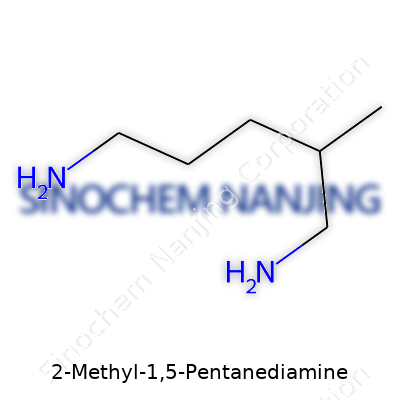
| Names | |
| Preferred IUPAC name | 5-Methylpentane-1,5-diamine |
| Other names |
1,5-Diamino-2-methylpentane 2-Methylpentane-1,5-diamine 2-Methyl-1,5-diaminopentane MPDA |
| Pronunciation | /tuː ˈmɛθ.əl waɪn.faɪv ˌpɛn.teɪn.daɪˈæm.iːn/ |
| Identifiers | |
| CAS Number | 15520-10-2 |
| 3D model (JSmol) | `C[C@H](CN)CCC[NH2]` |
| Beilstein Reference | 1209266 |
| ChEBI | CHEBI:85335 |
| ChEMBL | CHEMBL165474 |
| ChemSpider | 54686 |
| DrugBank | DB14096 |
| ECHA InfoCard | 01b8ecd9-6fd8-4e04-9e63-9b090acf8f8c |
| EC Number | 205-897-5 |
| Gmelin Reference | 107233 |
| KEGG | C19679 |
| MeSH | D000069257 |
| PubChem CID | 15604 |
| RTECS number | SJ8575000 |
| UNII | HTS0O43B7R |
| UN number | UN2734 |
| Properties | |
| Chemical formula | C6H16N2 |
| Molar mass | 116.20 g/mol |
| Appearance | Colorless to pale yellow liquid |
| Odor | ammonia-like |
| Density | 0.872 g/mL at 25 °C |
| Solubility in water | miscible |
| log P | -0.5 |
| Vapor pressure | 0.0187 mmHg (25°C) |
| Acidity (pKa) | 10.76 |
| Basicity (pKb) | pKb = 3.34 |
| Magnetic susceptibility (χ) | -7.3×10⁻⁶ cm³/mol |
| Refractive index (nD) | 1.454 |
| Viscosity | 11 mPa·s (25 °C) |
| Dipole moment | 2.39 D |
| Thermochemistry | |
| Std molar entropy (S⦵298) | 319.7 J·mol⁻¹·K⁻¹ |
| Std enthalpy of formation (ΔfH⦵298) | −51.9 kJ·mol⁻¹ |
| Std enthalpy of combustion (ΔcH⦵298) | -4346.7 kJ/mol |
| Hazards | |
| Main hazards | Harmful if swallowed. Causes severe skin burns and eye damage. Toxic to aquatic life. |
| GHS labelling | GHS02, GHS05, GHS07 |
| Pictograms | GHS05,GHS07 |
| Signal word | Warning |
| Hazard statements | H302, H314, H317 |
| Precautionary statements | P280, P261, P264, P271, P302+P352, P304+P340, P305+P351+P338, P310, P321, P362+P364, P332+P313, P337+P313, P362, P501 |
| NFPA 704 (fire diamond) | 3-3-0 |
| Flash point | 71°C |
| Autoignition temperature | 320 °C (608 °F; 593 K) |
| Explosive limits | 1.3–9.7% |
| Lethal dose or concentration | LD50 oral rat 1690 mg/kg |
| LD50 (median dose) | LD50 (median dose): Oral, Rat: 316 mg/kg |
| NIOSH | MWG75440 |
| PEL (Permissible) | PEL (Permissible Exposure Limit) for 2-Methyl-1,5-Pentanediamine: Not established |
| REL (Recommended) | REL (Recommended): 0.04 ppm (0.18 mg/m3) |
| IDLH (Immediate danger) | IDLH: 12 ppm |
| Related compounds | |
| Related compounds |
Pentamethylenediamine Hexamethylenediamine 1,2-Diaminopropane 1,3-Diaminopropane 2-Methylpentane 2,2,4-Trimethyl-1,6-hexanediamine |



