2-Cyclohexylaminoethanesulfonic Acid: Deep Dive Into a Buffer Compound
Historical Development
Years ago, biochemistry labs needed precise pH control in experiments, especially during protein work and cell culture. Long before digital meters and purified reagents, researchers scrambled to keep their reactions stable. The search for reliable zwitterionic buffers picked up steam in the 1960s when Norman Good and colleagues started mapping new agents that kept cell and enzyme systems happy. Out of this push, 2-Cyclohexylaminoethanesulfonic acid—better known as CHES—joined the toolkits. Unlike older phosphate and acetate buffers, CHES handled its job in the basic pH range and kept metal ions from mucking up data. Its structure, stable under heat and exposure to air, allowed more reproducible results. Back then, reproducibility often meant the difference between a breakthrough and hours lost on the benchtop.
Product Overview
CHES found its main calling as a biological buffer, and even now its uses center in labs tackling DNA manipulations, enzyme studies, and diagnostics. It usually arrives as a white crystalline powder, dissolving easily in water. Pick up a bottle from trusted suppliers and the labeling points straight to its intended use: consistent pH buffering for experiments that can’t tolerate large swings above neutral. The packed bottles travel with careful instructions since moisture and contamination wreck batch integrity and research outcomes.
Physical & Chemical Properties
On paper, CHES lists a molecular formula of C8H17NO3S and a molecular weight a bit over 200. That formula only hints at what happens once it's mixed. Its chemical backbone, built from a cyclohexyl group attached to a sulfonic acid through a short ethylamine spacer, brings solid water solubility without hogging cations from solution. pKa settles in around 9.3 at room temperature, suiting experiments hovering in the basic range. In daily work, this means CHES handles temperature jumps and salt fluctuations better than many buffers. It feels powdery and clumpy in humid offices, with melting between 210-215°C. Stored right, it can last for years, though open containers often yellow and lose potency after sitting too long near the bench top splash zone.
Technical Specifications & Labeling
Technical grade or research-grade CHES powders show batch variations, and so labels always quote purity (typically at or above 99%) and heavy metal content in parts per million. Specifications include identity checks through NMR and IR, water content determined by Karl Fischer titration, and any detectable impurities using HPLC or TLC. The labeling covers recommended storage between 2-8°C in drying cabinets, with warnings about moisture, dust, and chemical cross-contamination. Regulatory info often appears in a footnote, giving hazard identifiers and precautions—good practice since labs have seen serious mix-ups between similar looking powders in cluttered storage racks.
Preparation Method
CHES comes from a multi-step synthesis. Manufacturers react cyclohexylamine with ethylene sulfonic acid or its sodium salt. Conditions stay controlled, with strict pH adjustment to avoid burning off the sulfonic acid group or breaking the amine ring. Yields depend on good water removal and careful pH monitoring. After the bulk reaction, purification steps strip out color and odor-causing byproducts before crystallization. Skilled technicians spot off-batch odor, excess yellow tinge, or low solubility right away. Analytical tools confirm the right ratio of cyclic to linear isomer—a key factor in keeping buffer behavior stable.
Chemical Reactions & Modifications
CHES sometimes goes beyond simple buffering. Its sulfonic acid group stays resilient, but under strong acid or base, it can hydrolyze or split. Some chemists modify the amine section, tacking on fluorescence or affinity tags. This lets CHES follow enzyme kinetics or track movement inside cells. Industrial chemists have tried attaching the molecule to resins for chromatography applications, pulling out specific proteins or nucleic acids from mixtures. Under mild oxidizing conditions, though, CHES itself keeps a low reaction profile and rarely interferes in the test tube.
Synonyms & Product Names
Walking into a storeroom, scientists might see bottles labeled as N-cyclohexyl-2-aminoethanesulfonic acid, 2-(cyclohexylamino)ethanesulfonic acid, or simply CHES. Chemical catalogs might list it under CAS number 103-47-9. Other regional suppliers use trade names or internal codes, though the structure stays consistent. Navigating synonyms matters—confusing CHES with closely related buffers like CAPS (3-(Cyclohexylamino)-1-propanesulfonic acid) risks ruining the control over experimental pH, especially with sensitive biological systems.
Safety & Operational Standards
CHES has a low acute toxicity for most handling situations, but personal experience says don’t trust any chemical just because it’s a buffer. Odd skin reactions or eye irritation sometimes show up, pushing good labs to rely on standard-issue gloves, eye protection, and chemical hoods for weighing and mixing. Dust generates sneezing or mild respiratory discomfort if spilled. Safety data sheets help identify emergency procedures, and old-timers never transfer unlabeled portions into open jars—simple mix-ups have led to ruined assays or worse. Waste solutions go for neutralization and proper disposal according to local regulations, since the sulfonic acid group can stress wastewater treatment.
Application Area
CHES sees heavy use in enzyme assays favoring alkaline pH, especially those involving diagnostic kits, protein fingerprinting, and certain electrophoresis protocols. DNA polymerases and restriction enzymes run best with reliable pH and ion compatibility—buffer drift ruins results. Some chemical engineers have tested CHES for stabilizing pigments and dyes at high pH. Plant biology labs favor it over older buffers for maintaining culture media, cutting down cell stress that throws off experiment outcomes. More recently, researchers investigating protein folding diseases explored CHES because its buffering keeps delicate systems in line without chaperoning unwanted ions, which could interfere with critical protein-protein interactions.
Research & Development
Across the globe, research teams keep tweaking buffer systems to match new assays. CHES rarely stands alone—instead, project leads mix it with other buffers or salts to fit exacting protocols. Application-oriented research has pushed CHES into microfluidic chip design, next-generation DNA sequencing prep, and even the stabilization of live cell imaging dyes. Developers have modified its structure to test new pH ranges and compatibility with metal cofactors. As biotech companies race to automate routine lab workflows, CHES offers consistency, an anchor point when comparing data between labs and across borders. Custom blends and specialty packaging extend its reach far beyond the glassware of the 1970s.
Toxicity Research
Long-term exposure research on CHES remains limited. Short-term studies with cell cultures and animal models point to low biological impact at concentrations needed for routine buffering. At substantially higher doses, mild cytotoxic effects appear, especially when used outside recommended pH and concentration ranges. Environmental studies indicate limited breakdown under typical lab disposal, with possible bioaccumulation if dumped unchecked. Regulatory committees stress careful disposal practices, especially for wastewater containing residues, to prevent overloading treatment systems with sulfonates. Ongoing work probes subtle metabolic effects that could crop up in advanced cell culture or routine diagnostic test kits. The push for green chemistry has started discussions about developing more biodegradable alternatives or improved CHES blends with lower toxicity risk and higher environmental compatibility.
Future Prospects
Lab innovation always looks for buffers with sharper performance, less drift, and greener profiles. CHES has carved out a solid place in scientific supply rooms, but the march of automation and stricter environmental laws puts pressure on both suppliers and users. Work on biodegradable buffer alternatives intensifies, and new analytical methods highlight both the strengths and gaps of CHES in cutting-edge science. High-throughput labs and synthetic biology platforms increasingly demand custom blends, driving chemical companies to revisit CHES formulations—sometimes fusing buffer capacity with built-in indicators or immobilization capabilities. With the growth of molecular diagnostics and precision medicine, researchers reach for standards they can trust, often turning back to tried-and-true compounds like CHES while pushing development for even better solutions. Experience says the next leap in biotechnology will rely on chemical backbones as stable and reliable as those found in 2-Cyclohexylaminoethanesulfonic acid.
What is 2-Cyclohexylaminoethanesulfonic Acid used for?
Digging Into Laboratory Buffers
Talking with someone in the life sciences, you’ll hear stories about buffers—they hold reactions steady, they keep environments where enzymes work just right. 2-Cyclohexylaminoethanesulfonic acid, shortened to CHES, plays one of those unsung supporting roles in the biochemistry lab. Plenty of experiments rely on buffering systems that don’t shift their pH easily, and CHES sits at the right range for many jobs. It’s made to control pH, specifically holding things between 8.6 and 10. This pH “sweet spot” allows many protein and enzyme reactions to fire off without skipping a beat.
Pushing Science Forward
Nobody wants results getting thrown off by a drifting pH. A buffer like CHES helps scientists get reliable data in research studies, where accuracy counts for everything. I remember setting up enzyme reactions as an undergrad, and the instructor shared a hard truth—one batch of buffer prepared even slightly wrong, and a whole afternoon gets tossed out. A robust buffer like CHES means fewer surprises and more trust in the outcome.
In research, CHES ends up supporting protein purification, enzyme assays, and even studies of how cell membranes transport small molecules. The molecule does not react much with the metals and other salts floating around, so researchers choose it for sensitive tests. It dissolves in water, mixing cleanly. This matters, especially as labs strive to cut down on toxic or volatile chemicals.
Molecular Biology and Diagnostics
Beyond the basics, diagnostics and biotech fields have picked up on the strengths of well-behaved buffer agents. Take test kits looking for viruses or bacteria—those reactions happen in a narrow pH pocket to avoid false negatives or positives. Many times, the recipe calls for CHES. Molecular biology experiments, like separating DNA or RNA on gels, lean on consistent pH too. The versatility of this chemical means safe handling, repeatable results, and costs that don’t break budgets. Public funding for research often dries up at the first sign of waste, so reliable supplies win out.
Addressing Transparency and Sustainability
A lot more labs now demand disclosures for chemicals—where they come from, how pure they are, if they pose environmental headaches at disposal. 2-Cyclohexylaminoethanesulfonic acid scores decently on safety; it lowers risks compared to older pH buffers containing toxic elements. The industry trend favors chemicals supporting both research and greener lab practices. This shift trickles down, encouraging suppliers to offer more detailed quality data and support for recycling packaging.
Making Sense for the Future
Science keeps evolving, and the tools adapt. Lab workers, students, and industry techs all benefit from supplies that do the job, do it safely, and don’t fade out when results matter. CHES has stuck around in research kits for good reason—it helps tackle challenges in enzyme chemistry, protein research, and advanced diagnostics, all without the baggage of older chemicals. With more oversight and growing attention on sustainability, smart choices like these help drive transparency and progress in all corners of modern science.
What is the chemical formula of 2-Cyclohexylaminoethanesulfonic Acid?
Getting to Know CHES: Why Chemical Formulas Matter
2-Cyclohexylaminoethanesulfonic Acid, better recognized as CHES in lab circles, carries a formula that looks a bit intimidating at first glance: C8H17NO3S. Reading those letters and numbers is like looking at the label on a familiar ingredient in the kitchen. Each part tells you something about what you’re working with, whether you’re mixing up solutions for a biology experiment, tweaking buffer conditions for proteins, or troubleshooting an unexpected result. In science, accurate formulas aren’t trivial—they’re the backbone for reproducibility and safety.
Breaking Down the Parts
This formula spells out everything packed in one molecule of CHES. You find eight carbon atoms, seventeen hydrogens, a nitrogen, three oxygens, and one sulfur. That gives CHES a unique character—something you’d notice if you’ve ever tried to swap it out for another buffer and watched your experiment behave differently. CHES stands out especially for its stable pH range, often between 8.6 and 10.0. That niche range can make or break the quality of data in enzyme assays or electrophoresis runs.
Real-World Significance
Early in my research career, I bumped up against more than one ruined batch of samples because someone overlooked the choice of buffer—even though the formulas looked “close enough.” The impact of getting a formula right stretches well past the chemistry textbook. It prevents wasted effort, supports trusted results, and safeguards health when you’re mixing reagents in a shared space.
CHES gets tossed into the mix for reactions precise about pH. For example, when working with enzymes that denature anywhere outside a narrow window, this compound’s structure—the sulfonate group with its negative charge, hooked up to a flexible cyclohexyl ring—gives just enough versatility while still holding steady in alkaline environments. That’s because the chemical structure makes it less likely to interact with metal ions or other molecules in your solution.
Building Trust in Science
Trust matters deeply in chemistry. Being able to point to the exact formula for what goes in your flask means others can repeat what you did, or they can trace what went wrong. Mistakes pop up when staff mislabel bottles, or when formulas get copied with typos. This can cost labs both time and credibility. Part of earning a place in the scientific community comes from attention to detail, and that means not just memorizing formulas like C8H17NO3S, but also knowing the behavior that each atom brings to the mix.
What Keeps the Work Flowing
Sometimes a solution lies in transparency. Post up chemical structures and names by every shared bench and insist on distinct labeling. Digital lab notebooks with easy search functions save more confusion than anyone expects. Keeping the formula for CHES visible and understood brings a level of order to day-to-day research, and helps everyone—from veterans to first-year students—stay on the same page.
Getting formulas right, sharing that knowledge, and learning from mistakes keeps science honest, practical, and safe.
How should 2-Cyclohexylaminoethanesulfonic Acid be stored?
Understanding the Risks Behind Chemical Storage
Anyone who has spent time in a research lab knows the feeling when shelves are stacked with bottles and strange powders. It’s easy to overlook one bottle, thinking it’s harmless. With 2-Cyclohexylaminoethanesulfonic Acid (known as CHES), tiny oversights can mean headaches, health issues, or lost results. I’ve seen labels peeled by time or bottles left in sunlight. Most problems in laboratories do not come from wild chemical reactions, but from small leaks, spills, or chemical degradation. Safe storage is not about following a checklist. It’s about building habits that keep coworkers, students, or anyone else in that space safe year-round.
Why CHES Needs More Than Basic Attention
CHES has a specific job in the world of science. It works as a buffer, keeping pH stable so experiments don’t spin off into disaster. It looks plain—white, powdery, and almost like sugar. The risks are not obvious at first glance. Moisture, bright light, and high heat might make CHES clump or break down faster than expected. My own research has taught me: uncontrolled storage strips a powder of its usefulness without a sound or a signal.
Sourcing data from trusted references such as Sigma-Aldrich, CHES falls under low hazard for most direct contact. Still, if CHES absorbs water or degrades, pH readings start to wander and experiments fail unpredictably. Anyone who has repeated failing titrations knows that painstaking hours get wasted, and journals do not care much for excuses about “old buffer stocks.” Our results only stay credible with fresh reagents.
Simple Steps to Keep CHES Stable and Useful
Leaving CHES in an open jar on a bench will lead to clumping. Storing it out in the hot sun cracks the lid, and every whiff of moisture in the room turns it into a sticky mess. Many labs assign cabinets only to dry powders, but in small spaces, bottles get moved around. I always store CHES with silica gel packets—something I picked up from a senior technician. These tiny packets absorb moisture before it even gets to the acid. A tightly sealed glass or high-quality plastic bottle blocks vapor or accidental drips from above.
I avoid placing CHES right next to water baths, sinks, and heavy chemical fumes. Do not tuck it in with strong acids or bases. Corrosive fumes or even a few splashes can start reactions at the bottle’s mouth. In my undergraduate days, I saw a label melted clean off from simple negligence.
The best places for CHES storage sit on cool, shaded shelves—ideally in a chemical storage room with temperature control below 25°C (77°F). This looks different in each setting, but I use a cart with slide-out bins that shut tight. Each bin gets a label with the date the bottle was opened and the initials of the last user. I teach my students to keep storage simple and consistent. It works.
Minimizing Accidents: Labeling and Communication
A storage protocol is only as strong as its weakest user. Everyone who handles CHES should know its shelf, its container, and its risks. Training matters. Make a habit of checking the desiccant and tightening the lid after every use. That’s the difference between successful research and mysterious “bad batches.”
Labs should not just rely on written protocol. A walk-through once a month, making sure every bottle looks clean and closed, catches problems that paperwork misses. This isn’t just about ticking boxes. It’s about respect—respecting your work, your safety, and everyone else’s results.
Is 2-Cyclohexylaminoethanesulfonic Acid hazardous or toxic?
Everyday Reality with Laboratory Chemicals
Working in scientific labs puts people face to face with a parade of chemical names. 2-Cyclohexylaminoethanesulfonic acid, usually called CHES, comes up now and then. Most folks recognize it as a buffer, often helping keep solutions steady for biological experiments. But not everyone knows right away if CHES brings real risk, or if it quietly sits in a low hazard zone like many household cleaners do.
Understanding the Real Hazards
Nobody wants dangerous surprises in a research space. It’s fair to ask whether CHES is one of those chemicals that needs extra gloves, a fume hood, and your full attention on the Safety Data Sheet. Fact is, CHES falls into a group known as “Good’s buffers,” designed for their low toxicity and easy compatibility with living things. These buffers, tested over decades, tend to get good scores for safety and effectiveness in mixtures exposed to cells or proteins.
Looking at standard safety documents, CHES does not flag itself as highly hazardous or acutely toxic. Folks making up lab solutions usually treat it like a soap ingredient or a routine salt—not something likely to cause burns or fumes. The safety data sheets across suppliers agree: avoid inhaling dust and keep it out of your eyes, but you won’t see high-level warnings or urgent hazard codes.
What Data Actually Shows
The European Chemicals Agency (ECHA) checks substances for health and environmental hazards. Their records list no severe health impacts after short- or long-term exposure to CHES in normal laboratory use. No proven link to cancer, no reproductive risks, and no dramatic stories from industrial workers or scientists over the years.
Animal testing gives a similar message. Labs studying mice and rabbits used far greater doses than most researchers ever see, without producing significant illness or obvious harm. That doesn’t mean it’s edible, nor should anyone throw safety out the window while weighing out powders. But so far, CHES stands on the far end from scary lab chemicals like formaldehyde or acrylamide.
Practical Handling and Common Sense
In my own experience prepping biological samples, I stick to the basics: wear gloves, keep the workspace tidy, don’t stir up dust, and give the bench a wipe at the end. That’s standard procedure for any lab powder, really. I’ve never seen a case of acute poisoning or chemical burn from CHES, only the rare spilled beaker or empty container in the trash. Labs working with younger students or volunteers sometimes add goggles and a quick safety reminder, just to keep everyone alert and respectful.
Safe chemical storage makes a difference too. All powders—no matter how benign—should stay sealed, in a dry place, and labelled with date and contents. Rinsing hands and keeping drinks away from the bench adds a layer of protection that almost always prevents minor accidents from turning into major headaches.
Room for Improvement
Should people get too casual about even low-toxicity lab supplies? Absolutely not. An allergic reaction or a weird interaction with another chemical isn’t out of the question. Sometimes, longtime lab workers develop sensitivities nobody predicted. Keeping clear records, wearing basic protective gear, and training newcomers well all pay off year after year.
In short, 2-Cyclohexylaminoethanesulfonic acid counts as low hazard by lab standards, but chemical respect isn’t optional. Keeping best practices front and center remains the smartest way to avoid turning any substance—safe or not—into an accident.
What are the solubility properties of 2-Cyclohexylaminoethanesulfonic Acid?
What Matters About 2-Cyclohexylaminoethanesulfonic Acid
Working with chemicals in the lab brings its own set of surprises, especially with compounds like 2-cyclohexylaminoethanesulfonic acid, often called CHES. This buffer has found its way into biochemistry and molecular biology spaces, largely thanks to its stable behavior near neutral pH. Knowing how it acts in different solvents can mean the difference between a successful experiment and lost hours at the bench.
The Way CHES Handles Water and Other Solvents
Anyone who’s mixed CHES knows it loves water. It dissolves easily, making clear solutions without much fuss. This trait makes it dependable for biological systems, especially those that demand precise pH control between 8.6 and 10. Given that water acts as the main solvent for most biochemical work, CHES’s free-moving ions help maintain consistent results. Accuracy in buffer concentration supports enzyme activity and keeps proteins intact—a critical deal for researchers.
Swing over to organic solvents, like ethanol or acetone, and CHES doesn’t play as nice. Poor solubility in those mixes limits its usefulness if someone needs a buffer outside of an aqueous solution. Storage and prep become tougher, not to mention cleanup after spills. This trait highlights why water solubility matters—not every buffer steps up to the plate so reliably when researchers need predictable outcomes in labs from teaching classrooms to biotech firms.
Facts from Experience and Published Research
From direct work in university and industry labs, the story of CHES rings clear: its sulfonic acid group and cyclohexyl ring help it break apart in water while resisting breakdown at higher pH. Professional reference guides, including biochemical handbooks published by Merck and Sigma-Aldrich, confirm solubility often falls around 100g per liter in water at room temp. This means labs can prepare strong stock solutions that won’t turn cloudy or drop out, even when pushing close to maximum concentrations. Heavy reliance on water as a solvent doesn’t just help with buffer prep; it also slashes costs by skipping expensive mixes and fancy equipment.
Why These Solubility Traits Matter
Reliable buffers aren’t about convenience—they’re about getting repeatable results. Inconsistent solubility leads to random pH shifts, precipitation, or protein aggregation. All three spell bad news for scientists chasing reproducible data. The water-loving nature of CHES keeps these headaches to a minimum. Those working on protein crystallization or enzyme assays know how even tiny insoluble particles throw off sensitive readings. No one wants to waste resources hunting down why an experiment failed, only to land on a poorly dissolved buffer as the real culprit.
Real Fixes and Smarter Use
Solutions exist for folks who still need to use CHES in less-than-ideal situations. Adjusting the temperature, using sonication, or dissolving in a small amount of warm water before diluting can help. Still, the safest bet stays right with water. If a protocol calls for a solvent that won’t accept CHES, the hard truth is that another buffer, one built for that solvent, saves more time and money in the long run.
Choosing any buffer, including CHES, means understanding what’s practical versus what just looks good on paper. Solubility underpins this decision. It opens the door for reliable research and educational outcomes, helping both newcomers and seasoned chemists avoid common stumbles and wasted effort.
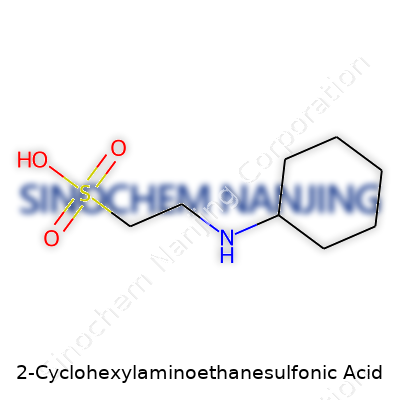
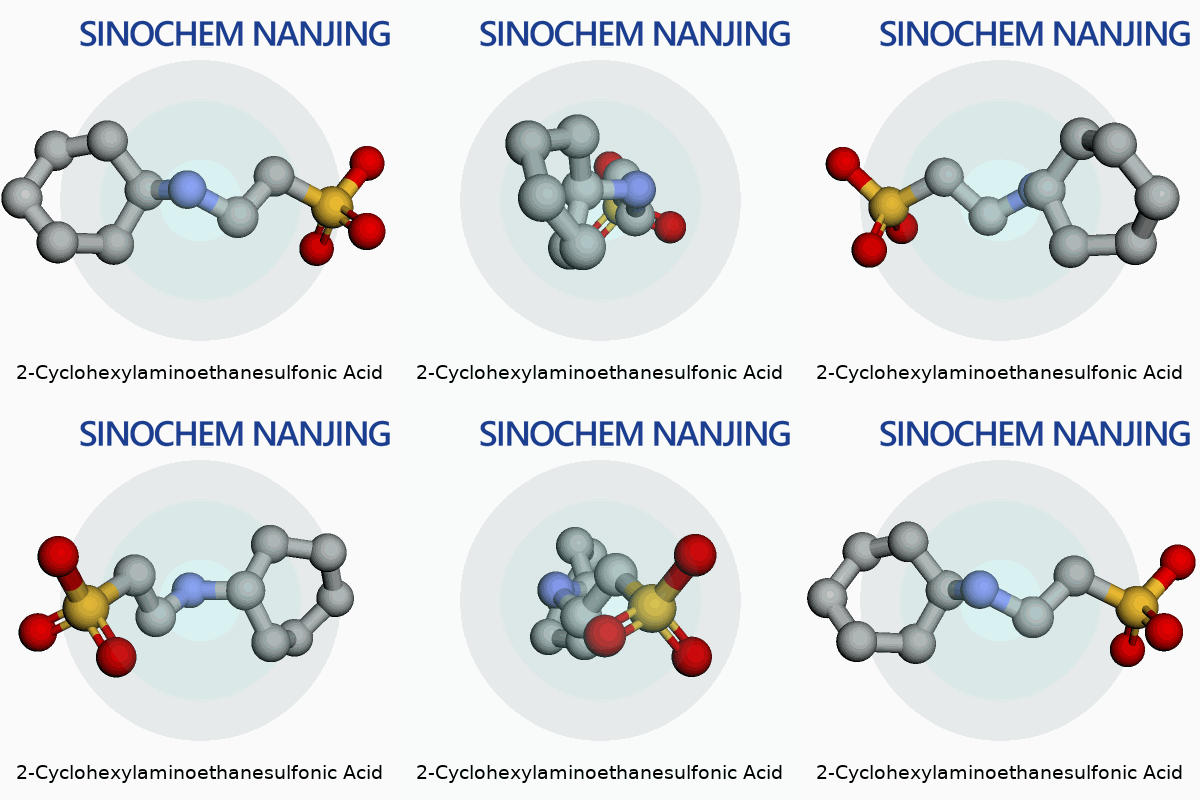
| Names | |
| Preferred IUPAC name | 2-(Cyclohexylamino)ethane-1-sulfonic acid |
| Other names |
2-(Cyclohexylamino)ethanesulfonic acid CHES N-Cyclohexyl-2-aminoethanesulfonic acid |
| Pronunciation | /tuː saɪkloʊˈhɛk.sɪl.əˌmiː.noʊˈɛθ.eɪn.sʌlˌfɒn.ɪk ˈæs.ɪd/ |
| Identifiers | |
| CAS Number | 103404-87-1 |
| 3D model (JSmol) | `3D Model (JSmol) String:` `CC1CCCCC1NCCS(=O)(=O)O` |
| Beilstein Reference | 1712786 |
| ChEBI | CHEBI:39055 |
| ChEMBL | CHEMBL1230608 |
| ChemSpider | 23245 |
| DrugBank | DB04161 |
| ECHA InfoCard | 100.055.898 |
| EC Number | 65142-87-2 |
| Gmelin Reference | 88877 |
| KEGG | C07048 |
| MeSH | D02.092.211.081.150.175 |
| PubChem CID | 22215 |
| RTECS number | GV4375000 |
| UNII | W8YZ47DSVR |
| UN number | Not regulated |
| CompTox Dashboard (EPA) | DTXSID2054098 |
| Properties | |
| Chemical formula | C8H17NO3S |
| Molar mass | 207.29 g/mol |
| Appearance | White crystalline powder |
| Odor | Odorless |
| Density | 1.176 g/cm³ |
| Solubility in water | soluble in water |
| log P | -2.2 |
| Vapor pressure | 0.0000146 mmHg at 25°C |
| Acidity (pKa) | 9.9 |
| Basicity (pKb) | 1.94 |
| Magnetic susceptibility (χ) | -77.5·10⁻⁶ cm³/mol |
| Refractive index (nD) | 1.527 |
| Dipole moment | 4.04 D |
| Thermochemistry | |
| Std molar entropy (S⦵298) | 338.6 J·mol⁻¹·K⁻¹ |
| Std enthalpy of formation (ΔfH⦵298) | -577.8 kJ/mol |
| Std enthalpy of combustion (ΔcH⦵298) | -373.7 kJ/mol |
| Pharmacology | |
| ATC code | V03AX27 |
| Hazards | |
| Main hazards | Causes serious eye irritation. |
| GHS labelling | GHS05, GHS07 |
| Pictograms | GHS07 |
| Signal word | Warning |
| Hazard statements | H315, H319, H335 |
| Precautionary statements | Precautionary statements: P261, P264, P271, P280, P302+P352, P304+P340, P312, P305+P351+P338, P337+P313 |
| NFPA 704 (fire diamond) | 1-1-0 |
| Flash point | 261.6 °C |
| Lethal dose or concentration | LD50 Oral Rat 3160 mg/kg |
| LD50 (median dose) | LD50 (median dose): > 1000 mg/kg (Rat, oral) |
| NIOSH | NA9426000 |
| PEL (Permissible) | Not established |
| REL (Recommended) | 50 mg/m³ |
| Related compounds | |
| Related compounds |
Ethanolamine MES CHES HEPES CAPS |



