2-Bromochlorobenzene: A Commentary on Its Development, Use, and Future
Historical Development
Back in the early decades of the twentieth century, the world of organic chemistry charged ahead with a determined curiosity. Benzene derivatives quickly became the centerpiece in both lab benches and industrial synthesis. One compound that emerged from this burst of chemical innovation is 2-bromochlorobenzene. Originally, its preparation aimed to meet the ever-growing need for halogenated intermediates. Chemists, working by trial and error, learned that the addition of both bromine and chlorine atoms on a benzene ring gave rise to a novel substrate with unique reactivity. Those years saw small refineries and academic researchers flock to these compounds not only for their own usefulness but also for their role in illuminating reaction mechanisms. The birth of 2-bromochlorobenzene paralleled the explosive demand for more versatile building blocks in the age of synthetic dyes, pharmaceuticals, and pesticides. What began as a simple curiosity in modifying benzene set the stage for a compound that would later find itself woven into worldwide industrial and research processes.
Product Overview
2-Bromochlorobenzene stands out among halobenzenes for its versatility and chemical resilience. It positions one chlorine and one bromine side by side on a benzene ring, a layout that adds specific reactivity and influences how it interacts with other chemicals. As someone who has spent time in organic synthesis labs, I have seen that this compound isn’t chosen at random. It works as a reliable intermediate and its roles extend far beyond preparation—showing up in drug design, development of agrochemicals, and even in some advanced materials research. The chemical enjoys a certain popularity because it brings halogen functionality into complex molecules, paving the way for new linkages and transformations that might otherwise face more hurdles.
Physical & Chemical Properties
On the benchtop, 2-bromochlorobenzene appears as a clear to pale yellow liquid. The impressive thing isn’t so much its color or viscosity, but its distinct aromatic odor and its persistence under a surprisingly broad range of temperatures. It boils somewhere around 220–225°C, and the melting point isn’t especially noteworthy—many chemists don’t even see its solid phase unless they work under chilly conditions. Chemically, this compound reacts as a typical halobenzene, but the combination of a bromine and a chlorine makes the ring more susceptible to certain metalation reactions or coupled processes. Solubility isn’t glamorous, yet the compound dissolves decently in organic solvents such as ether, toluene, and chloroform. Its volatility means fume hoods get used every time someone opens a bottle, which echoes the respect the industry gives to any halogenated aromatic.
Technical Specifications & Labeling
In practical settings, clear, precise labeling marks each container of 2-bromochlorobenzene. Laboratories demand purity levels above 98%. Any contamination from other isomers alters its behavior in planned syntheses and brings in unwanted complexity. Product bottles note storage away from sunlight and sources of ignition – it is both flammable and sensitive in the presence of some metals. Standard technical sheets describe their content in mass percent, preferred storage temperatures, and relevant hazard warnings. Ensuring these details remain up to date forms part of basic laboratory safety, but also stands as a sign of the compound's accepted place in chemical supply chains.
Preparation Method
In early research, 2-bromochlorobenzene was often prepared from chlorobenzene by direct bromination, using iron or other catalysts to drive selective substitution. Later, advances in synthetic methods led to more reliable routes. Sandmeyer reactions and other transition metal-catalyzed protocols increased the yields and helped avoid mixtures of isomers. Industrial reactions favor continuous flow methods now, pairing tight process controls with real-time monitoring. This evolution highlights not just the ingenuity of chemists, but also the push for safer and more sustainable production as environmental and occupational regulations have caught up to the realities of halogenated aromatic compounds.
Chemical Reactions & Modifications
2-Bromochlorobenzene always finds a place in cross-coupling experiments. Both halogens allow chemists to play with selectivity, using palladium or copper catalysts to swap out those atoms for other groups. Suzuki, Sonogashira, and Heck couplings all make good use of the bromine, leaving the chlorine atom for further transformations. In the right hands, one molecule of this compound seeds a cascade of modifications: nucleophilic substitutions, Grignard formations, or even oxidative reactions. The ability to tailor the ring for pharmaceutical or materials science applications starts with mastering these interactions.
Synonyms & Product Names
In catalogs and research papers, 2-bromochlorobenzene sometimes goes by names like o-bromochlorobenzene or 1-bromo-2-chlorobenzene. Each name refers back to the same core chemical, but the variety in nomenclature can catch newcomers off guard. Most chemists rely on CAS numbers to avoid confusion altogether. No matter the synonym chosen, each points to a molecule whose legacy in synthetic chemistry stands unchallenged.
Safety & Operational Standards
Long experience shows that halogenated benzenes, including this one, demand careful handling. Their volatility and toxicity keep researchers alert in the lab. Eye and respiratory irritation crop up quickly if fume hoods aren’t used, and spills call for immediate containment. Chemical hygiene plans drive the training required before someone gets to open a bottle. One can’t overstate how important it is for anyone working with these compounds to have access to robust safety protocols and emergency eyewash stations. Glove choice and careful planning go a long way toward minimizing risk—chlorinated and brominated aromatics can linger on surfaces if not cleaned up efficiently. Regulatory bodies keep pushing for lower exposure limits in both R&D and industrial venues.
Application Area
The utility of 2-bromochlorobenzene stretches across fields. In pharmaceuticals, chemists use it as a launching pad for creating heterocycles or installing custom side chains. Agrochemical researchers find similar value, slotting this molecule in as a stepping stone toward novel fungicides or herbicides. It also takes its place in the world of materials science, where researchers incorporate halogenated rings into polymers for advanced electronics or optical applications. It doesn’t work in isolation—collaboration with analytical chemists, toxicologists, and engineers enables further integration into finished products. Each step taken in the lab opens new options for downstream manufacturing.
Research & Development
Innovation with 2-bromochlorobenzene keeps pace with changing scientific priorities. As green chemistry principles gain traction, research teams invest in catalytic systems that lower energy use and avoid hazardous waste. Automating certain reaction steps finds a balance between throughput and safety. Process intensification, once a buzzword, now shapes how manufacturers look at scaling up the compound’s production. Data from academic studies inform industrial practices, creating a feedback loop that pushes both fields further. Some of the most intriguing research explores selective activation of either the bromine or chlorine atom, letting chemists build increasingly complex molecules from a straightforward starting point.
Toxicity Research
Decades of use have prompted rigorous examination of 2-bromochlorobenzene’s health effects. Animal studies demonstrate that exposure over prolonged periods can impact liver and kidney function, typical of many aromatic halides. Inhalation brings on headaches, dizziness, or respiratory irritation pretty fast, which underlines the need for proper exhaust and monitoring systems. Mutagenicity appears low, based on published work, but environmental persistence remains a real concern—improper disposal allows these molecules to stick around in soils and water longer than many aliphatic analogues. Regulators now look for ways to limit emissions and encourage responsible stewardship at every point from synthesis to disposal.
Future Prospects
The journey of 2-bromochlorobenzene reveals a landscape where classic chemistry meets new demands. Political and social pressure on chemical manufacturers brings cleaner technologies and stricter safety rules. Research groups continue to unlock more selective transformations, often with cheaper or less toxic catalysts. Digital chemistry, including predictive modeling, finds fresh routes to halogen-substituted benzenes and tests them before anyone pours a single reagent. The future likely belongs to those who harness the compound’s twin reactivity while finding better ways to protect people and the environment. The next generation of chemists and engineers inherit a legacy of curiosity and practical innovation—a lesson that keeps the legacy of 2-bromochlorobenzene both relevant and inspiring.
What are the primary uses of 2-Bromochlorobenzene?
What Makes 2-Bromochlorobenzene Useful?
2-Bromochlorobenzene shows up in the lab almost as reliably as coffee. Chemists reach for it because it brings together two halogens—bromine and chlorine—linked to a benzene ring. That combination opens doors in the world of organic chemistry. The real value of this compound shows up in how easy it is to trade those halogens for something more interesting or useful. It acts as a launchpad for building bigger, more complex molecules.
Building Blocks for Pharmaceuticals
Drug discovery relies on developing fresh molecules that target diseases in new ways. 2-Bromochlorobenzene steps into this world as a trusted starting point. Researchers use its unique structure to build intermediates for cancer drugs, antipsychotics, and some painkillers. The presence of bromine and chlorine lets scientists selectively tweak the core, fine-tuning a medicine’s activity or cutting down on unwanted side effects. Every tweak means a chance for a safer, more effective drug.
A Mainstay in Agrochemical Synthesis
Farmers count on pesticides and herbicides to keep fields healthy and productive. Getting those molecules right means leaning heavily on intermediates like 2-Bromochlorobenzene. Its use ramps up the efficiency and reduces the byproducts during synthesis. By making chemical reactions more selective, it cuts waste and boosts yields. That matters to the environment and to the farmer’s wallet. When the base chemicals work better, the products become more affordable and accessible.
Dyes, Pigments, and Advanced Materials
Not all innovation ends up in a pill or on a crop. The textile and plastics industries need stable dyes and sturdy polymers. Here, 2-Bromochlorobenzene's structure gives designers the backbone they want for vibrant, fade-resistant colorants. In electronics, its role pops up in materials that handle heat and electricity well. The chance to create custom compounds starts by replacing bromine or chlorine with pieces that make a molecule fit the job—maybe longer-lasting plastics or more reliable circuit boards.
What About Safety and Sustainability?
Just because chemists can use something doesn't mean they always should. 2-Bromochlorobenzene, like many halogenated chemicals, demands care. It’s not the kind of stuff you leave out on the bench or pour down the drain. Safe handling means gloves, ventilation, and proper disposal. In my experience, companies that train their chemists and invest in safe waste management don’t just protect their workers—they also stay compliant and avoid ugly surprises from regulators.
Pushing for Greener Chemistry
These days, nobody wants chemicals lingering in the air or water. Researchers keep exploring ways to use 2-Bromochlorobenzene more efficiently or swap it in processes with lower waste. Catalysts and milder conditions can help. Sometimes, companies invest in closed-loop systems to capture byproducts. The goal stays the same: make essential products while reducing risks and waste. Society can’t give up on vital pharmaceuticals or crop protection, so the pressure remains to tighten up every step.
Moving Forward
Looking at all the ways 2-Bromochlorobenzene supports new discoveries, it’s clear that practical chemistry relies on trusted building blocks. Putting science into practice means working on safety, efficiency, and finding paths to cleaner manufacturing. Anyone in the field knows that chemistry, at its best, keeps improving the world while respecting both people and the planet.
What is the molecular formula and molar mass of 2-Bromochlorobenzene?
Diving Into the Details
Learning about organic molecules like 2-Bromochlorobenzene connects real chemical properties to everyday science. We see halogenated benzenes everywhere—in labs, pharmaceutical design, even in the coatings of some electronics. The backbone is a benzene ring, sporting one bromine and one chlorine atom. Throwing molecular formulas and molar mass into the mix helps researchers and students understand not only what’s in the material but also how to handle it.
An Atom-by-Atom Breakdown
2-Bromochlorobenzene follows a simple naming pattern. The benzene ring brings six carbons (C) and six hydrogens (H). One hydrogen gets swapped for a bromine (Br), and another for a chlorine (Cl). Drawing the structure in the classroom takes me back to my first organic chemistry lab—every bond and atom counted, each substitution changing properties.
The formula comes out as C6H4BrCl. Every atom has a story. Carbon forms the ring, hydrogen dots the remaining spots, bromine and chlorine change how the molecule interacts with its environment. I’ve held vials of this clear liquid, and just knowing the atomic count helps predict reactions and safety measures.
Crunching Numbers: Molar Mass Calculation
Calculating molar mass involves looking up each element’s average atomic weight on the periodic table. Here’s how it stacks up:
- Six carbons: 12.01 g/mol x 6 = 72.06 g/mol
- Four hydrogens: 1.008 g/mol x 4 = 4.032 g/mol
- One bromine: 79.90 g/mol
- One chlorine: 35.45 g/mol
Total those figures, and you get 191.44 g/mol. Every chemistry student in my classes has gone through the calculator routine—double-checking, sometimes forgetting to carry a decimal, but always ending up with that answer. This isn’t just academic practice; manufacturers and lab techs use it for dosing, formulation, even for inventory controls.
Why Structure and Mass Matter
Molecular structure and weight affect everything from how easily a substance dissolves, to how it travels in the environment. For 2-Bromochlorobenzene, the weight means it vaporizes less readily than plain benzene. Shift a halogen’s position or swap out bromine for iodine, and suddenly, physical behaviors change. This small difference can change toxicity, safety protocols, even legal classifications.
Understanding molecular calculations also protects people; incorrect records or formulas in a lab can spell trouble. I’ve seen glassware corrode from wrong storage decisions, all because an intern didn’t double-check the molecular makeup.
Making Chemistry Safer and Smarter
Solving issues in chemical safety and supply starts with education and good records. Labs should keep clear material safety sheets, updated with accurate molecular details. Schools can help future scientists by demystifying formula and mass calculations in hands-on sessions, connecting each number to real-world impact.
Switching to digital inventory systems with built-in formula calculators can ease slip-ups. Factories benefit by automating these molecular checks before mixing ingredients—a little programming up front can prevent hazardous mistakes later. My colleagues who track these steps closely report fewer incidents and better compliance audits every year.
Practical Takeaways for Chemistry Fans
Knowing the ins and outs of molecules like 2-Bromochlorobenzene pays off, whether working in a research setting, teaching a high school lab, or reading the fine print on a reagent label. Understanding what goes into calculating molar mass and formula sets the groundwork for safe, smart science. Simple diligence goes a long way in making both the classroom and the workplace a safer spot for chemical discovery.
How should 2-Bromochlorobenzene be stored and handled safely?
Why the Way We Store Chemicals Matters
Walk into any chemistry lab or industrial workshop, and someone will tell you about a time an accident happened. Most of the time, these accidents come from ignoring small steps—like putting the right cap back on a bottle or not bothering to label a flask. I remember my first lab job, where a small leak in storage went unnoticed until the smell got strong enough to make folks leave the room. All it took was careless storage. With 2-Bromochlorobenzene, mistakes add up quickly since it’s not something you want on your skin, in your eyes, or anywhere near an open flame.
Getting the Basics Right: Storage Conditions You Can Trust
Storing 2-Bromochlorobenzene isn’t difficult if you follow simple habits. Find a cool, dry, and well-ventilated spot. Humidity and heat help chemicals degrade, and fumes become a problem in closed spaces. I read a recent case out of a university where a storage room without air movement allowed fumes to build, sending people to the nurse complaining of headaches. A locked, ventilated cabinet away from direct sunlight keeps surprises to a minimum.
Using glass containers with tight-fitting, chemical-resistant lids works best. Plastics often break down when locked in with some solvents, and metal containers can corrode. Labels should be clear and permanent, listing the substance and the date opened. It sounds obvious, but more than once I have found people trying to guess what’s inside a bottle because someone skipped the label.
Personal Protective Equipment: A Non-Negotiable Habit
You pick up good habits by paying attention to folks who know what they’re doing. If you use 2-Bromochlorobenzene, never skip the gloves made for chemical work, safety goggles, and, if the smell lingers, a mask designed for organic vapors. A cotton lab coat blocks splashes, but long sleeves and an apron give even more coverage. Don’t leave your coffee or snacks nearby; toxic dust and liquids have ended up in someone’s drink more times than anyone will admit.
Good Chemistry Means Clean Work
Spill control matters as much as storage. I once watched a colleague use paper towels for a moderate spill—bad idea. Use absorbent pads and neutralizing agents rated for halogenated organics. Dispose of everything in sealable hazardous waste containers, not regular garbage. Wash up with soap and warm water after handling, and always take off protective gear before touching anything else in the lab.
Dealing With Exposure and Emergencies
People sometimes freeze up in emergencies. If 2-Bromochlorobenzene hits the skin, plenty of water and gentle soap will do the job. If it gets in the eyes, keep them under running water while someone fetches medical help. If inhaled, get into fresh air and call a professional. Having a written protocol that everyone understands means panic stays low and response times quicken.
Building a Culture of Safety for the Long Haul
Shortcuts around chemicals always catch up with you eventually. Consistent training, well-stocked safety cabinets, and the confidence to speak up about what feels unsafe make a difference every single day. With 2-Bromochlorobenzene and chemicals like it, clear habits are your best protection. If you treat every container with respect and keep your workspace clean, it protects everyone: the new hire, the seasoned chemist, and anyone else who steps through the door.
What are the hazards and necessary precautions associated with 2-Bromochlorobenzene?
Understanding the Risks
Anyone who’s spent time in a chemical lab knows some compounds just feel trickier. 2-Bromochlorobenzene fits that bill. It looks clear and almost harmless, but don’t trust appearances. People need to know—this stuff can cause problems both short and long term for those who don’t respect it.
2-Bromochlorobenzene gives off fumes that irritate the eyes and lungs. Even a brief whiff can leave your nose burning and eyes watery. Prolonged skin contact sometimes causes rashes. Some workers have reported headaches and nausea after an accidental splash or spill. In my early days working with aromatic halides, mistakes during transfer meant a trip to the eyewash station more than once. I saw how even careful people can get exposed.
The real worry comes from repeat or careless handling. Research continues into benzene derivatives and links to things like organ damage if inhaled or absorbed over weeks or months. Safety data shows this molecule doesn’t explode from heat, but it’s still combustible. That means basic lab fires become much riskier with flammable organics around. For anyone who’s ever watched a bench-top experiment flare up, it changes how you treat chemical containers—closed caps, away from ignition, always labeled.
Simple, Real-World Precautions
If you ask lab veterans, they’ll tell you: gloves, goggles, and coats aren’t just for decoration. Nitrile gloves stand up to most halogenated aromatics, and splash goggles should be a habit, not a formality. I keep chemical-resistant aprons for larger transfers because, once spilled, these liquids find their way right onto your clothes and skin. Even colleagues in synthetic labs—folks who’ve done this for years—still double-check their protective gear before cracking open a bottle.
Decent ventilation matters a lot. Even with good fume hoods, I’ve seen supervisors run air monitors after big experiments. Cells or weigh boats left out after use mean the vapor levels go up, especially on warm afternoons or in small rooms. Door seals, working exhaust fans, and air flow checks save headaches—literally and figuratively. If you ever walk into a room that smells off, assume something got out and clear the air before you linger.
Labeling and secure storage aren’t just rules to follow—they keep everyone in the loop. More than one shop has locked cabinets labeled for halogenated solvents, so chemicals like 2-Bromochlorobenzene don’t get mixed up with acids or bases. I once found a student about to pour waste into the wrong jug, just because the labels had worn off. Clear labels and separate bins prevent trouble down the line. Used wipes, gloves, and empty bottles go in the right drum, not the regular trash, since halogenated waste costs more to dispose of and needs a special process.
Training and Shared Responsibility
Most incidents I’ve heard about came down to people skipping steps or rushing. Training matters—learning the signs of exposure or knowing exactly how to use a spill kit avoids panic during an emergency. Real-world practice beats reading any manual. The best labs I’ve worked in hold quick refreshers regularly. Universities and companies bring in health officers to check storage and keep everyone sharp. Recordkeeping and incident logs help spot patterns, so small mistakes don’t become big ones.
In the end, safety with 2-Bromochlorobenzene isn’t overly complicated, but it requires consistency and watching out for your team. Seeing hazards early, using tools wisely, and keeping information open means fewer trips to the ER and more successful experiments.
Is 2-Bromochlorobenzene available in different purities or grades?
Looking Beyond the Chemical Name
2-Bromochlorobenzene sounds like something out of a high school chemistry lab, but for people in pharmaceutical research or organic synthesis, it's everyday language. This compound, built from a benzene ring with bromine and chlorine atoms attached, finds its way into labs working on new drugs, dyes, or specialty materials. Behind the glass bottles, though, is a quiet, crucial question—how pure is the stuff you’re using?
Why Purity Makes a Real Difference
Anyone who’s run experiments or produced chemicals for a living knows that impurities like to cause trouble. Just a percent or two of the wrong elements can throw off results or ruin whole batches. Purity becomes more than a number on the label; it’s the difference between solid results and wasted time. In fields like pharma or electronics, inconsistent purity means guessing instead of knowing—never a good spot to be in.
Manufacturers don’t just send out one standard version of 2-bromochlorobenzene. Labs might order “technical grade” to do proof-of-concept runs, where cost matters but a little impurity won’t wreck the work. For drugs or microchips, researchers ask for “analytical grade” or “high-purity” materials, where every decimal point counts. Analytical grade can clock in at 99% or higher, so there’s less risk of stray reactions or ghost peaks on fancy instruments.
The Supply Chain Juggle
Quality control teams at chemical suppliers have a tough job—they need raw materials that meet tough specs time after time. Getting that just-right purity doesn’t happen by luck. It takes repeated rounds of distillation, recrystallization, or chromatography to peel away traces of other halogenated benzenes or odd byproducts. Anybody who’s spent hours purifying samples knows this can add real cost and time, but skipping it can cost even more.
Labs running spectroscopy checks or chromatographic tests can spot the weakest spots in a batch of chemicals. One off-brand bottle mixed into the process, and the error shows up on expensive equipment. Several recalls and safety issues in the news trace back to exactly this—chemicals that didn’t get cleaned up enough before they were shipped out.
The Human Factor
Regulations don't just materialize from nowhere—they often start with scientists who run into a problem with fuzzball chemicals and decide that no one should cut corners again. In my own experience working on reaction development, batches labeled “97%” purity sometimes acted great, but then the yield dropped out of nowhere. We’d trace it back to a contaminant that slipped in during careless storage or a weak purification step. Nothing wastes lab hours like remaking a batch because you trusted a label instead of checking for yourself.
Finding Smarter Solutions
Open communication between chemical suppliers and researchers is the best route forward. A purchasing agent can insist on certificates of analysis for every lot, and analysts in the lab can back it up with their own checks. Auditing suppliers, buying small test samples before bulk orders, and building strong relationships help keep standards high. Some labs invest in their own purification gear to add another layer of insurance.
Bringing pure 2-bromochlorobenzene to the world isn’t just about fancy equipment or deep pockets; it’s about people not taking shortcuts and building trust batch after batch. That’s what raises science above just mixing stuff in bottles.
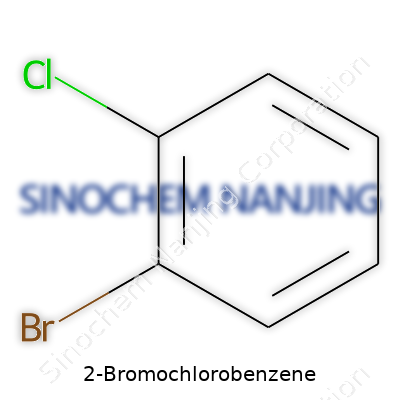
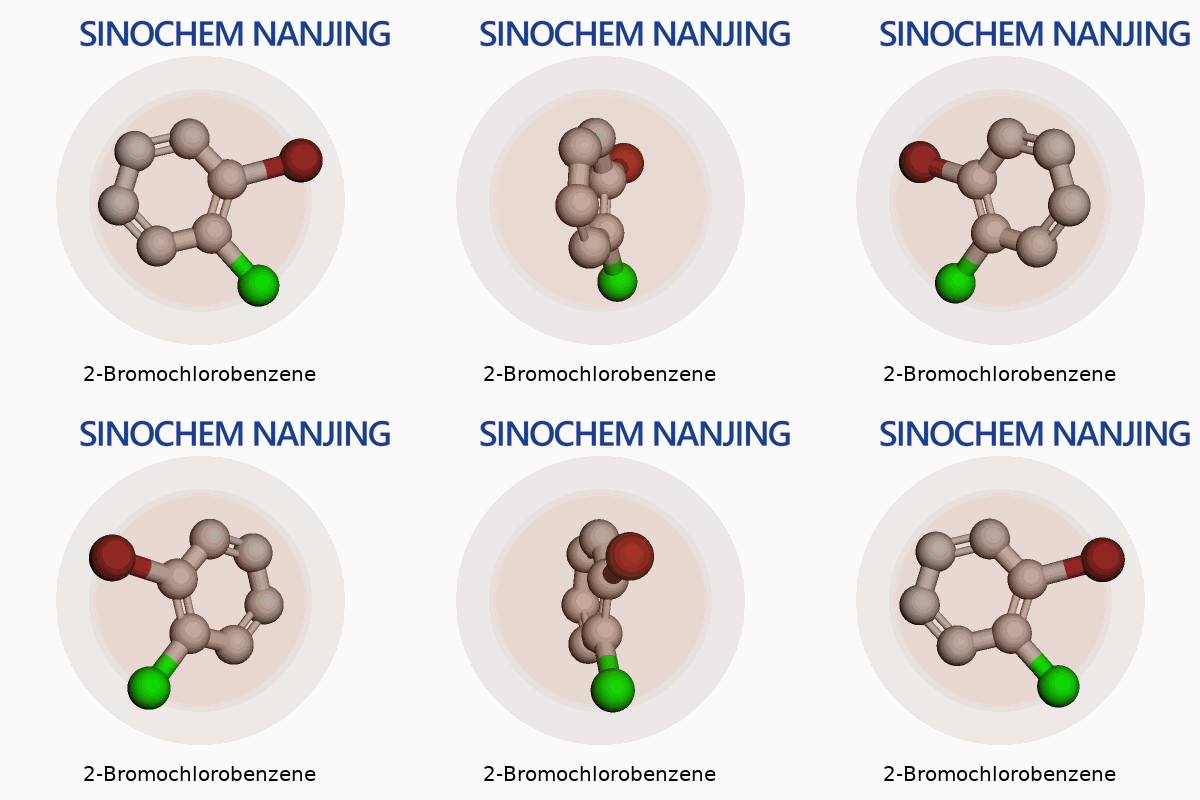
| Names | |
| Preferred IUPAC name | 1-Bromo-2-chlorobenzene |
| Other names |
1-Bromo-2-chlorobenzene o-Bromochlorobenzene 2-Chlorobromobenzene |
| Pronunciation | /tuː ˌbroʊmoʊˌklɔːroʊˈbɛnziːn/ |
| Identifiers | |
| CAS Number | 615-60-1 |
| 3D model (JSmol) | `/propan-2-ol-3d-model.jmol` |
| Beilstein Reference | 1209223 |
| ChEBI | CHEBI:36685 |
| ChEMBL | CHEMBL21718 |
| ChemSpider | 157463 |
| DrugBank | DB03270 |
| ECHA InfoCard | ECHA InfoCard: 100.011.734 |
| EC Number | 39489-77-5 |
| Gmelin Reference | 7777 |
| KEGG | C19271 |
| MeSH | D017929 |
| PubChem CID | 69792 |
| RTECS number | CY8575000 |
| UNII | K6YRM3OE5A |
| UN number | UN2512 |
| CompTox Dashboard (EPA) | DTXSID4043084 |
| Properties | |
| Chemical formula | C6H4BrCl |
| Molar mass | 206.45 g/mol |
| Appearance | Colorless to pale yellow liquid |
| Odor | Aromatic odor |
| Density | 1.5 g/mL |
| Solubility in water | Insoluble |
| log P | 3.9 |
| Vapor pressure | 1 mmHg (at 63°C) |
| Acidity (pKa) | NA |
| Magnetic susceptibility (χ) | -78.9×10⁻⁶ cm³/mol |
| Refractive index (nD) | 1.562 |
| Viscosity | 1.268 cP (20°C) |
| Dipole moment | 2.60 D |
| Thermochemistry | |
| Std molar entropy (S⦵298) | 211.9 J·mol⁻¹·K⁻¹ |
| Std enthalpy of formation (ΔfH⦵298) | 84.5 kJ·mol⁻¹ |
| Std enthalpy of combustion (ΔcH⦵298) | -3632.8 kJ/mol |
| Pharmacology | |
| ATC code | '' |
| Hazards | |
| GHS labelling | GHS02, GHS07 |
| Pictograms | GHS07 |
| Signal word | Warning |
| Hazard statements | H302, H315, H319, H332 |
| Precautionary statements | P261, P264, P271, P273, P301+P312, P305+P351+P338, P337+P313, P403+P233, P501 |
| NFPA 704 (fire diamond) | 1-2-0 |
| Flash point | 62 °C |
| Autoignition temperature | 565 °C |
| Lethal dose or concentration | LD50 oral rat 2700 mg/kg |
| LD50 (median dose) | LD50 (median dose): 6800 mg/kg (oral, rat) |
| NIOSH | CN8575000 |
| PEL (Permissible) | Not established |
| REL (Recommended) | 0.5 ppm |
| Related compounds | |
| Related compounds |
Chlorobenzene Bromobenzene 1,2-Dichlorobenzene 1,3-Dibromobenzene 2-Iodochlorobenzene 2-Bromotoluene |



