1-Pentene: More Than Just a Simple Olefin
Historical Development
Long before talk of green chemistry and alternative fuels, chemists poked and prodded at hydrocarbons to see what could be built from them. 1-Pentene popped up early in the story of organic chemistry, recognized by its pungent smell and knack for reacting with just about anything carrying an affinity for double bonds. As petrochemical infrastructure took shape in the 20th century, 1-pentene moved from curiosity in the flask to a mainstay in plants churning out high-value intermediates. I’ve come across old texts that marvel at how distillation and catalytic cracking produced these linear alpha-olefins, quietly highlighting 1-pentene’s place in an industrial wave that fused chemistry with commodity production. The pathway from side-product to strategic feedstock really exemplifies how industry adapts as new uses and separation technologies arise.
Product Overview
At its core, 1-pentene belongs to the family of alkenes that carry a double bond at the first carbon in a straight, five-carbon chain. Workers in polymer plants and chemical labs know it as a clear, volatile liquid, carrying a characteristic gasoline-like odor. Production often relies on cracking of longer hydrocarbons from crude oil or through selective oligomerization of ethylene, with the ratio of linear alpha-olefins carefully managed by catalyst choice and reaction conditions. This single compound sits at the start line for entire product families that reach into adhesives, resins, and specialty chemicals.
Physical & Chemical Properties
1-Pentene usually shows up as a colorless liquid, boiling at about 30 °C, though high vapor pressure and its tendency to form explosive mixtures with air means folks in production or labs pay it extra respect. Its structure provides a reactive double bond, making it more flexible for chemical transformations than its saturated siblings like pentane. With a specific gravity a little less than water and a flash point well below room temperature, handling this compound pushes safety high on the list, as even a small spill or leak can create real risks. Its main appeal in synthesis comes from that terminal alkene group, which reacts with acids, halogens, and even gentle oxidizing agents to build more complex molecules.
Technical Specifications & Labeling
Labels for chemicals such as 1-pentene need to do more than just identify what's inside the drum—they must lay out the hazards in plain language. Labels reference key identifiers like CAS number 109-67-1 and signal the dangers tied to flammability and health: inhalation hazard, skin and eye irritation, and risk of fire. Regulations push for standardized pictograms and clear-cut hazard statements, so anyone cracking open a new container isn’t left guessing about what’s inside. Specifications for industrial buyers expect purity ranging from 96% to 99%, though traces of cis- and trans-2-pentene or heavier alkenes can show up depending on the source. In some applications, the color, peroxide content, and water level all play into final acceptability, especially when downstream processes require tight control over impurities.
Preparation Method
Most commercial 1-pentene comes out of petrochemical complexes through the cracking of naphtha or gas oils, where careful temperature and pressure management tilt yields toward alpha-olefins. Selective oligomerization of ethylene is another big route, especially with advanced catalysts that steer the process toward forming five-carbon chains with the double bond at just the right end. Bench chemists sometimes dehydrate alcohols such as 1-pentanol over acid catalysts, though that’s rarely practical for scale. As the world scrutinizes crude oil dependency, there’s growing talk about producing alpha-olefins, including 1-pentene, from renewable feedstocks. Experiments in catalytic deoxygenation of plant-derived alcohols hint at a greener version down the line, but so far the real action still comes from the energy-intensive, fossil-based methods.
Chemical Reactions & Modifications
What gives 1-pentene its punch is that double bond. It acts as a handle for building new chemical architectures. Addition reactions, especially with hydrogen or halogens, convert it easily into pentanes, halopentenes, or epoxides. In polymer chemistry, it serves as a co-monomer for tailoring properties of plastics like linear low-density polyethylene. Ozonolysis splits it into aldehydes, which feed into flavorings or specialty molecules. It’s hard not to admire the way 1-pentene fits into so many transformations: hydroformylation, alkylation, even free radical processes—all open up with this molecule as a starting point. With a number of emerging catalysts, regio- and stereoselectivity in these reactions can be finely tuned, building more precise molecules for pharmaceuticals or advanced materials.
Synonyms & Product Names
Names for 1-pentene shift with context: n-pentene, alpha-pentene, and amylene all point to the same chemical. Researchers and regulatory bodies usually stick to 1-pentene or n-pentene to avoid confusion with its branched isomers. In older chemical catalogs or safety documents, don’t be surprised to see references to amylene—although that term broadly covers several five-carbon alkenes. This highlights why attention to nomenclature matters, as mix-ups in an order or safety review can have consequences when handling liquids with such high volatility and reactivity.
Safety & Operational Standards
Bringing 1-pentene into a plant or lab means putting fire safety, ventilation, and proper training at the top of the checklist. Its vapors catch fire quickly, sometimes explosively, if they collect in poorly vented spaces. Strict grounding and bonding of equipment reduce static discharge risk, while chemical-resistant gloves and goggles keep the compound off skin and out of eyes. Storage away from oxidizers and in flame-proof areas tackles the most common mishaps before they start. Regulatory bodies set occupational exposure limits and require regular monitoring for leaks or air contamination; these rules come from real-world experience where accidents have cost lives or shut down operations. Even with controls, emergency showers and eye washes are non-negotiable in areas that handle bulk quantities, and procedures for spills or exposures remain front of mind for anyone working near this chemical.
Application Area
1-Pentene rarely ends up as a product on its own—it’s a builder for other chemicals. Polymer makers blend it into the recipe for plastics with well-defined properties, such as those used in flexible films for food and medical use. Lubricant and surfactant manufacturers prize its ability to modify chain length and functional group placement. Even the fragrances and flavor sector sees value in oxo-products derived from this alkene. Catalytic transformations starting from 1-pentene lead to intermediates for agrochemicals, specialty fuels, and performance fluids in the automotive industry. Its influence stretches far beyond what one might expect from such a simple structure, with innovation in applications closely tied to each breakthrough in processing and catalysis.
Research & Development
Academic labs and corporate R&D teams circle 1-pentene for good reason. New catalytic approaches seek sharper selectivity and higher yields, especially from greener starting points than fossil feedstocks. Work in homogeneous catalysis, often supported by NMR and high-throughput screening, turns up ligand systems that control not just yield but also which isomer forms. Collaborations between chemical engineers and environmental scientists look at evolving purification techniques, where membrane methods or advanced distillation cut energy use. High-throughput molecular screening for pharmaceutical and agricultural discovery keeps pushing the catalog of derivatives and functionalizations. I’ve talked to researchers frustrated by the stubbornness of traditional processes, prodding at the molecule in search of more sustainable pathways. These conversations echo industry’s long-term need for raw materials that check not just price but also climate and regulatory boxes.
Toxicity Research
Studies on 1-pentene’s toxicity point out the dangers of inhalation and skin or eye contact, with headaches, dizziness, and respiratory irritation showing up even at comparatively low exposure. Chronic effects remain less well mapped in humans, as exposure in the industrial setting centers on short-term contact rather than slow build-up over months or years. Animal studies sometimes flag concerns for nervous system impacts, but thresholds set by regulatory agencies guide safe workplace levels based on what is observed at concentrations much higher than what is likely in air under normal handling. Still, each new research paper adds a piece to the picture, with a real push on understanding metabolic breakdown products and whether any long-term health effects lurk for workers handling the chemical day in and day out.
Future Prospects
Alpha-olefin chemistry sits at a transition point. Renewables, tighter emissions rules, and circular economy ambitions all pressure producers to shift sourcing and processing. The big question for 1-pentene, and similar molecules, centers on how quickly technology can bridge from fossil-based routes to plant or waste-based feedstocks without giving up on the purity and price the market has come to expect. Advances in biocatalysis or electrochemical routes may tip the balance over this next decade, making this classic five-carbon molecule just as relevant in tomorrow’s sustainable industry as it was during the early days of petrochemicals. Emerging markets in specialty polymers, with stricter standards on performance and safety, will demand even greater control over how each molecule is built and used. Amid talk about the future, this small alkene keeps earning its place as both a touchstone and a battleground for chemical innovation.
What is 1-Pentene used for?
Shaping the Modern Chemical World
Ask a person walking down the street about 1-pentene, and you’ll probably get a puzzled look. Still, it’s a name that comes up quietly in a surprising number of products. This little-known molecule pops up behind the scenes in plastic wraps, packaging, car interiors, and shelves filled with bottles. It’s a colorless liquid that, for all its simplicity, pulls weight in some complex and essential industries.
Putting Plastics to Work
Let’s dig into plastics first. Polyethylene reigns in the world of packaging, and 1-pentene acts as a comonomer in its production. This just means it gets mixed in with ethylene to give the resulting plastic some special traits. Grocery bags, wrappers, and bin liners—most of them carry a bit of 1-pentene’s fingerprint. Manufacturers look for better flexibility and strength in these products, and adding 1-pentene often delivers. Ever notice how some packaging stretches without tearing, or keeps food fresh longer? Chemical tweaks like these, made possible by compounds like 1-pentene, make these improvements happen.
A Behind-the-Scenes Master in the Lab
Out in the lab, 1-pentene stands out as an effective building block. Chemists rely on it for synthesizing flavors, fragrances, dyes, and pharmaceutical ingredients. It slots right into reactions, making it valuable for producing more complex molecules that wind up in medicines, cleaning agents, or even perfumes. A product on the pharmacy shelf may have needed 1-pentene somewhere along the line, giving it properties or chemical structures that improve health outcomes for real people.
Fueling Cars and Cleaning Air
Refining gasoline also gives a nod to 1-pentene. Refineries use it in reforming processes to boost octane, letting engines run smoother and burn fuel more thoroughly. This helps engines last longer while squeezing out extra performance, a clear plus for anyone who spends time behind the wheel. Cleaner running fuels often mean less pollution, so a molecule like this can work quietly toward reducing carbon footprints in big cities and crowded highways.
The Hard Truth About Chemicals
Most folks don’t think much about these industrial chemicals until a spill or accident makes headlines. This points to the need for better transparency and strong safety checks—not just in the manufacturing plants, but all the way down the supply chain. Workers need real training and up-to-date protective gear. Companies can invest more in leak detection, air monitoring, and rapid-response drills instead of just ticking off legal boxes.
Researchers keep chipping away at ways to recycle or reuse the waste from 1-pentene and its relatives. Right now, recycling plastics that use it is tough, but no one’s giving up. Increased funding, public-private partnerships, and honest reporting about what works and what doesn’t will help chip away at the mountain of single-use plastics piling up worldwide.
The story of 1-pentene gives a glimpse into the choices baked into everyday life, from safer packaging to efficient engines. By understanding what these molecules do and pushing for responsible management, it’s possible to keep enjoying the good side while cutting down on the risks.
What are the physical and chemical properties of 1-Pentene?
Getting to Know 1-Pentene
1-Pentene is a colorless liquid with a sharp, gasoline-like smell that hangs in the air. Chemically, it carries the formula C5H10 and belongs to the family of alkenes, marked by a double bond between two carbon atoms. That double bond isn't hiding; it sits right at the tip of the chain, giving the molecule a bit of an edge in how it reacts.
Physical Nature Up Close
The boiling point settles near 30–36°C, just a bit above room temperature, so this stuff easily shifts from a liquid to vapor if left in open air. It floats on water, thanks to a density around 0.64 g/cm3. Its solubility in water is low, almost nothing, but it mixes well with most organic solvents like ether and alcohol.
Don't expect it to stick around if you crack open a bottle. As a volatile liquid, 1-pentene evaporates fast. On a hot day, even just handling it can send those fumes right up your nose, which means using it indoors without good air flow quickly becomes a safety risk.
Chemical Tendencies
The double bond running through its backbone gives 1-pentene most of its character. This part of the molecule acts like a magnet for reactions, pulling in other elements or groups eager to break or add onto that bond. That makes 1-pentene a busy player in the chemical world, showing up in polymer synthesis or reactions like addition, oxidation, and halogenation.
Its double bond can grab on to hydrogen in a process called hydrogenation, turning it into pentane, a common fuel additive. Expose it to ozone, and the molecule splits along that bond, which comes in handy for breaking down larger chemical structures. React it with acids, and new groups snap onto the chain, leading to the creation of alcohols or halogenated compounds.
Why Any of This Matters
Every time crude oil gets refined or plastics get made, 1-pentene has its hands in the process. On a personal note, when tinkering with lab setups, even a small whiff reminds me that volatile organics demand respect—gloves, goggles, and plenty of fresh air. The dangers aren't just flammability or headaches. If enough vapor fills up a room, there’s a real risk of fire. At high concentrations, it can irritate eyes, throat, and skin.
Chemists value the molecule’s double bond. That spot lets them build more complicated molecules or start chains for polymerization. Polyethylene made from alkenes like 1-pentene ends up in plastic containers, wire coatings, and even artificial joints. These products land everywhere from recycling bins to hospital operating rooms.
Tackling Risks and Handling
Labs and factories often install spark-proof tools and fine-tuned ventilation to keep accidents off the table. Training workers to spot leaks, use spill kits, and limit exposure remains common sense. Companies turn to sensors and alarms to catch vapors early—because relying on nose power doesn’t cut it.
1-Pentene cannot be poured down a drain or dumped without thought. Spills evaporate and escape into the atmosphere, so collection and recycling, or incineration under controlled conditions, reduce its impact. Regulations make sure companies stick to standards, protecting both people and the local environment.
Worth a Second Look
I’ve watched how small tweaks in a molecule’s structure—like that double bond—open up pathways in industry and science. 1-Pentene looks simple, but its properties carve out a spot in countless products, bringing both opportunities and responsibilities for anyone working with it.
Is 1-Pentene hazardous or toxic?
Understanding 1-Pentene in Everyday Settings
People outside chemical fields often don’t recognize 1-pentene, but it finds its way into manufacturing, plastic production, and sometimes even fuel research. This clear, colorless liquid comes with a faint gasoline-like scent. It carries a small molecule structure—five carbons with a double bond—and tends to get handled mainly by trained workers. Knowing this chemical’s risks matters, especially since it isn’t just locked inside a laboratory. Accidents in transit or storage happen more than many realize.
Health and Environmental Effects
Breathing vapors from 1-pentene at high concentration can cause headaches, dizziness, or nausea. It acts as an irritant, especially in close quarters with poor ventilation. Prolonged skin exposure can pull oils out, leading to dry or cracked skin. Research on this chemical does not point to it being a strong, long-term poison like benzene, but the flashpoint sits low, so vapor escapes at room temperature. In my work supervising factory lines, a few workers came close to passing out when a valve leaked near a tank of hydrocarbon liquids—not just from pentene—but the lesson stuck: any leak in this chemical group deserves respect.
The fire risk stands out as a real concern. 1-pentene catches fire easily, shooting invisible vapor close to the ground. In dry summer weather, a spill can flash into a blaze. Untrained responders sometimes underestimate how far this vapor will travel before igniting. Over the years, I’ve seen media footage where a small drum of similar liquids caught a spark twenty yards away. Calls for better labeling on tanks and storage drums stem from these events.
Regulatory and Scientific Perspective
Scientists and health agencies rank 1-pentene as less toxic in the long term than heavy-duty solvents or compounds like toluene. Federal agencies do not label it as carcinogenic to humans. Animal studies find possible mild liver stress at extreme doses. Safety data sheets require fume hoods and personal protective equipment, a nod to preventing repeated, large exposures.
Regulators make companies track volumes stored on site to lower spill threats. The Environmental Protection Agency tracks chemicals like this because they persist if released, traveling through soil into waterways. Most companies respond by keeping tight lids and using carbon filters in vents. These actions come from lessons learned instead of theory or hope.
Improving Safety in Real Life
Workers on the front line need more than warning labels. Training on how 1-pentene behaves, what to do if a leak starts, and honest reporting of near-misses builds a safer workplace. I recall a safety meeting where a newcomer asked why fumes seemed worse at the door than inside the tank room. Clear communication and walk-throughs matter more than reading a manual alone.
Communities near industrial sites need regular information about what chemicals sit next door, what emergency sirens mean, and how to stay safe if evacuation orders come. These efforts build trust. City leaders who push for regular chemical safety drills and open reporting will see fewer accidents and less panic in the rare event something goes wrong.
1-pentene is no household name, but in the wrong hands or under weak safety measures, it can cause real harm. Keeping sharp focus on fire prevention, training, and transparency stands as the surest way to limit the downside while letting industry get value from this useful, but risky, liquid.
How should 1-Pentene be stored and handled safely?
Understanding What’s at Stake
1-Pentene catches attention in industrial settings because of its role in everything from plastics to specialty chemicals. Many people might never see this colorless liquid, but those who work with it day in and day out know just how important safety becomes. It’s flammable, it evaporates easily, and the vapors can create explosive mixtures with air. That risk doesn’t stay on paper; enough plant accidents and close calls have left experienced workers much more cautious around volatile chemicals like this one.
Keeping Flammables in Their Place
In my experience, storage makes all the difference. 1-Pentene asks for cool, well-ventilated storage away from heat sources and any possible sparks. Even a small static discharge can trigger trouble with this substance. We keep containers grounded and bonded during transfer, using spark-proof tools to cut down on risk.
A lot of folks underestimate how fast vapors spread. It doesn’t take much for fumes to reach a pilot light or worn-out wiring. That’s why sealed metal drums or tightly capped glass bottles offer peace of mind. Store them on spill-proof pallets, not on bare concrete, to limit risk if a container gets knocked over. An annual review of storage areas catches those little changes over time—like blocked vents or shifting inventory—that can quietly shift the odds against you.
Avoiding Common Handling Hazards
Experience teaches respect—always pay attention to your gear. Chemical splash goggles, flame-resistant gloves, and a lab coat or coveralls cut down on the danger from personal exposure. It doesn’t take a huge spill to irritate skin or eyes. We rely on small-scale containment trays and quick-access to eyewash stations. For larger sites, emergency showers and spill sorbents sit right nearby.
One thing I’ve learned: never count on your nose to warn you. 1-Pentene’s smell gets masked by stronger chemicals, or just dulled by tiredness at the end of a shift. Installing air monitors and exhaust hoods takes guesswork out of the picture. Fresh air changes everything, so good ventilation stands as the simplest way to limit vapor buildup—no fancy engineering needed. It’s basic, but it works.
Training: A Lifesaver, Not a Formality
OSHA and the CDC both stress the value of regular hazard communication. Even someone who’s done twenty years in a plant picks up blind spots, so we run annual refresh sessions and real spill drills, not just once at hire. I’ve seen near-misses stick with someone more than any rulebook reading ever could.
Labeling containers right and keeping up-to-date safety data sheets help new folks and old hands make smart decisions. It builds a culture where “double check” isn’t just a slogan—it’s how people watch out for each other. If something doesn’t look right, everyone should feel empowered to hit pause and ask questions.
Disposal and Emergency Readiness
Disposing of leftover 1-Pentene or contaminated tools in the regular trash sits high on the mistake list. Specialized waste bins for flammables and regular pickup through certified contractors offer the only safe path. If an emergency strikes, having fire extinguishers rated for chemical fires and a plan clearly posted—not tucked away in a binder—spells the difference between a scare and a disaster.
People’s lives and the livelihood of a company ride on taking these everyday choices seriously. Safe chemical management doesn’t come from luck or one-size-fits-all rules; it grows from paying attention, keeping your eyes open, and learning from past lessons.
What is the molecular formula and structure of 1-Pentene?
The Nuts and Bolts: Formula and Shape
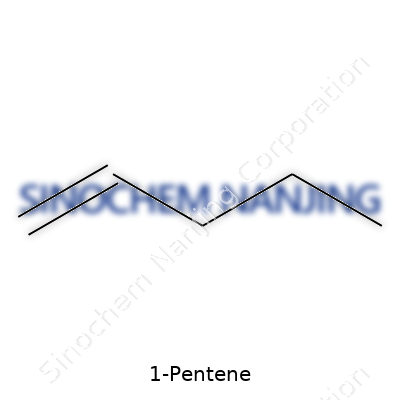
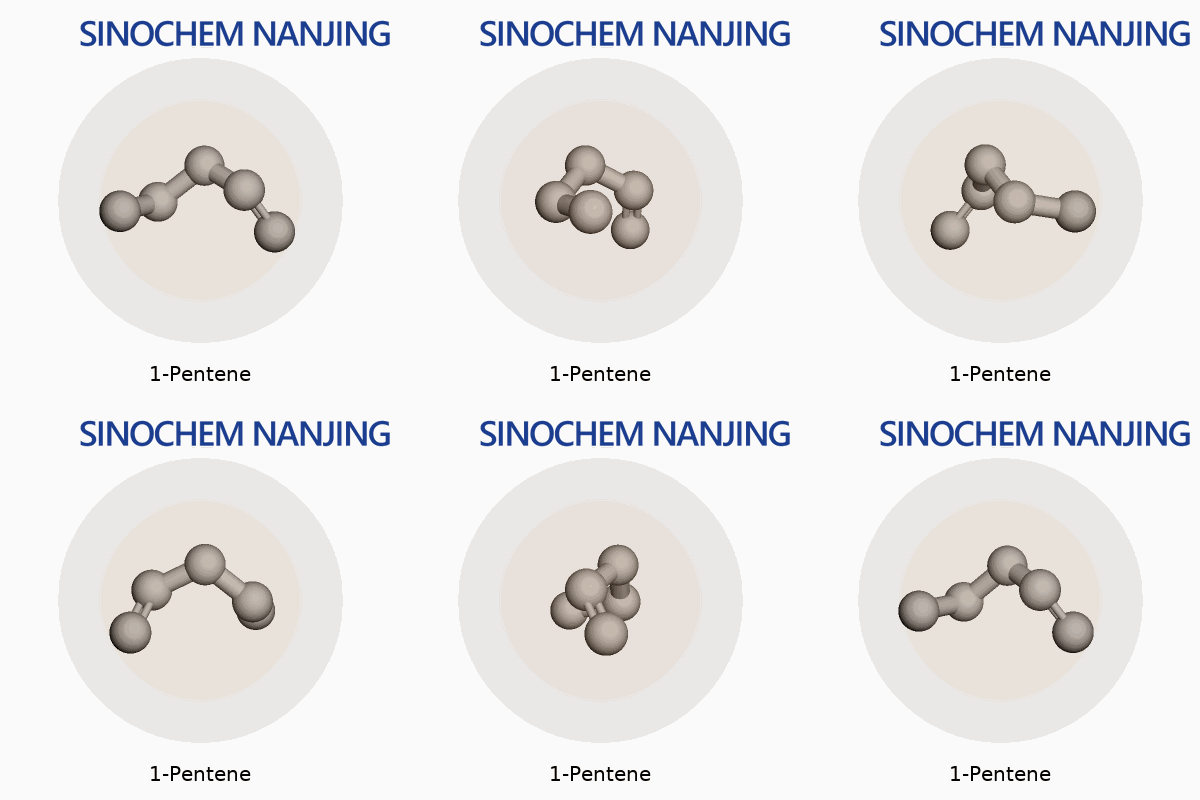
1-Pentene packs five carbons and ten hydrogens. Its molecular formula reads C5H10. What sets it apart from pentane or pentanol is that little double bond between the first and second carbon atoms. Line it out on paper and the structure goes CH2=CH–CH2–CH2–CH3. The double bond grabs your attention; it’s reactive and opens the door to making bigger, more complicated compounds.
The Shape Matters—And So Does That Double Bond
Nothing in chemistry happens for no reason. That double bond at the start of the chain gives 1-Pentene some real attitude. Reactivity jumps up; you can polymerize it, stick on other functional groups, or use it as an intermediate. The molecule stays fairly linear, except for those four extra hydrogens on the end carbon. Unlike its isomers, like 2-pentene, the double bond sits right out front, making it stand out in chemical reactions. Stereochemistry is straightforward, with no chiral centers, so no one’s sorting out mirror images here.
Finding 1-Pentene All Around the World
1-Pentene doesn’t just turn up in a chemistry kit. It’s a product from oil refineries and comes through cracking larger hydrocarbons. Big companies separate it using distillation, based on its boiling point, which lands at around 30 to 36°C. Because it’s not found in nature in large amounts, most of it gets made in the lab or refinery.
Real-World Uses and Why They Matter
Industry treats 1-Pentene as a workhorse. I’ve seen it used as a building block for plastics like polyethylene. Manufacturers also turn out specialty lubricants and surfactants starting with this one molecule. And it kick-starts many synthesis pathways because that double bond grabs other atoms and groups so easily. The double bond also makes it handy for making flavors and fragrances. If a company needs to prop up rubber elasticity or create functionalized lipids, this molecule often gets the call.
Upside and Downside in Handling 1-Pentene
Chemists respect the volatility. It evaporates fast, catches fire with a low spark, and can form peroxides if left in air too long. Nobody pours this down the drain—safe handling means good ventilation, flame-proof gear, and no open sources of ignition nearby. On the bright side, the high reactivity makes it a favorite for research. A single carbon double bond lets chemists model everything from lubrication systems to polymer reactions. Mistakes in storage or poor labeling can create dangerous situations; real lab experience has taught me that routine checks and good ventilation prevent those headaches.
What’s Next for 1-Pentene?
Cleaner production methods could cut emissions from its synthesis, and tighter recovery systems mean less waste. Synthetic chemists continue dreaming up new uses—biodegradable plastics, fuel additives, and even pharmaceuticals. Students often meet this molecule early in organic chemistry, because it does so much for its small size. 1-Pentene’s straightforward formula and structure have ripple effects in manufacturing and academic labs, where simple, reliable molecules grease the gears of innovation. For anyone wanting to understand modern chemistry, follow the chain from C5H10: you’ll see more doors open than you imagine.
| Names | |
| Preferred IUPAC name | Pent-1-ene |
| Other names |
alpha-Pentylene 1,2-Butylethylene n-Amylene 1-Penten Pent-1-ene |
| Pronunciation | /ˈwʌnˈpɛnˌtiːn/ |
| Identifiers | |
| CAS Number | 109-67-1 |
| Beilstein Reference | 1718739 |
| ChEBI | CHEBI:35774 |
| ChEMBL | CHEMBL169731 |
| ChemSpider | 6823 |
| DrugBank | DB14165 |
| ECHA InfoCard | ECHA InfoCard: 100.003.893 |
| EC Number | 203-892-1 |
| Gmelin Reference | 63538 |
| KEGG | C08361 |
| MeSH | D010419 |
| PubChem CID | 8004 |
| RTECS number | RR1750000 |
| UNII | 5C10P9S07U |
| UN number | UN1266 |
| Properties | |
| Chemical formula | C5H10 |
| Molar mass | 70.13 g/mol |
| Appearance | Colorless liquid |
| Odor | pleasant, gasoline-like |
| Density | 0.641 g/mL at 25 °C (lit.) |
| Solubility in water | Insoluble |
| log P | 2.80 |
| Vapor pressure | 34.3 kPa (at 20 °C) |
| Acidity (pKa) | 16.7 |
| Magnetic susceptibility (χ) | -7.58×10⁻⁶ |
| Refractive index (nD) | 1.3612 |
| Viscosity | 0.425 mPa·s (20 °C) |
| Dipole moment | 0.36 D |
| Thermochemistry | |
| Std molar entropy (S⦵298) | 303.0 J·mol⁻¹·K⁻¹ |
| Std enthalpy of formation (ΔfH⦵298) | -36.1 kJ/mol |
| Std enthalpy of combustion (ΔcH⦵298) | -3303.0 kJ/mol |
| Pharmacology | |
| ATC code | R02XA22 |
| Hazards | |
| GHS labelling | GHS02, GHS07 |
| Pictograms | GHS02, GHS07 |
| Signal word | Warning |
| Hazard statements | H225, H304, H315, H336, H411 |
| Precautionary statements | P210, P240, P241, P242, P243, P261, P271, P280, P303+P361+P353, P304+P340, P305+P351+P338, P312, P370+P378, P403+P235, P501 |
| NFPA 704 (fire diamond) | 2-4-2 |
| Flash point | -56 °C (-69 °F) (closed cup) |
| Autoignition temperature | 220 °C (428 °F; 493 K) |
| Explosive limits | 1.4% - 9.7% |
| Lethal dose or concentration | LD50 oral rat 1870 mg/kg |
| LD50 (median dose) | LD50 (median dose) of 1-Pentene: "4400 mg/kg (rat, oral) |
| NIOSH | PNN000 |
| PEL (Permissible) | PEL (Permissible Exposure Limit) of 1-Pentene: 500 ppm (1,375 mg/m³) |
| REL (Recommended) | 100 ppm |
| IDLH (Immediate danger) | IDLH: 1,000 ppm |
| Related compounds | |
| Related compounds |
Butene 2-Pentene 3-Methyl-1-butene Cyclopentane Pentanol Pentanal |



