1-Methyl-3-Hexylimidazolium Tetrafluoroborate: Navigating the Layers of an Ionic Liquid’s Impact
Historical Development
Curiosity about ionic liquids didn’t just pop up overnight. Decades back, chemists started to pay attention to these salt-like compounds that behave like liquids at room temperature. Through years of slow, determined research, ionic liquids began to reveal their unique ability to dissolve metals and other substances that regular solvents wouldn’t touch. 1-Methyl-3-hexylimidazolium tetrafluoroborate is one of the results of this steady journey. Scientists extended the carbon chain on classic imidazolium cations, hoping to see different solubility or physical properties pop up. By swapping out the familiar for the longer hexyl side chain, researchers aimed at tuning melting points, viscosity, and chemical stability, looking for new uses in industries like electrochemistry and material science. The lure? A mix of versatility and low volatility missing from so many traditional solvents.
Product Overview
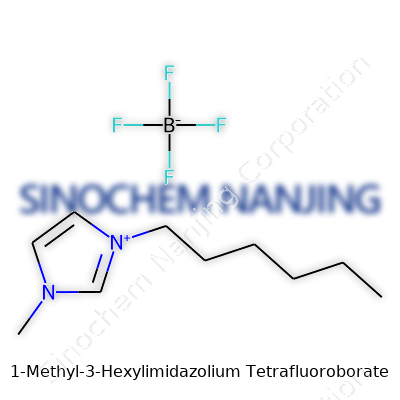
The structure of 1-methyl-3-hexylimidazolium tetrafluoroborate feels straightforward at a glance: a cation with a six-carbon hexyl tail bound to an imidazolium ring along with a small but mighty tetrafluoroborate anion. Its clear, oily liquid form and mild aroma set it apart from solids or harsh-smelling volatile chemicals in many labs. The intuition behind designing these molecules lies in balancing bulkiness and charge to control solubility, melting point, and interactions with other ingredients. Instead of the “one size fits all” approach, chemists now tinker with the alkyl chains, not just for the fun and challenge, but to solve tough, real-world separation and catalysis tasks.
Physical & Chemical Properties
Here’s where everyday experience in the lab teaches a lasting lesson — this ionic liquid hardly evaporates, handling drying ovens or even spills on the benchtop without filling the room with fumes. Its density sits higher than water’s, so a splash settles quickly rather than splattering everywhere. That weight comes from the combination of carbon-heavy cation and the boron-fluorine cluster in the anion. Viscosity can sometimes frustrate more than water-based solvents; simple pouring turns slow, especially in cooler rooms. On the chemical side, the imidazolium ring gives it some resilience against breakdown, while the tetrafluoroborate will hydrolyze under strong basic or high moisture conditions if left unattended. Unlike classic organic solvents that might catch fire or corrode through glassware, this compound stands as a model for patience — stable under most common lab conditions but not invincible.
Technical Specifications & Labeling
Precise labeling and handling grow more important every year, as regulatory scrutiny increases and companies demand transparency. Safety sheets stress purity levels, water content, and absence of halide impurities, alongside graphical symbols flagging potential hazards to skin and eyes. The technical side covers melting and boiling points, electrical conductivity, and shelf life. Experienced chemists know these numbers from memory, treating even small deviations as potential signs of batch degradation or contamination from careless use. Trust in the quality of this liquid builds on repeated, careful verification, especially with applications in sensitive electronic or pharmaceutical settings.
Preparation Method
Synthesizing this compound never feels like a simple “one-pot” situation. The process usually begins with methylimidazole, which reacts with an alkyl halide like 1-hexyl bromide. Care and patience define the process—temperature management, solvent selection, and careful monitoring all play their role. When the imidazolium salt forms, it usually arrives with bromide as the counterion, demanding an anion exchange, often with sodium tetrafluoroborate, to swap in the sought-after BF4−. The result comes after repeated washings and purifications to minimize contaminants and side reactions like alkylation on wrong positions or lingering halide traces. This is the stage where most problems appear: rush too much, and purities drop; take time, and yields suffer. Lab work matches life in that you rarely get both speed and perfection together.
Chemical Reactions & Modifications
Not many substances play as well on both sides of the chemical fence—hydrophobic settings on one hand, polar mixtures on the other. The imidazolium framework supports further functionalization, and the tetrafluoroborate anion usually stays out of most direct reactions, providing a neutral background. Researchers have explored swapping out the hexyl group for other alkyl chains, or modifying the imidazole itself, to adjust solubility or biological compatibility. Sometimes, mixing this ionic liquid with polymers or nanoparticles brings surprising changes—boosting the conductivity of electrolytes or tweaking surface properties just enough to create a better battery or a more efficient extraction process.
Synonyms & Product Names
Anyone working with chemicals long enough knows the confusion from a handful of different names for one item. 1-Methyl-3-hexylimidazolium tetrafluoroborate bounces between shorthand like [HMIm][BF4] and various catalog numbers. Alternate spellings or Greeked-out versions sneak into journals and even patents, so precision matters every step. Translation across languages or lab cultures only adds to the tangle, pushing for wide adoption of clear, consistent nomenclature, especially when mistakes in labeling could lead to wasted time or safety risks.
Safety & Operational Standards
The glossy, benign look hides the need for gloves and eye protection. Most ionic liquids aren’t as toxic or flammable as the standard laboratory arsenal, but skin exposure or inhalation still pose risks not worth ignoring. Regulatory agencies don’t look the other way—safety data points to low but not zero toxicity, particularly with eye or mucous membrane contact. Handling this liquid near heat or light sources rarely poses much of a fire hazard, but strong acids, bases, or even simple water can slowly break down the tetrafluoroborate. For those who train new scientists, the best lesson is routine: wash hands, label waste, and treat “new” chemicals as unknowns until enough reliable data says otherwise.
Application Area
Chemists often reach for 1-methyl-3-hexylimidazolium tetrafluoroborate when they want to avoid the volatility or toxicity of older organic solvents. It sits at the crossroads between electrochemistry and green synthesis. In electrochemical devices, its low vapor pressure means longer-lasting, more stable sensors and batteries. Extractive and separation processes use this liquid to draw stubborn metals or organic compounds out of mixtures, sidestepping the need for more hazardous alternatives. Sometimes the real-world cost—purification, safe disposal, and regulatory compliance—makes a company hesitate. On the other hand, the reduced environmental footprint, compared to legacy solvents, tips the scales in favor for many newer ventures, especially with regulations on volatile organic compound emissions tightening everywhere.
Research & Development
The curiosity driving research on this ionic liquid stays strong because the questions never really stop. Industry labs track modifications in the imidazole cation looking for sharper selectivity, higher ionic conductivity, or novel environmental compatibility. Big grants sometimes follow teams promising electrolytes that don’t dry out or signals that stay sharp year after year in harsh analytical tools. Academic projects dig into the relationships between structure and property, hoping the right tweak turns up a use case nobody saw coming. Some of the most promising efforts now look at blending ionic liquids with biomolecules or renewable feedstocks, aiming for greener, cheaper ways forward while keeping performance high.
Toxicity Research
It’s tempting to assume a solvent so far removed from traditional volatile organics comes with no baggage, but early optimism runs up against careful, repeated testing. Long-term, low-dose toxicity takes years to assess. In practice, animal studies haven’t turned up the level of acute toxicity seen in classic chlorinated solvents, yet skin absorption and aquatic toxicity present ongoing reasons for caution. The jury still deliberates about chronic effects when these liquids end up in wastewater or soil, and the broader ecological footprint forms part of most grant applications and regulatory filings now. Lab workers and environmental analysts push for continuous research, since an incomplete toxicology record means unknown risks down the road.
Future Prospects
Every scientist peering into the future of solvents, batteries, and chemical reformulations wonders where ionic liquids like this one fit in. Some look for improved synthesis methods to lower costs and resource use, hoping to shrink the gap between laboratory innovation and bulk commercial adoption. Others eye the energy sector, where these compounds could enable safer, more durable batteries or recyclable fuel cells. For everyone, the ongoing challenge remains blending performance, user safety, and economic realities—without skipping the necessary research on long-term effects, waste management, and workplace exposure. As the world moves beyond the “one size fits all” approach to chemicals, the thoughtful custom-building of molecules like 1-methyl-3-hexylimidazolium tetrafluoroborate shows how much ground remains for discovery and debate.
What are the main applications of 1-Methyl-3-Hexylimidazolium Tetrafluoroborate?
Why Chemists Care About 1-Methyl-3-Hexylimidazolium Tetrafluoroborate
Anyone who has worked in a chemistry lab knows that finding the right solvent changes everything. Some solvents treat your hands badly, others evaporate too quickly or show little willingness to dissolve tricky compounds. 1-Methyl-3-hexylimidazolium tetrafluoroborate is a special kind of ionic liquid that solves real problems. Chemists love it because it stands up to high temperatures, doesn’t catch fire easily, and mixes with a wide range of organic and inorganic compounds.
Batteries and Electrochemical Devices Get a Boost
Over the past two decades, there’s been a rush to improve battery tech. Anyone who has seen an old phone battery swell up or stop charging knows why. Standard electrolytes break down, catch fire, and kill expensive electronics. This ionic liquid doesn’t evaporate at room temperature, works with lithium ions, and doesn’t light up when it gets hot. Research teams have packed lithium-ion cells with it, reporting safer and longer-lasting cycles. It also holds up in supercapacitors—devices that charge faster than most batteries and store lots of energy for quick power bursts.
Green Chemistry and Sustainable Solvents
Traditional solvents create huge waste streams that pollute the air and water. Many workers develop health issues from breathing them in. People who care about sustainability look for replacements. This chemical attracts attention because it doesn’t release much vapor, and doesn’t produce the same nasty byproducts as common alternatives. In extraction processes, analysts use it to pull out specific compounds from mixtures, from biofuels to pharmaceuticals, usually with less environmental impact. Cleaner processes cut plant downtime and lower overall costs.
Industrial Catalysis and Synthesis
Anyone who has spent hours trying to coax reactants to blend knows how much a good solvent matters. Many organic and inorganic reactions run more efficiently with ionic liquids. This one supports transition metal catalysts, speeding up organic transformations that make everything from plastics to medicines. Scientists use it for alkylation, Diels-Alder reactions, and even cross-couplings. Some industrial plants replace volatile organic solvents in select processes, and see higher yields in less time. Better reaction rates help companies scale up cleanly instead of throwing more raw materials and energy at the problem.
Challenges and the Search for Safer Chemicals
No one should pretend that ionic liquids fix every problem. Tetrafluoroborate carries some toxicity and environmental concerns. If spilled, it can break down and release fluorinated compounds that harm waterways and organisms. Handling and disposal still require good safety protocols. Researchers have started developing less harmful alternatives, though no silver bullet exists. More studies track breakdown products and look for replacements that work as well but break down harmlessly.
What’s Next?
From battery research to greener chemical processes, 1-methyl-3-hexylimidazolium tetrafluoroborate attracts innovators. As tech changes, industries need safer, more reliable materials. Teams across the world tweak the formula, test new applications, and share results. Watching how science adapts this compound to tomorrow’s needs reminds us that progress means asking smarter questions about what goes into our labs, our products, and our environment.
What is the chemical purity and specification of this product?
The Real Impact of Purity Levels
Every time I’ve dealt with a new batch of chemicals at work, one question always comes up: “How pure is it, really?” Purity isn’t just a technical detail buried in paperwork; it shapes everything from reaction safety to end-product quality. A 99.9% pure solvent supports a very different process than one at 96%. Trace amounts of the wrong contaminant can disrupt results or, worse, create safety risks. In research and manufacturing, reliable data starts with defined purity. It’s not about chasing perfection—it’s about trust.
Defining Chemical Specifications
Spec sheets might look dry, but for anyone using chemicals, they’re essential guides. The specs lay out the grades—analytical, reagent, technical—and these labels mean more than marketing. Take sodium chloride: laboratory grade is tested for clarity, insoluble matter, heavy metals, and iron content. “Technical grade” costs less, but it’s better suited to de-icing roads than making IV fluids. Only clear specs—appearance, melting point, specific impurities—let users know what they’re getting. Vagueness opens the door to mistakes.
Why Verification Goes Beyond the Label
Plenty of customers have assumed high purity because a supplier claimed it. A smart chemist always checks the certificate of analysis. Reputable producers list actual results for each batch, tested by titration, spectroscopy, or chromatography. Heavy metals, water content, and residual solvents need real measurements, not general assurances. I once saw a project stall for weeks because a supposedly “pure” acid came with unlisted iron contamination. Every claim needs backup, especially with critical applications in pharma or food production. Analytical transparency doesn't just help labs—patients and consumers depend on it, too.
The Cost Angle Nobody Likes to Admit
Budget constraints tempt buyers to compromise on grade. Some believe saving a bit on a large lot won’t have much impact downstream. This trade-off rarely pays off. Low-quality chemicals drive up overall costs: unexpected lab failures, more waste, and even damaged equipment. From years of experience, I can say that hidden costs pop up fast when purity isn’t prioritized. Suppliers cut corners, and buyers get burned. Upfront investment in higher grade materials avoids these headaches and gives teams confidence to push projects forward.
Building Quality Into the Supply Chain
Companies secure quality not just by picking the “best” supplier, but through real relationships and audits. I’ve found that working openly with suppliers—requesting regular documentation, discussing contamination risks, visiting production facilities—keeps standards high. Good suppliers welcome tough questions and detailed oversight. It’s never just about checking boxes. Open dialogue about raw material sources, QA protocols, and change notifications strengthens everyone’s position.
Solutions Worth Pursuing
Everybody in the chain plays a part. Regulators enforce minimum standards, but industry players gain reliability by pushing past them. Openly publishing analytical methods, sharing batch-by-batch results, and keeping records transparent builds trust. For buyers, standardized questionnaires and supplier audits cut confusion. For manufacturers, investing in proper testing capability pays off with fewer recalls and better market access. Front-line staff spot issues long before managers realize, so organizations should welcome feedback from the lab bench up.
Looking Beyond the Bottle
Purity isn’t just a technicality or a selling point; it dictates outcomes, shapes reputations, and in the case of pharmaceuticals, even saves lives. No shortcut replaces clear specifications and real-world verification. The industry’s future—cleaner products, fewer errors, safer processes—rests on getting these details right.
How should 1-Methyl-3-Hexylimidazolium Tetrafluoroborate be stored?
Real-World Safety Starts in the Lab
Nobody wants chemicals leaching onto shelves or wrecking good glassware. I once saw a lab mate lose a costly batch, all thanks to neglecting simple storage advice. Experienced scientists learn that minor lapses take down big projects. 1-Methyl-3-Hexylimidazolium Tetrafluoroborate isn’t your run-of-the-mill salt; ionic liquids like these open doors for clean reactions and greener processes. Yet, their hidden risks sneak up quickly without mindful handling.
Temperature and Moisture: The Stark Reality
Chemicals with complex ions often attract moisture like magnets attract metals. This one pulls in water from air before you know it, especially if the cap isn’t replaced right away. I’ve seen test results swing wildly because water got involved. That small slip nearly torched the accuracy of an entire series.
Storage in a cool, dry spot truly delivers results. Anything beyond room temperature threatens the stability and could set the stage for slow decomposition. Avoid placing the bottle anywhere near radiators, vents, or sunlit windows. In many labs, a dedicated flammable cabinet or temperature-controlled locker tackles these issues. Even home-base scientists keep their ionic liquids clear of kitchen-level humidity and heat.
Material Compatibility: Not All Containers Get Along
Not every bottle on the shelf fits the bill. Polyethylene and borosilicate glass bottles resist attack and don’t interact with the ionic liquid. Using improvised containers—jam jars, soft plastics, recyclables—invites disaster. Contaminants sneak through scratches, and impurities build up fast. Just last year, a colleague reused a soda bottle, and days later, contamination ruined both the sample and his cushiony grant timeline.
Select containers with airtight seals. The stopper matters just as much as the bottle itself. Even a high-end flask turns useless if a worn cap or leaky joint lets air or moisture sneak inside.
Labeling and Reaccess
Chemicals stored in public or shared spaces often end up relabeled or misplaced. Always mark the substance, source, date received, and last date opened. One forgotten bottle could mean a months-old sample gets mixed into critical work. Fastidious notes easily save hours of repeating work.
Returning chemicals to uncontrolled environments—or worse, leaving them open—asks for headaches. Sometimes folks keep "temporary" working bottles at benches. They soon pick up more contaminants than a spilled bag of flour. After use, close and return the main supply to its proper home before handling anything else.
Minimizing Risk and Waste
Spills dry awkwardly, and without quick cleanup, sticky residues glue labels to shelves or force costly deep cleans. Planning for fast spill response—like using absorbent pads and gloves within reach—takes only one extra minute. I’ve watched floors and hands stay clean when folks keep the right tools handy rather than hope for the best.
Smaller aliquots protect the bulk of your product from repeated air exposure. Taking just what you need into a secondary container preserves most of the stock. This habit, more than any expensive lab tech, keeps quality high for longer.
Building Good Habits
Colleagues trust those who treat their chemicals with care and precision. Proper storage of 1-Methyl-3-Hexylimidazolium Tetrafluoroborate secures quality, cuts down on wasted time, and improves both yield and morale. Smart practices create good science—and safer labs—without expensive fixes or big theory.
Is this compound hazardous or does it have any safety precautions?
Knowing What You’re Handling
Taking a closer look at any chemical compound, whether it's a common cleaner or something from a research lab, shrinks the gap between curiosity and safety. Every bottle on a shelf or drum in a warehouse tells its own story through warnings, symbols, and sometimes a thick stack of paperwork. Easy to overlook, but skipping that fine print can land you in serious trouble. Some folks trust that if something is for sale, it can't be all that dangerous. Just look at ammonia under the kitchen sink or industrial solvents—routine, right up until they aren't.
Over the years I’ve seen more than one person throw caution aside, thinking a pair of standard gloves or a basic mask has them covered. That hasn't always ended well. You won’t always smell the hazard, and a delayed reaction can mask early symptoms. There's not always a cloud of smoke or instant rash to alert you when things go sideways. Take bleach and vinegar, both everyday names. Mix them, and you end up with toxic chlorine gas, which is anything but safe. It's an old-school mistake, but folks continue to repeat it. The lesson smarts—danger hides in plain sight, even in the most familiar combinations.
What Science (and Regulations) Tell Us
It's not lazy to want simple instructions, but science rarely deals in shortcuts. Material Safety Data Sheets (MSDS) or Safety Data Sheets (SDS) come packed with info because risk isn’t a matter of opinion. Facts tell us if a compound sets off sparks in air, eats through gloves, or evaporates invisibly but attacks the lungs. The Occupational Safety and Health Administration (OSHA) in the U.S., for instance, enforces strict reporting for hazardous substances. Those rules came from workplace injuries—every label, every pictogram is written in sweat, sometimes blood.
Cancer risk grabs headlines, but not all dangers are dramatic. Some compounds cause harm slowly by interfering with the nervous system, lungs, or skin. Others might not kill outright but can leave scars after exposure. I remember a summer job in an auto shop, breathing in solvent fumes. No coughing, but headaches and itchy skin told their own story by week’s end. It stuck with me: just because you can't see or smell the problem, doesn't mean it’s not there.
Safer Habits Start with Questions
A practical solution sits on the shelf with every chemical—education, not more expensive gear. Asking, "What does this do if I drop it, spill it, or mix it?" pulls hidden risks into the open. Proper gloves come in more varieties than most realize, and not every filter fits every mask. Rushing, skipping hand washing, or assuming a fume hood solves all problems gets people hurt. It only takes one shortcut for disaster to follow.
Smart workplaces train folks to treat every unknown substance with respect. Outdated labeling or poor storage leads to confusion—clearer signs, group drills, and step-by-step spill guides save more than time; they keep workers going home healthy. Crowdsourcing advice from experienced users or even calling a poison control center beats guessing every time.
Takeaway for Today
Nobody can memorize the hazards of every compound on sight, and most people don’t get second chances to learn. Curiosity and caution go hand in hand. Fact-based awareness beats winging it, every single day. Reading the label isn’t enough—experience and preparation do more than any warning sign can convey.
Can this product be used in electrochemical or catalytic processes?
Looking Beyond the Sales Sheet
Every new material hits the lab with a promise—efficiency, innovation, maybe even a way to solve that stubborn problem that’s been eating time and research budgets. People ask if a product can unlock fresh ground in electrochemistry or catalysis. These aren’t buzz fields anymore; they’re lifelines for clean energy, advanced sensors, and production methods low on environmental impact. My time working in R&D taught me that usefulness in either area has little to do with marketing copy and everything to do with a product’s real-world traits.
Electrochemical Application—It’s All in the Surface and Structure
Let’s talk electrochemistry. For a product to be more than bench clutter, its electrical properties matter. Take carbon materials—graphene, carbon nanotubes, or even simple activated carbon—a tweak in their structure switches them from lab curiosity to backbone of supercapacitors and batteries. A quick conductivity test tells you more than a brochure ever could. It doesn’t stop with electrons; porosity is a massive deal. If ions can’t move fast enough, the reaction stalls. In my old lab, we moved to a porous catalyst and watched the response rate jump threefold just by giving ions a faster route through the maze.
Safety, purity, and chemical stability keep products in play. Impurities mess up current flow and introduce false positives. Even trace metals can sabotage an electrode. I’ve thrown out more half-used vials than I care to remember because stability dropped after a single experiment. If you want a product for electrochemistry, demand a detailed impurity analysis and get hands-on data.
Catalysis: The Test Is in the Turnover
Catalysts don’t rely on showy properties; they earn their keep by sticking around and surviving cycles. Lean on products that give consistency: activity, selectivity, and resistance to fouling. I once ran a side-by-side with two palladium compounds—one cut corners on purity. By mid-week, side reactions cropped up, and yields fell. Tracing back, the metal content didn’t match the claims. You need to hold the supplier accountable.
Surface area matters here too, but for a different reason. In catalysis, that’s your playground—more area means more reactions. A product for this line of work should stay stable under temperature swings and harsh reactants. If it clumps together or breaks down, the catalytic power drops. Years ago in industry, we shifted from a powder that packed too tight to a more open-structured one and watched our catalyst lifespan nearly double.
Real Testing Beats Theoretical Specs
Researchers face a wall of technical data. Numbers and graphs tell part of the story, but nothing replaces testing the product in an actual system. I’ve worked with teams who trusted spec sheets, only to find that in the reactor, nothing happened—or worse, the product dropped out as sludge. Quick pilot trials, stress tests, and real-world comparison with market leaders matter far more. Future investment in any electrochemical or catalytic line hinges on repeatable – and honest – results.
As demand for sustainable energy and new chemistry grows, industry and academia both need products they can trust. The market rewards those willing to ask tough questions and demand transparency. Capable suppliers back their claims and provide more than data—they offer access to real users, examples, and performance benchmarks. Next time a sales rep mentions a product for electrochemistry or catalysis, I’ll be reaching for my own test plan, not just a checkbox.
| Names | |
| Preferred IUPAC name | 1-methyl-3-hexyl-1H-imidazol-3-ium tetrafluoroborate |
| Other names |
1-Methyl-3-hexylimidazolium tetrafluoroborate 1-Methyl-3-hexylimidazolium fluoroborate HMIM BF4 HMIM tetrafluoroborate 1-Hexyl-3-methylimidazolium tetrafluoroborate |
| Pronunciation | /waɪˈmɛθɪl θriːˈhɛksɪl ɪˌmɪd.əˈzoʊ.li.əm ˌtɛ.trəˌflʊə.roʊˈbɔːr.eɪt/ |
| Identifiers | |
| CAS Number | 280116-89-0 |
| Beilstein Reference | 4122344 |
| ChEBI | CHEBI:141562 |
| ChEMBL | CHEMBL2346989 |
| ChemSpider | 21868987 |
| DrugBank | DB11126 |
| ECHA InfoCard | 03b76e4d-84bd-4745-b03d-3ae59a1ce5e6 |
| EC Number | 205-488-0 |
| Gmelin Reference | 1089206 |
| KEGG | C116701 |
| MeSH | D000070587 |
| PubChem CID | 102108460 |
| UNII | 66M3H0P3K1 |
| UN number | UN3474 |
| Properties | |
| Chemical formula | C10H19BF4N2 |
| Molar mass | 263.20 g/mol |
| Appearance | Colorless to light yellow liquid |
| Odor | Odorless |
| Density | 1.15 g/cm³ |
| Solubility in water | soluble |
| log P | “-0.654” |
| Vapor pressure | 0.0000113 mmHg at 25 °C |
| Acidity (pKa) | ~24 |
| Basicity (pKb) | pKb: 15.09 |
| Magnetic susceptibility (χ) | -80.8×10⁻⁶ cm³/mol |
| Refractive index (nD) | 1.428 |
| Viscosity | 72 cP (25 °C) |
| Dipole moment | 5.5381 Debye |
| Thermochemistry | |
| Std molar entropy (S⦵298) | 285.6 J·mol⁻¹·K⁻¹ |
| Std enthalpy of formation (ΔfH⦵298) | -498.7 kJ·mol⁻¹ |
| Std enthalpy of combustion (ΔcH⦵298) | -6231.8 kJ/mol |
| Hazards | |
| GHS labelling | GHS02, GHS07, Warning, H226, H315, H319, P210, P280, P305+P351+P338 |
| Pictograms | GHS07 |
| Signal word | Warning |
| Hazard statements | H315, H319, H335 |
| Precautionary statements | P210, P233, P240, P241, P242, P243, P273, P280, P303+P361+P353, P370+P378 |
| NFPA 704 (fire diamond) | 1-1-0-⊕ |
| Flash point | > 176 °C |
| Autoignition temperature | 343 °C |
| Lethal dose or concentration | LD50 oral rat > 2000 mg/kg |
| LD50 (median dose) | LD50 (median dose): >2000 mg/kg (rat, oral) |
| NIOSH | Not Established |
| PEL (Permissible) | Not Established |
| REL (Recommended) | 0.02 ppm |
| IDLH (Immediate danger) | No IDLH established |
| Related compounds | |
| Related compounds |
1-Butyl-3-methylimidazolium tetrafluoroborate 1-Hexyl-3-methylimidazolium hexafluorophosphate 1-Ethyl-3-methylimidazolium tetrafluoroborate 1-Octyl-3-methylimidazolium tetrafluoroborate 1-Methyl-3-propylimidazolium tetrafluoroborate |



