1-Butylpyridinium Tetrafluoroborate: A Deep Dive into a Changing Chemical Landscape
Tracing the Path: The Historical Roots
Chemists started exploring ionic liquids like 1-butylpyridinium tetrafluoroborate in detail in the late twentieth century, hunting for safer replacements to conventional volatile organic solvents. Early work tipped the scales in favor of these salts because of their low vapor pressure and high chemical stability. Since then, a knot of researchers—driven by the rise of green chemistry, energy storage demands, and tougher industrial rules—found new ground in ionic liquids for electrochemistry, catalysis, and material science. As solvents edged toward stricter controls, compounds like 1-butylpyridinium tetrafluoroborate began surfacing as smarter choices. Markets soon noticed, responding with a wider range of ionic liquids, and scientific attention ramped up, pulling in heavy investment from both public and private sectors. That broader adoption has kept this chemical on a growth path tied to continued innovation and sustainability demands.
Where Does It Stand Today?
You won’t spot 1-butylpyridinium tetrafluoroborate on a grocery store shelf, but in research labs and high-tech industry, this compound has become a quiet staple. Built from a pyridine ring adorned with a four-carbon butyl chain, paired with a tetrafluoroborate anion, its trade names often cluster around the shorthand [BPy][BF4]. Some suppliers lean into alternate spellings, but the descriptive names point to the same underlying structure. Unlike many classic organic liquids, this salt’s character flips expectations: it shows almost no measurable vapor at room temperature, resisting evaporation, and possessing wide liquid temperature ranges. This blend of non-volatility and chemical resilience lets it play in fields from electroplating to battery tech, sidestepping many downsides plaguing petroleum-based solvents.
What Sets Its Properties Apart?
In my own chemical work, physical quirks of ionic liquids stand out—especially their density, viscosity, and impressive chemical stabilities. 1-butylpyridinium tetrafluoroborate typically presents itself as a colorless to pale yellow liquid, sometimes with a light tint depending on its purity—a note that makes preparation and storage especially important. The density lands north of one (~1.1 to 1.2 g/cm³), so it sinks in water. Viscosity can fluctuate with slight temperature shifts, and conductivity remains high enough for electrochemical tasks. Its thermal stability stretches past 250°C, and it shrugs off air exposure better than most common solvents. Water solubility usually stays low, and it resists mixing with hydrocarbons. Some folks overlook that the tetrafluoroborate anion holds up well to weak acids and bases, making the compound less likely to break down under harsh reaction conditions.
How is it Made?
Syntheses often follow a straightforward two-step reaction. First, butylpyridine forms by reacting pyridine with 1-chlorobutane or 1-bromobutane—an alkylation reaction under reflux. The resulting butylpyridinium halide undergoes salt metathesis with sodium or potassium tetrafluoroborate to generate the ionic liquid. Careful washing and drying scrub out excess salts and byproducts. In my experience, purity checks—like NMR spectroscopy and Karl Fischer titration—make a huge difference, since trace water or halide contaminants can influence many properties. Green chemists keep working to tighten these routes, optimizing for better yields, lower waste, and gentler conditions, but lab-scale prep remains largely reliable.
How Does it Behave Chemically?
What makes 1-butylpyridinium tetrafluoroborate fascinating is not just its basic stability, but its openness to being tweaked at the molecular level. Chemists often exchange the tetrafluoroborate anion for related partners, swapping properties to match specific tasks. Researchers also step in to decorate the butyl side chain or the pyridine ring, tuning solubility or electric charge density. In catalytic reactions, this liquid helps dissolve and stabilize tricky reagents, assist in metal plating, or provide an inert reaction medium. It rarely breaks down during use, but at high voltages or under strong acids, its tetrafluoroborate partners can hydrolyze, releasing small amounts of HF—a hazard many labs now monitor closely. Such reactivity hasn’t scared industries away but rather guided more careful operational strategies.
Safety, Toxicity, and Responsible Use
Handling 1-butylpyridinium tetrafluoroborate reminds seasoned researchers to never take chemical safety for granted; just because a liquid doesn’t fume doesn’t make it benign. Many ionic liquids show mild to moderate toxicity in cell studies—enough to warn against skin contact, inhalation, or careless disposal. This substance can irritate eyes and skin, particularly if handled for long periods. More pressing, though, are the environmental questions. Ionic liquids don’t burn off like traditional solvents, so spills and improper disposal linger. Modern labs insist on gloves, goggles, and good ventilation, with clear protocols for accidental contact. Disposal routes prioritize incineration under controlled settings. Regulatory research keeps expanding as more scientists publish about breakdown products, bioaccumulation risks, and subtle ecological effects. Future regulations may evolve as more data piles up, pushing everyone to balance high-tech advances with a stronger safety culture.
Research, Applications, and a Look Forward
Energy, catalysis, and sustainable manufacturing keep 1-butylpyridinium tetrafluoroborate in the headlines. In electrochemical circles, it shows up in advanced batteries and supercapacitors, thanks to its wide electrochemical window and thermal resilience. In catalysis, its solvent powers unlock previously unworkable combinations of reactants. Some pharmaceutical and membrane-processing applications take advantage of its distinct solubility, especially where other solvents fall short in selectivity or safety. Academics keep probing for greener alternatives but find themselves returning to the reliability of this ionic liquid—at least for now. R&D has ramped up to tweak environmental footprint and to chase molecules with even lower toxicity.
Studies measuring environmental and biological toxicity are still catching up—long-term effects remain hard to pin down, given the relatively recent industrial use and still-growing global market. Some researchers point out that certain modifications, like switching out the tetrafluoroborate anion for less persistent alternatives, might help lower ecological impact. Others are digging into improved waste treatment, recycling protocols, and even designing task-specific ionic liquids less likely to cause harm down the pipeline.
1-Butylpyridinium tetrafluoroborate stands as a symbol of how chemistry’s landscape keeps shifting: new needs prompt new solutions, heightening the call for both performance and responsibility. Guided by tighter regulations and relentless research, the field pushes for compounds that play a part in sustainability without losing their edge in demanding applications. Watching these efforts unfold in the lab and reading the steady flow of new studies, I sense that 1-butylpyridinium tetrafluoroborate will keep pulling double duty—as a core part of modern chemistry’s toolkit and as fuel for debates over chemical next steps.
What is 1-Butylpyridinium Tetrafluoroborate used for?
A Unique Liquid for Modern Chemistry
1-Butylpyridinium tetrafluoroborate doesn’t grab headlines like big pharma or electric vehicle breakthroughs. Yet in many research labs, this liquid quietly fuels modern chemistry. This chemical belongs to a group called ionic liquids, and stands out because it stays liquid at room temperature. It’s especially good at dissolving all sorts of molecules, even stubborn ones. Growing up with a father who worked in an industrial lab, I watched him test materials that rarely dissolved unless doused in harsh solvents. He would have loved a bottle of this stuff for those stubborn cases. Its impressive dissolving power comes from its salty structure, where ions swim around freely instead of locking into a solid.
Why People in the Lab Reach For It
Chemists often look for alternatives to old-school solvents that require careful handling and leave behind toxic waste. Many are exploring ways to swap out volatile and harmful solvents to keep workplaces safer. 1-Butylpyridinium tetrafluoroborate lets researchers avoid using traditional hazardous chemicals for purification or separation. Electrochemists especially like this ionic liquid for generating or storing electricity. I once sat in on a grad seminar at a university where the excitement in the room centered around how these liquids could push battery technology beyond today’s lithium batteries. Ionic liquids act as electrolytes, letting ions move without drying out or exploding, and handle heat better than water-based equivalents. That means more durable, safer batteries and supercapacitors.
Making Greener Chemistry Possible
Lab safety and sustainability matter more now than ever. Replacing flammable, carcinogenic solvents with ionic liquids reduces risks. There’s a big push across the chemical industry to cut waste and greenhouse gases. According to the journal Green Chemistry, teams using these salts sometimes find that reactions work faster or more selectively than with traditional solvents. Less waste, fewer hazardous byproducts—that’s always a plus. I remember hearing from a team that switched over to ionic liquids for a common separation step and stopped dealing with noxious odors and dangerous spills. Anyone who has handled old solvents like chloroform will understand the appeal.
Beyond the Lab: Industry and Practical Uses
Industries are testing 1-butylpyridinium tetrafluoroborate for stripping contaminants from metal surfaces, recycling precious metals, or even as part of sensors. Airlines, for instance, have looked for better ways to protect engine parts from corrosion during long flights. Ionic liquids, with their stability and low vapor pressure, help coat parts or remove gunk without corroding metals. There’s also ongoing research in dye-sensitized solar cells, where the liquid’s stability and ability to handle heat push solar technology forward. The ability to dissolve materials traditional solvents cannot opens options for new products, not just cleaner processes.
Looking Forward—What’s Next?
One challenge for wider adoption remains the cost. Most ionic liquids sell for more than everyday solvents, a hurdle that could fall if demand increases. Some companies and universities are investing in scalable production and recycling methods, aiming to close these economic gaps. For now, these liquids stay staples in advanced research and specialty manufacturing, but their reputation for safety, stability, and versatility suggests a future in mainstream industrial chemistry, electronics, and energy systems. If we keep seeing progress, more industries may lean on these modern tools.
Is 1-Butylpyridinium Tetrafluoroborate safe to handle?
What Is This Chemical and Where Does It Show Up?
1-Butylpyridinium tetrafluoroborate shows up in conversations among chemists, especially those tinkering with ionic liquids, energy storage, or organic synthesis. You won't find this compound everywhere—it's not a household name—but inside research labs or advanced industrial settings, it fuels a good share of experiments. Its value often ties back to its stability in high temperatures and low volatility. But the practical matter many want to know: do its benefits outweigh the risks during handling?
My Own Glove-and-Goggles Moment
Once, working in a university lab, I encountered this salt. The label on the bottle warned: wear gloves, keep away from skin, avoid inhaling dust. These instructions matched up with stories I'd heard from colleagues. One dropped a tiny amount on their bare arm; nothing dramatic happened right away, but mild irritation developed hours later. We cleaned it up immediately, but the message was clear—no shortcuts even if it seems less dangerous than some strong acids or peroxides.
Health Hazards: Facts, Not Hype
Every chemical has a story, told through Material Safety Data Sheets (MSDS). This ionic liquid does not burn easily, but if it does catch fire, it can release toxic fumes, including hydrogen fluoride—a nasty one famous for damaging lungs and bones. Even contact with skin doesn't lead to instant pain, which fools newcomers into thinking it's safe. Long-term effects of some ionic liquids remain under-studied, but enough research links tetrafluoroborate compounds to eye and skin irritation, and the risk climbs with poor ventilation.
During one literature review, I saw mention of environmental risks. Spilled drops find their way into water easily, and they do not break down quickly. This poses a problem for aquatic life, since many ionic liquids linger for years, and scientists have discovered their presence disrupts the normal function of even simple water organisms.
Common Sense in Handling: Lessons Learned
The lesson from these experiences stands out: personal protective equipment isn’t just a formality. In a well-run space, you’ll see heavy-duty gloves, goggles, filter masks, and lab coats worn without exception. A well-ventilated hood forms the front line of defense, especially if weighing out powders or cleaning accidental spills with solvents. I've seen coworkers get lazy about this. That shortcut usually ends up causing mild health problems or, worst case, an emergency response.
Another thing that sticks with me is the value of storage. Keeping the salt in airtight, clearly marked bottles makes sense. It keeps vapors inside and cuts the chance of accidental exposure. I've also watched teams develop clear waste protocols, with spent containers sealed and labeled, never sent down the drain. This matches European Chemicals Agency advice, and helps avoid surprise leaks or environmental headaches.
Better Practices, Safer Labs
The real solution comes from a mix of training, equipment, and constant vigilance. Teams that meet regularly to go over chemical safety keep issues in check. Digital safety checklists help new users make the right moves. Open communication lowers mistakes caused by assumptions—like “It doesn’t smell strong, so it must be safe.” Other labs have even invested in spill kits tailored to ionic liquids, which speed up clean-ups and reduce exposure.
Chemicals only feel safe in the hands of people who know what they’re doing and care about the outcome. As the chemistry world keeps exploring new compounds, these habits protect not just individuals, but the air, water, and community beyond the lab door.
What is the chemical structure of 1-Butylpyridinium Tetrafluoroborate?
Why Care About This Ionic Liquid?
Walking through a chemistry lab, you notice tiny vials filled with clear liquids tagged with names that barely fit on the label. Some of these are ionic liquids—salts that melt below 100°C— and 1-butylpyridinium tetrafluoroborate is one chemists trust for its stable, ionic properties. It isn’t just a curiosity. This compound has crept into renewable energy work, battery research, and even cleaner chemical processing. Years ago, during a summer internship in electrochemistry, I watched researchers swap out classic solvents for salts like this one, just to avoid volatile compounds that risk air quality.
Every structure shapes what a molecule can do. Take 1-butylpyridinium tetrafluoroborate. The cation—1-butylpyridinium—consists of a pyridine ring (five carbons and one nitrogen forming that aromatic core) with a butyl group tacked onto the nitrogen. The butyl chain is a straight, four-carbon stretch. In class, I remember synthesizing similar pyridinium salts; even modest tweaks in chain length would turn viscous puddles into near-solids. That butyl stretch gives enough bulk to shift the melting point far below most table salt or sodium chloride. It’s those subtle shifts that keep floors safe and labs quieter, since volatile fumes drop to almost zero.
On the anion side, tetrafluoroborate brings four tightly clinging fluorine atoms hooked onto a single boron. This anion stands out for staying out of the way—no major color, odor, or weird reactivity. Its real power is in stabilizing the positively charged part and not reacting with water or oxygen in a way that would threaten safety or shelf life. That's a key decision point for engineers and chemists who’d rather not replace ruined samples every season.
Impact on Research and Technology
Not long ago, lithium-ion batteries drew the most attention for smartphone and vehicle technology, but power sources like those demand solvents that handle charge and discharge without breaking down. Traditional solvents give off fumes, especially when hot. Using a compound like 1-butylpyridinium tetrafluoroborate, you cut evaporation and corrosion, possibly extending device lifespan.
In the lab, this compound’s ionic nature means it conducts electricity well. Electrochemists rely on solutions that won’t gum up delicate electrodes and can deal with high voltages; these ionic liquids stand out in that regard. I recall running tests where any trace of water tossed the results out the window. Tetrafluoroborate’s hydrophobic touch helps keep other water-sensitive components stable.
How to Tackle Challenges
No substance gets a free pass. Long-term toxicity and cost come up every time someone pitches ionic liquids for broader consumer use. Disposal and possible environmental build-up still lack the regulatory clarity seen with mineral oils or classic salts. Companies need standardized protocols for collecting and recycling these liquids, since tossing them down the drain can spark trouble—especially with fluorinated parts that accumulate in waterways.
Industry teams have looked for greener synthesis routes. Some methods now replace fluorinated chemicals with milder alternatives, which helps both workers and the environment. Still, reduced waste and better end-of-life processing rely on industry partnerships, not just lab tinkering. If researchers and regulators align goals on transparency and lifecycle management, the upsides of these compounds may shine brighter in real-world tech.
How should 1-Butylpyridinium Tetrafluoroborate be stored?
Understanding the Real Risks
I spent years in a university research lab before moving into chemical safety consulting, and I’ve handled more specialty chemicals than I can count. Few people outside of chemistry circles spend much time thinking about compounds like 1-butylpyridinium tetrafluoroborate, but real care—grounded in verified evidence—becomes crucial. This substance belongs to the family of ionic liquids, which means it doesn’t behave like water or oil. Its chemical structure brings unique challenges to the table.
The Role of Dryness and Temperature
Water is an enemy for this chemical. Exposure to humidity can cause it to break down over time. I’ve seen storage containers left slightly open for just a day in a damp lab, only to come back and find the contents clumped or partially degraded. Direct sunlight and high temperatures help speed up this breakdown. Store it in a cool, dry spot—ideally in a chemical refrigerator or in a room that holds a steady temperature around 20°C. Skip the windowsills and shelves above hot equipment.
Choosing the Right Container
Glass bottles lined with Teflon stoppers or caps work well, as do high-quality polypropylene jars. Inferior plastics tend to react or allow slow ingress of water vapor, and metal can cause unwanted chemical reactions. Seal bottles tightly. My colleagues and I once lost a whole batch after storing it in a container with a loose seal. Using fresh, dry air or even nitrogen to ‘blanket’ the bottle before closing helps stop moisture from creeping in.
Labeling: Not Optional
Mislabeled bottles have caused more drama in my lab than any technical fault. Include the full compound name (no abbreviations), date received, your initials, and—if you plan to store it a while—the expected shelf life. A dated label keeps everyone on the same page and controls accidental mix-ups.
Physical and Chemical Separation
I once made the mistake of storing several reactive agents near ionic liquids. Even minor leaks caused by cracked caps created a mess and put people at risk. Keep this compound far from organic acids, chlorinated solvents, and strong reducing or oxidizing agents. Segregation by hazard class beats out convenience every time, both in home setups and company storerooms.
Emergency Planning
Regulatory agencies—OSHA, EPA, and peer-reviewed sources—point to the possibility of decomposition products, like hydrogen fluoride, if the compound’s exposed to extreme heat or moisture. Keep nitrile gloves, splash goggles, and chemical-resistant aprons handy. Every year I review spill response plans with new lab techs. Properly stored, the odds of an emergency shrink, but keeping a spill kit and chemical neutralizer nearby stops a small mishap from turning into a crisis.
Using Personal Experience to Improve Safety
Over my career, practical lessons stick more than notes from safety lectures. Storing this ionic liquid safely starts with respect for its quirks and a willingness to stick to strict protocols. Skimping on air-tightness, skipping a label, choosing the nearest shelf—these shortcuts land people in trouble. Take a quarter hour to get it right the first time. The time saved later, not having to deal with contamination, lost material, or health risks, outweighs any inconvenience.
What are the physical and chemical properties of 1-Butylpyridinium Tetrafluoroborate?
Understanding the Substance
Many in the lab know 1-Butylpyridinium tetrafluoroborate as a clear, liquid salt. Its formula, C9H16BF4N, hints at its structure: a butyl group hooked onto a pyridinium ring, paired with the tetrafluoroborate anion. Its chemical design brings unique features that make this ionic liquid stand out among organic substances.
Physical Properties That Matter
One striking trait is its room-temperature liquidity. Most salts stay solid at ambient temperatures, but this compound flows freely, even when you leave it on the bench overnight. With a melting point dipping well below zero—somewhere near -71°C—storage worries ease up. Density clocks in around 1.05 g/cm3, which means it sinks below water but still pours like a thick oil.
Put it under a lamp, and you’ll see it doesn’t evaporate like water. A low vapor pressure keeps it from drifting into the air, making lab work a little safer and easier. These physical features save money and time, since less product gets lost and the workplace feels cleaner over long-term projects.
Chemical Behavior and Stability
Some ionic liquids break down fast in the presence of water, but 1-Butylpyridinium tetrafluoroborate proves resistant. Splash a little water into your beaker, and it stays stable, not fizzing or turning cloudy. With a decomposition temperature that reaches up to 300°C, you can use it for plenty of high-temperature reactions or syntheses without it failing you.
The compound resists most acids and bases, and it doesn’t react much with air. Since it holds together in a range of chemical experiments, folks in organic chemistry rely on it for difficult separations and clean catalysis. In practice, its chemical resilience cuts down the need for complicated purification steps, translating to fewer headaches in the lab.
Handling Solubility and Viscosity
A big question for chemists is always “Will it dissolve?” This salt mixes well with many polar organic solvents. It won’t disappear into nonpolar substances like hexane, but pair it with acetonitrile or dimethyl sulfoxide (DMSO), and you’re set for a homogenous solution. Its viscosity sits around 75 to 110 centipoise at room temperature, thicker than water but nowhere near honey’s drag. Heating it a touch will thin things out, making pipetting less of a hassle.
Why Properties Like These Matter in Real Work
Lab safety and efficiency depend on stable, predictable substances. 1-Butylpyridinium tetrafluoroborate’s liquid state, low vapor pressure, and chemical endurance allow chemists to run reactions that water, alcohols, or more volatile solvents just can’t manage. Its unique ionic structure stabilizes reactive species and promotes selective catalysis, which pushes green chemistry forward by limiting hazardous byproducts.
Researchers in analytical science see real benefits, too. Since this salt serves as both solvent and electrolyte in electrochemical setups, it underpins breakthroughs in batteries and sensors. The combination of non-volatility and wide thermal stability range takes much of the worry out of scaling up experiments from benchtop to pilot plant.
Chasing Solutions to Remaining Hurdles
Not every property works in its favor. Ionic liquids often cost more than common organic solvents, so commercial viability hits a wall for low-budget projects. Researchers keep aiming for improved recyclability through integrated purification systems and developing new synthetic routes to lower their price. Another route focuses on designing biodegradable analogues using similar cations and anions that break down harmlessly after use. If development continues, the range of accessible green chemistry tools will only expand.
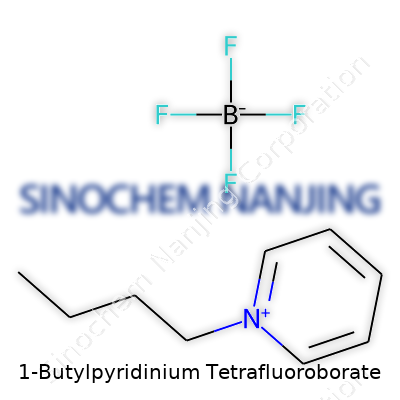
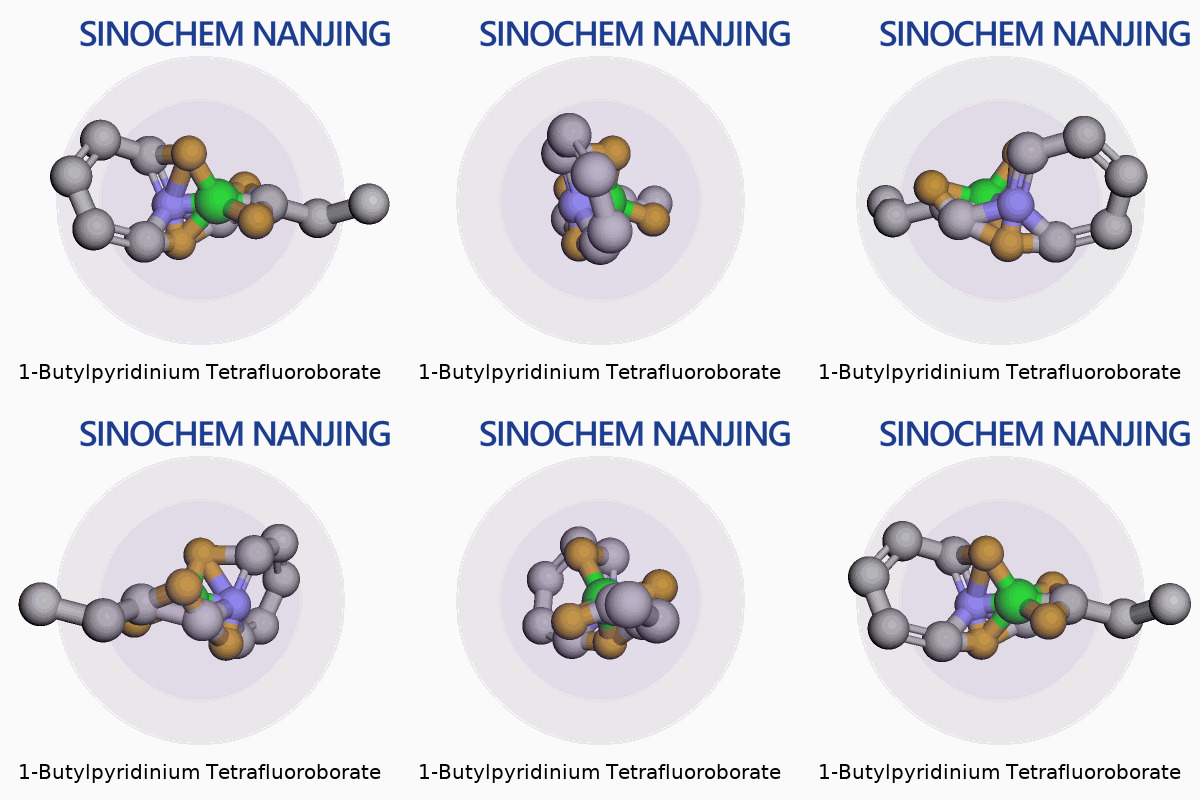
| Names | |
| Preferred IUPAC name | 1-butylpyridin-1-ium tetrafluoroborate |
| Other names |
1-Butylpyridinium tetrafluoroborate 1-Butylpyridinium fluoroborate N-Butylpyridinium tetrafluoroborate BPyBF4 |
| Pronunciation | /ˈwʌn ˌbjuːtɪl pɪˈrɪdɪniəm ˌtɛtrəˌflɔːrəˈbɔːreɪt/ |
| Identifiers | |
| CAS Number | [244193-51-7] |
| Beilstein Reference | 1242450 |
| ChEBI | CHEBI:139538 |
| ChEMBL | CHEMBL429522 |
| ChemSpider | 68479 |
| DrugBank | DB11135 |
| ECHA InfoCard | 100.143.185 |
| Gmelin Reference | 10436 |
| KEGG | C19448 |
| MeSH | D000070266 |
| PubChem CID | 14922940 |
| RTECS number | NL9350000 |
| UNII | 6G8W2G2L2R |
| UN number | UN3462 |
| Properties | |
| Chemical formula | C9H16BF4N |
| Molar mass | 215.07 g/mol |
| Appearance | colorless to pale yellow liquid |
| Odor | Odorless |
| Density | 1.07 g/cm3 |
| Solubility in water | soluble |
| log P | 0.81 |
| Vapor pressure | 0.0000243 mmHg at 25 °C |
| Acidity (pKa) | -10.0 |
| Basicity (pKb) | pKb = 8.8 |
| Magnetic susceptibility (χ) | -8.0E-6 cm³/mol |
| Refractive index (nD) | 1.428 |
| Viscosity | 87.1 cP (25 °C) |
| Dipole moment | 5.28 D |
| Thermochemistry | |
| Std molar entropy (S⦵298) | 476.9 J·mol⁻¹·K⁻¹ |
| Std enthalpy of formation (ΔfH⦵298) | -763.9 kJ/mol |
| Std enthalpy of combustion (ΔcH⦵298) | -5646.3 kJ/mol |
| Hazards | |
| Main hazards | Harmful if swallowed. Causes skin and serious eye irritation. May cause respiratory irritation. |
| GHS labelling | GHS02, GHS07 |
| Pictograms | GHS07,GHS05 |
| Signal word | Warning |
| Hazard statements | H315, H319, H335 |
| Precautionary statements | P264, P280, P305+P351+P338, P337+P313 |
| NFPA 704 (fire diamond) | 1-Butylpyridinium Tetrafluoroborate: "NFPA 704: 1-1-0 |
| Flash point | > 124 °C |
| Autoignition temperature | > 355 °C |
| Lethal dose or concentration | Lethal dose or concentration (LD50, Oral, Rat): >2000 mg/kg |
| LD50 (median dose) | LD50 (median dose): Rat oral >2000 mg/kg |
| PEL (Permissible) | PEL (Permissible exposure limit) for 1-Butylpyridinium Tetrafluoroborate is not established. |
| IDLH (Immediate danger) | Not Listed |
| Related compounds | |
| Related compounds |
1-Butyl-3-methylimidazolium tetrafluoroborate 1-Butylpyridinium chloride N-Butylpyridinium bromide 1-Butyl-2,3-dimethylimidazolium tetrafluoroborate Pyridinium tetrafluoroborate |



