1,3-Pentadiene: A Closer Look at Its Legacy and Role in Science
Historical Development
Chemistry buffs know that the story behind any compound often tells as much as the compound itself. 1,3-Pentadiene traces its roots back over a hundred years, riding the wave of early organic synthesis. Back then, chemists experimenting with cracking and reforming hydrocarbons during the rise of petroleum chemistry would stumble upon simple conjugated dienes. They realized quickly that the reactivity of conjugated systems like 1,3-Pentadiene offered pathways to everything from synthetic rubber to a library of intermediate compounds. Those early discoveries fueled industrial revolutions, especially through the polymer industry. For researchers exploring polymerization or organic reaction mechanisms, the availability of diene structures such as 1,3-Pentadiene meant a reliable jumping-off point for new technologies and products. The knowledge built through that trial and error keeps paying dividends in countless modern labs.
Product Overview
1,3-Pentadiene shows up in two isomeric forms, cis and trans, both with their own quirks. The backbone is simple — five carbons, two double bonds just ripe for transformation. Chemists grab for this hydrocarbon as a basic ingredient, not because it's flashy, but because those double bonds lend themselves to Diels-Alder reactions, cyclization, and even complex modification. This molecule doesn’t get the headlines of ethylene or butadiene, but for anyone working with fine chemicals, adhesives, surfactants, or resins, it serves as a practical and flexible building block. Even with new tools coming onto the market, 1,3-Pentadiene hangs on by being reliable, reasonably priced, and well-understood.
Physical & Chemical Properties
Most folks in the lab recognize 1,3-Pentadiene as a clear, colorless liquid at ambient temperature, giving off that familiar hydrocarbon odor. It boils at just over 40 degrees Celsius, so it evaporates readily and needs careful handling to prevent loss or unwanted inhalation. Its reactivity, rooted in the conjugated diene system, holds remarkable potential — not just for polymer chemistry but for any reaction that wants to dive into cycloadditions or produce unique ring systems. Diene chemistry rides on that electron cloud overlap between double bonds, and 1,3-Pentadiene provides a flexible, manageable template for exploring those effects. Even on the bench, you feel its volatility and reactivity — not a compound to leave uncapped or forgotten.
Technical Specifications & Labeling
Walking down the aisles of a chemical stockroom, you never see 1,3-Pentadiene in grand, bulk containers. Most labs order it in smaller volumes, properly labeled for purity, isomeric composition, and any stabilizers added to keep it from polymerizing in storage. Labeling focuses on hazard warnings — flammability jumps right out, paired with strict reminders not to breathe in vapors. For anyone handling this pentadiene, gloves and goggles aren’t negotiable. These specifications exist for a reason: Nobody enjoys reacting to accidental exposure because a label didn’t spell out real-world risks.
Preparation Method
Old-school preparation relied on pyrolysis or dehydrogenation of heavier hydrocarbons. In industrial practice, pentadienes often roll out during high-temperature cracking of naphtha or petroleum feedstocks. Chemists aiming for lab-scale isolation sometimes turn to alcohol dehydration or the selective elimination of halides from pentyl derivatives. The appeal in these synthesis routes isn’t just efficiency; it’s the chance to fine-tune isomeric purity, reducing byproducts that complicate downstream processing. The basics haven’t changed: Apply enough heat, use the right catalyst, and watch simple hydrocarbon rearrangement yield a useful diene.
Chemical Reactions & Modifications
One of my early organic labs involved a series of Diels-Alder reactions, and 1,3-Pentadiene earned a spot as the go-to diene. Those double bonds put it right in the sweet spot for cycloadditions with all sorts of dienophiles. Hydrogenation easily reduces the double bonds to give pentane, or you can push the system into halogenation and hydroboration to install other functionalities. The conjugation means it reacts faster and more cleanly than isolated dienes. Chemists aiming for specialty chemicals or modified polymers love this kind of reactivity. Modifying 1,3-Pentadiene means you’re never more than a few steps from something valuable — from flavor compounds to specialty resins.
Synonyms & Product Names
Though most folks stick to 1,3-Pentadiene, you’ll sometimes see it listed as piperylene, especially in industrial applications. Both names describe the same basic compound, but “piperylene” feels old-fashioned, a nod to its discovery in the distillation of black pepper oil and other natural products. If you skim through chemical supplier catalogs or older research, both names pop up, sometimes with reference to its cis/trans isomers. Being familiar with both terms can make literature searches and purchasing smoother, cutting down on confusion and order errors.
Safety & Operational Standards
The jumpy nature of 1,3-Pentadiene in the lab tells you all you need to know about its flammability and inhalation risks. Open flames, static charges, even a hotplate set a bit too high will turn this diene into a hazard. Modern laboratories insist on storage in flammable cabinets, good ventilation, and keeping it away from incompatible oxidizers. Over the years, I’ve seen the difference that clear safety protocols make — nothing replaces a well-trained crew and the discipline to keep caps tight and glassware labeled. Safety data sheets recommend limiting exposure, monitoring air quality, and having spill cleanup supplies ready. These aren't just formalities; a single slip can ruin an afternoon and cause lasting harm.
Application Area
Most people don’t realize just how widespread 1,3-Pentadiene’s impact stretches. Synthetic rubber production draws heavily on diene chemistry for its capacity to produce tough, elastic polymers. Manufacturers add it to resins and adhesives, use it as a crosslinker in coatings, and even as a monomer to tailor plastics’ physical properties. Chemical researchers take advantage of its structure in the design of specialty materials, pharmaceutical intermediates, and fine chemicals. This broad utility comes from those two double bonds, letting chemists build upward into multi-functional molecules or downward into simple hydrocarbons. Its flexibility means it won’t exit the scene anytime soon.
Research & Development
Development never really stalls for compounds as adaptable as 1,3-Pentadiene. Across the years, I’ve noticed shifts in research priorities — some teams chase higher-purity isomers, others look to green chemistry methods for cleaner synthesis. Modern catalysis and selective hydrogenation keep bringing new ways to decrease byproduct formation. Academic research leans on 1,3-Pentadiene for modeling reaction mechanisms or designing new materials, while industrial labs keep testing its limits in next-generation polymers and bio-based products. This molecule’s value comes from being a baseline — useful on its own but always ready for an upgrade when new catalysts and methods hit the scene.
Toxicity Research
Decades of laboratory and animal studies confirm that, in high concentrations or with repeated exposure, 1,3-Pentadiene irritates the respiratory tract and eyes. Animal models link chronic exposures to liver and kidney effects, and workers in factories processing large volumes face elevated risk if safety measures slip. Regulatory agencies push for strict airborne limits, not just for acute symptoms but for the long-term risks that often slip by unnoticed. For occasional bench work, risks drop dramatically, but regular exposure calls for engineered controls, protective equipment, and lots of training. I’ve seen what happens when these standards get ignored: downtime, health claims, and steady erosion of trust between workers and management. It reminds everyone — no shortcut is worth that gamble.
Future Prospects
Science rarely leaves a well-understood molecule alone. As sustainable chemistry picks up speed, research teams keep seeking ways to source 1,3-Pentadiene from renewables, cutting both environmental impacts and price volatility driven by oil markets. Improved catalysts, greener feedstocks, and safer handling standards rise to the top of priority lists. As new materials demand tailored polymers, diene chemistry will remain indispensable — and 1,3-Pentadiene, with its straightforward structure and proven reactivity, offers a foundation ready for both scaling and refinement. Its journey from a simple lab curiosity to a keystone chemical proves one thing: in chemistry, utility outlasts flash.
What is 1,3-Pentadiene used for?
What Makes 1,3-Pentadiene Useful?
Not all chemicals get much attention, but 1,3-pentadiene deserves a look. Its structure, featuring two double bonds, gives it a unique reactivity. Chemists have relied on it for decades, mainly thanks to its performance as a building block in several industrial processes. The pungent smell might catch you off guard, but that same molecule supports bigger things in the lab and beyond.
Role in Polymer Production
Most people interact with polymers every day—plastics, rubbers, resins. The production of some synthetic rubbers, especially chloroprene rubber, depends on 1,3-pentadiene. It can take part in cyclization reactions, acting as a diene in Diels-Alder chemistry. By plugging it into these reactions, chemists make complex rings that sit at the foundation of resilient materials. Everyone with a set of quality gaskets or hoses might owe a debt to the behavior of this small diene.
Organic Synthesis and Research Applications
1,3-Pentadiene shows up a lot as a reference molecule in laboratories worldwide. Researchers often use it to study reaction mechanisms. Since chemists like to watch how molecules twist and turn, 1,3-pentadiene gives a clear example for examining addition, polymerization, and rearrangement. Organic courses often make students follow the fate of this molecule, because it teaches lessons about regioselectivity and stereochemistry. The way this diene acts under heat or in the presence of acids helps students and scientists understand more complicated organic behavior.
Fine Chemicals and Fragrances
Fine chemical synthesis sometimes calls for 1,3-pentadiene as a starting material. It’s not the end product, but it makes the journey easier. Through processes like functionalization or cross-coupling, it can transform into alcohols, aldehydes, or other chain compounds. These chemicals play a quiet role in flavors and fragrances, even if you won’t see 1,3-pentadiene listed on the back of a perfume bottle. One interesting fact: that sharp smell? It hints at potential use as a scent precursor, though proper handling is essential due to its volatility.
Industrial Safety: Risks and Solutions
Handling 1,3-pentadiene comes with responsibilities. It’s flammable, and inhaling its vapors causes discomfort or worse. Proper ventilation makes all the difference in a lab or factory. Workers depend on up-to-date training and good equipment, including gloves and eye protection. Smart storage in flame-resistant cabinets, away from open flames, prevents accidents. Facilities that scale up use watch for leaks with specialized detectors, and they invest in rapid-response plans to address spills or fires. Past incidents teach the value of vigilance and regular safety drills, and today, companies use those lessons for a safer workplace environment.
Moving Forward with Responsibility
Society benefits from the creative chemistry that brings safer materials and effective consumer products. But these advances rest on thorough knowledge about raw materials like 1,3-pentadiene. Regular evaluation of its handling—from personal protection, to ventilation, to emergency plans—supports both company reputations and public trust. Looking for greener synthesis methods, and swapping out riskier substances when possible, keeps the focus on progress without forgetting the human element.
What are the safety precautions for handling 1,3-Pentadiene?
What Makes 1,3-Pentadiene Worth Respect
Anyone who’s worked around chemicals knows that even the clear, watery ones come with stories—not always pleasant. 1,3-Pentadiene, a flammable liquid with a strong, gasoline-like odor, can fool anyone new to the game. It catches fire easily, evaporates quickly, and turns breathing air into a headache or worse. Early on in my lab days, I learned not to underestimate clear liquids—just a brief whiff can remind you this substance belongs in a ventilated fume hood, not at the kitchen sink.
Personal Protection Still Comes First
Gloves, safety glasses, and lab coats might seem like a uniform, but with 1,3-Pentadiene, this is your everyday armor. I’ve seen folks skip gloves because they plan to “just pour a little bit.” Skin contact leaves you open to irritation, and sometimes the reaction is not immediate. Chemical-resistant gloves—think nitrile or neoprene—handle the job. Never rely on regular latex; they can break down pretty fast. Full goggles block the fumes as much as splashes. Long sleeves and closed shoes are a must; no one wants blisters because they wore shorts.
Ventilation and Storage: Don’t Cut Corners
The smell of 1,3-Pentadiene in the air is a warning, not just an inconvenience. Good ventilation—mechanical exhaust, fume hoods—protects your lungs and keeps the work area safer for everyone. Working without airflow, especially in small rooms, leaves you dizzy before you know it. I once helped design a simple airflow system using bathroom fans; even a basic setup made a difference in smell and how people felt by the end of the day.
Storing this compound means strong, sealed containers away from heat and any spark source. I’ve seen oily rags spontaneously ignite in trash cans, so with pentadiene, you want dedicated, flame-resistant cabinets. Keep it far from oxidizers—peroxides, acids, even old bleach. I’ve watched a bottle overheat in direct sunlight and it’s no joke. Label everything. Spend the extra minute to triple-check since accidents can happen on rushed days.
Handling Spills with Confidence
Treat every spill like it matters because they add up. A small drip on the bench can stink up a room. Soak it up with absorbent pads, not paper towels, then clean the area with soap and water. Properly dispose of waste rags in metal bins—never dumpster them with regular trash. I remember a lab that skipped this, and cleaning up a smoky trash can left a lasting impression.
Fire Safety Means Thinking Ahead
With pentadiene, one spark changes the room in a flash. Keep fire blankets and class B extinguishers close by. Don’t trust matches or lighters anywhere near where you open bottles. My old supervisor always checked for electrical shorts, bald wires, and open flames at the start of every shift. It took only a single slip-up with another solvent to see how fast things can escalate. Plan your exits and know your route before starting a job.
Knowledge and Training Matter
No one keeps all the safety info in their head. I learned early to keep the Material Safety Data Sheet in sight, highlight key parts, and share it with anyone new to the lab. Quick refreshers at the start of a project save headaches later. Safety drills may seem boring but running through one, just once, changes how fast you react during a real emergency.
What is the molecular formula of 1,3-Pentadiene?
Grasping the Building Blocks
In chemistry class, 1,3-pentadiene landed on my desk as a puzzle worth solving. Pretty soon, anyone studying organic chemistry runs into molecules like this. It’s made up entirely of carbon and hydrogen, just like so many hydrocarbons out there. Each carbon atom wants four bonds, each hydrogen wants just one. These simple facts make for some surprising diversity. With 1,3-pentadiene, those double bonds say a lot about its structure: two of them, spaced with a single carbon in between, give this compound its name and character.
The Details That Matter
To figure out what 1,3-pentadiene actually looks like on paper, you lay it out by counting up the atoms. Five carbon atoms give the backbone—hence “penta”—then two double bonds at the 1 and 3 positions. Visualizing this, you find yourself with a chain that looks like this: CH2=CH–CH=CH–CH3. Each bond, each atom falls into place. Add up the hydrogens: two on the end carbon, one on the next three, and three at the other end, totaling eight hydrogen atoms. The formula is C5H8.
Why a Simple Formula Matters
By pinning down this formula, chemists get a basic passport for this molecule. 1,3-pentadiene’s formula tells more than just its recipe—it gives away possible ways it might react. In chemical manufacturing, that sort of information shapes decisions. For example, with fewer hydrogens than its fully saturated cousin, pentane, 1,3-pentadiene fits into patterns chemists use to spot unsaturation. That often means reactivity, and in industrial settings, people use this trait to craft anything from synthetic rubber to specialty solvents.
Real Impacts in Industry and Research
People who deal with making tires or plastics look to molecules like 1,3-pentadiene for their ability to react, combine, and create stronger links. Similar structures pop up in the recipe for neoprene and other synthetic rubbers, built up through processes like polymerization. Chemists working in labs take this same formula and use it to predict how the molecule will behave under a wide range of reactions, from combustion to hydrogenation.
Health and safety don’t take a back seat, either. Knowing that 1,3-pentadiene holds two double bonds helps predict flammability and the risks in storage. Safety data sheets all start with the molecular formula, because information like this lets first responders and plant workers make quick decisions during mishaps. I’ve seen seasoned lab workers double-check formulas before handling new materials, just to avoid surprises.
Solving Practical Challenges
Mistakes in tracking a molecular formula can send an experiment sideways. In classrooms, getting it wrong leads to confusion. In industrial settings, it means wasted batches or, worse, dangerous reactions. Digital databases at companies catalog compounds using the molecular formula at the core of every record. Efforts to improve chemical safety and manufacturing efficiency both depend on people getting these details right.
Practical solutions start in the details. Teachers can give students more hands-on practice drawing structures and writing out formulas. Chemical plants can enforce stronger checks in their inventory systems before production ever begins. Data scientists developing chemical informatics tools help make sure every molecule is labeled properly, and every risk flagged ahead of time. Paying attention to basics—knowing C5H8 by heart for 1,3-pentadiene—frees up more energy for the creative problem-solving that industry and research both need desperately.
How should 1,3-Pentadiene be stored?
Handling Volatile Chemicals with Respect
Most people rarely think about what sits inside heavy metal drums in chem labs or production plants. It’s easy to forget these compounds can be downright dangerous if neglected. 1,3-Pentadiene stands out in that crowd. It’s colorless, smells a bit sweet but that’s where the pleasantness ends. Flammable, reactive with air, and ready to polymerize, this stuff calls for real respect.
The Dangers are Not Overblown
Ask anyone who’s worked with alkenes and they’ll tell you, this diene can turn nasty when conditions slip out of control. Spontaneous polymerization means it doesn’t wait for a reaction vessel to be set up—exposure to light, air, or even regular temperatures can kick things off. The explosion risk climbs when the compound gets too warm or when it meets peroxides. That sweet smell masks a short fuse.
Trustworthy Storage: Metal Matters
Steel drums or tanks lined with specialized coatings usually end up being the go-to containers. Anything flimsy or reactive adds fuel to the fire, sometimes literally. Paint the outside black or store away from sunlight: direct UV light ramps up reactions inside the container, which sometimes means a slow leak turns into an open flame. Not all plastics can stand up to 1,3-Pentadiene’s bite—so stick to tested materials.
It pays off to keep containers in a cool spot, away from heat sources, open flames, or any spark at all. Stick with rooms built for hazardous chemical storage. Most experienced handlers avoid big temperature swings, since condensation or rapid heating can mess with the pressure inside drums. Real-world experience says never skimp on ventilation—fumes collect quickly, and one loose match can take out an entire storage shed.
Don’t Just Lock it Up—Monitor and Label
Label every container boldly and clearly. Don’t trust duct tape or handwritten notes—legible, chemical-resistant tags keep people from making fatal mistakes. Double-check valve seals and drum lids after every use. Some companies use inert gases like nitrogen to blanket the liquid, blocking oxygen that would otherwise nudge that slow polymerization into high gear.
Proper records make a difference. Mark the date that the 1,3-Pentadiene arrived and when it’s due for inspection or use. Leaving it for months without oversight is asking for trouble. Sensors that flag rising temperature or pressure give some warning, but there’s no substitute for trained eyes and structured routines.
Prevention: Fire and Health Risk Control
Once you’ve got 1,3-Pentadiene on site, fire suppression comes front and center. Dry chemical extinguishers, foam, and carbon dioxide—grassroots training makes sure nobody grabs water, since that spreads burning liquid or vapor. Everyone should suit up with gloves, goggles, and a full suit—splashes invite chemical burns or worse. Don’t ignore the air: a solid fume hood, filtered air, or full face respirators help block those vapors from entering lungs.
Disposal gets tricky too. Never pour leftovers down sinks or drains. Licensed chemical disposal outfits understand the quirks and dangers, so let professionals haul waste away. Keep the emergency numbers on hand, keep the exits clear, and double up on drill practice.
A Human Touch Counts
I’ve seen cabinets stocked with everything from sodium metal to cyanide, but 1,3-Pentadiene sits in that league where a healthy dose of caution—plus regular checkups—keeps disaster at bay. Building habits around storage and open communication between coworkers gets overlooked by folks who count too much on gear and signs. Setting a culture of responsibility, not just rules, protects the shop, the site, and the city outside.
Is 1,3-Pentadiene hazardous to health?
Chemicals in Industry Are Not All Created Equal
In the daily rhythm of chemical plants and laboratories, some substances make you pay attention as soon as they leave the bottle. 1,3-Pentadiene jumps out as one of those. It's a colorless liquid, used in the making of plastics, synthetic rubber, and various other products. If you work in an industrial lab or you’ve spent time near petrochemical plants, chances are you’ve come across this chemical. The scent is sharp, with a gasoline-like kick. At first sniff, that alone signals caution.
Direct Impact on the Body
Fresh out of college, I helped monitor air quality in a small medical plastics plant. We always wore gloves and masks when chemicals like pentadienes were in use. The reason is simple—exposure does not feel good. Just a splash on the skin caused irritation and redness for some coworkers. Prolonged breathing of the vapors, even at low levels, raised complaints about headaches, dizziness, or sore throats.
Because 1,3-Pentadiene evaporates quickly at room temperature, most exposure goes straight to the lungs. Studies show high doses can damage the nervous system and lungs, and the chemical’s label warns against repeated skin contact. Even when you don’t get sick after brief encounters, those chronic, small exposures pile up over months and years.
What Science Says About Long-Term Risks
Researchers have studied animals that breathed the chemical over long periods. Some showed effects like lung irritation, confusion, or signs that organs were under stress. There’s still more research left to do, especially about cancer risks, but signs point to pentadiene being something you don’t want floating around freely. The Environmental Protection Agency lists it as a hazardous air pollutant. OSHA, which sets safety rules for workplaces in the U.S., puts strict limits in place for how much can be present in the air.
Community Safety and Environmental Risks
The trouble with industrial chemicals is they rarely stay put. If safety systems fail, leaks or spills can put neighbors at risk, too. People living near factories might not know what’s floating in the air until folks start getting sick. In some towns, local clinics keep track of health issues that pop up more often in communities that share a fence with industry. Pentadiene isn’t just a workplace concern—it’s a neighborhood concern.
What Can Actually Protect People?
Personal experience taught me to never skip the basics. Gloves, face shields, and proper ventilation beat wishful thinking every time. Industry must double-check their ventilation systems and properly train workers on safe handling—even temp workers and maintenance staff who might not handle the chemicals every day. I remember union stewards fighting for real-time air monitoring, not just dusty warning stickers on barrels.
Regulators hold power, but the real defense comes from watchful coworkers and strong safety cultures. Factories that invite questions and address complaints head-on tend to avoid major incidents. Communities with strong advocacy groups keep plants honest and push for cleaner technologies and safer substitutes.
The Road Toward Safer Workplaces
1,3-Pentadiene doesn’t make headlines like asbestos or lead, but its risks are real. Listening to workers, following up on health complaints, and pushing for greater transparency matter. Modern chemistry can sometimes find ways to swap out high-risk substances for less hazardous ones—this takes pressure, investment, and time. In the meantime, robust safety standards are the surest way to defend health, from the plant floor to the neighborhood next door.
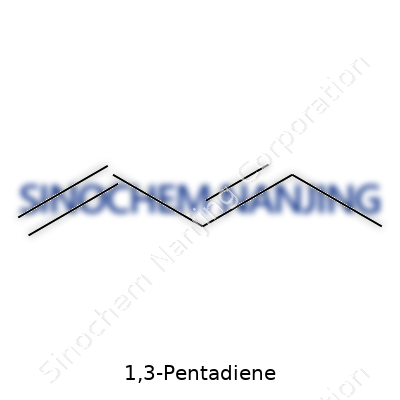
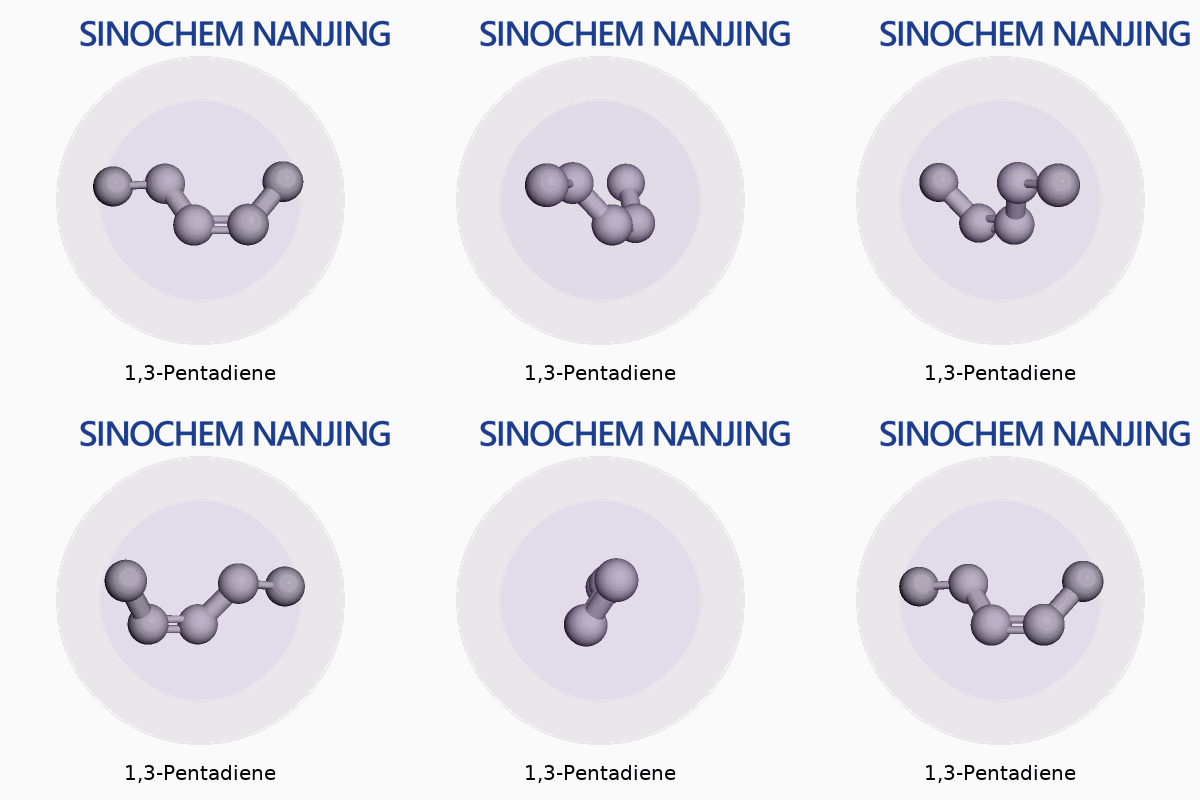
| Names | |
| Preferred IUPAC name | penta-1,3-diene |
| Other names |
piperylene 1,3-divinyl 1,3-penta-diene divinylmethane |
| Pronunciation | /wʌn θriː ˈpɛntəˌdaɪiːn/ |
| Identifiers | |
| CAS Number | 504-60-9 |
| Beilstein Reference | 1209247 |
| ChEBI | CHEBI:39497 |
| ChEMBL | CHEMBL1230602 |
| ChemSpider | 12179 |
| DrugBank | DB03248 |
| ECHA InfoCard | 31dcef2c-64ac-4dfb-a9e5-ff254e4db202 |
| EC Number | EC 203-692-4 |
| Gmelin Reference | 785 |
| KEGG | C06504 |
| MeSH | D010419 |
| PubChem CID | 11574 |
| RTECS number | SA9100000 |
| UNII | F9H7G2BJKE |
| UN number | UN2048 |
| CompTox Dashboard (EPA) | DTXSID9021263 |
| Properties | |
| Chemical formula | C5H8 |
| Molar mass | 68.12 g/mol |
| Appearance | Colorless liquid |
| Odor | mild, unpleasant |
| Density | 0.680 g/mL at 25 °C |
| Solubility in water | insoluble |
| log P | 1.94 |
| Vapor pressure | 367 mmHg (20 °C) |
| Acidity (pKa) | 15.7 |
| Basicity (pKb) | 11.09 |
| Magnetic susceptibility (χ) | -10.4·10⁻⁶ |
| Refractive index (nD) | 1.401 |
| Viscosity | 0.440 mPa·s (20 °C) |
| Dipole moment | 0.45 D |
| Thermochemistry | |
| Std molar entropy (S⦵298) | 276.5 J·mol⁻¹·K⁻¹ |
| Std enthalpy of formation (ΔfH⦵298) | +101.4 kJ/mol |
| Std enthalpy of combustion (ΔcH⦵298) | ΔcH⦵298 = -3229 kJ/mol |
| Hazards | |
| GHS labelling | GHS02, GHS07 |
| Pictograms | {"pictograms": "flame, exclamation mark, health hazard"} |
| Signal word | Warning |
| Precautionary statements | P210, P233, P240, P241, P242, P243, P261, P271, P280, P303+P361+P353, P304+P340, P305+P351+P338, P312, P337+P313, P370+P378, P403+P235, P501 |
| NFPA 704 (fire diamond) | 1,2,2 |
| Flash point | -36 °C |
| Autoignition temperature | 220 °C |
| Explosive limits | 2.2–11.8% |
| Lethal dose or concentration | LD50 (oral, rat): 2100 mg/kg |
| LD50 (median dose) | LD50 (median dose): 72 mg/kg (rat, oral) |
| NIOSH | PSR097 |
| PEL (Permissible) | PEL (Permissible Exposure Limit) of 1,3-Pentadiene: 100 ppm (350 mg/m³) |
| REL (Recommended) | 0.003 ppm |
| IDLH (Immediate danger) | 1,000 ppm |
| Related compounds | |
| Related compounds |
1,2-Pentadiene Isoprene 1,4-Pentadiene Cyclopentadiene 1-Pentene 2-Pentene |



