Reflecting on the Story of 1,2-Dibromoethane: Lessons from Chemistry's Difficult Legacy
Historical Development
Anyone who’s spent time around old photo albums, history books, or farm fields might recognize how often chemicals leave a long shadow over the past. 1,2-Dibromoethane, known to many as ethylene dibromide or EDB, stepped into the industrial spotlight in the early 20th century. Its main claim to fame at first—serving as a lead scavenger in leaded gasoline—illustrates just what happens when chemistry meets mass demand. In the days when vehicle engines depended on tetraethyl lead for smoother running, EDB played the less-glamorous but critical role of cleaning out engine-destroying lead deposits. Later, EDB earned a spot in agriculture as a pesticide and a fumigant to protect stored grain and soil. The shift from revered innovator to health concern in later decades traces a story played out by so many chemicals: big promise, sudden popularity, sobering consequences.
Product Overview, Synonyms, and Names
Whether scientists call it ethylene dibromide, EDB, or 1,2-dibromoethane, the substance links many professional circles. Its colorless appearance and mild sweet odor betray little about its true nature. Buyers may encounter it under names like Glycol bromide or Brocide, with slight differences in trade names reflecting regional practices. Each label signals a similar mix of potentials—industrial utility and stubborn toxicity. For decades, warehouses kept drums of EDB as a go-to additive or bug killer. Over time, regulatory reforms led to tighter controls, but many old storage tanks and contaminated soils still bear traces of a chemical that refuses to disappear.
Physical and Chemical Properties
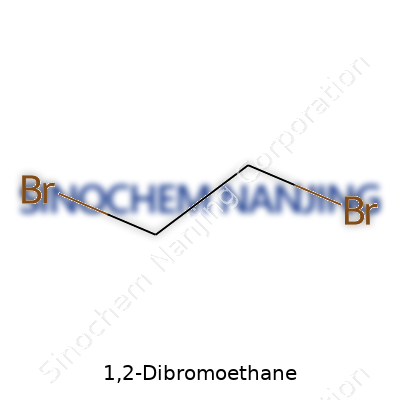
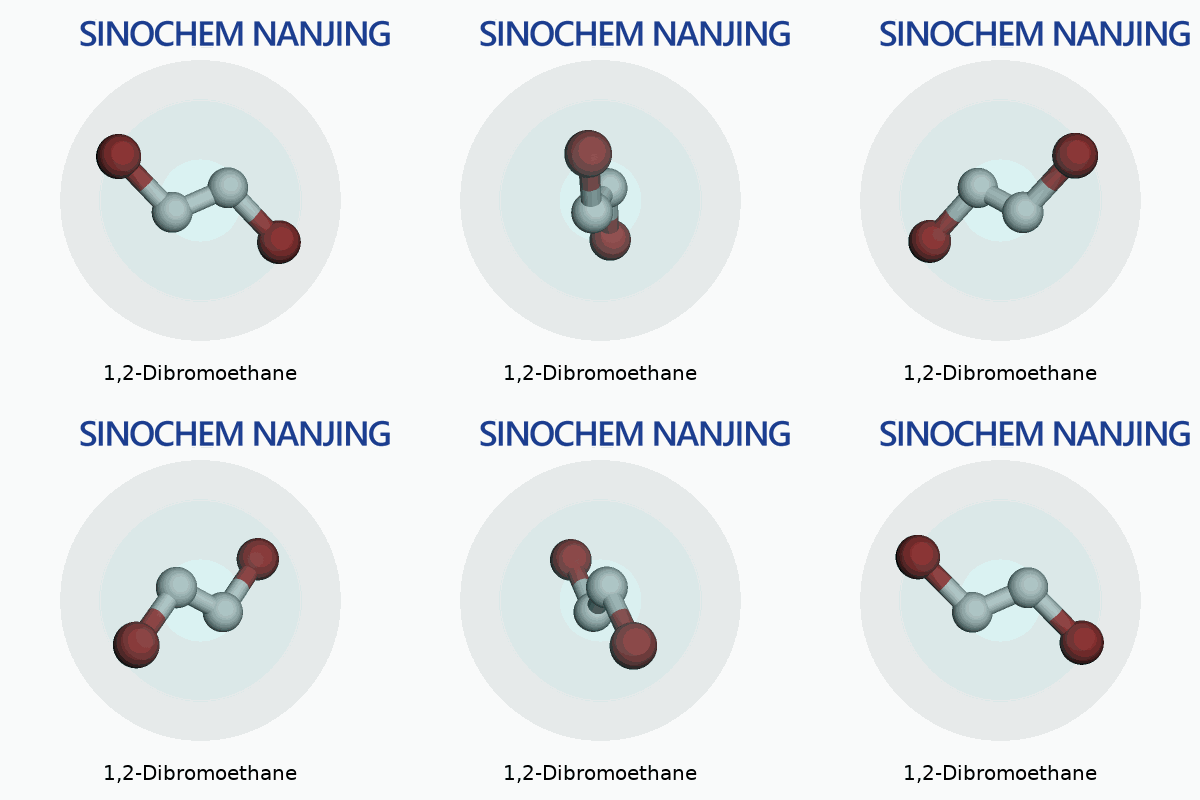
A clear liquid at room temperature, 1,2-dibromoethane boils at about 131°C and weighs in with a density much higher than water, at nearly 2.2 grams per milliliter. Every drop sinks quickly in a beaker of water, yet EDB’s solubility in water remains quite low. Its chemical structure—two bromine atoms locked to an ethane backbone—makes the molecule highly reactive with nucleophiles. That same reactivity once made it valuable, but today, it’s viewed from the perspective of persistent residue and potential harm. EDB evaporates, though not as rapidly as lighter organics, so any spills have a way of sticking around or seeping underground.
Technical Specifications and Labeling
At the height of its popularity, technicians judged EDB’s quality by purity specification—typically upwards of 98 percent for industrial applications. Laboratories relied on clear labeling to flag it as both a hazardous and regulated substance. Packages featured hazard symbols and precautionary instructions that spelled out its need for careful handling, though not all workers paid those warnings the attention they deserved. In the legal context, labels also had to meet local right-to-know or chemical inventory laws, gradually adding layers of bureaucracy to what used to be a routine shipment.
Preparation Method
Synthetic routes for 1,2-dibromoethane belong to classic organic chemistry. The main process unites ethylene, a staple chemical produced from oil or natural gas, with bromine by direct halogenation. The double bond in ethylene opens, each carbon bonds with a bromine atom, and EDB springs forth as a clear liquid ready for drum storage. This pathway feels almost too simple in retrospect; rapid conversion and high yields seemed perfect for scaling up, turning EDB into a commodity traded by the ton.
Chemical Reactions and Modifications
Anyone curious about its reactivity has an open field. EDB’s twin bromines make it a versatile alkylating agent. Nucleophiles split it into simpler chains or use it to stick new groups onto bigger molecules. That kind of reactivity has been a blessing and a curse. In industrial synthesis, it helped build dyes and specialty compounds. As a pesticide, its action on insects hinged on the same chemistry that makes it risky for humans—breaking apart DNA and cellular structures. Once science caught up with these biological impacts, the debate shifted fast from innovation to remediation.
Safety and Operational Standards
Health stories tied to 1,2-dibromoethane read like chemical cautionary tales. Workers exposed to high concentrations—especially in unventilated bottling facilities, old filling stations, or poorly managed fumigation rooms—sometimes suffered acute symptoms: headaches, nausea, respiratory complaints, even neurological issues with heavy exposure. Over time, chronic effects came into sharper focus, and animal studies painted a grim picture, with enough links to cancer and reproductive harm to jolt regulators out of complacency. The U.S. Environmental Protection Agency, along with others worldwide, moved to ban or strictly limit most uses of EDB by the late 1970s and early 1980s. Strict ventilation rules, personal protective equipment, and soil or groundwater monitoring replaced earlier optimism. For many developing countries, legacy contamination remains stubbornly resistant to quick fixes, especially where old stockpiles still rot or toxic plumes spread in groundwater.
Application Area
Only a generation ago, EDB saw widespread use across the petroleum industry and commercial agriculture. It kept leaded gasoline engines humming with less maintenance, and, throughout rural America and export depots, it protected rice, wheat, and other staples from devastating pests. A handful of niche industrial organic syntheses still rely on its properties, but for most of the world, regulatory shutdowns mean EDB has all but disappeared from legal commerce. Countries facing smuggled or leftover EDB, though, still contend with clandestine applications and poorly managed disposal. Residual challenges also arise in environmental cleanups, where groundwater plumes or contaminated silos expose small farms and communities to unsafe levels, long after the main players have exited.
Research & Development
Battles over EDB’s toxicology and fate in the environment have driven decades of scientific debate. Researchers long ago learned to trace every stage, from chemical kinetics in soil and water to metabolic breakdown products in exposed animals. The tightly interwoven chemistry and biology behind EDB’s effects often catch attention in toxicology and public health classrooms. Technological advances in monitoring—down to parts per billion—have clarified how EDB drifts beyond factory sites, challenging engineers and policymakers to track and remediate old contamination hotspots. Real solutions for EDB-impacted sites now lean heavily on advanced sorbents, bioremediation with adapted microbes, and better detection tools. None of these solutions moves fast or comes cheap.
Toxicity Research
Study after study—especially those tracking exposed crop workers, chemical plant staff, or affected communities—has cemented the reputation of EDB as a potent carcinogen and mutagen. The chemical’s structure fits into the DNA of plant, animal, and human cells, disrupting normal replication and triggering a cascade of cellular errors. Researchers looking to make sense of occupational cancer spikes in the mid-20th century found troubling links back to routine mishandling of compounds like EDB. Ongoing experiments reveal just how little exposure it can take to create long-term problems, so public health authorities and advocacy groups continue to push for thorough site remediation and better health monitoring wherever EDB once found favor.
Future Prospects
Staring ahead, the legacy of 1,2-dibromoethane stands as more than chemical history. The story of this compound pushes societies to reflect on the balance between technical progress and human risk. Most industrial uses will not come back, due to solid scientific consensus about its hazards. Future research points toward safer alternatives in pesticide chemistry and more responsible chemical management overall. Clean-up of contaminated groundwater and brownfields offers a proving ground for new environmental technologies, including targeted breakdowns of persistent organohalogens. Policy discussions about legacy pollutants almost always circle back to cases like EDB, forcing regulators and innovators to look beyond short-term gains. For all its scientific pedigree, EDB’s real lesson lies with the communities that shoulder the consequences of rushing headlong into mass production without a clear exit plan.
What is 1,2-Dibromoethane used for?
Where 1,2-Dibromoethane Shows Up
1,2-Dibromoethane, often called ethylene dibromide or EDB, earned a controversial reputation over the past century. In the mid-1900s, it played a huge part in farming and fuel industries. For years, farmers poured EDB onto soils as a pesticide, especially to kill off nematodes and other pests threatening crops like cotton and peanuts. Gasoline refineries mixed it into fuel to control engine knocking, since it helped keep lead—yes, that toxic stuff—from building up inside engines.
The pattern repeats across the U.S. and other countries. Agriculture, oil refining, even chemical manufacturing—big players put EDB to work. Many people grew up without knowing how much touched the food we eat or the air we breathe. I grew up in a small rural town, and as a kid, I never thought twice about the sweet, chemical smell rolling in from the fields in spring. Only later did I learn what drifted on that breeze.
Why Its Past Still Matters
For those of us living in older farming regions, 1,2-Dibromoethane still sticks around. The compound seeps deep into soil and doesn’t vanish fast. According to EPA reports, EDB can migrate into groundwater, sticking around for decades and showing up in wells. That causes real worry, both for private well owners and families relying on municipal water systems. A 2018 state survey I read in California found low but persistent traces of EDB in several rural water supplies, and the CDC continues to warn both the farming community and nearby towns.
Health problems tie straight back to past exposure. Folks exposed to EDB, even at low levels, have seen everything from skin irritation to more serious effects—trouble with lungs, liver, and possibly higher risks of certain cancers. Stories from people who worked the fields in the 1970s echo these warnings. My uncle, a retired grower, deals with nagging coughs and vague fatigue, and I hear him puzzle over whether the chemicals he handled play a part.
Moving Forward: Dealing with a Difficult Legacy
After 1984, EDB lost its approval for most uses in the U.S., mostly because too many studies linked it to health problems. Still, stockpiles sat unused on farms or stashed in old barns. Old habits don’t always fade fast, and some regions abroad still rely on it. Anyone living near old farm fields or oil refineries faces a lingering question—what’s in the ground beneath us?
One clear step involves more frequent and honest testing of soil and water. Community-funded programs help homeowners test private wells. Lawmakers can push for tighter rules on legacy pollutants. Schools and doctors practicing in old farming areas could educate people about the warning signs of past exposures, both for themselves and for their families. For those still working with crops or in industries tied to chemicals like EDB outside the U.S., safer alternatives should take center stage—integrated pest management, less toxic fumigants, mechanical pest controls.
For me, the lesson stays clear: chemicals with wide-spread impact rarely keep to themselves. The past matters here—what choices were made in the name of progress, and who remembers to check the cost years later. Real protection grows out of local knowledge, keeping track of history, and refusing to let yesterday’s mistakes sneak into today’s wells or tomorrow’s crops.
Is 1,2-Dibromoethane hazardous to health?
What Makes 1,2-Dibromoethane a Concern?
1,2-Dibromoethane, better known as ethylene dibromide (EDB), grabbed my attention some years ago after reading one too many reports about pesticide residue and water testing. This chemical shows up in soil fumigants, leaded gasoline, and even as an industrial solvent. Common use doesn’t mean safe, and lots of chemicals have found infamy after their negative health impacts surfaced—but EDB’s track record stands out.
No one needs a chemistry degree to know that breathing or touching certain substances can turn hazardous. With EDB, hundreds of workplace studies give us a clear picture: it stings eyes, skin, and airways during exposure. Workers may feel headaches, nausea, or dizziness with just a short stint in a contaminated environment. Direct skin contact brings on rashes and burns. Even so, the real threat lurks in long-term exposure.
Digging Deeper Into the Risks
Some of the oldest studies from the National Institute for Occupational Safety and Health (NIOSH) and the Environmental Protection Agency (EPA) show a troubling trend. EDB links to cancer in animals, damaging DNA and unleashing cell mutations. Evidence has pushed regulatory bodies in Europe and North America to slap it with a probable human carcinogen label.
People living near contaminated landscapes can’t ignore the stuff. In the past, EDB-contaminated groundwater forced communities in California and Florida to use bottled water for drinking and cooking. Its high mobility means it doesn’t just stick to the spot where it’s dumped; it creeps into water supplies, moving further than many think possible.
Serious kidney and liver damage show up in the medical literature, especially after sustained exposure. A handful of severe poisoning cases—often accidental or through industrial mishaps—also highlight EDB’s harm to the nervous system, lungs, and reproductive organs. I’ve seen the pressure community health workers face explaining these dangers to people who have never set foot in a lab but live right above contaminated wells.
Why Should Anyone Care?
Communities aren’t the only ones at risk. Farmers, factory workers, and waste management staff deal with real-world consequences. Take it from folks who handle chemical spills: a single leaky barrel can turn a field or stream into a health hazard. The CDC offers sobering numbers: significant exposure boosts cancer risk, doing irreversible damage before symptoms even appear.
The U.S. phased out most agricultural uses after the 1980s, and Europe followed suit. Still, the legacy sticks around in forgotten waste sites, old machinery, and in food imported from countries where regulation falls flat. Everyday people don’t always hear about these risks on the nightly news. But learning about EDB builds pressure on governments and companies to keep contamination in check—and to clean up what’s been left behind.
Towards Safer Ground
Solutions aren’t out of reach. Regular water testing, especially near old storage sites and landfills, has already let some communities dodge health crises. Using personal protective equipment and improving ventilation protects workers. Better labeling and tighter shipping controls go a long way, too.
From a personal angle, I’ve learned that clear communication and straightforward health education make a real difference. When people understand the risks, they push for monitoring and cleanup. Knowledge gives families the power to question what’s in their water and air. And it turns out, getting informed sometimes means the difference between years of illness and a chance at a healthy future.
What are the storage and handling precautions for 1,2-Dibromoethane?
Looking Closer at 1,2-Dibromoethane
Most folks know 1,2-dibromoethane as a chemical with some hard-hitting hazards. It’s toxic, flammable, and packs a punch as a suspected carcinogen. Its main use runs from fuel additives to fumigants, but I’ve seen how even small spills indoors can set off alarm bells. Health and safety become a daily conversation with this compound, and for good reason.
Storage Done Right
1,2-dibromoethane thrives in cool, dry, and well-ventilated spots, away from sunlight and other heat sources. Locked steel drums or high-density polyethylene containers make life easier—corrosion or leaks spark more than a cleanup headache. I’ve worked with labs that layered storage with fire suppression equipment; they always checked gaskets and lids for a tight fit. Chemical incompatibility jumps out here: keep it clear of strong bases, alkalis, and especially oxidizers. One missed label led to a close call when an old supply sat next to bleach—nobody wants a repeat of that.
Nobody’s got time for moisture, either. 1,2-dibromoethane can break down and release dangerous gases when water slips into the container. Simple things like a faulty cap or a carelessly cleaned funnel leave doors open to trouble. Staff in warehouses sometimes forget how volatile these tanks get when they warm up; pressure release valves and shaded shelves keep the compound right where it should be. Spill kits with absorbent pads and sand keep cleanup straightforward if an accident makes a mess.
Handling: Respect Over Routine
Routine gets shattered the moment someone breathes in even a little of this chemical. Gloves made from nitrile or neoprene cut down on skin contact, and splash goggles hold back stinging vapors. My first exposure came with a stinging nose and a fast exit out the lab door. Later came the realization that lab coats, face shields, and even fitted respirators need to line the wall—right where everyone can grab them. People sometimes rush to pour, but slow, steady transfers under a fume hood lock in safety. One fumble means emergency showers, and nobody wants to hose off toxic liquid at work.
Reusing disposable gear or letting contaminated clothes float around raises big red flags. Laundry teams see trouble if a jacket soaks up just a drop and mixes with everyday wash. I’ve seen protocols tighten fast after small exposures. Waste heads straight for marked hazardous bins, and the containers take a clear chemical label. Nothing creates more confusion than an unmarked bottle on a crowded shelf; reckon every site sees that problem repeat until someone sets a rule.
Keeping People and Places Safe
Anyone who’s been around 1,2-dibromoethane understands that education saves lives. Safety drills, updated handling manuals, and quick access to material safety data sheets (MSDS) turn a risky job into a safer one. Good managers don’t let new hires touch a bottle until they’ve trained side by side with old hands. I’ve seen people shrug at the known dangers—until the day they miss a step and wind up with weeks of health checks.
Companies do better with regular inspections, leak detectors, and strict logs for every delivery and transfer. Simple routines, like walking storage rows every morning or logging temperatures, reduce bad surprises. Engineers, lab techs, and the cleaning crew all play a part. Clear labeling and regular checkups make sure nobody forgets what’s in each drum.
Why This All Matters
Handling chemicals like 1,2-dibromoethane tests every link in the safety chain. Mistakes cross departments and hit the whole team. Putting good habits into practice—checking gear, tracking inventory, keeping eyes open for leaks—keeps families and neighborhoods safer. With tight protocols, a well-organized storage area, and a culture that values safety, the dangers turn manageable. Safety isn’t just checking boxes, but helping each other get home healthy, every single day.
What is the chemical formula of 1,2-Dibromoethane?
A Closer Look at a Familiar Chemical
Many folks have come across 1,2-dibromoethane in one science class or another, maybe even smelled it in a well-ventilated chemistry lab. Its chemical formula is C2H4Br2. Simple as that sounds, those letters and numbers carry more meaning than most realize at first glance. They've shaped entire branches of industry, influenced regulations, and sparked health studies across the globe.
Why Its Structure Matters
Chemicals like 1,2-dibromoethane have specific uses because of their structure. For this one, two carbon atoms link together in a chain. Four hydrogens fill out the rest of those carbon bonds, except for two slots, which bromine atoms occupy. The positioning of those bromines (one attached to each carbon) makes the compound not just a tongue-twister, but an active player in chemical reactions. People long relied on 1,2-dibromoethane as a leaded gasoline additive and a soil fumigant. It worked well—too well, some would say—because that structure suited those jobs perfectly.
Health and Environmental Concerns
Science chases facts wherever they lead, and over decades, its pursuit uncovered some dark sides to 1,2-dibromoethane. Breathing in large amounts or touching the liquid comes with serious risks. Health experts have linked exposure to severe problems, including damage to organs such as the liver and kidneys. The U.S. Environmental Protection Agency classifies it as a probable human carcinogen. After seeing links between the chemical and rising cancer cases in agricultural workers, governments limited its use sharply during the 1980s.
Runoff and residues from days gone by still show up in groundwater around the world. Decades after the heyday of its use, the formula that made it so useful also means it lingers longer than most water-soluble chemicals. Clean-up efforts turn costly and complicated for this reason. It isn’t just a matter of breaking down the molecule; it’s about finding safe ways to do so without creating worse byproducts.
Moving Forward: What Can Be Done?
I learned the importance of chemical safety on family farms. Neighbors used soil fumigants with little protection, never understanding the long-term effects. The answer isn’t always swapping one chemical for another but seeking new methods—sometimes mechanical, sometimes biological—to reduce risk. Phytoremediation, for instance, uses plants to draw out certain toxins from the ground. Strict monitoring of water sources and better storage practices also reduce accidental contamination.
Education can’t be overstated. Chemical formulas, simple as they look, hold real power over health, economies, and ecologies. Getting acquainted with those combinations—like C2H4Br2—helps communities make better decisions when choosing tools for farming, manufacturing, or even school chemistry kits. The more we understand about the way even one formula interacts with living systems, the smarter and safer our choices become.
How should spills or exposure to 1,2-Dibromoethane be managed?
Why We Can’t Afford to Ignore This Chemical
1,2-Dibromoethane goes way beyond the usual workplace chemicals I’ve dealt with. Not many people realize this compound once turned storms of pests into nothing on farms, but its track record comes with a warning. The EPA calls it “highly toxic.” Experts list it as a probable carcinogen. Even a small exposure leaves an impact. Rashes, eye burns, breathing trouble — I’ve seen reports of these effects hitting people who underestimated a spill. Earning trust around chemicals always comes down to action, not talk. Someone’s health rides on it.
No Shortcuts: Spill Response Demands Respect
Suppose a drum tips or a hose leaks. Panic only wastes time. Closing off the area is my first move — not just because safety protocols say so, but because every second counts with volatile fumes. I always tell new staff, forget about holding your breath; get out and call trained responders.
For small leaks, specialized gear comes out right away. Standard gloves, goggles, and respirators won’t cut it. Air-purifying cartridges work in some situations, but a supplied-air system wins my vote if vapors hang thick. Direct contact with liquid brings more risk: even a drop can burn skin.
Don’t Rely On ‘Good Enough’ Cleaning
Tools matter as much as quick thinking. Absorbent pads soaked in 1,2-Dibromoethane will release it back into the air if you don’t seal them right. The EPA’s best practices call for locked, labeled containers, and in practice, I’ve seen facilities written up for trashing contaminated waste improperly. Floor drains and storm sewers turn a localized incident into a community risk, something I’d never want to answer for. Anything used to control the spill goes to hazardous waste, no shortcuts.
Ventilation Can’t Fix Everything
Some folks trust open windows or fans with chemical fumes. Here, fans can stir up vapors, not clear them. Instead, facility managers bring in experts to test air after spills. OSHA sets exposure limits at 20 parts per billion — levels you can’t see or smell.
After big spills, air tests guide the timeline for safe re-entry. No one should rely on the “it smells fine now” approach. We’re talking about invisible gases linked to cancer and organ damage. These risks don’t shrink with bravado or best guesses.
Prevention is Worth the Trouble
Labeling stands as the first line of defense. I always double-check storage, especially since 1,2-Dibromoethane eats through some plastics and rubbers. Double containment means leaks stay manageable. Emergency showers and eyewash stations nearby stop a bad day from turning tragic. Training everyone — not just floor workers — makes a huge difference. The best labs I’ve visited send staff through real spill drills a few times a year.
Better Reporting, Safer Workplaces
Spills bring lessons we can’t afford to ignore. People hesitate to report incidents, out of fear for jobs or embarrassment. Facilities that encourage quick, honest reporting get ahead of small problems before they turn serious. Maintaining trust means owning mistakes, sharing what went wrong, and learning from it. I believe real safety grows from a culture built on openness, solid training, and respect for chemicals like 1,2-Dibromoethane — not just rules on a wall.
| Names | |
| Preferred IUPAC name | 1,2-dibromoethane |
| Other names |
Ethylene dibromide EDB Glycol bromide Dibromoethane Dibromethylene Bromoethane, 1,2- Ethylene bromide |
| Pronunciation | /ˌwaɪ.tuː.daɪˈbroʊ.moʊˌɛθ.eɪn/ |
| Identifiers | |
| CAS Number | 106-93-4 |
| Beilstein Reference | 358019 |
| ChEBI | CHEBI:35069 |
| ChEMBL | CHEMBL1359 |
| ChemSpider | 6829 |
| DrugBank | DB02641 |
| ECHA InfoCard | 03b0c8e0-6a94-4917-ae24-832fe45a959e |
| EC Number | 207-070-7 |
| Gmelin Reference | Gmelin Reference: 8369 |
| KEGG | C00375 |
| MeSH | D001963 |
| PubChem CID | 6057 |
| RTECS number | KI8575000 |
| UNII | C8H2M362WQ |
| UN number | UN1605 |
| CompTox Dashboard (EPA) | CQT0000145 |
| Properties | |
| Chemical formula | C2H4Br2 |
| Molar mass | 187.86 g/mol |
| Appearance | Colorless liquid |
| Odor | sweet |
| Density | 2.17 g/mL at 25 °C |
| Solubility in water | 4.3 g/L (20 °C) |
| log P | 1.6 |
| Vapor pressure | 11 mmHg (20°C) |
| Acidity (pKa) | 15.3 |
| Basicity (pKb) | pKb: -2.01 |
| Magnetic susceptibility (χ) | -62.0·10⁻⁶ cm³/mol |
| Refractive index (nD) | nD 1.538 |
| Viscosity | 1.97 mPa·s (25 °C) |
| Dipole moment | 2.19 D |
| Thermochemistry | |
| Std molar entropy (S⦵298) | 176.3 J·mol⁻¹·K⁻¹ |
| Std enthalpy of formation (ΔfH⦵298) | −120.2 kJ/mol |
| Std enthalpy of combustion (ΔcH⦵298) | -317 kJ mol⁻¹ |
| Pharmacology | |
| ATC code | V2B |
| Hazards | |
| GHS labelling | GHS02, GHS06, GHS08 |
| Pictograms | GHS02,GHS06,GHS08 |
| Signal word | Danger |
| Hazard statements | H225, H302, H315, H319, H331, H335, H341, H350, H373, H402 |
| Precautionary statements | P201, P202, P260, P264, P270, P273, P280, P301+P310, P308+P313, P330, P405, P501 |
| NFPA 704 (fire diamond) | 2-3-0- 危 |
| Flash point | Bruno: 38 °C |
| Autoignition temperature | 413 °C |
| Explosive limits | 6.1–15% |
| Lethal dose or concentration | LD50 oral rat 108 mg/kg |
| LD50 (median dose) | LD50 (median dose): 108 mg/kg (oral, rat) |
| NIOSH | PB5600000 |
| PEL (Permissible) | PEL (Permissible Exposure Limit) of 1,2-Dibromoethane: 1 ppm (8-hour TWA) |
| REL (Recommended) | 3 ppm |
| IDLH (Immediate danger) | 400 ppm |
| Related compounds | |
| Related compounds |
Ethylene dibromide Ethylene 1,2-Dichloroethane Bromoethane 1,2-Dibromoethene |



