1,1,2,2-Tetrabromoethane: A Closer Look at an Often Overlooked Industrial Chemical
Historical Development
Back in the late 1800s, chemical pioneers found unusual opportunities in elemental bromine, drawn largely from salt lakes and brines. 1,1,2,2-Tetrabromoethane found its start around this time. Chemists didn’t just stumble onto it by accident; they actively hunted for new organobromine compounds to support the emerging synthetic dye and photographic industries. Over the years, its use expanded as science found more reasons to harness its impressive density and solvating ability. My own time studying the chemical industry’s history made it clear: compounds like tetrabromoethane followed the path from scientific curiosity to daily industry tool, shaped by the needs of explosive growth in manufacturing and mining.
Product Overview
Most folks probably never hear about tetrabromoethane, though it quietly supports key scientific and industrial jobs. Picture a heavy, colorless (sometimes pale yellow) liquid, with enough specific gravity to sink metals. It's not the stuff of flashy headlines, but its high density lends value in ways that can't be matched by common organic solvents or water-based solutions. I’ve seen it come up in conversations about mineral separation—there, its density serves as a perfect tool, especially for distinguishing between minerals closely matched in size but different in density. Still, tetrabromoethane always appears with a shadow of caution—it’s toxic and requires thoughtful handling.
Physical and Chemical Properties
A molecule packing four bromines grabs your attention right away, even before checking the math for its molar mass (about 347.7 g/mol). The density stands out—2.95 g/cm³ at room temperature. That puts it among only a handful of organic liquids able to float quartz while sinking galena or cassiterite. Its boiling point hovers near 243°C, and the liquid barely gives off a smell—just a faint, sweet odor reminiscent of organohalogens handled in the lab. Solubility remains low in water, which makes clean-up after spills a real headache. It dissolves a variety of organic compounds and some inorganics, offering flexibility in industrial tasks like separating minerals or synthesizing compounds needing a sturdy, non-polar solvent. Chemists count on its chemical stability, at least under ordinary conditions. Heat, light, and open flames push it to break down, releasing bromine fumes and carbon-based fragments—reminding us that careful control should always win out over convenience.
Technical Specifications and Labeling
Industry insists on rigorous purity before putting reagents to work. Purity standards above 99% help prevent surprises during sensitive experiments or industrial processes. Analytical chemists use methods like gas chromatography and mass spectrometry to pin down impurities. Regulatory agencies also care about what’s in a drum of tetrabromoethane, not just what the supplier says is there. Labeling matters for a compound like this. Labels highlight not just the IUPAC name (1,1,2,2-tetrabromoethane), but known hazards—acute toxicity, environmental risks, and instructions for emergency response. I've noticed that professionals always double-check labels and paperwork before opening a fresh container, aware that even rare mislabeling can invite trouble.
Preparation Method
Lab manuals detail synthesis routes for tetrabromoethane, with direct bromination of acetylene or ethylene dibromide at the center. The approach often relies on adding bromine to a chilled solution of the unsaturated hydrocarbon, then monitoring temperature and stirring speed to avoid runaway reactions. My own brush with synthesizing organobromines left a strong impression: even minor lapses in cooling or venting produce nasty fumes and unwanted byproducts. Commercial facilities scale up with far more robust engineering controls, using sealed reactors to capture and recycle off-gassed bromine and mitigate worker exposure. Waste cleanup is no joke; unreacted bromine, hydrogen bromide, and other organics call for careful neutralization and disposal.
Chemical Reactions and Modifications
Tetrabromoethane can be stubbornly inert compared to less halogenated counterparts. Still, it steps up in nucleophilic substitution or reduction reactions where bromines may get swapped for hydrogen or other groups. Heating or photocatalysis can trigger partial dehalogenation, leading to lighter brominated ethanes or ethylene when conditions get harsh. For researchers, it presents both a challenge and a potential: pushing its molecule to react under the right conditions unlocks new synthetic possibilities. In classrooms, instructors often use its stability to demonstrate molecular structure and halogen effects without risking unexpected side reactions.
Synonyms and Product Names
You’ll see 1,1,2,2-tetrabromoethane on the bottle, but it goes by various aliases in lab catalogs and supply lists: acetylene tetrabromide, TBE, and ethylene tetrabromide all refer to the same dense liquid. These names can trip up new students, especially in multilingual workplaces or global supply chains. Consistency in naming avoids confusion; there’s nothing like discovering a mislabeled sample in the middle of an analytical run to ruin a morning.
Safety and Operational Standards
Tetrabromoethane brings hazards that demand respect. Toxic through inhalation, ingestion, or skin contact, its threat goes well beyond a typical organic solvent. Workers must wear gloves, goggles, and use fume hoods—no shortcuts. Spills need swift containment with absorbents and non-sparking tools. Disposal rules come down hard, given the risk to aquatic life and persistence in the environment. My time in industrial labs taught me that companies never gamble with casual handling—auditors spot-check adherence to safe-operating protocols, and one slip usually triggers retraining or process changes. Emergency wash stations, regular air monitoring, and detailed safety data sheets keep potential exposures in check.
Application Area
The key arena for tetrabromoethane sits in mineral and ore separation. Mining engineers prize its density, using it in heavy liquid separation—miners drop crushed ore into baths, and let physics do the rest. It also turns up as a calibration fluid for density meters and hydrometers, knocking other dense liquids such as bromoform or methylene iodide out of the running for particular applications. In chemical synthesis, it acts as an intermediate, a solvent for challenging separations, and even as a medium for studying phase transitions in high-density organics. Art conservators and forensic scientists sometimes rely on it to separate or analyze materials with tricky density profiles.
Research and Development
Researchers aren’t content with old uses—they keep finding new ways to push tetrabromoethane, especially in analytical chemistry and geochemical research. The ongoing hunt for less-toxic alternatives means researchers study its chemistry, breakdown pathways, and handling risks closely. There is a strong interest in developing better remediation methods for organobromine spills, and analytical chemists keep tuning their detection techniques to spot even trace amounts in air and water. Scientists explore green chemistry protocols that swap tetrabromoethane for safer, biodegradable heavy liquids, especially in mineral testing, but, so far, finding a perfect one-for-one substitute proves elusive.
Toxicity Research
Concerns over health impacts run deep. Animal studies point to its harm at modest exposures: liver and kidney damage, central nervous system effects, and impacts on fertility and fetal development. Chronic exposure in humans raises risks of organ failure and even cancer. Regulations limit workplace air concentrations; regular health monitoring for workers aims to catch problems before serious symptoms set in. Environmental scientists worry too—tetrabromoethane resists breakdown, clings to organic matter, and stubbornly persists in sediments. My conversations with environmental chemists often circle back to the ongoing search for reliable ways to track and remediate organobromines in real-world settings. Toxicity research shows the hard lesson: industry must always weigh utility against environmental and human health costs.
Future Prospects
Looking ahead, tetrabromoethane sits at a turning point. Regulation increases, and industry moves slowly but steadily toward safer alternatives. Regulations become tighter, hazard labeling grows more explicit, and new chemistries beckon from eco-friendlier corners. Future solutions likely focus on denser liquids with less toxicity and environmental persistence, paired with better process controls for measurement and handling. For now, tetrabromoethane sticks around in specialized applications thanks to its unique properties. The pressure to innovate, particularly from mounting environmental and workplace safety demands, means researchers and companies will keep pushing for alternatives that deliver performance without legacy hazards.
What is 1,1,2,2-Tetrabromoethane used for?
Understanding 1,1,2,2-Tetrabromoethane
On paper, 1,1,2,2-Tetrabromoethane looks like just another dense chemical compound. In practice, it punches above its weight in several specialized industries. Many folks have never crossed paths with it, but those working in geology or chemistry labs know its value. Its density stands out—over twice that of water—which immediately tells you this liquid does heavy lifting where other solvents can’t keep up.
Mineral Separation in Geology
Geologists often look for ways to separate minerals by their density. Most minerals don’t respond well to simple water separation methods because their weights are just too close together. Adding 1,1,2,2-Tetrabromoethane to the mix helps solve this problem. A rock sample, crushed to fine grains, gets poured into the liquid. Lighter minerals float, heavy ones sink. That sounds straightforward, but as someone who’s seen the process up close, it saves an enormous amount of labor compared to hand-picking grains or relying on less effective solutions like heavy salt brines.
Diamond extraction provides a real-world example. In some alluvial mining sites, gemstones and ordinary gravel all look similar. Using 1,1,2,2-Tetrabromoethane to sort them reduces the time and risk of missing valuable stones. This method lets miners quickly pull valuable minerals from the bulk. It cuts costs, improves yields, and reduces sorting errors.
Applications in Chemical Synthesis
The compound doesn’t just serve geologists. Chemists reach for it as a solvent thanks to its stability and high density. It can dissolve compounds that water can’t touch, opening doors for reactions that need a dense, non-aqueous environment. During my time assisting in a research lab, we sometimes struggled with reagents sinking to the bottom, missing full contact. By using heavier solvents like 1,1,2,2-Tetrabromoethane, reactions see more even mixing, leading to better results and repeatability.
Another point: its chemical reactivity brings it into play in synthesis work, especially for making specialized halogenated intermediates. These are building blocks for fire retardants, pharmaceuticals, and even some dyes. The science might sound complex, but the real-world impact shows up in everything from safety materials to consumer products.
Safety and Environmental Concerns
Every tool carries risks, and this chemical is no exception. It’s toxic. Taking precautions isn’t optional. Good lab practice demands gloves, goggles, and careful labeling. I have seen seasoned professionals get complacent, only for spills or exposure to drive home the risks. In the field, proper storage means locking away drums and collecting waste for safe disposal—not pouring leftovers down the drain. Some countries limit its use because once released, it can stick around in soil and water.
Alternatives exist, but they don’t always match the density or performance. Researchers keep searching for greener substitutes. Companies are under pressure to recycle more solvent, reduce emissions, and revisit older mineral separation processes. In some applications, water-based heavy liquid suspensions look promising, yet they require more maintenance and can drive up costs. Regulations and transparency about chemical handling become more important every year.
Looking Forward
1,1,2,2-Tetrabromoethane serves as a reminder that even rare chemicals have powerful roles when applied carefully. It remains vital in scientific fields, yet tighter rules on safety and environmental impact keep driving innovation toward safer alternatives. Those choosing to use it will keep facing challenges and responsibilities well beyond the lab bench.
Is 1,1,2,2-Tetrabromoethane toxic or hazardous?
Putting Chemical Risks Into Perspective
People run into chemicals every day, even outside the lab. Names like 1,1,2,2-tetrabromoethane can sound distant unless you’ve stood at a workbench with beakers or spent time reading labels on old bottles in a storeroom. Growing up, I remember watching my neighbor, a mechanic, use dense, odd-smelling liquids to clean engine parts. Later, I learned that folks in industrial settings often handle compounds far removed from anything you’d find in a kitchen or garden shed. 1,1,2,2-Tetrabromoethane is one of those specialized chemicals, mostly showing up in mining, research, and a handful of manufacturing jobs—certainly not in the corner store. But people have a right to know what this stuff can do to the body and the environment, not just in a jargon-filled safety sheet, but in plain language.
How Does 1,1,2,2-Tetrabromoethane Affect Health?
The toxic side of this compound shows up right away if you get too close without proper protection. Breathing in its vapors irritates the lungs and can lead to coughing, headaches, and even dizziness. Once, I spoke to a researcher who had worked with halogenated organics. He said the most minor chemical spill would leave the air syrupy and hard to breathe. Skin absorbs this compound quickly. Liquid drops can burn, itch, and, left long enough, make you feel unsteady on your feet. Prolonged or high exposure may put the liver and nervous system at risk—people who work with it every day have to follow safety rules to the letter.
Scientific studies back up those real-world experiences. The U.S. National Library of Medicine notes that 1,1,2,2-tetrabromoethane targets the liver and central nervous system with repeated contact. Reports of confusion, slowed reflexes, and even trouble with walking or memory show up in workers affected by overexposure. Dizziness or loss of coordination can creep in without much warning, especially if someone isn’t told what to watch for. That risks accidents, both in the lab and out on the factory floor.
Environmental Concerns
Nature doesn’t catch a break from this compound either. The chemical’s dense, slow-to-break-down nature means it can linger in water or soil. The U.S. Environmental Protection Agency points to real hazards for aquatic life and animals. In our own neighborhood, a small spill can run downhill, working its way into drains or streams where it resists breaking apart. The stuff keeps cycling in the ecosystem much longer than the original user intended.
Working Toward Safer Practices
Mitigating chemical risks starts with accountability. Labs and businesses using 1,1,2,2-tetrabromoethane need strong ventilation, strict storage protocols, and thorough employee training. I’ve seen how simply tracking container use and teaching emergency response cuts down on injuries and keeps cleanups swift. For folks worried about the big picture, controlling use and researching safer alternatives should become a priority. Swapping in less hazardous chemicals wherever possible opens the door for both health and environmental wins—less reactionary cleanup, less long-term regret.
Knowledge gives everyone from workers to everyday citizens the ability to push for safer practices. Reading labels, asking questions, and supporting policies that phase out high-hazard compounds does make a difference. In my own work, I’ve noticed that open communication—between safety officers, researchers, and the public—keeps us better prepared for both the expected and the unpredictable.
What is the chemical formula of 1,1,2,2-Tetrabromoethane?
Diving Into Molecular Structure
Most folks see chemicals with intimidating names and might want to run for the hills. In reality, something like 1,1,2,2-tetrabromoethane offers an interesting peek into how tiny tweaks in a molecule’s shape can shift its properties. The chemical formula for 1,1,2,2-tetrabromoethane is C2H2Br4. It stands for two carbon atoms, two hydrogens, and four bromines making up a single molecule. Such a simple arrangement forms the backbone of many stories in chemistry labs and industry alike.
Why Those Numbers Matter
These numbers aren't plucked out of thin air. Anyone who’s tried breaking down organic chemistry knows that each “C”, “H”, and “Br” in the formula pulls real weight. Imagine two carbon atoms linked together — that forms the ethane base. Then, replace four hydrogen atoms, two on each carbon, with bromines. This gives bromine atoms some of the most prominent seats around the carbons, affecting how the molecule behaves in water, with heat, and when pushed to mix with other chemicals.
Real-Life Use and Value
In my days working with chemicals, I saw 1,1,2,2-tetrabromoethane put to use in mineral separation. Its high density means miners can float or sink minerals in a bath of the stuff, which helps sort out ores containing valuable metals from the less exciting rocks. Because C2H2Br4 weighs so much thanks to all those bromine atoms, it can easily outclass water or lighter organics in separating minerals by density.
But it’s not just the mining world that appreciates this formula. Scientists peek at molecules like this to learn about halogen bonding and the polarizing power of bromine swapping places with hydrogen. This practice opens the door for designing new chemicals, flame retardants, or solvents that serve hefty industrial roles. Using this as a base, researchers tweak structure—a bromine here, a chlorine there—and end up with bespoke molecules for niche challenges.
Spotlight on Safety and Environment
C2H2Br4 doesn’t come without baggage. Decades ago, many folks handled such chemicals with little worry, yet more recent research has raised concerns about toxicity. Labs today must wear good gloves and goggles because skin can soak up brominated organics easier than water-based ones. Waste from this chemical can linger in groundwater, showing up in places nobody ever intended.
I've seen regulations change on chemicals like this over time. Government agencies now keep a close watch on its use and disposal. These steps don’t just protect workers; they keep communities and waterways safer. This shift toward responsibility pulls from lessons learned the hard way—stories of contamination and costly cleanup efforts.
Building a Smarter Future
Chemicals such as C2H2Br4 spark a crucial dialogue among scientists, industry leaders, and environmental groups. By investing in research and safer alternatives, we move away from toxic standbys toward greener solutions. Funding goes into finding methods to recycle or neutralize waste, redesign processes, and educate workers. This work never ends, and it ties directly back to something as simple and complex as a chemical formula. Understanding what C2H2Br4 represents is not just an academic pursuit but an invitation to use knowledge with care.
How should 1,1,2,2-Tetrabromoethane be stored safely?
Understanding the Chemical
1,1,2,2-Tetrabromoethane comes with a reputation for being both useful and dangerous. Decades in the lab have taught me one thing about chemicals like this: treat them with the respect they demand, or they’ll remind you in ways that sting. This dense, colorless liquid might find use in specialty labs or mineral separation, but its risks hit you right in the gut if you ignore the rules. Skin blisters. Offensive, irritating vapors. There’s nothing forgiving about it.
Containers Matter More Than You Think
Glass stroage bottles lined with tight seals make the safest choice, much better than plastics, which can soften or crack. Over the years, I’ve seen corners cut with cheap containers. The results? Leaks, warped storage shelves, and sometimes ruined inventories. If you store this material, check your containers every few weeks—or any time after a dusty, hot weekend in July. The law backs this up, since OSHA and the EPA classify 1,1,2,2-Tetrabromoethane as hazardous, so poor storage can invite steep fines.
Securing Your Storage Area
One mistake people make is to let chemicals mix and mingle on shelving. If you store this compound, use a cabinet marked “Toxic Liquids” or “Halogenated Organics.” No metal containers, either. This compound chews through aluminum and spreads the trouble. Never place it above eye-level; if the bottle breaks, liquid can splash onto the face and neck. Hidden cuts on your hands or arms act like open invitations for poisoning. I’ve seen panic in a person’s face after a minor splash, and the memory sticks.
Temperature and Ventilation
Kitchens or workbenches never cut it. This liquid likes to form vapors quickly, especially above room temperature. Always pick a storage spot away from sunlight, heating pipes, or other warm equipment. Use chemical storage fridges if long-term storage looks necessary. A fume hood pulls away vapors during use, but storage cabinets should also have good airflow—or at least avoid being shut in with other reactive chemicals.
Labeling and Emergency Planning
Clear, bold labeling prevents the wrong hands from opening bottles by accident. In my early years as a tech, I saw a coworker open a bottle with a faded label she thought was acetone. That mistake put her in the hospital. You want hazard symbols, full names, and the date of receipt. Everyone handling chemicals only needs one slip before they remember this forever.
Personal Protective Equipment (PPE) and Training
No matter how careful your storage, people will mess up without training. Safety goggles, chemical-resistant gloves, and lab coats are nonnegotiable. Closed-toe shoes are a must. You need spill kits rated for brominated organics nearby—all this should become automatic. Refresher training twice a year means new staff and old hands don’t get sloppy. I’ve witnessed experienced chemists skip glove checks; no one’s above the basics.
Looking Ahead: Responsible Disposal
I learned early to keep my chemical waste separate, stored up with compatible solvents and flagged for hazardous pickup. Don’t pour this stuff down the drain. That endangers water supplies and triggers legal headaches. If suppliers offer chemical tracking and disposal services, take them up on it whenever possible.
Careful storage of 1,1,2,2-Tetrabromoethane keeps your workspace safe, protects your people, and prevents environmental damage. Every spill or splash teaches a lesson, but some are just too expensive to learn the hard way.
What are the physical properties of 1,1,2,2-Tetrabromoethane?
Taking a Closer Look
My first experience with 1,1,2,2-Tetrabromoethane came in a university lab, juggling glassware and squinting at labels. I didn’t expect this clear liquid to punch such a strong notice: dense as syrup, heavy in the hand, and a whiff that lingers long after you set down the bottle. It was nothing like water or the standard organic solvents most folks meet in a classroom. Turns out, the unique heft and character of this compound have kept it in the toolkit for chemists, geologists, and folks in industry who need a liquid that literally out-weighs most common stuff.
Why Its Density Refuses to Be Ignored
Let’s start with what jumps out the most: the sheer density. 1,1,2,2-Tetrabromoethane carries a density somewhere around 2.96 grams per cubic centimeter at room temperature—well above water’s single gram per cubic centimeter. Try to float almost anything organic in it: most of it sinks fast. This isn’t just bragging rights for your chem lab shelf. Geologists actually use the stuff to separate minerals by density, which ends up saving time and effort during mineral exploration or in the hunt for valuable ore samples.
Having worked with mineral samples, I’ve seen that using tetrabromoethane makes a huge difference. Separating heavy minerals can take hours of careful, tedious sorting when you rely on dry sieves or handpicking. This liquid short-circuits that hassle. Dump in the ground-up rock, give it a stir, and the denser minerals pop straight to the bottom.
Boiling and Melting: Highs and Lows
This stuff doesn’t boil away in a hurry. Its boiling point sits close to 198°C (about 388°F). You can heat it up pretty high before it curls off into vapor—useful for reactions that need staying power. Its melting point chills down at about 50°F (11°C), which means you probably won’t see it freezing up in storage unless your workspace doubles as a meat locker.
Solubility in water runs really low, so spills don’t get rinsed down the drain easily. That’s bad news in an accident, and the environmental safety issue isn’t just academic. Regulatory agencies have flagged it for tricky cleanup, and handling it does take more caution than, say, acetone or simple alcohols. Gloves and a fume hood stayed within reach every time I had to pour or measure it out.
Color, Smell, and Experience Counts
Sight and smell say a lot. 1,1,2,2-Tetrabromoethane sits in the flask as a clear to faintly yellowish liquid. Its odor reminds me of hospital corridors—sweet and chemical, easy to pick out even in a crowded storeroom. It’s sneaky, too, as the vapors can cause headaches, making it necessary to take those warning labels seriously.
Anyone who's spent time around volatile, heavier halogenated solvents knows you can’t get complacent. The risk of exposure means training new researchers involves stressing ventilation, correct storage, and spill procedures over and over again. These features, combined with toxicity, have led some industries to search for safer alternatives, but nothing quite matches that distinctive set of physical properties all in one package.
Balancing Use with Health and Environment
The properties that make 1,1,2,2-Tetrabromoethane valuable—particularly its density, high boiling point, and chemical stability—also make it stubbornly persistent in the environment. Many labs now keep only small amounts, preferring to recycle or recover as much as possible. Some research groups have explored using less toxic, denser brines or organic alternative mixtures. Change takes time, but facts about its density, volatility, and risks push for safer habits and smarter substitutions.
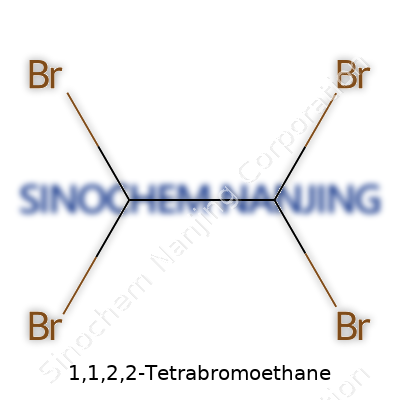
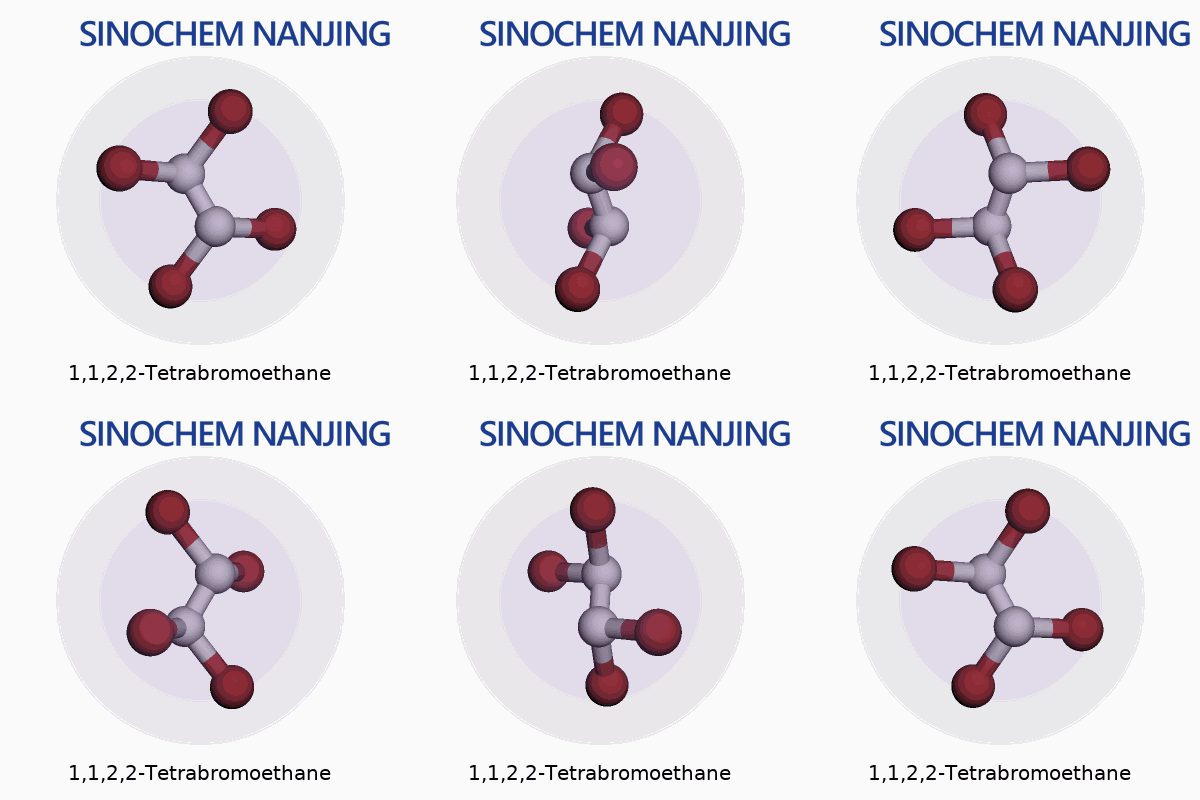
| Names | |
| Preferred IUPAC name | 2,2,2,2-Tetrabromoethane |
| Other names |
Acetylene tetrabromide Myrdbrom Tetrabromoethane TBE |
| Pronunciation | /ˌwʌnˌwʌnˌtuːˌtuːˌtɛtrəˌbrəʊməʊˈiːθeɪn/ |
| Identifiers | |
| CAS Number | 79-27-6 |
| 3D model (JSmol) | `JSmol.loadInline('load $c1ccccc1BrBrBrBr;')` |
| Beilstein Reference | 1209230 |
| ChEBI | CHEBI:38535 |
| ChEMBL | CHEMBL207223 |
| ChemSpider | 50210 |
| DrugBank | DB02071 |
| ECHA InfoCard | ECHA InfoCard: 03-2119552466-40-0000 |
| EC Number | 203-064-1 |
| Gmelin Reference | 31968 |
| KEGG | C01742 |
| MeSH | D013661 |
| PubChem CID | 8056 |
| RTECS number | KI9625000 |
| UNII | N5A7XJKQJ7 |
| UN number | UN1609 |
| CompTox Dashboard (EPA) | DTXSID3023876 |
| Properties | |
| Chemical formula | C2H2Br4 |
| Molar mass | 347.67 g/mol |
| Appearance | Colorless to pale yellow liquid |
| Odor | Odorless |
| Density | 2.967 g/mL at 25 °C |
| Solubility in water | 6.6 g/100 mL (20 °C) |
| log P | 1.93 |
| Vapor pressure | 0.003 mmHg (20 °C) |
| Acidity (pKa) | -0.19 |
| Basicity (pKb) | {pKb: 9.7} |
| Magnetic susceptibility (χ) | -62.0×10⁻⁶ cm³/mol |
| Refractive index (nD) | 1.620 |
| Viscosity | 2.967 cP (20°C) |
| Dipole moment | 2.25 D |
| Thermochemistry | |
| Std molar entropy (S⦵298) | 354.6 J·mol⁻¹·K⁻¹ |
| Std enthalpy of formation (ΔfH⦵298) | −27.3 kJ/mol |
| Std enthalpy of combustion (ΔcH⦵298) | -413 kJ·mol⁻¹ |
| Pharmacology | |
| ATC code | V09AX02 |
| Hazards | |
| Main hazards | Harmful if swallowed, causes skin and serious eye irritation, may cause respiratory irritation, suspected of causing cancer. |
| GHS labelling | GHS02, GHS06, GHS08 |
| Pictograms | GHS06,GHS08 |
| Signal word | Warning |
| Hazard statements | H302, H314, H373, H400 |
| Precautionary statements | P210, P261, P280, P301+P312, P305+P351+P338, P308+P313 |
| NFPA 704 (fire diamond) | 2-2-0 |
| Flash point | Flash point: 115°C (239°F) |
| Autoignition temperature | 563°C |
| Explosive limits | Explosive limits: 0.6–14% |
| Lethal dose or concentration | LD50 oral rat 640 mg/kg |
| LD50 (median dose) | LD50 (median dose): 175 mg/kg (oral, rat) |
| NIOSH | KN5075000 |
| PEL (Permissible) | 1 ppm |
| REL (Recommended) | 1 ppm (10 mg/m³) |
| IDLH (Immediate danger) | 40 ppm |
| Related compounds | |
| Related compounds |
Ethylene dibromide Bromoform Carbon tetrabromide 1,2-Dibromoethane |



