Zirconium Nitrate: A Grounded Look at Its Past, Properties, and Promise
Historical Development
Chemists started working with zirconium salts during the early days of modern chemistry, following the identification of zirconium itself in the late 1700s. Early efforts focused on understanding the behavior of the element and its compounds. By the late 1800s, European and American labs succeeded in preparing a crude version of zirconium nitrate by acting on the native mineral zircon with nitric acid. Over time, researchers honed methods to isolate purer products, using them in dye work, research, and eventually in more complex applications like nuclear materials and high-performance ceramics. Manufacturing scaled up during the Cold War, under the pressure of nuclear reactor development, which needed high-purity zirconium compounds for fuel cladding and chemical processes. This push for performance drove ongoing refinement in synthesis and purification, building a knowledge base that industry still draws from today.
Product Overview
Zirconium nitrate sits in a small family of specialty chemicals. Chemists mark it by its formula, Zr(NO3)4, and point to its role as both a building block for other zirconium chemicals and a unique oxidizing agent. Most labs see it as a white, granular solid or sometimes as a colorless, slightly syrupy liquid if hydrated. The product enters the market as a reagent for analytical work, as a base for surface treatments, and as a catalytic agent in some advanced syntheses. Its ability to decompose and leave clean zirconia behind draws attention from researchers working on ceramics and advanced coating technologies.
Physical & Chemical Properties
Zirconium nitrate keeps a strong, almost biting chemical smell that signals its oxidizing strength. The hydrated salt, often the most commonly handled, shows up as a faintly sticky powder that melts easily and absorbs water from the air. In contact with organic matter, it can spark reactions, releasing nitrogen oxides and creating the risk of combustion. Its solubility in water sits quite high, making it easy to use in solution-based research and industrial work. Upon heating, the solid releases brownish fumes of nitrogen oxides and leaves behind a fine layer of zirconia, which holds value in many high-tech areas.
Technical Specifications & Labeling
Industry standards define product categories using purity levels, usually at 98% or higher for research-grade salt. Labeling includes lot number, manufacture date, and purity. Material Safety Data Sheets spell out all hazards, including recommendations for storage away from heat, light, and incompatible materials like organics or strong reducers. Purity checks rely on titration and spectroscopic analysis. Some firms sell the compound stabilized with excess nitric acid, flagged clearly on the label to warn against mixing with incompatible solvents.
Preparation Method
Making zirconium nitrate calls for a reaction between high-purity zirconium dioxide—usually derived from zircon mineral—and nitric acid. The process starts by dissolving zirconia powder in concentrated nitric acid, creating a hot, strongly acidic solution. The process demands excellent ventilation, as the reaction throws off nitrogen oxides, which can choke unprepared workers. Cooling and crystallization follow, sometimes taking hours or even days for larger batches. To get the product as a pure solid, operators concentrate the solution by gentle heating and then let the nitrate crystallize out. After filtration and drying under vacuum, the compound is ready for packaging.
Chemical Reactions & Modifications
Zirconium nitrate plays a reactive role in both the lab and the factory. Mixed with ammonia, it quickly crashes out as zirconium hydroxide, which can then be calcined to give zirconia. In organic syntheses, the compound donates nitrate ions or acts as a mild oxidizer. Researchers sometimes exploit its hydrolysis behavior, adding small amounts of base to get fine, reactive zirconia particles. Chemists also try tweaking it by adding alkali metals, using it as a precursor to more exotic metal nitrates. The compound reacts quickly with strong reducing agents, raising safety concerns due to its tendency to produce nitrogen dioxide gas, a powerful respiratory irritant.
Synonyms & Product Names
Zirconium nitrate carries a full set of technical aliases, popping up in supply catalogs under names like "zirconium(IV) nitrate," "tetranitratoxozirconium," and "zirconium nitrate hydrate." Sometimes, firms describe it informally by its water content, such as "zirconium nitrate pentahydrate." In older texts, the chemical drifts under the synonym "zirconic nitrate," though this rarely appears in modern documentation.
Safety & Operational Standards
Workplace safety needs close attention when handling zirconium nitrate. It burns skin and eyes almost instantly on contact, often leaving a yellowish chemical stain. Inhaled vapors can start coughing fits and, at higher exposures, bring on inflammation or delayed lung injury from nitrogen oxide gases. Labs set up chemical hoods and spill kits before use. Workers suit up with gloves, face shields, and tough aprons. Storage lockers stay cool, airtight, and far from flammable or reducing chemicals. Waste must route through qualified hazardous disposal, with no shortcuts. Safety inspectors regularly check handling methods and ensure emergency eyewash stations keep fresh water. There’s no room for complacency—this compound punishes carelessness every single time.
Application Area
Most of the demand for zirconium nitrate comes from coatings, corrosion inhibitors, catalysts, and nuclear research. In surface technology, workers use it to deposit thin zirconia layers on metals, boosting resistance to wear and corrosion, especially for aerospace and biomedical alloy parts. Ceramics labs rely on it to prepare ultra-pure zirconia for heat-resistant and electrical insulating applications. Nuclear engineers value its role in purifying and processing zirconium, keeping reactor fuel components free from neutron-poisoning impurities. Small volumes go to analytical chemists who depend on it for precise titrations and sample digestions. Some companies experiment with it in electronic component fabrication, eyeing its ability to leave clean zirconia films on microchips.
Research & Development
The last decade saw researchers push zirconium nitrate in new directions, exploring its function in nanotechnology and advanced ceramics. By spinning it into sol-gel processes, labs squeeze out super-fine grains of zirconia, improving toughness and reducing flaws in manufactured parts. Newer studies test its value as a precursor for doped ceramics, mixing in yttrium or rare earths to get custom-made optical or mechanical properties. A few university labs explore its catalytic power, hoping to coax greener chemical reactions out of familiar industrial feedstocks. There’s steady R&D on refining preparation steps, aiming to slash energy use or eliminate noxious emissions during large-scale production—a key focus for climate-conscious manufacturers.
Toxicity Research
Concern runs deep about worker exposure, given the compound’s knack for irritating airways and skin. Toxicologists charted the acute hazards early on but started looking into chronic effects only recently. Most studies confirm that short-term exposure causes symptoms like coughing, skin burns, and watery eyes. Long-term inhalation, at moderate levels, risks more serious lung disease. Animal studies back up these warnings, showing damage to the lining of the lungs after repeated inhalation. On the environmental side, researchers watch for downstream effects from improper disposal, noting that heavy nitrate runoff can disrupt aquatic ecosystems through eutrophication, a risk that sharpens regulations around factory waste streams. Today’s industry standards rely on tight process controls and medical surveillance programs for those who work with or near this compound.
Future Prospects
Looking ahead, zirconium nitrate could play a surprisingly wide role in green technology and advanced manufacturing. As the world leans harder into clean energy, demand for tougher, purer ceramics grows in parallel, and most pathways to those products run through specialized salts like this one. Electronics manufacturing stands to gain from thinner zirconia films and refined coating procedures, potentially slashing defects in next-generation chips or sensors. Researchers also test the compound as a base for safer, more efficient catalysts in industrial chemistry, already pointing toward reductions in process waste and hazardous byproducts. Regulatory pressure will keep driving innovations in waste treatment and personal protection, funneling R&D cash into safer alternatives or lower-impact production. If society can keep risks in check, this workhorse chemical will anchor more breakthroughs—on Earth and maybe even in spaceborne materials production.
What are the primary uses of Zirconium Nitrate?
Key Applications You Can’t Ignore
Zirconium nitrate pops up across science and industry, but its story rarely makes headlines. Folks often overlook this compound, yet it helps things run behind the scenes in chemical labs, process plants, and even the energy sector. I’ve worked in chemical research long enough to notice how compounds like this quietly support technologies that many people count on every day.
From Labs to Manufacturing Lines
Many chemists appreciate zirconium nitrate for its role as a catalyst. Those seeking fine-tuned results in synthesis choose it because it brings a punch to certain organic transformations. In my experience, researchers often rely on it for preparing other zirconium compounds or kicking off polymerization reactions that would otherwise stall. Take the manufacturing of specialty glasses and ceramics. Instead of sticking to common additives, engineers here put zirconium nitrate in their mixes because it encourages the chemical changes they want. The end products come out tougher, more heat-resistant, and sometimes even more attractive.
Zirconium nitrate also proves itself in the water treatment field. Some facilities use it to prep surfaces that will later purify water or filter out unwanted ions. In this line of work, stability under pressure and good reactivity matter a lot. I’ve met environmental engineers who trust compounds like this for coating filtration membranes. They’re always on the hunt for ways to make water cleaning more effective, and they swear by these chemical enhancements when explaining improved results.
Specialty Uses in Energy and Pyrotechnics
People chasing the next breakthrough in nuclear power pay close attention to zirconium compounds, including the nitrate form. Zirconium absorbs very few neutrons, which makes it golden for fuel rod cladding. Before it lands in a reactor, folks use the nitrate to craft pure zirconium oxides and metals with the right consistency. Safety and reliability here aren’t negotiable, so the quality of each chemical step takes on a real urgency.
Pyrotechnicians find another use for this compound. Zirconium nitrate provides a stable oxygen source in specialized pyrotechnic mixes. I remember a demonstration at a safety training session where experts broke down how compounds like this control burn rates and help create color effects, all while minimizing unwanted byproducts. These displays pop up at mining sites and in the military, where controlling reactions isn’t just about entertainment—it's about getting the job done safely.
Kinks in the System
Zirconium nitrate’s uses build on its unique chemical behavior, but handling it requires real care. Corrosive and oxidizing, it can cause harm if someone skips proper protective gear or ignores safe storage practices. In an industrial setting, I’ve seen cases where poor labeling or old storage drums became near-misses—reminders that materials management matters as much as chemistry know-how.
The price and supply chain for this compound also pose a challenge, especially as rare minerals remain tangled in international politics and environmental rules. Some countries hold the lion’s share of zirconium reserves, which can leave buyers hunting for stable sources or looking to stockpile.
Paving the Way to Safer, Smarter Processes
Safer alternatives do get some attention, but few deliver the exact results that zirconium nitrate offers. Scientists keep looking for ways to recycle these compounds or convert waste into something less risky. In labs, more training on chemical handling and smarter sourcing help reduce accidents and supply hiccups. The push for better transparency along the production chain could make it easier for buyers and regulators to track where these materials come from and spot trouble before it hits operations.
What is the chemical formula of Zirconium Nitrate?
The Basics: Chemical Make-Up
Zirconium nitrate goes by the formula Zr(NO3)4. This simple arrangement packs a punch in the chemistry world. You start with the element zirconium and bond it with four nitrate groups. That’s it—yet that combination drives some unique behaviors, making this compound a topic worth more than a passing glance.
Why Does Zirconium Nitrate Matter?
Zirconium nitrate doesn’t pop up much on the shelves of your local shop, but it sits inside a toolkit for chemists handling serious jobs. In my time as a lab technician during university, I discovered it has quirks you can’t ignore. Combine it with water—it dissolves easily and forms a vivid solution. Hit it with heat and you won’t be left with nitrate for long. Nitrate groups break down, and you’re left with different zirconium oxides, which behave in a completely new fashion. This quality turns it into more than just a building block for other compounds.
Factories chasing new flame retardants and developers working on corrosion-resistant surfaces both turn to zirconium nitrate. The field of nuclear power engineering leans on these properties, not only for their reactivity but for how zirconium resists corrosion so stubbornly. The nitrate part gives chemists flexibility. They get to introduce other useful chemicals through reactions that would stall out with simpler ingredients.
Bigger Picture: Safety and Environmental Impact
Holding a substance like zirconium nitrate in your hand isn’t a job for the careless. This compound eats through organic matter quickly if spilled and produces toxic fumes under heat or moist conditions. In my college lab, a single careless drop on a bench meant the technician had to clear the area. Safety goggles became more important than coffee.
There’s also the matter of nitrate pollution. Runoff from industrial runoff can boost nitrate levels in water, risking algae blooms or messing with the balance of river life. Industry leaders face pressure to maintain safety, not just for staff, but for the environment as well. Scrubbing technologies and waste management steps pop up throughout any company working with zirconium solutions. As regulations on nitrate emissions tighten, research into recyclable or less hazardous compounds gains ground. People want strong results without wrecking the land or water near their factories.
Finding Alternatives and Managing Risks
Research teams search for methods that deliver the performance of zirconium nitrate, but with less environmental baggage. Some focus shifts to different zirconium compounds—like zirconium oxide, or even combined systems that don’t rely on nitrates at all. Still, for critical specialty processes, companies stick with zirconium nitrate because of the results it brings to the table.
Training for safe handling and environmental controls remains the backbone of responsible work with this compound. Regular inspections, thorough emergency plans, and efforts to catch spills before they grow into disasters—these aren’t mere formalities. I’ve seen how a staff alert to the dangers of such reagents prevents major headaches down the line. Chemical safety updates aren’t about box-ticking; they protect real people doing demanding work.
Wrapping Up: Hard Facts, Real Consequences
Zirconium nitrate stands as both a tool and a challenge. Its formula—Zr(NO3)4—looks simple on a blackboard, but the decisions around its use ripple far beyond that simplicity. From fireproofing to nuclear safety, and from chemical reactions to water quality, the impact of handling it right speaks much louder than the dry data on a label ever could.
Is Zirconium Nitrate hazardous or toxic?
Understanding Zirconium Nitrate in Everyday Settings
Walking through a lab or a manufacturing plant, you spot labels with chemical names like zirconium nitrate. For many, it’s just another hard-to-pronounce ingredient. Up close, it’s a crystalline powder that dissolves in water and adds value to ceramics, fireworks, and some chemical processes. Beneath the surface, the focus shifts to safety—what risks come from coming into contact with or using zirconium nitrate?
Hazard Profile: Irritation, Not Mass Poisoning
Experience in chemistry classrooms and industry taught me to read safety sheets closely. Zirconium nitrate can irritate the skin or eyes and inhaling its dust is a bad idea. Reports from workers handling this compound highlight coughing, sneezing, and watery eyes when exposed without proper gear. One study from the National Institute for Occupational Safety and Health (NIOSH) flags respiratory irritation as a concern.
Swallowing zirconium nitrate isn’t a regular problem, but if it does happen, people complain of mouth and throat burning and stomach discomfort. Curiosity about cancer or organ damage sometimes comes up. Up to now, research hasn’t linked zirconium nitrate with cancer in humans or with reproductive health issues. This isn’t a free pass—absence of long-term proof doesn’t mean zero risk.
Environmental Impact: More Than Just Human Health
Working in environmental labs taught me that chemicals don’t just disappear after use. Spilled zirconium nitrate dissolves in water and can slip into canals or soil. While zirconium itself isn’t known for wildlife toxicity, the nitrate part can be a problem for aquatic systems, fertilizing algae blooms or affecting small critters in rivers. Europe’s REACH regulations rank it as hazardous for aquatic life with long-lasting effects, underlining the need to manage waste responsibly.
What Real-World Experience Shows
Lab stories stick with me—once, a beaker spilled, sending white clouds of dust onto the bench. Gloves and eye protection minimized harm, but the sharp odor lingered. It drove home the message: respect chemicals, don’t take shortcuts. Even with “low toxicity” labels, not every exposure is harmless. Mild cases pop up because someone dropped their guard, not because the material is inherently deadly.
Fire safety deserves a special word here. Zirconium nitrate can intensify fires, especially if it touches organic material. It provides oxygen to flames—an oxidizer in chemical terms. The fire department’s caution list includes this material for that reason.
Reducing Risk: Simple Steps That Work
Some solutions are boring but proven. PPE—gloves, goggles, dust masks—keeps most exposures in check. Good airflow in workspaces lowers dust, and storing the powder in tightly sealed containers blocks accidental spills. Following recognized disposal rules stops contamination. Training makes a difference: workers who really know their material tend to avoid both routine accidents and headline-making mistakes.
People handling chemicals like zirconium nitrate owe it to themselves and their coworkers to ask questions and stay alert. Safety isn’t just learning a rulebook; it’s creating a culture where nobody gets harmed because someone decided to save time or skip a small step. That approach pays off beyond the workplace, protecting the environment and the wider community too.
How should Zirconium Nitrate be stored and handled?
The Risks of Zirconium Nitrate
Zirconium nitrate rarely grabs headlines, but in labs and certain industries, it has a knack for causing big problems when ignored. A real risk comes from its oxidative properties. This stuff reacts fiercely with organic materials and reducing agents. I’ve seen chemists get complacent around such chemicals, only to stumble into sharp lessons about safety. Too often, storage mistakes lead to fires or releases of toxic gases. Every safety step matters.
Smart Storage in Real World Settings
Forget fancy jargon. Storing this chemical in a cool, dry spot makes a big difference. Moisture triggers reactions, so keep it away from sinks, windows, and humid zones. I usually look for climate-controlled cabinets with good airflow. It feels like overkill to some, but storing chemicals like zirconium nitrate in containers made of compatible materials is a real hedge against accidents. Plastic with tight lids, clearly labeled bottles, and no improvising with secondary containers from the kitchen drawer.
Lab veterans skip shelves above eye-level, especially if containers might fall. Most injuries I have seen came from rushed or careless handling — grabbing bottles from awkward heights, or stacking more weight on a shelf than it can bear. Accidents often happen at quitting time, when people just want to finish up and go home. Taking the time to put things back properly avoids headaches later.
Keep Good Company in Storage
Rule of thumb: don’t mingle oxidizers with flammable goods or acids. Just because storage isn’t a high-tech process doesn’t mean it’s casual. At my first internship, I saw how much trouble can follow from letting oxidizers share space with solvents or scraps of paper. Even pencil shavings can go up in smoke from the wrong leak or spill.
Workplaces with tight space often cut corners, but separate, lockable cabinets for oxidizers stand between a routine day and a chaotic emergency. Fire marshals in my area recommended color-coded or clearly marked storage to help newcomers avoid risky combinations. I’ve found these small steps beat even the most complicated paperwork at keeping people safe.
Handling Practices that Prevent Trouble
Personal experience sticks with me more than any rulebook. I never open new containers unless I wear gloves and goggles. No catch-all bowl for used tools or pipettes – contamination snowballs fast. One slip, and chemical residues build up. In shared labs, clear job assignments work best: one person manages chemical dispensing, cleans up spills, and signs off on logbooks. This creates accountability. People remember their safety habits when they know it reflects on them personally.
Spills call for speed and attention. Most labs post spill kits nearby, and I recommend everyone practice using them. Silicon-based absorbents work better than clay, which can sometimes react. Used absorbents go straight to hazardous waste buckets, out of reach from casual passersby and well-labeled to avoid mix-ups. Air-curing a spill is never an option, since vapors pack a health punch and linger longer than anyone expects.
Training Makes the Difference
Reading all the safety data sheets in the world won’t match a few hours of hands-on training. Real understanding comes from seeing how colleagues handle emergencies, set up storage areas, and manage each step. Ask for refreshers if unsure, and treat storage and handling like skills to sharpen, not chores to skim. The more people treat these details as part of the work, the fewer stories I hear about preventable disasters with chemicals like zirconium nitrate.
What are the physical properties of Zirconium Nitrate?
Getting to Know Zirconium Nitrate
Zirconium nitrate stands out as a colorless, crystalline compound. Working in labs, I’ve noticed its appearance often throws people off because they expect a bright or distinctive color from strong oxidizers. In reality, it looks almost deceptively plain, taking the form of slightly clumpy or granular crystals. This character comes from how the molecule latches onto water from the atmosphere, leaving the crystals feeling a bit sticky if exposed for too long.
Melting and Boiling Points
Zirconium nitrate doesn’t really melt in the traditional sense. Instead, it starts to decompose at a temperature just below 100°C, right around the temperature for boiling water. Any attempts to heat it above this temperature trigger a breakdown of the compound, leading to nitrogen oxide gases that you really don’t want wafting through a workspace. Instead of acting predictably, heating brings a complex cascade of decomposition rather than a smooth transition from solid to liquid.
Hygroscopic Nature and Solubility
This compound absorbs water like a sponge, an important point for anyone storing or handling it. Within minutes in humid air, it starts to liquefy, soaking up moisture and changing its texture. Its strong affinity for water means it dissolves fast in water, forming clear and colorless solutions. This property shows up all the time as a blessing and a curse. On one hand, it opens up options for aqueous chemistry. On the other hand, storage always becomes a race against time and humidity.
Density and Crystalline Form
Zirconium nitrate usually turns up as a pentahydrate, which means each molecule clings onto five water molecules. This version has a density of about 2.3 g/cm3, feeling dense and gritty as you handle it in the lab. Compared to salts like table salt—sodium chloride—zirconium nitrate feels weightier in small samples, adding to the sense that you’re handling a specialty chemical rather than a kitchen staple. The pentahydrate’s true crystalline nature sometimes gives it a slight sheen under strong light, but for most practical purposes, it shows up as off-white lumps or powders.
Oxidizing Power and Reactivity
The oxidizing nature sets zirconium nitrate apart. In the open air, it remains stable enough in sealed containers, but once it hits organic material or reducing agents, reactions can get vigorous. One memorable lab incident involved someone accidentally brushing metal filings into a spill of damp zirconium nitrate, leading to light fizzing and some light-hearted panic. The compound’s strong oxidizing power isn’t a footnote; it guides every decision on storage, safety, and disposal.
Handling Challenges and Practical Concerns
Experience in the lab keeps teaching me that storing zirconium nitrate demands respect for its moisture-hungry nature. Desiccators and sealed jars become non-negotiable. Even with the best intentions, a humid day can ruin a week’s supply within hours. Cleaning up spills with dry methods is crucial because adding water just spreads the mess and kicks up more fumes. Anyone working with it needs chemical splash goggles, gloves, and good ventilation. The compound’s tendency to produce nitrogen oxides as it breaks down is no joke; you don’t want to take shortcuts with your lungs.
Why These Things Matter
Knowing the physical properties of zirconium nitrate goes way past trivia. Every property changes your approach—from choosing storage solutions to avoiding accidents in the lab. By understanding the gritty reality of how the compound behaves, chemists avoid ruined reagents, protect their health, and make sure experiments stay reliable from start to finish. That direct experience with how a chemical acts often counts for more than any textbook entry—it keeps the work both safe and productive.
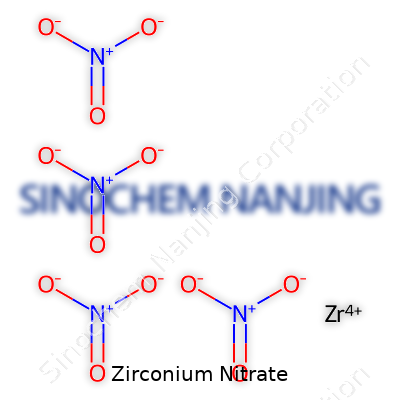
| Names | |
| Preferred IUPAC name | zirconium(IV) nitrate |
| Other names |
Zirconium dinitrate Zirconyl nitrate Zirconium(IV) nitrate |
| Pronunciation | /zɜːrˈkoʊniəm ˈnaɪtreɪt/ |
| Identifiers | |
| CAS Number | 13746-89-9 |
| Beilstein Reference | 3589104 |
| ChEBI | CHEBI:86329 |
| ChEMBL | CHEMBL1201561 |
| ChemSpider | 21171248 |
| DrugBank | DB09437 |
| ECHA InfoCard | 100.029.214 |
| EC Number | 231-715-8 |
| Gmelin Reference | 120185 |
| KEGG | C18668 |
| MeSH | D015592 |
| PubChem CID | 24568 |
| RTECS number | ZW2600000 |
| UNII | 4V50WD1237 |
| UN number | 1437 |
| Properties | |
| Chemical formula | Zr(NO3)4 |
| Molar mass | 251.242 g/mol |
| Appearance | White crystalline solid |
| Odor | Odorless |
| Density | 2.8 g/cm3 |
| Solubility in water | Very soluble |
| log P | -4.6 |
| Vapor pressure | Negligible |
| Basicity (pKb) | -4.2 |
| Magnetic susceptibility (χ) | +84.0e-6 cm³/mol |
| Refractive index (nD) | 1.505 |
| Viscosity | 4.65 cP (25 °C) |
| Dipole moment | 4.44 D |
| Thermochemistry | |
| Std molar entropy (S⦵298) | 231.6 J mol⁻¹ K⁻¹ |
| Std enthalpy of formation (ΔfH⦵298) | -1070.6 kJ/mol |
| Pharmacology | |
| ATC code | V07AB30 |
| Hazards | |
| GHS labelling | GHS02, GHS05, GHS07 |
| Pictograms | GHS01,GHS05,GHS07 |
| Signal word | Danger |
| Hazard statements | H272, H315, H319, H335 |
| Precautionary statements | P210, P220, P221, P264, P280, P370+P378, P305+P351+P338, P337+P313, P501 |
| NFPA 704 (fire diamond) | 3-0-1-OX |
| Autoignition temperature | 250°C |
| Lethal dose or concentration | LD50 oral rat 2250 mg/kg |
| LD50 (median dose) | > 4,640 mg/kg (rat, oral) |
| NIOSH | SN29300 |
| PEL (Permissible) | PEL (Permissible Exposure Limit) for Zirconium Nitrate: "5 mg/m³ (as Zr) |
| REL (Recommended) | 10 mg/m3 |
| IDLH (Immediate danger) | 100 mg/m3 |
| Related compounds | |
| Related compounds |
Zirconyl nitrate Zirconium oxide Zirconium chloride Zirconium sulfate |



