Valeryl Chloride: Legacy, Science, and Future Directions
Historical Development
Humans have a way of chasing both the strange and useful, and the story of valeryl chloride fits the bill. By the late nineteenth century, as organic chemists learned to tinker with carbon chains and functional groups, the demand for special-purpose reagents also grew. Valeryl chloride, with its five-carbon backbone capped with an acyl chloride, became part of a small but powerful group of chemicals used in the labs that gave rise to the early pharmaceutical and materials industries. German and French chemists found that swapping out acetic or propionyl chloride for its heavier cousin changed the behavior of reactions, building blocks for drugs, and industrial compounds. Its use kept spreading wherever esterification and acylation offered new chemical frontiers.
Product Overview
Valeryl chloride, sometimes called pentanoyl chloride, is an acyl chloride based on valeric acid. Chemists reach for it to introduce a five-carbon acyl group into organic molecules quickly. It makes appearances in labs dealing with pharmaceuticals, agricultural chemicals, and dyes, and keeps finding niches wherever a longer acyl chain changes molecular properties. Clear to pale yellow and unmistakably pungent, this liquid shows up in brown glass bottles bearing hazard stickers, destined for careful hands.
Physical & Chemical Properties
What strikes anyone working with valeryl chloride is both its volatility and its reactivity. The boiling point sits around 130°C, with a melting point well below room temperature. It's heavier than water but doesn’t mix with it, and any careless drip into a water bath sends out white clouds of hydrogen chloride—no mistaking that sour note in the air. The molecule packs a five-carbon chain capped with a linear carbonyl chloride, formula C5H9ClO. It reacts swiftly with nucleophiles, swapping out the chloride and locking in new functionalities.
Technical Specifications & Labeling
Walk into a well-run chemical storage room, and valeryl chloride bottles catch the eye with their explicit hazard diamonds: corrosive to skin, violent in water, and reactive with many common reagents. Spec sheets will note a minimum assay of 98%, a water content below 0.5%, and few other impurities—too much valeric acid, and the product doesn’t perform the way chemists expect. Each drum or flask gets a UN identification for transport, and labeling spells out the need for gloves, goggles, face shields, and working fume hoods. There’s no faking it: mishandling means trouble.
Preparation Method
Manufacturers rely on a straightforward recipe rooted in classic organic synthesis. Start with valeric acid, produced from fermentation or synthesis. Add thionyl chloride or phosphorus pentachloride under controlled cooling, and the reaction transforms the acid into the acyl chloride, with hydrogen chloride and sulfur dioxide (or phosphorus oxychloride) vented off. Every operator must track the water meticulously—too much ruins yield and quality. The final distillation shines the product up, ready to be bottled under anhydrous conditions for transport.
Chemical Reactions & Modifications
Chemists pull out valeryl chloride for its ability to hand over a pentanoyl group in a snap. Pour it into a flask of alcohol, and an ester forms, with hydrochloric acid hissing off as a byproduct. Add it to an amine, and the result is an amide—a key linkage in pharmaceuticals, dyes, and plastics. Chloride’s a good leaving group, so once it takes off, the rest of the molecule locks together neatly, which helps speed things up and keeps side reactions to a minimum. Playing around with conditions lets you steer toward ketones, thioesters, or even substituted aromatic compounds using Friedel–Crafts conditions or other catalysts.
Synonyms & Product Names
Across catalogs and regulatory documents, the name valeryl chloride alternates with pentanoyl chloride. In some historic printed guides, you’ll spot “butanecarbonyl chloride” or “n-pentanoyl chloride.” Each name circles back to the same chemical: C5H9ClO. Laboratories often stick to CAS numbers—638-29-9—for ordering, sidestepping translation troubles.
Safety & Operational Standards
Handling valeryl chloride means respecting its dangers from start to finish. Any direct contact causes burns, rashes, or serious eye damage, and splashes into water deliver a punch of hydrochloric acid vapor. Workers need to keep air flows running and reactive gear separate, as even traces of moisture set off unwanted fumes. Industry standards put valeryl chloride under strict controls, with spill kits, emergency showers, and inspected ventilation topped up by secondary containment. Training matters: only experienced handlers should reach for this bottle.
Application Area
Pharmaceutical makers have turned to valeryl chloride for crafting prodrugs, antibiotics, and active pharmaceutical ingredients where a longer acyl chain changes absorption or metabolic rate. Pesticide developers use it for tweaking lipophilicity and persistence in soil. Polymer chemists play with valeryl groups for engineered resins and specialty plastics, tuning melting points, flexibility, or chemical resistance. Even perfume and flavor houses once explored this compound, searching for esters that offer intriguing aromas, but the risk from residual acyl chloride limited direct consumer use. Each sector finds value and challenge: the product opens doors but makes everyone work for it.
Research & Development
Academic groups and industrial chemists keep exploring new uses for valeryl chloride, particularly for building block efficiency in new materials and drugs. It stands out for the way its five-carbon chain can change solubility, permeability, and structure-activity relationships. Scientists looking into antibiotics, anti-cancer agents, and crop protectants ask if a pentanoyl tweak shifts biological activity or environmental persistence. Newer enzymatic and green chemistry protocols aim to cut down on harsh byproducts and push more sustainable chemistry, leveraging flow reactors or solid-supported reagents to keep reactions quick and cleaner.
Toxicity Research
Valeryl chloride attracts serious scrutiny from toxicologists. Direct exposure delivers acute burns, blistering, and lung trouble, meaning personal protection can’t be optional. Risk assessments note moderate oral toxicity in mice and rats, with most harm coming from local tissue destruction more than systemic absorption. Chronic effects remain less well understood, but organochlorine compounds in general demand caution. Regulatory agencies call for monitoring workplace air, using sealed handling, and banning use outside professional settings. The byproducts—hydrogen chloride, valeric acid—raise separate health and environmental questions, especially if neutralization steps aren’t up to par.
Future Prospects
The demand for valeryl chloride will likely rise as specialty pharmaceuticals and agricultural products look for unique structure modifications. Green chemistry circles push for process improvements—switching out thionyl chloride for less polluting acylation methods, catching and treating vapors, and moving to closed-loop systems. Analytical chemists work on detection methods to catch accidental releases quickly and keep operators safe. In my own experience, labs that put in the effort to improve handling and waste management offer a safer and more productive space for novel chemistry. Growth comes with responsibility: those who master both the art and the safety behind this unique molecule will drive it into future breakthroughs.
What is Valeryl Chloride used for?
Digging Into Its Real-World Roles
Plenty of people outside of chemistry circles haven’t heard of valeryl chloride, but its impact shows up in everyday life. Working in a chemistry lab some years ago, I saw barrels coming in with clear warnings—this stuff isn’t for careless hands. So, what’s making valeryl chloride so valuable? It’s got to do with how it shapes other materials, and many of them matter more than you’d imagine.
Turning Raw Materials Into Everyday Products
Valeryl chloride serves as a fast-reacting building block. Chemists reach for it to set off chemical reactions. This doesn’t just mean lab experiments—companies rely on this compound as an “acylating agent,” which takes simple molecules and adds more complex chains onto them. Through this process, valeryl chloride creates pieces that form drugs, fragrances, flavors, and several plasticizers.
In pharmaceuticals, this chemical helps build the backbone of certain drugs. For example, making painkillers and other medicines often kicks off by tying together molecules with this ingredient. If you’ve picked up allergy medication or antibiotics at a store, there’s a fair shot valeryl chloride contributed a step or two in the process.
Perfume companies like to use it, too. Fragrance chemists add valeryl chloride to make esters, which provide many of those fruity, pleasant smells people enjoy. The same goes for flavorings. Think of those tastes in candies and sodas—the “esterification” reaction powered by valeryl chloride helps deliver those signature notes.
The Safety Side Few People See
Valeryl chloride isn’t a chemical for casual use. In every facility where I saw this handled, the rules felt strict for good reason. This chemical can release hydrogen chloride gas—the kind of stuff that burns eyes and lungs. Workers in chemical plants wear full gear, check air flow systems, and run regular inspections. It’s not just caution, it’s a requirement set out by agencies like OSHA and the EPA, both of which classify valeryl chloride as a hazardous substance.
Reports from the National Institute for Occupational Safety and Health provide clear advice on protective practices. Direct contact can cause burns, and breathing the gas for an extended time might lead to serious lung damage. Because of these risks, only trained professionals handle this substance, always in well-ventilated settings and with clear spill protocols.
Trouble With Production and Disposal
Every ton of valeryl chloride made or used leaves behind problematic waste. Chemical plants run scrubbers to pull out harmful fumes from the air, but even the best systems need regular checks. Communities near large manufacturing centers sometimes raise concerns over leaks and accidental releases. Environmental reviews published in regulatory filings raise questions about how to keep soil and water safe from contamination.
Growing awareness around environmental safety pushes more companies to refine how they manage valeryl chloride. Factories shift toward closed-loop systems, where nothing escapes into the air, and waste treatment focuses on breaking down dangerous byproducts into less harmful forms. Engineers and chemists look for cleaner alternatives, yet many current products still count on valeryl chloride’s unique reactivity.
Moving Toward Better Use
Knowledge of the risks and benefits shapes smarter approaches. From my own time working in a chemical plant, the difference came from teams learning how to spot the early signs of a leak, report issues without hesitation, and get everyone on the same safety page. Manufacturers that prioritize this awareness cut down on accidents, protect their staff, and shield communities near their sites.
Valeryl chloride’s story isn’t just about what it creates, but how people use and control it. Continued research into safer methods, both in making and disposing of it, could lead to fewer accidents and a smaller environmental footprint. At the same time, recognizing how often it underpins daily products lets us see the hidden science behind familiar items, reminding us that responsibility matters even far from the spotlight.
What are the safety precautions when handling Valeryl Chloride?
What Makes Valeryl Chloride Demanding?
It’s clear from the first whiff—Valeryl Chloride isn’t something to treat lightly. That sharp, pungent smell does more than wrinkle noses. A splash of this liquid can turn skin raw, and a single breath of its fumes hits the nose and throat. Chemists, lab techs, and anyone in research know the drill. I’ve worked with reagents that let me get away with some mistakes. Valeryl Chloride doesn’t give that luxury.
This chlorinated compound reacts fast with water, giving off hydrochloric acid and other harsh fumes. So, if there’s one message that’s stuck with me from chemical safety training, it’s this: keep Valeryl Chloride sealed and respect every drop.
Practical Protection: The Gear I Trust
Handling Valeryl Chloride means getting suited up. I grab a heavy lab coat, chemical-splash goggles, and gloves rated for organic solvents—nitrile or butyl, never latex. I once had a colleague forget this step. A tiny spill chewed through a cotton lab coat in minutes and left a painful burn on the forearm. People think household gloves will cut it, but they turn brittle and leak. Proper gloves keep hands safe and let me move confidently.
I never work with this chemical on an open bench. Working under a well-ventilated fume hood keeps the worst vapors away. I keep the sash low—a small opening leaves less room for fumes to sneak past. Spray bottles and squirt bottles stay far away; everything goes into glassware marked for corrosives, with tight stoppers and no cracked seals.
Handling Spills and Reactions
Accidents happen even on careful days. If something leaks, I reach for a spill kit, not a paper towel. Paper makes vapors worse, and water brings trouble. Neutralizing agents—solid, not liquid—work best. I remember once trying to mop up a spill with baking soda and watching the cloud that came up. After that, I switched to acid-neutralizer granules made for labs. They soak up the spill and keep the air clearer. Once contained, everything goes into a sealed bag labeled for hazardous waste.
Storage and Waste
Valeryl Chloride never stays out on my bench. I keep it in tightly closed bottles, with the original label clear and facing forward in a vented chemical cabinet. Even a small leak can damage nearby supplies and set off alarms. Disposal takes real planning. It can’t go down the sink or in the trash. A licensed waste disposal service handles all waste containers. There’s always a handwritten log, tracking every gram until it leaves the facility.
Why All This Matters
Over time, I’ve seen plenty of near-misses and a few close calls. One time, a splash landed on a benchtop, and fumes drifted across the room. Two people ended up coughing all afternoon, even though nobody touched the liquid itself. If our hoods weren’t working and nobody wore goggles, things could have gotten much worse. Chemical regulations aren’t just paperwork. Proper handling prevents fires, injuries, and lingering health problems.
Valeryl Chloride demands focus and preparation. Posting safety guidelines by every bench, checking fume hoods twice each week, and teaching new lab members about proper handling all help keep everyone healthy. Sharing worst-case stories sticks with people far longer than a checklist. We work with dangerous tools because we’re trying to build something new; safety lets us get there without getting hurt.
What is the chemical formula of Valeryl Chloride?
Chemical Formula: C5H9ClO
Valeryl chloride steps into the chemistry world with the formula C5H9ClO. That string of letters and numbers may seem like alphabet soup, but each atom tells a story about what this compound can do. Five carbon atoms, nine hydrogens, one chlorine, and one oxygen. Those numbers point toward a very specific structure that’s common in laboratories and industrial manufacturing alike.
Everyday Encounters with Valeryl Chloride
People outside chemical plants rarely hear about valeryl chloride. Tucked away in glass bottles on laboratory shelves, it rarely gets publicity. Yet, its formula forms the basis for all sorts of products we do hear about: fragrances, specialty plastics, and certain medicines. In college labs, I watched as my chemistry professors handled this reagent with heavy gloves, always under a fume hood, teaching us the golden rule of respecting both its power and its hazards.
Most folks never see or touch this compound on its own, but many enjoy the outgrowths made possible by its use. That perfume you catch in an elevator, or a plastic part in your car, may trace its origins to reactions involving this particular acid chloride. So, even though it’s tucked out of sight, the consequences of mishandling could ripple out fast. Just a whiff of valeryl chloride stings your nose and eyes; improper disposal can cause bigger headaches for workers, communities, and the environment.
Why Do We Need to Know About It?
Chemistry isn’t just about memorizing formulas like C5H9ClO. It’s about understanding the risks, benefits, and the chain of custody that follows each bottle. Valeryl chloride reacts briskly with water, producing hydrochloric acid fumes. In the wrong hands or the wrong place, this brings health risks. A minor spill in a classroom once reminded me just how quickly vapors could fill a room—a lesson nobody forgets.
Those who work with chemicals carry the burden of care for everyone downstream. From safe storage to smart transport, missing even a single detail could start a series of events with real consequences. Laws exist for a reason, but what matters most comes down to culture—engineers, technicians, and students look out for each other and the community at large. Clear communication and hands-on training keeps dangerous surprises in check.
Better Practices, Safer Outcomes
The formula C5H9ClO means much more than the sum of its atoms. It stands as a reminder that safety never goes out of style. Keeping valeryl chloride contained, labeling it clearly, and building in emergencies response plans works better than any one gadget or rulebook alone. People matter more than any single chemical.
Moving forward, I believe more open education about handling high-risk substances reduces mistakes. Encouraging curiosity along with deep caution pays off for everyone involved. If the next generation of chemists sees safety as a daily habit, not just classroom theory, we’ll have fewer accidents and longer careers.
In short, recognizing what C5H9ClO can do—both good and bad—landmarks smarter choices. That’s the kind of knowledge every community deserves.
How should Valeryl Chloride be stored?
The Ignored Details: Everyday Realities of Chemical Storage
Storing valeryl chloride isn’t just a box-ticking exercise. With years spent around chemical plants and small labs alike, one thing stands out: chemicals known for their sharp, stinging smell and reputation for being highly reactive never let you cut corners. Valeryl chloride sits in that category. Anyone who’s had to clean up after an accidental spill knows the headache—literally and figuratively—that comes from underestimating this colorless liquid.
I’ve watched new staff walk into a storeroom piled high with dusty glassware and quickly sense something’s “off.” That smell, irritating to the eyes and nose, signals poor sealing or, worse, a leaky valve on an old drum. Companies that take chemical storage lightly wind up wasting money, risking health, and, in serious cases, facing regulatory penalties.
The Risks Lurking in Plain Sight
Valeryl chloride reacts with water and gives off hydrogen chloride gas. That gas, once released, can corrode surfaces, burn skin, and cause respiratory distress. It doesn’t take much moisture—sometimes just humid air will start the trouble. So, storing it in a dry spot, away from humidity, can sidestep major headaches.
I’ve seen metal drums with corroded lids thanks to careless placement under leaky pipes. Even in supposedly “climate-controlled” rooms, shifting temperatures and lackluster checks can form condensation inside containers, fueling reactions and slow leaks.
Fire is another genuine threat. Valeryl chloride ignites easily and spreads flames quickly. I recall a warehouse near our lab that lost thousands in damages, not from a full-on fire, but from one forgotten bottle leaking vapors that caught a pilot flame. No one wants to call the fire marshal over something so avoidable.
Solutions That Actually Work in Practice
In my time, I’ve seen smart and simple methods keep dangerous chemicals under control. Start with a chemical-resistant, airtight container—usually glass with a quality PTFE (Teflon) seal works well. I skip plastic since it softens or deforms. Every time someone ignores this step, they pay for it later with messes or lost product.
Next, I favor using a cool, ventilated storeroom. Fluctuations in temperature speed up breakdown, which can shoot vapors right out of a container, even those looking properly closed. Dedicated exhaust fans cut down on that risk.
A clear, visible label with hazard warnings stands between safe storage and confusion. I’ve seen errors where a rushed worker grabbed the wrong container and ended up sending coworkers to the nurse’s station. No label, no safety.
Chemical segregation saves lives. Valeryl chloride shouldn’t get cozy with water, alcohols, or bases. Mixing up shelves—usually from trying to cram everything into one cabinet—only breeds emergencies. I always keep strong acids and reagents on their own shelves, with spill trays underneath. It’s tempting to ignore segregation for space, but every chemical handbook spells out reaction hazards for good reason.
Routine inspection: it sounds basic but checks catch loose caps, bulging bottles, and sneaky leaks. In my workplace, we set aside time every week to walk the storage area. Finding a small leak before it wreaks havoc has paid off more times than I can count.
PPE forms the last line of defense. Goggles, gloves, and lab coats stop splashes from reaching skin or eyes. I keep extra gloves and eyewash fluid nearby because, after all these years, accidents still catch even seasoned hands off guard.
The Value in Getting It Right
Safe storage for valeryl chloride isn’t just about following legal rules—it protects people, equipment, business, and, in the end, peace of mind. I’ve learned from hard lessons and close calls. Respecting a challenging chemical pays off every time—by keeping harm offsite and everyone else heading home in good health.
What are the potential health hazards of Valeryl Chloride exposure?
What Happens After Breathing It In
Valeryl chloride often gets overlooked outside of the lab, though people who work around it can tell you the smell is sharp and irritating. Breathe it in for just a few seconds and you’ll probably feel your throat sting and your eyes water. Short-term exposure usually leads to coughing, shortness of breath, or an uncomfortable scratch in the chest. Dose matters. Workers in chemical plants can end up gasping for air or dealing with chest pain after heavy exposure. Long-term inhalation carries real risk for serious lung problems — not just a passing irritation. Damage to the lining of airways can trigger asthma, chronic bronchitis, or, if someone’s already got trouble breathing, a more rapid decline.
What It Does to Skin and Eyes
Spilling a little on your hands creates more than a nuisance. Valeryl chloride burns on contact, and it doesn’t take much to set off redness, blisters, or peeling skin. Some folks develop allergic reactions that turn into crusty rashes after repeated exposure, making it tough to keep working safely. Chemical splashes near the eyes sting like crazy and can do real damage in seconds, sometimes leading to permanent scarring or vision loss if you can’t flush it out fast enough. During my stint as a student in a university lab, seeing a classmate sprint to the eyewash station taught me real quick just how dangerous careless handling gets.
What’s Going On In the Body
Valeryl chloride releases hydrogen chloride gas if it meets even a little bit of water (like the moisture on your skin, eyes, or in your lungs). This gas reacts with tissues fast and starts breaking down cells — that’s why burns from chemical splashes don’t just stop at the surface. Over time, repeated exposure puts stress on immune systems and can actually lower your resistance to other irritants and infections, according to research from the U.S. National Library of Medicine.
Symptoms to Watch For
Anyone working in an environment that uses valeryl chloride should be on alert for headaches, dizziness, heavy coughing, chest tightness, sudden skin rashes, and even nosebleeds. The fact that valeryl chloride vapors don’t always announce themselves with an easy-to-spot odor makes it even more important to stay vigilant. Workers sent home after exposure sometimes develop delayed symptoms, feeling fine for a few hours before swelling and pain set in.
Prevention and Solutions
The most effective protection comes from keeping exposure below recommended limits. The American Conference of Governmental Industrial Hygienists suggests a time-weighted average threshold limit value (TLV) of 1 ppm for substances like hydrogen chloride. Relying on fume hoods, using chemical splash goggles, double-layer gloves, and long sleeves help cut risk significantly. Good ventilation isn’t just about comfort — it’s essential in jobs where small leaks or spills could turn into dangerous clouds within moments. Safety training that covers real-world accident scenarios helps new staff avoid learning the hard way. Companies serious about safety regularly check equipment for leaks and teach their people what to do after spills or accidental contact.
Why It Matters Beyond the Lab
Industrial accidents and mishandling can spill beyond company gates. Communities near chemical plants rely on companies to keep the air and water safe. The Bhopal tragedy in India stands as a sharp reminder of how ignoring chemical handling standards affects thousands. Building a culture that respects risks — and not just profits — keeps everyone safer. As someone who has spent years working with chemicals, respect for even the “routine” materials like valeryl chloride makes the difference between an uneventful shift and a medical emergency.
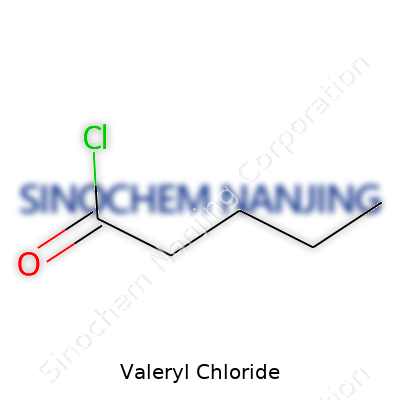
| Names | |
| Preferred IUPAC name | Pentanoyl chloride |
| Other names |
Pentanoyl chloride Valeric acid chloride Pentanoic acid chloride |
| Pronunciation | /ˈvælərɪl ˈklɔːraɪd/ |
| Identifiers | |
| CAS Number | 638-29-9 |
| Beilstein Reference | 598364 |
| ChEBI | CHEBI:51736 |
| ChEMBL | CHEMBL13588 |
| ChemSpider | 8079 |
| DrugBank | DB14007 |
| ECHA InfoCard | '03b3a1b2-0a19-406a-b0a3-352a71bafe8f' |
| EC Number | 203-686-1 |
| Gmelin Reference | 8052 |
| KEGG | C14529 |
| MeSH | D014627 |
| PubChem CID | 8009 |
| RTECS number | UY4375000 |
| UNII | 3WR8A1G12Y |
| UN number | UN1507 |
| Properties | |
| Chemical formula | C5H9ClO |
| Molar mass | 120.57 g/mol |
| Appearance | Colorless to pale yellow liquid |
| Odor | Pungent |
| Density | 0.943 g/mL at 25 °C |
| Solubility in water | Decomposes |
| log P | log P = 2.5 |
| Vapor pressure | 15 mmHg (20°C) |
| Acidity (pKa) | 1.0 |
| Basicity (pKb) | Valeryl Chloride has a pKb of - |
| Magnetic susceptibility (χ) | -7.38e-6 cm³/mol |
| Refractive index (nD) | nD 1.410 |
| Viscosity | 0.73 mPa·s |
| Dipole moment | 2.40 D |
| Thermochemistry | |
| Std molar entropy (S⦵298) | 363.6 J·mol⁻¹·K⁻¹ |
| Std enthalpy of formation (ΔfH⦵298) | -322.7 kJ/mol |
| Std enthalpy of combustion (ΔcH⦵298) | -726.8 kJ/mol |
| Hazards | |
| GHS labelling | GHS02, GHS05, GHS06 |
| Pictograms | GHS02,GHS05 |
| Signal word | Danger |
| Hazard statements | H226, H301, H314, H335 |
| Precautionary statements | Precautionary statements: P210, P234, P260, P264, P271, P280, P301+P330+P331, P303+P361+P353, P305+P351+P338, P310, P321, P363, P370+P378, P403+P233, P405, P501 |
| NFPA 704 (fire diamond) | 3-2-2-W |
| Flash point | 102 °F (39 °C) - closed cup |
| Autoignition temperature | 235 °C |
| Explosive limits | Explosive limits: 2.2–10.1% |
| Lethal dose or concentration | LD50 oral rat 1230 mg/kg |
| LD50 (median dose) | LD50 (median dose): Oral-rat LD50: 245 mg/kg |
| NIOSH | CF2450000 |
| PEL (Permissible) | PEL: 1 ppm |
| REL (Recommended) | 1 mg/m³ |
| IDLH (Immediate danger) | IDLH: 200 ppm |
| Related compounds | |
| Related compounds |
Butyryl chloride Isovaleryl chloride Pelargonic acid Valeric acid |



