Triethylaluminum: More Than a Metal Alkyl—A Lens on Its Journey and Impact
Historical Development: The Path from Curiosity to Essential Catalyst
Every time people talk about catalytic breakthroughs in the chemical industry, the name Triethylaluminum pops up. This molecule, Al(C2H5)3 if you like molecular shorthand, started turning heads in the mid-20th century. Folks like Karl Ziegler and his team got the ball rolling, realizing its knack for turning simple alkenes into polymers, which proved essential for making plastics tougher, cheaper, and easier to handle. It didn't take long for Triethylaluminum to catch on in both the research halls and production floors, playing a strong role wherever catalysis or controlled polymerization came into play. Its fine-tuned reactivity set off decades of innovation in plastics and beyond. Looking at any modern high-performance polyethylene, you’re probably seeing the fingerprints of Triethylaluminum somewhere along the value chain.
Product Overview: Distinct Traits with Lasting Value
Triethylaluminum stands out as a clear, sometimes slightly yellow, sharply smelling liquid with real muscle in the chemical world. Folks use it for more than just stirring up reactions in a flask; it serves as a co-catalyst for making both commodity and specialty polymers. Its punch comes from a strong drive to give up its aluminum atom in just the right conditions, making it a hit among chemists who want precision and speed. People who’ve had their hands in organometallic chemistry respect the quirks and promise it packs with every bottle.
Physical and Chemical Properties: No Surprises, Just Consistent Performance
If you spend time in a chemical lab, you learn quickly that Triethylaluminum doesn’t play well with water. Even a tiny drop can set off fireworks, shooting out ethane gas and heat in a hurry. With a boiling point hovering around 194 degrees Celsius and a density close to that of water, it ends up easy enough to handle with proper gear, but even seasoned chemists raise an eyebrow at its energetic nature. Its vapor catches fire in the air, not just in a poetic sense, but in a way that keeps people on their toes from the warehouse to the lab. In contrast with some other aluminum alkyls, its liquid state and relatively modest viscosity help keep dosing accurate and manageable, at least for those who treat it with the respect it demands.
Technical Specifications & Labeling: Precision and Vigilance Required
Manufacturers and chemical distributors typically supply Triethylaluminum in airtight steel containers, stamped with labels warning about pyrophoric hazards. The spec sheet highlights purity, water and alkane content, and trace metals since tiny impurities throw off catalytic performance. In my own search for lab-grade reagents, I’ve seen attention to detail here matter as much as any elaborate safety briefing: one overweight drum, one missed label, and things can get dangerous quickly. Regulatory checks in the United States, Europe, and Asia circle back on the critical need for airtight seals and secondary containment during shipping and storage.
Preparation Method: Practical Chemistry in Action
The classic recipe mixes aluminum metal with ethyl chloride, usually in a controlled hydrocarbon solvent and under nitrogen or argon, to keep everything dry and safe. Handling each step means gearing up in flame-retardant clothing and full-face protection. The reaction can be touchy, running exothermic and producing ethylaluminum sesquichloride as an intermediate before reducing fully to the trialkyl. Chemists harvest the product by distillation, carefully controlling pressure and temperature to keep everything stable. People might see this as textbook chemistry, but the hassle and attention to safety give it a complexity that goes beyond rote synthesis.
Chemical Reactions & Modifications: The Backbone of Polymer Innovations
Triethylaluminum doesn't just enter a reaction—it takes over. In polymerization, it teams up with titanium or vanadium-based catalysts, transforming monomers into long chains that shape hundreds of household and industrial plastics. Its high reactivity also means it adds ethyl groups to organic molecules effectively, widening its application in fine chemicals too. Modifying Triethylaluminum—adding more bulky ligands or swapping out ethyls for other alkyls—has led to a dozen close cousins, each tailored to different catalytic landscapes. That flexibility has let researchers keep pace with stricter polymer requirements and more complex manufacturing pipelines.
Synonyms & Product Names: Many Labels, Same Legwork
In the trade and scientific journals, you’ll find Triethylaluminum called TEAL, TAl, or spelled in ways that sometimes stump even seasoned chemists on a tired afternoon. Whether it rolls off the tongue in English, German, or Japanese, chemists trust that the sharp smell and reactive streak carry across languages. For those hunting catalog numbers, it pays to check for structural drawings since a missed synonym can mean the wrong compound ending up on your bench.
Safety & Operational Standards: A Case Study in Respecting Risks
Stories about Triethylaluminum accidents travel fast, and for good reason. It burns on contact with air, reacts hard with water, and turns a careless moment into an emergency. Lab teams enforce strict use of full-face respirators, flame-resistant coats, and triple-gloved hands, with everything done under inert gas in glove boxes or sealed lines. Routine safety drills around alkyl aluminum storage and transport don’t just feel like box-ticking: one mishandled drum creates a blazing mess that puts workers and first responders at serious risk. For every published case of mishap, countless close calls get reported internally, making Triethylaluminum something no one ever cuts corners with.
Application Area: Quiet Giant of the Polymer World
The influence of Triethylaluminum in polyethylene, polypropylene, and synthetic rubber stretches far beyond what most people realize. The boots on factory floors and hard hats in control rooms all owe some debt to the catalyst chemistry that keeps these plants humming. By fine-tuning polymer structures, polyethylene film for food packaging lasts longer, wire coatings insulate better, and even rocket fuels mix with more predictability. Engineers lean on this molecule when they want high-density plastics, extra-strong fibers, or specialty grades that need a tight handle on microstructure and branching.
Research & Development: An Ongoing Experiment
Academic labs and industrial R&D never sit still where Triethylaluminum is concerned. Some teams look for alternatives with lower flammability or easier handling, while others focus on tweaking this compound to maximize polymer yields or reduce catalyst residue. My own late evenings at the bench, wading through stacks of NMR and IR data, test out new ligands grafted onto the aluminum center to control selectivity, a game that mixes discovery with practical benefits. While the path to breakthrough is slow and full of trial and error, every tweak promises sharper performance, cheaper processes, or safer operation.
Toxicity Research: Balancing Utility and Caution
Toxicologists and occupational health specialists keep their magnifying glasses on Triethylaluminum. It doesn’t bioaccumulate, but its acute inhalation and contact risks raise caution flags. In animal studies and occasional human exposure cases, severe irritation, tissue burns, and pulmonary complications arise quickly. Chronic exposure links remain less clear, yet safety data sheets repeat the message: keep your guard up, work behind shields or in fume hoods, and keep emergency drench showers in reach. It calls for a workplace culture where risk awareness becomes daily practice, not just compliance.
Future Prospects: Evolving with Industry
Looking forward, Triethylaluminum faces more scrutiny, not less. Regulatory agencies continue tightening safe handling codes, while emerging ‘green’ chemistry is pushing industry folks to reduce hazardous intermediates and find ways to recycle or neutralize spent catalyst. Research groups stay busy seeking analogs with less fire hazard but similar catalytic punch. Still, demand for high-performance polymers and precision chemical synthesis means Triethylaluminum keeps its job in the toolkit. If future chemists tame its hazards through engineering controls, process automation, or breakthrough substitutes, the molecule’s story will keep growing, written by people who match curiosity with caution.
What is triethylaluminum used for?
Understanding Its Place in Industry
Triethylaluminum, often written as TEAl, may sound unfamiliar unless you’ve wandered into chemical plants or read up on polymer science. At its core, this compound steps into action as a catalyst component, especially for making plastics like polyethylene and polypropylene. These types of plastics cover everyday objects—grocery bags, car bumpers, and even medical devices. Nothing ground-breaking looks or smells different about these plastics, yet their reliability often traces back to what TEAl helps set in motion.
The True Workhorse in Polymerization
Across the world, companies make plastics through processes called Ziegler-Natta and metallocene catalysis. Triethylaluminum supplies aluminum atoms needed to get these reactions moving. You can picture TEAl as a coach on the sideline. It doesn’t run the plays, but it fires up the right players so the team (catalyst system) produces tough, flexible plastics. Without compounds like TEAl, controlling the quality and strength of these materials just turns unpredictable. Factories can’t simply swap in any old metal or chemical and hope for the best; TEAl brings a blend of reactivity and stability that makes large-scale, dependable production possible.
More Than Polymers: A Role in Electronics and Pharmaceuticals
Companies involved in semiconductors and electronics reach for triethylaluminum, too. In chip manufacturing, TEAl acts as a precursor. The ultra-thin layers of aluminum, essential for microchips, often come from processes where this compound carefully lays down just a few atoms at a time. The precision brings gadgets with greater speed and less heat. Any shortcut or error here leads to chips that glitch or fail, so getting this step right really matters.
Doctors’ offices and drug makers may not talk about TEAl, yet this chemical assists in specialty drug synthesis. It sometimes kicks off reactions or transforms other chemicals so researchers end up with the right active molecule. Medicines become more targeted and with fewer side effects, all because companies can depend on consistent, controlled reactions involving triethylaluminum.
Risks and Responsibility: What Workers and Communities Should Know
Handling TEAl is risky business. This chemical reacts violently with water and air. Stories from plant floors still circulate about workers who witnessed fires just from a tiny drip. Safety drills, double-sealed containers, and experienced operators set the pace, not flashy automation or quick fixes. These measures cost time and money, but the real payoff shows up in reduced injuries and less damage to surrounding neighborhoods.
Environmental rules around storage and spill response track TEAl closely. Anyone living near a plastics plant probably trusts that strict protocols stay in place. Regulatory agencies, community watch groups, and company insiders all play a part. Regular drills, emergency communications, and investment in safety gear help prevent large-scale disasters.
Looking Ahead: New Ideas and Smarter Use
Researchers are searching for ways to both improve catalysts and lower risk. Some investigate safer delivery systems for TEAl, reducing exposures from broken seals or missteps. Others seek out replacement compounds that might do the same job with less volatility. Any breakthroughs here could ripple through plastics, electronics, and drug industry supply chains. Fact-based conversations, steady investments in worker training, and open safety reporting go a long way to keeping trust high and making sure no one pays too steep a price for progress.
How should triethylaluminum be handled and stored?
No Room for Mistakes with Triethylaluminum
Triethylaluminum comes with a reputation—it’s highly pyrophoric and reacts violently on contact with air or moisture. Once, during my years in a research facility, I watched as a small drop released a bright, quick burst of flame the moment it escaped its sealed container. Safety officers kept reminding us that preparation and respect for the chemical topped every single step. Working with this compound isn’t about being nervous, but about developing practiced, repeatable habits. Skipping even a single safety step has real consequences.
Keeping Risks Low: Experience Teaches the Right Setup
Anyone handling triethylaluminum must use an inert atmosphere—most often, this means working in a well-maintained glovebox or under an argon or nitrogen stream. One cracked seal, one leaky valve, and everything can go wrong. I remember one mishap caused by a tiny, unnoticed nick in the tubing. The incident resulted in a minor flare, followed by a lot of paperwork, and a revised checklist before every use. Simple glass flasks don’t belong here. Certified equipment that resists corrosion and contains the material safely makes all the difference. Flammable-resistant lab coats, heavy gloves, and eye protection are basic. Face shields give extra defense when pouring or transferring.
Storage Isn’t Optional—It’s Survival
It surprises me every time someone assumes a regular chemical cabinet will do. Triethylaluminum calls for sealed metal containers, stored far from sources of water or humidity, in a well-ventilated building designed for flammable chemicals. Ordinary storage locations become dangerous if conditions turn humid or a fire breaks out elsewhere in the building. Always double-check temperature guidelines, because overheating even by a small margin can kick off chemical decomposition, risking a runaway reaction.
Training and Preparedness Lead to Fewer Incidents
No one learns safe handling just by reading a lab manual. Institutions invest in routine drills and hands-on walk-throughs. My first solo transfer never happened without an experienced supervisor guiding every movement. Fresh eyes—especially from people who’ve seen close calls—bring home what’s at stake. Access should stay limited to staff who’ve trained on-site. Bystanders or untrained assistants don’t belong anywhere in the area.
Fire Suppression: Water Isn’t Your Friend
If triethylaluminum catches fire, spraying water makes things worse, not better. That kind of fire behaves like a magnesium blaze, flaring hot and fast. Class D fire extinguishers, packed with dry powder, are the right tool. Emergency response teams own the job of containing spills, backed up by in-depth chemical knowledge. Every lab keeps tailored spill kits on hand for this reason.
Improving Practices Goes Beyond Rules
Every case of mishandling goes into review meetings, because learning from near-misses shapes better habits. Manufacturers offer updated storage systems and training materials based on real-life feedback from chemists worldwide. Automated handling—robot arms, remote pumps—reduces the need for direct contact. Institutions that build in extra layers of supervision tend to report far fewer incidents over time.
Valuing Health Over Speed
Triethylaluminum has value in producing catalysts or specialty materials, but no goal in the lab or factory outweighs safety. Quick shortcuts never pay off. Respect for chemical hazards grows out of real stories, mistakes, and shared hard-earned lessons. Long-term health and a stable workplace matter more than shaving a few minutes off a procedure.
What are the risks and hazards of triethylaluminum?
The Substance Behind the Scenes
Triethylaluminum has played a big role in the chemical industry for decades. It’s a crucial agent in the production of polyethylene and polypropylene, which show up across plastic goods, packaging, and automotive parts. I remember seeing cases in industrial labs where small vials of this material required special handling—people never took chances around it, even those with decades of experience. Triethylaluminum comes with real risks that have claimed fingers, eyesight, and sometimes entire buildings over the years.
Touch and Air Don’t Mix Well
Triethylaluminum hits danger levels straight out of the bottle. Contact with air makes it light up fast—catching fire at room temperature, it can blaze with bright sparks or explode if spilled or splashed. People who’ve worked nearby talk of a metallic smell in the air and a sudden, searing flicker when mistakes happen. Fire departments know that usual tools—foam, water, or regular extinguishers—do nothing but make the flames worse. Water contacts trigger violent bursts, sending droplets and vapor flying in all directions. Those who train for these jobs always practice with dry sand or powder instead, hoping they never need to use it.
Health Hazards and Chemical Burns
Direct exposure tears up skin and lungs. Even tiny amounts on bare skin burn faster than most acids, and inhaling the vapor can destroy tissue in the throat and lungs. Workers remember routine checks for pinholes in gloves or slight tears in their protective suits. Goggles and full face shields aren’t just recommended, they’re essential if anyone expects to avoid permanent scars or respiratory failure.
Environmental Risks and Storage Problems
Triethylaluminum escapes into the environment more often than most companies want to admit. Spills can poison soil and groundwater, igniting fires that destroy lab animals, research plots, and local wildlife. Disposal remains a headache. Leftover product calls for slow neutralization using precisely controlled chemical steps—and any slip-ups splash toxic gases or cause boiling reactions. Long-term storage must stay bone dry, with double-walled sealed steel drums, a nitrogen blanket to choke off oxygen, and high-security monitoring. Even then, no system stops every leak.
Lessons Learned in Industrial Rooms
I’ve seen experienced chemical handlers sweat over closing a poorly sealed cap, call in teams just to move a single drum, and halt work over a missing pair of gloves. No one shrugs off these experiences as accidents. Hospitals near industrial plants earn regular business from burns and inhalation injuries. Insurance companies either hike their rates through the roof or refuse to sign off unless strict handling rules prove enforced by real audits and surprise checks. Instruction books go into dozens of pages, loaded with hard-earned lessons and reminders about damaged gear causing disaster.
Moving Toward Safer Practices
Solving these risks starts with tighter training and stronger barriers between people and the chemical itself. Modern automated dispensing cuts down on human error, but budgets sometimes push companies to cut corners. Regulators and industry watchdogs press for improved leak detection and real-time monitoring. Real progress always comes from workers who stick together, share stories of close calls, and demand fixes before the next shift begins. Until there’s a safer alternative, keeping triethylaluminum on a short leash belongs high on any priority list in plants where its value still outweighs its dangers.
What is the chemical formula and structure of triethylaluminum?
Looking at Triethylaluminum’s Chemical Formula
Triethylaluminum has a fairly straightforward formula: Al(C2H5)3. This formula points to one aluminum atom joined with three ethyl groups. That’s three pairs of carbon and hydrogen chains coming off a single central metal. In common language, each ethyl group stacks two carbon atoms, and each carbon partners with just the right number of hydrogen atoms to keep the group stable.
The shape of the molecule isn’t a simple little Y or T. In reality, it forms a dimer under most conditions—two molecules reaching out to hold each other in a kind of handshake. Chemists refer to this as a “bridged” structure, where aluminum atoms trade ethyl groups and end up connected to two carbons at once. It’s not the sort of structure you’d spot in household products. The dimer form—(Al(C2H5)3)2—dominates when you pull it off the shelf in research or industry.
Triethylaluminum’s Structure
I remember reading research about how that dimer shows itself in practice. Both aluminum atoms each bond to six carbon atoms: three from its own ethyls, and three shared by “bridging” carbons. If you imagine aluminum in the center, the carbons sweep around it in a roughly tetrahedral shape. It’s a bit lopsided, not perfectly symmetrical. Its non-bridging ethyl groups point outwards, while the shared ones loop the two aluminum centers together.
This zig-zagging arrangement is what gives triethylaluminum its famous reactivity. Air and water attack it on contact, causing it to burst into flame and release ethane and aluminum hydroxide. As a chemist, I developed a healthy respect for how fast it reacts—reminds me of lighting up magnesium ribbon in school, except the flame from triethylaluminum streaks blue-white and fierce.
Chemical Facts and Real-World Responsibility
Triethylaluminum’s importance lands squarely in its role as a catalyst co-component in the Ziegler–Natta process—a system that changed the way the world makes plastics. Polyethylene and polypropylene, which keep food fresh in bags or seal medical instruments, owe their existence to this chemistry. The catalyst system relies on the hyper-reactivity of triethylaluminum to kick-start the polymerization, using its electron-rich aluminum centers to set things moving at the tiny scale.
People working in the field know all too well how much care these chemicals demand. Triethylaluminum reacts with air or water so violently that even a drop of humidity in a glovebox threatens safety. Factory teams often get special training long before they set foot near this liquid. Makes sense, given that serious accidents have happened due to lapses in handling or inadequate safety measures.
Having spent some days in industrial labs, I trust strict protocols more than luck. Specialized flush systems, air-free transfer lines, and double-check routines kept me and my colleagues safe. For me, the real lesson is that chemistry cuts both ways—amazing for plastics, but only in hands trained to respect its energetic nature.
Addressing the Challenges and Moving Ahead
As the push for greener production grows, companies and researchers explore ways to reduce the hazards of using triethylaluminum. Some teams work to improve containment methods or substitute less dangerous aluminum compounds where possible. There’s talk about automating some transfer steps, removing humans from the highest-risk moments.
No magic fix removes the risks completely, but the push for continual improvement—whether in lab design, emergency planning, or process updates—will keep this chemistry as safe as it is useful.
How should triethylaluminum spills or leaks be managed?
Not Your Everyday Chemical
Triethylaluminum doesn’t show up in your average toolbox. This clear, colorless liquid lights up the moment it hits air—literally. Folks working around it see firsthand how fast it reacts, bursting into flames and sometimes even skipping the warning signs. The heat it produces can peel skin or warp metal in seconds. Engineers and chemists usually wear serious gear: flame-resistant suits, tight-sealing goggles, and robust gloves just to check a valve.
Fast Action Fights Disaster
Even a few drops on concrete can set off a chain reaction you don’t want spreading. Once, working at a facility in Baton Rouge, I saw the tension shoot through the crew just spotting a small leak. Everyone knew the drill and moved fast. Alarms blared, area blocked off, and specialty fire extinguishers—dry powder, not water—came out within moments. Trying to use water doesn’t just fail; it explodes. Anyone in that line of work understands: no shortcuts.
Proper spill management starts with strict training. Nobody gets near triethylaluminum unless they’ve reviewed emergency walkthroughs—multiple times. Both new hires and old hands go through refreshers every few months. The point goes deeper than policy: regular drills help keep panic away and turn action into habit.
Shelter, Contain, Quench
Every facility with triethylaluminum stores it under heavy-duty containment—sealed drums or tanks, with inert gases (like nitrogen) blanketing all open space. That’s no accident. Even cracked seals throw up red flags. Workers carefully check gaskets and seals after every shift. If any spill escapes, barriers like sand or dry limestone go up quick.
Quenching means stopping the reaction cold—from what I’ve seen, mixing a small leak with copper sulfate, powdered graphite, or dry sand contains fire and halts the spread. Never once did a successful cleanup involve pouring water. Firefighters closest to the action talk about the importance of fast-acting, specialized extinguishing agents. Companies stock massive amounts just for these low-probability events. They don’t skimp on storage or keep it in backrooms.
Eyes Open, Records Kept
After a spill, every inch of the site gets checked and logged. Health and safety officers take regular air samples to rule out aluminum oxides lurking in dust. Any record of a leak means more oversight from regulators—OSHA and the EPA, for starters. Transparency matters: companies call in outside auditors to look over safety equipment and train staff.
Building a Culture That Doesn’t Cut Corners
The best-run plants I’ve visited build a sense of responsibility across every level. It’s not all up to supervisors. Each worker feels pressure and pride to catch small problems well before they grow. Companies support a whistleblower culture, so no one fears pointing out a weird smell or weird hiss. Public awareness plays a role too—communities near these plants expect prompt updates, not spin or delays.
Triethylaluminum shows no mercy to complacency. The facts leave no middle ground: quick thinking, the right gear, specialized extinguishers, and a team ready to act in seconds save lives. That’s something I’ve seen hold true no matter the zip code or shift schedule.
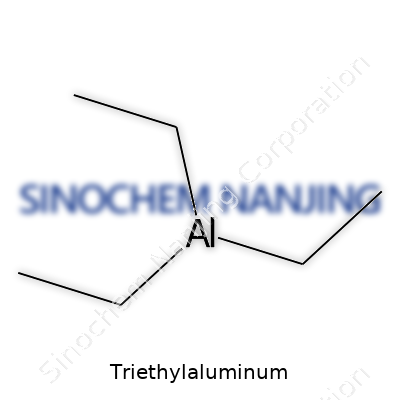
| Names | |
| Preferred IUPAC name | Triethylalumane |
| Other names |
TEA Aluminum triethyl Triethyl aluminium Aluminium, triethyl- AlEt3 |
| Pronunciation | /traɪˌɛθɪl.əˈluːmɪnəm/ |
| Identifiers | |
| CAS Number | 97-93-8 |
| Beilstein Reference | 3586917 |
| ChEBI | CHEBI:30418 |
| ChEMBL | CHEMBL429063 |
| ChemSpider | 53216 |
| DrugBank | DB11340 |
| ECHA InfoCard | 100.004.738 |
| EC Number | 208-875-2 |
| Gmelin Reference | 84889 |
| KEGG | C18607 |
| MeSH | D014258 |
| PubChem CID | 7897 |
| RTECS number | AL2625000 |
| UNII | PY97841716 |
| UN number | UN3391 |
| Properties | |
| Chemical formula | C6H15Al |
| Molar mass | 144.18 g/mol |
| Appearance | Colorless to yellowish liquid |
| Odor | garlic-like |
| Density | 0.832 g/mL at 25 °C |
| Solubility in water | Reacts violently |
| log P | -0.24 |
| Vapor pressure | 1 mmHg (20 °C) |
| Acidity (pKa) | ~36 (for conjugate acid) |
| Basicity (pKb) | 15.8 |
| Magnetic susceptibility (χ) | -36.6e-6 cm³/mol |
| Refractive index (nD) | 1.381 |
| Viscosity | 0.73 cP (20 °C) |
| Dipole moment | 0.91 D |
| Thermochemistry | |
| Std molar entropy (S⦵298) | 206.6 J·mol⁻¹·K⁻¹ |
| Std enthalpy of formation (ΔfH⦵298) | −141.1 kJ/mol |
| Std enthalpy of combustion (ΔcH⦵298) | -4436 kJ/mol |
| Hazards | |
| GHS labelling | GHS02, GHS05, GHS06 |
| Pictograms | GHS02, GHS05, GHS06 |
| Signal word | Danger |
| Hazard statements | H260, H314, H400 |
| Precautionary statements | P210, P222, P223, P231, P280, P284, P370+P378, P403+P233, P422 |
| NFPA 704 (fire diamond) | 4-4-2-W |
| Flash point | -18 °C |
| Autoignition temperature | 180°C |
| Explosive limits | 1.5–20% |
| Lethal dose or concentration | LD50 (oral, rat): 100 mg/kg |
| LD50 (median dose) | LD50 (median dose): Oral, rat: 162 mg/kg |
| NIOSH | AL0175000 |
| PEL (Permissible) | PEL = 2 mg/m³ |
| REL (Recommended) | 2 mg/m³ |
| IDLH (Immediate danger) | **2 mg/m³** |
| Related compounds | |
| Related compounds |
Trimethylaluminum Triisobutylaluminum Diethylaluminum chloride Triethylborane |



