Tributyltin Hydride: A Look at Its Legacy, Challenges, and the Road Ahead
Tracing Roots: The Historical Arc of Tributyltin Hydride
Tributyltin hydride (TBT-H), introduced in the early 1970s, quickly became a fixture on the benches of synthetic chemists. If you've walked through the corridors of any academic or industrial chemistry lab, chances are you've seen TBT-H’s compact bottles stored under inert gas. Back in its early days, tributyltin hydride looked like a revelation. Chemists could reduce alkyl halides and dehalogenate aromatic rings under remarkably mild conditions, sidestepping harshness that older tin-based or lithium reagents demanded. The introduction of TBT-H fed an explosion in the use of radical chemistry. In decades past, executing radical reactions safely and reliably posed a real headache. Tin hydrides changed that landscape, opening routes to molecules that once seemed out of reach in medicinal and organic synthesis circles.
What Is Tributyltin Hydride? A Closer Look at Its Role
Tributyltin hydride stands as an organotin compound where three butyl groups and one hydrogen attach to a central tin atom. Crafted as a colorless to pale yellow liquid, it earned its keep for delivering hydrogens to organic radicals with precision. This ability transformed both academic and industrial labs. The pharmaceutical industry sought out TBT-H during route-scouting—searching for reliable methods to access complex fragments. Its role in the Barton-McCombie deoxygenation, for example, became almost textbook. By acting as a source of atomic hydrogen, TBT-H empowered chemists to reduce carbon-oxygen bonds cleanly, often under an atmosphere of nitrogen or argon to limit side reactions.
Physical and Chemical Face of TBT-H
If you ever held a vial of tributyltin hydride, you’d notice its faint, almost oily odor—an indicator of the butyl chains. With a boiling point near 180°C at atmospheric pressure and impressive solubility in organic solvents like toluene or ether, TBT-H can travel through a range of chemical spaces without much fuss. Chemically, it carries the reducing spirit of tin hydrides. The Sn-H bond sits at the core of its reactivity. On paper, tin stays in the +4 oxidation state during most uses, though its willingness to shed that hydrogen emboldens all sorts of molecular tinkering.
How Labs Prepare Tributyltin Hydride
Laboratories usually generate tributyltin hydride by treating tributyltin chloride with lithium aluminum hydride or sodium borohydride. These methods yield TBT-H cleanly, provided chemists avoid moisture and air—tricky since tin hydrides decompose fast in their presence. This presents both a challenge and a lesson: keeping TBT-H pure isn’t about fancy robotics or million-dollar glove boxes. It’s about careful hands, steady nitrogen lines, and the patience to dry everything, right down to the stir bar.
Technical Specs, Labeling, and Day-to-Day Handling
The typical bottle reads something like: “Tributyltin hydride, C12H28Sn, CAS 688-73-3.” You’ll often find purity stated north of 95 percent, and vendors advertise storage under inert gas at cool temperatures. Those labeling rules don’t just serve compliance; they save lives. TBT-H carries health risks not everyone appreciates. Avoiding inhalation or skin contact takes precedence, because past mistakes—rashes, dizziness, organ damage—remind everyone that tin isn’t just another innocuous metal in the toolbox. Splash goggles and double-layered gloves signal respect for these risks, not just bureaucratic box-ticking.
Sparking Reactions: Chemical Behavior and Tinkering
TBT-H broke new ground through radical-based dehalogenation and deoxygenation. The hydride hands off hydrogen to carbon-centered radicals, forging fresh hydrocarbon linkages. For a young chemist, that opens up a playground for making complex systems, from antibiotics to complex natural products. Extensions have reached beyond classical reduction: newer groups experiment with TBT-H-driven cyclizations, cascade reactions, and creative conjugations. Tweaking its reactivity—by adding co-reagents or engaging in photochemical setups—keeps the field nimble. At the same time, persistent environmental worries mean the search for less toxic, tin-free mimics never stops.
Names and Faces: Synonyms for TBT-H
In chemical literature, tributyltin hydride also appears as tributylstannane and tributylhydrostannum. Names morph across catalogs and languages, yet anyone trained in the lab knows this liquid by its shorthand: TBT-H. The duality of names sometimes muddies global safety enforcement or purchasing, but the chemistry remains unchanged.
Health and Safety: An Uneasy History
Years of research underscored tributyltin hydride’s dark side. It sits atop a category of persistent organic pollutants. Human exposure, even accidental, triggers not just headaches or allergic skin reactions but—at sufficient levels—immune and reproductive effects. Scientists linked marine ecosystem declines to related tributyltin compounds, most notoriously TBT in antifouling marine paints. These findings shook policy and forced chemists to rethink “standard” protocols. In my own experience, watching veteran chemists don heavy PPE and police every bottle’s transfer, I learned that safety with TBT-H isn’t instinctive; it’s hard-earned. If chemical education skips past these stories, students pay the price years later.
Beyond the Bench: Application Territory
TBT-H’s magic never fit in just one box. Its reach goes far beyond basic organic synthesis. In pharmaceuticals, entire drug routes once hinged on tin hydride reductions. Polymer scientists took advantage of its ability to create end-capped chains or craft fine-tuned architectures. Agricultural chemists sometimes used organotin compounds in pest control, though not without consequence or controversy. Nonetheless, regulatory crackdowns and the green chemistry movement have dialed down tributyltin’s global footprint.
Pushing the Boundaries: R&D and the Modern Shift
Even with mounting health concerns, tributyltin hydride has fueled innovation. Creative tweaks—such as loading TBT-H onto solid supports—change how scientists manage toxicity and reusability. Instrument manufacturers and synthetic groups push for tin replacements, looking at silanes, boranes, or even photoredox strategies. Textbook reactions now often flag TBT-H as “last resort” or demand risk/benefit justification. This conscious shift pushes both established chemists and students to ask tougher questions about environmental compatibility and lifecycle impacts. If research dollars go toward cleaner radical sources, students may grow up considering tin chemistry the exception, not the default.
Mapping Toxicity: Lessons from the Evidence
Toxicity research on tributyltin compounds dates back decades. Animal studies from the 1980s showed stunted growth, immune problems, and reproductive failures at modest doses. Regulatory agencies—prodded by evidence—banned TBT-H and its relatives from certain products, including marine paints. The persistence of organotin compounds in water and sediment makes environmental recovery slow. Today, environmental scientists and analytical chemists spend their days tracking old pollution and measuring trace levels downstream from shipyards. These studies form a sobering backdrop. For newcomers to chemistry, these stories serve as a warning. Relying on “business as usual” for hazardous reagents without public health vigilance can turn progress into regret.
Where Next? The Outlook for Tributyltin Hydride
The story of tributyltin hydride stands at a crossroads. Its legacy in organic chemistry is secure, yet its continued use faces growing pressure from regulators and sustainability advocates. Many labs explore nontoxic, earth-friendly routes, but some transformations still lean on TBT-H’s unique abilities. For now, that keeps it on a short leash—reserved for the most demanding challenges, handled with extensive safeguards and respect for its power and risks. Educators have a duty to share the full picture: what TBT-H made possible, what it cost, and why the chemists of tomorrow must balance progress with environmental and personal responsibility. If new generations absorb these lessons, tributyltin hydride’s future will be defined less by harm and more by the wisdom to know when and how to use powerful tools with care.
What is Tributyltin Hydride used for?
Walking Through the Lab, You’ll Meet Tributyltin Hydride
Many folks outside chemistry circles have never heard of tributyltin hydride. It makes sense. This isn’t the sort of compound you bump into unless you’re deep into organic synthesis. I remember my grad school days, a stretch of late nights and stained lab coats, where this chemical showed up with a reputation—both for its usefulness and its hazards.
Tributyltin Hydride in Organic Synthesis
Researchers have made a place for tributyltin hydride in radical chemistry. It knocks off atoms from molecules, stitches together tricky carbon frameworks, and helps clear away troublesome halides. Here in the lab, tributyltin hydride works like a helpful coworker who’s always ready with the right tool. If a project called for breaking a carbon-halogen bond, this reagent would cut through that job with accuracy just about every time.
Why Do Chemists Keep Turning to It?
Tributyltin hydride does things other reagents simply can’t. Take medicinal chemistry—where getting the exact structure matters. It often steps in to help build up complex shapes or cut down long molecules into right-sized pieces. Those reactions aren’t just for show; making new antibiotics or cancer drugs depends on being able to manipulate the carbon skeletons of molecules. This tin-based compound gets the job done quickly, often cleaner than older approaches built on harsher chemicals.
The Dangerous Side Nobody Misses
Working with tributyltin hydride brings worry along with results. The stuff carries a significant environmental cost. It doesn’t break down easily, and marine scientists have found tributyltin compounds causing trouble for sea life. In labs, we learned the protocols almost by heart: gloves, eye protection, strict waste disposal. One slip-up could lead to accidental exposure or a dangerous spill.
Beyond the Lab—Lessons from Tributyltin’s Dark Side
I saw firsthand the shift away from tributyltin hydride in the past decade. Colleagues started exploring alternatives like silanes or other radical sources. Smaller-scale work and green chemistry principles moved up the priority list. I supported the push for these changes, especially once I learned more about the tin legacy in oceans and waterways.
The story goes deeper. Restricting tributyltin hydride in commercial and academic work has forced chemists to rethink old methods. Newer tools fill gaps—though not always as easily. This transition fits a bigger theme across chemistry and medicine: the call to find safer, cleaner answers. It’s hard to completely put down a compound that works so well in specific reactions, so the quest for better substitutes is nowhere near done.
A Path Forward Built on Lessons Learned
Tributyltin hydride leaves a mixed legacy. There’s no denying its power in building and restructuring molecules. At the same time, its dark environmental side can’t be swept under the rug. Chemists have to stay honest about those risks. Labs design better waste systems, seek out green chemistry options, and test new catalysts that drop the tin entirely.
With so much energy now behind cleaner science, the days of routine tributyltin hydride use may be numbered. In my experience, progress always starts with clear facts and a willingness to try new paths. If chemistry can teach us anything, it’s that the best solutions never stand still.
Is Tributyltin Hydride hazardous to health?
Understanding the Risks
Tributyltin hydride isn’t a household name, but it finds a spot in some research labs thanks to its handy metal-reducing abilities. No one keeps it next to their flour and sugar. This organotin compound usually sees action when chemists run into stubborn chemical bonds needing a nudge, like in organic synthesis or certain environmental tests. Despite its specialized use, the hazards connected to tributyltin hydride do matter, and they reach beyond chemists’ workbenches.
Health Threats: What the Science Says
Talk about health issues—this compound doesn't play around. Breathing in tributyltin hydride, getting it on your skin, or swallowing even a small amount could spell trouble. Evidence from animal studies paints a picture no one enjoys: liver, kidney, and immune system damage, plus nervous system impacts. Skin and eye contact brings burns and irritation, and long-term handling ramps up the risk for serious organ harm.
Several health agencies, including the EPA and European Chemicals Agency, point out the same thing: extended exposure to organotins may mess with hormone systems, which play a part in mood, metabolism, and childhood development. Stories from the water world show tributyltin contamination hurting aquatic life, leading to deformed mollusks and thinning shellfish populations. If tributyltin hits rivers or soil, it doesn’t just vanish; it sticks around and works its way up the food chain.
Why Should Non-Chemists Care?
For most folks outside technical jobs, tributyltin hydride rarely pops up in daily life. Still, its legacy matters. In the ’80s and ’90s, related chemicals (like tributyltin oxide) powered antifouling paint on ships—keeping barnacles away, but leaving a toxic trail in ports and harbors. Scientists traced the chemical's durable trail even in shellfish meant for dinner plates. Seafood lovers probably remember tales of tainted oysters and scallops, especially from coastal regions famous for fresh catch. Lessons learned here pushed governments to ban or choke off these chemicals, but persistence in the environment means legacy risks stick around.
Staying Safer: Smarter Handling and Better Rules
Labs working with tributyltin hydride know the drill: full face shields, double gloves, strong ventilation, and chemical fume hoods—these speak louder than company memos. Clear labeling, easy-to-read safety data sheets, and ongoing hazard training stand between an accident and a normal day at work. Safe storage also matters, since moisture or heat can make this compound break down and cause a fire or release toxic fumes.
As for broader solutions, strict disposal guidelines keep tributyltin hydride from ending up in water or city dumps. Some facilities treat leftover chemicals with special scrubbers or incinerate them under controlled conditions. Serious, transparent monitoring programs make sure that any pollution gets tracked, not swept under a rug.
Looking Forward
Most countries have already pressed for swaps—safer chemicals, greener alternatives, and bans where risks outweigh rewards. Scientists hunting for less hazardous, more biodegradable reagents remind us that chemical progress brings responsibility with it.
Anyone handling tributyltin hydride or living near facilities using it deserves proper information and up-to-date rules. Good science pays attention to these risks, listens to data, and looks out for safety beyond the walls of the lab.
How should Tributyltin Hydride be stored?
Keeping Risk in Check
Tributyltin hydride isn’t something to leave lying around on a bench in the lab. In practical terms, this chemical brings along serious hazards—flammability tops the list, followed by its reputation for toxicity. I’ve seen people go the route of casual handling, thinking a tightly sealed bottle is enough. It isn’t. One breath of the vapors, or even a splash on the skin, can spell trouble for anyone.
Toxicity ranks high for organotin compounds, and tributyltin hydride stands out. Overexposure sends organic tin straight into the body, piling up damage in the nervous system and the liver. There’s plenty of documentation about these risks, so winging it is never a smart move.
Storage Isn’t Just About a Locked Door
A real storage plan starts before chemicals arrive. Lab groups I’ve worked with run through chemical inventories monthly, keeping amounts low. This isn’t fretting over nothing—smaller volumes mean fewer headaches if something goes wrong. Tributyltin hydride stays in its original amber bottles, and every label shouts about water sensitivity and flammability.
Nothing good happens when this stuff meets moisture or open air. Over time, even slight exposure to damp conditions lets hydrolysis creep in, with new, often more toxic, breakdown products forming. Dry, airtight storage goes a long way here. Desiccators filled with silica gel keep humidity out, and staff use glove boxes or dry cabinets for transfers.
Temperature Matters
Room temperature isn’t a guarantee if you’re dealing with an aging building or wild weather swings. Tributyltin hydride prefers cool, consistent storage. That usually means 2–8°C—lab refrigerators that don’t double as food storage make the cut. Local laws back this up, too. Separate fridge space, no sharing with lunch or other organic samples, and never popping bottles in the freezer where fragile seals might let air or water vapor inside.
Ventilated chemical cabinets do a lot of heavy lifting, especially backed up with secondary containment trays. A spill, even inside a fridge, can spread quickly. Absorbent pads, quick-access spill kits, and well-trained eyes make sure nobody faces an unpleasant surprise.
Personal Protection: Not a Suggestion, a Requirement
Stashing a dangerous compound safely only works if people suit up whenever they handle it. Gloves, goggles, and flame-resistant lab coats aren’t extras—they’re part of the job. I’ve dealt with students brushing chemical rules aside, only to see them scramble after a splash. Once they take protection seriously, everyone breathes easier.
Ventilation limits vapor risks. Fume hoods—checked and loud when running—are always on during handling. Labeling containers with clear hazard warnings keeps anyone from grabbing the wrong thing by mistake.
Emergency Steps and Waste Disposal
Accidents happen, no matter how good the prep. Rapid response plans make a difference—safety showers, eyewash stations, and clear exit paths have saved real people in labs. Waste bottles for tributyltin hydride and its byproducts get scheduled pickups, no waiting for an accident to remind staff what’s inside those containers.
Staying Accountable
Responsible storage means sticking with training. New students, visiting scientists, and even maintenance crews run through storage safety rules. Logs document every in-and-out from the chemical fridge. Sharp enforcement, not friendly reminders, keeps everyone motivated to stick with the rules.
Safety wraps around everyday choices. Tributyltin hydride doesn’t care if you’re busy or tired—store it right, handle it right, avoid chemical disasters.
What precautions should be taken when handling Tributyltin Hydride?
Understanding the Risks
Working with tributyltin hydride (TBT-H) means stepping into the world of organotin chemistry where the risks feel pretty real. TBT-H does a lot of heavy lifting in research labs—especially when shifting carbon bonds in organic molecules. Yet with its benefits come hazards that can’t be shrugged off. Even short exposure leaves the body open to skin irritation, breathing trouble, and problems down the line.
Don’t Skip the Right Gear
Personal protection deserves honest attention. Chemical splash goggles matter more than regular glasses, offering a solid barrier to protect your eyes from invisible splatter. Cotton-polyester blend lab coats slow down splashes. Nitrile gloves, reaching over the wrists, do a far better job than latex at keeping TBT-H off your skin. Even with gloves, don’t trust them for hours—switch to a fresh pair if you touch spills, and have a habit of never leaving the lab with them on.
Ventilation and Air Quality Matter
If you’ve ever caught the harsh odor of organotin, you know fans on a counter won’t cut it. Only a chemical fume hood sets up the right layer of defense. Working inside the hood, with the sash lowered between your hands and your face, creates a zone where fumes go straight into a scrubber, not your lungs. Relying on anything less means rolling the dice with your breathing—over time, those vapors don’t just float away.
Avoiding Spills and Splashbacks
Think about all the speedy reactions you’ve run where minor spills led to gloves getting soggy. Pouring TBT-H always brings a chance for accidents. Start small, open containers slowly, and hold everything over an absorbent pad, so nothing hits the unprotected bench. Pipettes with slow, steady pressure make a huge difference—jerky moves send droplets flying further than you think.
Storage and Fire Safety
TBT-H needs a home away from sunlight, open flames, and humidity. Keep it in a tightly sealed amber glass bottle, inside a cool, flammable storage cabinet. Don’t trust plastic, since organotin compounds can soften or crack through certain materials. Keep a dry chemical spill kit nearby, and know where your eyewash and shower sit. Every person in the lab ought to practice spill drills—knowing who calls safety, who closes doors, and who grabs the right kit.
Disposal Isn’t a Guessing Game
Pouring this stuff down the sink shouldn’t even cross your mind. Mix TBT-H waste with compatible solvents in a clearly labeled glass container, and log the waste with the campus or workplace chemical safety office. Scheduled pickups from qualified waste handlers avoid surprises for municipal water supplies and local wildlife. Don’t let the lab’s waste barrel overflow, since one knocked-over container spells disaster.
Why Paying Attention Pays Off
In the end, every extra minute spent prepping or cleaning up keeps everyone in better health. Working with toxic chemicals like tributyltin hydride never fits the rush-job mindset. I’ve seen close calls turn heads and change habits for the better. Science can only deliver its promise if people walk home healthy, and young researchers grow up to teach tomorrow’s lab techs with all their fingers and lungs intact.
What is the chemical structure of Tributyltin Hydride?
Understanding the Backbone: Composition and Shape
Tributyltin hydride doesn’t show up often in daily conversations, but many chemists know its worth. The structure keeps things simple: you get a tin atom in the center. Attached to this, there are three butyl groups—straight chains, each with four carbons—and a single hydrogen atom. Picture it: Sn holds on to one hydrogen (H) and three C4H9 butyls. If you write it out, it looks like (C4H9)3SnH.
The bond between tin and hydrogen creates its real value in labs. That single Sn-H bond serves as a tool for reducing other molecules, making tributyltin hydride an essential player in organic synthesis. There’s a practical side to that structure. With the three long carbon chains, tributyltin hydride behaves as a colorlessish oily liquid, soluble in many organic solvents. People who work in laboratories notice its strong odor, which sometimes becomes a warning about its toxicity.
Why Chemists Pay Attention
My days in the lab during grad school hammered home the importance of this compound. Once you see how tributyltin hydride donates its hydrogen to organic molecules, generating radicals, you understand its influence in rearrangements and dehalogenation reactions. Being able to break carbon-halogen bonds opens up new routes for transforming chemical structures. The practical effect: making complex molecules that matter for pharmaceuticals and materials science.
With great power comes responsibility: even if tributyltin hydride makes difficult reactions easier, it also raises flags for environmental and health safety. Studies have linked organotin compounds to toxic effects in humans and aquatic life. Tributyltin in antifouling paints once helped keep barnacles off ships, but run-off devastated marine environments, affecting immune systems in shellfish and even disrupting human hormone pathways. That’s why smart chemistry matters—not just making molecules, but also caring for the impact molecules have outside the flask.
Balancing Benefits and Risks
Access to tributyltin hydride drives innovation, but so does minimizing harm. People cannot ignore pollution or toxicity. I remember my research group moving to use alternatives wherever possible. Some chemists switched to silane-based hydrogen donors, which break down into less harmful byproducts. Green chemistry pushes for lower-impact reagents in synthesis. In 2023, scientists published advances in iron or cobalt-catalyzed reactions, hoping to cut the need for organotin compounds entirely.
For labs that do need tributyltin hydride, safe handling becomes critical. Storage calls for airtight containers, preferably under an inert gas. Working under a fume hood, wearing gloves, and using eye protection all matter. Proper waste disposal means working with environmental health officers, not just pouring leftovers down the drain.
Looking Ahead: Smarter Molecules
Understanding the structure of tributyltin hydride is not just an academic exercise. Chemistry doesn’t exist in isolation; it tracks back to the choices people make in protecting the planet and themselves. Scientists owe it to their teams and communities to take both chemistry and safety seriously. Innovation depends on this balance between deep molecular knowledge and responsible action. That’s the core lesson tributyltin hydride has taught me, in the lab and beyond.
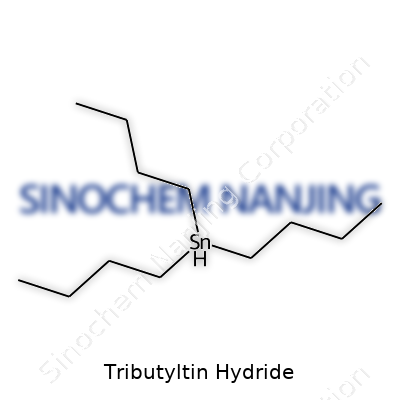
| Names | |
| Preferred IUPAC name | tri(butyl)stannane |
| Other names |
Tributyltin Hydride Tri-n-butyltin hydride Tributylstannane n-tributylstannane TBT-H |
| Pronunciation | /traɪˈbjuːtɪltɪn haɪˈdraɪd/ |
| Identifiers | |
| CAS Number | 688-73-3 |
| 3D model (JSmol) | `3D model (JSmol)` string for Tributyltin Hydride: `C[Sn](C)(C)C` |
| Beilstein Reference | 1718734 |
| ChEBI | CHEBI:34713 |
| ChEMBL | CHEMBL9743 |
| ChemSpider | 23022 |
| DrugBank | DB01936 |
| ECHA InfoCard | 100.064.736 |
| EC Number | 211-047-6 |
| Gmelin Reference | 52954 |
| KEGG | C02576 |
| MeSH | D014264 |
| PubChem CID | 30303 |
| RTECS number | WH6650000 |
| UNII | C73P356501 |
| UN number | UN2929 |
| Properties | |
| Chemical formula | C12H28Sn |
| Molar mass | 291.97 g/mol |
| Appearance | Colorless liquid |
| Odor | Unpleasant odor |
| Density | 1.07 g/mL at 25 °C(lit.) |
| Solubility in water | Insoluble |
| log P | 2.6 |
| Vapor pressure | 0.4 mmHg (20 °C) |
| Acidity (pKa) | 10.6 |
| Basicity (pKb) | Basicity (pKb): 3.6 |
| Magnetic susceptibility (χ) | -65.0×10⁻⁶ cm³/mol |
| Refractive index (nD) | 1.520 |
| Viscosity | Viscous liquid |
| Dipole moment | 1.29 D |
| Thermochemistry | |
| Std molar entropy (S⦵298) | 451.6 J·mol⁻¹·K⁻¹ |
| Std enthalpy of formation (ΔfH⦵298) | -230.6 kJ/mol |
| Std enthalpy of combustion (ΔcH⦵298) | -6876 kJ/mol |
| Hazards | |
| GHS labelling | **GHS labelling of Tributyltin Hydride:** `Danger; H226, H301, H331, H373, H410; P210, P261, P273, P280, P301+P310, P302+P352, P304+P340, P308+P313, P391, P403+P235, P501; GHS02, GHS06, GHS08, GHS09` |
| Pictograms | GHS06,GHS08,GHS09 |
| Signal word | Danger |
| Hazard statements | H228, H301, H310, H330, H373, H400, H410 |
| Precautionary statements | H226, H301, H311, H331, H373, H410, P210, P260, P273, P280, P301+P310, P302+P352, P304+P340, P308+P313, P370+P378, P391, P403+P235, P501 |
| NFPA 704 (fire diamond) | 2-4-2-W |
| Flash point | 40 °C (104 °F; 313 K) |
| Autoignition temperature | 185 °C |
| Lethal dose or concentration | LD50 (oral, rat): 21.4 mg/kg |
| LD50 (median dose) | LD50 (median dose): Oral rat 131 mg/kg |
| NIOSH | WH6650000 |
| REL (Recommended) | Glove Box |
| IDLH (Immediate danger) | 250 ppm |
| Related compounds | |
| Related compounds |
Tri-n-butyltin chloride Tributyltin oxide Tributyltin acetate |



