Tin(IV) Iodide: A Chemical with Rich History and Versatile Potential
Historical Development
Chemists during the early days of halide studies paid close attention to heavy metal compounds. Among them, Tin(IV) Iodide stands out for its vibrant color and reactive behavior. Back in the 1800s, researchers in European labs explored the reaction of tin with elemental iodine, curious about the formation and structure of tin-iodine bonds. Over the decades, advances in crystallography and analytical chemistry revealed more about this compound. Textbooks from the twentieth century documented its synthesis and offered practical tips on isolating pure samples. Today, it remains on the radar of those working in both classical inorganic chemistry and niche material science. The arc from curiosity-driven discovery to applied research shows how some chemicals keep cropping up whenever technology asks for something only they can do.
Product Overview
Tin(IV) Iodide (SnI4) appears as a striking orange-red crystalline solid. It catches the eye on a lab bench with its vibrant, metallic sheen. Chemists and industry experts recognize its dual use: both as a teaching tool and as a reagent where clean, predictable tin(IV) sources are required. It dissolves in nonpolar solvents, lending a hand in organometallic syntheses. Packaging varies between glass- and plastic-lined bottles, with clear labeling to distinguish it from less reactive tin compounds. Buyers in specialty chemical markets appreciate that reputable suppliers provide batch purity analysis along with their shipments.
Physical & Chemical Properties
SnI4 crystallizes in a tetrahedral geometry. The appearance is unmistakable, with orange crystals and a density over 4 g/cm³. It melts around 144°C, and boils just shy of 440°C, which means it transitions through its phases well within reach of standard laboratory heating equipment. The compound brings a certain volatility — not extreme, but enough to demand respect for sealed containers, even at room temperature. It doesn’t dissolve in water but goes into ether and chloroform willingly, showing preference for the nonpolar world. Chemically, SnI4 acts as a Lewis acid, and participates in exchange reactions with ligands and nucleophiles. Its stability under dry conditions ensures a longer shelf life, but it’s sensitive to moisture, breaking down with hydrolysis.
Technical Specifications & Labeling
Responsible producers mark each bottle with precise information. Labels clearly show chemical formula, batch number, purity percentage — generally above 98% for laboratory grade — and storage guidance. The specifications chart lists melting point, boiling point, and confirmation of absence of contaminants like iron or tin(II). Each container carries a warning about respiratory and skin contact, in compliance with regulations. Material Safety Data Sheets (MSDS) ship with each order, which aids safe transport and handling, even for those using it in undergraduate teaching labs or industrial process trial runs.
Preparation Method
Chemists synthesize Tin(IV) Iodide by passing dry iodine vapor over freshly prepared tin metal, often using a gentle heat source to encourage the reaction. In a glass tube or round-bottom flask, pure tin powder meets iodine, reacting exothermically and releasing a visible fume that condenses to form the characteristic crystals. The handling during synthesis matters—a dust-free, dry environment prevents unwanted side reactions. Purification involves recrystallizing the crude product from nonpolar solvents to wash out unreacted iodine or tin. This preparation method remains relatively unchanged, a nod to the reliability of old-school chemistry glassware and procedures.
Chemical Reactions & Modifications
SnI4 earns a spot in many reaction schemes. As a typical Lewis acid, it attracts nucleophiles, opening doors for further derivatization. Researchers use it to introduce iodine into organic frameworks, pushing forward new organotin compounds. It hydrolyzes in water to give tin dioxide and hydroiodic acid, which draws interest from those studying decomposition pathways. Reaction with ammonia forms complex iodostannate salts, changing the game for those making advanced solid-state materials. Tinkering with reaction partners and solvents produces a spectrum of new tin and iodine-containing products, making SnI4 a flexible starting point.
Synonyms & Product Names
The chemical world calls Tin(IV) Iodide by a few names: stannic iodide comes up often, especially in older texts or supplier catalogues. Some regions refer to it as tin tetraiodide, a nod to its exact iodine content and oxidation state. Researchers recognize its CAS number in procurement systems, while abbreviated forms like SnI4 appear in academic journals and technical papers. Knowing these synonyms matters during literature searches and ordering: it avoids mix-ups, particularly in global supply chains where translation and mislabeling have tripped up projects before.
Safety & Operational Standards
Working with SnI4 means showing respect for its hazards. It can irritate skin, eyes, and respiratory passages if handled without care. Best practice dictates gloves and lab coats, plus operating in a fume hood, especially for large-scale preparation or prolonged exposure. Storage calls for sealed, moisture-proof containers, kept away from strong bases or acids. Emergency procedures and disposal rules rely on clear protocols: neutralization and containment should a spill occur, with responsible transfer to chemical waste streams. Industry relies on international standards—GHS labeling, REACH compliance in Europe—to inform both workers and downstream users.
Application Area
Tin(IV) Iodide finds real-world use in more than just academic labs. Electronics specialists use it as a starting material to grow layered semiconducting films. It plays a part in the creation of organometallic complexes for catalysis. Researchers test its UV-absorbing properties for specialty optical coatings and filters. Some creative chemists explore its behavior at interfaces, studying charge transfer in thin films. Since it remains reactive and easy to handle for those trained, it persists as a go-to option in chemical education, functional material R&D, and niche industrial applications.
Research & Development
Modern lab advances push SnI4 into new territory. Scientists explore its reactivity with organic ligands, seeking innovative catalysts and functional hybrid materials. Computational chemists turn to quantum models to predict its electronic structure and bonding, refining predictions for new synthesis routes. Material scientists look at how SnI4 layers interact with semiconductors, aiming for novel electronics or sensory devices. Through collaboration between industry and universities, methods to recycle and refine SnI4 come into focus, driven by cost and environmental considerations.
Toxicity Research
The toxicity profile of SnI4 compels careful handling. Exposure studies reveal the risk of irritation and acute toxicity at higher doses. Animal studies show that ingestion or inhalation leads to negative effects, meaning workplace safety training stays current, and disposal practices follow strict environmental protection rules. Health organizations include it in their chemical hazard databases, guiding both practitioners and regulators. In discussions about laboratory safety, instructors share cautionary tales about lax handling, reinforcing that the striking color offers no immunity to chemical risk.
Future Prospects
Looking ahead, the potential for Tin(IV) Iodide seems tied to both its legacy and adaptability. The electronics industry continues seeking new tin-halide materials for energy conversion and sensor development. Academic labs probe the fundamental properties, from crystal growth habits to electron mobility. Sustainable chemistry principles encourage more eco-friendly syntheses and recycling of tin compounds. As global regulatory pressures grow around chemical sourcing and responsible waste practices, companies building on tin chemistry need creative routes to greener products, turning tradition into forward-thinking solutions.
What is Tin(IV) Iodide used for?
Shedding Light on an Uncommon Chemical
If you ever tried poking around a chemistry supply closet, you might come across a bottle labeled Tin(IV) Iodide. It's not exactly a household name. A bright orange crystalline powder, it seems pretty exotic. Most folks won’t bump into this compound outside of research or specialty labs, but that’s not to say it doesn’t have its place in the world of science and technology.
Laboratory Curiosity and Teaching Tool
Tin(IV) Iodide pops up as an example in teachings on inorganic synthesis. Chemistry students remember it for that flashy orange color and the way it’s made—usually by mixing tin and iodine directly. Teachers reach for it to show how halides of metals behave differently than the metals themselves. It offers a neat way to study properties like volatility and solubility. Since it behaves as a molecular solid, showing just how temperature affects it never fails to surprise newcomers.
Stepping Into the World of Materials Science
Real innovation comes from looking at old compounds with fresh eyes. Researchers started testing Tin(IV) Iodide for uses in optoelectronics. It has a crystal structure that can interact with light in useful ways. Science always needs new semiconductors—devices like solar cells and sensors depend on finding materials that react just right to light and electricity. In a few papers, scientists mixed Tin(IV) Iodide with organic dyes to investigate improved solar absorption. Although still mostly an experiment, early work hints at promise for next-gen solar devices where common materials like silicon just won’t do the trick.
Chemical Reactions and Synthesis
Anyone making organotin compounds sometimes works with Tin(IV) Iodide as a starting point. Chemists like it because it’s more reactive than tin metal itself. That orange powder dissolves in organic solvents, which gives researchers another lever to pull while building bigger, more complicated molecules. For example, it helps prepare other tin-halide compounds, which can step into roles as catalysts or specialty reagents. In chemical research, even a rarely-mentioned material can kickstart a new line of experiments.
Examining the Downsides and Safety Gaps
No conversation about a specialty chemical should skip over safety. Tin(IV) Iodide brings the same hazards as other iodine compounds—exposure can irritate both the skin and respiratory system, and environmental disposal regulations must be followed to keep the compound out of waterways. That means anyone using it for labs or research should have proper ventilation and handle it with gloves. Waste management rules rightfully demand attention, given its persistence and the toxicity tied to iodide ions in water supplies.
Room for Growth and Responsible Handling
Every chemical has a story that mixes both promise and risk, and Tin(IV) Iodide is no exception. There’s opportunity for growth in green chemistry if scientists focus more on recycling and recovery methods for specialty reagents like this. A shift toward better safety data and precise usage guidelines would go a long way. The more honest we get about what’s known and unknown, the faster we can open Tin(IV) Iodide up to wider applications while sticking to good stewardship and compliance with safety standards.
What is the chemical formula of Tin(IV) Iodide?
Beneath the Surface Chemistry
Tin(IV) iodide, identified in laboratories as SnI4, isn’t just another entry in the catalog of inorganic compounds. The formula itself gives a clear sign of its structure—one tin atom bonded with four iodine atoms. This golden-orange solid stays in the textbook as a staple of coordination chemistry, but its significance stretches further than introductory courses. To students and those who experiment at the benchtop, it's often encountered as a vibrant catalyst for curiosity. Few colors in chemistry match the dramatic look of this compound when made fresh in a fume hood.
Why Get the Formula Right?
Mistaking the formula risks more than a hypothetical test score. Mixing up SnI2 with SnI4 leads to very different properties at the bench and out in real-world practice. Tin(IV) means the tin ion sits in a +4 oxidation state, not the +2 that might seem natural to new learners. That +4 state translates to stronger oxidizing capability and can make reactions snap to completion—or cause an unexpected mess. In my days as a teaching assistant, I watched one too many undergraduates fumble a synthesis by reaching for the wrong tin salt from the shelf. Cleaning up the fallout became a lesson in double-checking formulas before anything goes near the flask.
Looking Closer: Uses and Cautions
Chemists trust SnI4 to help with organic synthesis, especially when exchanging functional groups or working up clever semiconductor materials. It's an air-stable compound in the right bottles, though it prefers to sit undisturbed and shielded from too much heat. More than once I've handled this powder in a glove box, taught by experience that its iodine vapor smells unpleasant and shouldn’t hit unprotected lungs or skin. The heavy iodine ions also bring environmental impact—waste handling needs respect, not shortcuts. Every chemistry classroom would benefit from more time spent on practical hazard management, and that starts by asking what’s in the bottle and what happens, step-by-step, if you turn SnI4 loose in the wrong place.
Getting Hands Dirty: How to Approach Solutions
Solving problems with Tin(IV) iodide isn’t isolated to chemistry majors. Electronics, materials science, and even solar research lean on this formula for making thin films and testing new kinds of circuitry. At a conference one summer, I watched researchers debate the safest way to recycle spent tin-iodide compounds. They focused on solvent choices and closed-loop systems, talking plain sense: if science can harness the compound’s unique properties, it should also take ownership of reducing its downsides.
Educators need to demystify the step from formula to function. Understanding what SnI4 does isn’t only for the exam—it matters for safety in the lab and mindfulness in industry. If a compound promises dazzling results, that means thinking two steps ahead about disposal, exposure, and accident prevention. That principle doesn’t end at graduation; it carries through to every place that smart chemistry gets done.
Is Tin(IV) Iodide toxic or hazardous?
Understanding Tin(IV) Iodide
People working in labs eventually run into some chemicals that sound exotic: Tin(IV) Iodide, with its striking red-orange crystals, is one of those compounds. It shows up in organic synthesis and sometimes pops up in semiconductor research. To anyone outside those fields, it looks flashy, maybe even a bit dangerous. So does the threat match the color?
The Facts About Toxicity
Let’s cut right to it: Tin(IV) Iodide can cause health problems. It isn’t in the league with mercury salts or cyanides, but it contains both tin and iodine in an oxidized state. Both elements matter for the human body, but only in the right forms and amounts. The body doesn’t handle metal halides like this one easily. Several sources, including safety datasheets from Sigma-Aldrich and science labs, warn that Tin(IV) Iodide could irritate the skin, eyes, and lungs on contact.
There’s also the issue of how the compound breaks down. If it decomposes, maybe from getting heated or exposed to moisture, it releases toxic iodine compounds and tin oxides. Anyone who’s worked in a warm, poorly ventilated lab knows how quickly these breakdown products can make the air uncomfortable or even unsafe.
Personal Experience In the Lab
My first encounter came during a graduate-level inorganic chemistry class. Handling Tin(IV) Iodide didn’t require a hazmat suit, but gloves and goggles became the unofficial uniform. We learned to keep all the work in a fume hood. The jar label was a bold red, and for good reason. A colleague told me she once spilled a spoonful — not much, just a gram or two. Even after cleaning, the air had that unmistakable, sharp scent that means you’d better leave the room soon. The irritant effects are not just theory; you feel it in your throat and your eyes if you get careless.
I’ve seen more seasoned researchers talk about the tendency of metal iodides, in general, to stain fingers and surfaces. The stain acts as a reminder that you don’t want this stuff lingering on you, even for a few minutes.
Routes of Exposure and Real-World Impact
Direct contact with Tin(IV) Iodide can lead to irritation, but inhaling the dust or fumes can make it worse. Respiratory problems show up quickly if someone ignores ventilation. Most problems come from carelessness or lack of training. In industry, strict protocols cut down on accidental exposure. In schools and smaller labs, new students sometimes cut corners, skip gloves, or forget to turn on the fume hood. Even in small doses, repeated exposure may build up mild but cumulative risks.
Managing Hazards and Improving Safety
Strong habits and good policy keep these risks under control. Proper labeling, consistent use of protective equipment, and mandatory safety training go a long way. The compound shouldn’t be handled outside of a designated chemical hood, especially since the byproducts of decomposition don’t just vanish. Emergency showers and eyewash stations should always be available. Even old-timers sometimes ignore the posted safety sheets, but that’s usually where trouble starts.
Disposal is another sticking point. Pouring Tin(IV) Iodide down the drain isn’t a safe solution. The right approach means treating all byproducts with neutralizing solutions and shipping waste to a hazardous waste facility.
Everyone in science ends up with a favorite story about a chemical that taught them respect. Tin(IV) Iodide sits in that category: it’s not among the most lethal, but it’s a good reminder that respect for safety rules never gets out of date.
How should Tin(IV) Iodide be stored?
What Makes Tin(IV) Iodide Special?
Tin(IV) iodide—known to chemists as SnI4—catches interest because of its bright orange-red color and its distinct crystalline look. Like many compounds that contain both a metal and a halogen, the beauty of this chemical hides some risks. People use it in research, for synthesizing other tin compounds, and sometimes in advanced electronics studies. If you ever cracked open a bottle in a lab, you’d probably notice right away: this stuff doesn’t love air or water.
The crystals break down in the presence of moisture, releasing fumes of hydroiodic acid and elemental iodine, both of which are corrosive and harmful if touched or inhaled. Thinking back to my own chemistry days, I’ve seen old, poorly capped bottles leave rusty marks and a nose-stinging smell on glassware. A little neglect leads to bigger cleanups later—and none are pleasant.
Choosing the Right Container and Location
Storing tin(IV) iodide calls for more than grabbing a random plastic jar. Glass containers with airtight seals work best, since plastics let in water vapor and even some gases over time. Make sure jar lids fit tight—no old or cracked rubber stoppers. If you spot dry, crusty residue around the lid, the stuff inside probably suffered from air sneaking in.
People might browse for secondary containment—something to catch any spills or leaks. A plastic bin lines with absorbent pads in a chemical cabinet helps contain a mess and offer a warning if something does go wrong.
Watch Out for Sun and Heat
Light and high temperatures start trouble for tin(IV) iodide, so cabinets made for chemicals—steel with fire protection—make sense. Keep them far from heat sources or sunny windowsills. Too much heat increases the pressure inside the container, risking a pop or slow leak.
If you check university or company labs, you’ll notice the best practice is never keep chemicals above eye level. Getting a grip on a glass jar while standing on a chair just adds risk nobody wants.
Labeling and Inventory
A clear, legible label protects you and others. Write the chemical name, date received, hazard symbols (corrosive, toxic), and your initials for accountability. Regularly check for cracked containers, dried powder, or strange colors. Early catches can prevent accidents and save money.
Some workplaces keep a spreadsheet or digital system to track who last handled each bottle and where to find safety data sheets. If your setup doesn’t have one, a sturdy notebook by the cabinet goes a long way—no memory is perfect.
What About Emergencies?
No matter how careful you are, mistakes happen. Clean workspace rules set the stage for quick responses. If tin(IV) iodide spills, cover with a dry, inert absorbent—do not add water. Gather up with gloves and dispose of it following hazardous waste protocols. Ventilation prevents fume buildup, and goggles keep splashes away from the eyes.
Smart Practices Make the Difference
Years in the lab taught me this: safety grows from respect for the little things. Tightly capped bottles, low storage, smart labeling, and routine checks build habits that keep everyone healthy and working comfortably. As with all specialty chemicals, treat tin(IV) iodide with patience and a clear head, and it stays an asset instead of a headache.
What are the physical properties of Tin(IV) Iodide?
What Tin(IV) Iodide Looks Like in Real Life
I remember the first time I held a vial of Tin(IV) Iodide. The crystals had this sharp, burnt-orange color—something you don’t forget if you’ve spent enough time around colorless salts and white powders. It struck me how some compounds manage to stand out, and this one sure does. In the chemistry world, that color isn’t just pretty; it’s a clue. Rich hues often point toward heavy halogen content, and Tin(IV) Iodide is loaded with iodine.
You’re looking at a solid compound at room temperature, but it doesn’t handle moisture well. Leave it out, and humidity creeps in, dulling its luster and setting off a slow decomposition. Tin(IV) Iodide turns out to be unstable in damp air, which keeps you on your toes if you’re trying to store it long-term or move it between bottles for an experiment. It also dissolves in organic solvents like benzene or chloroform, but water prompts it to break down. That’s a real practical issue: mishandle it, and it won’t stay pure for long.
How It Feels and What It Smells Like
It forms flaky, plate-like crystals—a solid with a distinct look and feel. In the lab, one notices its texture under a spatula: slippery, almost as if it were waxy. Part of working with chemicals is trusting your senses, within safe limits. As for odor, there's usually no obvious smell, which is a good thing since many heavy metal iodides aren’t exactly perfume-worthy. But just because you can’t smell trouble doesn’t mean it’s not there.
Melting, Boiling, and Thermal Decomposition
Heat it, and Tin(IV) Iodide melts around 144°C. That’s relatively low compared to a lot of other inorganic salts. Take it hotter and you’ll see sublimation, meaning the solid will vaporize without turning into a liquid first if the conditions are right. That vapor, bright orange and dramatic, demands ventilation and respect. I remember one time we accidentally let a flask get too warm, and you could see the orange vapor hug the glass before it condensed elsewhere. More than just a neat party trick, this behavior informs how you purify or store the stuff.
This compound also breaks down when you push the heat much higher, losing iodine as a gas and leaving behind tin-based residues. Folks using it in synthesis applications have to pay attention, or they won’t get the pure product they want.
Density and Structure
Tin(IV) Iodide sports a molecular structure in the form of discrete tetrahedral units. With a density close to 4.6 g/cm³, it sinks fast in most liquids, showing off the “heavy atom effect” you’d expect with all those iodine atoms. Knowledge of these numbers isn’t just academic: it matters for anyone trying to purify or separate it from mixtures. Handling something with that heft always reminds me that properties like density shape decisions in the lab, from separation techniques to waste management.
Why These Properties Matter Outside Textbooks
Tin(IV) Iodide doesn’t just interest academic chemists. Its ability to sublimate and sensitivity to moisture limit its storage, transportation, and even the types of containers you pick. For anyone working with it at scale—say, for creating advanced materials or serving as a reagent for nanotechnology research—these details stack up quickly. Damage from moisture or loss due to volatility lead to contamination, wasted money, and inconsistent results.
Solving these problems starts with paying attention to packaging and environmental control. Airtight bottles with desiccants, limited exposure to light, and careful measurement practices all help mitigate the risks. My best advice for students and professionals: treat every compound as individual, not just as a formula. Keep an eye on those orange crystals, and don’t underestimate the lessons baked into their physical properties.
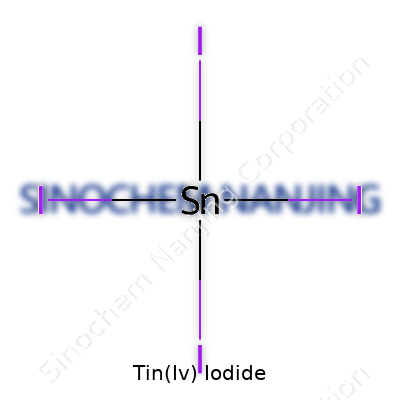
| Names | |
| Preferred IUPAC name | tetrajodostannane |
| Other names |
Stannic iodide Tin tetraiodide |
| Pronunciation | /ˈtɪn fɔːr ˈaɪədaɪd/ |
| Identifiers | |
| CAS Number | 7790-31-2 |
| Beilstein Reference | 3589607 |
| ChEBI | CHEBI:30336 |
| ChEMBL | CHEMBL3300492 |
| ChemSpider | 21143017 |
| DrugBank | DB14273 |
| ECHA InfoCard | 100.944.585 |
| EC Number | 231-870-1 |
| Gmelin Reference | Gm1354 |
| KEGG | C18725 |
| MeSH | D014436 |
| PubChem CID | 24815 |
| RTECS number | XP8925000 |
| UNII | 79SCF411QT |
| CompTox Dashboard (EPA) | DTXSID5044367 |
| Properties | |
| Chemical formula | SnI4 |
| Molar mass | 626.328 g/mol |
| Appearance | Red solid |
| Odor | Odorless |
| Density | 6.4 g/cm³ |
| Solubility in water | Practically insoluble |
| log P | 3.67 |
| Vapor pressure | 0.0000185 mmHg (25 °C) |
| Acidity (pKa) | -2.7 |
| Basicity (pKb) | 12.6 |
| Magnetic susceptibility (χ) | −80.0·10⁻⁶ cm³/mol |
| Refractive index (nD) | 2.65 |
| Dipole moment | 0 D |
| Thermochemistry | |
| Std molar entropy (S⦵298) | 331.1 J·mol⁻¹·K⁻¹ |
| Std enthalpy of formation (ΔfH⦵298) | -207.0 kJ/mol |
| Std enthalpy of combustion (ΔcH⦵298) | -173.1 kJ/mol |
| Pharmacology | |
| ATC code | V09AX02 |
| Hazards | |
| Main hazards | May cause eye, skin, and respiratory tract irritation. |
| GHS labelling | GHS02, GHS07 |
| Pictograms | GHS05,GHS07 |
| Signal word | Warning |
| Hazard statements | H302: Harmful if swallowed. |
| Precautionary statements | P264, P270, P273, P301+P312, P330, P501 |
| NFPA 704 (fire diamond) | 1-0-0 |
| LD50 (median dose) | LD50 (median dose): Oral-rat LD50: 212 mg/kg |
| NIOSH | TW0173000 |
| PEL (Permissible) | PEL (Permissible Exposure Limit) for Tin(IV) Iodide: "2 mg/m³ (as Sn) |
| REL (Recommended) | Ambient temperatures. |
| IDLH (Immediate danger) | Not established |
| Related compounds | |
| Related compounds |
Tin(IV) bromide Tin(IV) chloride Tin(IV) fluoride |



