Thiophenol: Science, Safety, and Where the Future Leads
Looking Back: The Path of Thiophenol in Chemistry
Scientists first isolated thiophenol in the 19th century, a time when organic chemistry was taking off in Europe. This sulfur-containing compound turned heads, not for pleasant reasons at first — thiophenol has a smell that clears a room. Early researchers, some working with open benches and poor ventilation, quickly learned to respect this substance before understanding its value. The journey from stinky oddity to industrial staple didn’t happen overnight. Over decades, thiophenol shifted from lab curiosity to an essential building block in pharmaceuticals and specialty chemicals. Its story tracks closely with the growth of synthetic chemistry: advances in analytical methods, greater chemical understanding, and a constant push for new reactions. As laboratories and factories got better at handling volatile and toxic materials, thiophenol found more places in research and production.
The Nature and Shape of Thiophenol
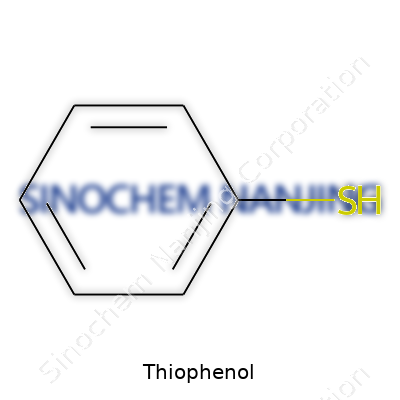
Organic chemists see thiophenol, or benzenethiol, as a phenol where an oxygen atom gives way to sulfur. This small change means a lot. Thiophenol appears as a colorless or slightly yellow liquid, although exposure to air can cause it to darken. The scent, unmistakable and pungent, flags its presence from meters away. It boils at around 169°C and freezes well below room temperature, which means it stays liquid year-round in most factories. Mixing it with water doesn’t work well; it prefers solvents like ethers or alcohols when chemists want to dissolve or react it. Add sulfur to the benzene ring and you get something much more reactive and, in many cases, riskier to store and transport. The technical data on pure samples—such as refractive index or exact melting point—proves valuable to chemists seeking to confirm what they’re working with, but for most tasks, knowing its strong smell and oily feel are practical markers.
How Chemists Prepare and Modify Thiophenol
Synthesizing thiophenol usually involves reduction reactions that swap out chlorine from chlorobenzene, using sodium hydrosulfide in a solvent to introduce the sulfur. Researchers might also reach for alternative routes depending on scale or available materials, but these reductions form the backbone of production in both lab and factory. Most thiophenol used in industry these days doesn’t come from natural sources — it is made synthetically in controlled conditions, which helps avoid some of the mess and unpredictability of older methods. Once in hand, thiophenol’s sulfur atom opens the door to a world of chemical modifications: formation of thioethers, sulfonation, or further functionalization on the benzene ring. Its role as a nucleophile powers many routes to complex molecules, especially those needed for drug development or new materials.
Synonyms and Names in the Chemical World
Spending time with seasoned chemists means learning a few aliases for thiophenol. Some call it benzenethiol, others stick to the straightforward “phenyl mercaptan.” Older literature occasionally mentions phenylic sulfhydrate; in industry catalogs, both English and non-English names turn up. Grasping these synonyms helps with research, as published work under one title might not turn up under another in a database. No matter the name, each refers to the same classically stinky, sulfur-ringed compound.
Working With Thiophenol: Safety and Standards Matter
Experience shows that one should never approach thiophenol casually. Direct skin or eye contact causes burns; inhalation irritates lungs severely. Regulations put strict limits on workplace exposure for good reason — acute poisoning can be life-threatening. Most labs handling thiophenol enforce fume hood use and require full protective gear: goggles, gloves made for organics, and lab coats. Spills can’t go untreated, as thiophenol fumes quickly fill enclosed spaces. Ventilation, monitoring for leaks, and routine training on handling emergencies aren’t theoretical; anyone familiar with the piercing smell won’t forget the risks. Waste disposal adds another layer, since environmental breakdown doesn’t happen quickly and wildlife aren’t any better equipped for thiophenol than people. The evidence from animal studies and overdose incidents keeps safety high on the priority list wherever this chemical gets used.
Thiophenol in Action: Key Applications
Development of modern drugs and new materials often leans on thiophenol at one step or another. Drug chemists use it to introduce sulfur groups—crucial for many biological activities—into candidate molecules during their search for new therapies. Its ability to form thioethers or serve as a building block for specialty reagents broadens options for innovation in everything from crop protection to dyes. Certain semi-synthetic antibiotics, anti-inflammatories, and agricultural chemicals may trace one of their steps back to a sulfur atom appearing thanks to thiophenol. In electronics, thiophenol derivatives pop up in the world of organic semiconductors or as surface modifiers for gold nanoparticles—tiny tweaks with big consequences for device performance. I’ve read about research teams leveraging its chemistry for more sensitive sensors or as a starting point for synthetic polymers with unique electrical properties.
Pushing the Frontier: Research and Development
The landscape for thiophenol continues to shift. Chemists search for safer reactions, more efficient processes, and applications that cut down on risk and waste. Recent technical papers point to modified thiophenol molecules outfitted with additional chemistry—helpful for snapping together new molecules with more selective biological activity. Research teams also explore alternative synthetic methods aiming to reduce the use of problematic reagents or harsh conditions. Industry pushes for green chemistry often focus on minimizing both worker exposure and downstream pollution. Some universities even look to biotechnological routes, using engineered bacteria or enzymes to perform steps once considered out of reach for living systems. The pursuit of new uses in medical diagnostics, advanced coatings, or energy storage widens its potential impact every year.
Looking at Toxicity: Limits and Real-World Effects
Few people who have worked with thiophenol forget its power to harm. Toxicology reports show it gets absorbed rapidly, especially where protective gear comes up short. Short-term exposure can cause headaches, nausea, and in serious cases, organ damage. Chronic exposure may sensitize the body over time, raising the stakes for those in frequent contact. Regulatory agencies set tight thresholds, and rightly so—as few grams released into a room can create a dangerous situation for air quality. Waste management protocols get constant attention because thiophenol lingers and spreads quickly in ecosystems, where even small amounts damage aquatic life. Research confirms that its risks demand more than basic caution, balancing technical need against health and environmental cost at every stage from lab to landfill.
A Road Ahead: Future Prospects for Thiophenol
Industry and academic science continue to seek cleaner processes, more predictable chemical transformations, and safer working conditions for everyone involved with thiophenol. Advances in catalysis and automation reduce hands-on risk, while emerging applications in nano- and biotechnology open new markets for thiophenol derivatives outside established sectors. The need for specialty chemicals in electronics, greener pharmaceuticals, and smarter surface coatings means researchers will likely keep thiophenol on their lists for years. Ongoing research into handling, waste minimization, and less toxic alternatives shapes how industries prepare for future regulations and new application standards. Those committed to green chemistry and occupational safety keep searching for substitutes and improved protocols—an effort that benefits from open data sharing, industry-academic partnerships, and constant innovation in both chemistry and workplace safety practices.
What is Thiophenol used for?
Stories From The Lab Bench
Some compounds earned their keep in my graduate lab days, and thiophenol has a place on that list. The moment its sharp, rotten-egg odor leaks out of a bottle, you know you’re handling something powerful. Behind that smell hides a useful tool for organic chemists trying to build or tweak molecules.
Where Thiophenol Shows Its Strength
The real value of thiophenol (also called benzenethiol) shines in its role as a sulfur donor. The compound looks a bit like phenol but swaps oxygen for sulfur. That swap changes everything. Sulfur brings new chemical possibilities, the main one being the ability to create thioethers and thiol esters. In everyday language, it lets labs add sulfur to other molecules—the first move for making custom flavors, agrochemicals and even drugs.
Thiophenol steps up most in the making of certain dyes and pharmaceuticals. Take the antibiotic ceftriaxone: its manufacture uses thiophenol as a building block. In many cases, only a simple chemical reaction will swap out a chlorine atom for a thiol group, turning a boring molecule into something biologically active.
Harnessing Stink for Science
Many researchers and engineers complain about the odor, but there’s no denying the usefulness here. Thiophenol often knocks loose protective groups from delicate intermediates. Imagine you pour months into making a molecule, only to ruin your hard work stripping away those groups the wrong way. Thiophenol and its relatives pull off this final step cleanly, saving time and headaches.
It turns up in analytical chemistry as well. Detecting trace metals in water sometimes needs a chelating agent. Mix thiophenol with samples, and it latches onto some metals, making them easier to pick out. That detail matters if a food or drug company needs to prove their product stays within safe metal thresholds.
Risks and Solutions
Smell aside, thiophenol comes with real hazards. Small doses irritate the skin and lungs. In bigger quantities, the compound can damage organs, especially the nervous system and liver. I learned early on to work in the fume hood and double-check gloves. Safety protocols in most research settings treat thiophenol with the same seriousness as other hazardous reagents.
Many companies now try to limit waste and exposure. One fix uses solid-supported versions of thiophenol, keeping the stink and risk under better control. Some creative chemists turn to “green chemistry” approaches, using less toxic sulfur sources or milder conditions when possible. But for certain specialized reactions, nothing replaces pure thiophenol.
Facts back up its power. Each year, global markets move tons of thiophenol, mostly to serve the pharmaceutical and dye industries. Research from the American Chemical Society notes steady growth in its use for custom drug synthesis, especially where sulfur’s unique properties make or break a compound’s bioactivity.
Why Knowledge of Thiophenol Matters
Most people never hear about thiophenol outside of advanced chemistry classes, but for those of us who’ve used it, the compound sticks in memory—for both its odor and its impact. The drive for greener, safer tools continues, but thiophenol stands as an example of chemistry’s trade-offs: risk and reward bundled in every pungent bottle.
What are the safety precautions for handling Thiophenol?
Why Thiophenol Demands Caution
Thiophenol carries a harsh smell that fills the room within minutes, and that’s only the start. Having worked with sulfur compounds before, I can say few chemicals stick so stubbornly to your hands or equipment. Thiophenol is toxic through inhalation, ingestion, and skin contact. Its vapors irritate eyes and throats, and absorbing just a small amount can hit the nervous system, cause headaches, dizziness, even more severe trouble. For many researchers and chemists, the harsh odor acts as an early warning, but trusting your nose is a poor substitute for strong safety habits. Property damage from careless spills or vapor leaks is not far-fetched either, since the liquid can corrode some surfaces and linger for days.
Ventilation and Personal Protective Equipment
Anytime thiophenol comes out of storage, a chemical fume hood should handle the vapors. Regular room airflow doesn’t cut it; even a sniff outside a hood usually means you’ve already let too much escape. I always check the hood’s airflow indicator before starting. On the body, nitrile gloves work, but I double up for peace of mind and keep a spare pair nearby in case of rips. Safety goggles are a must, since a few drops in the eye do real damage. Lab coats and closed shoes stay on throughout, and long sleeves keep exposed skin down to a minimum. Splash-proof aprons work well if there’s any chance of spills. Respirators with suitable organic vapor cartridges can be important in settings with heavy use or if fume hoods aren’t plausible.
Storage and Labeling
Thiophenol belongs in a tightly sealed bottle, preferably amber glass to reduce breakdown from light. When I store it, I check that the cap closes without leaks and keep the bottle in a secondary containment tray. This tray catches drips and stops a roll-off if the bottle tips. Labels show the full chemical name, hazard symbols, and the date. Spaces shared with food or common areas are bad news; once that smell gets in, it’s tough to clear out. Separate storage for sulfur compounds also helps avoid dangerous mixing with oxidizers or acids.
Spill Response and Waste Disposal
Spills create panic if you’re unprepared. My habit is to keep spill kits with absorbent pads and neutralizers next to the workspace before I even open a bottle. If a spill happens, restricting the area and alerting others around solves a lot before they walk into the fumes. I open up the hood full blast and use absorbent material without raising more dust. Waste with thiophenol can’t go in the trash — special labeled waste containers set aside for sulfur organics prevent accidental leaks or chemical reactions. Lab managers arrange for pickup and chemical waste disposal instead of risking a hazardous mess in the drain.
Training and Emergency Action
New lab members rarely realize just how persistent thiophenol can be. Running safety drills and reviewing the chemical safety data sheet creates muscle memory for those rare moments when something goes wrong. Nearest eyewash stations and showers get pointed out on day one, because moments matter if there’s a splash. In my experience, a well-drilled team fixes small mistakes fast and avoids a string of permanent chemical odors — or far worse, a trip to the emergency room.
Bridging Precautions with Responsibility
Working with thiophenol always feels a bit tense until the evidence sinks in — strong habits, not just rules, prevent exposure. Good lab gear, clear labeling, and organized storage set everyone up for safer work. Frequent safety refreshers, especially with new personnel, make a big difference. Fume hoods stay the most important tool, but it’s the day-by-day choices that keep everyone hardworking and, most importantly, safe from nasty side effects or unneeded risks.
What is the chemical formula of Thiophenol?
What is Thiophenol?
Thiophenol stands out in the world of chemistry for bringing together a sulfur atom and a benzene ring, giving it the formula C6H5SH. In practical terms, that means a benzene molecule (C6H5) attached to a thiol group (–SH). This simple arrangement packs a punch both in the lab and in industry. Anyone who has worked around it would never forget its strong, penetrating odor, which comes from the sulfur. Most chemists can spot it a mile away by smell alone.
Why Does this Matter?
Thiophenol is more than just another chemical on a shelf. Its core formula, C6H5SH, makes it a staple in organic synthesis labs worldwide. The reason is straightforward: the thiol group acts as a pawnbroker, trading out its hydrogen to build new molecules. I’ve seen it play roles in making pharmaceuticals, agricultural agents, and specialty dyes. Its sulfur component can slip into molecules, transforming their behavior and reactivity. That gives researchers powerful tools for building with precision.
Health and Safety Issues
While thiophenol’s chemical structure makes it useful, it demands respect. Breathing in its fumes can damage the respiratory tract and cause headaches or dizziness, so fume hoods are a must. Years ago, a researcher in my lab underestimated its risks. Even with gloves on, just a few drops contaminated a doorknob, and the smell lingered for days. That served as a hard reminder to upgrade our containment practices and double-check labels each time.
Concerns stretch beyond the person handling it. Thiophenol can run into the environment through poor waste disposal, harming both water sources and wildlife. The Environmental Protection Agency keeps a close eye on sulfur compounds because of these hazards.
Better Practices in Handling Thiophenol
Labs have set up tighter controls in the past decade. Dedicated exhaust lines, proper training, and real-time detection of vapors help control exposure. Some companies go a step further, developing derivatives that offer similar chemical value but with fewer risks. I’ve worked in spaces trying to swap out pure thiophenol for these alternatives. The results vary, but it’s an ongoing experiment that appeals to anyone who values safety.
Paths Toward Safer Use
Mistakes in chemistry can be costly, and thiophenol isn’t forgiving. Sharing stories and practical experiences, like that doorknob lesson, can drive home the importance of vigilance better than safety sheets ever could. Lives and livelihoods depend on keeping risks low, so ongoing education matters every day.
The Value Behind the Formula
Saying thiophenol’s formula is C6H5SH might look like simple memorization, but the real story sits in its uses and impact. Every bit of research, every product development, brings the need for respect, responsibility, and creativity. The right protocols and constant improvement make sure its benefits come through without the heavy price of carelessness.
How should Thiophenol be stored?
Understanding What’s at Stake
Walk into any lab where thiophenol shows up, and the sharp, pungent odor hits right away. It lingers. For many, that smell draws a clear line—this isn’t a bottle to handle carelessly. Thiophenol can harm skin, eyes, lungs, and even the nervous system if exposure stretches too long. Beyond its effects on people, it sparks easily and reacts with air, putting facilities at risk if stored without much thought. The caution, then, comes from direct experience. No matter how often someone works with chemicals, complacency invites trouble with compounds like this.
Choosing Safe Storage
Glass goes far. Polyethylene and other plastics can break down over time, or let vapors slip through. Glass bottles with tight-fitting, screw-on lids work best. Store under a nitrogen or argon blanket to spare the thiophenol from slow air oxidation. If that’s not in place, a sealed environment cuts down contact with moisture and oxygen. Store these bottles far from sunlight, heat sources, or open flames. There isn’t much room for shortcuts, especially since thiophenol catches fire at fairly low temperatures.
Location Matters
Experience shows that mixing up storage of incompatible substances breeds accidents. Thiophenol calls for separation—far from oxidizers, acids, and bases. Anyone who’s seen a mystery spill that started from cross-contaminated chemicals can tell you, one event sets off a chain nobody wants. A ventilated chemical cabinet makes sense here, fitted with spill trays. Ventilation keeps any minor vapor leaks from spreading across workspaces and affecting anyone nearby.
Labeling Prevents Mistakes
Labels should be clear and permanent. Anything confusing, or worse—no label at all—turns simple oversight into emergency. People in the lab must be able to pick out the container without guesswork. Use hazard labels that don’t fade. In my own work, I’ve seen colleagues reach for what looks like harmless solvent, only to realize, after cracking the cap, they came close to a dangerous mistake. Good labeling stopped a problem before it started.
Emergency Procedures and Training
No storage method stands alone. Even with the best cabinets and seals, spills or leaks happen. Training staff to use respirators, gloves, and goggles means reactions happen fast if a problem appears. Clear signage directs people to eyewash stations and hoods. If no one takes these drills seriously, real accidents become much harder to contain. Having clean-up kits ready—absorbent pads, neutralizing agents, waste containers—makes a difference.
Disposal Can’t Be an Afterthought
Waste thiophenol doesn’t belong down the drain or in general trash. Dispose of it by sealing in compatible containers and contacting licensed chemical waste handlers. Some may see this as a hassle, but simple shortcuts bring long-term harm to people, pipes, and the environment. Nobody wants traces of organosulfur compounds seeping into groundwater or building up in labs where others work down the line.
Better Practices, Safer Labs
Care in storage grows from respect—both for the power of thiophenol and for fellow lab workers sharing the space. Stories from research benches all echo the same truth: less trouble comes to those who plan ahead and follow steps that keep harmful chemicals in their place. That’s how good science and good health both move forward.
What are the physical properties of Thiophenol?
Understanding the Look and Feel
Chemistry classes never covered the full sensory punch of encountering thiophenol, but in any lab, the first thing that strikes you is its smell. Anyone who’s handled it remembers that fierce odor—something between burnt rubber and garlic. This scent isn’t just memorable; it’s a warning. Even minute amounts tell you to work with care. Thiophenol lays out clear physical evidence of its presence, showing you immediately that respect for it comes naturally the first time it’s uncorked.
Physically, thiophenol appears as a colorless to pale yellow liquid. Its color may deepen when left out, as air exposure leads to slight oxidation. In the bottle, this change can be subtle, but over time in a shared laboratory space, you learn to notice even faint yellow tinges signaling that the chemical may have aged and demands careful scrutiny.
Boiling, Freezing, and Spilling
The numbers matter for safe lab work. Thiophenol boils at about 169°C (336°F) and freezes at around -16°C (3°F). Those aren’t simply abstract figures for a notebook—they affect everything from the way you store it to how you design experiments. At standard room temperature, thiophenol stays liquid. Glassware doesn’t tend to frost over, but don’t let a cold refrigeration drop change storage plans. Leaks or spills vanish slowly because this stuff evaporates steadily, not all at once. It clings, forcing thorough cleanup.
Mixing with Water and Other Solvents
No one pours thiophenol down the sink and hopes for the best; it floats on water, barely mixing. This tells you something practical about cleanup and disposal: water dilution won’t help much. For greater solubility, organic solvents like diethyl ether or ethanol work. On the bench, the sharp odor lingers even when diluted. The separation from water can sometimes surprise newcomers to the field who expect all “smelly chemicals” to mix away with a simple rinse.
Density, Weight, and Safety
Thiophenol has a density around 1.07 grams per cubic centimeter at room temperature. Pour some, and it flows with a slight viscosity—not syrupy, but heavier than a splash of water. Handling this liquid makes you realize a bottle feels denser than expected for its size, hinting at its potent chemical punch. This property may seem minor until someone overturns a container and realizes cleanup isn’t as simple as a paper towel and a mop.
Flammability and Direct Handling Risks
One aspect that carries consequences in labs is flammability. Thiophenol catches fire more easily than water. Its vapor mixes with air and forms a flammable composition. Fires involving thiophenol aren’t frequent—partly because anyone who’s worked with it tends to double-check containers and avoid ignition sources without being told twice.
Reactive Character and Real-Life Implications
Exposure to light and air leads to degradation. In storerooms, brown glass bottles and tight caps get used to limit this reaction. Even then, periodic checks are crucial. Store chemistry gets real when chemicals go off, ruining long-planned experiments or creating unexpected hazards. Supporting proper safety with facts means labeling and handling according to these traits, not just relying on memory or routine.
Thiophenol stands as both an everyday chemical and a daily reminder of why thorough cleanliness and clear labeling remain non-negotiable. Its physical properties anchor habits that keep science—and scientists—safe. For anyone who’s opened a fresh bottle, that distinctive smell lingers as a nudge to stick to the facts, follow best practices, and stay mindful of everything from color to cap.
| Names | |
| Preferred IUPAC name | Benzenethiol |
| Other names |
Mercaptobenzene Benzenethiol Thiofenol Phenyl mercaptan Phenylthiol |
| Pronunciation | /ˌθaɪ.oʊˈfiː.nɒl/ |
| Identifiers | |
| CAS Number | 108-98-5 |
| Beilstein Reference | 1209222 |
| ChEBI | CHEBI:17590 |
| ChEMBL | CHEMBL1427 |
| ChemSpider | 696 |
| DrugBank | DB02130 |
| ECHA InfoCard | 100.004.283 |
| EC Number | 207-702-0 |
| Gmelin Reference | 5888 |
| KEGG | C00736 |
| MeSH | D013883 |
| PubChem CID | 7907 |
| RTECS number | XM5425000 |
| UNII | 9O4Y07500N |
| UN number | UN1708 |
| Properties | |
| Chemical formula | C6H6S |
| Molar mass | 110.17 g/mol |
| Appearance | Colorless to pale yellow liquid |
| Odor | garlic-like |
| Density | 1.07 g/mL at 25 °C |
| Solubility in water | slightly soluble |
| log P | 1.94 |
| Vapor pressure | 2.5 mmHg (20°C) |
| Acidity (pKa) | 6.6 |
| Basicity (pKb) | 6.92 |
| Magnetic susceptibility (χ) | -36×10⁻⁶ cm³/mol |
| Refractive index (nD) | 1.621 |
| Viscosity | 3.24 mPa·s (20 °C) |
| Dipole moment | 1.27 D |
| Thermochemistry | |
| Std molar entropy (S⦵298) | 163.0 J·mol⁻¹·K⁻¹ |
| Std enthalpy of formation (ΔfH⦵298) | −6.0 kJ·mol⁻¹ |
| Std enthalpy of combustion (ΔcH⦵298) | -635.0 kJ·mol⁻¹ |
| Hazards | |
| GHS labelling | GHS02, GHS06, GHS05 |
| Pictograms | GHS06, GHS05, GHS08 |
| Signal word | Danger |
| Hazard statements | H301 + H311 + H331, H311, H302, H311, H314, H331, H373, H400 |
| Precautionary statements | P260,P261,P264,P270,P271,P273,P280,P301+P310,P303+P361+P353,P304+P340,P305+P351+P338,P310,P311,P312,P330,P361,P363,P391,P403+P233,P405,P501 |
| NFPA 704 (fire diamond) | 2-4-2-W |
| Flash point | 43 °C |
| Autoignition temperature | 345 °C |
| Explosive limits | Lower 1.3%, Upper 16% |
| Lethal dose or concentration | LD50 oral rat 260 mg/kg |
| LD50 (median dose) | LD50 (median dose): Oral-rat: 46 mg/kg |
| NIOSH | SN8525000 |
| PEL (Permissible) | PEL: 0.1 ppm |
| REL (Recommended) | 0.1 ppm |
| IDLH (Immediate danger) | 15 ppm |
| Related compounds | |
| Related compounds |
Phenol Benzyl mercaptan Diphenyl disulfide 4-Nitrothiophenol Thiophenol S-oxide |



