Tetramethylsilane: A Commentary on Its Significance Across Science and Industry
Historical Development
Looking back at the early days of modern organosilicon chemistry, few compounds have left as distinct a mark as tetramethylsilane. In the years after World War II, the chemical industry sought new carriers and standards for emerging analytical techniques. Chemists recognized the stability and volatility of this molecule—four methyl groups tethered to a single silicon atom—as ideal for new nuclear magnetic resonance (NMR) technologies. For many scientists laboring in small laboratories, the arrival of tetramethylsilane coincided with a period where precise measurement built credibility. The demand for a chemical shift reference in NMR drove broader synthesis and study, opening new questions in organosilicon reactivity that still spark research today.
Product Overview
Walk through a research lab or specialty chemical plant, and you’ll find that tetramethylsilane rarely stays on shelves for long. Its widespread recognition wasn't an accident. For decades, researchers gravitated to this colorless, flammable liquid precisely because it brings more than stability; it offers clarity and reproducibility in instrumental analysis. It doesn’t react with most common reagents under standard conditions, which turns it into something of a backbone chemical—a reliable cornerstone in settings where consistency matters more than showy performance.
Physical & Chemical Properties
The physical attributes of tetramethylsilane explain its popularity. It delivers a low boiling point sitting near 27°C, a handy feature for low-temperature distillations and rapid evaporation in sample prep. Silicon's tetrahedral geometry in this compound offers unique shielding effects to the central atom, a fact appreciated by every spectroscopist who seeks clean and sharp NMR baselines. Chemical resilience defines its character; the methyl groups shelter silicon, producing a molecule that keeps its shape and avoids unexpected side reactions with acids, bases, or oxidizers under benign conditions. Water doesn’t break it down, so accidental moisture picks up less risk than with many organosilicons. Whether dissolved in hydrocarbons or evaporated from glassware, tetramethylsilane behaves predictably.
Technical Specifications & Labeling
On packaging, clear safety and purity data keep users informed and safe. Commercial supplies most often indicate spectroscopic grade, with purities jumping above 99.9%. Labels state batch numbers, hazard pictograms for flammability, and basic storage instructions. Safety sheets reinforce the need for cool, well-ventilated storage, protective gloves and goggles, and robust spill preparedness. Chemists appreciate concise labeling, making sure every specification is clear enough to avoid mismatches mid-experiment. Reputable vendors maintain rigorous quality checks, publishing impurity profiles down to ppm levels where necessary.
Preparation Method
Manufacture of tetramethylsilane leans on classic organosilicon routes. Alkylation of silicon tetrachloride with methyl chloride in the presence of a Grignard reagent (or, on industrial scales, metallic sodium) produces high yields. The process favors dry conditions, excluding water with care, as moisture triggers hydrolysis byproducts. Once the main reaction finishes, distillation steps purify the output. Smaller labs can prepare it batchwise, but larger operations take advantage of more continuous systems, sometimes recapturing excess methyl chloride to reduce costs and emissions.
Chemical Reactions & Modifications
By itself, tetramethylsilane resists all but the harshest conditions. Strong acids, high temperatures, or specialized oxidizers might split methyl groups or oxidize the silicon center, but mild reagents rarely disturb it. Its minimal reactivity earns value as an internal standard, while persistent efforts to tweak its structure led chemists to related families—silanes and siloxanes—where reactivity can be dialed up for advanced materials applications. On occasion, specially designed catalysts nudge the breakdown or substitution of methyl groups, generating intermediates for other silicon-based building blocks.
Synonyms & Product Names
Ask around in chemical circles, and a handful of names pop up: TMS, tetramethylsilicon, and trimethylsilylmethane all trace back to this compound. Catalogs might feature registry numbers such as CAS 75-76-3. Each moniker points to the same utility, and while the acronyms change, the substance’s essential features remain the same.
Safety & Operational Standards
Every bottle brings an inherent fire risk. Labs with tetramethylsilane on the shelf prioritize blast-resistant storage, no open flames, and ventilation that routes even minimal vapors safely outside. Contact with skin or eyes triggers brisk washdowns, and inhalation calls for immediate fresh air and monitoring. Training for chemical hygiene builds staff awareness, using spill pads, fire extinguishers, and first aid kits as standard protection in all active spaces. Awareness doesn’t just come from safety data sheets; it emerges from routine drills, clear signage, and mentoring between experienced chemical handlers and those newer to hazardous materials.
Application Area
The most widely-known application lands in NMR spectroscopy, where it outperforms alternatives as a reference standard because its resonance falls at zero chemical shift. Every organic chemist building out a molecular structure leans on this feature. Technologies for medical imaging, quality assurance, forensic analysis, and advanced materials characterization rely on its predictability. In Silicon Valley’s semiconductor landscape, tetramethylsilane shows up as a precursor for depositing thin films via CVD in microelectronics manufacturing. Demand among electronics makers taps into its capacity to provide uniformity in film quality and fine-tuned device performance.
Research & Development
Current research heads in several promising directions. Catalysis experts seek ways to adapt or recycle tetramethylsilane into specialty silane reagents for optoelectronics and solar cell components. Environmental scientists examine its fate and transport in air and wastewater, seeking solutions for leak mitigation and capture. Process chemists work on scaling safer, greener synthetic methods, often switching out hazardous reagents for alternatives with reduced environmental impact. Collaboration between academic and industrial teams shortens the time between discovery, pilot scale, and full adoption, so chemists can quickly pivot to emerging needs in analytical chemistry and materials science.
Toxicity Research
Tetramethylsilane’s low acute toxicity puts it in a different class than some volatile hydrocarbons or halogenated solvents, yet risks remain. Inhaling concentrated vapors irritates lungs and upper airways, and accidental splashes challenge skin and eye safety. Chronic exposure data continues to develop, though current evidence doesn’t show major long-term health hazards with controlled use. Toxicologists have tested metabolic breakdown, confirming rapid exhalation and minimal systemic retention in mammals. Regulatory frameworks reflect a balance: significant hazard labels cover fire and explosive risk more than systemic toxicity. Nonetheless, continued vigilance from health and safety teams keeps incidents to a minimum.
Future Prospects
Technological shifts always spark new uses for established chemicals. Tetramethylsilane now faces evolving roles in nanotechnology, quantum dot engineering, and even atmospheric monitoring sensor development. The push for sustainable chemistry may nudge manufacturers to refine synthetic methods, reduce energy footprints, or use bio-based routes. Automation in chemical analysis keeps it in demand as a stable NMR standard, but emerging quantum computing applications or advanced electronics could generate demand far beyond anything seen today. As research questions evolve, so do the tools, and tetramethylsilane seems poised to remain highly relevant—possibly enabling advances no one would have predicted just a few years ago.
What is Tetramethylsilane used for?
Seeing the Unseen in Chemistry Labs
Chemistry often looks like smoke, mirrors, and a dash of magic. That’s the feeling I got first time I watched a nuclear magnetic resonance (NMR) spectrum bloom out of a simple computer screen. But at the core of this spectacle sits an unassuming chemical: tetramethylsilane, usually called TMS. Most people outside the lab never hear the name, yet, inside research or pharmaceutical labs, you’d struggle to finish a project without it.
How TMS Came to Matter
TMS doesn’t get attention for flash or danger. It’s clear, volatile, and pretty much immune to most chemical drama. The reason it draws so much trust goes back to how NMR works. Researchers use NMR to figure out what different molecules look like, atom by atom. TMS provides a point of reference, showing up at “zero” on the scale so scientists know how to read everything else. Without this marker, shifting signals drift all over the place, making it hard to tell anything with confidence.
The silicon in TMS gives it an edge over everyday organics. It shows just one, clean peak in the NMR spectrum. No wild side reactions, no confusing byproducts, and no overlap with signals from most organic compounds. TMS’s electrons cushion its methyl groups, keeping its signal sharp and reliable. After running spectra, I learned to appreciate just how stabilizing that zero-point can be amid the chaos of unknowns.
Beyond the NMR Tube
TMS now features well beyond classic 1H-NMR. Scientists trust it for calibrating 13C NMR, too, thanks to carbon atoms in its structure. That’s a rare bit of efficiency in lab work. And every chemist I know values efficiency. In the past decade, techniques in materials science and polymers have leaned on TMS to understand new plastics and coatings. Even food testing and forensic science rely on it to mark out chemical signatures in complex mixtures. Its limit, though, pops up with water-heavy samples, as TMS doesn’t mix with water easily. Labs sometimes swap it out for other markers, depending on the sample.
Concerns and Safer Use
Safety always comes up around volatile organics. TMS isn’t especially toxic or stubborn in the environment the way some silicon compounds can be, but it vaporizes quickly and can irritate the eyes or lungs. Fume hoods and care with pipetting become part of muscle memory. I remember a time in grad school when a bottle lost its cap: the smell let us know in minutes, clear proof this chemical doesn’t like to sit around uncovered. Any student learns fast to work smarter with it.
Future Thinking and Sustainability
Manufacturing uses a lot of TMS today, not just for NMR but as a building block in making silicon-based polymers and specialty fluids. The push for greener chemistry means we look at every solvent or reference compound with sharper eyes—what impact does its production and disposal have? Recycling or replacing TMS in certain cases could move research toward cleaner lab practices. At the same time, nothing in my experience replaces the clarity it brings to chemical analysis. If better, more eco-friendly alternatives show up in the future, chemists will have to put them to the test. For now, TMS stands as a subtle but powerful tool in our toolkit, helping scientists around the world draw solid conclusions from messy mixtures.
Is Tetramethylsilane hazardous or toxic?
What Is Tetramethylsilane?
Walk into any chemistry lab, and it’s hard to miss a bottle labeled tetramethylsilane — often just called TMS by those who work with it. This clear, colorless liquid rolls into my mind when I think about NMR spectroscopy, where TMS sets the standard for calibrating instruments. I remember prepping NMR samples in grad school, appreciating how a drop of this stuff made peak assignments so much easier.
Toxic by Touch, Breath, and Ingestion
Reading a TMS bottle makes you pause. It signals flammable with a big red diamond — not something to ignore. Exposure can irritate eyes, skin, or the inside of your nose. Breathing its vapors can mess with your head, causing dizziness, headaches, or that woozy feeling nobody wants in a lab.
The science backs up those warnings. Studies, like those summarized in PubChem and Chemwatch, report skin and eye irritation, but don’t show it ramping up to cancer-causing or long-term health damage after a typical, minor exposure. The US National Library of Medicine lists a moderate acute toxicity, with effects mostly showing up during direct and prolonged contact. Most people who have spent time in labs have likely come across the overpowering scent and have learned to keep samples closed and use fume hoods.
If someone drinks TMS by accident — which, thankfully, rarely happens — doctors often treat it like a solvent poisoning. The situation can turn serious, with risk to lungs, nervous system, and other organs. It’s clear that TMS isn’t stuff to get casual with.
Bigger Problems: Fire and Air
It doesn’t just sting your eyes; TMS catches fire with surprising ease. Sparks or high temperatures can turn it into a safety nightmare. When it burns, it gives off toxic fumes such as silicon oxides and formaldehyde — something open flames in a lab don’t mix well with. Because vapors are heavier than air, they sink and spread, increasing the chance of accidental ignition.
This flammability means most labs store TMS in flammable safety cabinets. I still remember a close call with a tipped-over vial before a supervisor gave us all a sharp lesson about carelessness around open flames.
Environmental Side of the Story
Dumping TMS down a drain isn’t just wasteful; it brings up worries about local water supplies and ecosystems. It breaks down in air, but not instantly, and what happens next can produce other chemicals that impact plants and animals.
Waste policies suggest collecting leftover TMS in special solvent bins, never letting small-scale lab convenience harm bigger environmental health. The responsible thing means not just following the rules but understanding why the rules exist.
Smarter Handling and Safety
The facts tell me clear steps make a difference. Always use gloves and eye protection. Fume hoods aren’t optional. Proper training — the practical, hands-on kind — sticks in your mind long after the textbook warnings fade.
Safer chemicals and green chemistry approaches have grown more popular, particularly for those trying to find alternatives for teaching labs. Still, until NMR technology evolves past the need for these reference chemicals, people must keep a sharp eye out for unsafe moments and sloppy habits.
Knowing the risks, we’re not left powerless. Personal habit, updated systems for local airing and waste collection, and honest conversations all help keep TMS from doing harm.
What are the storage requirements for Tetramethylsilane?
Understanding Tetramethylsilane’s Behavior
Anyone who’s ever handled chemicals at the bench knows that not every colorless liquid behaves the same. Tetramethylsilane (TMS) shows this pretty clearly. Volatile, low-boiling, and highly flammable, TMS has a knack for evaporating quickly and catching fire even more easily. The flash point sits around -0.7°C, so even a cool room won’t guarantee safety—TMS still gives off enough vapor to ignite in normal environments. I remember the first time I cracked open a fresh ampule in a spectroscopy lab; the instructor practically hovered over my shoulder, triple-checking that every spark, every open flame was far from the scene.
Keep It Cool, Keep It Closed
Storage starts with temperature control. TMS shouldn’t sit in direct sunlight or near heaters, not only to prevent warming but to keep those vapors from building up. Even indirect sunlight through a window can warm a glass bottle just enough for troubles to start. Low-temperature storage, in a well-ventilated chemical cabinet, works reliably. If your lab runs hot in summer, it’s worth stashing small bottles in a flammable liquids refrigerator. That habit saved me from a close call once, since metal cabinets without cooling easily heat up on long July days.
Choose Containers Built for the Job
Cheap caps and ill-fitting lids lead to leaks, and TMS has enough vapor pressure that it’ll find any crack. Standard glass bottles with Teflon-lined screw caps usually hold up well, and they keep evaporation at bay. I’ve watched new students pour TMS into unlabeled jars, only to come back days later and wonder why their sample dried up or why the air carried that sharp, ether-like smell. Clear labeling, tight closures, and chemical-resistant seals make a difference.
Separation from Incompatibles
Lab shelves get crowded, and it’s tempting to stack whatever fits. Storing TMS apart from oxidizers matters more than many realize—small spills or leaks, even without flame or spark, can lead to nasty surprises when the chemicals mix. Chlorine, peroxides, acids, and even some everyday cleaning agents can start reactions. It pays to keep TMS in a designated area marked for flammables, away from strong acids and bases.
Healthy Respect for Ventilation
Many chemical mishaps start with vapors ignored. TMS vapors are heavier than air and can drift along benches or floors toward ignition sources. Proper ventilation isn't just a suggestion. Using fume hoods or purpose-built storage cabinets that vent outside the building keeps exposure in check. I’ve learned to look for any faint “sweet” or gasoline-like odor as a warning—a sign that vapor is escaping and the room's airflow needs adjusting.
Handling and Small Quantities
Practical storage habits touch handling, too. Lab managers often decant TMS into smaller bottles to limit risk: less to spill, less to vaporize, easier access. The National Fire Protection Association (NFPA) assigns a high flammability rating to TMS, so even a few milliliters can cause trouble if spilled. Keeping absorbent pads and spill kits nearby gives peace of mind and allows for quick fixes.
Eye on the Shelf Life
TMS won’t last forever, especially with repeated opening. Over time, bottles can show signs of moisture ingress—cloudiness, or a faint vinegar smell hinting at hydrolysis. Rotating stock and using up older material first keeps waste in check.
Summary Table: Storage Quick Facts
- Temperature: Cool, well-ventilated, away from sunlight/heaters
- Container: Tight-sealing, Teflon-lined, labeled bottles
- Separation: Store away from oxidizers and acids
- Ventilation: Use fume hoods or vented cabinets
- Shelf life: Watch for moisture contamination; rotate stock
What is the chemical formula of Tetramethylsilane?
Chemical Formula: Si(CH3)4
Tetramethylsilane, with the chemical formula Si(CH3)4, often shows up on the lab bench as a simple silane base adorned by four methyl groups. Anyone who’s run a proton NMR knows its importance—tetramethylsilane, or TMS, acts as the standard every chemist depends on for precise calibration. Its distinct presence at zero ppm, far from the signals of organic compounds, helps researchers avoid confusion over chemical shifts. In my experience, nothing replaces the confidence that comes from seeing that sharp single peak from TMS, making sure chemical shift values stay reliable and consistent across the world.
Tetramethylsilane gets chosen for real reasons. Its symmetrical structure shields the hydrogen atoms from electronic noise, creating a strong, sharp signal during measurement. The signal does not wander or split, making interpretation straightforward. With a boiling point around 26°C, TMS evaporates easily but survives long enough for careful measurements. Flammable and volatile, it needs careful handling, but these properties don’t outweigh its value as a universal reference.
Why Tetramethylsilane Remains Essential
Chemists trust TMS because it doesn’t react with samples, solvents, or glassware. The molecule’s sulfur-free, stable silicon core sits untouched in most conditions, so readings stay clean. TMS occupies a unique low-field, high-shielding zone, so typical organic compounds do not crowd its signal. That keeps analysis clear, especially when handling complex mixtures or new synthetic molecules where every signal counts. This feature delivers transparency in science—a value the research community holds close.
Supply and purity matter too. Many companies purify TMS to over 99% purity, reducing background interference in spectra. Still, counterfeit or contaminated lots sneak into the market sometimes. Contaminants erode trust in data and throw off research. To tackle this, some labs have moved toward regular quality checks and purchasing only from trusted suppliers, a practice that maintains results people can trust.
Potential Risks and Moving Forward
TMS brings hazards along—flammability, skin and eye irritation, air and water pollution. Small spills in the lab can vaporize fast and cause workplace issues if hood ventilation isn’t up to par. Labs can’t ignore these realities. Training and clear safety protocols become part of the workflow. Safety goggles, gloves, tight bottle seals, and good ventilation should never be skipped. People who’ve experienced minor TMS mishaps learn quickly; they pass this hard-earned caution to new trainees, building a safer lab culture from the ground up.
Alternative references exist. Deuterated solvents and other chemical standards compete for attention, especially in fields focusing on environmental impact. Still, TMS holds its spot in most organic labs. Cleaner production processes and improved container systems—like vapor-tight refillable ampoules—can help reduce spillage and waste. Research groups interested in green chemistry look for recyclable, less hazardous standards, but so far, nothing beats TMS for convenience and clarity in NMR.
Looking Beyond the Glass Tube
Reliable chemical data trickles into pharmaceuticals, materials science, and food safety. The work hinges on a simple, reliable, universally understood molecule—tetramethylsilane. Its chemical formula, Si(CH3)4, figures in nearly every line of quality science pouring from university and industrial labs. Precise reference standards give strength to interpretation, research progress, and new discoveries. Recognizing the value—and managing the risk—of a humble molecule keeps the wheels of science turning, one spectrum at a time.
What safety precautions should be taken when handling Tetramethylsilane?
Understanding the Risks
Tetramethylsilane shows up in plenty of labs, especially in chemistry departments and the semiconductor industry. It smells like ether, evaporates even faster, and burns more readily than most folks would expect. On top of that, it can irritate the skin, eyes, and lungs in short order. Once it catches fire, it produces messy silicon oxides and a lot of heat. So, it demands respect and careful handling every step of the way.
Practical Ways to Handle Tetramethylsilane Safely
I’ve worked with colorless liquids that move fast and react quickly to the slightest spark. Tetramethylsilane ranks high on that list. To keep the risk low, don’t underestimate the need for basic protection. Always wear goggles that fit snugly and gloves rated for chemical resistance. A lab coat shouldn’t just be for show — it keeps splashes off your skin and clothes.
Lab ventilation keeps everyone a little safer. Fume hoods do more than just suck air away; they shield you from accidental vapors and unexpected reactions. Anyone who’s ever watched solvent vapors fog up a visor knows how quickly things can get out of control. Even a short exposure to the fumes can make your eyes sting or your throat scratchy; longer exposure carries even bigger health risks. So, turn on the fume hood every single time.
Fire Hazards and Preventive Steps
Tetramethylsilane lights up much too easily. Static charge alone could start something you can’t stop fast enough with a simple fire extinguisher. To cut down on risk, keep sources of ignition away — no open flames, no sparks, no hot plates sitting nearby. It helps to ground and bond containers during transfers. I once saw a colleague nearly get singed just by pouring from one flask to another without taking time to ground the vessels. No one wants that to happen twice.
Water doesn’t do much against a tetramethylsilane fire. Instead, dry chemical extinguishers or specialized foam step up as the right tools for this job. Make sure they’re right within reach, and everyone nearby knows where they are.
Smart Storage and Disposal
Never let tetramethylsilane stand in the wrong spot. Keep it in a flammable storage cabinet, away from sunlight, acids, or oxidizers. Label every single container, even if someone claims they’ll use it tomorrow. Clear labels prevent confusion and save time, especially during emergencies.
Spills happen, but they don’t need to become disasters. Treat every spill seriously. Ventilate the area well, and use absorbent materials designed for solvents — not paper towels or rags. Dispose of any cleanup waste as hazardous material through the right channels. Dumping leftover chemicals down the drain invites environmental trouble and penalties.
Training and Teamwork
Relying on experience and gut feeling only goes so far. Genuine safety takes real training and refreshers. Everyone working around tetramethylsilane should know emergency eye wash locations, fire extinguisher use, and proper procedures for handling spills or exposures. Share those tips and observations in every safety meeting. A little preparation eases worry and helps those around you stay alert.
Tetramethylsilane demands a culture of vigilance because one misstep can undo years of safe work. Don’t rush, don’t skip steps, and don’t leave safety as an afterthought. It keeps everyone healthy and means you go home without a story about what went wrong that day.
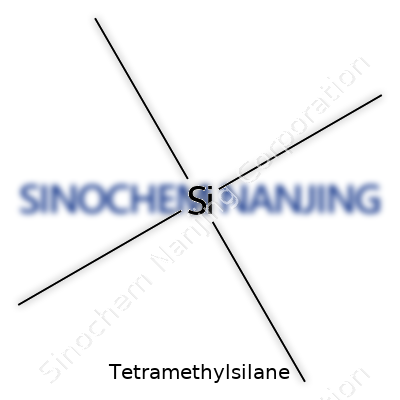
| Names | |
| Preferred IUPAC name | tetramethylsilane |
| Other names |
TMS Tetramethylsilicon Silicic acid, tetramethyl- Silane, tetramethyl- |
| Pronunciation | /ˌtɛtrəˌmɛθɪlˈsɪleɪn/ |
| Identifiers | |
| CAS Number | 75-76-3 |
| Beilstein Reference | 1465061 |
| ChEBI | CHEBI:28755 |
| ChEMBL | CHEMBL14256 |
| ChemSpider | 55793 |
| DrugBank | DB01928 |
| ECHA InfoCard | 04b5928d-632c-4913-9dde-c0eaa8b2efb9 |
| EC Number | 200-934-1 |
| Gmelin Reference | 50809 |
| KEGG | C06424 |
| MeSH | D013754 |
| PubChem CID | 6427 |
| RTECS number | VV7325000 |
| UNII | G6K8F91C1E |
| UN number | UN1992 |
| Properties | |
| Chemical formula | C4H12Si |
| Molar mass | 88.22 g/mol |
| Appearance | Colorless liquid |
| Odor | Odorless |
| Density | 0.648 g/mL at 25 °C(lit.) |
| Solubility in water | Insoluble |
| log P | 2.8 |
| Vapor pressure | 533 mmHg (20 °C) |
| Acidity (pKa) | 49.0 |
| Basicity (pKb) | 12.58 |
| Magnetic susceptibility (χ) | −25.5×10⁻⁶ cm³/mol |
| Refractive index (nD) | 1.369 |
| Viscosity | 0.38 mPa·s (25 °C) |
| Dipole moment | 0.00 D |
| Thermochemistry | |
| Std molar entropy (S⦵298) | 171.0 J·mol⁻¹·K⁻¹ |
| Std enthalpy of formation (ΔfH⦵298) | -182.5 kJ/mol |
| Std enthalpy of combustion (ΔcH⦵298) | -3176.7 kJ/mol |
| Hazards | |
| GHS labelling | GHS02, GHS07 |
| Pictograms | GHS02,GHS07 |
| Signal word | Danger |
| Hazard statements | H225, H319 |
| Precautionary statements | P210, P233, P240, P241, P242, P243, P261, P271, P280, P303+P361+P353, P304+P340, P305+P351+P338, P312, P337+P313, P370+P378, P403+P235, P405, P501 |
| NFPA 704 (fire diamond) | 1-4-0 |
| Flash point | -21 °C |
| Autoignition temperature | 240 °C |
| Explosive limits | 1.2–24 % |
| Lethal dose or concentration | LD50 (oral, rat): 6700 mg/kg |
| LD50 (median dose) | LD50 (median dose): Oral rat LD50 = 1540 mg/kg |
| NIOSH | PF9450000 |
| REL (Recommended) | 50 ppm |
| IDLH (Immediate danger) | 2500 ppm |
| Related compounds | |
| Related compounds |
Trimethylsilane Dimethyldichlorosilane Methyltrichlorosilane Tetramethyltin |



