Tetradecanoyl Chloride: More Than a Specialty Chemical
Historical Development
Tetradecanoyl chloride has a story that tracks alongside the rise of modern organic synthesis. Years ago, chemists started looking for ways to modify fatty acids, drawing on advances in acyl chlorides. The structural simplicity—just a fourteen-carbon straight chain holding a reactive acid chloride group—put tetradecanoyl chloride on research benches by the 1950s. Chemical companies integrated it into workflows for synthesizing surfactants, esters, and specialty intermediates. Lab safety lagged in those early years, long before the widespread use of fume hoods and gloves. The product’s role expanded as downstream chemistry needed purer acylating agents for pharmaceutical testing and polymer modification. Industry history proves that practical needs, rather than trend-chasing, shaped this molecule’s story.
Product Overview
Tetradecanoyl chloride, known as myristoyl chloride, serves as a critical link for building complex chemicals. It appears as a colorless to pale yellow liquid, with a sharp, acrid odor that tells you to keep it far from your nose and skin. Tough enough for large-scale handling but simple in formula, this liquid finds its way into pharmaceuticals, surfactant manufacturing, and custom synthesis. Many research biochemists know it for its use in preparing myristoylated proteins—those little lipid tails have an outsized impact on protein targeting in cells. Product demand spikes when researchers dig deeper into membrane biology, vaccine delivery systems, or new performance chemicals.
Physical and Chemical Properties
There’s no mystery about the way tetradecanoyl chloride handles itself in the lab. Its molecular formula is C14H27ClO, which packs a solid punch—boiling near 310°C, melting around -3°C, and swinging between densities depending on how pure and hydrated the sample stays. Vapor pressure can pose a risk, releasing sharp HCl fumes on contact with moisture in the air. It dissolves in non-polar solvents like hexane or diethyl ether and reacts vigorously with water, alcohols, or amines. Shelf life often comes down to proper capping and storage in a cool, dry place, since its reactivity doesn’t wait around for convenience. Flammability concerns seldom arise indoors, but open flames spell trouble.
Technical Specifications and Labeling
Product data sheets draw a clear line: purity usually stands above 98%, with acid content and color index documented batch by batch. Reputable suppliers mark every bottle with CAS numbers, batch codes, manufacture and expiry dates, and signal words for toxicity and reactivity. Labeling stretches into route-of-entry information—eyes, skin, inhalation—because even trace exposure can burn or sensitize. European REACH certification and US GHS standard labeling guard against hidden hazards; businesses carry extra liability if labels skip a beat. Those codes and warning diamonds may feel routine, but every experienced chemist can recite the burn of forgetting proper labeling in a rushed experiment.
Preparation Method
Most factories make tetradecanoyl chloride by reacting tetradecanoic acid (myristic acid) with thionyl chloride under controlled dry conditions. The smell burns your nose, and the white fumes force quick work under fume hoods. Sometimes, phosphorus trichloride or oxalyl chloride replaces thionyl chloride, but the same challenge comes up across settings: getting rid of byproducts like SO2 or POCl3 safely. Large-scale plants use glass-lined reactors and strict temperature monitoring to keep yields high and impurities low. Anyone who’s tried a home-scale preparation knows the difference that professional venting and quenching make. Each run requires patience with distillation and a sharp eye on color and viscosity changes that announce successful synthesis.
Chemical Reactions and Modifications
Chemists reach for tetradecanoyl chloride when standard acids can’t deliver speed or selectivity. As an acylating agent, it tacks fatty chains onto alcohols and amines, turning them into esters or amides. Researchers count on it for actions like making myristoylated peptides or modifying polysaccharide surfaces. In peptide synthesis, it’s a backbone for N-terminal modification—speeding up reactions compared to myristic acid alone. Environmental regulations push labs to consider greener alternatives, but none match its sharp efficiency for many jobs. If downstream demands call for branching or longer chains, tetradecanoyl chloride becomes a stepping stone, reacting first with nucleophiles before further tweaking. Each reaction produces byproduct HCl, so smart chemists use neutralizing agents and work in ventilated spaces.
Synonyms and Product Names
Across countries and catalogs, the chemical wears plenty of names: myristoyl chloride, n-tetradecanoyl chloride, 1-chlorotetradecanoyl, or simply C14-acyl chloride. Vendors sometimes tag it by the fatty acid lineage—linking it to palm nut oils. Drug researchers might catch it as an ingredient for “myristoylation agent” in custom peptide synthesis. Mislabeling has dragged a few projects into confusion, especially in older labs where bottles wear faded stickers or alternate abbreviations. Product names might vary, but a trained eye spots the fourteen carbon backbone and acid chloride handle every time.
Safety and Operational Standards
Handling this chemical means real-life hazard mitigation. Tetradecanoyl chloride brings on severe skin and eye burns, as well as respiratory irritation—years in a lab taught me never to trust low odor as an indicator of low risk. Proper gloves, goggles, and full face shields become standard, not optional. Chemical fume hoods keep vapor from wrecking lungs. Spills call for sand or absorbent pads followed by careful neutralization with dilute base. Storage in flame-proof cabinets, away from humidity, slashes the risk of runaway reactions or container breaches. Many employers require spill kits and eye-wash stations nearby; seasoned researchers remember the times those tools kept a disaster from getting worse. Emergency training, posted procedures, and up-to-date MSDS sheets drive down accident rates.
Application Area
Pharmaceutical innovation takes the lead when it comes to major demand. Myristoylation—the process of attaching a C14 group to a peptide or protein—helps target molecules inside cells, strengthens drug delivery, and opens new doors in vaccine engineering. Surfactant production—think soaps, shampoos, and emulsifiers—draws heavily from tetradecanoyl chloride for making specialty esters. Chemists interested in new nanomaterials, functional textiles, and coatings often tap this molecule for site-specific modifications. I’ve seen startups in drug delivery scramble for consistent, high-purity supply. Biochemical assays, membrane research, and even flavor engineering trace critical steps back to this flexible compound. Food chemists focus on trace limits, and medical researchers value the clarity of data myristoylation can provide.
Research and Development
Chemical R&D stretches tetradecanoyl chloride into new territories each year. Scientists dig deeper into protein-lipid interactions by developing novel myristoylated probes for live cell imaging. Environmental researchers probe green synthesis routes: replacing thionyl chloride with recyclable reagents, reducing waste streams, and fine-tuning process safety. Collaborative work aims at improving esterification methods that cut down side products and purify final products with less chromatography. Pharmaceutical candidates grow in complexity; formulations rely on fatty acyl modifications for stability and targeted function. Academic labs examine the role of C14 acyl groups in protein-membrane interactions, bringing clarity to complex cellular processes. R&D demands a supply chain ready for customization, speed, and full transparency on impurity data.
Toxicity Research
Studies on tetradecanoyl chloride reveal both acute and chronic danger. Animal research shows corrosive effects at the skin and mucous membrane level, and inhalation tests report strong respiratory impacts. It rarely enters consumer products at levels high enough for chronic toxicity, but chemical plant workers face higher stakes. Chronic exposure can sensitize skin or trigger respiratory allergies; one small spill can become a lifelong issue. Epidemiological surveys among bench chemists and plant operators guide improvements in respirator technology and emergency response plans. Regulatory frameworks dig into toxicokinetics—tracking how the chemical moves through living systems, breaks down, and leaves the body. Most institutions advise against exposure during pregnancy or pre-existing skin conditions, based on animal modeling and case history data.
Future Prospects
Tetradecanoyl chloride continues to see growing demand as researchers push deeper into acylation chemistry and drug delivery technology. Startups seek greener manufacturing processes to ease pressure from environmental regulators. More companies look for biobased myristic acid feedstocks and attempt to recover and recycle solvents at scale. Pharmaceutical research doesn’t slow down, so new application areas—like next-generation lipid nanoparticles or antimicrobial coatings—promise new growth. AI-driven material discovery platforms accelerate exploration of fatty acid derivatives, so variant acyl chlorides receive fresh attention every month. If industrial hygiene keeps pace with demand, and green chemistry breaks old habits, future generations will discuss tetradecanoyl chloride not just as a tool but as proof that safety and innovation can share the same bottle.
What is Tetradecanoyl Chloride used for?
More Than a Chemical Name
Tetradecanoyl chloride sounds like something straight out of a lab manual, but its reach goes far beyond textbooks. The name might trip up a few tongues, but it describes a real workhorse in the industrial and scientific world. People use it mostly to introduce a fourteen-carbon chain into other molecules—a valuable trick in chemistry. Its role becomes clear once you dig into how it connects to daily life and business.
How Researchers and Manufacturers Use Tetradecanoyl Chloride
Anyone who's spent time in a university chemistry lab knows acyl chlorides can transform dull starting materials into something useful. Tetradecanoyl chloride helps make surfactants, which play a big part in cleaning products. By adding this lengthy fatty tail to molecules, chemists can create substances that trap oils and dirt—something as ordinary as soap often carries a bit of scientific wizardry from this compound.
In pharmaceuticals, research chemists use it to attach long alkyl chains to drug molecules. Making a drug more fat-friendly can help it slip through cell membranes more easily, which is especially handy for medicines that don’t dissolve well in water. This step, called “lipidation,” boosts absorption and changes the way the drug travels in the body.
Tetradecanoyl chloride also lends itself to making specialty lubricants, plasticizers, and additives used in plastics. Long-chain molecules like this make plastic goods less brittle and more durable, leading to fewer cracked or broken parts in everything from phone cases to car trims.
A Look at Safety and Environmental Impact
The stuff burns if it touches water, letting off hydrochloric acid fumes that irritate skin, eyes, and lungs. In my own experience during graduate school, prepping this chemical meant breaking out the thickest gloves and the sharpest focus. Most people working with tetradecanoyl chloride use fume hoods and tight protocols. Safety ain’t something to gloss over.
Waste management matters, too. Spilling the leftovers down the drain turns water sources acidic and hazardous. Big chemical plants and university labs have systems to neutralize leftover chemicals before they leave the building. Still, smaller outfits sometimes take shortcuts, risking environmental damage.
Room for Smarter Use
Demand keeps going up as manufacturers look for new specialty materials or ways to enhance old products. Pushing for greener alternatives has real traction these days. Chemists are exploring less hazardous acylation methods or trying reusable reagents. Investing in greener chemistry isn’t cheap upfront, but it slashes risks down the road.
Teaching safe handling and disposal should start early in technical education, so people don’t just memorize the rules—they understand the “why.” Companies benefit when their workers stay healthy and their facilities meet regulations. In the end, the debate over chemicals like tetradecanoyl chloride isn’t abstract. It has a lot to do with the quality of the things people use every day and the well-being of those who make and handle them.
Science With Impact
I don’t see tetradecanoyl chloride on my kitchen shelf, yet traces of its use touch my daily life. From the soap that cuts through the grease to the longer-lasting plastics in my car, these complex chains serve real, practical purposes. Chemistry often shapes the world in quiet ways, and sometimes it’s the behind-the-scenes compounds that carry the greatest weight.
What is the chemical formula of Tetradecanoyl Chloride?
Chemical Structure in Plain Language
Tetradecanoyl chloride, also called myristoyl chloride, holds the chemical formula C14H27ClO. If you’re looking for real-world importance, this formula points to a long carbon chain—fourteen carbons in total—with a chlorine atom linked up where you’d find a carboxylic acid group on its cousin, myristic acid. To understand why it matters, think about the kind of chemistry going on whenever cosmetic companies build specialty molecules, or when biochem labs modify proteins. This molecule forms the backbone for fatty acid derivatives that influence the texture of soaps, surfactants, and even the properties of some pharmaceuticals.
Why the Formula Matters
Tetradecanoyl chloride’s formula isn’t just a string of letters and numbers. It sets the stage for how this compound interacts with other chemicals in industrial and lab spaces. My own college chemistry days involved enough “stinky” lab experiments with acid chlorides, so I learned early how reactivity often comes down to structure. In this chloride’s case, swapping the -OH group of myristic acid for a chlorine atom transforms a relatively unreactive fatty acid into a reactive acyl chloride. That’s not just a minor tweak. Labs use this reactivity to link fatty chains to amines, alcohols, and other nucleophiles, building up more complex molecules in just a few steps. In the world of biochemistry, researchers attach these fatty acyl chains to proteins—sometimes to help anchor them inside cell membranes—shaping the way cells communicate, grow, and respond to their surroundings.
Safety Issues and Handling
Chemicals like tetradecanoyl chloride don’t belong in kitchens or careless hands. The chlorine atom in this formula ramps up the reactivity. Splash this compound near water, and it releases hydrogen chloride gas—a definite hazard for lungs, skin, and eyes. Anyone using this in a lab should keep benchtop fume hoods humming and gloves on. Safety data from the National Institute for Occupational Safety and Health points out the need to contain spills, use eye protection, and avoid inhaling vapors. Experience working with acid chlorides taught me to keep vinegar close; neutralizing small spills with acetic acid kept situations from spiraling. Chemistry isn’t about taking risks for show, but about staying smart—following that advice keeps research safe, labs productive, and students from hospital trips.
Where Tetradecanoyl Chloride Shows Up
This compound finds its way into more corners of daily life than most folks realize. Industrial chemists use tetradecanoyl chloride as a starting point for surfactants in detergents and cleaners. Chemical synthesis of pharmaceuticals often relies on creating esters and amides from such reagents. In the food science world, certain fatty acid derivatives—engineered using tetradecanoyl chloride—alter texture and shelf stability. Tinkering with this part of a molecule can change the way chocolate melts or a lotion feels on your skin. I’ve even come across it in protocols for creating model lipid membranes, which biochemists use to study how medicines cross into cells.
Responsible Use and Looking Ahead
Chemists owe it to the public to respect the power of reactive compounds like tetradecanoyl chloride. Clear labeling, thorough training, and strict storage make up the basics for handling this and similar reagents. Regulatory agencies such as OSHA and the EPA keep an eye on transport, storage, and disposal, holding manufacturers to standards that protect not just workers but communities downwind of factories. For future improvements, green chemistry challenges chemical industries to invent alternatives with milder byproducts and better biodegradability. In my view, embracing such changes leads not only to safer labs but also to stronger trust between chemists and everyone who depends on their work.
How should Tetradecanoyl Chloride be stored?
Understanding the Hazards
Tetradecanoyl chloride sits high on the list of chemical reagents that demand respect. Speaking from years in the lab, even a tiny spill fills the space with a harsh, choking odor. Breathing it in just once spells enough for anyone. Every container with this reagent holds risk; the vapors irritate eyes, skin reacts quickly, and anything organic gives off a hiss and cloud if it touches the liquid. Many forget: this isn’t just a job for one person — it’s about keeping shared air and equipment safe for everyone day after day.
Requirements for Storage Conditions
Possible hazards become emergencies fast with acyl chlorides. That often scares off newcomers. Set up the right environment and the stuff sits harmless, but cut corners and disaster waits. Tetradecanoyl chloride must go in a tight container, usually amber glass, with a corrosion-proof cap. Plastic bottles may buckle or let vapors escape. Secure the lid every single time — even one rushed moment lets air or water vapor in.
Store the bottle out of sunlight and away from heat sources. UV rays or extra warmth not only speed up decomposition, creating hydrochloric acid and organic matter — those both spell trouble if the bottle falters. Room temperature storage is okay, but most people use a chemical fridge or a ventilated, dry cabinet, tucked away from acids or bases. That keeps runaway reactions from starting if a bottle leaks or breaks in a crowded chemical shelf.
Keep Moisture at Bay
Sounds simple, but avoiding water is the trickiest part. Moisture from the air finds its way into loose seals and reacts with tetradecanoyl chloride right inside the bottle. Mistakes seem small at first — a trace of humidity, maybe — but later, gas or byproduct pressure pops off old lids or sends out fumes. Learning to double-bag the reagent jar or stash it inside a desiccator pays off, even if it feels old-school. Always label storage containers with dates and the exact name, not just a code or number, so nobody mistakes it for something less volatile.
Training Means Fewer Accidents
From personal experience, nothing beats regular hands-on drills and reminders. Post clear instructions right next to storage areas. Set a schedule to inspect containers for clouding, corrosion, or scent leaks. At a university lab I once worked for, a biannual “chemical audit” caught issues early, saving us from a bigger headache. If a new researcher starts, pair them with someone who understands chemical hygiene and storage rules.
Thinking Beyond the Storage Room
People treat safe storage as a box-ticking exercise. It’s much more. One wrong move with tetradecanoyl chloride leaves a whole workday up in smoke or sends coworkers to the nurse. Research benefits a lot from strict handling rules. Stock only what gets used up soon — don’t let extra bottles pile up for convenience. Invest in emergency supplies near every storage spot: absorbent neutralizers, gloves rated for acid handling, clear ammonia, and eye wash stations.
Mistakes can force entire teams out of their lab, shut down experiments, and leave costly messes to clean. Adopting disciplined storage habits, not cutting corners, and sharing lessons across teams set up safer work and fewer surprises. Training, good containers, and dry, ventilated shelves make all the difference. The peace of mind and everyday safety carry far more value than saving a few minutes.
What are the safety precautions when handling Tetradecanoyl Chloride?
Understanding Tetradecanoyl Chloride's Hazards
Tetradecanoyl chloride reacts aggressively with water and regular air moisture. Most lab workers spot this kind of behavior in acid chlorides but it never hurts to remind everyone about its tendency to release vapors that bother the eyes and lungs. With this substance, a small spill can escalate fast. It will eat through gloves that aren’t rated for strong chemicals. In my years of lab work, I’ve seen too many folks trust cheap nitrile gloves, only to end up with burning, itching skin. This chemical doesn’t care if you’re careful most of the time—it only takes one exposure to regret letting your guard down.
Personal Protective Equipment Makes the Difference
Comfort never comes before safety. Anyone handling tetradecanoyl chloride needs safety goggles, a face shield helps when splash risk hovers. A fitted lab coat or apron—ideally acid-resistant—prevents contact with arms and torso. The right gloves always mean heavy-duty, chemical-resistant ones: think butyl rubber or neoprene. Disposable nitrile gloves tend to fail quickly. From my experience, long sleeves and closed shoes become just as essential as anything sold in safety catalogs. If you think you won’t spill, you’re trusting luck more than skill.
Use a Fume Hood—No Excuses
No amount of experience replaces good ventilation. A working laboratory fume hood traps the hazardous vapors that tetradecanoyl chloride spits out. The air smells sharp; that hits first. In a small room, the effect lingers and bothers the airways, especially if the chemical heats up. For years, I noticed those who ignored fume hoods end up coughing by the day’s end or leave with a headache. Even the best mask rarely beats the effectiveness of proper local exhaust. This isn’t just company policy—this prevents real accidents.
Safe Storage and Transportation
Tetradecanoyl chloride needs a tight-sealing glass or compatible plastic container. Those plastic lab bottles with screw tops work well, but metal and soft plastic corrode or leak. Store away from water supplies—in fact, never sit it beside acids or bases, as spills can trigger serious reactions. A cool, dry cabinet dedicated only to reactive chemicals means fewer headaches. Anyone moving this chemical keeps it upright, double-bagged, and secured in a bottle carrier. If you have to walk it through a busy lab, warn everyone on your path. I’ve learned quick communication can stop an accident before it starts.
Dealing with Spills and Accidents
Nobody expects to drop a bottle, but a planning mindset matters. If a spill happens, contain it with absorbent pads rated for acids. Never toss water on a tetradecanoyl chloride spill, or the fumes erupt faster than you think. Always neutralize with a proper agent, like sodium bicarbonate slurry, before disposal. Emergency showers and eyewash stations provide immediate lifelines. Being trained on these saves precious seconds.
Training and Vigilance Keep Everyone Safe
Regular safety sessions remind everyone of the risks tied to chemicals like tetradecanoyl chloride. Ignoring these isn’t an option—complacency builds over time, and I’ve seen seasoned chemists rush a step and pay for it. Those who ask questions, stay alert, and respect the chemical protect both themselves and their team. Safety culture never grows overnight. It comes from every person treating every bottle with the concern it demands.
What is the molecular weight of Tetradecanoyl Chloride?
Clearing Up the Basics
Tetradecanoyl chloride offers a textbook example of how chemistry sneaks into everything from lab research to product formulation. Most folks know it best by its other name, myristoyl chloride. You don’t have to work in a lab every day to see why knowing its molecular weight matters. A molecular weight gives a foundation for everything that follows—dosing, formulation, shipping, even understanding how and why a reaction will tip a certain way.
The Number at the Center
The molecular formula of tetradecanoyl chloride is C14H27ClO. Running through the basics, it contains fourteen carbon atoms, twenty-seven hydrogens, one chlorine, and one oxygen. Chemistry class may feel like a distant memory, but this is straight arithmetic: Carbon weighs in at 12.01, hydrogen at about 1.01, chlorine at 35.45, and oxygen at 16.00. Multiply out each value and add them together, you get a molecular weight of 246.82 g/mol. This isn’t just trivia to stuff away for a quiz. It determines how much you use in a reaction, how you measure out materials for a batch run, and how you cost out an experiment before you even start mixing solutions in the lab.
Why This Holds Weight in Labs and Beyond
Working in research, I’ve watched colleagues shake their heads over botched reactions all because the math got fuzzy. Molecular weight touches almost every step. In the pharmaceutical or cosmetics world, where tetradecanoyl chloride pops up, a small miscalculation can waste time and hit the bottom line. Out in industry, folks rely on spot-on measurements to keep batches consistent and safe. Too much or too little, and you end up with unwanted byproducts or unstable solutions. There’s also the question of shipping. Filling out regulatory paperwork, calculating chemical inventories, and handling hazardous materials—all these depend on accurate molecular data. Shipping the right amount matters, especially with something as reactive as an acyl chloride.
Broader Impact—Accuracy Means Safety
Handling acyl chlorides means thinking about workplace safety, not just line items on a spreadsheet. Tetradecanoyl chloride, like others in its class, reacts rapidly with water. Splash it, spill it, or store it in a damp spot and problems crop up fast. Knowing exactly how much material you’re using cuts down on error and reduces the risks. Even a modest spill from a miscalculation can send folks to the emergency shower—or worse. On a broader scale, accurate molecular weights help with regulatory compliance. Agencies like OSHA or the EPA expect chemical inventories to line up with real risk assessments and incident reports. Sloppy math gets noticed fast.
Building Better Habits
Labs can dodge problems by making practical training a priority for technicians and students. I remember a mentor drilling into us that molecular weight isn’t just a number to jot down—it’s a tool. He’d point out how recalculating on the fly before a reaction could head off half a dozen issues downstream. Bringing it into software and digital inventory tools also makes the process smoother. Many labs now use automatic calculators and barcode systems to double-check deliveries and usage before reactions even start. Mistakes drop when your numbers match from bench to invoice.
Moving Science Forward
Solid science starts with solid fundamentals. The molecular weight of tetradecanoyl chloride—246.82 g/mol—serves as a foundation. It sounds small compared to bigger research breakthroughs, but precision here pays dividends all along the line. Science and industry both thrive when the basics aren’t up for debate and every batch runs to spec—right down to the last decimal place.
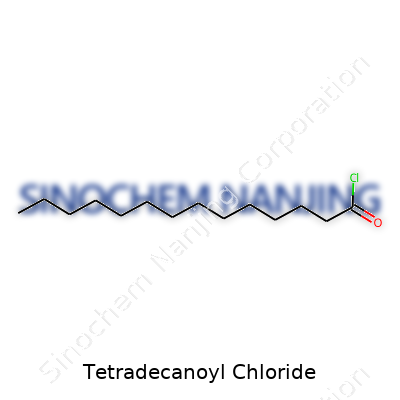
| Names | |
| Preferred IUPAC name | tetradecanoyl chloride |
| Other names |
Myristoyl chloride Myristic acid chloride n-Tetradecanoyl chloride n-Myristoyl chloride |
| Pronunciation | /ˌtɛtrəˈdiːkənɔɪl ˈklɔːraɪd/ |
| Identifiers | |
| CAS Number | 112-52-7 |
| 3D model (JSmol) | `/data/objects/3D/JSmol/CAS_112-52-7.sdf` |
| Beilstein Reference | 1209243 |
| ChEBI | CHEBI:38750 |
| ChEMBL | CHEMBL127464 |
| ChemSpider | 18252 |
| DrugBank | DB14110 |
| ECHA InfoCard | ECHA InfoCard: 100.018.814 |
| EC Number | 204-668-5 |
| Gmelin Reference | 5346 |
| KEGG | C14425 |
| MeSH | D013742 |
| PubChem CID | 12465 |
| RTECS number | XN6476000 |
| UNII | Z0W5FZP59B |
| UN number | UN3265 |
| CompTox Dashboard (EPA) | DTXSID0025126 |
| Properties | |
| Chemical formula | C14H27ClO |
| Molar mass | 242.80 g/mol |
| Appearance | Colorless to light yellow liquid |
| Odor | Pungent |
| Density | 0.944 g/mL at 25 °C |
| Solubility in water | Reacts with water |
| log P | 3.7 |
| Vapor pressure | 0.09 mmHg (25°C) |
| Acidity (pKa) | pKa ~ -7 |
| Magnetic susceptibility (χ) | -653.0e-6 cm³/mol |
| Refractive index (nD) | n20/D 1.436 |
| Viscosity | 2.3 mPa·s (20 °C) |
| Dipole moment | 2.15 D |
| Thermochemistry | |
| Std molar entropy (S⦵298) | 528.2 J·mol⁻¹·K⁻¹ |
| Std enthalpy of formation (ΔfH⦵298) | -328.5 kJ/mol |
| Std enthalpy of combustion (ΔcH⦵298) | -8886.7 kJ/mol |
| Pharmacology | |
| ATC code | D11AX22 |
| Hazards | |
| Main hazards | Causes severe skin burns and eye damage. Reacts violently with water. Harmful if inhaled. |
| GHS labelling | GHS02, GHS05, GHS07 |
| Pictograms | `GHS05` |
| Signal word | Danger |
| Hazard statements | H314: Causes severe skin burns and eye damage. |
| Precautionary statements | P261, P264, P271, P280, P301+P330+P331, P303+P361+P353, P304+P340, P305+P351+P338, P312, P321, P363, P405, P501 |
| NFPA 704 (fire diamond) | 1-3-0-W |
| Flash point | > 112 °C |
| Autoignition temperature | 205 °C |
| Lethal dose or concentration | Lethal dose or concentration: LD50 oral (rat) 3120 mg/kg |
| LD50 (median dose) | LD50 (median dose): Oral rat LD50 = 12,600 µL/kg |
| NIOSH | NL0000006101 |
| PEL (Permissible) | PEL (Permissible Exposure Limit) for Tetradecanoyl Chloride: Not established |
| REL (Recommended) | 1 μL |
| IDLH (Immediate danger) | Unknown |
| Related compounds | |
| Related compounds |
Lauryl chloride Palmitoyl chloride Myristic acid Myristoyl-CoA |



