Tetrabutylphosphonium Hydroxide: Insights Into a Modern Chemical
Historical Development
Tetrabutylphosphonium Hydroxide entered the landscape of quaternary phosphonium compounds as researchers explored alternatives to ammonium-based chemistry back in the mid-twentieth century. At a time when industry faced growing demand for nontraditional ionic liquids, this particular compound offered a new pathway, thanks in part to greater stability and solubility in organic contexts. Companies working on petroleum refining, electrochemistry, and advanced material synthesis saw merits in switching from older ammonium salts to phosphonium derivatives. Lab journals from the 1970s report the shift in approach, with research labs in Germany and Japan accelerating development and piquing wider industrial curiosity. Over time, wider applications brought scrutiny—both for process outcomes and worker handling. This journey mirrors the broader evolution of specialty chemicals in an age of growing sophistication.
Product Overview
Tetrabutylphosphonium Hydroxide, often abbreviated as TBPH, lands in the class of organic phosphonium bases. Marketed in aqueous solution, its main draw comes from robust basicity paired with unique solubility characteristics, thanks to the four butyl groups. Suppliers highlight its role as a versatile phase transfer catalyst, but TBPH has found utility well beyond. Laboratories and pilot plants reach for it in organic synthesis, electronics, and industrial water treatment. On the label, some call it Tetra-n-butylphosphonium hydroxide, and alternative listings show up as Phosphonium, tetrabutyl-, hydroxide. Beyond names, what matters is the way these formulations let manufacturers tweak reaction conditions or process efficiency in ways that would stump common bases.
Physical & Chemical Properties
Out of the shipping box, TBPH usually comes as a clear, colorless to pale yellow liquid, mainly because manufacturers distribute it as a water solution (almost always 40% wt TBPH in water, but higher concentrations exist). In hand, the solution feels slippery and exudes a faint, disagreeable odor reminiscent of other amines and phosphines. Specific gravity ranges from about 0.97–1.0, and the pH soars well above 13, reflecting its strength as a base. TBPH dissolves readily in water, ethanol, and several polar aprotic solvents. Chemically, it resists decomposition at room temperature, but alkylation and oxidation reactions will break it down if harsh enough. Unlike sodium hydroxide, TBPH’s cation confers unique lipophilicity, opening doors for it to act in two-phase systems or within organic reaction schemes where sodium and potassium bases fall short.
Technical Specifications & Labeling
On the technical front, labels list concentration, water content, and often chloride ion levels (since chloride contamination can compromise some sensitive reactions). Reputable producers run Karl Fischer titrations to pin down water content, report free base as a percentage, and use ion chromatography to call out residual contaminants. You also see batch-specific parameters, such as color (on the APHA scale), density, and identification codes for traceability. Safety data sheets flag hazards from inhalation or skin contact. In practice, fine print matters—impurities spell the difference between a successful organic synthesis and a ruined batch. Some research teams I worked with are picky about batch-to-batch consistency, as even tiny impurities sow doubt over scalable processes.
Preparation Method
TBPH production generally involves quaternization of tributylphosphine with n-butyl bromide to yield tetrabutylphosphonium bromide, followed by anion exchange using silver oxide or a hydroxide resin. The hydroxide version then appears in aqueous solution. Options exist—industrial players may swap the anion using sodium hydroxide in specialized columns to keep side reactions in check. The process takes place under inert conditions to curb unintended oxidation. Water content gets dialed in at the final dilution stage. Facilities that handle this chemistry often double as custom solution providers, clocking up multiple variants based on what researchers or process engineers want.
Chemical Reactions & Modifications
TBPH acts as a strong base in organic synthesis, participating in alkylations, deprotonations, and even as a support for phase-transfer catalysis. Its phosphonium structure resists Hoffman elimination—a notorious unwanted side reaction in ammonium analogues—making it a tool of choice in tough conditions where temperature control falters. Chemists chase its higher selectivity during synthesis of pharmaceuticals or fine chemicals, especially where water mixes with nonpolar media. Beyond the lab flask, TBPH also enables selective methylation and base-catalyzed rearrangements. Modifying the alkyl groups or adding functional handles leads to designer catalysts for special needs, and you see these offshoots in technical literature describing ionic liquid development or greener extraction processes.
Synonyms & Product Names
Across catalogs, TBPH appears under multiple identities. Besides the main moniker, suppliers label it as Tetra-n-butylphosphonium hydroxide, Tetrabutylphosphonium hydrate, or Phosphonium, tetrabutyl-, hydroxide, aqueous. Some academic papers refer to it by the abbreviation TBPH. Certain international chemical inventories list it under registry numbers, but most professionals skip formal names in favor of the initials or shorthand. Product identifiers boil down to lot numbers, concentration tags, and occasionally, purity descriptors, which buyers rely on for reproducibility in sensitive syntheses.
Safety & Operational Standards
Anyone handling TBPH learns that it causes severe skin and eye burns. Splash-proof goggles, nitrile gloves, and lab coats should be standard. Fume hoods cut the risk of inhaling vapors. Clean-up crews lean on neutralizing acidic materials to tamp down spills, and emergency protocols demand quick rinses with copious water for exposed skin or eyes. Globally, TBPH falls under workplace controls for hazardous bases, with SDS sheets backing up the need for training and incident logging. Chronic exposure remains rare, but all it takes is one hasty transfer in a crowded lab to turn an oversight into a recordable injury. Having spent late nights with this and similar bases, I keep spill kits nearby and urge everyone to give operational briefings, even if the job seems routine.
Application Area
Industries turn to TBPH because it unlocks possibilities unavailable to sodium or potassium bases. Electronics manufacturing uses it in printed circuit board fabrication for etching solutions. Water treatment facilities add small doses to adjust pH or catalyze reactions in specialty filtration trains. Academics grab it for organic synthesis—especially routes that like strong but less hydrophilic bases. TBPH also powers catalytic cycles in green chemistry and supports separations in analytical labs. Its use in developing ionic liquids means researchers can fine-tune solvent properties, designing systems for chloride-free chemical processing or battery development.
Research & Development
R&D focus has settled on environmental fate, performance as a green solvent, and safe handling protocols. Some teams dig into the mechanistic edge that phosphonium salts provide over ammonium relatives, probing reactions where TBPH acts both as a catalyst and a reactant. There’s growing investment from battery companies looking for new electrolytes with large electrochemical windows, and TBPH-based ionic liquids draw attention in supercapacitor research. Applied scientists want to identify ways to recycle or reactivate TBPH after use—both to cut costs and reduce waste.
Toxicity Research
Research points to TBPH’s caustic effect on skin and mucous membranes. Published studies show that accidental eye exposure causes rapid, lasting injury without prompt rinsing. Acute oral toxicity studies rank TBPH as harmful, with dose-dependent effects on the gastrointestinal tract and nervous system in rodents. Chronic effects remain less clear, since most users encounter it in diluted, controlled contexts. Environmental persistence, water treatment compatibility, and breakdown pathways receive attention as regulatory eyes focus harder on quaternary phosphonium compounds. Waste management rules direct users to treat TBPH as a hazardous base, and job-site monitoring reduces accidental exposure.
Future Prospects
Many in the chemical research community see TBPH as part of the transition to greener and higher-efficiency synthesis. Industries want to move away from halide-rich waste streams and legacy bases linked to corrosion or limited solubility. Improved manufacturing processes could reduce environmental load, with TBPH playing a central role in new ionic liquids for batteries, CO₂ absorption, and selective material syntheses. There’s potential for expansion in pharmaceuticals, too, as tailored catalysts gain wider adoption. Still, questions linger around long-term environmental impact and workplace safety, so chances are that tighter regulations and better containment strategies will shape TBPH’s next chapter.
What is Tetrabutylphosphonium Hydroxide used for?
What Stands Out About Tetrabutylphosphonium Hydroxide
Tetrabutylphosphonium hydroxide catches attention in the world of specialty chemicals. Chemists see it as more than just another compound with a long name. Its structure allows it to work as a powerful base and a phase transfer catalyst. In places where traditional alkalis don’t fit, this compound provides a different route. Chemical manufacturers, for example, use it to help reactions in both water and organic solvents, something that can save time, resources, and cut down on hazardous waste.
Behind the Scenes in Synthesis
Synthetic chemists turn to this compound for a reason. In organic laboratories, workers rely on tetrabutylphosphonium hydroxide for making intricate molecules. It helps transform raw ingredients into pharmaceutical intermediates and fine chemicals. This means, if you take an everyday pain relief tablet, part of its manufacturing process may have included this chemical working quietly behind the scenes.
I remember sitting next to a lab technician, watching a sluggish reaction speed up after adding a few drops of tetrabutylphosphonium hydroxide. The yield increased, and the process avoided byproducts that tend to show up with standard bases. It’s not hype—it’s lab-tested efficiency.
Tackling Environmental Challenges
Wastewater treatment plants now often add this compound to treat persistent organic pollutants. Its strong basicity breaks down tough molecules that linger even after several cleaning cycles. Companies facing stricter discharge regulations value anything that brings down pollution levels. Tetrabutylphosphonium hydroxide has helped meet those demands, in part because it reacts without leaving behind as many problematic leftovers.
Public health benefits every time factories improve their cleaning steps. Fewer contaminants in rivers protect aquatic life and reduce health risks down the line. Solving one problem, such as pesticide runoff, often means thinking at the chemical level, and this compound offers one answer.
Electronics and Beyond
Printed circuit boards—the ones that end up in every computer, phone, and even many appliances—need careful patterning with etchants and stripping solutions. Tetrabutylphosphonium hydroxide steps in here, helping remove unwanted layers without corroding vital traces. This use isn’t as famous as its chemistry lab applications, yet it has become standard practice among electronics manufacturers looking for precision and reliability.
It’s hard to picture a smartphone without layers produced using etching solutions. Every time technology moves to smaller, faster chips, those demands for precision only grow. Using the right chemical solutions can make the difference between a circuit that works perfectly or one destined for the recycling bin.
Safety and Future Directions
Handling this compound takes some care. Its high alkalinity requires workers to wear gloves, goggles, and proper protective clothing. In an industry pushing for greener, safer processes, some research teams look into how to recycle or neutralize leftover tetrabutylphosphonium hydroxide after use. Shifting to safer practices depends on collaboration between chemical companies, regulators, and research labs.
Green chemistry isn’t just a buzzword—it’s something you notice in improved storage procedures and updated waste protocols. Real change always comes from the shop floor, and the move to safer chemicals happens step by step, reaction by reaction.
What are the storage conditions for Tetrabutylphosphonium Hydroxide?
Understanding the Real Risks
Tetrabutylphosphonium hydroxide, known by many in the lab as a strong and versatile organic base, doesn’t just sit quietly on shelves. Unstable in poor conditions, this chemical can quickly lose its punch or cause safety headaches. I’ve seen a container crack from pressure buildup because someone stored it too warm one summer. It’s moments like that which stick with you.
The Right Place Makes All the Difference
This compound demands respect. Excessive heat? That can cause decomposition. Light can make it degrade faster than a busy Monday morning. If there’s any moisture, you’ll be cleaning up a slick mess that could get hazardous. Any lab worth its salt keeps Tetrabutylphosphonium hydroxide in a cool, dry, and dark spot. The thermometer doesn’t need to be at refrigerator range — room temperature, as long as the workspace stays under 25°C, does the trick. Direct sunlight is the enemy, so cabinets or sealed boxes work better than open shelves.
Sealing Out Trouble
Air exposure just leads to headaches for everyone. Tetrabutylphosphonium hydroxide absorbs CO₂ and moisture straight from the air, which can drop the solution’s strength over time. People get sloppy with caps and lids, but the best way I’ve found to keep this chemical safe is to use airtight containers. Laboratories that run smart check storage bottles after every use, and log opening dates to keep track of shelf-life.
Label Everything, and Mean It
Clear labels aren’t just busywork. If even one person in a shared lab misses a warning about Tetrabutylphosphonium hydroxide’s caustic nature, that safety culture breaks down fast. Labels need to show hazards, storage needs, and even the date the bottle was cracked open. That attention to detail means new students or untrained staff don’t get surprises they’ll regret.
Personal Experience with Storage Fails
I remember working with a team who skipped regular inspections, thinking the bottle looked fine from the outside. Liquid pooled around the cap; it turned out moisture had crept in, reducing purity and leading to an unanticipated reaction that ruined an entire batch. The lesson learned: ignoring small signs in storage means paying for bigger mistakes later.
Why Storage Saves More Than Just Product
Getting storage right isn’t just about supporting consistency in results. Broken bottles and vapor leaks put colleagues at risk, leading to extra paperwork and avoidable medical visits. On a broader scale, improper storage means wasted chemicals and more hazardous waste. That wastes money, slows down research, and can even threaten reputations with regulators.
Solutions Worth Considering
Implementing simple checklists beats making assumptions every time. Storage signs above the right shelves, reminders about the importance of airtight seals, and clear access to safety data sheets help keep everyone up to speed. Don’t forget routine walk-throughs by a designated safety lead, since extra eyes spot trouble faster. Teach the “why” behind these guidelines in lab orientations, so even new faces understand both the science and the real-world consequences.
Safe storage for Tetrabutylphosphonium hydroxide shows up in every well-run lab. Paying attention here means better results, fewer close calls, and more time spent on research rather than cleaning up emergencies.
Is Tetrabutylphosphonium Hydroxide hazardous or toxic?
Understanding the Risk
Tetrabutylphosphonium hydroxide shows up in labs and industries as a strong base, offering an alternative to traditional caustic chemicals. It’s a clear liquid, but don’t let that fool anyone into believing it’s harmless. When I walked into a research lab that used this compound, the MSDS binder sat right on the wall, warning that even small splashes needed quick action. Skin contact leads to burns; fumes can irritate the nose and throat. There’s real risk here, just like with other strong alkaline solutions.
Direct Exposure Matters
Research on phosphonium salts points to irritation as the biggest danger for workers. If someone spills Tetrabutylphosphonium hydroxide, you might see redness, blistering, and pain almost right away. Breathing in vapors brings on coughing and a raw feeling in the chest. It doesn’t stop there: swallowing even a small amount causes pain and damage all the way through your digestive system.
Phosphonium compounds don’t get the same level of public attention as ammonia or chlorine, but their effects aren’t much kinder. Few long-term studies exist with this chemical, yet short-term toxicity stands out clearly. Accidental spills have sent workers to the hospital for burn treatment. Some reports show strong skin reactions after only one exposure.
Handling and Precaution: What Works?
Gloves, goggles, and lab coats are musts. I’ve seen more than a few young chemists shrug off protective gear, thinking they’d “just be quick.” That’s a fast track to regret. Vapor can irritate eyes even if you never touch the liquid. Ventilation, fume hoods, and quick access to eyewash stations always make a difference in safety. Relying on old habits leaves room for dangerous mistakes.
Waste and Environmental Impact
Once Tetrabutylphosphonium hydroxide gets into wastewater, neutralization becomes crucial. Strong alkalis damage water life and unsettle ecosystems downstream. Labs turn to neutralizing the waste with acids until the pH comes down to safe levels. Even then, no one just dumps the solution—disposal regulations push for professional treatment and records. Fines are hefty for those who try shortcuts.
Potential Solutions
For companies and academic labs, switching to safer alternatives should be discussed before purchasing a new batch. Training counts too: I’ve watched veteran staff give hands-on tutorials for safe handling, with real-world spill drills. Investment in personal safety equipment pays off every time. Product manufacturers need to print bold warnings and clear instructions. Regulators have to enforce disposal guidelines vigorously. Sometimes, only a real scare gets decision-makers to tighten practices.
Facts and Reputation
According to the European Chemicals Agency, Tetrabutylphosphonium hydroxide meets criteria for serious eye and skin corrosion. OSHA and NIOSH provide guidelines, though information gaps still exist. Regular workers rarely read through dense government reports, so it falls to supervisors and safety officers to break down critical information. That extra step keeps people out of emergency rooms.
What Experience Shows
My time in chemical warehouses made it clear: treating every unknown bottle as dangerous avoids nasty surprises. For Tetrabutylphosphonium hydroxide, extra caution is not just smart; it’s non-negotiable. Safety routines, real training, and environmental responsibility go beyond good practice—they shape a safer workplace and less risky world.
What is the chemical formula of Tetrabutylphosphonium Hydroxide?
Understanding What Makes It Tick
Tetrabutylphosphonium hydroxide carries the chemical formula C16H37P(OH). You see these letters and numbers, and it’s easy to think they’re just an arrangement cooked up by chemists for the sake of paperwork. For me, the formula is the backbone of how this chemical works in the real world. The “tetrabutyl” part means four butyl groups (essentially, chains of four carbon atoms and their hydrogens) stick to a phosphonium atom, and that’s capped off with a hydroxide group.
What’s It Used For and Why It Matters
In industry, this compound finds its way into a surprising number of processes—organic synthesis, catalysis, material science, and especially as a phase-transfer catalyst. It gives chemists a gentle nudge when trying to combine ingredients that don’t mix well, like oil and water. The reason this matters: efficiency isn’t just about saving money, it’s about safer work environments, fewer byproducts, and less waste piling up.
Looking at published studies and chemical safety sheets, tetrabutylphosphonium hydroxide also offers low volatility and reduced flammability compared to older, harsher chemicals used for the same tasks. That reduces some health risks for workers and sets a benchmark for safety. Classrooms and research centres can handle it without reaching for a hazmat suit every time someone cracks a vial open.
Safety and Environmental Impact
Talking about chemicals can make people uneasy, especially when words like “hydroxide” and “phosphonium” pop up. Even with a relatively safe profile, care still matters. Direct contact with tetrabutylphosphonium hydroxide can irritate skin and eyes. Anyone using it wears gloves and goggles. The best workplace setups include proper ventilation and training, because mistakes and shortcuts tend to lead to accidents and spills.
From an environmental standpoint, rules about how much goes down the drain or into the atmosphere are strict for a reason. Long-term studies show phosphonium compounds can stick around in waterways. Industries focus on containment, responsible disposal, and looking for ways to recycle or reduce what’s left over.
Paths to a Better Approach
Chemical companies and researchers keep looking for smarter ways to use substances like tetrabutylphosphonium hydroxide. Advances in green chemistry have pushed suppliers to refine the production process, cutting down on waste. There’s more interest in “designer” solvents—tailor-made for specific tasks with lower toxicity or improved breakdown after use. When universities put effort into new chemical pathways, students and faculty create not just new compounds, but safer labs and workplaces, too.
I’ve seen labs jump ahead by investing in recovery systems that capture unused compounds from their waste streams. Conversations with chemists circle back to sustainable sourcing of raw materials and open sharing of accident data—transparency helps everyone avoid repeating mistakes.
The Real Value of Precision
Knowing the formula C16H37P(OH) isn’t about showing off or filling in a blank on a quiz—it lays the groundwork for every discussion about how safely and effectively we can use tetrabutylphosphonium hydroxide. Recognizing the importance of handling and disposal isn’t just a rule; it’s a responsibility to the people in the lab and the communities outside it.
How should Tetrabutylphosphonium Hydroxide be handled safely?
Why Tetrabutylphosphonium Hydroxide Matters
Tetrabutylphosphonium hydroxide doesn’t show up in every household, but for labs and certain industries, it’s more common than folks realize. The substance works as a strong organic base. One day I spent shadowing a research chemist, I saw just how careful everyone stayed around this chemical. Strong bases aren’t forgiving—one wrong move gives harsh burns or ends up damaging your eyes or lungs. The real question centers on respect: every person working with it needs to understand just how unforgiving it acts.
The Real Dangers You Don’t Ignore
Stories circulate about carelessness—a glove torn, goggles forgotten, or a bottle left uncapped. Tetrabutylphosphonium hydroxide clings to skin and lingers in the air. Inhalation irritates your airways in seconds. If you get it on your skin, the burning starts almost as fast as with strong acids. Since these risks deal with people’s health, taking shortcuts puts everyone in the lab or plant at risk.
Personal Protective Equipment—Not Just a Box to Check
Every workbench I visited stocked plenty of gloves, goggles, and sleeves. Chemical splash goggles cover every angle. Nitrile or neoprene gloves give a barrier, but watch out—latex fails fast with organics. Coats buttoned to the neck and shoes with closed toes cut down on chance exposure to bare skin. After speaking with a safety officer, I realized the difference isn’t always in having the gear, but in putting it on every single time, even for simple transfers.
Ventilation: Clearing the Air
Good ventilation always stands out as the invisible hero in safe handling. I’ll never forget the hum of fume hoods and exhaust fans during the times I handled materials like tetrabutylphosphonium hydroxide. Fume hoods suck up airborne traces right at the source, keeping everyone breathing easier. Overhead exhaust cuts down on stray vapors lingering after spills.
Spill Response—Think Fast, Act Smart
I’ve seen moments of panic when a bottle tips over. Training drills help workers tackle the mess quickly and calmly: absorbent pads get tossed down first, then the whole crew suits up for cleanup. Every site I’ve visited kept a clear set of instructions near chemical benches. Nobody reaches straight for a mop—neutralizing the chemical and collecting every scrap of residue come first.
Waste Disposal—Respecting the Chain
Dumping leftover tetrabutylphosphonium hydroxide down a drain creates even bigger problems for others and the environment. Labs follow rules on waste—sealed containers, proper labeling, storage away from incompatible chemicals, and professional chemical waste collection. Over years in safety consulting, I’ve seen how paperwork is tedious, but it tracks every gram and holds each worker accountable to the environment and their community.
The Human Factor and Training
No amount of gear or fancy systems makes up for people being untrained or careless. I remember a training session where we tried spill response blindfolded. It drove home the point—you learn best by doing, and reviewing mistakes keeps everyone safer. Regular safety refreshers, honest conversations about near-misses, and a culture that pays attention make much more difference than any single piece of equipment.
Moving Toward Safer Workplaces
Regulations exist for good reason, but safety culture starts with the people. By focusing on education, using correct protective gear, and honestly assessing every step, anyone handling tetrabutylphosphonium hydroxide can greatly lower risk and protect both people and the broader community.
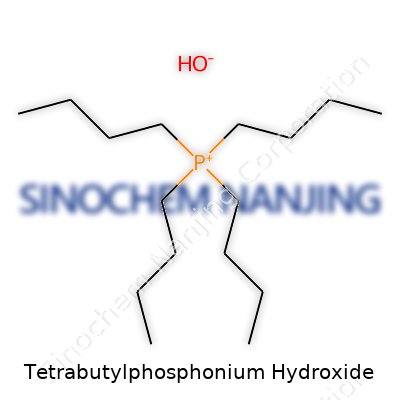
| Names | |
| Preferred IUPAC name | tetrabutylphosphanium hydroxide |
| Other names |
TBPH Tetrabutylphosphonium hydrate Tetrabutylphosphonium hydroxide solution Phosphonium, tetrabutyl-, hydroxide |
| Pronunciation | /ˌtɛ.trə.bjuːˌtaɪl.fɒsˈfəʊ.ni.əm haɪˈdrɒk.saɪd/ |
| Identifiers | |
| CAS Number | 58699-11-5 |
| Beilstein Reference | 82168 |
| ChEBI | CHEBI:147487 |
| ChEMBL | CHEMBL4296617 |
| ChemSpider | 154315 |
| DrugBank | DB11104 |
| ECHA InfoCard | 20-211-989-6 |
| EC Number | 243-226-8 |
| Gmelin Reference | 86194 |
| KEGG | C18362 |
| MeSH | D017929 |
| PubChem CID | 6851113 |
| RTECS number | WN9625000 |
| UNII | Q5H5BB959C |
| UN number | UN3132 |
| CompTox Dashboard (EPA) | DTXSID0030650 |
| Properties | |
| Chemical formula | C16H37OP |
| Molar mass | 339.53 g/mol |
| Appearance | Colorless to pale yellow liquid |
| Odor | Amine-like |
| Density | 0.889 g/mL at 25 °C |
| Solubility in water | Soluble in water |
| log P | 0.8 |
| Acidity (pKa) | 15.0 |
| Basicity (pKb) | pKb ~ 0.2 |
| Magnetic susceptibility (χ) | -53 × 10⁻⁶ cm³/mol |
| Refractive index (nD) | 1.436 |
| Viscosity | 44 cP (20°C) |
| Dipole moment | 6.353 D |
| Thermochemistry | |
| Std molar entropy (S⦵298) | 425.9 J·mol⁻¹·K⁻¹ |
| Std enthalpy of combustion (ΔcH⦵298) | -6371.8 kJ/mol |
| Hazards | |
| Main hazards | Corrosive, causes severe skin burns and eye damage, harmful if swallowed, harmful if inhaled |
| GHS labelling | GHS05, GHS06 |
| Pictograms | GHS05,GHS06 |
| Signal word | Danger |
| Hazard statements | H302, H314 |
| Precautionary statements | P280, P260, P301+P330+P331, P305+P351+P338, P310 |
| NFPA 704 (fire diamond) | 2-3-1-ALK |
| Lethal dose or concentration | LD50 Oral Rat 459 mg/kg |
| LD50 (median dose) | LD50 (median dose) of Tetrabutylphosphonium Hydroxide: "298 mg/kg (rat, oral) |
| NIOSH | TL8750000 |
| PEL (Permissible) | Not established |
| REL (Recommended) | 0.5 mg/m3 |
| Related compounds | |
| Related compounds |
Tetraethylphosphonium hydroxide Tetrapropylphosphonium hydroxide Tetrabutylammonium hydroxide Tetrahexylphosphonium hydroxide Tetrabutylphosphonium bromide |



