Tert-Butylbenzene: A Commentary on Its Past, Present, and Future
Historical Development
Tert-Butylbenzene entered the chemical scene during a period when researchers felt inspired to push the boundaries of aromatic hydrocarbon modifications. Early organic chemists figured out ways to graft bulky groups onto benzene rings by experimenting with Friedel–Crafts alkylation, and tert-butylbenzene soon showed up in journals as a clear example of what could be achieved. Its story traces back to late nineteenth-century curiosity in alkyl benzenes, but real progress showed up as petrochemical industries expanded in the mid-1900s. Companies needed advanced solvents and intermediates, fueling commercial interest in making tert-butylbenzene on a larger scale.
Product Overview
Anyone familiar with aromatic hydrocarbons probably encountered tert-butylbenzene in a laboratory or manufacturing process. The compound combines a classic benzene ring with the steric hindrance of a tert-butyl group, making it useful for more than just academic exercises. Tert-butylbenzene shows up in organic synthesis, as a solvent, and as a building block for more complex molecules. Its structure—clear, colorless, carrying a characteristic odor—lets it stand out from other related benzenes. Often, its main appeal comes from how it changes reactivity at the aromatic core, which is a direct result of that bulky substituent.
Physical & Chemical Properties
Tert-butylbenzene features a boiling point hovering near 169°C, melting at about −58°C, and it weighs in with a molecular formula of C10H14. The density rests just below water at 0.86 g/cm³, so it floats in aqueous solutions. The aromatic core remains quite stable thanks to the resonance structure of benzene, but the tert-butyl group changes electron density in a way that influences substitution patterns and renders the compound less reactive toward certain electrophiles. The molecule’s lipophilic nature turns into an advantage in solvent applications—oils, greases, or other hydrophobic substances yields better results compared to less substituted benzenes.
Technical Specifications & Labeling
Transparency and reliability command attention in chemical standards, and tert-butylbenzene, sold commercially, usually comes with purity levels above 99%. Industry labeling systems—driven by organizations like IUPAC or following CAS registry rules—ensure traceability. Bottles list not just the IUPAC name (1,1-dimethylethylbenzene), but also CAS number 98-06-6. Labelling practices require hazard symbols showing flammability and environmental risk. Details about storage—preferably in cool, well-ventilated places away from oxidizers—fill safety data sheets. GHS and OSHA standards direct anyone handling it to wear goggles, gloves, and sometimes respirators, depending on the scale of use.
Preparation Method
Most industrial-scale syntheses start with benzene and isobutylene, employing an acid catalyst like aluminum chloride. The Friedel–Crafts alkylation method enables chemists to slap a tert-butyl group onto the aromatic ring with reliable yields. Once the organic layers separate, purification by distillation follows, often under reduced pressure to avoid decomposition or loss. The process seems straightforward, yet catalyst choice or feedstock quality can change yield or lead to impurities. Laboratory syntheses usually mirror the industrial blueprint, but batch sizes shrink and glassware replaces steel.
Chemical Reactions & Modifications
Tert-butylbenzene resists many reaction conditions that work on the plain benzene due to the electron-donating effect of the tert-butyl group and the steric hindrance it delivers. Electrophilic aromatic substitution works best at the para and ortho positions, but the large tert-butyl group essentially blocks ortho positions, channeling almost all activity to the para site. Oxidation reactions attack the alkyl group under drastic measures, leading to benzoic acid derivatives or opening new avenues to custom intermediates. Chemists also rely on tert-butylbenzene for directed ortho-metalation, where the tert-butyl group serves as a guiding “blocker.”
Synonyms & Product Names
Across catalogs and publications, tert-butylbenzene carries several monikers. 1,1-Dimethylethylbenzene gets attention in regulatory circles. Some industries abbreviate it as TBB. These names all point to the same C10H14 molecule, so chemists scan the data sheets to confirm structure and impurity profiles. Multinational chemical suppliers keep things consistent by cross-listing all synonyms, easing procurement and shipping across borders glutted with differing standards.
Safety & Operational Standards
Anyone who has spent time around volatile organics knows tert-butylbenzene demands respect. Its flammable liquid status appears prominent on all documentation and prompts safe-handling training for both lab staff and plant operators. Extended inhalation leaves users light-headed or nauseated, and skin contact brings mild irritation. Long-term exposure data remains limited, which encourages use of chemical fume hoods and robust glove systems. Spills soak into soil and might reach groundwater, where toxicity to aquatic organisms triggers further restrictions. Protocols require prompt reporting of incidents, and standard emergency plans—fire extinguishers for class B fires, safety showers, and proper waste labeling—reduce risk.
Application Area
Tert-butylbenzene shows up less often as a household product and more as an industrial asset. Blending in specialty solvents harnesses its properties for degreasing or specialty inks. Chemical syntheses lean on tert-butylbenzene as a launch pad for customized molecules—pharmaceutical intermediates, agrochemical precursors, and dyes benefit from its ability to block certain reactive sites on the aromatic ring. Fuel research studies occasionally draw on tert-butylbenzene as a reference material or knock-resistant additive. Environmental labs might spot it in soil testing panels where spills occur. Its use rarely stands alone—it’s valuable as part of a toolkit that unlocks further chemical opportunities.
Research & Development
Scientists continue probing the nature of tert-butylbenzene not because it solves every problem at hand, but because its unique reactivity builds bridges to novel applications. Investigators test modifications of the tert-butyl group—swapping for other branched chains or functionalizing the ring—to tune the molecule’s electronic and physical profile. Spectroscopy groups love it for calibration, as its distinct peaks cut through noise in NMR and GC analyses. Ongoing work includes modeling environmental fate during accidental releases and developing separation techniques to recycle or remove tert-butylated aromatics from process streams.
Toxicity Research
Data on long-term health impacts of tert-butylbenzene remains sparse compared to chemicals like benzene or toluene. Early animal studies point to low acute toxicity, though reports suggest repeated exposure in high doses leads to liver and kidney changes. There’s little evidence of mutagenicity or carcinogenicity at environmental exposure levels, but data gaps exist, so regulators often use a precautionary approach. Water and soil exposure—especially near chemical manufacturing hubs—gets close monitoring, with researchers often tracking metabolite fate in rats, fish, and soil microorganisms.
Future Prospects
Looking forward, tert-butylbenzene will likely hold its place as a specialty intermediate and marker molecule in process chemistry. Its ability to steer reactions away from certain ring locations means it stays valuable anywhere selective synthesis counts. Growing attention to sustainability puts pressure on manufacturers to develop “greener” methods for making and handling tert-butylbenzene, such as catalyst recycling and process integration. Environmental policies may nudge research into more rapid detection techniques or bio-based alternatives for applications that don’t truly demand aromatics derived from fossil sources. The real edge comes from researchers who see tert-butylbenzene as part of a family—one that, by tweaking structure and process, still holds untapped potential for new molecules, safer solvents, and more selective reagents across the next generation of chemical innovation.
What is tert-butylbenzene used for?
How Tert-Butylbenzene Finds Its Place
Tert-butylbenzene doesn’t end up in consumer news. Most people walking down the street probably couldn’t point it out on a chemical chart. Still, this small organic compound keeps the gears moving behind the curtain of a lot of chemistry work. Factories and research labs have turned to tert-butylbenzene because it gives them a sturdy starting point for building more complex chemicals. The compound’s shape—a benzene ring with a bulky tert-butyl group—makes it a favorite for certain reactions that can’t handle less stable materials.
From working in a few different labs, I learned that reliable building blocks matter as much as fancy equipment. Tert-butylbenzene sits in a lot of supply rooms. Chemists go after it because it stays put when exposed to heat and doesn’t react with the wrong partners at the wrong time. This level of control matters for fine-tuning molecules, especially in the world of pharmaceuticals, dyes, and specialty chemicals.
Key Roles in Industry
Take the fragrance and flavor industries for a start. Tert-butylbenzene offers the backbone for compounds that end up powering chili-like scents or stabilizing musk in perfumes. Unlike some raw benzene derivatives, this one brings less toxicity risk and a better experience for workers and end users. The chemical world looks at tert-butylbenzene as a way to make producing certain fragrances less hazardous and more precise. These shifts align with a push for cleaner, safer chemistry that respects both the maker and the environment.
Manufacturers don’t just stop at fragrances. They keep tert-butylbenzene close at hand while building fuel additives, antioxidants, and rubber components. In rubber processing, getting the right mix of durability and flexibility comes down to tweaking just a few atoms. A compound like tert-butylbenzene opens doors for making tires that grip better, don’t break down as fast, and last longer under stress. The chemical’s structure helps keep the materials from failing, sidestepping costly recalls and dangerous situations on the road.
Living Up to Safety and Responsibility
Big chemistry comes with big responsibility. Factories use tert-butylbenzene, but they don’t ignore its risks. One wrong shipment, and it can pollute water or hurt workers’ lungs. No one in the field wants to see headlines about chemical leaks or factory mishaps. Plants now keep tighter controls, install better ventilation, and demand more training for staff. I’ve seen colleagues spend days on hazard assessments, making sure any spill or exposure gets contained before it turns into a problem for the city outside the gates.
Handling chemicals always brings a chance for improvement. Switching to tert-butylbenzene, in some cases, has let companies move away from older and more toxic benzene derivatives. While not perfect, moving toward materials with less risk means safer jobs and less mess in the environment. Researchers keep hunting for even safer and greener substitutes, but right now, tert-butylbenzene answers some real-world needs without the same baggage as wilder alternatives.
Looking Ahead
Tert-butylbenzene quietly supports innovation behind the scenes. It keeps showing up in pilot projects pushing for new ways to make electronics, improve medical products, and protect consumer goods. Its place isn’t front-page news, but its importance adds up over time. The work continues to make chemistry safer for people and cleaner for neighborhoods near industrial zones. Tert-butylbenzene won’t grab headlines, but it helps set new standards for responsibility and progress in the chemical world.
What is the chemical formula of tert-butylbenzene?
The Story Behind Tert-Butylbenzene’s Chemical Formula
Growing up, chemistry always seemed to get complicated once those branched molecules showed up. Tert-butylbenzene is a good example of this. The name helps, since it tells you there’s a benzene ring and a tert-butyl group. The chemical formula for tert-butylbenzene is C10H14. Ten carbons and fourteen hydrogens come together in a way that’s more than trivia for students or scientists. These formulas underpin how chemists create safer products and greener solutions.
Benzene itself draws plenty of attention for its aromatic ring. Add a tert-butyl group—a structure with three methyl groups attached to a central carbon—and the formula picks up extra carbons and hydrogens. It isn’t just about numbers. This kind of structure changes how molecules behave. For people working in the lab, knowing C10H14 means understanding flammability, solubility, and what conditions make it safe or risky.
Why Do Formulas Like This Matter?
I’ve seen plenty of discussions where folks dismiss chemical formulas as background info. They play a bigger role. Manufacturers rely on formulas to assess environmental impact. Tert-butylbenzene isn’t just found in labs—it pops up in fuel additives and chemical intermediates. If a spill happens, emergency responders who can recognize C10H14 spot potential fire hazards or health risks much faster. The same formula helps regulators set safe exposure limits, based on how those molecules affect air and water. That’s not just paperwork—it keeps communities safer.
Research into alternative energy sources pulls heavily from organic molecules like tert-butylbenzene. The tert-butyl group makes it less likely to undergo certain unwanted reactions, so this molecule sometimes gets used in industrial processes that require stable, non-reactive ingredients. Small changes in molecular makeup can turn a benign compound into a concern, so these chemical structures aren’t abstract—they play out in real-world safety and sustainability choices.
Making the Most of Chemical Knowledge
The more someone understands about chemical composition, the more prepared they are to handle materials responsibly. Science education sometimes glosses over this, treating organic chemistry like a puzzle. It’s more like learning how the box gets built in the first place. For anyone working in fields like pharmaceuticals, environmental science, or materials engineering, molecules like tert-butylbenzene show up often. Safe handling relies on a solid grasp of chemical identity.
If high school lessons included applied chemistry—using models and hands-on activities—students would likely remember more about why a structure like tert-butylbenzene’s matters. Even simple toolkit approaches help: flashcards with names and formulas, or interactive databases, turn obscure terms into everyday knowledge. Makers and designers in green chemistry circles look past the old way of memorizing formulas, focusing instead on designing chemicals from the start for low toxicity and easy degradation. Knowing the formula helps in building safer molecules for the future.
Charting a Better Way Forward
Tert-butylbenzene’s formula, C10H14, marks the entry to deeper conversations about responsible chemistry. Industry leaders, teachers, and safety experts all benefit from pushing beyond the textbook. Working with the building blocks—knowing their numbers and their shapes—puts people in a better position to solve real-world problems. Chemical literacy strengthens society’s ability to handle emerging challenges, from clean energy to safer manufacturing. That’s the value in knowing more than just names and numbers.
Is tert-butylbenzene hazardous or toxic?
What Is Tert-Butylbenzene?
Tert-butylbenzene is a clear, colorless liquid that often turns up in chemistry labs and across certain industrial processes. Folks who work in places where solvents see regular use probably recognize the name. I remember my first encounter with this chemical. No one at the plant took any chances around it — gloves, goggles, the works. Questions about its safety always seem to trail right behind its arrival at any job site.
Health and Safety Risks
The big question most people ask is simple: is tert-butylbenzene toxic? Science points in a specific direction. The U.S. National Institute for Occupational Safety and Health (NIOSH) has flagged it for possible irritation to the skin, eyes, and respiratory tract. Anyone who’s spilled even a small amount knows the sharp, pungent aroma that follows. If you breathe it for too long, headaches, dizziness, or even drowsiness start to creep in. Skin contact can lead to dryness or redness, especially if you work with it day after day.
Toxicologists haven’t placed tert-butylbenzene high on the danger scale like benzene itself, which causes cancer with regular exposure. Still, the CDC advises caution, and they usually know what they’re talking about. Studies in animals have shown that high doses might upset the liver and kidneys. Regulations in the United States limit workplace exposure, not because this chemical acts instantly, but because repeated contact stacks up.
Environmental Impact
Factories that use tert-butylbenzene can create pollution if spills escape containment. It floats on water since it’s less dense, and it doesn’t easily break down by itself. Once it slips into soil or streams, cleanup teams and environmental engineers have a tough time fishing it out. Persistent chemicals like this end up contaminating groundwater, and those problems reach further than many people expect. I’ve seen communities fight for years to remove chemicals like tert-butylbenzene after equipment failures.
How to Protect Yourself
Personal experience shows me that companies tuning up their safety routines catch fewer problems. Workers who follow basic rules — wearing gloves and goggles, sealing containers, and cleaning up spills quickly — rarely report medical issues. Regular air monitoring and strong ventilation help, too. Companies with weak safety cultures face more sick days, and they pay for it both with money and with trust lost from their team.
Clear Communication and Training
The risks of tert-butylbenzene shrink whenever people know what they’re handling. Training sessions that actually show what happens after a spill or unprotected exposure make more impact than any written manual. I’ve watched newer employees take extra care after a hands-on demo, even if the manual stayed unread at the bottom of a locker.
Looking Ahead
Chemicals like tert-butylbenzene challenge workplaces to act responsibly. Tough regulations exist for a reason. The public trusts industries to keep potentially hazardous substances contained, and that only works with a focus on honest reporting and solid preventive action. Lasting solutions depend on smarter chemical substitutions, well-maintained safety equipment, and clear knowledge shared at every level.
How is tert-butylbenzene synthesized?
What Goes Into Making Tert-Butylbenzene?
Tert-butylbenzene doesn’t just appear out of thin air. Chemists put their heads together and use Friedel–Crafts alkylation to make it happen. Put simply, this reaction lets you stick certain groups onto a benzene ring. Here, benzene teams up with tert-butyl chloride, and a strong catalyst like aluminum chloride (AlCl3) encourages the two to combine.
The general reaction isn’t a mystery. Take a flask, pour in some benzene, add tert-butyl chloride, and then sprinkle in AlCl3. The benzene ring, despite its reputation for being a bit stubborn, reacts at room temperature with enough coaxing from AlCl3. The catalyst’s role keeps the reaction rolling—and this is where things matter for large-scale production too.
Real-World Challenges
People who work with organic chemistry in industry care about safety, cost, and the environment. AlCl3 isn’t exactly a friendly chemical; it can corrode equipment, and it isn’t reusable. Finding a way around using so much of it has become a major focus over the years. Also, Friedel–Crafts alkylations usually create a fair bit of byproduct. Some of the tert-butyl chloride might decide to react more than once, sticking two or even three tert-butyl groups to a single benzene ring. After that, chemists must separate and purify their target molecule from a mix of similar compounds, which takes time, energy, and extra chemicals.
Waste from this reaction can stack up. For every molecule of tert-butylbenzene, you end up with hydrochloric acid as a byproduct, which matters once you scale things up. Years ago, nobody cared much about this waste stream, but now environmental rules force companies to capture and neutralize byproducts. Handling ampules and glassware in a lab is nothing compared to working on an industrial scale, where leaks and spills turn into serious problems.
The Importance of Knowing the Synthesis
Understanding how tert-butylbenzene comes together shows more than just a clever chemical trick. A lot of industries rely on intermediate chemicals like this for making antioxidants, resins, and specialty fuels. Students and researchers pay special attention to the details, because a slip in measuring or timing could mean losing a batch or, worse, generating something useless. The hard lessons from running real reactions—fumes in the lab, equipment corrosion, risk of unexpected side reactions—don’t show up in textbooks the way they do in life.
Pushing Toward Cleaner Solutions
Plenty of scientists now search for alternatives. Some look for reusable solid acid catalysts to cut down on corrosive waste and costs. Others tinker with reaction conditions, pushing for processes that need less energy or create fewer byproducts. Big chemical companies fund research into continuous flow methods, which control reactions more tightly and keep dangerous chemicals contained. Progress moves at the speed of funding and regulation, but each improvement brings cleaner air and safer jobs for the people working behind the scenes.
What are the physical properties of tert-butylbenzene?
Understanding a Not-So-Ordinary Liquid
Tert-butylbenzene shows up in a space between industry and chemistry classrooms. Folks working with chemicals often want to know how this compound stacks up against others, especially when safety and environmental impact get thrown into the mix. With its chemical formula of C10H14, tert-butylbenzene takes on some properties that set it apart from relatives like toluene and ethylbenzene.
Appearance and Smell Mean Something
Anyone picking up a bottle will notice a colorless, clear liquid. There’s a whiff of gasoline—sharp but a touch sweet, a scent familiar to anyone who’s worked with aromatic hydrocarbons. Smell means more than just avoiding spills: it gives a heads-up if it’s floating around in the air, a handy built-in warning system, even if it isn’t as noticeable as some other solvents.
Boiling and Melting Points Matter for Handling
Tert-butylbenzene boils at around 169°C (336°F). That puts it higher than something like benzene or toluene. On the cold side, freezing doesn’t happen until about -58°C (-73°F). This range lets chemists use it in processes that require heating or cooling without worrying about it vanishing or freezing too soon. If a process runs hot, knowing this property helps keep things efficient and safe.
Density Tells Its Own Story
At room temperature, tert-butylbenzene weighs in at roughly 0.862 grams per cubic centimeter. This means it’s lighter than water and most of it will float atop if the two mix—useful knowledge if there’s ever a spill or a process that relies on layering liquids. The density also ties to how the body might handle accidental exposure, since less dense on the skin means it can spread quickly and get absorbed faster.
Solubility Changes the Game
Water hardly mixes with tert-butylbenzene. It dissolves more easily in organic solvents like ether, acetone, or ethanol. In practice, that means cleaning up after working with it takes special steps; plain water won’t pull it off the skin or out of contaminated surfaces. Chemists look at this fact when thinking about disposal or containment, since it can sneak into the environment if not managed carefully.
Vapor Pressure and Volatility
The vapor pressure at room temperature comes in lower than lighter aromatic rings but high enough calling for decent ventilation. People in labs or factories know that even a liquid with moderate vapor pressure can build up dangerous fumes if left uncovered. Fume hoods aren’t just nice to have—they lower real risk. Compared to industrial solvents or fuels, tert-butylbenzene doesn’t evaporate as fast, but enough escapes to matter if left unchecked.
Flash Point: What Sparks Can Do
The flash point sits at about 44°C (111°F), so the risk of catching fire isn’t far off from gasoline, though it takes a little more heat. That number isn’t there for trivia—it tells workers at what temperature vapors might catch if they meet a spark or flame. Good habits like grounding metal containers and careful storage keep accidents at bay. Fire safety teams factor this in whenever setting up a workspace or training new staff.
Physical Factors Put in Perspective
Boiling points, density, vapor pressure, and flammability—they matter beyond textbooks because they reflect real-world risks and benefits. Keeping hands, lungs, and airways safe hinges on knowing these details. People in labs and industries don’t just tick off checkboxes on a form; they make decisions each day based on these numbers, whether that’s improving ventilation, using better gloves, or choosing how to dispose of waste.
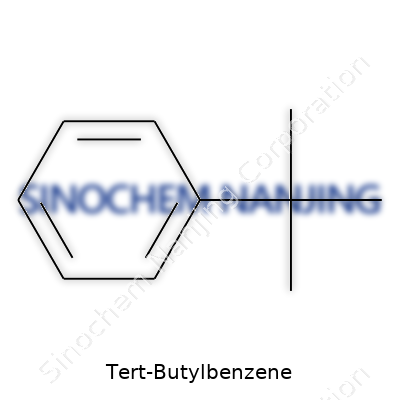
| Names | |
| Preferred IUPAC name | 1-tert-Butylbenzene |
| Other names |
1-Methyl-1-phenylethane tert-Butylbenzol T-butybenzene t-Butylbenzene Benzene, tert-butyl- 1,1-Dimethylethylbenzene |
| Pronunciation | /ˌtɜːrtˌbjuːtɪlˈbɛnziːn/ |
| Identifiers | |
| CAS Number | 98-06-6 |
| Beilstein Reference | 1209247 |
| ChEBI | CHEBI:51147 |
| ChEMBL | CHEMBL15712 |
| ChemSpider | 12617 |
| DrugBank | DB14143 |
| ECHA InfoCard | 100.162.909 |
| EC Number | 202-697-6 |
| Gmelin Reference | 1972 |
| KEGG | C01780 |
| MeSH | D017881 |
| PubChem CID | 7813 |
| RTECS number | CY1400000 |
| UNII | Z01L3L5X0U |
| UN number | UN2616 |
| Properties | |
| Chemical formula | C10H14 |
| Molar mass | 134.22 g/mol |
| Appearance | Colorless liquid |
| Odor | Aromatic |
| Density | 0.862 g/mL at 25 °C |
| Solubility in water | Insoluble |
| log P | 3.7 |
| Vapor pressure | 2.2 mmHg (25°C) |
| Acidity (pKa) | 40.5 |
| Magnetic susceptibility (χ) | -64.0·10⁻⁶ cm³/mol |
| Refractive index (nD) | 1.490 |
| Viscosity | 0.806 mPa·s (20 °C) |
| Dipole moment | 0.60 D |
| Thermochemistry | |
| Std molar entropy (S⦵298) | 346.8 J·mol⁻¹·K⁻¹ |
| Std enthalpy of formation (ΔfH⦵298) | -50.7 kJ/mol |
| Std enthalpy of combustion (ΔcH⦵298) | -5534.7 kJ/mol |
| Pharmacology | |
| ATC code | C01EB23 |
| Hazards | |
| GHS labelling | GHS02, GHS07 |
| Pictograms | GHS02, GHS07 |
| Signal word | Warning |
| Hazard statements | H226, H315, H319, H335 |
| Precautionary statements | P210, P261, P280, P301+P312, P305+P351+P338, P337+P313 |
| NFPA 704 (fire diamond) | 1-2-0 |
| Flash point | 52 °C (126 °F; 325 K) (closed cup) |
| Autoignition temperature | 516 °C |
| Explosive limits | Explosive limits: 1.2% to 6.9% |
| Lethal dose or concentration | LD50 oral rat 6800 mg/kg |
| LD50 (median dose) | LD50 (median dose): Oral rat 6 g/kg |
| NIOSH | CN8575000 |
| PEL (Permissible) | 50 ppm |
| REL (Recommended) | 50 mg/m³ |
| IDLH (Immediate danger) | 500 ppm |
| Related compounds | |
| Related compounds |
Benzene Cumene (Isopropylbenzene) N-Propylbenzene Sec-Butylbenzene Isobutylbenzene Toluene Ethylbenzene |



