Tantalum Pentachloride: A Deep Dive into Its Development, Properties, and Future
Historical Development
Tantalum pentachloride has traveled an interesting path from obscure curiosity to essential chemical in laboratories and industry. In the early days of inorganic chemistry, researchers found that heating tantalum with chlorine gas yielded a pale, volatile solid—soon identified as TaCl5. Chemists in the late 19th and early 20th centuries pushed their glassware to the limits to isolate it in pure form. Labs used highly corrosive gases and sought methods to separate tantalum from niobium, settling on pentachloride volatility as a reliable route. I remember seeing old laboratory notes showing the challenges of keeping TaCl5 pure: a slight leak in the apparatus, and the compound would react with moist air, ruining an entire batch. The legacy of those early efforts continues to underpin current manufacturing methods.
Product Overview
Tantalum pentachloride looks like a white or slightly yellow powder. It moves between solid and vapor quite easily at moderate temperatures, which speaks to the strength of chlorine’s grip on the central tantalum atom. Industrial suppliers offer it primarily for researchers and specialists. This is not a product you buy in bulk for construction—demand comes mainly from chemical synthesis labs, electronics manufacturers, and advanced metallurgy.
Physical & Chemical Properties
This solid boasts a melting point near 216 °C, but vaporizes well before boiling. The substance leaves behind a pungent, irritating odor reminiscent of burning chlorine, which never fades from memory if encountered unguarded in a fume hood. TaCl5 reacts aggressively with water—or even just humid air—releasing hydrogen chloride and forming a white cloud. Only glass or some fluorinated plastics hold it without damage, as metals and basic plastics corrode away. Its stark reactivity springs from the high oxidation state of tantalum, which creates real excitement for chemists needing a strong chlorinating agent or a versatile precursor.
Technical Specifications & Labeling
Bottles and ampoules of TaCl5 carry clear hazard labels because the solid presents multiple dangers: inhalation, contact with skin, and the threat of violent reaction with moisture. Technical literature specifies purity to the third decimal, with trace niobium content strictly limited—since in tantalum’s world, “pure” often means “as niobium-free as possible.” Density sits at about 3.68 g/cm³, and most suppliers standardize packaging to minimize contact with air. Only qualified handlers with appropriate gloves and air-tight facilities should manage the material, as a small spill can create a caustic mess that endangers staff and equipment alike.
Preparation Method
The classic way to make TaCl5 relies on direct chlorination: pass dry chlorine gas over heated tantalum metal or tantalum oxide. The reaction runs hot—above 200 °C—and pumps out copious white vapors, which workers condense into solid flakes or needles. There’s something almost theatrical about this process—heavy glassware, hoses, and dry ice traps line the bench, and a visible plume forms inside reaction vessels. The chemistry remains largely unchanged from a century ago, focusing on practical containment and optimization, not radical innovation. Some labs venture to refine TaCl5 using modern flow techniques or improved sealing materials, but the core idea stays the same.
Chemical Reactions & Modifications
Few tantalum compounds prove as reactive or helpful as its pentachloride. It serves as a chlorinating agent, a foundation for organotantalum compounds, or a bridge to less common halides. Reacting TaCl5 with alkali metals or organic ligands opens avenues toward tailored catalysts or materials with unique electronic properties. Chemistry classrooms use it to illustrate the heft of Group 5 metals, while industrial chemists use it to grow tantalum films on semiconductors or generate tantalum-based superalloys. My own experience with TaCl5 underlined how easily it contaminates other compounds if safety measures lapse—scrupulous cleanliness becomes a habit, not just advice.
Synonyms & Product Names
Tantalum pentachloride goes by several names: tantalum(V) chloride, pentachlorotantalum, and TaCl5. Suppliers often refer to CAS number 7721-01-9 for clarity. In trade catalogues and procurement portals, names shift according to regulatory context—some sticking to the rigorous IUPAC convention, others adopting more approachable commercial labels. These varied names reflect its niche usage but consistent role across industries and academia.
Safety & Operational Standards
Once you open a vessel of TaCl5, the clock starts ticking. Protective clothing, gloves made from butyl or Viton, and certified fume extraction all stand between a routine transfer and a hazardous accident. The substance reacts instantly with skin moisture, burning and releasing acidic fumes. Disposal procedures emphasize neutralization in a controlled environment—not in a regular drain or waste bin. Safety data sheets require storage under dry, inert gas to halt slow degradation. I’ve seen how even experienced researchers slip up, so regular safety training and rigorous protocols must remain non-negotiable. There’s no overestimating the risks: chlorine burns, tantalum contamination, even pressure build-up if containers trap residual moisture.
Application Area
Niche but vital—those words fit TaCl5 best. Electronic component manufacturers use it to coat substrates with tantalum for high-performance capacitors and corrosion-resistant metal films. Advanced chemistry labs draw on its extreme reactivity for organometallic synthesis and to stumble along new materials research. Firms looking to separate tantalum from niobium deploy TaCl5 as a separation intermediate, relying on its unique volatility. Tantalum chemicals like pentachloride underpin catalytic studies, showing up in experimental fuel cell work and somewhere in the pipeline of renewable energy innovation. The material rarely headlines mainstream manufacturing but shows up consistently in the background of high-tech advancements.
Research & Development
Research into tantalum pentachloride doesn’t rest. In the past decade, researchers have unlocked new low-temperature routes, safer encapsulation for shipping, and methods to handle ever-tighter purity controls. High-resolution spectroscopy and imaging have mapped its molecular geometry, offering clues for computational modellers chasing better catalyst design. Collaborations across universities and industry keep inching towards scalable routes that reduce byproducts and toxic emissions. Stories from the lab floor still echo with tales of oxygen contamination and failed seals, but the increased use of gloveboxes and improved analytical tools make today’s work both more efficient and safer than decades before. Funding agencies and grantmakers increasingly recognize the tie between tantalum chemistry and next-generation electronics, ramping up support for applied research.
Toxicity Research
Tantalum pentachloride presents a clear hazard to humans, animals, and the broader environment. Direct exposure damages lungs, eyes, and skin, driven by the evolution of hydrochloric acid and the corrosiveness of the pentachloride itself. Over the years, studies published in occupational safety and toxicology have examined low-level exposure, accidental release, and the risks faced by workers in manufacturing and transport. Animal studies reveal inflammation and respiratory distress upon inhalation; chronic exposure has not gained much focus, since regulation keeps most human contact very limited. Environmental toxicity centers around accidental spills—remediation experts recommend rapid neutralization and isolation of contaminated areas. There’s no good argument for reducing regulations on TaCl5 handling—not after reading case studies of facility evacuations caused by routine mistakes. Any future advances must build on less hazardous manipulation and passive safety features.
Future Prospects
Despite the hazards, the future for tantalum pentachloride looks promising. Ongoing trends in miniaturized electronics and specialty chemical catalysts feed demand for high-purity tantalum intermediates. Researchers worldwide continue investigating milder, more efficient routes to produce and apply TaCl5 without sacrificing safety. Industry pressure to recycle tantalum waste and minimize harmful byproducts spurs innovation in both production and disposal. Novel uses surface in quantum computing and environmental remediation—each dependent on reliable supply and well-tested methods. As society leans into high-performance devices and renewable energy, expect the role of compounds like TaCl5 to become both more critical and more scrutinized. My own encounters remind me that every advance in handling or synthesis has come from painstaking, sometimes nerve-wracking, hours in the lab. Only continued diligence, open information sharing, and relentless engineering stand between tantalum chemistry and the next major leap forward.
What is Tantalum Pentachloride used for?
The Real Role of Tantalum Pentachloride
Tantalum pentachloride isn’t a name that pops up at the dinner table, but its uses touch key corners of both modern technology and chemistry. I see its real value in how it helps shape other materials. Tantalum pentachloride works as a starting point for producing pure tantalum metal, which engineers like for making electronics because it resists corrosion and stands up to high temperatures. You might not notice it directly, but every time a device lasts years without failing, there’s a chance tantalum chemistry played a part.
Building Blocks for Electronics
Looking at your mobile phone or laptop, you’ll find tiny components that keep working even under pressure. Tantalum capacitors, for example, offer a small size and steady performance. Here’s where tantalum pentachloride comes in. Chemists use it as a building block when refining tantalum to that high purity needed for electronics. The pentachloride enables a process called chemical vapor deposition, a method that creates thin films and coatings by turning materials into gas and then laying them down layer by layer. With tantalum pentachloride, the coatings come out pure and reliable—which makes the difference between a phone that charges every time and one that fizzles out.
Helping Hands in the Lab
Beyond its industrial job, tantalum pentachloride plays a solid role in scientific discovery. Chemists looking to make new molecules often use it as a “chlorinating agent.” This means it helps swap out parts of complex molecules for chlorine—think of it as swapping a Lego brick in a big build. Certain advanced drugs, for example, rely on reactions using tantalum pentachloride. It’s not just about chemistry for chemistry’s sake; it’s about making the next generation of medicines and materials.
Challenges and Safety Concerns
Every tool in the lab or factory comes with a trade-off, and tantalum pentachloride proves this truth. It reacts quickly with water, making toxic and corrosive fumes. Anyone working with it needs solid training and strong safeguards, like special ventilation and protective gear. The risk is real—accidents with chemicals like this cause serious harm, reminding everyone why updates to safety practices stay high on priority lists. I remember a friend in graduate school who got a nasty chemical burn during a rushed experiment using a similar compound. That stuck with me, and it's why manufacturers and labs have to treat these raw materials with respect.
Responsible Use and the Future
Balancing the benefits of tantalum pentachloride with its risks means looking closely at supply chains and waste handling. Mining the ores that produce tantalum raises environmental topics, too. Conflict minerals once filled headlines for a reason; people want to know that materials in their gadgets don’t come at a hidden cost to someone else’s community or ecosystem. I’ve seen a push among companies to trace the origins of tantalum and tighten up recycling. There’s more work ahead. Smarter uses of tantalum pentachloride can cut down on waste and advance recycling efforts. By supporting responsible sourcing and research into greener processes, we can get more of the good—and less of the harm—from compounds like this.
Final Thoughts
Tantalum pentachloride packs a quiet punch in tech and science. It stands behind the scenes, helping build better devices, tougher materials, and even new medicines. Its usefulness demands respect, not just for what it can do, but for the responsibility it places on everyone who works with it.
What is the chemical formula of Tantalum Pentachloride?
The Formula: TaCl5
Tantalum pentachloride, best known among chemists by its formula TaCl5, draws attention for reasons that go well beyond just a classroom quiz. This straightforward string of letters and numbers hides a bigger story connected to high-tech industries, global economics, and safe handling practices.
Rarity and Value of Tantalum
Most people haven't handled a chunk of tantalum or seen it on a store shelf. Still, this element shapes much of today's technology. Tantalum comes from minerals dug up in specialized mines, mostly found in central Africa, Brazil, and parts of Australia. The process of turning rough ore into pure tantalum isn’t easy or cheap. For professionals working in labs, getting a steady supply of compounds like tantalum pentachloride starts with understanding just how tough that journey can be. Metals like tantalum end up priced higher than others because the mining and refining steps involve a lot of work and strict safety checks.
Why TaCl5 Gets Used
I remember my first encounter with TaCl5 during a graduate project in chemistry. Just opening the bottle left a faint whiff of sharp acidity that never quite faded. This compound reacts quickly with moisture and needs to be stored with care, because it will fume and break down if left out. Chemists often turn to TaCl5 when they want to create other tantalum compounds or thin films. The electronics sector makes good use of it, especially for producing high-quality capacitors. These capacitors drive everything from smartphones to medical devices, all thanks to the special properties of tantalum—stability, resistance to corrosion, and the ability to store charge efficiently. Getting pure TaCl5 is one step in producing the high-purity tantalum metal and components that modern circuits demand.
Hazards and Handling
TaCl5 isn’t something you'd want to spill in a crowded lab. It reacts violently with water to release hydrochloric acid, posing clear risks to anyone not wearing protective gear. I’ve seen new students rush to weigh reagents without thinking, only to startle as fumes rise up instantly. This kind of experience makes safety guidelines and proper storage real priorities. For suppliers and responsible organizations, tracking and labeling play a huge role, since any loss or accidental contact can mean an expensive cleanup and possible health hazard. Keeping things dry and controlling air exposure have to become habits.
Supply Chain and Ethical Questions
The chemistry doesn’t end at the lab door. The supply chain for tantalum, including TaCl5, runs through regions often wracked by conflict. Upstream companies seek “conflict-free” certifications and traceable sourcing to avoid funding armed groups and harming local communities. Research into recycling tantalum from used electronics has picked up lately, driven by growing demand and tighter regulations. By reusing what’s already out there, industries help reduce mining pressure and environmental harm. New advances in extraction methods—less waste, safer processes—give hope that the future won’t rely as much on risky or unstable sources.
Looking Forward
Knowledge about compounds like TaCl5 doesn’t just fill textbooks. It feeds into decisions at every link in the tech supply chain. Chemists, engineers, and buyers all shape how these materials flow from the earth to the end product, with safety and ethics along the way. This chemical formula isn’t just trivia—it’s a reminder that science, business, and real-world solutions tie together every day.
Is Tantalum Pentachloride hazardous or toxic?
Understanding the Substance
Tantalum pentachloride shows up as a white, sometimes yellowish, crystalline solid. Chemistry labs and some industrial processes use this compound—mainly in the synthesis of other tantalum-containing chemicals and sometimes in electronics. So, the material doesn’t turn up in everyday household products, but it’s common in places where specialty chemicals are handled.
Physical Risks and What Happens on Contact
This compound does not play nice with water or moisture. Drop a bit in water, and it reacts instantly, generating hydrochloric acid fumes. Those fumes attack the nose, eyes, and throat without much warning. Anyone who’s spent time around strong acids knows how quickly irritation sets in—from stinging eyes and burning lungs to coughing fits. A spill or splash anywhere on skin can bring severe burns, while contact with eyes may lead to lasting injury. So working with it means wearing solid personal protective equipment, at a minimum goggles and gloves—preferably a full-face shield and a chemical-resistant apron as well.
Toxicity and Long-Term Risks
Breathing in dust or vapors from tantalum pentachloride irritates the airways and can start chest pain and shortness of breath. Even without signs right away, damage to the respiratory tract develops over hours. The hydrochloric acid produced during any mishandling only adds to the danger. Chronic exposure or repeated skin contact can set off more severe effects, including tissue necrosis. It’s not a substance for anyone untrained or without specialized equipment. Accidental exposure has landed chemists in medical clinics more than a few times. I saw a situation in graduate school where a lab mate's glove tore. He didn’t wash it off fast enough and needed months of treatment for chemical burns.
Environmental Hazards and Waste
Tantalum pentachloride gets flagged on environmental lists because of its reactivity with moisture-rich environments, including soil and water. Throwing this material down the drain or leaving it exposed outdoors is asking for trouble. The compound doesn’t break down cleanly—those hydrochloric acid fumes spike local acidity fast enough to kill off small organisms in soil or water. Disposing of it requires a proper hazardous waste handler, and even small spills can force a room evacuation.
Regulation and Worker Safety
Regulatory agencies consider tantalum pentachloride a hazardous substance. Material Safety Data Sheets (MSDS) mark it as corrosive and dangerous on inhalation or skin contact. The workplace safety rules are strict: chemical fume hoods, full protective gear, and access to emergency eyewash stations. For anyone with children or pets nearby, this isn’t a material you want anywhere close. In my years in chemical research, all the labs stored this compound in tightly sealed containers inside ventilated cabinets, and only trained chemists got the clearance to use it.
Safer Practices and Alternatives
To keep people and the environment safe, regular training, access to up-to-date safety data, and clear protocols bring down the risk. Spills need immediate containment with inert absorbents, and spill kits should be within reach. Substitute materials that offer lower toxicity and reactivity should get priority, and scaled-down experiments help limit the chance of major exposure. Some newer research even focuses on alternative tantalum compounds that sidestep the dangers of pentachloride—though nothing fully replaces it in specialized chemistry yet.
Why Awareness Matters
Tantalum pentachloride reminds us that useful compounds can carry hidden dangers. Without respect for its hazards, the cost can be health, safety, and environmental harm. Facts show that with the right precautions, human risk drops—but carelessness brings serious consequences. Informed handling and strict adherence to safety keep everyone out of harm’s way.
How should Tantalum Pentachloride be stored?
Getting Real About Chemical Hazards
Tantalum pentachloride isn’t just another laboratory bottle on the shelf. Many of us see chemicals like this through the lens of protocols and data sheets, but the consequences of sloppy storage show up quickly. I’ve seen firsthand what a fumbled cap or the wrong container can do. Those corrosive fumes cut through coatings, damage surfaces, and make you regret any shortcuts you took. Working with reactive metals like tantalum, you learn quickly that some rules keep you and everyone around you safer.
Moisture Is the Enemy
The big danger is water. Tantalum pentachloride grabs at moisture fast, breaking down to produce hydrochloric acid fumes. You breathe in that mess, it hurts. Splash a little on a wet glove, you feel the burn. Watching a storage cabinet fog up just from a careless transfer drills home the lesson: even air humidity can trigger reactions. Dry storage isn’t an option—it’s the only way that keeps accidents at bay.
Glass Reigns Supreme—Plastics Don’t Cut It
Every chemist I know trusts glass for good reason. Strong borosilicate glass bottles stop hydrochloric acid from seeping out, so the stuff inside doesn’t eat holes in everything around it. Screw caps line up tight, making sure fumes stay put. I’ve seen coworkers grab a plastic jar thinking it’s “just for a quick sample,” then toss the ruined and brittle container days later. It’s an expensive reminder: plastics break down, corrode, or melt, especially with reactive chlorides. Glass stands up to the abuse.
Keep It Cool—But Not Freezing
Tantalum pentachloride hates heat, but cold matters too. Leaving it in the sun or near a hot plate breaks bonds, sending those nasty fumes out into the workspace. Too cold, and condensation sneaks in anytime you open the lid. Chemical storage rooms should stay dry, shady, and roughly at room temperature or a bit cooler. I’ve found low shelves in vented cabinets away from direct light offer the best results. Every spill on a hot surface or freeze-thaw cycle makes a mess, and sometimes, a visit from the hazmat team.
Label, Seal, Separate
No one plans an accident, but failing to label or secure chemical containers is asking for one. Good practice means writing the full name, concentration, and date on every bottle. I’ve seen well-meaning folks trust memory or “temporary” tape—labels peel off in humid rooms, and sudden inspections can lead to fines or, worse, unsafe mixing. Tight cap seals matter too; double-sealing with parafilm adds one more barrier, especially in crowded cabinets. Put reactive chlorides on their own shelf, away from water sources and organics. I’ve seen spill trays catch the run-off during minor leaks, saving hours of cleanup.
People Matter More Than Protocol
In my own work, chemical expertise always takes a back seat to simple, honest care for coworkers. Sharing a space means respecting everyone’s safety. Storing tantalum pentachloride properly isn’t about following rules for their own sake; it’s about making sure the next person through the door never gets a cloud of acid in the face. Sharing tips, holding each other accountable, and keeping each other informed builds a safer, kinder lab.
What are common methods for synthesizing Tantalum Pentachloride?
Why Tantalum Pentachloride Matters
Tantalum pentachloride often pops up in chemistry labs and high-tech industries for a simple reason: it turns out to be the bridge to plenty of tantalum compounds and organotantalum chemistry. Without this solid, white, moisture-sensitive powder, synthesizing many tantalum-based catalysts and specialty materials would turn into a real headache. Researchers rely on it for a range of transformations, from building up electronics to crafting molecular sieves and tailored catalysts.
Classic Chlorination Route
The most traditional route to tantalum pentachloride involves throwing metallic tantalum in with a steady stream of dry chlorine gas. Heat this up above 300°C and you get your product in the form of white crystals. The reaction looks pretty simple on paper:
Ta (s) + 5 Cl2 (g) → TaCl5 (s)
In practice, handling chlorine gas and high temperatures calls for pretty serious lab skills and safety measures. My first time working with direct chlorination, I realized how unforgiving mistakes can be when you work with corrosive gas at high temperatures. No fume hood, no experiment. This method keeps showing up in textbooks and industry because the raw materials aren’t hard to find, though keeping the tantalum piece clean matters for a good conversion rate.
Oxide Chlorination
Another approach starts with tantalum pentoxide (Ta2O5), which reacts with chlorine in the presence of carbon. Temperature comes in higher, usually between 350–400°C. The reaction replaces the oxygen atoms with chlorine and produces carbon monoxide or dioxide on the side.
One of the upsides of this method: tantalum pentoxide is much easier to handle than metallic tantalum and easier to find in purified form. The downside, at least based on my own graduate lab days, is that you end up needing a solid carbon source and careful temperature control to avoid clogging your setup with unreacted by-products. Still, for many labs, the convenience of using pentoxide outbalances the extra cleanup.
Alternative Laboratory Methods
If you want tantalum pentachloride on a smaller scale—or if chlorine handling feels too risky—there’s another path using thionyl chloride (SOCl2). Mix tantalum pentoxide with thionyl chloride and heat, and you can produce TaCl5 along with sulfur dioxide and sulfur oxychloride as by-products. From my experience, this method saves a lot of hassle with gas lines, letting the reaction run in a sealed tube or round-bottom flask. The catch is that thionyl chloride isn’t friendly either, so solid technique and ventilation still matter a lot.
Why Purity Matters in Synthesis
Any impurities in the tantalum source—metal or oxide—can create big issues. Even a small amount of moisture transforms tantalum pentachloride into a sticky mess that’s hard to handle and impossible to weigh accurately. Every researcher I know has accidentally ruined a batch by skipping this detail, so burying the product under dry inert gas or storing it in a glovebox makes all the difference. Also, good separation of by-products prevents machinery or glassware from gumming up after repeated runs.
Making Safer and Cleaner Processes
Modern labs increasingly look at minimizing the use of dangerous chlorine gas and considering alternatives like higher-efficiency flow reactors or microwave heating to bump up yield with fewer hazards. Using digital controls and better sensors has helped keep temperatures and chlorine flow more stable, cut down on waste, and improve recovery. Green chemistry is taking root slowly, but the basic challenges of moisture sensitivity, yield loss, and safety still come down to smart equipment, training, and respect for the reagents in play.
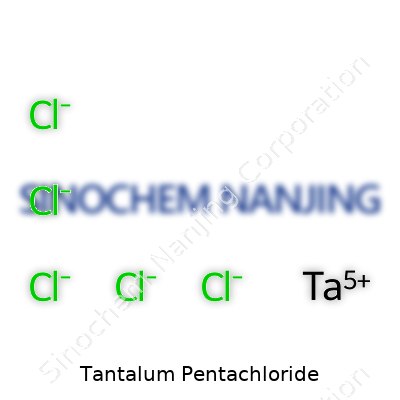
| Names | |
| Preferred IUPAC name | Tantalum(V) chloride |
| Other names |
Tantalum(V) chloride Tantalum chloride Pentachlorotantalum |
| Pronunciation | /ˈtæn.tə.ləm ˌpɛn.təˈklɔː.raɪd/ |
| Identifiers | |
| CAS Number | 7721-01-9 |
| Beilstein Reference | 3587066 |
| ChEBI | CHEBI:33273 |
| ChEMBL | CHEMBL3340941 |
| ChemSpider | 167986 |
| DrugBank | DB16078 |
| ECHA InfoCard | 100.032.522 |
| EC Number | 205-110-7 |
| Gmelin Reference | 49818 |
| KEGG | C14438 |
| MeSH | D017718 |
| PubChem CID | 24944 |
| RTECS number | XN6475000 |
| UNII | W50T44P6EK |
| UN number | UN3264 |
| CompTox Dashboard (EPA) | DTXSID5044288 |
| Properties | |
| Chemical formula | TaCl5 |
| Molar mass | 358.205 g/mol |
| Appearance | White crystalline solid |
| Odor | Pungent |
| Density | 3.25 g/cm³ |
| Solubility in water | Reacts violently |
| log P | 1.70 |
| Vapor pressure | 0.1 mmHg (84°C) |
| Acidity (pKa) | 1.3 |
| Basicity (pKb) | -0.96 |
| Magnetic susceptibility (χ) | −94.0·10⁻⁶ cm³/mol |
| Refractive index (nD) | 1.900 |
| Dipole moment | 0 D |
| Thermochemistry | |
| Std molar entropy (S⦵298) | 364.0 J·mol⁻¹·K⁻¹ |
| Std enthalpy of formation (ΔfH⦵298) | −1116 kJ·mol⁻¹ |
| Pharmacology | |
| ATC code | V19AX04 |
| Hazards | |
| Main hazards | Toxic if swallowed. Causes severe skin burns and eye damage. Causes serious eye damage. Reacts violently with water. |
| GHS labelling | GHS02, GHS05, GHS06 |
| Pictograms | GHS05,GHS06 |
| Signal word | Danger |
| Hazard statements | H301 + H331: Toxic if swallowed or if inhaled. H314: Causes severe skin burns and eye damage. H410: Very toxic to aquatic life with long lasting effects. |
| Precautionary statements | P234, P261, P264, P270, P271, P301+P330+P331, P304+P340, P305+P351+P338, P308+P313, P310, P312, P321, P330, P363, P405, P501 |
| NFPA 704 (fire diamond) | 3-0-2 |
| Autoignition temperature | 221 °C (430 °F; 494 K) |
| Lethal dose or concentration | LD50 (oral, rat): 600 mg/kg |
| LD50 (median dose) | LD50 (median dose): Oral rat LD50: 389 mg/kg |
| NIOSH | TT4550000 |
| PEL (Permissible) | Not established |
| REL (Recommended) | 0.1 mg/m³ |
| IDLH (Immediate danger) | Not established |
| Related compounds | |
| Related compounds |
Niobium pentachloride Tantalum(V) bromide Tantalum(V) fluoride |



