Silicon Tetrafluoride: From Discovery to Modern Industry
Historical Development
Silicon tetrafluoride first caught the attention of chemists in the 19th century, back when scientists regularly poked at the boundaries of chemistry with basic but effective glassware. It emerged from work involving mineral reactions with hydrofluoric acid, soon showing up as a curious gas with a strong smell and specific behaviors. Early laboratory reports described its sharp, choking odor and its tendency to etch glass, earning it both respect and caution. By the early 20th century, as the chemical industry ramped up, researchers realized it wasn’t just an academic curiosity; it started to hold promise for industry and research.
Product Overview
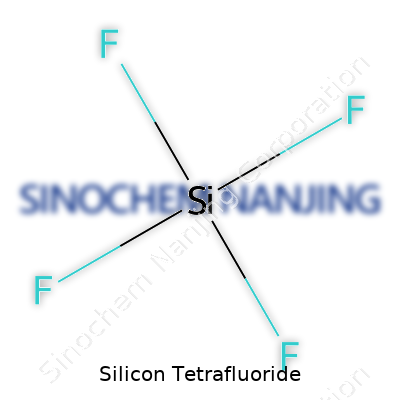
Silicon tetrafluoride, sometimes branded as silicium tetrafluoride or tetrafluorosilane in trade catalogs, carries the chemical formula SiF4. On the surface, it appears as a colorless, highly reactive gas, notable for its distinct, pungent odor. Companies involved in semiconductor production, glass manufacturing, and fluorine chemistry often keep cylinders of this gas on hand, finding value both in its reactivity and its ability to introduce fluorine into silicon compounds.
Physical & Chemical Properties
The gas boils at -86°C and has a relatively low molecular weight of around 104. It doesn’t dissolve much in cold water but turns into a strong, corrosive acid when exposed to moisture. People working with it have to stay aware that even a slight leak can corrode stainless steel and other common materials in a lab or factory. Its density is higher than air, so it hugs the floor or settles in low places—something that changes the way facilities handle leaks or accidental releases. The sharp, irritating smell makes detection straightforward without special sensors, although relying on that sense is never enough for safe operation.
Technical Specifications & Labeling
Cylinders carrying industrial SiF4 receive strict labeling under international chemical safety rules. Each cylinder displays the UN number 1859, hazard classes for corrosion and toxicity, and a clear warning for inhalation risks. Purity can range from commercial grades above 95% to electronic grades that reach 99.99%, tailored for chip fabrication or advanced coating applications. Each supplier notes residual impurities, usually listing hydrogen fluoride and sometimes traces of SiO2 dust formed during transport. Labels require date of manufacture, lot number, and traceability information to help downstream users dig into the full chain of supply if a quality hiccup arises.
Preparation Method
Labs and factories usually make SiF4 through direct action of concentrated hydrofluoric acid on sand, quartz, or silica gel. The reaction kicks off aggressively at room temperature: SiO2 + 4 HF → SiF4 + 2 H2O. This process produces the gas along with heat, and industrial plants collect it straight from the reaction vessel by concentrating, drying, and compressing it into steel cylinders lined to resist corrosion. Other trails, such as reduction of silicon hexafluoride or byproducts from phosphate fertilizer plants, sometimes provide alternative routes, but the acid–silica reaction still rules in terms of control and scale.
Chemical Reactions & Modifications
SiF4 doesn’t just sit around; it turns reactive, especially in the presence of water or alcohol. Moisture cracks it into silicic acid and hydrofluoric acid, both highly corrosive. Organic chemists also prize it for introducing fluorine into molecules or building up specialty silicon compounds. Mixing it with ammonia cranks out white smoke of silicon imide, and in big reactors, it can react with metallic potassium or sodium to yield a range of unusual silicides and fluorides. The gas doesn’t hang around long under atmospheric conditions; it gets broken down quickly, especially as soon as it meets humid air.
Synonyms & Product Names
On labels and in purchase orders, the compound pops up under several aliases: silicon fluoride, tetrafluorosilane, and silicium tetrafluoride. Trade names might tweak the wording based on local language or marketing aims, but the chemical stays the same. Regulatory sheets always list its CAS number, 7783-61-1, to keep sourcing tidy and avoid confusion.
Safety & Operational Standards
Handling silicon tetrafluoride demands a full safety plan and solid training. Direct exposure leads to serious lung, skin, and eye irritation, so operators suit up with full face protection, gloves, and—once in a while—even supplied air respirators, depending on the job site. Leaks have to be dealt with right away, as SiF4 reacts with atmospheric moisture to form hydrofluoric acid, which penetrates tissue deeply and triggers painful, sometimes fatal injuries. Regulatory bodies like OSHA and the European Chemicals Agency publish tight restrictions on exposure and outline ventilation, emergency procedures, and PPE standards. Any plant or lab storing it relies on acid-resistant piping, sealed transfer lines, and robust alarm systems. Response teams run regular drills for release scenarios—nobody treats it lightly.
Application Area
If you look at semiconductor fabs, advanced ceramics manufacturing, or specialized glass etching, SiF4 finds constant work. It acts as a fluorinating agent in the synthesis of high-purity silicon-containing materials and sometimes comes in as a precursor for the formation of silicon-based thin films or nano-coatings. The gas finds a spot in the production of optical fibers, boosting their resistance to water damage and fine-tuning laser transmission. In metallurgy, technicians use it to separate rare earths or clean up alloy surfaces. Heavy industries tap it for its ability to scavenge oxygen or glassy materials from metal melts. More broadly, researchers in chemistry and materials science count on its predictability to help design new compounds or push the limits of what silicon-based chemistry can do.
Research & Development
Right now, R&D teams see SiF4 as a starting point for developing advanced silicon nanostructures, functional coatings, and high-performance ceramics. People working on new batteries investigate how silicon-fluorine compounds perform as electrolytes or surface treatments. Green chemistry labs explore ways to recycle silicon tetrafluoride waste, turning it into useful fluorosilicates or silica products, cutting out environmental hazards and saving money on disposal. Academics look for cleaner routes to make it, aiming to swap out hydrofluoric acid for milder fluorinating agents or even low-temperature plasma methods, reducing risks for workers and the planet alike.
Toxicity Research
SiF4 already stands out as a dangerous gas for anyone unlucky enough to breathe it or come in unprotected skin contact, but researchers keep pushing for clarity around long-term and low-level exposures. Animal studies paint a picture of progressive lung damage and fibrosis, along with severe chemical burns in tissues. Epidemiology looks at workforces in fertilizer or ceramics production, aiming to separate the effects of SiF4 exposure from other industrial chemicals. Monitoring does more than protect workers; it lays the groundwork for tougher workplace standards and helps suppliers refine their containment and delivery systems. Innovative filtration materials and advanced detectors, driven by this research, continue to shrink the odds of accidental exposure.
Future Prospects
Looking ahead, silicon tetrafluoride is bound for new roles in electronics, nanotechnology, and sustainable chemistry. Engineers in the chip sector want ever-purer source gases as circuits keep shrinking, filling demands for tailored SiF4 grades. As energy storage and green manufacturing take off, the compound could turn up in more eco-friendly processes, either as a recyclable fluorine donor or as a feeder for innovative silicon-based materials. There’s buzz around reusing byproduct SiF4 from large chemical plants, looping it back into useful cycles or transforming it into safer, less hazardous substances before disposal. Wherever precision, reactivity, and fluorine count, this old-school but relentlessly useful gas keeps earning its spot.
What is Silicon Tetrafluoride used for?
What Is Silicon Tetrafluoride?
Silicon tetrafluoride raises a few eyebrows among those who don’t work in industrial chemistry, but it pops up in some pretty big processes. This colorless gas, SiF4, comes out naturally when certain minerals break down, but it's also made in big batches in factories. Anyone who’s walked by a phosphorus plant or studied glassmaking will know the sharp, choking odor of this stuff. That tells you it’s got bite—and utility.
Glassmaking and Cleaning
Growing up near a glass factory, I remember seeing shipments labeled with all kinds of warnings, and SiF4 made the list for one simple reason: it reacts strongly with water, making hydrofluoric acid. That sounds scary, but it plays a major role in etching specialty glass. Silica in the glass doesn’t stand a chance. This aggressive chemistry lets manufacturers make frosted patterns, intricate circuits for electronics, and even safety markings. Skip the etchant, and you’re left without details that make glass products useful and unique.
Silicon Industry and Cleaning
Silicon tetrafluoride doesn’t just haunt glass plants. The solar and semiconductor industries rely on high-purity silicon as a starting point. Part of producing that pure silicon means stripping away the mess, and SiF4 steps up by cleaning silicon surfaces. Folks designing chips for computers and phones can’t afford debris the size of a dust particle, let alone contamination from the factory floor. Using SiF4 helps them get precision down to the atomic level.
Fluorosilicic Acid and Water Treatment
I’ve seen city water boards debate about adding fluoride to municipal water. Much of the debate has roots in where the fluoride comes from. The answer is usually fluorosilicic acid—a direct product of SiF4 reacting with water. This acid plays a huge role in public health. For millions of people, it helps keep teeth stronger. Critics focus on sourcing and purity, but the public benefit is hard to argue when cavities drop in communities with fluoridated water.
Makeshift Uses and Niche Chemistry
Silicon tetrafluoride crops up in smaller, less-known spots. Chemistry labs sometimes use it to introduce fluorine into compounds, especially where other fluorinating agents bring risks or leave undesired leftovers. Its unique reactivity gives researchers more ways to build complex molecules, part of the reason our modern world has everything from advanced plastics to cleaner-burning fuels.
Handling and Environmental Concerns
Sometimes it just takes a gust of wind to remind people why industrial accidents make headlines. This gas, while useful, can irritate lungs and eyes quickly. Major spills near rivers or water can create hydrofluoric acid clouds, a danger to both factory teams and everyone downstream. The safe handling of SiF4 depends on respecting its power—protective gear, strong ventilation, and emergency plans aren’t just recommendations. They’re the line between ordinary day-to-day work and catastrophe.
Looking Forward
Industries count on SiF4 for practical, real-world tasks, but new tech pushes for cleaner, safer options. Research into capturing emissions and recycling the gas picks up pace as environmental standards tighten. Over time, companies turn to alternatives or build better filters for gases. Change won’t erase the need for strong chemistry—it just means SiF4 will work in smarter, safer ways.
Is Silicon Tetrafluoride toxic or hazardous?
The Chemistry of Silicon Tetrafluoride
Silicon tetrafluoride looks harmless in textbooks—a clear gas with the formula SiF4. Science classes cover it mostly in the context of making electronics or glass, and it doesn’t get the same headlines as lead or asbestos. Still, there’s more to its story than just its industrial uses.
Why Toxicity Concerns Matter
I remember years ago, working near a facility that handled lots of industrial gases. Safety talks often focused on things that could injure you if you spilled them or touched them, but gases that hurt you simply by breathing them seemed more abstract. Silicon tetrafluoride falls squarely in that category. According to the U.S. National Institute for Occupational Safety and Health (NIOSH), the gas causes severe irritation of the eyes, skin, and respiratory system. At higher concentrations, it forms hydrofluoric acid when it meets moisture—including the moisture in your lungs. That acid has a reputation among chemists and emergency teams as especially nasty. People exposed to high levels have ended up with lung damage, and some cases involved fatalities.
What Happens on Contact
Direct exposure isn’t just a theoretical risk. If you work in manufacturing settings that use silicon tetrafluoride—say, for making semiconductors or treating glass—safety sheets require a respirator and eye protection. If the gas leaks in a poorly ventilated place, workers can get chemical burns or worse, just from breathing in. Even brief contact can lead to coughing, choking, or pain as the acid forms. OSHA considers this enough of a hazard that they set strict limits on how much anyone should breathe during a work shift. The gas also tends to hang close to the ground when it leaks, which means people often encounter it before alarms go off.
Environmental Impact Isn’t Limited to the Workplace
Factories sometimes give off trace amounts of silicon tetrafluoride into the atmosphere. After a volcanic eruption, the same gas pours out of the ground. Studies on eruptions show damage to crops and even forests, underlining how toxic it is for animals and plants. Drinking water or soil exposed to the gas becomes acidic, and small animals near the source die off. My own community once dealt with the aftermath of an accidental release; people spoke about a bitter, choking fog, and the cleanup took weeks.
Stopping Hazards at the Source
Every factory has protocols for dealing with leaks and spills. In my experience, the best approach puts heavy focus on early detection—gas detectors hooked up to alarms, regular maintenance, and clear evacuation plans. Personal protective equipment can only do so much, so good ventilation and training staff on emergency procedures becomes essential. Research keeps pushing for safer alternatives in manufacturing, but for now, strict control remains the best defense.
The Need for Community Awareness
Local governments should require public notification of any significant gas release, not just for silicon tetrafluoride but for any hazardous material. Hospitals, emergency responders, and residents need practical information: how to recognize symptoms, what to do, and whom to call. As someone who has seen the confusion first-hand, I think real-time communication may help save lives if something goes wrong.
Respecting Invisible Dangers
Silicon tetrafluoride rarely gets attention outside of industries or science classrooms, yet its hazards are real and immediate where it’s used or released. Giving people the facts—without panic but with proper respect for the chemical—can push manufacturers and communities to take it seriously. That’s the key to keeping people safe.
What are the storage and handling requirements for Silicon Tetrafluoride?
What Is Silicon Tetrafluoride?
Silicon tetrafluoride isn’t something you bump into at the local hardware store. This is a colorless, fuming gas with a biting odor, used mostly where people are making fluorosilicates or doing advanced material work. For all its fancy uses, it brings real hazards. If you mishandle it, you’re asking for trouble. Having spent years working in labs and chatting with people who work in semiconductor plants, I’ve seen what even a small leak can cause: dangerous mists and eye-watering, throat-searing exposure. No one wants that.
Tough Stuff: Keeping Silicon Tetrafluoride Safe
Let’s be blunt — this isn’t a material for a cluttered storeroom or a makeshift shed. Silicon tetrafluoride needs solid steel cylinders, properly rated for pressure. Regulators and valves make a huge difference too. Leaky fittings or cheap gear don’t just spell lost product; they ramp up the risk for toxic exposure or even fire if it snags onto the wrong substance. You want to keep these containers upright and tightly sealed, strapped to something sturdy. I’ve watched experienced techs double-check everything before leaving for the day, because they know what’s at stake.
The Problem: Moisture and Air Are Foes
Whoever said “just keep it dry” never worked with silicon tetrafluoride. This stuff reacts fast with water in the air to spit out hydrofluoric acid and finely powdered silica. The acid eats through flesh and bone, no hesitation, and the dust causes major lung issues. I’ll never forget the safety drills highlighting one point: you keep this gas away from humid rooms, wet pipes, or any open water. Decent ventilation is a bare minimum, but in many places, full chemical scrubbers are the rule. Systems with leak detection and automated shutoff can stop chaos before it starts.
Beating the Risk with Training and Gear
You can’t just hand someone a tank and say, “Get going.” Regular training lowers the odds of a disaster. My first year working at a chemical supplier, a senior engineer called out every time a valve was even slightly loose. He drilled into us that personal protective gear isn’t a suggestion, it’s the baseline: goggles, gloves made for handling corrosive agents, face shields, the works. Safety showers and eye-wash stations need to be ready within a ten-second sprint, and everyone should know that route by heart.
Thinking Ahead: What Happens in an Emergency?
No one wants to face a spill, but hoping for the best never saved anyone. Response plans need to spell out who calls for help, who shuts off the valve, and who corrals people to safety. Fire departments and emergency teams should get the rundown on what to expect if they’re called. Over my career, the workplaces that escaped disasters were always the ones that practiced their drills and kept clear records.
Room for Smarter Solutions
Better sensors, tougher storage options, and upgraded automation could limit accidents. Some companies already invest in remote monitoring and even open lines to poison control centers. Sharing knowledge across facilities and industries can save time and lives. It isn’t just about having the right gear; it’s the culture of speaking up whenever something feels off. People trust you more when you’ve got systems that put health and the environment first.
What is the chemical formula and molecular weight of Silicon Tetrafluoride?
The Role of Chemical Formulas in Science
Chemical formulas have always shaped the way people in science and engineering talk to each other. No other language gives such a direct, precise way to communicate the nuts and bolts of a substance, whether you work in a lab or you just have a healthy curiosity. Looking at Silicon Tetrafluoride, you run into a formula that packs a lot into a small package. For anyone curious, the chemical formula for Silicon Tetrafluoride is SiF4. That shorthand means a molecule made from one silicon atom and four fluorine atoms. Seeing that kind of formula brings a particular thrill to anyone who’s ever braved a general chemistry class, especially when balancing those equations on a chalkboard.
Breaking Down the Numbers: Molecular Weight
Diving into molecular weight, the story gets more interesting. Silicon weighs in at about 28.09 grams per mole, and fluorine weighs around 19.00 grams per mole. So, for Silicon Tetrafluoride, you’re looking at a total molecular weight of 104.08 grams per mole (Si = 28.09 + 4 × F = 4 × 19.00). These numbers aren’t random; they're the product of decades of careful measurement, collaborative effort, and – in my experience – a few errors in high school labs. Sticklers for detail always remind everyone: those decimals can matter.
Why Formulas and Molecular Weights Matter
Knowing the formula and molecular weight of a compound isn’t just an academic drill. In college, calculating molar masses became my ticket to understanding why some reactions fizz like a shaken soda while others sit quiet and still. Silicon Tetrafluoride pops up in industries tied to glass and semiconductor manufacturing. Understanding its makeup means you can handle it safely, measure it out with precision, and predict how it behaves in the real world. Miss that calculation and you risk wasting expensive resources or, worse, putting safety on the line.
Challenges Working With Silicon Tetrafluoride
SiF4 doesn’t play nice with moisture—it reacts to release toxic hydrogen fluoride gas. I remember stories from graduate students who had to double-check every hose and connection before working with it. Good data about its molecular weight keeps people from taking shortcuts. If someone tries to wing the measurements, they end up with clouded glassware and an irate lab supervisor. For smaller research teams or manufacturing facilities, having a grip on these basics protects both budgets and workers.
Improving Chemical Handling and Awareness
Working with reactive, specialized chemicals like Silicon Tetrafluoride reminds me how critical hands-on training stays, even in an age where software can spit out numbers in seconds. Beyond just handling the compound, understanding its formula has helped my peers troubleshoot equipment failures and prevent chemical leaks. I’ve learned that knowledge gaps pop up when people rely on software instead of building their own skills. Companies and labs should encourage frequent, informal quizzes and lab safety workshops. Even running quick in-person reviews before starting a procedure helps keep everyone up to speed and aware.
The Push for Informed Handling
Understanding the formula SiF4 and its weight runs deeper than textbook memorization. It anchors safe, responsible, and effective lab work. From my own stumbles in chemical calculations to seeing how seasoned professionals triple-check data, I’ve watched this knowledge prevent disasters and boost efficiency. The more people can connect fundamentals to real-world risks and projects, the better off everyone becomes—scientists, workers, and the communities that depend on their work.
How is Silicon Tetrafluoride produced or synthesized?
The Chemistry Involved
Silicon tetrafluoride isn't exactly a household name, but chances are high anyone working in the chemical or electronics world has bumped into it. The basic synthesis looks simple on paper: take silicon dioxide, the main stuff that makes up sand, and react it with hydrofluoric acid. The interaction releases silicon tetrafluoride gas and water. The moment the chemical reaction kicks in, white fumes pour off. That’s pure silicon tetrafluoride escaping as a gas.
The classic formula goes like this:
SiO2 + 4HF → SiF4 + 2H2O
Plenty of people in chemical production find this reaction reliable, cheap, and easy to scale. Hydrofluoric acid usually gets handled with extreme care. It’s notorious in labs for its ability to eat through glass and the risk it poses to people if it touches skin. So, the whole process needs good engineering controls—what I see as one of those reminders that chemistry isn't all neat textbook diagrams.
Why Does Silicon Tetrafluoride Matter?
In my own work with materials science, silicon tetrafluoride pops up especially in areas where microchips, industrial etching, and specialized glass production are on the table. It acts as an intermediate step in the production of pure silicon for electronics—nobody could put together advanced microchips today without careful chemical transformations. By producing this gas, plants can further refine it, end up with products like ultra-pure silicon, and keep feeding the demands of digital tech.
This gas offers a foot in the door for making fluorosilicic acid as well, which shows up in water fluoridation and other chemical syntheses. Demand for silicon-based materials just keeps climbing, especially in solar panels and advanced computing.
Safety and Environmental Impact
My personal experience working around hydrofluoric acid taught me real respect for lab safety. Direct contact can result in intense burns and health emergencies. Any process involving silicon tetrafluoride needs airtight systems and skilled personnel. Accidental release of this gas into the air can lead to environmental problems—moisture in the air quickly transforms it to hydrofluoric acid and silica particles, both harmful to the environment and public health. Reports and regulatory case studies keep flagging the need for modern extraction systems and regular workplace audits.
Industry Solutions and Recommendations
Producers using the traditional method should invest in ventilation, gas scrubbing, and spill containment. Some advanced facilities focus on recycling spent acid or capturing silicon tetrafluoride from production streams before releasing any exhaust. Not every plant has state-of-the-art systems, though. Updating equipment, improving enclosure of reactors and piping, and training workers in emergency protocols makes production safer and cuts down on accidents.
Universities and industry groups keep pushing for cleaner and safer alternatives, but so far, the traditional acid reaction dominates. Some researcher friends have tried plasma-based production or direct fluorination with elemental fluorine, but scale and cost keep posing tough obstacles for wider use.
Building supply chains that take seriously the risks—both to workers and to the air outside the plant—matters just as much as chemical know-how. Pulling that off means not just technical expertise but a commitment to protecting both people and the places they live.
| Names | |
| Preferred IUPAC name | tetrafluorosilane |
| Other names |
Silicon fluoride Tetrafluorosilane Silicic tetrafluoride |
| Pronunciation | /ˌsɪlɪkən ˌtɛtrəfluˈaɪd/ |
| Identifiers | |
| CAS Number | 7783-61-1 |
| Beilstein Reference | 1721940 |
| ChEBI | CHEBI:30147 |
| ChEMBL | CHEMBL1201643 |
| ChemSpider | 21512 |
| DrugBank | DB09311 |
| ECHA InfoCard | 03c5b430-0e98-4c4e-8b82-7166ea99df67 |
| EC Number | 231-947-6 |
| Gmelin Reference | 778 |
| KEGG | C18758 |
| MeSH | D012827 |
| PubChem CID | 24562 |
| RTECS number | VV9275000 |
| UNII | K89SKY75SU |
| UN number | UN1859 |
| Properties | |
| Chemical formula | SiF4 |
| Molar mass | 104.0791 g/mol |
| Appearance | Colorless gas |
| Odor | Pungent |
| Density | 1.66 g/L |
| Solubility in water | Reacts violently with water |
| log P | -0.4 |
| Vapor pressure | 3.24 bar (20°C) |
| Acidity (pKa) | -10 |
| Basicity (pKb) | ~7 |
| Magnetic susceptibility (χ) | −60.4×10⁻⁶ cm³/mol |
| Refractive index (nD) | 1.174 |
| Viscosity | 0.424 cP (20 °C) |
| Dipole moment | 0 D |
| Thermochemistry | |
| Std molar entropy (S⦵298) | 247.6 J·mol⁻¹·K⁻¹ |
| Std enthalpy of formation (ΔfH⦵298) | -1615 kJ/mol |
| Std enthalpy of combustion (ΔcH⦵298) | –1619.8 kJ/mol |
| Pharmacology | |
| ATC code | V03AN01 |
| Hazards | |
| Main hazards | Toxic if inhaled; causes severe skin burns and eye damage; reacts violently with water producing toxic, corrosive fumes. |
| GHS labelling | GHS02, GHS05, GHS06 |
| Pictograms | GHS04,GHS05 |
| Signal word | Danger |
| Hazard statements | Hazard statements: Fatal if inhaled. Causes severe skin burns and eye damage. |
| Precautionary statements | P260, P280, P304+P340, P305+P351+P338, P310 |
| Lethal dose or concentration | Lethal Concentration (LC50) inhalation (rat): 600 ppm (1 hour) |
| LD50 (median dose) | > 15,000 ppm (rat, inhalation) |
| NIOSH | TC-14-13 |
| PEL (Permissible) | 1 ppm (6 mg/m³) |
| REL (Recommended) | 5 ppm |
| IDLH (Immediate danger) | 300 ppm |
| Related compounds | |
| Related compounds |
Silicon tetrahalides Germanium tetrafluoride Tin tetrafluoride Lead tetrafluoride Tetrafluoromethane |



