Selenium Tetrachloride: A Comprehensive Exploration
Historical Development
Chemists first encountered selenium tetrachloride back in the nineteenth century, part of a boom in elemental discovery. Early industrial laboratories pushed for new ways to manipulate rarely used materials, and selenium landed on their list thanks to its unique spots on the periodic table. Synthetic routes didn’t offer much room for error—oxygen would often interfere, air carried moisture, and glassware sometimes etched under attack from chlorine compounds. Over the years, progress improved equipment and air-free techniques. Today, chemical producers rely on controlled atmospheres and pure reagents to achieve consistent selenium tetrachloride with far better yields than early pioneers could dream of. Historical notes say selenium tetrachloride offered insight into how nonmetal chlorides behave, opening up thinking on reactivity and molecular geometry, which guided mid-century inorganic chemistry.
Product Overview
Selenium tetrachloride came out of these early discoveries as a solid reagent in industry and research. On the shelf, the substance looks like a pale-yellow or white crystalline solid, sometimes forming brittle chunks that break easily. The product attracts chemists searching for selenium-containing intermediates or those aiming to introduce selenium into organic molecules. Demand never rivaled staples like sulfur dioxide or hydrochloric acid, but niche uses in both synthesis and materials science kept production viable. The reagent ships in airtight containers, always kept well away from water, because contact with moisture triggers a violent release of hydrochloric acid—a hazard nobody wants in the lab or at the warehouse. Experienced researchers trust only reputable suppliers to deliver high-purity selenium tetrachloride, since impurities compromise both safety and results.
Physical & Chemical Properties
Physical properties draw attention right away: selenium tetrachloride melts at about 192°C, and sublimes before hitting its boiling point around 340°C. The vapor doesn’t just disappear into air—it breaks down, giving off selenium dioxide and chlorine gas. The solid picks up a pungent, acrid smell, noticeable long before a spill gets out of hand. Chemically, the material fits in as a strong Lewis acid, reacting quickly with water and alcohols, converting to selenium dioxide or organo-selenium derivatives. Reactivity hinges on polar covalent Se–Cl bonds; chlorine atoms pull electron density away from the selenium center, making it hungry for nucleophiles. This eagerness makes handling tricky, since almost any trace of moisture sets off a reaction. Volatility demands careful containment, and spills turn sticky and hazardous in seconds.
Technical Specifications & Labeling
Technical data sheets include precise content—look for a molecular weight of 220.77, density near 2.6 g/cm3, and guaranteed assay above 99%. Labels warn about fume formation, provide GHS pictograms for acute toxicity and corrosivity, and offer emergency guidance on accidental exposure. Detailed certificates of analysis accompany shipments, confirming trace metal levels, absence of organic residues, and strict packaging controls. Regulations demand that bulk shipments comply with both local transport codes and global conventions, labeling each drum or ampoule with hazard classifications and emergency response numbers. Companies usually supply updated SDS documents, ensuring each customer understands the dangers, emergency action steps, and proper disposal procedures.
Preparation Method
Chemists traditionally prepare selenium tetrachloride by introducing elemental selenium to dry chlorine gas at controlled temperatures. Hot, purified chlorine flows over finely divided selenium, and a volatile product sublimes away from the reaction site for easy collection on a cold trap. The process seems straightforward, but a blast of uncontrolled chlorine or a contaminated batch can ruin purity and introduce corroding byproducts. Producers use inert gas setups, dry boxes, and constant monitoring to keep oxygen and water out of the work area. Residues often contain selenium dioxide or lower chlorides, which require careful separation before bottling the final product. In research-scale work, smaller batches use sealed glass tubes, slowly ramped up in temperature, to minimize risk and maximize yield.
Chemical Reactions & Modifications
Selenium tetrachloride reacts with a long list of nucleophiles. Water attacks the Se-Cl bonds, releasing hydrogen chloride and leaving behind selenium dioxide. Alcohols react to form alkoxy selenides, sometimes in stepwise substitution, giving chemists flexibility to introduce selenium into organic frameworks. The tetrachloride reacts with phosphorus compounds, turning into selenophosphates, which find their way into special ligands and coordination complexes. Some reactions with alkali halides allow swaps for other halogens, building mixed selenium halide libraries for studying ligand effects. In fluorination, selenium tetrachloride unlocks routes to selenium tetrafluoride, a valuable precursor for advanced electronics. Oxidative conditions drive it toward higher oxides; reducing agents turn selenium tetrachloride into lower-state selenides. The breadth of reactivity underscores its value as an intermediate and as a model system for chemical reactivity studies.
Synonyms & Product Names
This compound goes by several names among professionals and suppliers. Some catalogs list it as selenium(IV) chloride, SeCl4, or selenious chloride. Different vendors might mark drums and vials as “Selenium tetra-chloride” or simply “tetrachloroselenium.” Researchers entering purchase orders sometimes abbreviate, but chemical safety paperwork always sticks to full spelling and the CAS number for certainty. Regional naming can complicate searches, although most databases synchronize entries to key identifiers—and anyone working across national lines checks translated names before ordering.
Safety & Operational Standards
Every handling guide for selenium tetrachloride puts safety first. Direct exposure could burn skin, eyes, or lungs. Inhalation poses a risk of severe respiratory distress, and prolonged skin contact may trigger chemical burns that need hospital intervention. Accidental spills give off hydrogen chloride vapors and free selenium, creating a potent mix of corrosive and potentially toxic fumes. Best practice means working in a fully functional fume hood, donning heavy gloves, goggles, and long sleeves. Laboratories store the material in tightly sealed containers, segregated from moisture, acids, and bases. Spill response kits stock neutralizing agents for acid vapors and specialized absorbents; labeling points out incompatibilities with common cleaning agents that might set off dangerous reactions. Regular safety drills ensure workers know emergency eyewash and shower locations. Disposal routes through licensed waste handlers prevent environmental release, matching strict global regulations around selenium and chlorine-containing compounds.
Application Area
Even though selenium tetrachloride does not see broad consumer use, its industrial footprint makes an impact. Glass and ceramics manufacturing sometimes employ selenium compounds to control color or improve optical properties. Specialty chemical synthesis takes advantage of its selenium source for introducing selenium atoms into organic structures, valuable in pharmaceutical and agricultural research. Advanced electronics depend on selenium-based films in solar panels and photoconductors; preparation of these materials often draws on selenium tetrachloride as an intermediate. Coordination chemistry programs exploit the molecule’s reactivity to tune ligands and explore new catalytic cycles. Analytical laboratories working on elemental analysis or chalcogenide chemistry use selenium tetrachloride as a calibration standard or as a reactant in test sample preparations. Its capability for making pure selenium dioxide also gives glassmakers a route to controlled tinting, an old but proven technology.
Research & Development
Recent R&D efforts zero in on new uses for selenium compounds in electronics, medicine, and catalysis. Scientists invest in developing better methods for stabilizing and handling selenium tetrachloride, especially at the nanoscale where volatility threatens sample integrity. Research initiatives look at incorporating selenium-based linkages into medicinal chemistry, aiming for innovative anticancer agents and antivirals. Materials scientists experiment with selenium doping in photovoltaic materials, seeking gains in solar cell efficiency. Solubility experiments continue to optimize crystal engineering around this compound, searching for safer, more effective delivery routes for both laboratory and industrial synthesis. Funding bodies support work on greener, less hazardous synthesis pathways, hoping to bring costs and risks down in future batch production. Interdisciplinary projects involve toxicologists, waste engineers, and product designers, all collaborating to shape tomorrow’s uses and best practices for handling this reactive material.
Toxicity Research
Toxicologists have flagged selenium tetrachloride as hazardous both in the short term and after prolonged exposure. Animal testing shows that inhalation irritates lungs and airways, while ingestion can lead to severe gastrointestinal distress, systemic toxicity, and deep organ damage. Chronic exposure to selenium compounds creates risk of selenosis—a syndrome marked by hair loss, skin lesions, neurological symptoms, and in extreme cases, death. Laboratory workers report nasal irritation and eye discomfort after brief encounters with vapors, matching findings from controlled animal studies. Toxicity mechanisms involve both the corrosive effects of hydrochloric acid released in reactions and the intrinsic toxicity of selenium in bioavailable forms. Guidelines set occupational exposure limits, and regulatory agencies update directives as new toxicity data emerges from long-term studies. Environmental risks also come under investigation, especially regarding selenium’s persistence in soils and waterways. Mitigation strategies rely on closed-system handling, personal protective equipment, and robust ventilation systems.
Future Prospects
Looking forward, selenium tetrachloride’s role hinges on stricter safety standards, evolving regulations, and fresh scientific discoveries. Laboratory automation and real-time monitoring promise safer synthesis, with less risk to workers. Industry wants greener pathways, so process chemists refine methods to minimize chlorine byproducts and energy intensity. In academic circles, selenium chemistry attracts attention for designing innovative drugs, catalysts, and optoelectronic devices. Environmental monitoring of selenium movement drives ongoing research into breakdown pathways for selenium tetrachloride in waste streams and natural settings. Open questions about bioaccumulation and remediation keep both ecologists and industrial hygienists invested. As new applications emerge in semiconductors and energy storage, the demand for high-purity, consistently manufactured selenium tetrachloride moves research on synthesis and purification to a new level, always under the watchful eye of regulators ensuring worker and environmental health.
What is Selenium Tetrachloride used for?
An Insider’s View on Selenium Tetrachloride
Selenium tetrachloride doesn’t show up in daily life, but it plays a serious role in chemical research and industry. I once worked in a university inorganic chemistry lab, and the glass bottles labeled “SeCl4” were always handled with care. That stuff is powerful—and a little intimidating. It isn’t just another bottle in the chemical storage room. It carries weight because of what it can do.
Real-World Uses and Why They Matter
Selenium tetrachloride mostly serves chemists and industry pros. Its biggest calling card? It makes other selenium compounds. Laboratories rely on it for the precise work of synthesizing organoselenium molecules. Researchers use these molecules to study reactions that might one day become new drugs or special semiconductors.
Selenium sits right below sulfur on the periodic table, but SeCl4 acts differently than its sulfur cousin. That uniqueness is gold to chemists hunting for new material behaviors. Research carried out at institutions like MIT and numerous industrial labs use this compound to add selenium atoms into organic molecules, tweaking properties for use in electronics. For example, certain selenium compounds have photo-conductive properties, which can fine-tune sensors or solar panels. I’ve watched grad students spend weeks coaxing selenium into the right spot in a molecule. SeCl4 gets the job done.
Industrial manufacture sees selenium tetrachloride as a way to clean up raw selenium or to shift it into other commercial products. For example, to create pure selenium or to prep selenium for pigments, lubricants, or glass coloring. Some battery companies are poking at selenium-based electrodes and coatings, since selenium offers special electrical and optical qualities. None of these advances are possible without handling selenium compounds with skill.
Risks That Need Attention
Risks in chemical work arrive on day one, and selenium tetrachloride provides no exception. The liquid releases nasty fumes—imagine sharp, choking hydrochloric acid but with a twist. Direct exposure can burn skin, eyes, or lungs. I remember one colleague leaving the fume hood open; the stinging in the nose lasted hours. Many labs require goggles, gloves, and even extra ventilation just for this one chemical. If spilled, it reacts with water, releasing toxic gases. Factories must train staff and invest in tight containment, which costs real money but saves lives.
Improper handling goes beyond workers. If leaks or spills reach soil or water, selenium can build up in plants and animals. High concentrations affect birds’ reproduction and even show up in fish meant for the dinner table. The U.S. Environmental Protection Agency keeps a close eye on selenium compounds for this reason. Nobody wants local rivers poisoned, especially communities depending on fishing or agriculture.
What We Can Do Better
Once you spend some time in labs or around factories, safety stops being just a rule on paper. It turns into a daily ritual. Proper handling needs serious training and regular drills. Community transparency matters: if your company stores selenium chemicals, people living nearby deserve to know about risks and plan for emergencies. Technology could help with continuous air monitoring near chemical plants. New sensor systems, perhaps even ones built using selenium-based materials, might catch leaks quickly and avoid disasters.
Selenium tetrachloride opens doors in science and manufacturing, but people working with it—everyone from lab techs to plant managers—should take every safety protocol seriously. Chemistry isn’t magic; nothing replaces good habits and tough safety standards.
How should Selenium Tetrachloride be stored?
A Chemical That Demands Respect
Anyone who’s set foot in a chemistry lab knows some substances call for more attention than others. Selenium tetrachloride is one of those. With a strong, suffocating smell and a proven record of reacting with moisture in the air, it commands control and understanding. Inexperience and casual handling around this compound almost always end badly. From my own time working as a lab assistant, I remember stories of careless storage leading to fuming bottles and surprise chemical burns. No one wants that, so respect for basic storage principles shapes every move with this stuff.
Why Moisture Means Trouble
Selenium tetrachloride doesn’t just dislike water—it reacts with it. Once it finds moisture, it starts releasing hydrochloric acid gas, which attacks both skin and lungs. You can spot problems right away if the bottle begins to fume when opened. The annoyance grows with every whiff and splash, and broken seals make a mess that’s hard to fix. So, putting it anywhere near humidity or leaving the cap loose can ruin a day, or worse, a lab’s safety record.
The Right Storage Environment
The rules for safe storage reward common sense and consistent habit. A dry, well-ventilated chemical storage cabinet becomes the first line of defense. I always stick to tightly sealed glass containers—never plastic. The glass stops reactions, and a strong seal keeps air and water out. A good desiccator, filled with drying agents like calcium chloride, adds another layer of protection in humid climates. Every seasoned chemist I’ve met stores reactive chemicals in a way that keeps them apart from incompatible substances—never next to strong bases, water sources, or open acids.
Clear Labeling and Inventory Control
Proper identification goes beyond writing “SeCl4” on a label. Expiry dates, concentration, and hazard symbols help everyone, from the newest intern to the most experienced supervisor, stay safe. Over the years, I’ve seen accidents start simply from confusion between similar-looking bottles. Keeping tight records—knowing what’s on the shelf and in what condition—cuts risk and saves time. Every audit I’ve sat through digs deep into chemical logs because regulators know too well how human error sneaks in when no one pays attention.
Emergency Planning Makes a Difference
Even in the best labs, spills and leaks happen. Fast access to fume hoods, eye wash stations, and chemical spill kits changes everything in an emergency. My old lab drilled these routines until every student could grab a mask and use a neutralizing agent without thinking. It’s valuable training, and it should never get skipped. Posting procedures in plain sight and making sure new staff review them keeps everyone sharp. No one forgets the first time a storage error sends fumes racing across a bench—having a plan cuts panic and keeps accidents contained.
Building a Culture of Caution
People matter as much as glass and chemicals. Team meetings and refreshers on safe storage, not just once a year but every season, keep risks low. I’ve seen how an open-door policy—where anyone can speak up about poor storage or outdated stock—makes a difference in team safety. The goal is never just to pass inspection but to send everyone home without a scratch. Respect for selenium tetrachloride grows from shared stories and collective vigilance, not just regulatory fear.
What are the safety precautions when handling Selenium Tetrachloride?
Straight Talk On A Hazardous Chemical
Selenium Tetrachloride shows up in labs where folks deal with inorganic compounds and specialized synthesis. Its appearance tips off anyone who’s worked with it—pungent fumes, yellowish liquid, and a serious potential to send you running for fresh air. If you’ve ever caught a whiff, you remember it. This stuff reacts with water, including the humidity in the air, and turns into hydrochloric acid and selenious acid—both corrosive, both a nightmare for skin and lungs.
Personal Protection: Not Just Gloves and Goggles
Preparation makes all the difference. Regular nitrile gloves can eat through if you rest your hands on a droplet too long, and lab coats do little unless fully buttoned up. Good safety practice means grabbing thick, chemical-resistant gloves—think neoprene or heavy-duty nitrile. Splash-proof goggles work better than regular safety glasses because fumes can sting straight through the eyes. Even in the best labs, face shields sit close, especially for anyone pouring or opening the bottle.
Contact lens wearers face extra risk. Fumes sneaking behind the lens can cause burning and tears that don’t stop. I once watched a colleague wash their face for fifteen minutes after a single careless whiff. Cotton or synthetic-lining sleeves keep droplets from running down wrists if you set the bottle back down too quickly.
Adequate Ventilation: Stop Fumes At The Source
Anyone uncorking Selenium Tetrachloride in a standard lab knows fume hoods, not open benchtops, provide the minimum safe space. Fume hoods need steady airflow, regular filter checks, and sash closures pulled as low as comfort allows. Fumbling with the container without airflow sets you up for burns, even blistered nasal passages.
Once, during a rushed session, I neglected to check the airflow sensor on the hood. My mistake—the sensor failed, fumes built up, and the resulting cough made me step away for hours. Proper ventilation serves as the first real defense, and maintenance teams check for blockages or failing fans as regularly as possible.
Storage and Clean-Up: Consistency Saves
Selenium Tetrachloride hates water, open spaces, and light. Anybody storing it puts the bottle in a tightly closed, labeled container, away from acids, bases, and most importantly, sources of moisture. Desiccators or ventilated chemical storage cabinets hold up well. Leaks mean instant corrosive messes—silica sand or spill kits stay close at hand. Clean-up means full respirators if the spill is more than a few drops, and not just for the unlucky person who spilled. Non-sparking tools help scoop up the mess. Rinse solutions and neutralizers like sodium bicarbonate should sit close.
Training Makes The Real Difference
No chemical protocol saves you if people don’t actually know what they’re facing. Every year, one or two students or new lab members underestimate the fumes. Posting clear signage, walking through emergency eyewash and shower use, and putting chemical MSDS sheets in arms’ reach keeps everyone honest. I’ve seen staff skip steps to save time—that’s the moment accidents multiply.
Solutions Moving Forward
Training, working equipment, clear labeling, and solid protective gear make up real safety. It doesn’t stop with regulations—hands-on drills, spill response practice, and conversations about what nearly went wrong clarify the consequences. With Selenium Tetrachloride, the lesson is clear: constant attention, up-to-date habits, and a willingness to step back and ask for help. No shortcut holds up against proper respect for the risks.
What is the chemical formula and molecular weight of Selenium Tetrachloride?
Understanding Selenium Tetrachloride
Selenium tetrachloride has the chemical formula SeCl4. Anyone who spends time in a science lab, or who just enjoys learning about chemistry at a granular level, will notice that selenium forms a range of halides, but SeCl4 stands out. The formula isn’t just a jumble of letters and numbers—this compound packs four chlorine atoms around a single selenium atom. The configuration matters in real-world uses, from research to industry, because it shapes everything from storage methods to chemical reactivity.
Why Formula and Molecular Weight Matter
Molecular weight clocks in at 220.77 grams per mole. This specific number matters more in practice than nearly any chemistry textbook might suggest. Accurate weights keep everything balanced. Think of a chemist preparing a reaction; getting the quantities right starts with knowing the exact formula and weight of every component. Incomplete or wrong numbers can ruin an entire experiment. In industry, mistakes set off chain reactions, from wasted resources to real safety hazards. The number 220.77 isn’t arbitrary—it guides dosing, synthesis, and even safe disposal.
Working with Selenium Tetrachloride
Those familiar with the material already know its properties aren’t just lab trivia. SeCl4 starts out as a white to yellowish solid, and it dissolves in many solvents—dry, controlled environments matter. The compound reacts vigorously with water, releasing corrosive and toxic gases, which means proper knowledge and respect for the formula and molecular weight are more than academic—they are the backbone of safe handling. Gloves, eye protection, and fume hoods aren’t suggestions; they’re essential safeguards. This aligns with recommendations from trusted sources like the National Institute for Occupational Safety and Health (NIOSH), which push for strict controls to minimize exposure and environmental impact.
Real-World Impact
SeCl4 gets used in chemical synthesis, especially when people want to introduce selenium atoms into organic molecules. Some folks in electronic manufacturing or specialized glass production use selenium compounds as well. The push for more sustainable chemical practices shines a spotlight on compounds with specific, clearly defined properties—SeCl4 makes the cut because its chemistry is predictable and documented.
Accurate data about chemical properties do more than fill up the datasheet. Scientists double-check molecular formulas and weights constantly. They trust sources like the CRC Handbook of Chemistry and Physics because errors can spell disaster—not only for experiments but for human health. Overlooking a simple number like 220.77 can mean the difference between a successful reaction and a hazardous spill.
Improving Chemical Literacy for Safety
Confusion over formulas and molecular weights shows up even among experienced hands. Out-of-date references, misread labels, or accidental typographical mistakes slip in surprisingly often. Open, cross-checked data access and hands-on safety training offer a way forward. Interactive material safety data sheets (MSDS), routine audits, and refresher workshops reduce risk. Newcomers and veterans both gain from a workplace where accuracy is respected, not just expected.
In chemistry, clear information saves time, money, and lives. Simple, trusted facts about compounds like selenium tetrachloride underpin effective decisions—from mixing chemicals to environmental protection. Experts lean on precision and stay alert to the risks because the line between knowledge and carelessness can be perilously thin.
Is Selenium Tetrachloride hazardous to health or the environment?
Understanding What Selenium Tetrachloride Can Do
Selenium tetrachloride doesn’t often pop up in everyday news, but in labs and industrial chemistry circles, it gets attention. This compound acts as a reagent in chemical synthesis and sometimes in electronics or glass production. Its hazards don’t stem from public rumor or chemical anxiety — they come from real, direct contact and the legacy left behind after use.
Breathing or Touching: Real Health Concerns
An open bottle of selenium tetrachloride won’t just announce itself with fumes; it bites at your throat and eyes. I still recall conducting an experiment with chalcogen reagents in a research lab and someone let a small drop hit the bench. Minutes later, the sharp, suffocating odor spread. This isn’t just a matter of discomfort. Selenium tetrachloride hydrolyzes to hydrochloric acid and selenium dioxide, both of which irritate lungs, skin, and eyes. Data from the National Institute for Occupational Safety and Health (NIOSH) warn that short exposure can cause severe respiratory pain and skin burns. Chronic or repeated contact can lead to selenium poisoning, which brings brittle nails, fatigue, and a strange, metallic garlic breath.
Direct statistics on accidental exposures are rare, but high-profile poisonings from other selenium compounds show the dangers lack mystery. The body cannot eliminate selenium rapidly, so cumulative effects become a problem for those unaware of necessary precautions.
Environmental Risks After Use or Disposal
Leaks and spills worry environmental chemists for a reason. Selenium tetrachloride reacts with moisture and spreads its byproducts — hydrochloric acid changes soil chemistry, while selenium mixes with water to become bioavailable. Plants draw selenium up through roots, moving it up the food chain. Smaller animals, especially fish or birds, build up selenium much quicker than larger creatures and show deformities or population crashes from contamination.
I’ve spoken with river ecologists who cite selenium as a stubborn contaminant, difficult to remove once it enters waterways. Even trace amounts can edge up against the EPA’s water quality criteria; above two parts per billion, it threatens aquatic habitats. Runoff from poorly managed sites or improper disposal at factories has created high-profile problems before — notably in areas near mining and chemical manufacturing.
Managing the Risks
Gloves, face shields, and daily awareness matter in the lab, and companies put millions into ventilation and leak prevention. The rules for storing toxic chemicals haven’t come out of thin air; they follow plenty of hard lessons. Proper labeling, dedicated spill kits, employee training sessions, and secondary containment are common-sense steps that prevent both acute injury and environmental losses.
Policies have a role. Governments mandate strict reporting, enforce storage rules, and set discharge limits. With ongoing monitoring and rapid-response protocols, communities sidestep the worst of accidental releases. Alternative reagents, where possible, reduce reliance on hazardous chlorine and selenium combinations.
Looking Ahead
Questions about selenium tetrachloride won’t disappear, and neither will the industrial need that drives its production. Responsibility starts with good lab habits and extends to systemic oversight from manufacturing through end-of-life disposal. That circle of care means injuries remain rare and natural habitats get a fighting chance.
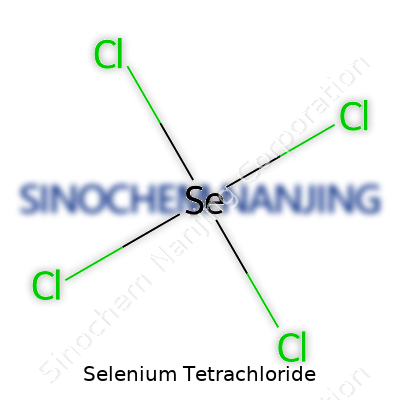
| Names | |
| Preferred IUPAC name | tetrachloroselane |
| Other names |
Selenium(IV) chloride Selenium tetrachloride Selene chloride |
| Pronunciation | /sɪˈliːniəm ˌtɛtrəˈklɔːraɪd/ |
| Identifiers | |
| CAS Number | 10026-03-6 |
| Beilstein Reference | 1203077 |
| ChEBI | CHEBI:30185 |
| ChEMBL | CHEMBL3300931 |
| ChemSpider | 82124 |
| DrugBank | DB14638 |
| ECHA InfoCard | 100.032.420 |
| EC Number | 231-956-9 |
| Gmelin Reference | 7316 |
| KEGG | C18794 |
| MeSH | D017165 |
| PubChem CID | 24815 |
| RTECS number | VS7175000 |
| UNII | 0G3I2U7SHE |
| UN number | UN2046 |
| Properties | |
| Chemical formula | SeCl4 |
| Molar mass | 213.77 g/mol |
| Appearance | White to pale yellow crystalline solid |
| Odor | Pungent |
| Density | 3.09 g/cm³ |
| Solubility in water | Reacts |
| log P | -0.54 |
| Vapor pressure | 1 mmHg (20 °C) |
| Acidity (pKa) | -4.15 |
| Basicity (pKb) | -4.15 |
| Magnetic susceptibility (χ) | -53.0e-6 cm³/mol |
| Refractive index (nD) | 1.740 |
| Viscosity | 1.37 cP (25 °C) |
| Dipole moment | 0 D |
| Thermochemistry | |
| Std molar entropy (S⦵298) | 107.5 J·mol⁻¹·K⁻¹ |
| Std enthalpy of formation (ΔfH⦵298) | -243.4 kJ/mol |
| Std enthalpy of combustion (ΔcH⦵298) | -318.6 kJ/mol |
| Pharmacology | |
| ATC code | V03AB31 |
| Hazards | |
| Main hazards | Toxic if swallowed, inhaled, or in contact with skin; causes severe burns to skin and eyes; reacts violently with water, releasing toxic and corrosive gases. |
| GHS labelling | GHS02, GHS05, GHS06 |
| Pictograms | GHS05,GHS06 |
| Signal word | Danger |
| Hazard statements | H301 + H331: Toxic if swallowed or if inhaled. H314: Causes severe skin burns and eye damage. H410: Very toxic to aquatic life with long lasting effects. |
| Precautionary statements | P260, P280, P301+P330+P331, P303+P361+P353, P305+P351+P338, P304+P340, P310 |
| NFPA 704 (fire diamond) | 3-0-2 |
| Autoignition temperature | 185 °C |
| Explosive limits | Non-explosive |
| Lethal dose or concentration | LD₅₀ (oral, rat): 177 mg/kg |
| LD50 (median dose) | LD50 (median dose): Oral-rat LD50: 770 mg/kg |
| NIOSH | WH4025000 |
| PEL (Permissible) | PEL: 1 mg/m3 (as Se) |
| REL (Recommended) | 2°C to 8°C |
| IDLH (Immediate danger) | 1 ppm |
| Related compounds | |
| Related compounds |
Selenium oxychloride Selenium hexafluoride Sulfur hexafluoride |



