Sec-Butylbenzene: Insight Into a Chemical’s Journey
Historical Development
The story of sec-butylbenzene starts over a century ago as researchers dove into aromatic hydrocarbons for industrial purposes. As chemists sought to diversify the uses of benzene derivatives, sec-butylbenzene gained traction for its stability and unique properties. Its history runs through the veins of early oil refining, where it emerged as a valuable by-product, and into the labs that fueled the post-war chemical boom. Scientists found its structure—an aromatic ring with a sec-butyl group—offered opportunities for downstream chemistry, which shaped industries from petrochemicals to specialty solvents. The drive to optimize yields and purity led to more efficient production routes as time went on. Each decade brought tweaks in process technology and strict regulations that nudged manufacturers to invest in safer, cleaner methods.
Product Overview
Sec-butylbenzene belongs to the alkylbenzenes category. Its molecular formula, C10H14, sketches out a benzene ring with a secondary butyl group branching off—giving it a distinct profile compared to its isomers. Used mostly as an intermediate, it has found a foothold in chemical manufacturing and laboratory research. Producers tend to sell it in bulk liquid form, packaged in steel drums, or in smaller laboratory containers lined with inert materials to avoid unwanted reactions. Turnover as an ingredient in organic synthesis, solvents, and chemical blends proves steady, thanks in large part to its consistent performance under diverse conditions.
Physical & Chemical Properties
Looking at sec-butylbenzene from a scientific perspective, its clear, colorless liquid state stands out. It produces a sweet, aromatic odor typical of other alkylbenzenes. A boiling point of around 177–179°C supports its usefulness in high-temperature processes, while its relatively low freezing point keeps it in liquid form even in cool environments. Insolubility in water prevents exposure risks in many applications, yet it dissolves easily in organic solvents. Chemical stability under normal storage and use means manufacturers can handle it without much concern for rapid degradation; though it can combust, releasing noxious fumes, under fire conditions. Density sits near 0.86 g/cm3. Flash point circles around 54°C, which signals the need for careful storage and transport.
Technical Specifications & Labeling
Detailed labeling features on each container, following globally harmonized standards. Labels bear the chemical’s full name (Sec-Butylbenzene), its molecular structure, batch number, purity grade (often 98% or higher for lab work), and hazard pictograms. The CAS registry number (135-98-8) helps prevent confusion during audits or handling between facilities. Data sheets accompany each shipment, outlining storage advisories, spill procedures, and PPE recommendations for operators. Specific gravity, boiling range, and refractive index often round out the technical specs, empowering buyers to judge suitability for their particular set-ups.
Preparation Method
Producers prepare sec-butylbenzene by alkylating benzene with sec-butyl halides (like sec-butyl chloride or bromide) or by using alcohols in the presence of acid catalysts. Historically, the Friedel-Crafts alkylation dominated, relying on aluminum chloride to initiate reaction. More recently, process engineers have favored safer, more efficient catalysts to minimize hazardous by-products. Strict temperature, pressure, and reactant ratios control reaction output. Once the reaction finishes, purification follows—distillation strips away unreacted benzene and other impurities, isolating high-purity sec-butylbenzene. This continuous fine-tuning over decades honed productivity while reducing environmental footprints.
Chemical Reactions & Modifications
Sec-butylbenzene acts as a starting material in multiple reactions. Its aromatic ring can undergo nitration, sulfonation, or halogenation, opening doors to value-added chemicals used in pigments, surfactants, and pharmaceutical intermediates. Chemists have relied on its side chain to guide selective oxidation or functionalization. Its reactivity makes it an excellent probe chemical for mechanism studies in organic synthesis. Coupling reactions and isomerizations broaden the landscape even more, as researchers continually aim to unlock new derivatives for both academic and industrial pursuits.
Synonyms & Product Names
Beyond sec-butylbenzene, labels on shipments often list synonyms such as 1-Methyl-1-phenylpropane, 1-Phenylbutane-2, and secondary butylbenzene. Traders might refer to it by trade names in purchasing contracts or inventory systems. Awareness of these alternate terms plays a crucial role in international dealings, preventing accidental substitutions or miscommunication between suppliers and end-users scattered across different linguistic backgrounds. Both common and IUPAC names wear equal weight in safety documents, purchase orders, and research articles.
Safety & Operational Standards
Handling sec-butylbenzene brings its own set of risks, drawing focus to robust safety protocols. Direct contact or inhalation can irritate eyes, skin, and respiratory tract. Flammability concerns call for grounded storage tanks, strict no-smoking rules, and rapid clean-up procedures for leaks or spills. Operators don gloves, safety goggles, and flame-resistant lab coats to block exposures. Workspaces deploy local exhaust ventilation to prevent vapor build-up. Disposal practices comply with local hazardous waste laws, often routing used material or residues through licensed waste management services. Emergency showers and eyewash stations stand ready in facilities working with the chemical, ensuring rapid response to accidental splashes or spills.
Application Area
Sec-butylbenzene serves as a vital raw material in specialty chemical synthesis. Manufacturers turn to it for creating surface-active agents, additives for lubricants, and as a component in custom chemical blends. Labs employ it as a solvent and reaction medium, taking advantage of its stability and compatibility with other organic substances. Some fragrance makers experiment with it in formulations, drawn to its mild aromatic note, though regulatory approval for consumer goods still lags. Outside chemistry, engineers see promise in its properties for explorations into green fuels and advanced material science.
Research & Development
Research surrounding sec-butylbenzene reflects a push for both safety and efficiency. Scientists pursue greener, non-toxic catalysts and alternative feedstocks, trimming reliance on benzene from fossil fuels. Universities investigate its interactions within complex organic matrices, aiming to streamline synthesis steps for pharmaceuticals or electronics. R&D teams collaborate with regulatory agencies to understand exposure pathways better and set threshold limits that keep both workers and communities safe. Cross-disciplinary projects eye new applications in energy storage and functional polymers, pulled by the need for novel structures and high-performance materials.
Toxicity Research
Toxicologists have spent years tracing the effects of sec-butylbenzene on humans and the environment. Acute exposure tends to prompt irritation, while chronic effects remain less well-documented, urging further study. Animal research highlights mild central nervous system symptoms at high doses, underscoring workplace monitoring. Environmental scientists watch for persistence and bioaccumulation, though sec-butylbenzene shows modest volatility and breaks down under sunlight. Regulatory bodies set occupational exposure limits based on this growing body of evidence, and newer studies continue examining both short- and long-term impacts. A significant knowledge gap persists around interaction with other solvents and industrial chemicals common in shared facilities.
Future Prospects
Looking at what the future holds, sec-butylbenzene stands at a crossroads. Rising demand for performance chemicals keeps it in the spotlight, but sustainability pressures push producers toward cleaner pathways and less hazardous substitutes. Digital process controls and smarter sensors contribute to safer operations, with traceability upgrades built into every shipment. Custom molecules and advanced materials on the horizon promise new uses for sec-butylbenzene’s backbone, driven by biomedical, nanotech, and composite engineering. Most important, the ongoing dialogue between chemical makers, regulators, and researchers will determine just how responsibly and widely sec-butylbenzene influences the next chapter of industrial innovation.
What is sec-butylbenzene used for?
The Quiet Engine Behind Industry
Sec-butylbenzene hardly gets talked about outside of certain labs, but it plays a quiet role in some big industries. At first glance, it’s just one molecule in a sea of chemicals that most folks never hear about. Yet, for people working in petrochemicals, specialty chemistry, or research, sec-butylbenzene answers real needs that a textbook may not spell out.
A Building Block, Not a Superstar
Years ago, during my first internship at a chemical plant, I remember being stunned by the sheer number of substances delivered by truck. Engineers pointed out barrels marked with unfamiliar names, including sec-butylbenzene. I learned it doesn’t end up in products you’d see in a pharmacy or on a store shelf. Its strength lies in boosting processes behind the scenes.
In labs, sec-butylbenzene pops up as a useful solvent. Chemists choose it for its stability when other solvents might break down or react. Its structure gives it that edge—for example, the secondary carbon on the butyl group makes it behave a bit differently than normal butylbenzene. Organic synthesis can sometimes run better, cleaner, or with fewer unwanted side products through its use. This matters to anyone refining new molecules or scaling up production, because reliable results help control costs and research time.
Pushing Petrochemical Boundaries
Companies tapping into oil and gas derivatives look for compounds like sec-butylbenzene as ingredients for custom blends. In practice, sec-butylbenzene helps tune the performance and safety profile of fuels and lubricants. The science comes down to flash points, viscosity, and how well a blend will resist breaking down under heat. Real-life testing drives these choices—engineers bring samples out to test engines or equipment before pushing expensive batches through.
If you’ve ever relied on a generator, small engine, or an industrial pump and didn’t have to worry about runaway engine temperatures, you might have sec-butylbenzene partly to thank. The tweaks it offers may seem minor, but that’s how chemical engineering works: small changes in composition, big differences in output.
Health and Environment Questions
Sec-butylbenzene, like a lot of aromatics, carries some baggage. It’s not a household toxin like acetone or toluene, but it still brings workplace exposure risks. Years ago, I visited a site where personal protective equipment wasn’t negotiable because of how compounds like this evaporate and enter the air. The industry has guidelines, and the EPA tracks both spills and emissions. Responsible companies take care with handling, storage, and disposal, using closed systems and careful venting to keep air and water clean.
The real challenge comes from balancing industrial growth with human safety. Too many stories start with shortcuts and end with sick workers or polluted rivers. Education and hands-on training travel further than policy alone—the best operators are those who treat every barrel with respect, whether or not it’s a headline chemical.
Why Attention Still Matters
Sec-butylbenzene won’t ever headline a consumer product launch, but it fills a need that won’t disappear soon. As renewables rise and fossil feedstocks phase out, industry might invent greener analogs someday. For now, practical folks in labs and plants lean on it for properties few other compounds deliver so reliably. Anyone interested in safer, cleaner, and more efficient industry will keep a watchful eye—not just on sec-butylbenzene, but on every backstage player that keeps the lights on.
What is the chemical formula of sec-butylbenzene?
Understanding Sec-Butylbenzene’s Chemical Identity
Sec-butylbenzene brings together two familiar molecular pieces: a benzene ring and a sec-butyl group. The chemical formula, C10H14, might seem straightforward, but there’s something interesting about how the structure affects its uses and the way it behaves in the real world. Benzene, with its six carbons linked in a ring and each carrying a hydrogen, is pretty stable. Attach a sec-butyl group to it—basically, a butane fragment that hooks onto the ring at its secondary carbon—and the structure gains a set of physical and chemical properties that set it apart from other isomers.
Why This Molecule Matters
Sec-butylbenzene isn’t part of everyday conversation, but it deserves attention. Chemically, its structure makes it less reactive compared to straight-chain alkylbenzenes like n-butylbenzene, but more reactive than tert-butylbenzene. That slight difference in branching changes how it interacts in chemical manufacturing. If you’ve spent time in a research lab or have worked in the chemical industry, you’ll know that tweaking a side chain in a benzene derivative can affect things like boiling point and solubility. Sec-butylbenzene boils at about 183°C—good information to keep in mind if you're handling it in synthesis or as an intermediate.
Environmental and Health Factors
Anything involving benzene gets extra scrutiny. Workers in chemical plants know that inhaling solvents with benzene rings can introduce risks, so protections stay tight around its derivatives. With sec-butylbenzene, inhalation, skin contact, and even environmental release need watching. In the environment, if the compound spills, it can break down—slowly—leaving residues that linger in soil and groundwater. I remember fieldwork near a storage facility—the citrus-like scent from a benzene derivative hung in the air long after a spill. Stories like this shape rules and safety measures for both large-scale facilities and research labs.
Industry Uses and Ethical Manufacturing
Sec-butylbenzene serves as an intermediate for other chemicals, fuels, and industrial solvents. Given the attention that regulators pay to aromatic hydrocarbons, manufacturers must track every stage—raw materials, process conditions, emissions—to comply with environmental and occupational standards. Consumers rarely see sec-butylbenzene named on a label, but its fingerprint shows up in products further down the line, from coatings to specialty chemicals.
Supporting safe production means more than following the rules. It calls for investments in leak prevention, worker safety programs, and regular emissions testing. Facing the reality of benzene-based intermediates, I often think of the pressure on companies to innovate. More green chemistry and less reliance on old-school aromatics can make a difference, especially if alternative feedstocks bring down the risk.
Informed Decisions and Transparency
Transparency matters whether you’re mixing chemicals in a university lab or scaling up for a global market. Sharing chemical identities, safety data, and full environmental profiles empowers everyone—from nearby community members to workers and industry watchdogs. C10H14, written down on a material safety data sheet, isn’t just a number. It connects real risks, real people, and real decisions about how we keep both products and people safe in a world reliant on chemical innovation.
Is sec-butylbenzene hazardous to health?
What Is Sec-Butylbenzene and Where Does It Show Up?
Sec-butylbenzene comes from the world of industrial chemicals. Folks in the lab blend it from benzene and butyl groups for use as a solvent, in fuel additives, or even in labs running tests. Most people don’t keep sec-butylbenzene in their garage, but production workers and chemists might cross paths with it. Everyday folks sometimes encounter it through accidental leaks, spills, or illegal dumping near neighborhoods or waterways.
Digging into Health Concerns
Benzene—the backbone of sec-butylbenzene—has made the headlines for years because of its cancer links. That makes anyone reasonable wonder, does sec-butylbenzene cause the same problems? Data remains slim, but experts compare its effects to other similar chemicals because the body breaks it down in related ways.
Short-term exposure mostly brings up irritation: watery eyes, scratchy throat, headaches. No one wants to breathe it in or get it on their skin for long. Higher doses or longer exposure crank up the risks: dizziness, sleepiness, and in bad situations, confusion. Studies in animals suggest liver and kidney stress at high doses. No doctor says you should take those symptoms lightly.
Longer exposure becomes trickier. The International Agency for Research on Cancer keeps sec-butylbenzene off its confirmed carcinogen list—for now. Still, with its chemical cousins under heavy suspicion, acting like it’s harmless goes against common sense.
Everyday Life and Environmental Runoff
Most people don’t live next to a refinery or lab, but neighborhoods across the world have felt the sting of chemical accidents. I remember hearing about a spill downriver from where I grew up. Dead fish, headaches, a persistent chemical tang in the air. The factory manager said it “washed away,” but the folks with rashes didn’t find much comfort in that.
Water runs downhill, and so do mistakes. Sec-butylbenzene, even at low levels, doesn’t always break down right away in the environment. Fish and wildlife face the consequences first, but people drinking from local wells see the aftershocks months or years later. The EPA pays close attention to these stories since the chemical does not just fade off into the distance after a spill. Even if lab evidence remains thin, precaution comes cheap compared to full cleanups and medical bills.
Occupational Safety Pulls Its Weight
Laws set by OSHA deserve respect. The limit for airborne exposure to sec-butylbenzene stands clear. Workers get training, gloves, fume hoods, and sometimes air monitors. I worked with a guy who never skipped his gloves or goggles, even if he only handled a “trace amount.” He said: “If you wouldn’t eat it, don’t touch it with bare skin.” That stuck with me. Personal stories like his often spread faster than training manuals, but rules remain the backbone when corners get cut to save a buck.
Smart Solutions and Honest Conversations
Hazardous chemicals demand real measures. It starts with mapping hot spots, tracking leaks, and enforcing cleanup. Regular folks can push for stronger neighborhood right-to-know laws so everyone knows what’s stored on their block. Governments ought to stick to funding groundwater checks and public health studies rather than just relying on industry self-reporting. Companies need regular, public audits and the means to stop leaks before they spread. That keeps kids, pets and wildlife from paying the price. Staying ahead of the next accident or medical case takes both science and a big dose of everyday caution. If we wait for perfect data, it sometimes comes too late for the people already exposed.
How should sec-butylbenzene be stored?
Real Risks, Real Responsibility
Sec-butylbenzene sits among those chemicals that don’t make headlines, tucked into processes in research labs and manufacturing sites. Still, it carries its share of risks—mainly flammability and health hazards from inhalation or skin contact. I’ve seen well-meaning people downplay storage, thinking a basic container in a cool room covers it all. This is often a misstep. Small oversights—like a leaky seal or a forgotten spill—can escalate, especially because sec-butylbenzene vapor builds up fast and presents a fire hazard that is hard to control with standard extinguishers.
Choosing the Right Container
Any old bottle can fail when you’re handling a flammable organic solvent. Only tightly sealed, chemical-resistant containers—usually those made from amber glass or specific non-reactive plastics—truly keep sec-butylbenzene safe from air exposure and light, both of which can speed up degradation and risk contamination. I’ve learned through lab work and facility audits that labeling every single container in clear, permanent ink becomes essential. A missing label creates confusion that invites mistakes, particularly when multiple solvents share the same space.
Environmental Controls Matter
Temperature and humidity control go hand in hand with chemical storage safety. Even short windows of high heat in storage rooms can push vapors above safe limits. Ventilation helps, but good practice means more than a fan in the corner. Ventilated cabinets built to handle flammables—grounded to prevent static—make all the difference. Properly installed cabinets include flame arresters and closures that lock tight in any emergency. These aren’t just for regulatory compliance. They protect real people. Years of incident reports back this up, with furniture fires and explosions cropping up most often where chemicals have been left in standard shelves or near heat sources.
Health Precautions in Handling
No one likes wearing extra gear, but gloves and splash-proof goggles keep benzene derivatives from soaking through skin or reaching your eyes. Respirators won’t draw much enthusiasm, but they stop invisible clouds from building up in tight workspaces. Chronic exposure, even at low doses, has real effects—headaches, drowsiness, and much worse if the contact piles up. Regular health training isn’t just a legal checkbox. It prepares people for unexpected leaks or splashes, cuts down missteps, and supports a culture where everyone looks out for each other’s well-being.
Emergency Preparedness
A storage plan only stands up as long as the emergency response plan matches it. Spills happen—sometimes from a cracked container, sometimes from a jolted shelf. Quick response starts with absorbent pads and neutralizing agents placed nearby. Spill kits can’t stay locked up across the building. Alarm systems, smoke detectors, and clear exit signs seem obvious, but they aren’t always installed or checked regularly. Fire extinguishers suitable for chemical fires—like foam or CO2 versions—need to sit where hands can reach them instantly, not behind locked doors or piled under paperwork.
Building a Safer Culture
Storing sec-butylbenzene responsibly doesn’t mean relying only on the right tools. It runs on communication—regular walkthroughs, open reporting of close calls, and continuous training keep small mistakes from ballooning into disasters. Digital tracking systems support this, with reminders and logs for inspections and reorders. These steps protect not just inventory or equipment—ultimately, they safeguard the people who work with and around these chemicals every day.
What are the physical properties of sec-butylbenzene?
The Basics of Sec-Butylbenzene
Sec-butylbenzene belongs to the family of alkylbenzenes, carrying a significant role in both industrial chemistry and research labs. Folks who spend time in chemical production, quality control, or even academic labs will know the importance of getting hands-on with its practical features. Experience really highlights how physical properties guide the safe handling, storage, and real-world application of a compound like this.
Key Details: Appearance and Smell
If you unscrew a bottle of sec-butylbenzene, you’ll notice it comes as a colorless liquid, which usually stays clear unless it gets contaminated. Its distinct aromatic odor—a trait shared by most benzene derivatives—lingers in the air, so a good fume hood will always be your best friend during lab work. That smell isn’t just a nuisance; it gives you a crucial heads-up about vapor presence, something worth paying attention to with volatile organics.
Boiling and Melting Point Data
Sec-butylbenzene has a boiling point that hits around 183 to 185°C, which means it stays a liquid even after some serious heating. Melting point sits low, between -79 and -76°C, so you rarely see this liquid freeze outside extreme cold. These numbers shape how you store and ship the chemical. You never want to heat it unnecessarily or let it linger in a workspace without airflow, because the vapor, like many aromatic hydrocarbons, has its hazards.
Density, Solubility, and Polarity
One experience that comes up with sec-butylbenzene is observing its density—about 0.86 grams per cubic centimeter at room temperature. Pour it into water and you’ll see it float right on top, since it refuses to mix with water. This makes cleanup tedious if there’s a spill; you’re dealing with a layer that doesn’t dissolve and easily spreads across surfaces. When water won’t do the trick, you need strong solvents—think ethanol, ether, or acetone—to dissolve or thin it out. Its low polarity follows from its hydrocarbon backbone, so it blends best with other non-polar compounds. That means in practical terms, whether you’re flushing equipment or doing chemical synthesis, reach for hydrophobic solvents first.
Vapor Pressure and Flammability
Handling sec-butylbenzene, pay attention to its vapor pressure (nearly 1 mmHg at room temperature). Even though it’s not as volatile as lighter hydrocarbons, it will still evaporate enough to raise flammability risks, especially in enclosed spaces. I’ve seen labs skimp on ventilation only to end up troubleshooting unnecessary headaches with fumes and safety alerts. Its flash point, sitting above 50°C, confirms it won’t catch fire at room temperature, but things change near heat sources.
Real-World Impact and Safer Approaches
Being practical, I know nobody wants to deal with chemical burns or accidental inhalation. Experience tells me to keep basic safety habits front and center: gloves, goggles, and a well-ventilated setup. Sec-butylbenzene finds use in organic synthesis and industrial production, so these safety basics stick no matter the scale of work. Switching from older, poorly ventilated setups to updated systems makes a noticeable difference, especially in shared workspaces where exposure accumulates over time. Leveraging its unique set of physical properties translates to efficiency, solid results, and fewer headaches when safety guides your workflow.
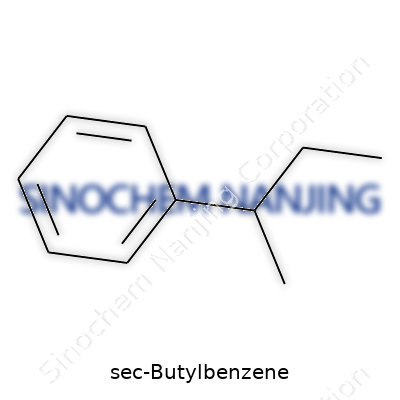
| Names | |
| Preferred IUPAC name | (Butan-2-yl)benzene |
| Other names |
1-Phenylbutane 1-Phenylbutylbenzene sec-Butylbenzol 2-Phenylbutane |
| Pronunciation | /ˌsɛkˌbjuːtɪlˈbɛnziːn/ |
| Identifiers | |
| CAS Number | 135-98-8 |
| Beilstein Reference | 1209241 |
| ChEBI | CHEBI:8958 |
| ChEMBL | CHEMBL141307 |
| ChemSpider | 10147 |
| DrugBank | DB16576 |
| ECHA InfoCard | ECHA InfoCard: 100.008.753 |
| EC Number | 202-458-9 |
| Gmelin Reference | 7151 |
| KEGG | C08345 |
| MeSH | D017946 |
| PubChem CID | 7698 |
| RTECS number | DW3150000 |
| UNII | K0H1896A9J |
| UN number | UN 2589 |
| Properties | |
| Chemical formula | C10H14 |
| Molar mass | 134.22 g/mol |
| Appearance | Colorless liquid |
| Odor | Aromatic odor |
| Density | 0.867 g/mL at 25 °C (lit.) |
| Solubility in water | Insoluble |
| log P | 3.7 |
| Vapor pressure | 0.6 mmHg (at 25 °C) |
| Acidity (pKa) | 34.9 |
| Basicity (pKb) | 12.33 |
| Magnetic susceptibility (χ) | -74.5·10⁻⁶ cm³/mol |
| Refractive index (nD) | 1.488 |
| Viscosity | 1.03 mPa·s (25 °C) |
| Dipole moment | 1.10 D |
| Thermochemistry | |
| Std molar entropy (S⦵298) | 269.6 J·mol⁻¹·K⁻¹ |
| Std enthalpy of formation (ΔfH⦵298) | -34.7 kJ/mol |
| Std enthalpy of combustion (ΔcH⦵298) | -6011.7 kJ/mol |
| Hazards | |
| GHS labelling | GHS02, GHS07 |
| Signal word | Warning |
| Hazard statements | H226, H304, H315, H319, H335, H411 |
| Precautionary statements | P210, P243, P261, P273, P280, P301+P310, P303+P361+P353, P305+P351+P338, P403+P235, P370+P378 |
| Flash point | 77°C (171°F) |
| Autoignition temperature | 482°C |
| Explosive limits | 1.0–6.7% |
| Lethal dose or concentration | LD50 (oral, rat): 9750 mg/kg |
| LD50 (median dose) | LD50 (median dose): Oral (rat) 16 g/kg |
| NIOSH | NIOSH = "E01750000 |
| PEL (Permissible) | 100 ppm (OSHA) |
| REL (Recommended) | 200 ppm |
| IDLH (Immediate danger) | 500 ppm |
| Related compounds | |
| Related compounds |
Cumene n-Butylbenzene tert-Butylbenzene Isopropylbenzene |



