Samarium Nitrate: A Down-to-Earth Look at a Rare Earth Compound
Historical Development
Before we could talk about touchscreens or advanced lasers, the early studies around samarium compounds opened doors for researchers seeking new magnetic and optical materials. In the 19th century, French chemist Paul-Émile Lecoq de Boisbaudran separated samarium from didymium. At the time, there wasn't much commercial interest in rare earths; researchers and collectors valued these colorful salts and their curious behavior under flame. Decades rolled by, and with the surge in electronics after World War II, samarium found a commercial use, fueling research into its salts, including samarium nitrate.
Product Overview
Manufacturers make samarium nitrate mainly as a pale-yellow deliquescent powder, dissolving easily in water and ethanol. Researchers often hunt for high-purity materials since unwanted elements can interfere with sensitive reactions. In practice, most of the samarium nitrate in research labs comes as a hydrated solid, often as Sm(NO3)3•6H2O. People in the chemical industry usually think of it as a source for the samarium ion in solution, which has a role in everything from fluorescent materials to catalysts. The supplier’s label often says “samarium(III) nitrate hexahydrate.”
Physical & Chemical Properties
Samarium nitrate stands out for its yellowish hue, giving a subtle color when dissolved. This solid melts easily with water in the air, picking up moisture if left open. Chemically, smoldering it produces samarium oxide, which paves the way for further reactions. Its nitrate ions trigger strong oxidizing behavior, so you want to keep it clear of flammable materials. As a lanthanide compound, its paramagnetic nature and unique spectroscopic fingerprint find value in analytical chemistry and research.
Technical Specifications & Labeling
Buyers check for purity, usually quoted at above 99.9%. Moisture content matters; if the bottle sits open too long, weight drifts as hydrates pick up water. Typical labels state the chemical formula, batch number, and purity. Packaging often relies on airtight glass jars or sealed plastic bottles with desiccants. For researchers, it’s important to track both the amount of samarium and the total nitrate concentration, since this balance steers both experimental design and safety planning.
Preparation Method
Manufacturers usually prepare samarium nitrate by reacting samarium oxide with nitric acid. The reaction delivers a steady release of nitrogen oxides and forms a clear yellow solution. This mixture gets evaporated, cooled, and allowed to crystallize—careful temperature control keeps impurities at bay. Larger producers recycle samarium from waste streams, so refining methods help shave costs while cutting down on environmental impact. Keeping the acid concentration right stops side products or excess dissolution of vessel materials.
Chemical Reactions & Modifications
With a handful of reactions, samarium nitrate turns into a springboard for other compounds. Heating leads to samarium oxide, a powder prized for its magnetic uses or as a ceramic additive. Inorganic chemists often react it with various anions to make phosphates or sulfates, tapping into color shifts for analytical purposes. Its action as an oxidizer draws interest; researchers sometimes use it alongside reducing agents, leveraging the multivalent nature of samarium for catalysis or synthetic work.
Synonyms & Product Names
Around the lab, people call it samarium(III) nitrate or samarium nitrate hexahydrate. Some catalogs list it as nitric acid, samarium(3+) salt, hydrate. In trade, the product code often implies formula weight, batch, or vendor-specific abbreviations. Despite variations, researchers tend to focus on the hydrate status and purity over branding.
Safety & Operational Standards
Anyone handling samarium nitrate should keep oxidizer risks in mind. Mixing with combustible materials, even by accident, sets up real hazards. Wearing gloves and eye protection matters, especially since nitric acid residues and samarium compounds irritate the skin, nose, and eyes. Good lab practice means storing bottles in a cool, dry place away from acids or anything remotely flammable. For larger facilities, vented cabinets and chemical fume hoods reduce exposure. In my work, I never underestimated the oxidizer symbol on the bottle—a gentle reminder that a little slip could ruin your day.
Application Area
Samarium nitrate finds a home in glass coloring, where its yellow shade changes transmission in specialty optics. In phosphors, it helps color televisions or LED lights. Some researchers explore samarium’s use in catalysts, helping speed up organic reactions or in water treatment systems for breaking down pollutants. Another use shows up in ceramics, especially those headed for lasers or batteries. A growing field looks at samarium compounds for cancer treatment, building radiopharmaceuticals that combine samarium’s radiation with nitrate’s solubility in physiological solutions.
Research & Development
New ideas spark innovation in rare earth chemistry, and teams worldwide keep testing samarium nitrate in new contexts. In one project I joined, samarium nitrate worked as a starting material in nanomaterial synthesis—we wanted its slow hydrolysis to seed crystal growth. Others dive into spectroscopy, excited by its sharp emission peaks. Publications document its role as a dopant for fiber optics or as a tool for understanding exchange coupling in magnetic materials. Each step advances our grip on how rare earths can transform technologies, and samarium nitrate delivers a versatile platform.
Toxicity Research
Toxicologists identified main exposure routes: inhalation of dust, skin contact, and accidental ingestion. While samarium nitrate isn’t as toxic as heavy metals like lead, it causes irritation and, over time, researchers debate subtle risks linked to rare earth exposure. Studies find accumulation mostly in the liver, spleen, and bones after long-term use, with little evidence for acute lethal effects at low concentrations. Wastewater standards urge careful disposal—residues pose ecological risks because rare earths linger in waterways and may harm aquatic life. Simple solutions, like dedicated waste streams and containment, cut hazards for users and the environment alike.
Future Prospects
Rare earths drive innovation, and new battery tech, high-brightness LEDs, or clean-energy magnets keep demand growing. For samarium nitrate, future development leans toward higher purity, better eco-friendly preparation, and more advanced applications as new industries seek its unique properties. Medical fields look to radiopharmaceuticals, needing reliable, safe nitrogen donors. Material science researchers anticipate combining samarium nitrate with cutting-edge oxides or polymers. Smarter recycling and recovery methods continue gaining attention; with rising rare earth prices, rethinking waste handling and scrapping traditional extractive processes has become a priority. From optical technologies to tomorrow’s pharmaceuticals, samarium nitrate looks set to remain on research agendas for years ahead.
What is Samarium Nitrate used for?
A Rare Earth with Big Jobs
Samarium nitrate rarely shows up in headlines, but it plays a part in some of the tech that drives modern life. The stuff gets made by dissolving samarium oxide in nitric acid, and where it ends up can look like science fiction. I’ve looked into the heart of a clean energy lab and recognized the blueprints often depend on specialty materials most people never hear about. Samarium nitrate fits right in among them.
Pushing Stronger Magnets
One thing that stands out about this compound lies in its connection to permanent magnets. Not any old magnets—these are used in speakers, wind turbines, and even guided missile systems. Researchers count on samarium nitrate as a starting point when they need to create pure samarium for advanced alloys. For instance, samarium-cobalt magnets stand up to scorching temperatures, hold their magnetism, and don’t break down like cheaper types. Growing up, I took apart old hard drives and loudspeakers, never realizing something as rare as samarium helped boost performance.
Glass Industry and Laser Tech
Fact is, glassmakers and optical engineers have relied on samarium nitrate too. It’s been mixed into specialty glasses for lasers and optical filters. These glasses can block out unwanted wavelengths or enhance laser precision. Each time doctors use a high-powered laser for surgery or scientists measure light in a new way, materials like samarium nitrate quietly pull the strings behind the scenes.
Lighting moves forward too thanks to rare earths. Samarium nitrate finds use in phosphors—those chemicals that make color TVs, energy-saving lights, and digital displays shine with vivid reds and oranges. You can trace improvements in color brilliance all the way back to smart chemistry in the factory, with samarium nitrate playing a key part.
Catalysis and Clean-Up
Some of the less glamorous jobs get overlooked. Chemists use samarium nitrate as a catalyst in organic syntheses and pollution control. When scientists set out to build complex drug molecules or break down dangerous industrial byproducts, they sometimes reach for this compound to speed things along or scrub out toxins. Clean air and new medicine can depend on a well-chosen rare earth salt.
Chemical labs often favor samarium nitrate because it dissolves easily in water and reacts readily, reducing the fuss and wasted effort common with trickier materials. That means less waste, cheaper processes, and in the long run, less environmental impact.
Supply, Safety, and the Future
None of this comes for free. Like most rare earths, samarium depends on mining in a handful of regions. China controls most of the supply, and that brings up plenty of geopolitical headaches. I remember stories from industry friends who had to pay double for rare earths overnight due to new tariffs or export restrictions. This risk spotlights why we should think carefully about ethical sourcing and recycling. Good stewardship pays off once these materials finish their service in tech and wind up in e-waste or junk drawers.
No one really notices samarium nitrate in daily life, but it powers progress in quieter ways. Smart investments in recycling and international partnerships can make sure this rare material keeps supporting medical technology, clean energy, and safer chemistry—without new crises or pollution.
What is the chemical formula of Samarium Nitrate?
What Makes Up Samarium Nitrate
Sometimes, a chemical name announces its makeup with all the subtlety of a shouted greeting. Samarium nitrate doesn't leave much mystery with its formula: Sm(NO₃)₃. This compound brings together samarium, a rare earth element you don't find at the local hardware store, with three nitrate groups. The three nitrate ions – that’s NO₃ – balance out the rare-earth element’s +3 charge, giving us a stable, water-soluble salt.
Why Samarium Nitrate Matters in the Lab
I remember many late nights working in the inorganic chemistry lab, where chemicals like samarium nitrate light up a workbench. Its uses stretch further than many expect. Researchers have turned to it for making specialty glasses, phosphors for lighting, and catalysts. Sometimes, I think about the quiet role these compounds play in big industries that feel a world apart from our day-to-day. Glassmakers add samarium nitrate to help block UV rays and filter light in tinted glass, often protecting art or scientific instruments.
Phosphors, another area where samarium nitrate stands out, bring color to TV screens and energy efficiency to lighting. In the 21st century, with the pressure on for longer-lasting and more efficient lighting, every bit of brightness matters. Samarium nitrate’s ability to help tune the color and glow of phosphors turns it into a valuable player in the field. This isn’t just chemistry for chemistry’s sake – it’s the backbone for tech people use in their homes every day.
Staying Safe with Rare Earth Salts
Lab safety doesn’t take a day off just because a chemical feels a bit exotic. Samarium nitrate, like many rare earth nitrates, comes with certain risks. Inhaling dust or handling the powder without gloves means risking irritation and possible toxicity. University labs and industrial sites keep updated safety data sheets for a reason. People who spend time around compounds like this—from undergrads to seasoned researchers—wear gloves, goggles, and sometimes full lab coats, knowing that respect for the material keeps everyone healthy.
Environmental safety always shows up in the conversation too. Nitrates can run off into water systems if not disposed of properly. Too many nitrates in streams and rivers fuel algae growth, which chokes out fish and aquatic plants. Proper waste handling—neutralizing or containing the chemical before it leaves the lab—keeps the science from backfiring.
Reducing the Risks, Growing the Benefits
One practical solution involves encouraging best practices, starting with precise labeling and safe storage. In my experience, this often means regular training for anyone who touches the stockroom shelves. Chemists learn to never understate the importance of clear labeling and handling rules. Today, digital inventory systems help track chemicals and alert teams before stocks get old or hazardous, catching problems before they start.
Science moves fast, but care keeps pace. As technology pushes for smarter lighting and stronger materials, compounds like samarium nitrate step up. Knowing its formula—Sm(NO₃)₃—is just the start. Understanding why and how it’s used, as well as appreciating the basic safety protocols, helps the next generation of scientists stay prepared. Even rare earths like samarium nitrate shape the everyday world, often in ways that only those paying attention get to see.
Is Samarium Nitrate hazardous or toxic?
A Closer Look at Samarium Nitrate
Samarium nitrate doesn’t show up in most homes or come up at family dinners. It earns its place, though, in labs and industries, showing up in magnets, ceramics, and some specialized glass. Some people work near it daily, which raises a good question: Is this stuff hazardous?
Understanding the Risks
If you spill samarium nitrate powder, it looks a lot like any other chemical salt. The difference comes from the samarium itself. Samarium belongs to the family of rare earth elements. Chemically, it doesn’t scream danger as loud as lead or mercury, but complacency doesn’t help anyone. The nitrate part can’t be written off either. Nitrates often show up in fertilizers and fireworks, and in pure form, they act as strong oxidizers.
Breathe in samarium nitrate dust, and the lungs might complain. Inhaling fine particles of most metal compounds leads to lung irritation, coughing, maybe a sore throat after enough exposure. Skin contact sometimes causes irritation, and in rare cases, allergic reactions. If it gets in the eyes, pain and redness usually follow. Swallowing it isn’t a great idea either—gastrointestinal discomfort knocks at your door, maybe nausea or vomiting.
Long-Term Concerns
The real trouble with exposure isn’t always obvious right away. Samarium compounds don’t break down easily. Over time, rare earth metals can collect in bones. While studies on samarium aren’t as deep as for some other elements, animal research hints at the risk of liver and kidney effects from chronic exposure. I’ve seen how tricky rare earth dusts act in a workshop—those tiny particles get everywhere, especially if air handling isn’t top notch.
Samarium nitrate in the environment usually doesn’t move very far in soil, which helps a bit if there’s a spill, but doesn’t mean it disappears. Workers in ceramics plants or magnet manufacturers must stay alert. Risks jump for those grinding or heating the stuff, where fine airborne particles turn into a real problem.
Fire, Reactivity, and Storage
Forget about tossing samarium nitrate near anything flammable. As an oxidizer, it can make a small fire a whole lot worse. That’s not just theoretical—labs with poor chemical storage have told some scary stories over the years. Mixing it with fuels, reducing agents, or certain organic materials brings on a real risk of fire or explosion. That means proper containers, clear labeling, and dry storage, away from anything it could react with, aren’t optional—they’re the basics for keeping people and property safe.
What Works in Practice
Sensible chemistry departments and industrial labs treat samarium nitrate with straightforward safety practices: lab coats, gloves, and goggles. Good air flow matters, so fume hoods get used often. Cleanup and washing hands still go a long way. Training does even more. Emergency showers and eyewash stations wait nearby in case someone gets sloppy or unlucky.
Waste collection gets handled carefully. Dumping it down the drain lands you in hot water with environmental rules. Special waste containers, regular pickups, and a good relationship with a licensed disposal service pays off in the end.
Keeping Perspective
In daily life, most folks will never cross paths with samarium nitrate. For the people who do, treating it as a hazardous material isn’t overkill, just plain good sense. Occupational safety agencies keep samarium nitrate on their lists for a reason, and following those rules doesn’t slow anyone down once routines are in place. The focus stays on prevention: contain the dust, stay covered up, and always assume any exposure matters.
How should Samarium Nitrate be stored?
Understanding the Risks
Samarium nitrate isn’t exactly a household name. Still, for those handling rare earth compounds, its potential dangers stick out. Over the years, I’ve seen folks underestimate materials that don’t scream “danger.” Samarium nitrate brings its own set of headaches. Moisture draws it in like a magnet, breaking it down and potentially releasing toxic fumes. Even though it doesn’t explode without reason, throw heat or incompatible chemicals into the mix and things get dicey. Underestimating its reach in the wrong setting, like a humid room or with other reactive substances, creates chaos for both workers and any project relying on it.
What Proper Storage Looks Like
A regular cabinet won’t keep samarium nitrate stable. Its crystals break down with water exposure. Once, I walked into a lab with a leaky air conditioner right above chemical storage—the place reeked, and labels peeled from wet flasks. The samarium nitrate bottles swelled up, and the color shifted. Today, I tell anyone dealing with it: containers must seal tight, using glass or plastic that resists acidity and isn’t scratched. A dry storeroom with low humidity, controlled temperature, no sunlight, and away from any drains or potential flooding matters far more than a locked door.
The Material Safety Data Sheet, or MSDS, for samarium nitrate, always jumps to storing away from oxidizers and anything flammable. Keeping separate shelves for different classes of chemicals matters. Losing track for even a short period plunges workplaces into paperwork, fines, and cleanup. A simple spreadsheet or marked bins makes a difference. Too many labs disappoint here, hoping that an old box somewhere out of sight is good enough.
The Cost of Overlooking Details
One summer years ago, a power outage killed air conditioning while samarium salts sat on a high shelf. Days later, condensation soaked through cardboard boxes. Luckily, a routine check caught it before anything more dangerous happened. Even trained eyes sometimes miss early warning signs. Cost-cutting skips in temperature or humidity control usually invite damage. Where I’ve worked, the best places put silica gel packs inside every container. More advanced setups invest in climate-controlled cabinets even for batches that sit unused for months.
Record-keeping also goes much farther than labels. Spot checks help, but digital logs catch creeping risks faster. For facilities without deep pockets, a dedicated logbook and basic hygrometers save equipment, prevent injury, and keep regulators happy. Labs that store inventory above eye level risk missing leaks or lid failures—placing bottles in easy reach and visible keeps everyone safer.
Building Better Habits
Safety rules around samarium nitrate sound basic. Seal containers. Keep everything dry. Store it away from heat and reactive chemicals. Still, it’s the daily routines that trip up busy teams. Overfilling storage, skipping routine checks, or stacking incompatible chemicals nearby brings real headaches.
The solution lies in treating rare earth chemicals as “high maintenance” from day one. New team members need hands-on training. Emergency spill kits and clear escape routes don’t just sound good—they keep the work going when plans fall apart. Regular reviews by outside safety experts spot weak links easily overlooked by tired eyes. These steps don’t just satisfy inspectors; they keep lives and projects safe long after the spotlight moves on.
What are the physical properties of Samarium Nitrate?
A Look at Samarium Nitrate’s Appearance
Samarium nitrate steps onto the scene as a pale pink solid. You won’t see it glowing or sparkling, but under the nearly white powder lies the character of an important lanthanide salt. The color points to the samarium ions—giving it more distinction than boring white salts like sodium chloride. Most labs receive it either as a powder or crystals, ready to dissolve at a moment’s notice.
Solubility and How It Behaves in Water
Drop a pinch into water and watch it vanish—this compound dissolves easily. Easy solubility matters for any application where mixing is needed. Researchers depend on that, whether preparing reagents or working on new materials with rare earth elements. If you leave it exposed to damp air, it will clump as it pulls water from the atmosphere thanks to its hygroscopic nature. Proper storage means locking it away from humidity.
Density and Handling
Samarium nitrate has a density close to 2.5 grams per cubic centimeter. That’s denser than many common organic compounds, but it feels similar to plenty of other lanthanide salts. Don’t expect it to weigh down your scoop dramatically. In my own experience, measuring rare earth compounds takes steady hands and often requires a mask—the powders easily become airborne, raising health caution flags.
Melting and Decomposition
Compared to typical metals or salts, samarium nitrate prefers to break down rather than melt. If heated above roughly 50°C (122°F), it starts to lose its crystal water, and strong heating will create gases like nitrogen oxides and leave samarium oxide behind. These gasses pose serious hazards in poorly ventilated spaces. Anyone who’s worked in an inorganic synthesis lab knows the importance of a good exhaust hood and watching your thermometer.
Odor, Taste, and Toxicity
No one recommends tasting or sniffing laboratory chemicals, but I’ve noticed that samarium nitrate doesn’t release much odor, both a blessing and a curse when you want to identify accidental spills. Toxicity is real. Most rare earth salts require extra gloves and care—breathing in the dust, or skin contact over time, can harm health. While data on direct, chronic effects in humans are limited, the lessons of chemistry labs stick: treat every rare earth with respect.
Storage: Keeping It Dry and Safe
In my time in labs, careless storage of samarium salts led to ruined samples. Air-tight bottles and cool, dry shelves save technicians from headaches. Any opening of containers in humid spots creates sticky messes and spoils reagents. Sudden color changes signal contamination or hydrolysis; in labs chasing purity, that wastes both time and grant money.
Application-Driven Insights
Samarium nitrate forms the building block for a range of products, from catalysts to specialty glasses. Specific projects may exploit its easy solubility or distinct samarium ion color for analytic chemistry, while material scientists use it to introduce samarium into ceramics or advanced magnets. The choice of samarium nitrate over the oxide or chloride often comes down to needing a material that blends easily with water or alcohol solvents.
Down to the Bottom Line
Understanding samarium nitrate means experiencing its quirks directly. Easy dissolution, water attraction, and decomposition hazards give a window into its lab role. Handling it well protects both the user and the sample. That kind of firsthand awareness beats dry data tables every time and pushes you toward safer, smarter research.
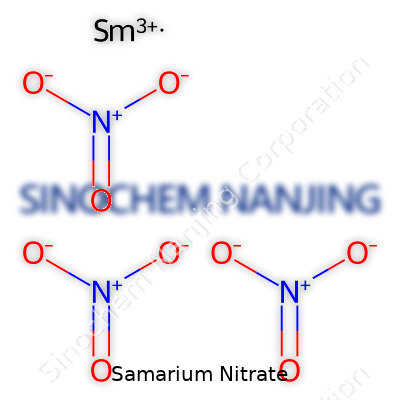
| Names | |
| Preferred IUPAC name | samarium(3+) trinitrate |
| Other names |
Samarium(III) nitrate Samarium trinitrate Nitric acid, samarium(3+) salt |
| Pronunciation | /ˌsæˈmeəriəm ˈnaɪtreɪt/ |
| Identifiers | |
| CAS Number | 13759-83-6 |
| Beilstein Reference | 14623 |
| ChEBI | CHEBI:84951 |
| ChEMBL | CHEMBL61407 |
| ChemSpider | 21434 |
| DrugBank | DB11158 |
| ECHA InfoCard | ECHA InfoCard: 100.029.213 |
| EC Number | 233-011-4 |
| Gmelin Reference | Gmelin Reference: **1532** |
| KEGG | C18697 |
| MeSH | D003602 |
| PubChem CID | 159423 |
| RTECS number | WV5900000 |
| UNII | D8QD817S3P |
| UN number | UN1428 |
| Properties | |
| Chemical formula | Sm(NO3)3 |
| Molar mass | 376.473 g/mol |
| Appearance | White crystalline powder |
| Odor | Odorless |
| Density | 3.96 g/cm³ |
| Solubility in water | Soluble |
| log P | -3.55 |
| Basicity (pKb) | 6.5 |
| Magnetic susceptibility (χ) | −13.0×10⁻⁶ cm³/mol |
| Refractive index (nD) | 1.900 |
| Dipole moment | 0 Debye |
| Thermochemistry | |
| Std molar entropy (S⦵298) | 221.6 J·mol⁻¹·K⁻¹ |
| Std enthalpy of formation (ΔfH⦵298) | -1186.6 kJ/mol |
| Pharmacology | |
| ATC code | V09IX06 |
| Hazards | |
| Main hazards | Oxidizer, harmful if swallowed, causes serious eye irritation, may cause respiratory irritation |
| GHS labelling | GHS labelling: Danger; H272, H315, H319, H335; P210, P220, P261, P280, P305+P351+P338, P337+P313, P370+P378; GHS02, GHS07 |
| Pictograms | GHS07,GHS09 |
| Signal word | Danger |
| Hazard statements | May intensify fire; oxidizer. Harmful if swallowed. Causes serious eye irritation. |
| Precautionary statements | P280, P305+P351+P338, P337+P313, P261, P264, P271, P304+P340, P312, P403+P233 |
| NFPA 704 (fire diamond) | 2-0-3-OX |
| Lethal dose or concentration | LD50 Oral Rat 3200 mg/kg |
| LD50 (median dose) | LD50, Oral, Rat: 3,250 mg/kg |
| NIOSH | TRC0362759 |
| PEL (Permissible) | PEL (Permissible Exposure Limit) for Samarium Nitrate: Not established |
| REL (Recommended) | REL (Recommended): 0.05 mg/m³ |
| Related compounds | |
| Related compounds |
Samarium(III) oxide Samarium(III) chloride Samarium(III) acetate Samarium(III) sulfate Samarium(III) fluoride |



