Neodymium Praseodymium Nitrate: More Than Just a Rare Earth Compound
Historical Development
Neodymium and praseodymium, both rare earth elements, spent most of their early years tucked into the background of chemical research, their potential mostly untapped. Chemists in Europe started pulling them apart from other lanthanides in the late 1800s, a job easier described than done since they love to stick together in ores like monazite and bastnäsite. Isolation required patience, with fractional crystallization and selective precipitation dominating the narrative for decades. Today, even with all the advanced techniques, it still feels a little like alchemy. Neodymium praseodymium nitrate only emerged as a distinct product after refining processes tightened up during the 20th century, especially after World War II spurred interest in rare earths for optics, electronics, and later, clean energy technology. Watching the global competition for rare earth security, it’s clear that the early work by scientists like Carl Auer von Welsbach set the stage for every high-tech marvel we take for granted now.
Product Overview
Neodymium praseodymium nitrate doesn’t exactly dazzle at first glance; it usually shows up as a pale green crystalline powder or granules that are easy to dissolve in water. In the chemical trade, its blend of the two rare earths, usually with a slight lean toward neodymium, offers a cost-effective compromise where both are needed. Suppliers label it with the trihydrate or hexahydrate tag most of the time, which changes just how much water the crystals hold. Variety and purity matter in industry—whether the powder winds up inside a high-power laser or a catalyst batch, a small slip in quality can throw off a whole production line.
Physical & Chemical Properties
Lift a bottle and you’ll see the color shifting toward an eerie, soft green. That’s the lanthanide magic at work, as both neodymium and praseodymium ions mess with how light passes through. Neodymium praseodymium nitrate feels slightly sticky in damp air, a hint that its hydrates pick up water gladly. It dissolves so quickly in water that there’s barely time for it to settle; careful folks note how the solution stays clear but reacts fast with basic substances. As a nitrate, it carries all the risk of other strong oxidizers—mix it with combustible material, a hint of stray spark, and things get exciting fast.
Technical Specifications & Labeling
On the shelf, the product arrives labeled with atomic ratios and hydration state. Purity levels can cross the 99.9% mark for scientific research or dip lower when destined for bulk industrial use. I’ve seen certificates break down the trace metal content piece by piece, because even a tight handful of foreign elements can alter behavior inside magnets or lasers. Labeling usually highlights warnings about moisture sensitivity, oxidizing potential, and the batch number to trace back through the supply chain. This isn’t just bureaucracy—fast recalls or pinpointing the source of contamination depend entirely on this meticulous chain of information.
Preparation Method
Manufacturing neodymium praseodymium nitrate starts with extracting a mixed rare earth concentrate. In my time working with chemists, I’ve watched them go at it with hydrochloric acid leaching, solvent extraction, and then selectively precipitating out unwanted lanthanides. After isolating the neodymium and praseodymium fractions, each gets dissolved into nitric acid, producing their respective nitrates. Blending them in the right ratio and evaporating the solution gives a hydrate that looks almost like sea salt. Avoiding contamination is a constant battle, as even lab air carries enough dust to spoil a batch meant for optical-grade uses. The real trick comes during crystallization; too much heat, or too quick a cooling, and the crystals trap impurities or form weird polytypes.
Chemical Reactions & Modifications
As both an oxidizer and a source of rare earth ions, the compound lands in plenty of chemical recipes. Drop it into a reaction vessel with a reducing agent, and out come neodymium and praseodymium oxides or mixed chlorides, ready for magnet alloy blending. In ceramics, adding ammonium hydroxide to the solution will nudge the rare earths to settle out as hydroxides. Chemical engineers often need to tweak the composition, sometimes shifting the neodymium-to-praseodymium ratio depending on whether the powder heads toward colorant production or lighting phosphors. That flexibility makes the nitrate blend appealing in pilot plant experiments hunting efficiency gains.
Synonyms & Product Names
Shoppers searching for this product run into a trail of names: neodymium-praseodymium nitrate, NdPr nitrate, didymium nitrate (a throwback to the days when their combo masqueraded as a single element), or just rare earth nitrate blend. Regulatory documents swing between these, sparking confusion unless you check the chemical abstract number or look for a breakdown of metal content.
Safety & Operational Standards
Handling neodymium praseodymium nitrate depends a lot on respect for nitrate chemistry. Anyone in research or processing wears gloves and goggles; a slip leads to chemical burns or worse—nitrate dust isn’t your friend if it touches moist skin. Labs set strict storage rules. They keep the compound away from any source of ignition, in double-sealed containers, tucked into dry cabinets. I’ve had to run safety drills in rooms holding kilos of rare earth nitrates, and one truth always stands out: ventilation matters. Inhaled dust leads to lung irritation, and the heavy metal content carries long-term health risks. Safety data sheets recommend splash-proof clothing, a fume hood, and trained personnel on every shift.
Application Area
Demand for neodymium and praseodymium has grown beyond advanced optics. In every new electric vehicle winding plant, workers rely on the blend to seed strong permanent magnets that drive motors. The same nitrate finds its way into glass coloring, where even a slight tweak in the blend shifts window tint from soft violet to a pale yellow-green. Fiber optics labs depend on the compound to tailor light emission properties. The push for green tech put the rare earths in wind turbines, energy storage, and catalytic converters—each field cares about consistency, and a single hiccup in supply can slow development.
Research & Development
Researchers looking to replace critical raw materials test new blends and reaction routes using neodymium praseodymium nitrate as a starting point. I’ve watched graduate students experiment late into the night, chasing nanocrystal growth or boosting efficiency in LED substrates. With government funding aimed at supply chain security, the hunt for recycling methods that recover these rare earth nitrates from end-of-life electronics keeps labs busy. New work focuses on lowering environmental impact: using green solvents, minimizing acid waste, and designing reactors that reuse heat or cut down on water usage.
Toxicity Research
Early safety studies mostly focused on acute symptoms, with high doses leading to kidney and lung problems in animal tests. Now, interest shifted to chronic exposure—nitrate ions, heavy metals, and tiny airborne particles act together and not always in predictable ways. One study from China recently showed that rare earth compounds, while not heavily bioaccumulative, still disrupt soil bacteria at high concentrations. Teams testing biotechnological cleanup methods use the nitrate blend to explore which species break it down or neutralize. Strict regulations in Europe and North America cap exposure limits for workers, especially since neodymium and praseodymium dusts hold similar toxicity patterns to other heavy metals like lead or cadmium.
Future Prospects
Technology’s pace promises a future where neodymium praseodymium nitrate touches nearly every advanced field: from quantum computing components to new antenna designs. As renewable energy grows, the sector’s hunger for rare earths will only go up. The pressure lands not just on miners and refiners, but also on recycling specialists trying to recover these elements from spent electronics and magnets. Researchers imagine synthetic biology opening new purification techniques, even using engineered microbes to grab rare earths from mine runoff. As the landscape tightens, every efficiency boost—from better separation technologies to smarter downstream processing—shapes who controls both the supply and next generation of innovation driven by these remarkable elements.
What is Neodymium Praseodymium Nitrate used for?
The Real-World Importance of Rare Earth Compounds
Most people never come across neodymium praseodymium nitrate in daily life, but industries would look very different without it. This compound counts as a backbone material for the high-tech and green energy sectors. Anyone who follows the news about electric vehicles, wind turbines, and advanced electronics may not realize how key these rare earths have become. I watched this shift from traditional fuels to renewables, and it’s clear: the things we build today rely on specialty chemicals like this one.
What Exactly Gets Made With It?
Neodymium and praseodymium both go straight into manufacturing powerful magnets. These rare earth magnets show up in everything from electric vehicle motors to wind turbine generators. A better magnet means greater energy efficiency and, in turn, cleaner power. The nitrate form is practical here because it dissolves well, making the metals easy to mix at an atomic level. I’ve talked to engineers who describe how even small impurities can trash a batch of high-grade magnets. Clean starting chemicals matter more than most people realize.
Optics is another place where this compound stands out. Neodymium, in combination with praseodymium, tunes the way glass absorbs and emits light. Lacquered safety glasses, laser equipment, and even camera lenses use these elements to sharpen colors or filter out certain wavelengths. The nitrate form lets glassmakers and scientists get repeatable results. Years ago, I visited a photonics lab, watching glass experts carefully weigh out rare earth chemicals for experimental lenses; the tiniest adjustments made all the difference in clarity and function.
Beyond Gadgets: Medicine, Ceramics, Environmental Tech
Few people think about these rare earths in medical imaging, laser surgeries, and even the ceramics lining our homes. Hospitals use devices that depend on neodymium lasers for everything from cutting tissue to correcting vision. Ceramic companies use rare earths to get vibrant colors and safety coatings for cookware. Environmental tech uses these elements to create catalysts helping scrub out air pollution and manage water contaminants.
Issues with Supply and Solutions in Sight
With any conversation about rare earths, scarcity and ethical mining come up fast. Countries like China dominate the supply, raising national security worries and price volatility. Mining brings up strong debates about pollution—some of the worst environmental disasters of the last 20 years came from poorly managed rare earth extraction. I’ve reported on communities fighting for stricter controls, demanding traceability and greener mining techniques.
Solutions hinge on recycling and better alternatives. Companies in the US and Europe are investing in recycling old magnets and electronic waste to recover neodymium and praseodymium. Others experiment with substitute materials, but those haven’t matched the performance of the original elements. Improved processing can cut waste and energy use, and stricter environmental rules are slowly becoming the norm.
Why It Matters for the Future
Rare earth nitrates like neodymium praseodymium nitrate might seem like obscure chemicals, but they carry real weight in shaping industries and technology. Their story ties into clean energy, global trade, medical breakthroughs, and even the gadgets in every pocket. Behind many of today’s tech advances is a supply chain built on materials that few people know, but nearly everyone relies on.
What is the chemical formula for Neodymium Praseodymium Nitrate?
The Real Science Behind the Name
Neodymium praseodymium nitrate doesn’t show up in your average conversation. Still, it plays a big role in a few growing industries like magnets, lasers, and specialized ceramics. The name hints at the makeup: it’s not a single element but a compound formed by mixing neodymium and praseodymium—two rare earth metals. Chemically, these elements usually go hand in hand, almost inseparable in ores, complicating their extraction and use. Combining them into one nitrate helps in both handling and usage for some applications.
So, What Is That Formula?
The straightforward chemical formula borrows from the way each element teams up with nitrate ions. Neodymium nitrate is Nd(NO3)3, and praseodymium nitrate is Pr(NO3)3. In practice, companies often blend these, and the mixed compound is usually written as (Nd,Pr)(NO3)3. The ratio between neodymium and praseodymium can shift, but both contribute three nitrates per atom, reflecting a rare earth nitrate mixture where the metals share similar chemical behavior.
Why Is Anyone Mixing These Metals?
Back in college, a professor once showed us how small changes in a material’s chemistry could totally transform its properties. Neodymium alone builds powerful magnets, found in headphones and electric vehicle motors. Praseodymium tweaks those magnetic features while offering added resilience or adjusting light absorption for glass coloring and lasers. Engineers look for special blends to match both magnet strength and heat stability, especially for green tech. If you’ve ever ridden an electric bike or used noise-canceling headphones, odds are you’ve benefited from a compound close to neodymium praseodymium nitrate in that supply chain.
Industry Gets Creative with the Mixture
Refiners don’t always separate neodymium and praseodymium because the process adds cost and complexity. Both elements turn up together in the ore bastnaesite, often extracted from places like China’s Bayan Obo mine or Mountain Pass in California. By blending them as nitrates, manufacturers keep costs in check, conserve resources, and reduce environmental harm that follows excessive chemical separation. The mixed nitrate form helps researchers create alloys, magnets, or catalysts with just the right balance of properties.
Some Real-World Hurdles
A big challenge: supply chain risks. Most rare earth mining and refining happens in just a couple of countries, so even a small hiccup there sends ripples worldwide. I saw this happen in my time covering raw material markets—the price of neodymium jumped, and suddenly companies scrambled to find substitutes. Blending praseodymium provides a buffer, but the world could use better recycling and more diversified mining. Supporting research into cleaner extraction methods, plus investing in recycling rare earth-containing waste, will make sure that magnets aren’t the luxury item of tomorrow.
Stepping Toward Smarter Chemistry
Mixing neodymium and praseodymium as nitrates shows that chemistry can solve tough industrial problems without making things more expensive or less efficient. Smarter use of these resources will keep powering green tech, clean energy, and high-performance devices. Knowing what goes into these products—even something as technical as (Nd,Pr)(NO3)3—helps push for systems that waste less and innovate more.
How should Neodymium Praseodymium Nitrate be stored?
What Is at Stake With This Compound?
Neodymium praseodymium nitrate isn’t an everyday household item. It plays a big part in making magnets, glass, and lasers work. Because these rare earth salts react strongly with water and air, they bring real safety concerns to anyone handling them. In my early days working in a lab, I remember the nervous caution that surrounded opening any bottle labeled with this name. A small cloud of humidity could turn a powder into a mess. That lesson stuck with me: smart storage isn’t about perfection, it’s about managing real risks every day.
Keeping It Stable: The Role of Dry, Cool Spaces
Store this compound in a well-ventilated spot, away from sunlight and heat sources. Dampness is an enemy—leave a bottle open too long, and lumps will form as moisture sneaks in. I saw a colleague once forget to reseal a container, and by the next morning, the contents had drawn in moisture from the air and clumped together. That batch got tossed. Proper sealing cuts down on waste, and good labeling keeps everyone on the same page about what’s inside.
Safety First: Containers and Emergency Gear
Forget cheap jars. Always use high-quality, corrosion-resistant bottles that close tightly. Glass with airtight lids or certain plastics (like HDPE) handle this job well. Find bottles that can’t be mistaken for everyday water flasks. Add clear hazard labels. In labs I’ve worked in, “SDS first” became our shorthand. Reading a Safety Data Sheet before first use builds good habits. We kept gloves, goggles, and spill kits within reach—never under a dust layer in some locked cabinet. A chemical like this deserves that level of care every single time.
Know the Risks: What Can Go Wrong
Neodymium praseodymium nitrate isn’t a bomb waiting to explode, but it will irritate skin and eyes, ruin pipes, and harm the environment if handled carelessly. People working with it should check ventilation systems regularly. Accidental spills get cleaned fast with dry material, not water. Wet mops only spread the problem. Once, during a facility audit, inspectors caught an intern scrubbing up a powder spill with a wet rag. The reaction wasn’t dramatic, but it underlined the need for respect—and better training.
Sustainable Solutions: Waste Disposal and the Bigger Picture
Contamination spooks anyone in charge of hazardous waste. Tossing leftovers down a drain is illegal and dangerous. Arrange for disposal through certified hazardous waste programs. The best labs work with local waste managers who know these compounds by name. Some even reclaim and recycle rare earth solutions, saving money and keeping pollutants out of landfills. One leading magnet producer uses a closed-loop system so nothing gets lost or dumped. As global demand for these elements grows, tight control on storage and disposal will only become more important.
Why It Matters
People working with neodymium praseodymium nitrate take on invisible risks. Good storage cuts down on hazards, waste, and costs. Following best practices means no nasty surprises for workers, the environment, or end users. It’s about daily discipline and watching out for each other. In my own experience, the best teams share knowledge openly and keep safety a plain, practical priority. No fancy words—just honest work, a sharp eye, and respect for the compounds on the rack.
Is Neodymium Praseodymium Nitrate hazardous or toxic?
Breaking Down the Basics
Neodymium praseodymium nitrate holds a mouthful of a name, but behind the label you find a compound with real applications in optics, magnets, and electronics. The stuff carries the flashy job of helping to color glass or work its way into lasers, magnets, and polishing agents you’ll spot in factories or labs. But before curiosity morphs into carelessness, it's fair to ask: How safe is it to work around or handle neodymium praseodymium nitrate?
The Toxicity Question
I’ve read through stacks of lab safety charts and field reports over the years. Like most rare earth compounds, this nitrate form comes with hazards. You won’t meet it on grocery shelves, but in professional settings, the risk goes up. Handling neodymium or praseodymium compounds, in general, can irritate skin, eyes, and your respiratory tract. Swallowing small amounts by accident—maybe you forgot to wash your hands before lunch—can lead to nausea, vomiting, or worse if you don’t act fast.
Animal research shows that these compounds build up in bones and liver, so chronic exposure poses its own danger. Inhaling fine particles or dust ranks as one of the top worries for those working in research, rare earth mining, or manufacturing. The toxic effects don't just vanish—workers can suffer lung inflammation, long-term breathing trouble, or even changes in kidney function. Personal experience in an industrial laboratory made me extra careful with rare earth nitrates: that sting in your nose, the warning taste if you accidentally get too close to a spill, remind you that lab rules exist for a reason.
Environmental and Workplace Impact
Handling spills or improper storage can hurt more than one person. Rare earth nitrates make their way into water systems if facilities skip proper waste treatment. Heavy releases damage aquatic life, and contaminated drinking water may reach communities nearby. In the United States, the Environmental Protection Agency (EPA) enforces strict rules on rare earth disposal because the long-term buildup hurts more than fish. Researchers link persistent exposure to neurological, reproductive, and developmental issues in animals. So, the domino effect touches both human health and local ecosystems.
Minimizing the Risks
The key to cutting danger comes with respect for the material and rigorous housekeeping. Standard lab rules—good gloves, safety goggles, lab coats, and working in well-ventilated fume hoods—limit personal exposure. Proper labeling and training stand as frontline defenses. Spills need fast, thoughtful cleanup, not just a quick mop or brush-off.
Companies and universities investing in rare earth research choose closed containers, negative pressure rooms, and air filtration that stops dust from escaping into halls or lungs. Waste deserves careful segregation, plus certified treatment before heading out for disposal. Safety data sheets, clear communication, and a culture that encourages speaking up if something feels unsafe—or looks off—matter just as much as fancy ventilation systems.
Looking at Alternatives and Progress
Researchers search for safer alternatives to some rare earth chemicals, motivated by both workplace safety and global supply worries. Green chemistry aims for processes that create fewer toxic by-products, or that use smaller, safer chemical doses. Some companies try switching to less hazardous forms or encapsulating dust to keep it contained.
At home or in small workshops, the odds of running into neodymium praseodymium nitrate remain low, but increased electronics recycling has led to more possible encounters outside traditional labs. For those few who do face this compound: treat it with respect, use common sense, and recognize that industry safeguards exist for a reason.
What are the purity specifications for Neodymium Praseodymium Nitrate?
Why Purity Matters in Industrial Applications
Neodymium praseodymium nitrate shows up in a bunch of high-tech industries, from lasers to magnets to specialized glass. People working with advanced materials want chemical purity for a reason. Tiny traces of iron or other contaminants have a way of spoiling complicated manufacturing processes—sometimes the whole batch must be tossed if the levels creep out of range. Nobody enjoys reworking expensive components because a supplier shipped a chemical with questionable specs.
Common Purity Levels and Testing Methods
Many suppliers offer neodymium praseodymium nitrate with purities at 99.9% (also known as 3N), and sometimes 99.99% (4N), expressed as total rare earth oxide basis. For demanding applications—like high-performance magnets in electric vehicles or green lasers—buyers look beyond headline purity. Major elements such as neodymium and praseodymium count toward that percentage, but it pays to hunt for detailed spectrochemical breakdowns.
Manufacturers use inductively coupled plasma mass spectrometry (ICP-MS) or atomic absorption spectroscopy for trace metal analysis, highlighting impurities like calcium, silicon, iron, or lead at parts-per-million (ppm) or even parts-per-billion (ppb). My own experience in a research setting: even a few ppm of iron or copper can give odd color shifts in optical glass, or throw off the coercivity of a magnet. You only notice these problems after wasting a few weeks, or ruining a day’s work with a bad result.
Key Impurity Limits
Most buyers ask for certificates showing elemental analysis. The best suppliers spell this out clearly:
- Iron (Fe): Less than 10 ppm
- Silicon (Si): Less than 20 ppm
- Calcium (Ca): Less than 50 ppm
- Lead (Pb) and heavy metals: Less than 5 ppm each
Loss on ignition, chloride content, and sulfate levels matter, too. Too much water or leftover acid leads to surprises in the next production step—think unexpected gas evolution, or spattering in a furnace. Good specifications address all of these.
What Happens Without Tight Specs
Lax purity standards create quality issues. Devices need rework. Coatings peel. Customers send components back. In the world of high-reliability devices such as medical lasers or aerospace sensors, a mistake can hurt reputations fast. Lab techs spot this sooner or later—a single out-of-spec shipment can shake confidence for months.
Moving Toward Better Quality and Safer Handling
Companies committed to best practices—those who value expertise and honesty—invest in better quality control. They trace each batch, run frequent audits, and share test results with their customers. Safety data sheets support this process. Strong communication stops trouble before it gets serious. Better interactions with trusted suppliers mean smoother projects and fewer surprises on the production floor.
Clear purity specifications for neodymium praseodymium nitrate support progress. Products work reliably. Engineers lower their risk. Everyone—from lab tech to end customer—benefits from chemicals that do what they should, every time.
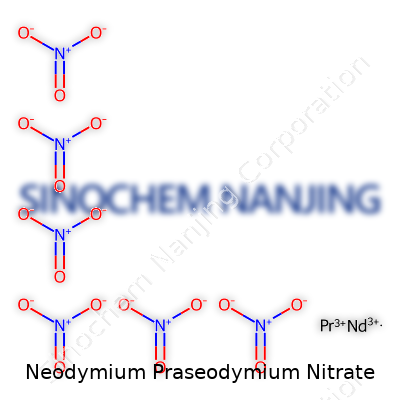
| Names | |
| Preferred IUPAC name | Neodymium praseodymium dinitrate |
| Other names |
Neodymium Praseodymium Nitrate NdPr Nitrate Praseodymium Neodymium Nitrate |
| Pronunciation | /niˌoʊˈdɪmiəm præsiˈoʊdiəm naɪˈtreɪt/ |
| Identifiers | |
| CAS Number | 14732-53-3 |
| Beilstein Reference | 3958735 |
| ChEBI | CHEBI:135907 |
| ChEMBL | CHEMBL4295702 |
| ChemSpider | 23632847 |
| DrugBank | DB14537 |
| ECHA InfoCard | ECHA InfoCard: 100.110.942 |
| EC Number | Op Ec Number for Neodymium Praseodymium Nitrate is 237-410-6 |
| Gmelin Reference | Gmelin Reference: "Nd 7/Pr 5 |
| KEGG | C19471 |
| MeSH | Neodymium Praseodymium Nitrate |
| PubChem CID | 101976644 |
| RTECS number | QV7875000 |
| UNII | 58W9C74YUH |
| UN number | UN2725 |
| Properties | |
| Chemical formula | NdPr(NO3)3 |
| Molar mass | 388.32 g/mol |
| Appearance | Light green crystalline powder |
| Odor | Odorless |
| Density | 2.30 g/cm³ |
| Solubility in water | Soluble in water |
| log P | -4.7 |
| Basicity (pKb) | 7.37 |
| Magnetic susceptibility (χ) | +4120e-6 cm³/mol |
| Refractive index (nD) | 1.558 |
| Dipole moment | 0 D |
| Thermochemistry | |
| Std molar entropy (S⦵298) | 325.0 J·mol⁻¹·K⁻¹ |
| Std enthalpy of formation (ΔfH⦵298) | −531.4 kJ/mol |
| Pharmacology | |
| ATC code | V09XX04 |
| Hazards | |
| Main hazards | Harmful if swallowed. Causes serious eye damage. Causes skin irritation. May cause respiratory irritation. |
| GHS labelling | GHS07, GHS09 |
| Pictograms | GHS01,GHS07 |
| Signal word | Danger |
| Hazard statements | H272, H315, H319, H335 |
| Precautionary statements | P264, P280, P301+P330+P331, P305+P351+P338, P310 |
| NFPA 704 (fire diamond) | 1-0-0 |
| Lethal dose or concentration | LD50 oral rat 375 mg/kg |
| LD50 (median dose) | LD50 (oral, rat): > 5000 mg/kg |
| NIOSH | Not Listed |
| PEL (Permissible) | 10 mg/m3 |
| REL (Recommended) | 10 mg/m3 |
| IDLH (Immediate danger) | No IDLH established. |
| Related compounds | |
| Related compounds |
Neodymium nitrate Praseodymium nitrate Neodymium oxide Praseodymium oxide Neodymium chloride Praseodymium chloride |



