The Hidden Legacy and Unknowns of Potassium Perfluorooctanesulfonate
Revisiting Its Roots: The Chemical’s Trajectory
Potassium Perfluorooctanesulfonate (PFOS K) has been on the scene for decades, threading its way from industrial labs into factory floors, water sources, and even the bloodstreams of people around the globe. PFOS in its potassium salt form really emerged as one cog in the greater PFAS machine—the so-called “forever chemicals” now stirring up regulatory fights and health concerns everywhere from Washington to rural China. Industry first prized PFOS for its chemical resilience, which meant spills, heat, and sunlight couldn’t easily break it down or ruin its performance. Back then, the public rarely stopped to ask how a molecule that refuses to degrade might trade environmental persistence for dangerous accumulation. Now, headlines catch our eye and make us wonder what luggage we all carry from an era that never saw this coming.
Inside the Molecule: Real-World Reasons for Lasting Use
Chemically, Potassium Perfluorooctanesulfonate lands at a crossroads between desire and regret. The stuff keeps its shape in the harshest chemical soups; think strong acids, bases, and oxidative stress. Firefighting foam in airport hangars, anti-stain coatings on sofas, manufacturing electronics—all benefited because the potassium salt dissolves more smoothly in water than its acid twin. Products made with PFOS K resisted stains, heat, and even electrical arcs, so manufacturers reached for it again and again. The chemical nature—strong carbon-fluorine bonds—meant products stayed tough under abuse. Yet this same stability meant that PFOS and its relatives linger in nature for decades, quietly leaching into water, refusing to rot in soil, and spreading across continents. It starts as a “miracle” and ends as a permanent resident.
How It’s Made and What Happens Next
Labs produce PFOS K mainly using electrochemical fluorination, which pushes electric current through a mixture of octanesulfonyl fluoride and potassium salts. This creates a stew of highly fluorinated compounds—PFOS K among them. Such manufacturing once allowed companies to scale up PFOS for everything from cleaner semiconductor wafers to more effective firefighting agents. At each step, though, this same process creates side products, some of which spark even more controversy. Once out in the wild, PFOS K can hydrolyze, drift into air or water, and even sneak into groundwater supplies. Attempts to chemically break it down often face the same problem: the molecule doesn’t give up its carbon-fluorine bonds easily, so even advanced waste-treatment plants struggle to catch and destroy it completely.
The Trouble with Labels and Superficial Standards
A closer look at technical documents for PFOS K shows how industry wanted consistency—purity levels, particle sizes, assay standards. Labeling and standards never asked whether those numbers meant safety for communities downstream. Regulatory systems built around catching spills and monitoring workers left enormous blind spots. Even now, global bans and restrictions on PFOS face loopholes, slow enforcement, and a lack of good substitutes, especially in places with weak oversight. While some regions now call for PFOS-free technologies, businesses entrenched in legacy processes balk at the cost and learning curve. The world needs real operational standards that recognize chemical persistence and biological build-up as red flags, not footnotes.
Unraveling Its Other Faces: Synonyms and End Uses
A single chemical often wears many hats, and PFOS K is no different. Sometimes it pops up on ingredient lists as “PFOS potassium salt” or other names that mask its linkage to the bigger PFAS story. In the past, no one flagged these synonyms because the real impacts of PFAS were poorly understood. For decades, its applications sprawled outward—helping keep carpets clean, oil out of medical gear, and photographic film smooth. Each use connects to a field where people trusted what went into the supply chain. This tangled web of names, products, and legacy contracts means even now, companies and regulators have trouble drawing the boundaries of real exposure.
Safety: Lessons Learned Too Late
Many workers and residents in industrial towns met PFOS K not just in papers but in real health effects—elevated cholesterol, immune changes, possible cancer risks. Decades ago, public discussion chose convenience over caution. Only after government-funded studies began to turn up PFAS in the blood of people far outside plant gates did the conversation shift. Rather than seeing safety as a checklist of lab monitoring and gloves, industries now face mounting pressure to address environmental buildup, not just exposure at the job site. Cleanup, public disclosure, and accountability for legacy waste have become urgent, complicated battles.
Science and the Human Cost: What Researchers Found
Years of toxicity work on Potassium Perfluorooctanesulfonate and its relatives make one conclusion inescapable: these chemicals stick around in people, animals, and the environment much longer than many legacy pollutants. Researchers keep finding links between long-term PFOS exposure and developmental delays, hormone disruption, and liver impacts. Studies tracking family health outcomes in regions near PFAS factories reveal a patchwork of risks that range from subtle immune changes to possible links with certain cancers. Regulators in some countries now require testing for PFOS in water at the parts-per-trillion range—a sign the old belief in “dilution as the solution” no longer carries any weight.
Seeking Answers: Innovation and Barriers
The industrial world has yet to find a cost-effective replacement for some PFOS K uses in specialty electronics and certain industrial applications. Scientists in academic labs and startups keep working on molecules that break down faster, pose less risk, and deliver similar technical edge. They call these “short-chain” fluorinated alternatives, yet replacement brings its own set of questions about safety and breakdown. Cleanup technology has marched forward: new filters, adsorbents, incineration approaches, and biodegradation research. These efforts demand serious investment and honest assessment of what we might have to live without. The easy path—treatments that only partially remove PFOS or move it between waste streams—buys time but doesn’t end the cycle.
A Look Ahead: Decisions We Can’t Avoid
PFOS K offers a clear lesson the world can’t forget. Powerful chemical tools can create as many hazards as solutions if no one stops to ask whether their strengths carry a price paid by people who never asked for exposure. Real solutions will need transparent tracking, bold moves on substitution, and maybe even global efforts to remove PFOS from the cycle entirely. As long as stored stockpiles, leaky landfills, and aging infrastructure exist, so will the risk. The next generation of chemists and regulators inherits a world shaped by decisions made in ignorance or haste—fixing those choices means putting the well-being of communities ahead of chemical profit sheets, no matter how impressive the molecules may look on paper.
What is Potassium Perfluorooctanesulfonate used for?
What Does This Chemical Actually Do?
Potassium perfluorooctanesulfonate, or PFOS potassium salt, doesn’t pop up in everyday conversation, but it definitely arranges the backdrop for many daily products. It’s a surfactant, the kind that helps liquids spread over surfaces and breaks the tension between oil and water. Factories put it in firefighting foam, stain-resistant sprays, and even some electronics. I noticed it first at a plant where they tested foam for handling fuel fires. The chemists raved about its ability to beat down flames and stop oil from running wild. The molecular structure looks like armor: a long perfluorinated tail that repels water and grabs oil, holding it in check.
The Convenience Comes with Strings Attached
Why do companies keep picking PFOS-related chemicals? Reliability and performance. In carpeting, the salt resists oil and grime better than just about anything else. Manufacturers found it handy in plating solutions for making chrome shine without bubbles or uneven layers. Even semiconductors in phone towers got an upgrade from its presence, protecting electrical contacts from dust and oxidation.
It’s easy to see the appeal. Stains, spills, grease, outwitted every time. When oily water threatened to mess up industrial work, PFOS never flinched. Firefighters told me foam with potassium perfluorooctanesulfonate handled jet-fuel fires where other foams sputtered. There is real-world proof—old news footage of emergency crews blanketing aircraft runways with the white, chemistry-loaded foam.
Long-Tail Problems: Where Does It All Go?
Here’s the rub. That same chemical muscle also causes trouble. The same molecular stability that keeps PFOS from breaking down in the wash also means it lingers after it leaves the factory. PFOS builds up in water, soil, and living things. After decades of use, scientists started to find it just about everywhere: rivers, tap water, blood tests. Research links PFOS exposure with health issues, including liver effects and immune system hits, and animal tests show it doesn’t just pass through unnoticed.
Once this kind of story makes headlines, regulators get moving. Policies shifted in the early 2000s, with PFOS and related chemicals landing on lists of substances to avoid. Companies started looking for substitutes, but the replacements have a hard time matching that near-magical combination of resistance and durability.
Alternatives and New Paths
Plenty of teams are searching for chemicals that do the same job with less fallout. Working in a lab focused on green chemistry, I watched researchers tinker with short-chain fluorosurfactants and silicon-based repellents. These try to wear the same cape but often can’t run as long or block as many stains. Some manufacturers switched to entirely new coatings, but it meant rethinking how to keep products clean and safe. I’ve seen the scramble play out — companies worried about meeting regulations, environmental groups keeping watch, and scientists balancing performance with responsibility.
Why It Matters Right Now
Potassium perfluorooctanesulfonate once looked like the ultimate solution for stubborn problems in industry. The shine is fading, replaced by concern over long-term health and environmental consequences. The challenge now is to strike that balance – keeping workplaces safe, keeping water sources clean, and holding onto the performance that industries count on. It takes more than swapping out one chemical for another. The discussion needs honesty about trade-offs, smart investment in new science, and a willingness to rethink old practices for the sake of both people and the places we live.
Is Potassium Perfluorooctanesulfonate safe for human exposure?
The Real Story About PFOS in Daily Life
Sitting down at the kitchen table with a cup of coffee, most of us trust that the mug isn’t giving off any harmful chemicals. The worry hits, though, every time headlines roll in about substances like Potassium Perfluorooctanesulfonate (PFOS). This chemical ended up in all sorts of products over the past few decades—everything from fabric protectors to firefighting foams. Over the years, more folks, myself included, started asking whether ordinary exposure to PFOS actually means trouble for health.
PFOS in Our Environment and Bodies
PFOS belongs to the family of PFAS, those “forever chemicals” that stick around in the environment and our bloodstreams. I remember seeing studies showing PFOS in the blood of nearly everyone in the U.S., no matter where you live. This doesn’t only come from working in a chemical plant or using a specific product. Our water, food, and even dust at home can contain trace levels. The chemical builds up slowly, and the body struggles to clear it out. In my own research, I’ve seen how this persistence turns what might seem like a low-level risk into something people can’t just ignore.
What the Science Says About Safety
Over the years, researchers noticed higher cholesterol, liver changes, immune problems, and links to cancers in people and lab animals with high PFOS exposure. Even the U.S. Environmental Protection Agency and World Health Organization don’t give this chemical a clean bill of health. The EPA’s latest health advisory for PFOS in drinking water dropped to tiny levels, less than a drop in an Olympic-sized pool, because even that small amount raises long-term health concerns.
Parents ask me what to do to keep their families safe. The uncomfortable truth is we still don’t have all the answers from the science. Some studies point to higher risks for young children and pregnant women. Immune effects, hormone disruption, and potential developmental issues keep coming up. Nobody wants to discover, thirty years from now, that everyday exposure led to damage we could have prevented.
The Policy and Practical Response
Laws and regulations have started catching up in the past decade. PFOS production pretty much stopped in the United States and much of Europe, but the chemical still lingers in old products and some imported goods. Water utilities in places with known contamination have turned to costly filtration methods, like activated carbon and reverse osmosis, just to keep levels down. At home, some families turn to certified water filters and limit takeout food wrapped in grease-resistant packaging.
I always urge people to support public pressure on companies and governments to actively replace PFOS and related chemicals with safer alternatives. Investment in tracking these chemicals and removing them from natural water makes a difference too. Community groups fighting for cleanups and stronger testing requirements often make the biggest strides, because voices from inside the community force action more quickly than waiting for distant lawmakers to notice the risk.
What Helps Going Forward
Learning about what’s in the air, water, and products at home gives people a real sense of control. I try to check ingredients on sprays and cleaners, avoid “stain-resistant” claims unless I’ve seen evidence of safety, and stay tuned into local water quality reports. In towns where contamination has turned up, real change only happens when neighbors band together. More honest labeling, more investment in health research, and accountability for companies that pollute neighborhoods are all part of the solution. Trust grows once experts, policymakers, and communities sit at the same table with all the facts—no swept-under-the-rug secrets or loopholes.
What are the handling and storage recommendations for Potassium Perfluorooctanesulfonate?
Understanding the Risks
Potassium Perfluorooctanesulfonate, often called PFOS potassium salt, is no newcomer among specialty chemicals. Used in firefighting foams, electronics manufacturing, and sometimes even in plating processes, this compound brings performance but also demands respect. Research links PFOS-related substances to environmental persistence and potential health impacts. Regulatory agencies in the US, EU, and many other regions place strict oversight on how workplaces manage this material.
Personal and Workplace Safety
Working with PFOS potassium salt means looking beyond the Material Safety Data Sheet. Anyone handling this chemical learns quickly: gloves aren’t optional. Nitrile rubber and chemical-resistant aprons, sealed goggles—these matter most. Supervision for splash or dust generation never gets overlooked. Good ventilation, either local exhaust or well-planned general systems, helps keep exposure to a minimum.
Accidents, however rare in a well-run lab, remind us why it’s not just necessary gear but also habits that build long-term safety. Splashing isn’t only possible in obvious ways. Even opening new containers in a drafty storeroom can send a dust cloud airborne. I once watched an intern clean a minor spill without gloves, believing the powder looked harmless. A rash followed, and later, a pointed lesson on the hidden risks of PFOS compounds got shared across the team.
Storage Conditions that Matter
Dryness ranks highest among storage priorities. PFOS potassium salt soaks up moisture, causing both clumping and potential reactivity. Desiccator cabinets or dry, well-ventilated shelves help prevent this. In spaces I've managed, humidity logs and regular shelf checks catch problems before the packaging degrades. Temperate conditions—below 30°C—extend the integrity of both the material and its packaging.
Storing in original, tightly-sealed containers makes a concrete difference. Manufacturers usually use robust, chemical-resistant plastics. Once opened, transferring to secondary containment (another sealed plastic or stainless-steel vessel) curbs the risk of leaks and accidental contamination. Keeping PFOS potassium salt far from acidic materials and oxidizers also matters, since incompatible chemicals in proximity cause unpredictable reactions. I learned to separate inventory by hazard class, long before it became a compliance requirement.
Preventing Environmental Contamination
PFOS compounds last in the environment. One spilled beaker or loose-lidded jar can trigger a years-long clean-up far beyond the initial mess. That lesson comes painfully clear to any team discovering PFOS residue months after a forgotten spill. One slip or overlooked crack in the storage area flooring allows the substance to track into drains and surface water, where it never truly disappears. For this reason, dedicated containment trays line storage shelves, and written logs track each package, no matter how small.
Waste management deserves honest attention. No washing down the drain. Certified hazardous waste pickups and documented destruction—these aren’t just ideal; they’re required by law in most regions, and for good reason. Every extra layer of attention to small things—a label checked, a lid retightened, gloves swapped out—adds up to protect both people and the wider community.
Building Protective Culture
Rules protect, but culture sustains. Safety briefings aren’t a yearly event—they happen as each shipment arrives. Regular reviews, unexpected spot checks, and honest reporting keep real mistakes from repeating. Training moves past paperwork when experienced team members explain which shortcuts are never worth the risk. Caring means more than compliance, especially when dealing with PFOS potassium salt, because the impact runs far past the laboratory.
Does Potassium Perfluorooctanesulfonate have environmental impacts?
Understanding What’s Really at Stake
Potassium perfluorooctanesulfonate (PFOS potassium salt) doesn’t make headlines the way oil spills or microplastics do, but for people who follow environmental news, its reputation carries some real weight. I grew up fishing with my family and always assumed the water was as clean as it looked. These days, science digs deeper. Compounds like PFOS don’t float to the top or coat wildlife in an obvious way, but they linger where our testing equipment can reach, and in alarming amounts.
PFOS in the Real World
What makes PFOS stand out isn’t some flashy chemistry; it’s how long it refuses to break down. Once these substances escape into the environment, they stick around for years, sometimes longer than a human lifetime. They show up in rivers, soils, fish, and even people. Blood sampling from many industrialized regions reveals PFOS lurking in the background, a result of decades of use in firefighting foam, stain repellents, and electronics.
Persistent, Bioaccumulative, and Toxic—Enough Said?
Scientists call PFOS “persistent,” but the reality is it’s almost impossible to scrub out. It’s also “bioaccumulative,” meaning fish, birds, and eventually people stockpile it higher up the food chain. I remember reading a CDC report showing that most Americans tested had detectable PFOS in their blood. It’s not about a single bad factory or one polluted lake—this is global. People eating fish from contaminated water face a much bigger risk, whether that’s in the Midwest or across the globe in Asia or Africa.
PFOS doesn’t just linger; it causes harm. Studies link it to liver and immune problems, thyroid disruption, and possible cancers. After following the science for years, trust in these links comes from repeated findings in both animal studies and human epidemiology. The World Health Organization and U.S. EPA treat PFAS chemicals—PFOS included—as substances of “very high concern.”
Turning Things Around Isn’t Easy
Communities living near chemical plants or airfields, where firefighting foam once washed into the soil, often lead fights for clean water. Every report on groundwater contamination tells a similar story: residents worry, kids play nearby, and testing comes too late. Processing plants and manufacturers need strict rules because voluntary bans call for trust—a tough ask with so much on the line.
Some countries banned PFOS long ago through treaties like the Stockholm Convention. Restrictions slow the use, but the cleanup remains. Water treatment plants struggle to filter these chemicals. High-tech filters—like granular activated carbon or ion-exchange resins—remove perfluorinated compounds, but replacing those filters often sends the problem somewhere else.
Hope on the Horizon?
Solving PFOS pollution will take more than better filters or stricter limits. Real progress comes from tracking contamination hotspots, prioritizing cleanup, and recognizing that big companies aren’t the only sources—the stuff lingers in everything from carpets to rain jackets. Home water filters, public awareness, and government-backed research help communities take matters into their own hands.
I’ve seen firsthand how a few concerned residents can shift local policy or demand better oversight. Sharing test results, organizing town hall meetings, and working with scientists makes a difference. Society faces a long road to undoing PFOS damage, but every clean glass of water is a win worth fighting for.
How should Potassium Perfluorooctanesulfonate spills be managed or cleaned up?
Why This Chemical Raises Red Flags
Potassium perfluorooctanesulfonate, or PFOS potassium salt, doesn’t show up in the news as much as lead or mercury—yet it lingers as one of those “forever chemicals.” Anyone who’s worked around fluorinated compounds knows cleanups can get expensive and complicated. PFOS compounds don’t break down in the environment, and even tiny traces can stick around in soil or water for decades. Research connects these compounds to health risks, including immune system problems and higher cholesterol. This isn’t the type of spill you handle with a mop and bucket.
Stopping the Spread—Right Away
Speed matters with PFOS spills. In my years working around industrial chemicals, delaying any response meant the mess only got worse—so gloves, masks, and full suits go on before anyone even steps close. Kicking dust up or letting a liquid trickle down a drain only makes the job tougher. Blocking the spill—using pads, sand, or dikes—keeps it from sneaking into drains or cracks where it hides and spreads out of sight. Good spill kits stocked with absorbents rated for acid and solvent resistance often make the difference.
Cleaning: No Shortcuts Here
PFOS doesn’t wipe away like oil. A quick sweep means nothing, because this salt embeds into surfaces, and even trace levels in soil or flooring keep leaching into groundwater. Cleanup starts with containment, then shifts to physically removing as much as possible. Shoveling up contaminated gravel and bagging it in sealed drums feels old-fashioned, but it works. Industrial vacuums fitted with HEPA filters help snag the powder, but anything that touched the spill—brooms, rags, shoes—should go straight to hazardous waste bins.
Safe Disposal Is Essential
Landfills usually reject anything PFOS-related, and for good reason. Incinerators built for hazardous waste offer the only safe way to destroy PFOS. My experience with landfill teams is that they never want these substances anywhere near their sites, and state regulations usually agree. Tracking and paperwork double or triple for every load, but skipping corners with PFOS only passes trouble along elsewhere. Disposal teams need proof of proper destruction and chain of custody to avoid legal headaches years down the line.
Monitoring and Long-Term Management
A cleanup crew might clear a spill site in days, but attention shouldn’t drift once they leave. Water testing and soil sampling weeks or months after the event show whether PFOS keeps moving below ground. Even with the best gear and teamwork, invisible traces slip past. Regular checks let you spot these early and deal with them before they become bigger headaches. Local laws keep getting stricter on monitoring, forcing businesses to go beyond the minimum—an approach that builds trust with neighbors and regulators alike.
Prevention: Smarter Than Any Cleanup
Leaving nothing to chance with PFOS starts with employee training. From my time in chemical plants, I saw the difference between “just do your job” and “here’s exactly why this spill matters.” Teams that know the stakes catch mistakes early. Storage in dedicated containment areas with spill sensors find leaks before they become spills. Investing in these systems looks expensive up front, but compared to long-term cleanup, it’s a bargain. At the end of the day, eliminating the use of persistent chemicals wherever possible drives real progress and keeps both communities and businesses safer.
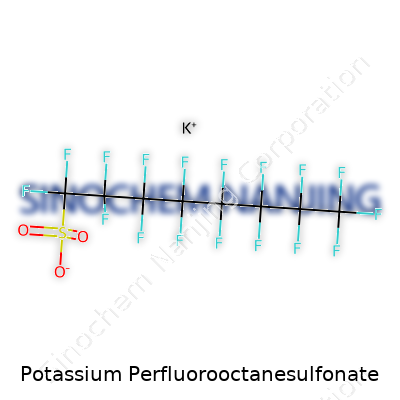
| Names | |
| Preferred IUPAC name | Potassium 1,1,2,2,3,3,4,4,5,5,6,6,7,7,8,8,8-heptadecafluorooctane-1-sulfonate |
| Other names |
Perfluorooctanesulfonic acid potassium salt PFOS K+ Potassium PFOS Potassium perfluorooctylsulfonate Perfluorooctylsulfonic acid, potassium salt |
| Pronunciation | /pəˈtæsiəm pɜˌfluːrəʊˌɒkˌteɪnˌsʌlˈfəʊneɪt/ |
| Identifiers | |
| CAS Number | 2795-39-3 |
| Beilstein Reference | 8822087 |
| ChEBI | CHEBI:39054 |
| ChEMBL | CHEMBL4292171 |
| ChemSpider | 4370541 |
| DrugBank | DB11284 |
| ECHA InfoCard | 04a68ec7-b01b-41f9-9835-5997a6a0a9b2 |
| EC Number | 223-320-4 |
| Gmelin Reference | 126148 |
| KEGG | C18632 |
| MeSH | D056345 |
| PubChem CID | 24836308 |
| RTECS number | TC4265000 |
| UNII | I6V8990B2V |
| UN number | UN9139 |
| Properties | |
| Chemical formula | C8F17KO3S |
| Molar mass | 538.22 g/mol |
| Appearance | White powder |
| Odor | Odorless |
| Density | 1.8 g/cm3 |
| Solubility in water | Soluble |
| log P | 7.02 |
| Vapor pressure | Negligible |
| Acidity (pKa) | -3.3 |
| Basicity (pKb) | 15.7 |
| Magnetic susceptibility (χ) | -41.0e-6 cm³/mol |
| Refractive index (nD) | 1.340 |
| Dipole moment | 4.94 D |
| Thermochemistry | |
| Std molar entropy (S⦵298) | 554.6 J·mol⁻¹·K⁻¹ |
| Std enthalpy of formation (ΔfH⦵298) | -1478 kJ/mol |
| Pharmacology | |
| ATC code | V03AB37 |
| Hazards | |
| Main hazards | Toxic if swallowed. Toxic if inhaled. Causes skin irritation. Causes serious eye irritation. May cause damage to organs through prolonged or repeated exposure. Very toxic to aquatic life with long lasting effects. |
| GHS labelling | GHS05, GHS07, GHS08 |
| Pictograms | GHS06,GHS08,GHS09 |
| Signal word | Danger |
| Hazard statements | H360D: May damage the unborn child. H362: May cause harm to breast-fed children. |
| Precautionary statements | P261, P273, P280, P302+P352, P305+P351+P338, P332+P313, P337+P313 |
| NFPA 704 (fire diamond) | 3-0-0-SPECIAL |
| Lethal dose or concentration | LD50 (oral, rat): >2000 mg/kg |
| LD50 (median dose) | 200 mg/kg (rat, oral) |
| NIOSH | TC8560000 |
| PEL (Permissible) | PEL (Permissible exposure limit) for Potassium Perfluorooctanesulfonate: Not established |
| REL (Recommended) | 0.01 mg/m3 |
| IDLH (Immediate danger) | No IDLH established. |
| Related compounds | |
| Related compounds |
Perfluorooctanesulfonic acid Ammonium perfluorooctanesulfonate Sodium perfluorooctanesulfonate Potassium nonafluorobutanesulfonate Perfluorooctanoic acid |



