Phenyl Isothiocyanate: A Look at Its History, Chemistry, Applications, and Prospects
Historical Development
In the middle of the 19th century, scientists started to unravel the mysteries of isothiocyanates, and phenyl isothiocyanate came into focus soon after. Early work by A.W. Hofmann in 1868 gave the scientific community its first clear description of this compound. Chemists have been putting it through its paces ever since, gradually uncovering its potential in both synthetic chemistry and industrial processes. This sort of steady progress, moving from curiosity-driven tinkering to practical use, hasn’t always made headlines, but it's set the stage for today’s applications. Over the decades, phenyl isothiocyanate has held a quiet, essential role in the nascent days of peptide mapping and sequencing, which shaped parts of the modern biotechnology industry. Rather than being a molecule that fizzled out after its initial discovery, it’s found itself in new experiments every generation.
Product Overview
Phenyl isothiocyanate is an organic compound best known under the abbreviation PITC. It does its job as a derivatizing agent, making amino acids visible to analytic equipment through chemical tagging. Outside the chemistry lab, you’ll see it in the finished goods of dye and pesticide production as well. You’d recognize its pungent, somewhat musty odor in a laboratory setting, giving away its presence long before it appears on any chromatogram. With so many technical uses, the compound gets shipped in sturdy, tightly-sealed containers, and only folks who work closely with chemical synthesis or protein chemistry tend to encounter it in daily life. The chemical sits on catalog lists of many reagent suppliers, clearly labeled as both powerful and hazardous.
Physical and Chemical Properties
As a pale yellow oily liquid at room temperature, phenyl isothiocyanate's distinct sharp smell means lab techs pay attention without even glancing at the label. It boils at roughly 221°C and solidifies near -29°C. It dissolves in ethanol and ether, and reacts vigorously with certain nucleophiles, especially amines. The chemical formula—C6H5NCS—tells you each molecule mixes a benzene ring and the reactive isothiocyanate group. The substance stands out because the N=C=S moiety practically jumps to form new bonds, giving chemists a reliable tool for tagging biological molecules. With a density of 1.13 g/cm³, it flows with a certain heaviness between the glass walls of a flask, reminding those handling it that this isn't a benign or bland laboratory solvent.
Technical Specifications and Labeling
Every product listing for phenyl isothiocyanate ought to state purity above 98%. Lower grades raise suspicion, particularly among those working in sensitive analytical fields, where even small contaminants mess up results. Bottles feature hazard pictograms and the word “Danger” or “Warning,” typically with reference to its harmful nature after skin contact or inhalation. Labeling also covers batch number and expiration date. There’s a practical reason for the clear labeling: a single mishap can lead to respiratory distress or chemical burns. That’s not fear-mongering, but the consequence of cutting corners when handling any isothiocyanate-based compound. I learned this lesson the hard way during late nights in a university lab, eyes stinging from a careless whiff of the vapor—a memorable introduction to chemical safety.
Preparation Method
Production of phenyl isothiocyanate usually follows the reaction between aniline and carbon disulfide in the presence of ammonia or other basic agents, followed by oxidation. One common approach involves first transforming aniline into a dithiocarbamate intermediate, then shifting to the isothiocyanate through oxidative decomposition. This route has seen tweaks over the years, largely to bump up yields and reduce unwanted byproducts. Some industrial operations refine the process further to recover and recycle starting materials, keeping waste streams manageable. Synthetic routes in research-scale laboratories stick to those that deliver the cleanest product with the least fuss, given the expense and hazard that come from sideline reactions featuring sulfur compounds.
Chemical Reactions and Modifications
This compound rarely sits idle. Its driving feature—the isothiocyanate group—is ready to react with primary and secondary amines, alcohols, and thiols, which proves valuable in organic synthesis. In the Edman degradation, phenyl isothiocyanate nips the terminal amino acid off a peptide, tagging it for identification and helping determine protein structure, which is a process that gave an enormous boost to fields like molecular biology and pharmacology. Its reaction with ammonia forms phenylthiourea, a classic product in many undergraduate labs. On the industrial side, chemists sometimes tweak the benzene ring to add new functionality, opening up derivatives with novel properties. These chemical reactions keep phenyl isothiocyanate at the workbench for many who design new molecules in both academic and commercial settings.
Synonyms and Product Names
In catalogs and chemical registries, phenyl isothiocyanate shows up under a handful of aliases. Besides the aforementioned PITC, you’ll also find it listed as “thiocarbanilide,” “isothiocyanatobenzene,” or “benzene isothiocyanate.” Sometimes vendors use the shorter “phenyl mustard oil,” though that name isn’t all that common in English-speaking labs. These various synonyms reflect regional and historical trends in naming, posing a bit of confusion until you realize they all point back to that recognizable sharp-smelling liquid with the C6H5NCS skeletal formula.
Safety and Operational Standards
Anyone planning to work with phenyl isothiocyanate must respect its hazards. Direct skin contact triggers irritation, and inhaling its vapors can inflame the respiratory tract; both short-term and repeated exposures risk causing lasting problems. Laboratories deal with this by installing adequate fume hoods, enforcing use of gloves, goggles, and lab coats, and storing it away from acids or bases that will provoke dangerous reactions. Spills prompt immediate cleanup with absorbent materials and disposal as hazardous waste. Fire risks come from flammable vapors, addressed by keeping quantities small and far from ignition sources. Institutions with robust training programs see fewer incidents; clear safety sheets and visible signage help remind even seasoned chemists that routine breeds complacency. Having years around labs, I’ve noticed the difference between places with old, half-torn warnings and those with bold reminders at every bench—mistakes tend to happen less in the latter.
Application Area
Protein sequencing stands out as the flagship use of phenyl isothiocyanate, where it’s the central reagent for Edman degradation—a tool that, for decades, formed the backbone of peptide mapping before the dawn of modern mass spectrometry techniques. The chemical finds use in analytical chemistry, particularly in pre-column derivatization for liquid chromatography or capillary electrophoresis of amino acids. It turns up in the synthesis of pharmaceuticals and agrochemicals, thanks to the versatility of its isothiocyanate group for introducing sulfur and nitrogen into target molecules. In the dye industry, its derivatives cut a path for new colorants, and in materials science, researchers exploit its ability to modify polymers or surfaces. The sheer reliability of its reactions, once you handle the hazards, means it has stuck around for a long time across many disciplines.
Research and Development
Academic labs frequently revisit phenyl isothiocyanate, searching for new tricks in chemical biology. Researchers push for variants with tighter selectivity or lower toxicity, aiming to combine the powerful chemical tag with better biocompatibility. At major pharmaceutical firms, teams tweak its structure to make new candidate drugs, hoping to land on versions with disease-fighting abilities. The relevance of PITC as a modification agent for surfaces shows value in building sensors or engineering advanced polymers. Peer-reviewed literature documents tweaks to the preparation process to make it greener or less labor-intensive, reflecting an industry-wide shift toward sustainability. My time evaluating grant proposals—where the molecule cropped up as a staple—showed that, often, the old guard of chemistry still fuels some of the freshest ideas in bioconjugation and labeling.
Toxicity Research
Phenyl isothiocyanate is not benign, and studies show it causes irritation, inflammation, and corrosive injuries if you’re unlucky or unprepared. Toxicological data indicate LD50 values in rats around 640 mg/kg (oral), reinforcing the need for careful dosing and handling, since large-scale exposures lead to severe systemic effects. Chronic exposure in lab animals revealed possible liver and kidney impacts, though such cases often result from repeated, high-level dosing. Eye and skin contact recommendations from occupational agencies stress prompt flushing and medical attention. Regulatory agencies keep a close watch, treating phenyl isothiocyanate as a hazardous agent that’s better kept in professional settings than casual environments. That balance between usability and risk comes down to training—something I’ve seen as the thin line between routine research and unexpected hospital trips.
Future Prospects
Chemists show little sign of dropping phenyl isothiocyanate from their toolkits as long as protein and peptide modification remain central research pursuits. Current trends push for methods that cut waste and increase selectivity, matching both scientific ambition and environmental responsibility. Innovations in high-throughput screening and bioengineering keep expanding the reach of isothiocyanate chemistry into fields like diagnostics, smart materials, and drug discovery. Biochemists continue testing new analogs that harness the reactivity of the isothiocyanate group with improved safety margins, eyeing applications in living systems without crossing into unacceptable toxicity. Regulatory pressure grows for processes that keep both workers and the environment safe, which nudges chemical manufacturers to refine supply chains and handling practices. As far as specialty reagents go, phenyl isothiocyanate represents a bridge between old-school chemistry and emerging technology—a familiar reagent still pivotal in modern discovery.
What is Phenyl Isothiocyanate used for?
Building Blocks in Peptide Research
Phenyl isothiocyanate has a big presence in labs focused on protein and peptide studies. Many chemists, myself included, first came across it during the Edman degradation process. Before high-throughput sequencing stole the spotlight, researchers needed a way to read amino acid sequences. They used phenyl isothiocyanate to react with the amino-end of a protein, stripping off one residue at a time to piece together the protein’s structure. This process still matters in certain areas, since verifying protein identity and purity keeps research honest. GPT-4 models might process language, but science relies on careful chemical work in the real world.
Scent and Flavor: Beyond the Bench
Walk into a perfumery or a synthetic flavor laboratory, and you might brush up against the sharp, mustardy aroma of an isothiocyanate. Natural foods such as mustard and horseradish develop their bite thanks to related compounds. In fragrance chemistry, phenyl isothiocyanate plays a role in forming more complex aromas. It isn’t exactly the star in your favorite cologne, but it helps create building blocks that mimic spicy and sultry notes.
Medical Diagnostics and Drug Discovery
Pharmaceutical labs keep phenyl isothiocyanate on hand. I once watched a team use it as a reagent in drug metabolism studies. It binds to amino acids and small molecules, forming derivatives that show up clearly when analyzed, especially through UV spectroscopy. Analysts get sharper, more reliable data, cutting down on the kind of guesswork that wastes time and money. Better data gives confidence when sliding results across the table to regulatory reviewers or publishing new findings.
Role in Crop Protection Research
Some agricultural scientists turn to isothiocyanates when exploring natural ways to ward off pests. While phenyl isothiocyanate isn’t as common as its cousins from garlic or broccoli, its structure inspires the search for safer pest control options. By tweaking the molecule, chemists try to develop compounds that repel insects while being less toxic for people and the environment.
Safety and Handling Concerns
Anyone using phenyl isothiocyanate quickly learns respect for its reactivity. It causes irritation on contact and, if inhaled, brings a painful tickle to the nose and throat. I’ve seen fresh researchers stumble into the lab coughing after opening a bottle without proper ventilation. Laboratories must have robust safety training and working hoods to cut exposure risks. These aren’t optional steps—they protect job health and keep projects from bogging down from accidental exposures.
Improving Accessibility and Reliability
Mislabeling or poor storage messes up experiments quickly. Suppliers who offer high-purity phenyl isothiocyanate, packaged to limit decomposition, help scientists avoid costly mistakes. It pays off to source from reputable companies following strict quality norms. Mistakes with reagents cost more than money; they drain time and shake trust in results.
Looking Ahead: Sustainable Chemistry
That sharp, mustardy molecule stands at an interesting crossroads. Green chemistry initiatives urge the industry to re-think solvent use, scale up reactions with less waste, and design safer variants. By investing in more sustainable synthesis of phenyl isothiocyanate and related reagents, the field catches up to modern expectations for both safety and environmental stewardship. I’ve watched labs shift priorities, boosted by pressure from grants and journals, to adopt these greener methods.
What is the chemical formula of Phenyl Isothiocyanate?
Chemical Formula: C7H5NS
Phenyl isothiocyanate stands out in labs and industry, marked by a sharp, distinct smell. Its formula, C7H5NS, tells you it combines a phenyl group with an isothiocyanate functional group. This isn’t just a string of letters and numbers—behind this arrangement sits a compound that shapes multiple fields, from pharmaceuticals to education.
In my time at the bench, the reactivity of phenyl isothiocyanate always grabbed my attention. That N=C=S group reacts clearly and predictably, creating room for chemists to modify molecules in simple ways. Peptide sequencing became much more effective after Edman’s method used this compound to tag amino acids. Before that, projects that required accurate sequencing demanded far more patience. Now, large-scale protein sequencing wouldn’t run efficiently without it.
Safety always remains a cornerstone in any discussion about such chemicals. Having worked closely with phenyl isothiocyanate, I learned pretty quickly about its irritant properties. Gloves, proper fume extraction, and eye protection aren’t just details—they are requirements. Data from incident reports show that inhalation and skin exposure can cause immediate health effects, so disregard for safety rarely ends well.
This compound also found a niche in several synthetic processes. Researchers keep returning to C7H5NS for developing dyes and pharmaceuticals. Big or small, labs appreciate its accessible reactivity. Published studies have pointed out its value in creating isothiocyanate derivatives for cancer research, marking progress in early-stage drug development. Simple changes to its structure can mean the difference between a useless by-product and a promising new lead.
Disposal presents challenges you can’t ignore. I’ve seen far too many junior chemists toss leftover phenyl isothiocyanate down the drain, risking contamination. Local environmental agencies have documented spikes in toxic runoff due to improper chemical waste handling. Adhering to strict disposal protocols—like using dedicated chemical waste containers—beats risking community and ecosystem health.
Accessible education forms the backbone for safe and effective chemical work. Demonstrations using phenyl isothiocyanate can teach students about nucleophilic addition and aromatic chemistry. Real-world examples drive home how formulas like C7H5NS matter outside tests and textbooks. Videos and structured practicals offer solid alternatives for schools that don’t want to store large volumes of regulated chemicals.
More transparent sharing of incident data, stronger training, and reinforcement from peer networks make a difference. The American Chemical Society and similar organizations provide case studies and lessons from past mistakes. Keeping these resources current builds a safer community for everyone working with reactive chemicals like phenyl isothiocyanate.
Whether you’re writing a lab report or considering commercial production, C7H5NS deserves careful respect. Experience, practical protocols, and ongoing discussion push the field forward. With global research and development ramping up, its formula remains more than a set of symbols—each letter reflects an impact across science and society.
What are the safety precautions when handling Phenyl Isothiocyanate?
Getting Real About Lab Safety
Working with chemicals like phenyl isothiocyanate brings more than textbook risks. It’s got a sharp smell that hits you right in the nose, but what matters most goes beyond odor. This stuff can cause serious damage if it touches skin, eyes, or gets inhaled. I’ve handled it in both teaching labs and research, and anyone around it quickly learns: shortcuts spell trouble.
Gloves Aren’t Optional
Putting on nitrile gloves seems basic, but I’ve seen people reach for latex or skip the gloves completely. Phenyl isothiocyanate eats through latex and sneaks past careless handling. Nitrile gloves give solid protection; double-gloving and swapping out gloves as soon as anything spills or rips can prevent exposure. Disposable gloves belong in the waste as soon as work wraps up; reusing them is asking for cross-contamination.
Goggles Save Sight
I can’t count the times someone ignored safety goggles because they fogged up or felt clunky. Direct contact with phenyl isothiocyanate stings eyes badly and sometimes leads to lasting damage. Full-seal goggles shut out vapors or droplets that regular safety glasses let slip past. If a lab has a face shield, even better.
Good Ventilation Isn’t Just Good Practice
Fume hoods keep vapors from reaching your lungs. This isn’t a nice-to-have feature; it’s make-or-break. Phenyl isothiocyanate off-gasses and the fumes act fast, leading to headaches and throat irritation. I always check hood airflow with a tissue or specialized flow meter before uncapping a bottle—those fans sometimes fail without alerting you.
Labeling Stops Accidents Before They Start
Unmarked bottles have led to too many scares. Permanent, clear labeling with the full name, hazard warnings, and date keeps everyone on track, especially in busy shared spaces. A spill or misused solution almost always traces back to bad labeling or no labeling at all.
Immediate Cleanup and Proper Waste Storage
If a spill happens, nobody should reach for paper towels and hope for the best. I’ve learned to keep spill kits nearby, stocked and within reach. Absorbent pads, goggles, and gloves mean cleanup goes quickly, and neutralizing agents take care of any splashy mishaps. Proper disposal bottles, labeled by hazard, stand near workspaces so nothing ends up in a sink or trash can by mistake.
Training Makes the Difference
Reading about chemicals won’t carry you through an emergency. Every new lab member should see a demonstration before they handle phenyl isothiocyanate solo, and regular drills keep safety responses sharp. I’ve seen good labs repeat the basics every year—reviewing the safety data sheet, practicing eyewash and shower use, and reviewing emergency contacts.
Don’t Forget Long-Sleeve Lab Coats
Phenyl isothiocyanate won’t burn through fabric instantly, but splashes seep through thin shirts. Long-sleeve coats protect arms and can be removed if an accident happens, preventing further spread. I always stash an extra lab coat close at hand for visitors or anyone who forgot theirs in a hurry.
Final Thoughts on Responsibility
Working with chemicals like this brings real responsibility for everyone in the room. The risks are manageable if you respect the dangers and commit to habits—gloves, goggles, labeling, and cleanup aren’t just recommendations. I’ve seen firsthand how small steps prevent big disasters, keep people healthy, and protect everyone’s ability to keep discovering without hesitation.
What is the storage condition for Phenyl Isothiocyanate?
Understanding the Risks
Phenyl isothiocyanate (PITC) shapes daily work for many scientists. Its sharp smell reminds anyone near it to work carefully. This is not a substance to leave neglected at the corner of the lab. It has value for peptide sequence analysis and helps molecular biologists do their jobs, but its benefits do not erase its hazards. Breathing in the vapors brings irritation. Skin and eyes suffer fast if spills happen. Stories circulate about broken vials and sharp headaches; each tale opens with the same question: could safer storage have avoided trouble?
Sensible Storage: Shielding Health and Results
Placing PITC into storage asks for more than a closed cap. Once exposed to air, the compound can degrade, lose strength, or risk contamination. Stability ties to low temperatures and darkness. Cool places slow down unwanted reactions. Laboratories use refrigerators for this; a sturdy, well-labeled chemical refrigerator set between two and eight degrees Celsius holds up over time. More warmth brings volatility. Light speeds up breakdown, which can distort experimental results. So, amber glass bottles become standard, shutting out damaging rays and protecting both users and purity.
Unsealed bottles spell trouble. Fumes drift through plastic bags, but a good, tight-sealing glass container blocks most leaks. Materials stored around PITC sometimes turn yellow—a sure sign of vapors escaping. That’s not just a cosmetic issue; it multiplies cross-contamination risk for other precious reagents. Labs keep PITC away from acids, bases, oxidizing agents, and moisture, because mixtures with any of these lead to dangerous reactions. Water, in particular, triggers breakdown, which means dry conditions are non-negotiable.
Practical Solutions, Not Theory
Real-world safety shows up in strong habits, not just compliance. In a poorly ventilated closet, fumes collect, and headaches and coughs soon follow. Dedicated fume hoods offer a line of defense for any opening or pouring. Direct exposure rarely gives warning before symptoms take hold, as every technician learns after just one accident. Wearing eye protection and gloves is more than box-checking; it is the difference between finishing a day’s work and spending hours at the campus clinic.
Science means waste is inevitable, but it matters how people handle it. Dumping leftover PITC down the sink isn’t just bad science; it brings environmental damage and sometimes legal trouble. Proper hazardous waste bins stand ready, and routes for safe chemical waste disposal often sit posted where all can see. I learned early from a mentor: labeling bottles and checking for leaks saves more trouble than any complicated safety protocol.
An Ongoing Commitment
Institutions invest time and money training new staff on chemical storage. The danger is forgetting after the first safety lecture, letting routines slip. Refresher courses, clear signage, and ready access to safety information lift that trap. In places where colleagues ask questions if something looks off, labs run smoother and safer.
Phenyl isothiocyanate earns respect not because of regulations but from practical field lessons. Careful storage—cool, dark, dry, separated from volatile chemicals—protects both researchers and research itself. It’s a daily discipline that builds confidence and keeps innovation moving forward without risking the people and environments behind the science.
Is Phenyl Isothiocyanate hazardous to health?
Understanding Phenyl Isothiocyanate
Phenyl isothiocyanate often pops up in classrooms, labs, and chemical catalogs. It gets used mostly in analytical chemistry, especially for sequencing proteins. Researchers treat it with a lot more respect than average solvents you see behind locked doors at any university. Ask a scientist who’s used this stuff: they’ll probably recall the sharp, sinus-burning smell. That’s warning enough to open a window and double-check if goggles fit right.
Real-World Effects and Risks
Inhaling phenyl isothiocyanate can do more than wrinkle your nose. The Centers for Disease Control and Prevention lists coughing, sneezing, and throat irritation. Eye contact triggers burning and watering. Skin exposure? Expect redness and maybe itching. I’ve seen colleagues distracted by a runaway drop land on a glove, which led quickly to the safety shower. These stories aren’t rare. The chemical reacts quickly with surfaces—living or otherwise.
What really raises concern is the risk associated with handling even small quantities. According to the National Institute for Occupational Safety and Health (NIOSH), phenyl isothiocyanate is a definite respiratory irritant. Severe cases, often after prolonged exposure, run the risk of chronic effects. Scientists take this seriously. There’s a reason why it’s kept under strict ventilation and only handled with the right personal protective equipment.
People often ask whether occasional lab exposure causes long-term problems. Animal studies have shown organ damage after repeated exposure. The World Health Organization classifies isothiocyanates as irritants, and while they’re not grouped with the worst known carcinogens, it doesn’t mean it’s harmless. You don’t need the worst label to take hazards seriously.
Common-Sense Practices and Safer Choices
Every laboratory safety course drills into you the basics for a reason. Always use gloves, a lab coat, goggles, and work within a fume hood. I’ve seen new researchers tempted to take shortcuts when experiments go long. That’s when mistakes happen. Accidental exposure might seem trivial, but the risks aren’t worth the gamble. Keep chemical spill kits nearby and know how to use them. Wash hands often, change gloves as soon as they show wear, and never eat or drink near your workbench.
Proper labeling makes all the difference. Unmarked vials create confusion and increase risk. Good lab practice also means storing phenyl isothiocyanate in a well-ventilated, secure area, away from acids and bases that might set off dangerous reactions.
At home, hobbyists and DIY chemists run even higher risks without access to safety infrastructure. There’s no substitute for proper training. If someone finds a bottle or chemical kit with unfamiliar compounds, the safest move is to reach out to local hazardous waste disposal, rather than risk curiosity or guesswork.
The Bigger Picture
The science community continues to look out for safer alternatives where possible. For protein sequencing, newer, less hazardous reagents keep popping up. Lab safety officers and trainers update protocols as evidence comes in. It’s easy to get caught up in routine, but remembering every step in safety procedures keeps everyone protected for the long run. Knowledge, preparation, and respect for the substance all play bigger roles than any warning label printed on a bottle.
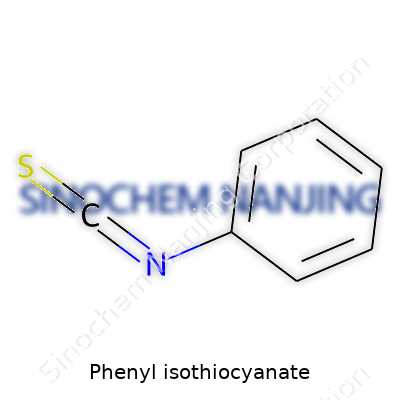
| Names | |
| Preferred IUPAC name | Isothiocyanatobenzene |
| Other names |
PITC Phenyl mustard oil Isothiocyanic acid phenyl ester Phenylthiocyanate NCS-phenyl |
| Pronunciation | /ˈfiːnaɪl aɪˌsoʊˌθaɪ.oʊˈsaɪ.əˌneɪt/ |
| Identifiers | |
| CAS Number | 103-72-0 |
| Beilstein Reference | 1209225 |
| ChEBI | CHEBI:7620 |
| ChEMBL | CHEMBL14028 |
| ChemSpider | 5886 |
| DrugBank | DB08343 |
| ECHA InfoCard | 100.007.794 |
| EC Number | 209-816-9 |
| Gmelin Reference | Gm.1425 |
| KEGG | C06161 |
| MeSH | D010626 |
| PubChem CID | 7017 |
| RTECS number | XN8575000 |
| UNII | SGIKSHI895 |
| UN number | UN2810 |
| CompTox Dashboard (EPA) | DTXSID2020280 |
| Properties | |
| Chemical formula | C7H5NS |
| Molar mass | 135.19 g/mol |
| Appearance | Colorless to pale yellow liquid |
| Odor | pungent |
| Density | 1.130 g/mL at 25 °C (lit.) |
| Solubility in water | Insoluble |
| log P | 2.9 |
| Vapor pressure | 0.4 mmHg (25°C) |
| Acidity (pKa) | 8.7 |
| Basicity (pKb) | pKb = 9.04 |
| Magnetic susceptibility (χ) | -67.7×10⁻⁶ cm³/mol |
| Refractive index (nD) | 1.612 |
| Viscosity | 1.744 cP (20°C) |
| Dipole moment | 4.11 D |
| Thermochemistry | |
| Std molar entropy (S⦵298) | 323.0 J·mol⁻¹·K⁻¹ |
| Std enthalpy of formation (ΔfH⦵298) | 78.6 kJ/mol |
| Std enthalpy of combustion (ΔcH⦵298) | -4473 kJ/mol |
| Hazards | |
| Main hazards | Harmful if swallowed, toxic in contact with skin or if inhaled, causes skin and eye irritation, may cause respiratory irritation. |
| GHS labelling | GHS02, GHS05, GHS06, GHS07 |
| Pictograms | GHS06, GHS05, GHS07 |
| Signal word | Danger |
| Hazard statements | Hazard statements: "H301: Toxic if swallowed. H315: Causes skin irritation. H319: Causes serious eye irritation. H332: Harmful if inhaled. H335: May cause respiratory irritation. |
| Precautionary statements | P261, P280, P304+P340, P305+P351+P338, P310 |
| NFPA 704 (fire diamond) | 2-2-2-W |
| Flash point | 129 °C |
| Autoignition temperature | 444 °C |
| Explosive limits | Lower: 1.1%, Upper: 8.3% |
| Lethal dose or concentration | LD50 oral rat 50 mg/kg |
| LD50 (median dose) | 640 mg/kg (rat, oral) |
| NIOSH | WF3325000 |
| PEL (Permissible) | PEL (Permissible Exposure Limit) for Phenyl Isothiocyanate: 0.06 mg/m³ (OSHA, 8-hour TWA) |
| REL (Recommended) | 0.06 ppm |
| IDLH (Immediate danger) | 25 ppm |
| Related compounds | |
| Related compounds |
Phenylthiourea Aniline Isothiocyanic acid Methyl isothiocyanate Benzyl isothiocyanate |



