Octafluorocyclobutane: The Cornerstone Gas with Big Shoes to Fill
Historical Development
Octafluorocyclobutane has roots going back to the early days of the fluorochemical industry. Chemists started looking at perfluorinated compounds in the first half of the 20th century, not just for theoretical interest, but also for the remarkable stability these molecules offered. It didn’t take long for researchers to notice that even small rings, like cyclobutanes, show tremendous resistance to acids, bases, heat, and light once every hydrogen gets swapped for fluorine atoms. By the late 1950s, industry—trying to replace toxic and reactive gases in electronics—finally had the means and the drive to make and purify octafluorocyclobutane reliably. Once the semiconductor business took off, this gas turned from curiosity to workhorse.
Product Overview
In the industrial sector, octafluorocyclobutane, known in shorthand as C4F8, has earned a kind of respect that comes with being both useful and difficult to substitute. It's more than just a specialty chemical. The gas gets called upon for etching in semiconductor processing, as a refrigerant, and sometimes in medical propellants. Most folks outside the lab or the chip fab might never see a cylinder of C4F8, but nearly every device with a memory chip or logic processor owes a little something to this gas.
Physical & Chemical Properties
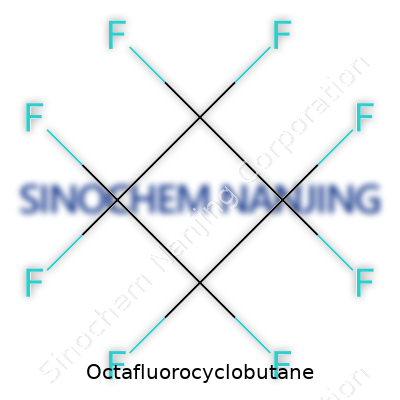
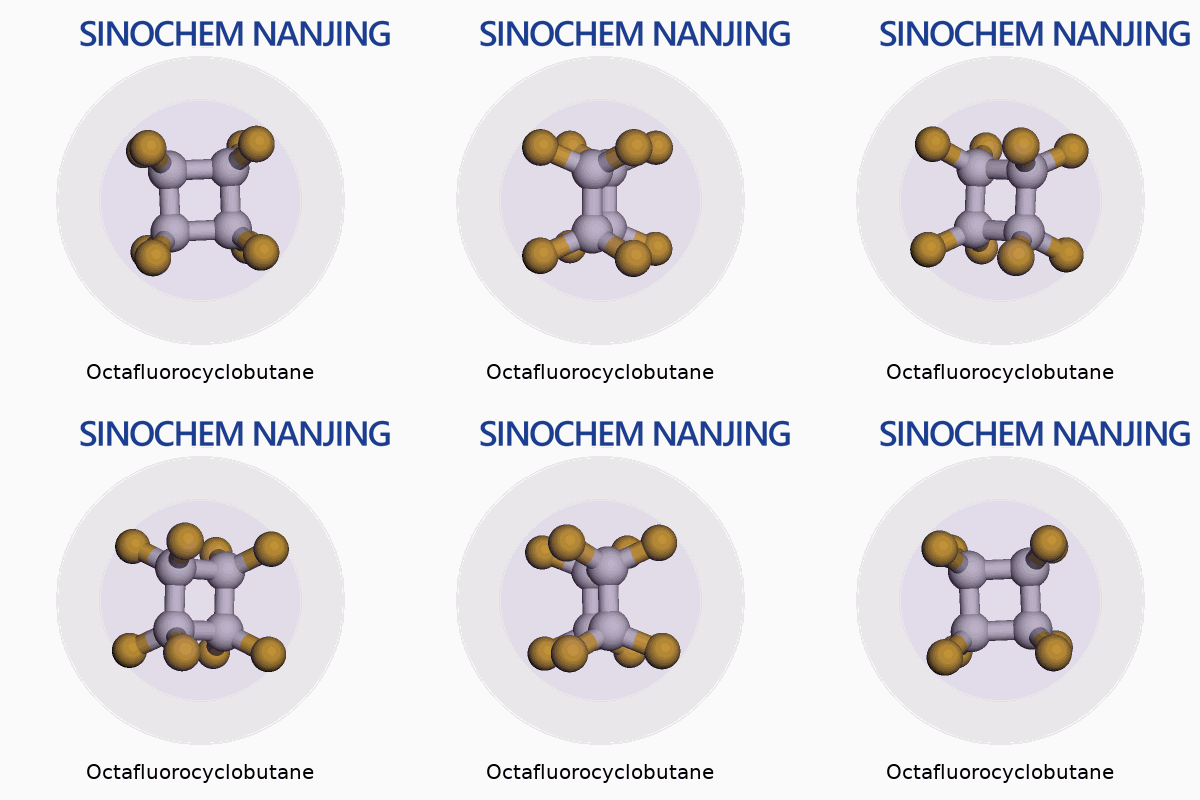
C4F8 looks simple on paper—four carbons, eight fluorines, locked in a square. In reality, it packs a molecular punch that few other gases manage. The boiling point stands at about -6.5°C, which means in most settings it shows up as a clear, odorless gas. Its chemical stability is legendary. The carbon-fluorine bond ranks among the strongest in organic chemistry, and eight fluorines arranged in a four-membered ring leave little room for weakness. People in the industry look for gases that won’t just fall apart under plasma or high temperatures, and octafluorocyclobutane fits the bill. It's dense and heavier than air, so it does take some consideration in handling.
Technical Specifications & Labeling
The technical specs for C4F8 depend on the application, but purity often reaches 99.9% or higher for electronics. Gas cylinders usually come with strict labeling, and the color coding meets established industrial standards, which helps anyone from a warehouse tech to a process engineer avoid dangerous mix-ups. Take any major gas supplier's documentation, and you'll find detailed information about valve type, maximum allowable pressure, and transport safety measures.
Preparation Method
Preparation of octafluorocyclobutane has matured over the years. Early work started with hexachloro-1,3-butadiene and swapped out chlorines for fluorines using antimony trifluoride or similar agents, a process that involves both skill and cost. Nowadays, electrochemical fluorination provides a more scalable path, where electricity and hydrogen fluoride do most of the heavy lifting. Even with modern equipment, these processes demand care and expertise—one misstep, and you’re dealing with highly toxic or corrosive byproducts.
Chemical Reactions & Modifications
Chemists often treat perfluorocarbons as nearly inert, and octafluorocyclobutane sticks with that reputation. Under the wild conditions inside a plasma etcher, though, C4F8 breaks apart into reactive fragments perfectly tailored for stripping unwanted material off silicon wafers. In other settings, the molecule resists ordinary acids and bases and doesn’t burn under normal conditions. It can undergo limited reactions with alkali metals or under extreme plasma conditions, but most folks count on its stubbornness rather than its versatility.
Synonyms & Product Names
Octafluorocyclobutane isn’t a name that rolls off the tongue. Industry uses synonyms like perfluorocyclobutane, and plenty of suppliers just call it C4F8. Some folks refer to it by trade names, but most people in labs or fabs stick to the chemical formula or basic name, especially given the dizzying array of perfluorinated compounds out there. Mistaking one for another could spell trouble, which is why clear nomenclature matters and why sharp operators double-check cylinders before hooking anything up.
Safety & Operational Standards
Handling any high-pressure gas demands procedures, but octafluorocyclobutane adds special considerations. Leaks don’t smell or warn you, and because the gas settles in low places, poor ventilation creates a real asphyxiation risk. Safety data from major suppliers and agencies lays out clear guidelines: storage cool and upright, leak checks before connecting to equipment, and ventilation wherever possible. Anybody entering a space where this sort of gas gets used needs training on what to look for, what to do in case of an alarm, and how to avoid accidental discharge. Pipes and cylinders often sport extra labels, and emergency plans should cover local evacuation plus rescue for workers. These standards come from hard experience, not just paperwork.
Application Area
The main market for C4F8 remains the electronics industry, particularly in plasma etch processes for microchips. Here, the gas breaks down in the plasma, releasing active species that eat away silicon or silicon oxide layers with impressive precision. Some labs look to C4F8 for special refrigerant mixes, and a few medical devices have used it as a propellant, though that's rare and faces tighter scrutiny now due to environmental concerns. Research pushes into other areas—like insulation for superconductors—keep popping up, but none match the scale of semiconductor work.
Research & Development
Development around octafluorocyclobutane keeps the focus tight on electronics. Engineers and chemists try to squeeze better etch rates, finer control, and lower sidewall roughness out of every batch. They study byproducts—many of which are greenhouse gases in their own right—and work to recapture, reuse, or destroy them before venting anything outdoors. R&D teams push equipment design so that lower total gas masses do the same job, cutting both cost and environmental impact. While only a handful of firms around the world make this gas, research groups stay close to industry, looking for better monitoring, new plasma recipes, and safer handling practices. Some universities also chase novel reactions, hoping one day to make octafluorocyclobutane a feedstock for useful, less persistent fluorochemicals.
Toxicity Research
Toxicity doesn’t come from contact or ingestion—octafluorocyclobutane acts as an asphyxiant, not a poison. If enough leaks into an enclosed area, it can crowd out the oxygen. Some worry about possible breakdown products, like carbonyl fluoride or perfluorinated acids, created in plasma systems or fires, which have much nastier health effects. Agencies set exposure limits low, based mainly on asphyxiation risk, but the threat of sudden decompression or accumulations in pits adds another layer. Research continues on long-term environmental impacts, especially as small amounts might escape into the atmosphere and linger for decades, just like other perfluorinated gases.
Future Prospects
Octafluorocyclobutane won’t just fade away, despite rising pressure to cut emissions of long-lived greenhouse gases. Electronics makers keep pushing for smaller, more complex chips, and C4F8 offers the kind of precision that no easier substitute matches yet. The industry faces a growing push from regulators and public campaigns to limit perfluorinated emissions, so tomorrow’s production sites will probably show even tighter controls, improved scrubbing, and maybe new recycling technology. On the science side, researchers look for ways to harness C4F8’s stability for next-generation materials, where its chemical ruggedness could let engineers design things from the molecular level up. New alternatives will need to check off a long list: safety, cost, environmental friendliness, and rock-solid performance. For now, though, C4F8 stands as an essential, if controversial, tool in the toolbox—still necessary, still evolving, and demanding respect both in and out of the lab.
What are the main industrial uses of Octafluorocyclobutane?
An Essential Ingredient in Semiconductor Production
The world’s massive demand for electronics keeps growing. Factories need precise tools to make chips thinner, faster, and more energy-efficient. Octafluorocyclobutane, known as C4F8, has found a firm spot in this business. I’ve seen cleanroom engineers praise its etching power when carving out fine features on silicon wafers. The gas creates reactive plasma, which chips away at specific materials but spares others. This selective etching shapes transistors and circuits with microscopic accuracy. GlobalFoundries, TSMC, and other chip giants depend on consistency. C4F8 delivers that—which means our phones and computers get better every year.
Plays a Role in Medical Device Sterilization
Hospitals trust specific gases to sterilize tools, especially for items that can’t handle steam. Octafluorocyclobutane fits that job in some niche sterilization blends. Low reactivity means it won’t mess up the finish or function of sensitive instruments. While not the only gas in play, it provides safer sterilization for parts where contamination is just not an option.
Boosts Plasma-Based Cleaning Systems
Contaminants inside microelectronics and optics ruin performance fast. I walked through a manufacturing plant where they use C4F8 in plasma chambers to break down stubborn residues—thin films, dust particles, and oils. Techs choose it because its chemical structure is stable, yet it becomes aggressive under plasma. That results in clean surfaces, longer component life, and lower rejection rates, which every plant manager appreciates.
Refrigeration Niche and Fire Suppressant Qualities
Octafluorocyclobutane’s stability also opened doors as a refrigerant and as an ingredient in some fire suppression systems. Compared to older refrigerants, C4F8 shows low toxicity and resists breakdown. Some specialized cooling systems in aerospace and submarine applications rely on its unique properties. In fire suppression, it acts as a clean agent, leaving equipment untouched after discharge. Data centers and museums sometimes pick these gases for protection against flare-ups, keeping delicate electronics or artifacts unharmed.
Challenges and Responsible Management
No industrial chemical works in a vacuum. C4F8 raises concerns about greenhouse effects—it’s a potent long-lived gas if allowed to escape unchecked. The semiconductor sector came under scrutiny for emissions, since a small leak could persist in the atmosphere for thousands of years. Industry groups launched abatement tech and tight recycling practices to tackle this. Air treatment facilities now scrub or break down the exhaust. Governments keep turning up the pressure for tighter environmental standards, which, in my experience, tends to drive technical innovation rather than stall progress.
Striking a Balance for the Future
Balancing technology’s benefits with our responsibility to the environment feels like a pressing issue, not a distant debate. Experts weigh lifecycle, alternatives, and containment every step of the way. Ongoing research explores new materials and processes that hit the mark without harming the planet. Until then, industries using octafluorocyclobutane need to stay transparent, push for greener chemistry, and keep emissions as low as possible. That’s how progress and responsibility can move forward together.
Is Octafluorocyclobutane considered hazardous or toxic?
Understanding What Octafluorocyclobutane Is
Octafluorocyclobutane comes across as a mouthful, but it shows up in more places than most people might expect. This chemical, often called C4F8, typically gets used in the electronics industry, especially for plasma etching during semiconductor manufacturing. Beyond that, you sometimes run into it as a refrigerant and in specialized firefighting systems. Folks handling industrial gases already know about these fluorocarbons from regular safety training, but most households will never bump into this stuff.
Hazardous or Not: Looking at the Risks
Toxicity sparks concern with plenty of new chemicals. Most people relax a little when told that C4F8 isn’t considered acutely toxic. Take a deep breath, though—not too deep, because it can still push out the oxygen you need in a confined space. Inhaling any gas that replaces air risks asphyxiation, and workers in closed spaces or those dealing with leaks can’t afford to look the other way.
The chemical isn’t flammable or explosive, which takes some pressure off first responders. The real danger shows up when C4F8 breaks down under high heat—think electrical fires or arc flash incidents. At those temperatures, C4F8 spits out nasty byproducts like hydrogen fluoride (HF). Skin contact or inhaling even a little HF causes serious burns and lung injury—and treating HF exposure takes specialized antidotes that can be hard to get at a moment’s notice.
Over the years, plenty of safety data and incident reports have shown that injuries tend to stem from these breakdown products, not C4F8 itself. Regular exposure to HF or related substances ties back to chronic health problems, including bone damage and lung scarring. Just calling the parent chemical safe misses the bigger picture.
Environmental Impact Can’t Be Ignored
Using a chemical with a long atmospheric life raises red flags for anyone worrying about climate change. C4F8 behaves as a greenhouse gas far more potent than carbon dioxide. The number, if you look at global warming potential, sits above 8,000 times that of CO₂ over a 100-year period. Regulations keep tightening around fluorinated gases, especially in Europe and parts of the U.S. Plainly put, the days of unfettered use won’t last forever.
Releasing C4F8 into the air tosses another problem onto an already overwhelmed climate. Some companies attempt recovery and recycling programs, capturing as much used gas as possible and keeping it out of the dump stack. These solutions don’t always work perfectly, but they show that the industry recognizes its responsibility. If you work in a lab or run a manufacturing floor, dealing with high-GWP fluorocarbons means making real-life decisions about leaks, abatement, and long-term planning.
Taking Safety Seriously
People want to believe that chemicals are either safe or dangerous. Most things fall somewhere in the middle, and C4F8 fits squarely in that gray area. Avoiding complacency takes training, the right monitoring equipment, and a willingness to review safety protocols before accidents happen. Checking for leaks, ventilating workspaces, and using protective equipment may sound like background noise, but those steps save lives every year.
Down the road, tech might develop replacements for high-GWP fluorinated gases, but they aren’t here yet. Until change happens, the best route means looking out for coworkers, knowing the real risks, and refusing to cut corners when a job deals with these potent chemicals.
What are the storage and handling recommendations for Octafluorocyclobutane?
Understanding What You’re Dealing With
Octafluorocyclobutane doesn’t show up in kitchen cabinets or corner shops. This compound lives in labs and industrial settings. Its ability to stay stable under pressure makes it valuable for specialty uses, but that same chemical resilience calls for respect.
Keep It Cool, Keep It Pressurized
Anyone who’s worked around compressed gases knows the routine hazards. Octafluorocyclobutane gets bottled up under its own pressure. Cylinders stay upright and secure. Cool, dry storage space ensures cylinders steer clear of dramatic temperature spikes. Excessive heat leads to rising pressure, which puts every seal and joint in the system to the test. From my own experience in facilities, the warning signs usually flash brightest in the hottest months, where failing to manage temperature can mean a scramble nobody wants.
Storing these cylinders away from direct sunlight and away from any heat sources just makes sense. The right spot mimics a chilly basement more than a window-sill. Not only does this slow down pressure build-up, but it cuts risk for everyone on the floor. Working in old factories, I saw cylinders stored outside in shaded, well-ventilated sheds with chained racks and weather covers. This simple, consistent habit spared countless headaches.
Shield From Sparks, Separate From Incompatibles
Some materials love to react; octafluorocyclobutane stays mostly inert, but mixing caution with routine provides more margin for error. No one wants to see cylinders near acetylene or chlorine stocks. These chemicals do not mix peacefully, and a simple leak can quickly turn into a hazard. Even though published guidance sometimes paints a conservative picture, separating gases and chemicals based on their properties consistently works out for the safest facilities.
Keep storage areas free from anything that sparks. The smallest droplight or extension cord could set off a bigger chain of problems during a leak. Separating empty cylinders from full ones also helps. I’ve watched confusion in storage rooms lead to wrong deliveries to process lines. Painted tags, clear physical barriers, and clear labeling help prevent basic mistakes.
Safe Handling: Everyday Discipline
Every set of hands that moves a cylinder makes a difference. Solid hand trucks, protective caps, and operators who understand how valves work keep accidents rare. A valve wrenched open the wrong way wastes valuable gas and puts everyone at risk. Training goes far—when even seasonal staff get short reminders, safe habits stick around. Many companies tie safety checks to every shift, not just monthly audits, because small leaks don’t wait their turn on the inspection calendar.
Regular checks for corrosion, damage, or wear stop problems before they start. Facilities I’ve worked in kept simple logbooks at every entry. Leaks get caught because people look—not because a rule somewhere says they should.
Disposal and Environmental Caution
Pumping leftover octafluorocyclobutane into the air is a dead end. This gas sticks around in the atmosphere, contributing to global warming. Responsible users contract certified hazardous waste operators for disposal. This extra cost up front keeps liability low and reputations intact over the long run.
Solutions That Hold Up
Real progress shows up in good training, solid storage, and diligent labeling. Tracking use cylinders keeps reordering on point and prevents storage rooms from turning into overlooked hazards. Long-run safety builds trust, and that steadiness supports both workers and the communities downwind.
What is the chemical formula and physical properties of Octafluorocyclobutane?
Chemical Composition and Formula
Octafluorocyclobutane carries the chemical formula C4F8. Each molecule packs four carbon atoms and eight fluorine atoms arranged in a ring. Chemists tag it as a perfluorinated compound, meaning every hydrogen bond from the parent cyclobutane structure swaps with fluorine. Most folks working in refrigeration or electronics have run into C4F8, or at least heard of it under industrial names like Freon-318 or Perfluorocyclobutane.
Physical Properties
At room temperature, octafluorocyclobutane comes as a colorless, non-flammable gas. A strong chemical bond makes it pretty stable, both chemically and thermally. You won’t catch it catching fire or breaking down under everyday conditions. The boiling point sits right around –5.8°C (21.6°F). Its melting point lies at –40°C (–40°F).
C4F8 weighs more than air—a molar mass near 200 grams per mole. Leaking cylinders tend to displace oxygen close to the ground, raising workplace safety issues. I remember a lab where we kept gas sensors close to floor level for that exact reason.
Some folks wonder about smell, but the gas comes odorless. Workers sometimes let that lull them into a false sense of safety. But with high concentrations, oxygen drops unnoticed. Even seasoned scientists double-check monitors for a reason.
Applications and Scope
Electronics manufacturing relies on octafluorocyclobutane because its strong carbon-fluorine bonds make it handy for etching silicon wafers. The reason lies in the breakdown products—it produces reactive fluorine atoms that tackle silicon dioxide cleanly. Every chip in your phone or computer likely benefits from this process at some stage.
Also, some refrigeration systems use this gas as a specialty refrigerant or as a dielectric fluid in high-voltage switches and transformers. Its inert nature helps engineers sleep at night—less risk of breakdown or flammability equals fewer headaches. But the same stability that makes it practical in industry creates an environmental conundrum.
Concerns and Solutions
There’s little question octafluorocyclobutane sticks around if it escapes into the atmosphere. It acts as a greenhouse gas, trapping heat way more efficiently than carbon dioxide. With a long atmospheric lifetime, even tiny leaks pile up. The Intergovernmental Panel on Climate Change points out its global warming potential measures over 8,700 times that of CO2 over a century.
That’s one reason more labs now use gas recovery units to capture and recycle what they can. Smart design in manufacturing, tight plumbing, and robust training have all cut down accidental emissions in many industries. Fines and increased reporting requirements mean managers can’t afford to let slips become routine. Some companies look for alternative etchants to curb environmental risk, but few replacements match C4F8 for reliability.
Personal Perspective
I’ve worked with teams who spent as much effort on containment as they did on process optimization. Even a few parts per million in a lab environment prompted a scramble to find and fix the source. It drove home a key point—being stable and effective doesn’t free a chemical from responsibility. Technologists, operators, and researchers work out solutions and shoulder the responsibility for clean handling. Preventing small leaks or careless venting stays top of mind, because a lapse affects more than just factory outputs or data logs.
Are there environmental concerns with the use or disposal of Octafluorocyclobutane?
What Makes Octafluorocyclobutane a Problem?
Octafluorocyclobutane, known in industrial circles for its role as a specialty gas, brings more than technical benefits to the table. Used in semiconductor manufacturing and refrigeration, this colorless gas is stable and does its job reliably. The real issue starts after use. Octafluorocyclobutane falls into a family of chemicals called perfluorocarbons (PFCs). PFCs don’t break down easily in nature. During my time working with engineers in tech manufacturing, concern over these gases came up in nearly every conversation about sustainability. PFCs, including octafluorocyclobutane, can stay in the atmosphere for thousands of years. Greenhouse gases with this sort of staying power mean we’re not just handing problems to the next generation; we’re handing them to dozens, if not hundreds, down the line.
The Greenhouse Gas Challenge
Octafluorocyclobutane has a global warming potential (GWP) that severely dwarfs carbon dioxide’s. A molecule of this stuff traps heat far longer and more effectively than CO2—by several thousand times, according to EPA assessments and peer-reviewed climate research. I remember an environmental engineer explaining how, once released, there’s almost no practical way to take it back out. The industry response so far has included attempts at containment, but leaks still happen. Dumping or venting to the open air practically guarantees a contribution to global warming.
Disposal Doesn’t Mean an Easy Exit
Getting rid of unused or spent octafluorocyclobutane safely is tough. Standard chemical incinerators aren’t enough. High temperatures and special scrubbing systems become necessary to prevent the formation of toxic byproducts like hydrofluoric acid. I’ve observed facilities in the tech sector where disposal involves strict procedures—double-checking seals, negative pressure rooms, teams trained to spot even tiny leaks. These setups cost money and time, and they’re still not foolproof. One unnoticed leak blows apart months of careful planning.
What’s the Path Forward?
Policy experts who focus on fluorinated gases stress stronger regulations. PFC phase-downs are gaining support from governments worldwide. In the early part of my career, companies didn’t want to hear about cutting down on chemicals that made processes easier. Nowadays, stricter oversight and public scrutiny push manufacturers to look for alternatives. Breakthroughs in abatement technology have started to chip away at emissions. For example, plasma-based incinerators destroy PFCs more completely before gas leaves the stack. Recycling and reclamation programs, once viewed as hassles, bring cost savings when run the right way.
Universities and research institutes put energy toward discovering gas mixtures with less damaging environmental footprints. The alternatives don’t always measure up in terms of performance, but with technology moving fast, it’s realistic to imagine safer substitutes. Collaboration across sectors—pulling together manufacturers, regulators, and researchers—feels like the only route that makes a real difference.
Every Decision Counts
Octafluorocyclobutane spotlights a bigger story within industrial chemistry. Responsibility rests on everyone from plant managers to regulators and consumers. If we demand accountability, back effective regulations, and reward better technology, the grip of PFCs on the atmosphere can loosen. My own experience watching dedicated teams track and recycle these gases makes it clear—progress on this front isn’t just a wish. It’s possible, but only if pressure and innovation keep growing side by side.
| Names | |
| Preferred IUPAC name | 1,1,1,2,2,2,3,3-Octafluorocyclobutane |
| Other names |
Perfluorocyclobutane FC-318 C4F8 Octafluorocyclobutene |
| Pronunciation | /ˌɒk.təˌflʊə.rəˌsaɪ.kloʊˈbjuː.teɪn/ |
| Identifiers | |
| CAS Number | 115-25-3 |
| Beilstein Reference | 1361142 |
| ChEBI | CHEBI:38728 |
| ChEMBL | CHEMBL137775 |
| ChemSpider | 10106 |
| DrugBank | DB11264 |
| ECHA InfoCard | 100.027.911 |
| EC Number | 204-075-2 |
| Gmelin Reference | 37750 |
| KEGG | C06591 |
| MeSH | D017723 |
| PubChem CID | 9207 |
| RTECS number | RY1050000 |
| UNII | D72K6WWN1U |
| UN number | UN1976 |
| Properties | |
| Chemical formula | C4F8 |
| Molar mass | 200.037 g/mol |
| Appearance | Colorless gas |
| Odor | Odorless |
| Density | 1.557 g/mL at 25 °C |
| Solubility in water | 13 mg/L (at 25 °C) |
| log P | log P = 2.8 |
| Vapor pressure | 25.2 psia (25°C) |
| Basicity (pKb) | pKb > 10 (very weak base) |
| Magnetic susceptibility (χ) | −74.6×10⁻⁶ cm³/mol |
| Refractive index (nD) | 1.228 |
| Viscosity | 0.42 cP (25°C) |
| Dipole moment | 0.00 D |
| Thermochemistry | |
| Std molar entropy (S⦵298) | 333.0 J·mol⁻¹·K⁻¹ |
| Std enthalpy of formation (ΔfH⦵298) | -1420 kJ/mol |
| Std enthalpy of combustion (ΔcH⦵298) | -2782 kJ/mol |
| Pharmacology | |
| ATC code | V03AN05 |
| Hazards | |
| GHS labelling | GHS02, GHS04 |
| Pictograms | GHS04 |
| Signal word | Warning |
| Precautionary statements | Keep away from heat, hot surfaces, sparks, open flames and other ignition sources. No smoking. Store in a well-ventilated place. Protect from sunlight. Do not breathe gas. Use and store only outdoors or in a well-ventilated place. |
| NFPA 704 (fire diamond) | 1-0-0 |
| Autoignition temperature | 385°C |
| Explosive limits | Explosive limits: 9.54–15.3% (in air) |
| Lethal dose or concentration | Lethal Concentration (LC50) Inhalation: 100000 ppm (rat, 2 hours) |
| LD50 (median dose) | > 25 g/kg (rat, inhalation) |
| NIOSH | **TQ4725000** |
| PEL (Permissible) | PEL (Permissible Exposure Limit) for Octafluorocyclobutane: "1000 ppm (TWA) |
| REL (Recommended) | 0.1 ppm |
| IDLH (Immediate danger) | 1000 ppm |
| Related compounds | |
| Related compounds |
Hexafluoropropylene Perfluoropropane |



